
Pedro Ruiz Gallo National University
Didactics English Master Program
Lic. Lupe Rivera Gonzales
Professor : Dr. Cesar Jimenez
20 - March 2011
Assignment: KRASHEN’S THEORY

QUESTIONNAIRE :


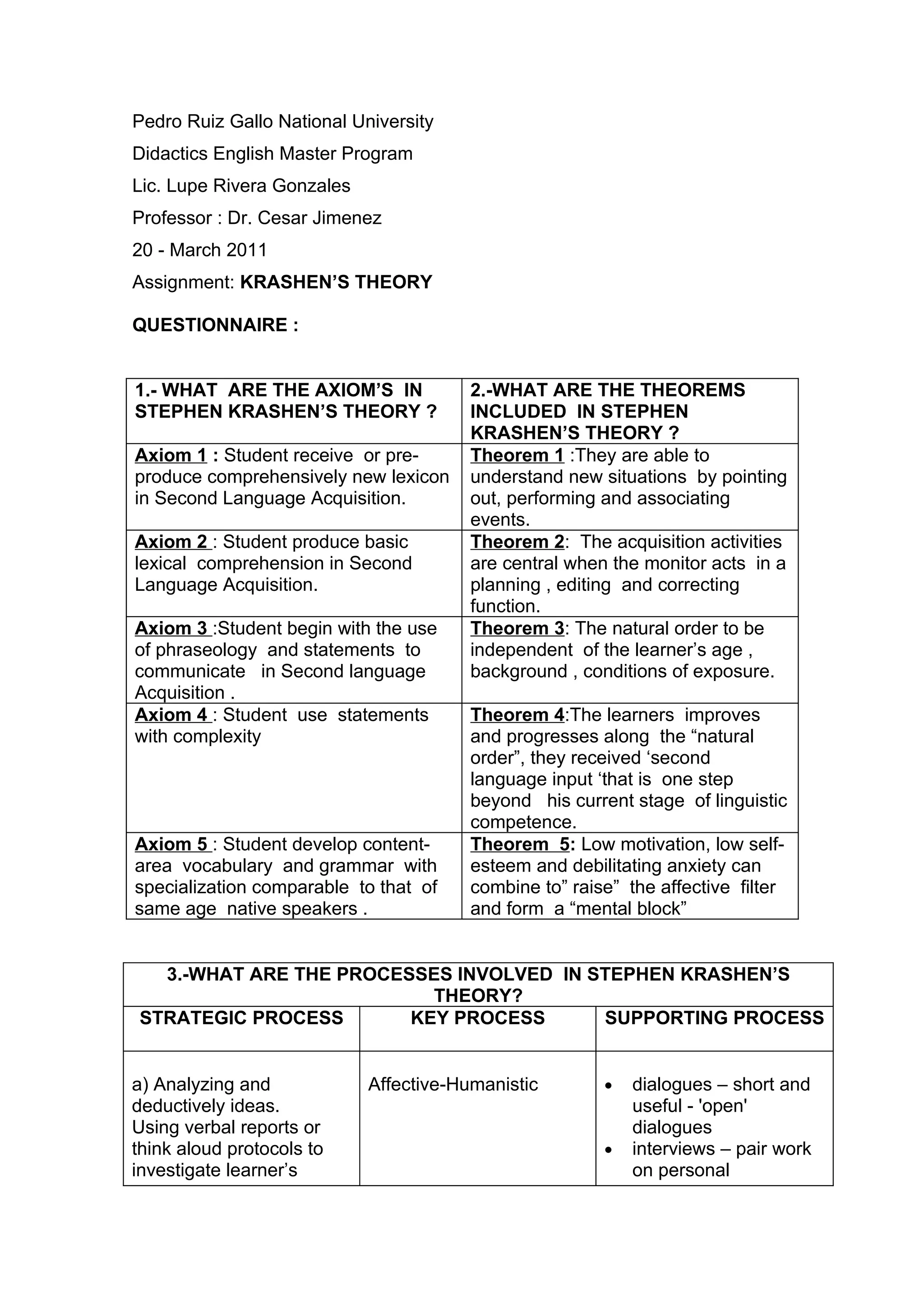
1.- WHAT ARE THE AXIOM’S IN             2.-WHAT ARE THE THEOREMS
STEPHEN KRASHEN’S THEORY ?              INCLUDED IN STEPHEN
                                        KRASHEN’S THEORY ?
Axiom 1 : Student receive or pre-       Theorem 1 :They are able to
produce comprehensively new lexicon     understand new situations by pointing
in Second Language Acquisition.         out, performing and associating
                                        events.
Axiom 2 : Student produce basic         Theorem 2: The acquisition activities
lexical comprehension in Second         are central when the monitor acts in a
Language Acquisition.                   planning , editing and correcting
                                        function.
Axiom 3 :Student begin with the use     Theorem 3: The natural order to be
of phraseology and statements to        independent of the learner’s age ,
communicate in Second language          background , conditions of exposure.
Acquisition .
Axiom 4 : Student use statements        Theorem 4:The learners improves
with complexity                         and progresses along the “natural
                                        order”, they received ‘second
                                        language input ‘that is one step
                                        beyond his current stage of linguistic
                                        competence.
Axiom 5 : Student develop content-      Theorem 5: Low motivation, low self-
area vocabulary and grammar with        esteem and debilitating anxiety can
specialization comparable to that of    combine to” raise” the affective filter
same age native speakers .              and form a “mental block”


  3.-WHAT ARE THE PROCESSES INVOLVED IN STEPHEN KRASHEN’S
                          THEORY?
STRATEGIC PROCESS       KEY PROCESS      SUPPORTING PROCESS


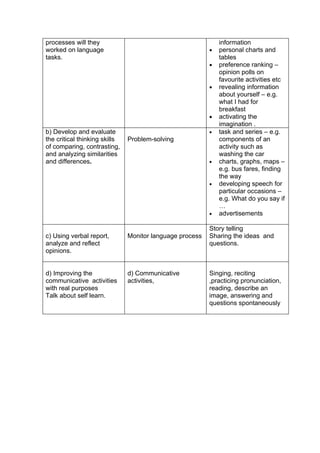
a) Analyzing and            Affective-Humanistic        •   dialogues – short and
deductively ideas.                                          useful - 'open'
Using verbal reports or                                     dialogues
think aloud protocols to                                •   interviews – pair work
investigate learner’s                                       on personal
processes will they                                           information
worked on language                                        •   personal charts and
tasks.                                                        tables
                                                          •   preference ranking –
                                                              opinion polls on
                                                              favourite activities etc
                                                          •   revealing information
                                                              about yourself – e.g.
                                                              what I had for
                                                              breakfast
                                                          •   activating the
                                                              imagination .
b) Develop and evaluate                                   •   task and series – e.g.
the critical thinking skills   Problem-solving                components of an
of comparing, contrasting,                                    activity such as
and analyzing similarities                                    washing the car
and differences.                                          •   charts, graphs, maps –
                                                              e.g. bus fares, finding
                                                              the way
                                                          •   developing speech for
                                                              particular occasions –
                                                              e.g. What do you say if
                                                              …
                                                          •   advertisements

                                                          Story telling
c) Using verbal report,        Monitor language process   Sharing the ideas and
analyze and reflect                                       questions.
opinions.


d) Improving the               d) Communicative           Singing, reciting
communicative activities       activities,                ,practicing pronunciation,
with real purposes                                        reading, describe an
Talk about self learn.                                    image, answering and
                                                          questions spontaneously
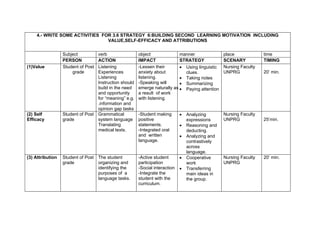
4.- WRITE SOME ACTIVITIES FOR 3.6 STRATEGY 6:BUILDING SECOND LEARNING MOTIVATION INCLUDING
                                VALUE,SELF-EFFICACY AND ATTRIBUTIONS


                  Subject         verb                 object              manner                place             time
                  PERSON          ACTION               IMPACT              STRATEGY              SCENARY           TIMING
(1)Value          Student of Post Listening            -Lessen their       • Using linguistic    Nursing Faculty
                      grade       Experiences          anxiety about         clues.              UNPRG             20’ min.
                                  Listening            listening.          • Taking notes
                                  Instruction should   -Speaking will      • Summarizing
                                  build in the need    emerge naturally as • Paying attention
                                  and opportunity      a result of work
                                  for “meaning” e.g.   with listening.
                                  .information and
                                  opinion gap tasks
(2) Self          Student of Post Grammatical          -Student making       •   Analyzing       Nursing Faculty
Efficacy          grade           system language      positive                  expressions     UNPRG             25’min.
                                  Translating          statements.           •   Reasoning and
                                  medical texts.       -Integrated oral          deducting.
                                                       and written           •   Analyzing and
                                                       language.                 contrastively
                                                                                 across
                                                                                 language.
(3) Attribution   Student of Post The student          -Active student       •   Cooperative     Nursing Faculty   20’ min.
                  grade           organizing and       participation             work            UNPRG
                                  identifying the      -Social interaction   •   Transferring
                                  purposes of a        -Integrate the            main ideas in
                                  language tasks.      student with the          the group.
                                                       curriculum.
KRASHEN'S THEORY

KRASHEN'S THEORY

  • 1.
    Pedro Ruiz GalloNational University Didactics English Master Program Lic. Lupe Rivera Gonzales Professor : Dr. Cesar Jimenez 20 - March 2011 Assignment: KRASHEN’S THEORY QUESTIONNAIRE : 1.- WHAT ARE THE AXIOM’S IN 2.-WHAT ARE THE THEOREMS STEPHEN KRASHEN’S THEORY ? INCLUDED IN STEPHEN KRASHEN’S THEORY ? Axiom 1 : Student receive or pre- Theorem 1 :They are able to produce comprehensively new lexicon understand new situations by pointing in Second Language Acquisition. out, performing and associating events. Axiom 2 : Student produce basic Theorem 2: The acquisition activities lexical comprehension in Second are central when the monitor acts in a Language Acquisition. planning , editing and correcting function. Axiom 3 :Student begin with the use Theorem 3: The natural order to be of phraseology and statements to independent of the learner’s age , communicate in Second language background , conditions of exposure. Acquisition . Axiom 4 : Student use statements Theorem 4:The learners improves with complexity and progresses along the “natural order”, they received ‘second language input ‘that is one step beyond his current stage of linguistic competence. Axiom 5 : Student develop content- Theorem 5: Low motivation, low self- area vocabulary and grammar with esteem and debilitating anxiety can specialization comparable to that of combine to” raise” the affective filter same age native speakers . and form a “mental block” 3.-WHAT ARE THE PROCESSES INVOLVED IN STEPHEN KRASHEN’S THEORY? STRATEGIC PROCESS KEY PROCESS SUPPORTING PROCESS a) Analyzing and Affective-Humanistic • dialogues – short and deductively ideas. useful - 'open' Using verbal reports or dialogues think aloud protocols to • interviews – pair work investigate learner’s on personal
  • 2.
    processes will they information worked on language • personal charts and tasks. tables • preference ranking – opinion polls on favourite activities etc • revealing information about yourself – e.g. what I had for breakfast • activating the imagination . b) Develop and evaluate • task and series – e.g. the critical thinking skills Problem-solving components of an of comparing, contrasting, activity such as and analyzing similarities washing the car and differences. • charts, graphs, maps – e.g. bus fares, finding the way • developing speech for particular occasions – e.g. What do you say if … • advertisements Story telling c) Using verbal report, Monitor language process Sharing the ideas and analyze and reflect questions. opinions. d) Improving the d) Communicative Singing, reciting communicative activities activities, ,practicing pronunciation, with real purposes reading, describe an Talk about self learn. image, answering and questions spontaneously
  • 3.
    4.- WRITE SOMEACTIVITIES FOR 3.6 STRATEGY 6:BUILDING SECOND LEARNING MOTIVATION INCLUDING VALUE,SELF-EFFICACY AND ATTRIBUTIONS Subject verb object manner place time PERSON ACTION IMPACT STRATEGY SCENARY TIMING (1)Value Student of Post Listening -Lessen their • Using linguistic Nursing Faculty grade Experiences anxiety about clues. UNPRG 20’ min. Listening listening. • Taking notes Instruction should -Speaking will • Summarizing build in the need emerge naturally as • Paying attention and opportunity a result of work for “meaning” e.g. with listening. .information and opinion gap tasks (2) Self Student of Post Grammatical -Student making • Analyzing Nursing Faculty Efficacy grade system language positive expressions UNPRG 25’min. Translating statements. • Reasoning and medical texts. -Integrated oral deducting. and written • Analyzing and language. contrastively across language. (3) Attribution Student of Post The student -Active student • Cooperative Nursing Faculty 20’ min. grade organizing and participation work UNPRG identifying the -Social interaction • Transferring purposes of a -Integrate the main ideas in language tasks. student with the the group. curriculum.