





CLASSROOM RESEARCH

Research in Second Language Acquisition
PBGS 6113 Med TESL University of Malaya
Semester 1 2011/2012

Dr. Jessie Grace U. Rubrico, Facilitator
LEE
               HUAN YIK          SHARILA
  PUSHPA
KANDASAMY       PGP110012        CHRISTIE
 PGP110002                       PGP110003


                 GROUP 2
                MEMBERS –
             TITLE: CLASSROOM
             RESEARCH – PART 2
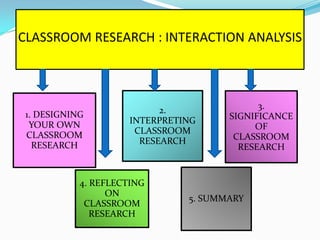
CLASSROOM RESEARCH : INTERACTION ANALYSIS


                            2.               3.
 1. DESIGNING                          SIGNIFICANCE
  YOUR OWN            INTERPRETING
                       CLASSROOM            OF
 CLASSROOM                              CLASSROOM
   RESEARCH             RESEARCH
                                         RESEARCH


            4. REFLECTING
                  ON
                                5. SUMMARY
             CLASSROOM
               RESEARCH
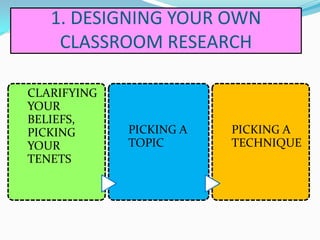
1. DESIGNING YOUR OWN
    CLASSROOM RESEARCH

CLARIFYING
YOUR
BELIEFS,
PICKING      PICKING A   PICKING A
YOUR         TOPIC       TECHNIQUE
TENETS
 beliefs about good teaching
 beliefs about effective learning


 Views are shared and many axioms are built
   Eg: Axiom – saying / statement
 learners learn more effectively when given positive
  feedback (praise, approval) than negative feedback
  (criticism, disapproval).
Research reports…….
 Positive evidence (Rosenshine and Frust, 1973)
 Negative evidence (Long, 1983)


 - clarify tenets (theories/ beliefs)
  - how such tenets could shape the research

*useful, relevant, effective, applicable…..
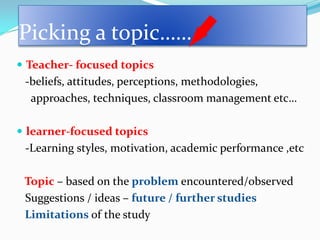
Picking a topic……
 Teacher- focused topics
 -beliefs, attitudes, perceptions, methodologies,
  approaches, techniques, classroom management etc…

 learner-focused topics
 -Learning styles, motivation, academic performance ,etc

 Topic – based on the problem encountered/observed
 Suggestions / ideas – future / further studies
 Limitations of the study
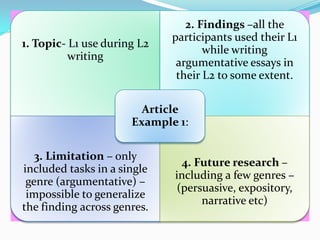
2. Findings –all the
                             participants used their L1
1. Topic- L1 use during L2
                                    while writing
          writing
                              argumentative essays in
                              their L2 to some extent.

                        Article
                      Example 1:

   3. Limitation – only
                               4. Future research –
included tasks in a single
                             including a few genres –
 genre (argumentative) –
                              (persuasive, expository,
 impossible to generalize
                                   narrative etc)
the finding across genres.
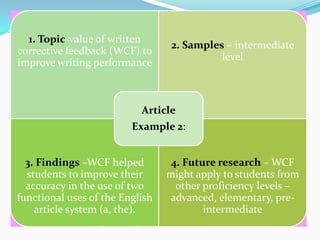
1. Topic-value of written
                                  2. Samples – intermediate
corrective feedback (WCF) to
                                            level
improve writing performance


                           Article
                         Example 2:


  3. Findings –WCF helped         4. Future research – WCF
  students to improve their      might apply to students from
  accuracy in the use of two       other proficiency levels –
functional uses of the English   advanced, elementary, pre-
    article system (a, the).             intermediate
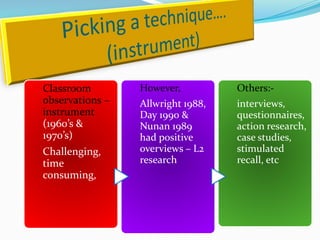
Classroom        However,          Others:-
observations –   Allwright 1988,   interviews,
instrument       Day 1990 &        questionnaires,
(1960’s &        Nunan 1989        action research,
1970’s)          had positive      case studies,
Challenging,     overviews – L2    stimulated
time             research          recall, etc
consuming,
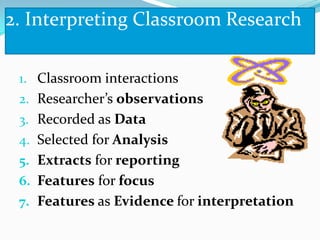
2. Interpreting Classroom Research

 1. Classroom interactions
 2. Researcher’s observations
 3. Recorded as Data
 4. Selected for Analysis
 5. Extracts for reporting
 6. Features for focus
 7. Features as Evidence for interpretation
CAUTION
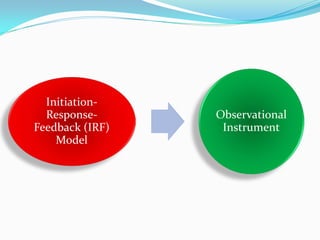
Initiation-
  Response-      Observational
Feedback (IRF)    Instrument
    Model
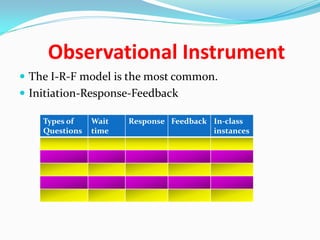
Observational Instrument
 The I-R-F model is the most common.
 Initiation-Response-Feedback

    Types of    Wait   Response Feedback In-class
    Questions   time                     instances
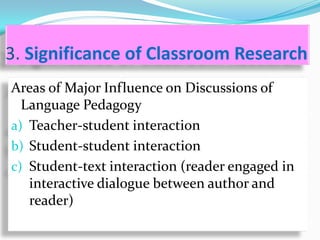
3. Significance of Classroom Research
Areas of Major Influence on Discussions of
  Language Pedagogy
a) Teacher-student interaction
b) Student-student interaction
c) Student-text interaction (reader engaged in
   interactive dialogue between author and
   reader)
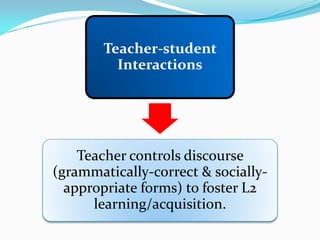
Teacher-student
          Interactions


    Teacher controls discourse
(grammatically-correct & socially-
  appropriate forms) to foster L2
      learning/acquisition.
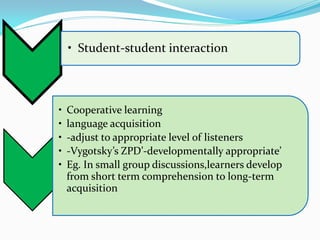
• Student-student interaction


•   Cooperative learning
•   language acquisition
•   -adjust to appropriate level of listeners
•   -Vygotsky’s ZPD’-developmentally appropriate’
•   Eg. In small group discussions,learners develop
    from short term comprehension to long-term
    acquisition
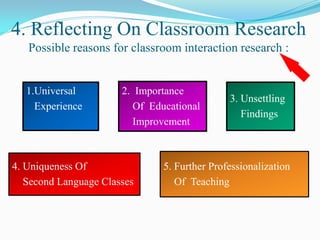
4. Reflecting On Classroom Research
   Possible reasons for classroom interaction research :


   1.Universal         2. Importance
                                               3. Unsettling
     Experience           Of Educational
                                                  Findings
                          Improvement


4. Uniqueness Of                5. Further Professionalization
   Second Language Classes         Of Teaching
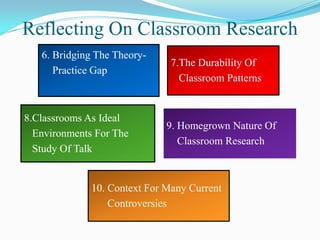
Reflecting On Classroom Research
   6. Bridging The Theory-
                               7.The Durability Of
      Practice Gap
                                 Classroom Patterns


8.Classrooms As Ideal
                              9. Homegrown Nature Of
  Environments For The
                                 Classroom Research
  Study Of Talk


              10. Context For Many Current
                  Controversies
Reflecting On Classroom Research

                     1. Universal
                        Experience


 Veteran observer – spent many years as classroom learner
 An expert about a topic and interesting to know deeper.
Reflecting On Classroom Research
                       2. Importance
                          Of Educational
                          Improvement


 Occupies the biggest budgets of most governmental agencies
  regardless of schooling location & subject of instruction.
 Therefore, there is always movements to improve delivery of education
  to make classroom interaction more efficient, effective & inspiring.
Reflecting On Classroom Research

                  3. Unsettling
                     Findings


 Teacher talk took up most of the interactional time.
 Teacher   ask questions to which answers already
 known.
Reflecting On Classroom Research
              4.Uniqueness Of
              Second Language
              Classes


 Research in second language classrooms shares many
  same interest and techniques of inquiry with research
  in other subject area classrooms.
 Unique- both medium and content of instruction
  provides special challenges and the opportunity.
Example 1
 Tan, B. T. (2011) suggests that for learners’ language to
  develop in complexity, conditions need to be set,
  requiring them to access the L2 directly to construct
  new ideas and that opportunities are needed for both
  L2 forms and meaning to co-evolve. Here the
  conditions set are considered unique.
Reflecting On Classroom Research
              5.Further
              Professionalization
              Of Teaching


 growing interest – involvement of classroom teacher in
  the process of research.
 This trends include school based curriculum
  development, field based teacher preparation and
  professional self-evaluation projects.
Reflecting On Classroom Research

              6.   Bridging     The
              Theory- Practice Gap


 Goals to narrow the gap between theory and practice,
 allowing teachers to become enthusiastic producers &
 consumers of educational research.
Example 2
 Gilmore, A. (2009) explains that
 participants were able to improve their
 writing after 90-minutes training session
 using online corpora and it was beneficial.
 Hence, online resources are tools that can be
 used to bridge the theory-practice gap to
 improve or develop writing skills.
Reflecting On Classroom Research

                  7.The Durability Of
                    Classroom patterns


 Classroom looked same for last 1,000 years.
 Despite changes in content, technologies, methods, educational
  priorities & professionalization of teaching, school classroom &
  activities in classroom not much change but the role and orientation
  of teacher and learners have maintained.
Reflecting On Classroom Research
             8.Classrooms As Ideal
             Environments For The
               Study Of Talk


 Classroom feature- attractive environment for the study of talk.
 Ethographers examine how talk systematically patterned in ways that
  reveal, or define & how speakers perceive their relationships and
  situations.
 Classrooms represent a strongly marked local social system, allowing
  researcher intimate looks at language which marks relationships &
  situations
Example 3
 Frazier, S. (2007) describes the sequential
  structures of a kind of talk typical to group work.
  The study analyzes video data of naturally
  occurring interactions between students in writing
  classes, draws its theoretical basis from
  conversation-analytic literature on ‘second stories’
  and on analytic approaches to the way talk,
  gesture, and other forms of embodiment produce
  action in the course of interaction.
Reflecting On Classroom Research

                9.Homegrown Nature
                 Of Classroom Research


 Many techniques comes from outside the field of applied linguistics.
 Studies of classroom talk, educational researchers acknowledge that initial
  impetus in investigations of classrooms talk come not from educational
  researchers but applied linguistics like Hymes, Gumperz, Sinclair and
  Coulthhard.
 Critical study of classroom interaction can be said home-grown.
Example 4
 Firkins, Forey and Sengupta, (2007) explains
  about a genre-based literacy pedagogy which can
  be used with English language learners. The
  method use is involved a combination of two
  explicit teaching methodologies, a genre-based
  and activity based pedagogical approach. The
  pedagogy was introduced in an English Club at a
  local Hong Kong school. It was found that a genre-
  based is suitable for educational context to low
  proficiency EFL learners. Here the genre-based is a
  home-grown       tool    in    explicit   teaching
  methodology.
Reflecting On Classroom Research

             10.Context For Many
             Current Controversies


 Educational psychologist, second language specialist,
  social anthropologist, linguist..etc all assert a multiplicity
  of views on how classroom interaction research should be
  carried out both within their own areas of specialization
  and wider context of teaching and learning generally.
PUSHPA KANDASAMY
References

Bitchener, J., & Knoch, U. (2008). The value of written
  corrective feedback for migrant and international students.
  Language Teaching Research, 12(3), 409-431. Retrieved 07
  October 2011, from http://ltr.sagepub.com/content/12/3/409

Brown, J. D., & Rodgers, T. S. (2009). Doing Second Language
  Research. United Kingdom: Oxford University Press.

Firkins, A., Forey, G. & Sima Sengupta, (2007). Teaching writing
  to low proficiency EFL students. English Language Teaching
  Journal, 61(4), 341-352.
Ford, M., & Opitz, M.. (2011). Looking Back to Move Forward with Guided
  Reading. Reading Horizons, 50(4), 225-240. Retrieved 11October 2011, from
  ProQuest Education Journals.

  http://ezproxy.um.edu.my:2110/pqdwebindex=0&did=2302650221&SrchMode=
  1&sid=2&Fmt=3&VInst=PROD&VType=PQD&RQT=309&VName=PQD&TS
  =1320572694&clientId=18803

Frazier, S. (2007). Telling of rememberances ‘Touch off’ by student reports in group
  work in undergraduate writing classes. Applied Linguistics, 28(2), 189-210.

Gilmore, A. (2009). Using online corpora to develop students’ writing skills.
  English Language Teaching Journal, 63(4), 363-372.

Lesaux, N. K.; Kieffer, M. J. (2010) Exploring sources of reading comprehension
  difficulties among language minority learners and their classmates in early
  adolescence. American Educational Research Journal 47(3), 596-632.
Lo, Y., Cooke, N., & Starling, A. (2011). Using a repeated reading program to
   improve generalization of oral reading fluency. Journal of Education & Treatment of
  Children, 34(1), 115-140. Retrieved 11October, 2011, from ProQuest Education
  Journals
    http://ezproxy.um.edu.my:2110/pqdwebindex=0&did=2298722431&SrchMode=1&sid=1
      &Fmt=3&VInst=PROD&VType=PQD&RQT=309&VName=PQD&TS=1320572599&cli
      entId=18803


Stapleton, P. & Radia, P (2010). Tech-era L2 writing: toward a new kind of process.
   English Language Teaching Journal, 64(2), 175-183.

Tan, B. T. (2011). Language creativity and co-emergence of form and meaning in
  creative writing task. Applied Linguistics, 32(2), 215-235.

Van Weijian, D., Van den Bergh, H., Rijlaarsdam, G., & Sanders, T. (2009). L1 use
  during L2 writing: An empirical study of a complex phenomenon. Journal of Second
  Language Writing, 18, 235-250. Retrieved 10 October 2011, from
  http://ezproxy.um.edu.my:2095/science/journal/10603743/18/4

Classroom research

  • 1.
    CLASSROOM RESEARCH Research inSecond Language Acquisition PBGS 6113 Med TESL University of Malaya Semester 1 2011/2012 Dr. Jessie Grace U. Rubrico, Facilitator
  • 2.
    LEE HUAN YIK SHARILA PUSHPA KANDASAMY PGP110012 CHRISTIE PGP110002 PGP110003 GROUP 2 MEMBERS – TITLE: CLASSROOM RESEARCH – PART 2
  • 3.
    CLASSROOM RESEARCH :INTERACTION ANALYSIS 2. 3. 1. DESIGNING SIGNIFICANCE YOUR OWN INTERPRETING CLASSROOM OF CLASSROOM CLASSROOM RESEARCH RESEARCH RESEARCH 4. REFLECTING ON 5. SUMMARY CLASSROOM RESEARCH
  • 4.
    1. DESIGNING YOUROWN CLASSROOM RESEARCH CLARIFYING YOUR BELIEFS, PICKING PICKING A PICKING A YOUR TOPIC TECHNIQUE TENETS
  • 5.
     beliefs aboutgood teaching  beliefs about effective learning  Views are shared and many axioms are built Eg: Axiom – saying / statement  learners learn more effectively when given positive feedback (praise, approval) than negative feedback (criticism, disapproval).
  • 6.
    Research reports…….  Positiveevidence (Rosenshine and Frust, 1973)  Negative evidence (Long, 1983)  - clarify tenets (theories/ beliefs) - how such tenets could shape the research *useful, relevant, effective, applicable…..
  • 7.
    Picking a topic…… Teacher- focused topics -beliefs, attitudes, perceptions, methodologies, approaches, techniques, classroom management etc…  learner-focused topics -Learning styles, motivation, academic performance ,etc Topic – based on the problem encountered/observed Suggestions / ideas – future / further studies Limitations of the study
  • 8.
    2. Findings –allthe participants used their L1 1. Topic- L1 use during L2 while writing writing argumentative essays in their L2 to some extent. Article Example 1: 3. Limitation – only 4. Future research – included tasks in a single including a few genres – genre (argumentative) – (persuasive, expository, impossible to generalize narrative etc) the finding across genres.
  • 9.
    1. Topic-value ofwritten 2. Samples – intermediate corrective feedback (WCF) to level improve writing performance Article Example 2: 3. Findings –WCF helped 4. Future research – WCF students to improve their might apply to students from accuracy in the use of two other proficiency levels – functional uses of the English advanced, elementary, pre- article system (a, the). intermediate
  • 10.
    Classroom However, Others:- observations – Allwright 1988, interviews, instrument Day 1990 & questionnaires, (1960’s & Nunan 1989 action research, 1970’s) had positive case studies, Challenging, overviews – L2 stimulated time research recall, etc consuming,
  • 11.
    2. Interpreting ClassroomResearch 1. Classroom interactions 2. Researcher’s observations 3. Recorded as Data 4. Selected for Analysis 5. Extracts for reporting 6. Features for focus 7. Features as Evidence for interpretation
  • 12.
  • 13.
    Initiation- Response- Observational Feedback (IRF) Instrument Model
  • 14.
    Observational Instrument  TheI-R-F model is the most common.  Initiation-Response-Feedback Types of Wait Response Feedback In-class Questions time instances
  • 15.
    3. Significance ofClassroom Research Areas of Major Influence on Discussions of Language Pedagogy a) Teacher-student interaction b) Student-student interaction c) Student-text interaction (reader engaged in interactive dialogue between author and reader)
  • 16.
    Teacher-student Interactions Teacher controls discourse (grammatically-correct & socially- appropriate forms) to foster L2 learning/acquisition.
  • 17.
    • Student-student interaction • Cooperative learning • language acquisition • -adjust to appropriate level of listeners • -Vygotsky’s ZPD’-developmentally appropriate’ • Eg. In small group discussions,learners develop from short term comprehension to long-term acquisition
  • 18.
    4. Reflecting OnClassroom Research Possible reasons for classroom interaction research : 1.Universal 2. Importance 3. Unsettling Experience Of Educational Findings Improvement 4. Uniqueness Of 5. Further Professionalization Second Language Classes Of Teaching
  • 19.
    Reflecting On ClassroomResearch 6. Bridging The Theory- 7.The Durability Of Practice Gap Classroom Patterns 8.Classrooms As Ideal 9. Homegrown Nature Of Environments For The Classroom Research Study Of Talk 10. Context For Many Current Controversies
  • 20.
    Reflecting On ClassroomResearch 1. Universal Experience  Veteran observer – spent many years as classroom learner  An expert about a topic and interesting to know deeper.
  • 21.
    Reflecting On ClassroomResearch 2. Importance Of Educational Improvement  Occupies the biggest budgets of most governmental agencies regardless of schooling location & subject of instruction.  Therefore, there is always movements to improve delivery of education to make classroom interaction more efficient, effective & inspiring.
  • 22.
    Reflecting On ClassroomResearch 3. Unsettling Findings  Teacher talk took up most of the interactional time.  Teacher ask questions to which answers already known.
  • 23.
    Reflecting On ClassroomResearch 4.Uniqueness Of Second Language Classes  Research in second language classrooms shares many same interest and techniques of inquiry with research in other subject area classrooms.  Unique- both medium and content of instruction provides special challenges and the opportunity.
  • 24.
    Example 1  Tan,B. T. (2011) suggests that for learners’ language to develop in complexity, conditions need to be set, requiring them to access the L2 directly to construct new ideas and that opportunities are needed for both L2 forms and meaning to co-evolve. Here the conditions set are considered unique.
  • 25.
    Reflecting On ClassroomResearch 5.Further Professionalization Of Teaching  growing interest – involvement of classroom teacher in the process of research.  This trends include school based curriculum development, field based teacher preparation and professional self-evaluation projects.
  • 26.
    Reflecting On ClassroomResearch 6. Bridging The Theory- Practice Gap  Goals to narrow the gap between theory and practice, allowing teachers to become enthusiastic producers & consumers of educational research.
  • 27.
    Example 2  Gilmore,A. (2009) explains that participants were able to improve their writing after 90-minutes training session using online corpora and it was beneficial. Hence, online resources are tools that can be used to bridge the theory-practice gap to improve or develop writing skills.
  • 28.
    Reflecting On ClassroomResearch 7.The Durability Of Classroom patterns  Classroom looked same for last 1,000 years.  Despite changes in content, technologies, methods, educational priorities & professionalization of teaching, school classroom & activities in classroom not much change but the role and orientation of teacher and learners have maintained.
  • 29.
    Reflecting On ClassroomResearch 8.Classrooms As Ideal Environments For The Study Of Talk  Classroom feature- attractive environment for the study of talk.  Ethographers examine how talk systematically patterned in ways that reveal, or define & how speakers perceive their relationships and situations.  Classrooms represent a strongly marked local social system, allowing researcher intimate looks at language which marks relationships & situations
  • 30.
    Example 3  Frazier,S. (2007) describes the sequential structures of a kind of talk typical to group work. The study analyzes video data of naturally occurring interactions between students in writing classes, draws its theoretical basis from conversation-analytic literature on ‘second stories’ and on analytic approaches to the way talk, gesture, and other forms of embodiment produce action in the course of interaction.
  • 31.
    Reflecting On ClassroomResearch 9.Homegrown Nature Of Classroom Research  Many techniques comes from outside the field of applied linguistics.  Studies of classroom talk, educational researchers acknowledge that initial impetus in investigations of classrooms talk come not from educational researchers but applied linguistics like Hymes, Gumperz, Sinclair and Coulthhard.  Critical study of classroom interaction can be said home-grown.
  • 32.
    Example 4  Firkins,Forey and Sengupta, (2007) explains about a genre-based literacy pedagogy which can be used with English language learners. The method use is involved a combination of two explicit teaching methodologies, a genre-based and activity based pedagogical approach. The pedagogy was introduced in an English Club at a local Hong Kong school. It was found that a genre- based is suitable for educational context to low proficiency EFL learners. Here the genre-based is a home-grown tool in explicit teaching methodology.
  • 33.
    Reflecting On ClassroomResearch 10.Context For Many Current Controversies  Educational psychologist, second language specialist, social anthropologist, linguist..etc all assert a multiplicity of views on how classroom interaction research should be carried out both within their own areas of specialization and wider context of teaching and learning generally.
  • 34.
  • 35.
    References Bitchener, J., &Knoch, U. (2008). The value of written corrective feedback for migrant and international students. Language Teaching Research, 12(3), 409-431. Retrieved 07 October 2011, from http://ltr.sagepub.com/content/12/3/409 Brown, J. D., & Rodgers, T. S. (2009). Doing Second Language Research. United Kingdom: Oxford University Press. Firkins, A., Forey, G. & Sima Sengupta, (2007). Teaching writing to low proficiency EFL students. English Language Teaching Journal, 61(4), 341-352.
  • 36.
    Ford, M., &Opitz, M.. (2011). Looking Back to Move Forward with Guided Reading. Reading Horizons, 50(4), 225-240. Retrieved 11October 2011, from ProQuest Education Journals. http://ezproxy.um.edu.my:2110/pqdwebindex=0&did=2302650221&SrchMode= 1&sid=2&Fmt=3&VInst=PROD&VType=PQD&RQT=309&VName=PQD&TS =1320572694&clientId=18803 Frazier, S. (2007). Telling of rememberances ‘Touch off’ by student reports in group work in undergraduate writing classes. Applied Linguistics, 28(2), 189-210. Gilmore, A. (2009). Using online corpora to develop students’ writing skills. English Language Teaching Journal, 63(4), 363-372. Lesaux, N. K.; Kieffer, M. J. (2010) Exploring sources of reading comprehension difficulties among language minority learners and their classmates in early adolescence. American Educational Research Journal 47(3), 596-632.
  • 37.
    Lo, Y., Cooke,N., & Starling, A. (2011). Using a repeated reading program to improve generalization of oral reading fluency. Journal of Education & Treatment of Children, 34(1), 115-140. Retrieved 11October, 2011, from ProQuest Education Journals  http://ezproxy.um.edu.my:2110/pqdwebindex=0&did=2298722431&SrchMode=1&sid=1 &Fmt=3&VInst=PROD&VType=PQD&RQT=309&VName=PQD&TS=1320572599&cli entId=18803 Stapleton, P. & Radia, P (2010). Tech-era L2 writing: toward a new kind of process. English Language Teaching Journal, 64(2), 175-183. Tan, B. T. (2011). Language creativity and co-emergence of form and meaning in creative writing task. Applied Linguistics, 32(2), 215-235. Van Weijian, D., Van den Bergh, H., Rijlaarsdam, G., & Sanders, T. (2009). L1 use during L2 writing: An empirical study of a complex phenomenon. Journal of Second Language Writing, 18, 235-250. Retrieved 10 October 2011, from http://ezproxy.um.edu.my:2095/science/journal/10603743/18/4