Instituto Pedagógico de Caracas
Departamento de Idiomas Modernos
       Cátedra de Lingüística
        Didáctica del Inglés
        Prof. Mirna Quintero


               Bach.
         Irania Salmerón
        Vanessa Contreras
Background
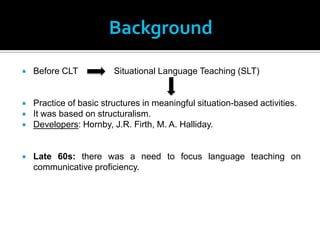
   Before CLT           Situational Language Teaching (SLT)


   Practice of basic structures in meaningful situation-based activities.
   It was based on structuralism.
   Developers: Hornby, J.R. Firth, M. A. Halliday.


   Late 60s: there was a need to focus language teaching on
    communicative proficiency.
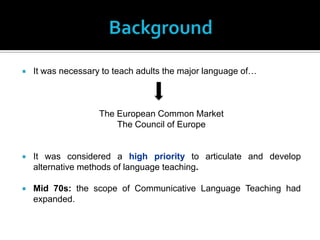
   It was necessary to teach adults the major language of…


                    The European Common Market
                        The Council of Europe


   It was considered a high priority to articulate and develop
    alternative methods of language teaching.

   Mid 70s: the scope of Communicative Language Teaching had
    expanded.
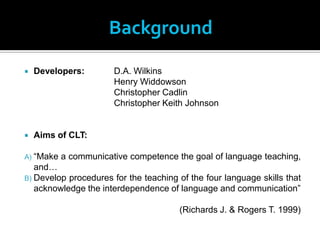
Background
   Developers:        D.A. Wilkins
                       Henry Widdowson
                       Christopher Cadlin
                       Christopher Keith Johnson


   Aims of CLT:

A) “Make   a communicative competence the goal of language teaching,
   and…
B) Develop procedures for the teaching of the four language skills that
   acknowledge the interdependence of language and communication”

                                       (Richards J. & Rogers T. 1999)
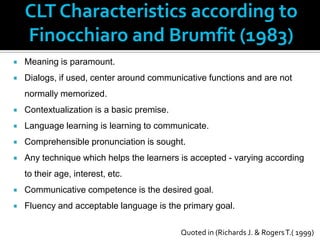
CLT Characteristics according to
    Finocchiaro and Brumfit (1983)
   Meaning is paramount.
   Dialogs, if used, center around communicative functions and are not
    normally memorized.
   Contextualization is a basic premise.
   Language learning is learning to communicate.
   Comprehensible pronunciation is sought.
   Any technique which helps the learners is accepted - varying according
    to their age, interest, etc.
   Communicative competence is the desired goal.
   Fluency and acceptable language is the primary goal.

                                            Quoted in (Richards J. & Rogers T.( 1999)
“There is no single text or authority on it, nor
      any single model that is universally
           accepted as authoritative.”


                           (Richards J. & Rogers T. 1999)
Based on:

   Hymes’ Theory (communicative competence)

   Halliday’s Theory (functions)

   Widowson’s view (Purposes of Lg.)
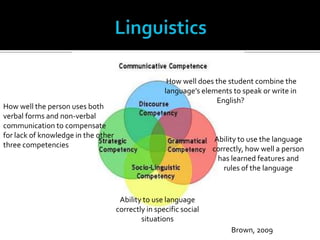
How well does the student combine the
                                                     language’s elements to speak or write in
                                                                    English?
How well the person uses both
verbal forms and non-verbal
communication to compensate
for lack of knowledge in the other                                   Ability to use the language
three competencies                                                  correctly, how well a person
                                                                      has learned features and
                                                                       rules of the language


                                      Ability to use language
                                     correctly in specific social
                                             situations
                                                                         Brown, 2009
   The primary function of language is for interaction and
    communication.

    The structure of language reflects its functional and
    communicative uses.

   The primary units of language are not merely its
    grammatical and structural features, but categories of
    functional and communicative meaning.
   Learner centered and experience based.
   Skill-syllabus & functional-syllabus based.
   Meaningful tasks.
   Functional activities.
   Social interaction activities.
   Accuracy and fluency are sought.
   Students induce or discover grammar rules.
   The teacher facilitates and monitors the
    process.
   link grammatical development to the ability to
    communicate.

   create the need for communication and
    interaction.

   allow students to apply what they have learned
    to their own lives.

   make use of authentic texts to create interest
    and to provide valid models of language.
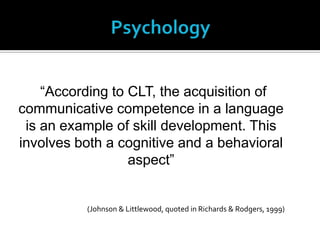
“According to CLT, the acquisition of
communicative competence in a language
 is an example of skill development. This
involves both a cognitive and a behavioral
                  aspect”


          (Johnson & Littlewood, quoted in Richards & Rodgers, 1999)
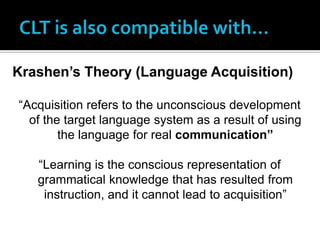
Krashen’s Theory (Language Acquisition)

“Acquisition refers to the unconscious development
  of the target language system as a result of using
        the language for real communication”

   “Learning is the conscious representation of
   grammatical knowledge that has resulted from
    instruction, and it cannot lead to acquisition”
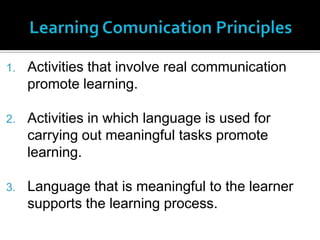
1.   Activities that involve real communication
     promote learning.

2.   Activities in which language is used for
     carrying out meaningful tasks promote
     learning.

3.   Language that is meaningful to the learner
     supports the learning process.
Communication
      is
  paramount.
Brown, P. (2009). What’s CTL? [Blog en linea]
  Language Matters. Disponible: http://language
  instinct.blogspot.com/2006/09/what-is-clt-language-
  competencies.html [Consulta: 2011, Octubre 25]

Richards, J. (2006). Communicative Language Teaching
  Today. NewYork: Cambridge Press.

Richars & Rodgers (1986). Approaches and Methods in
  Language Teaching. NewYork: Cambridge Press.

Communicative language teaching_(clt)2

  • 1.
    Instituto Pedagógico deCaracas Departamento de Idiomas Modernos Cátedra de Lingüística Didáctica del Inglés Prof. Mirna Quintero Bach. Irania Salmerón Vanessa Contreras
  • 2.
    Background  Before CLT Situational Language Teaching (SLT)  Practice of basic structures in meaningful situation-based activities.  It was based on structuralism.  Developers: Hornby, J.R. Firth, M. A. Halliday.  Late 60s: there was a need to focus language teaching on communicative proficiency.
  • 3.
    It was necessary to teach adults the major language of… The European Common Market The Council of Europe  It was considered a high priority to articulate and develop alternative methods of language teaching.  Mid 70s: the scope of Communicative Language Teaching had expanded.
  • 4.
    Background  Developers: D.A. Wilkins Henry Widdowson Christopher Cadlin Christopher Keith Johnson  Aims of CLT: A) “Make a communicative competence the goal of language teaching, and… B) Develop procedures for the teaching of the four language skills that acknowledge the interdependence of language and communication” (Richards J. & Rogers T. 1999)
  • 5.
    CLT Characteristics accordingto Finocchiaro and Brumfit (1983)  Meaning is paramount.  Dialogs, if used, center around communicative functions and are not normally memorized.  Contextualization is a basic premise.  Language learning is learning to communicate.  Comprehensible pronunciation is sought.  Any technique which helps the learners is accepted - varying according to their age, interest, etc.  Communicative competence is the desired goal.  Fluency and acceptable language is the primary goal. Quoted in (Richards J. & Rogers T.( 1999)
  • 6.
    “There is nosingle text or authority on it, nor any single model that is universally accepted as authoritative.” (Richards J. & Rogers T. 1999)
  • 7.
    Based on:  Hymes’ Theory (communicative competence)  Halliday’s Theory (functions)  Widowson’s view (Purposes of Lg.)
  • 8.
    How well doesthe student combine the language’s elements to speak or write in English? How well the person uses both verbal forms and non-verbal communication to compensate for lack of knowledge in the other Ability to use the language three competencies correctly, how well a person has learned features and rules of the language Ability to use language correctly in specific social situations Brown, 2009
  • 9.
    The primary function of language is for interaction and communication.  The structure of language reflects its functional and communicative uses.  The primary units of language are not merely its grammatical and structural features, but categories of functional and communicative meaning.
  • 10.
    Learner centered and experience based.  Skill-syllabus & functional-syllabus based.  Meaningful tasks.  Functional activities.  Social interaction activities.  Accuracy and fluency are sought.  Students induce or discover grammar rules.  The teacher facilitates and monitors the process.
  • 11.
    link grammatical development to the ability to communicate.  create the need for communication and interaction.  allow students to apply what they have learned to their own lives.  make use of authentic texts to create interest and to provide valid models of language.
  • 12.
    “According to CLT,the acquisition of communicative competence in a language is an example of skill development. This involves both a cognitive and a behavioral aspect” (Johnson & Littlewood, quoted in Richards & Rodgers, 1999)
  • 13.
    Krashen’s Theory (LanguageAcquisition) “Acquisition refers to the unconscious development of the target language system as a result of using the language for real communication” “Learning is the conscious representation of grammatical knowledge that has resulted from instruction, and it cannot lead to acquisition”
  • 14.
    1. Activities that involve real communication promote learning. 2. Activities in which language is used for carrying out meaningful tasks promote learning. 3. Language that is meaningful to the learner supports the learning process.
  • 15.
    Communication is paramount.
  • 16.
    Brown, P. (2009).What’s CTL? [Blog en linea] Language Matters. Disponible: http://language instinct.blogspot.com/2006/09/what-is-clt-language- competencies.html [Consulta: 2011, Octubre 25] Richards, J. (2006). Communicative Language Teaching Today. NewYork: Cambridge Press. Richars & Rodgers (1986). Approaches and Methods in Language Teaching. NewYork: Cambridge Press.