Jessie Grace Rubrico, PhD 
Facilitator
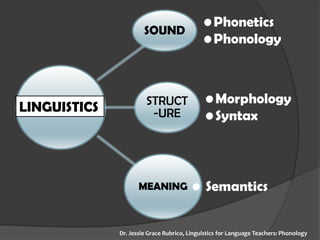
SOUND 
•Phonetics 
•Phonology 
STRUCT-URE 
•Morphology 
•Syntax 
MEANING 
• Semantics 
LINGUISTICS 
Dr. Jessie Grace Rubrico, Linguistics for Language Teachers: Phonology
PHONETICS 
AUDITORY ACOUSTICS 
ARTICULATORY 
PRODUCTION 
ARTICULATION 
DIPHTHONGS 
VOWELS 
CONSONANTS 
Height of Tongue Place of Articulation Rounding of Lips 
[+/- Voice] Place of Articulation Manner of Articulation 
Dr. Jessie Grace Rubrico, Linguistics for Language Teachers: Phonology
Phonology 
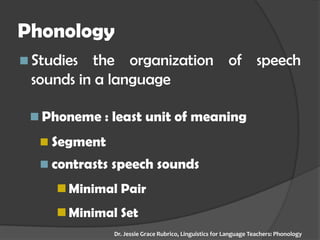
Studies the organization of speech sounds in a language 
Phoneme : least unit of meaning 
Segment 
contrasts speech sounds 
Minimal Pair 
Minimal Set 
Dr. Jessie Grace Rubrico, Linguistics for Language Teachers: Phonology
Phoneme : Minimal Pair 
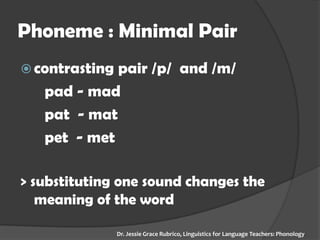
contrasting pair /p/ and /m/ 
pad - mad 
pat - mat 
pet - met 
> substituting one sound changes the meaning of the word 
Dr. Jessie Grace Rubrico, Linguistics for Language Teachers: Phonology
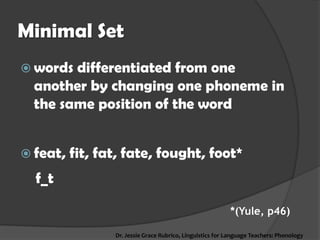
Minimal Set 
words differentiated from one another by changing one phoneme in the same position of the word 
feat, fit, fat, fate, fought, foot* 
f_t 
*(Yule, p46) 
Dr. Jessie Grace Rubrico, Linguistics for Language Teachers: Phonology
Features – differentiate one speech sound from others 
presence of feature [+] 
[+ voice] 
[+bilabial] 
[+stop] 
absence of feature 
[ - ] 
[ - voice] 
[-bilabial] 
[-stop] 
Dr. Jessie Grace Rubrico, Linguistics for Language Teachers: Phonology
Feature analysis 
/t/ - [-voice, 
+ alveolar, 
+ stop] 
/k/ - [- voice, 
+ velar, 
+ stop] 
/t/ and /k/ - share some features – belong to the same natural class of sounds 
tend to behave similarly: pl-kl; pr-kr 
/v/ - [+ voice, + labiodental, + fricative] – behaves differently: [vl-] 
Dr. Jessie Grace Rubrico, Linguistics for Language Teachers: Phonology
Phones and Allophones 
[phone] – 
Allophone - different forms/realizations of a phoneme 
/t/ > [t] – star; 
[th ] – tar (aspiration) 
allophones do not change the meaning of the word 
Dr. Jessie Grace Rubrico, Linguistics for Language Teachers: Phonology
Aspiration in English (O’Grady 2009; p80) 
[phæn]; [phejn]; [phowk]; [phæn];[phәrspájr]; [әphɑn] 
[thown]; [thәkhila]; [әthæk] 
[khәnú]; [khIn] 
[sphæn]; [sphejn]; [sphowk]; [sthown]; [skhIn]; [sphlæt]; [slæph]; blɑkh]; [slɑth] 
Dr. Jessie Grace Rubrico, Linguistics for Language Teachers: Phonology
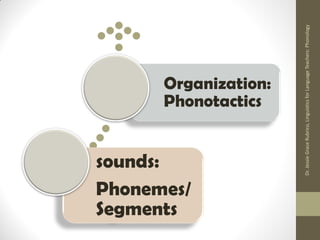
sounds: Phonemes/ Segments 
Organization: Phonotactics 
Dr. Jessie Grace Rubrico, Linguistics for Language Teachers: Phonology
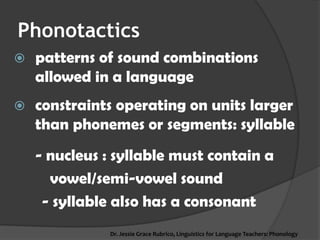
Phonotactics 
patterns of sound combinations allowed in a language 
constraints operating on units larger than phonemes or segments: syllable 
- nucleus : syllable must contain a 
vowel/semi-vowel sound 
- syllable also has a consonant 
Dr. Jessie Grace Rubrico, Linguistics for Language Teachers: Phonology
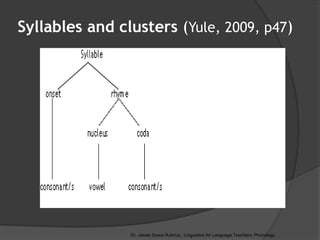
Syllables and clusters (Yule, 2009, p47) 
Dr. Jessie Grace Rubrico , Linguistics for Language Teachers: Phonology
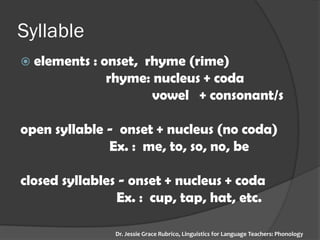
Syllable 
elements : onset, rhyme (rime) 
rhyme: nucleus + coda 
vowel + consonant/s 
open syllable - onset + nucleus (no coda) 
Ex. : me, to, so, no, be 
closed syllables - onset + nucleus + coda 
Ex. : cup, tap, hat, etc. 
Dr. Jessie Grace Rubrico, Linguistics for Language Teachers: Phonology
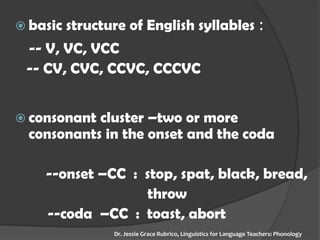
basic structure of English syllables : 
-- V, VC, VCC 
-- CV, CVC, CCVC, CCCVC 
consonant cluster –two or more consonants in the onset and the coda 
--onset –CC : stop, spat, black, bread, 
throw 
--coda –CC : toast, abort 
Dr. Jessie Grace Rubrico, Linguistics for Language Teachers: Phonology
Larger consonant clusters- 
--CCC: strike, stress, splash, etc. 
the first consonant is always an /s/ 
the next consonant must be a 
[-voice] [+stop] - /p, t, k/ 
the third is either a liquid -/l, r/- or a glide /w/ 
Dr. Jessie Grace Rubrico, Linguistics for Language Teachers: Phonology
Assimilation and Elision 
Assimilation –one segment copies a feature of its neighboring segment 
Ex: segments before nasals are 
nasalized 
pin – pin, pen, pan 
I can go – [aj kæn go] > [ajkәŋgo] 
Dr. Jessie Grace Rubrico, Linguistics for Language Teachers: Phonology
Elision 
 Elision – non-articulation of a sound in 
a word or phrase > efficient 
You and me – [juәnmi] --/d/ omitted 
 Friendship – [frenʃIp] 
Dr. Jessie Grace Rubrico, Linguistics for Language Teachers: Phonology
References 
McGregor, William B. 2009. Linguistics: An Introduction. London: Continuum International Publishing Group. 
O'Grady, William D., Archibald, John, [eds.] (2009). Contemporary Linguistic Analysis: An Introduction, 6th edition. Ontario: Pearson Education Canada. 
Yule G. 2006. The study of language. Cambridge: CUP. 
Dr. Jessie Grace Rubrico, Linguistics for Language Teachers: Phonology/141014

Phonology

  • 1.
    Jessie Grace Rubrico,PhD Facilitator
  • 2.
    SOUND •Phonetics •Phonology STRUCT-URE •Morphology •Syntax MEANING • Semantics LINGUISTICS Dr. Jessie Grace Rubrico, Linguistics for Language Teachers: Phonology
  • 3.
    PHONETICS AUDITORY ACOUSTICS ARTICULATORY PRODUCTION ARTICULATION DIPHTHONGS VOWELS CONSONANTS Height of Tongue Place of Articulation Rounding of Lips [+/- Voice] Place of Articulation Manner of Articulation Dr. Jessie Grace Rubrico, Linguistics for Language Teachers: Phonology
  • 4.
    Phonology Studies theorganization of speech sounds in a language Phoneme : least unit of meaning Segment contrasts speech sounds Minimal Pair Minimal Set Dr. Jessie Grace Rubrico, Linguistics for Language Teachers: Phonology
  • 5.
    Phoneme : MinimalPair contrasting pair /p/ and /m/ pad - mad pat - mat pet - met > substituting one sound changes the meaning of the word Dr. Jessie Grace Rubrico, Linguistics for Language Teachers: Phonology
  • 6.
    Minimal Set wordsdifferentiated from one another by changing one phoneme in the same position of the word feat, fit, fat, fate, fought, foot* f_t *(Yule, p46) Dr. Jessie Grace Rubrico, Linguistics for Language Teachers: Phonology
  • 7.
    Features – differentiateone speech sound from others presence of feature [+] [+ voice] [+bilabial] [+stop] absence of feature [ - ] [ - voice] [-bilabial] [-stop] Dr. Jessie Grace Rubrico, Linguistics for Language Teachers: Phonology
  • 8.
    Feature analysis /t/- [-voice, + alveolar, + stop] /k/ - [- voice, + velar, + stop] /t/ and /k/ - share some features – belong to the same natural class of sounds tend to behave similarly: pl-kl; pr-kr /v/ - [+ voice, + labiodental, + fricative] – behaves differently: [vl-] Dr. Jessie Grace Rubrico, Linguistics for Language Teachers: Phonology
  • 9.
    Phones and Allophones [phone] – Allophone - different forms/realizations of a phoneme /t/ > [t] – star; [th ] – tar (aspiration) allophones do not change the meaning of the word Dr. Jessie Grace Rubrico, Linguistics for Language Teachers: Phonology
  • 10.
    Aspiration in English(O’Grady 2009; p80) [phæn]; [phejn]; [phowk]; [phæn];[phәrspájr]; [әphɑn] [thown]; [thәkhila]; [әthæk] [khәnú]; [khIn] [sphæn]; [sphejn]; [sphowk]; [sthown]; [skhIn]; [sphlæt]; [slæph]; blɑkh]; [slɑth] Dr. Jessie Grace Rubrico, Linguistics for Language Teachers: Phonology
  • 11.
    sounds: Phonemes/ Segments Organization: Phonotactics Dr. Jessie Grace Rubrico, Linguistics for Language Teachers: Phonology
  • 12.
    Phonotactics patterns ofsound combinations allowed in a language constraints operating on units larger than phonemes or segments: syllable - nucleus : syllable must contain a vowel/semi-vowel sound - syllable also has a consonant Dr. Jessie Grace Rubrico, Linguistics for Language Teachers: Phonology
  • 13.
    Syllables and clusters(Yule, 2009, p47) Dr. Jessie Grace Rubrico , Linguistics for Language Teachers: Phonology
  • 14.
    Syllable elements :onset, rhyme (rime) rhyme: nucleus + coda vowel + consonant/s open syllable - onset + nucleus (no coda) Ex. : me, to, so, no, be closed syllables - onset + nucleus + coda Ex. : cup, tap, hat, etc. Dr. Jessie Grace Rubrico, Linguistics for Language Teachers: Phonology
  • 15.
    basic structure ofEnglish syllables : -- V, VC, VCC -- CV, CVC, CCVC, CCCVC consonant cluster –two or more consonants in the onset and the coda --onset –CC : stop, spat, black, bread, throw --coda –CC : toast, abort Dr. Jessie Grace Rubrico, Linguistics for Language Teachers: Phonology
  • 16.
    Larger consonant clusters- --CCC: strike, stress, splash, etc. the first consonant is always an /s/ the next consonant must be a [-voice] [+stop] - /p, t, k/ the third is either a liquid -/l, r/- or a glide /w/ Dr. Jessie Grace Rubrico, Linguistics for Language Teachers: Phonology
  • 17.
    Assimilation and Elision Assimilation –one segment copies a feature of its neighboring segment Ex: segments before nasals are nasalized pin – pin, pen, pan I can go – [aj kæn go] > [ajkәŋgo] Dr. Jessie Grace Rubrico, Linguistics for Language Teachers: Phonology
  • 18.
    Elision  Elision– non-articulation of a sound in a word or phrase > efficient You and me – [juәnmi] --/d/ omitted  Friendship – [frenʃIp] Dr. Jessie Grace Rubrico, Linguistics for Language Teachers: Phonology
  • 19.
    References McGregor, WilliamB. 2009. Linguistics: An Introduction. London: Continuum International Publishing Group. O'Grady, William D., Archibald, John, [eds.] (2009). Contemporary Linguistic Analysis: An Introduction, 6th edition. Ontario: Pearson Education Canada. Yule G. 2006. The study of language. Cambridge: CUP. Dr. Jessie Grace Rubrico, Linguistics for Language Teachers: Phonology/141014