ENGLISH VERB SYSTEM

 Jessie Grace U. Rubrico, PhD
        TESL PROGRAM
     University of Malaya
       14 February 2011
verbs


     main                                             aux


dynamic/        static/state
 action           of being                  be, do, have,
                                               modals

            cognition, perception,   Dr. Jessie Grace U. Rubrico, TESL Program
              emotion, relation             Universiti Malaya KL/feb 2011
TENSE


              TIME                                  ASPECT


   PAST                                   SIMPLE


                              FUTURE                            PERFECT


           PRESENT
                                                   CONTINUOUS


RUBRICO, Jessie Grace/PBET 1103 2011
TIME


                                            FUTURE
         PRESENT

PAST
       Dr. Jessie Grace U. Rubrico, TESL Program Universiti Malaya KL/feb 2011
ASPECT

     SIMPLE

      CONTINUOUS

          PERFECT

    PERFECT CONTINUOUS

Dr. Jessie Grace U. Rubrico, TESL Program Universiti Malaya KL/feb 2011
TENSES IN ENGLISH

                                            TIME
     ASPECT                        PAST    PRESENT            FUTURE

  SIMPLE                   Simple Past Simple Pres         Simple Fut
  CONTINUOUS               Past Cont      Pres Cont     Future Cont
  PERFECT                  Past Perf      Pres Perf     Future Perf
  PERFECT                  Past Perfect Pres Perf Future Perf
  CONTINUOUS               Continuous Continuous Contunuous

                                                         Jessie Grace U. Rubrico, PhD
Source: Master, P. (1996), p.48.                      TESL Program Universiti Malaya KL
Inflections of verbs

                   Ø
                  -s
SUFFIXES          -ing
                  -ed
                  -en

Inflection: number (Subj-V agr); tense
                  Dr. Jessie Grace U. Rubrico, TESL Program Universiti Malaya KL/feb 2011
Simple Tenses
•SIMPLE PRESENT
•SIMPLE PAST
•SIMPLE FUTURE

       Dr. Jessie Grace U. Rubrico, TESL Program Universiti Malaya KL/feb 2011
Simple Present Tense
Usage
• habitual action; recurring action

Structure: Verbbase             -S
                                -Ø

> adverbs of frequency: often, always, frequently,
  usually, sometimes, seldom, rarely, never, etc.
                   Dr. Jessie Grace U. Rubrico, TESL Program Universiti Malaya KL/feb 2011
Simple FutureTense
 Usage: action/states in a future time


 Structure    will                           + Verbbase
               be going to


       Simple Pres + future time expression:
        We leave for Kelantan tomorrow.
                 Dr. Jessie Grace U. Rubrico, TESL Program Universiti Malaya KL/feb 2011
Will or Be going to?
Making prediction
• will : for general prediction
         > It will rain tomorrow
• be going to: linking prediction to present
                   circumstance
         > They are going to find it difficult to get
            tickets to Manila.
                     Dr. Jessie Grace U. Rubrico, TESL Program Universiti Malaya KL/feb 2011
Will or Be going to?
Making decisions
• will: in the process of making
      > When will you get the ticket?

• be going to: decisions are already made
    > I’m going to drive up North tomorrow.


                Dr. Jessie Grace U. Rubrico, TESL Program Universiti Malaya KL/feb 2011
Simple Past Tense
 Usage: actions that happened in the past that
  has no connection to the present

 Structure: Verbbase                  -ed (regular)
                                       -irregular


Subject-Verb Agr > NIL, except for BE

                Dr. Jessie Grace U. Rubrico, TESL Program Universiti Malaya KL/feb 2011
Dr. Jessie Grace U. Rubrico, TESL Program Universiti Malaya KL/feb 2011
Present Continuous Tense

• STRUCTURE:
  – BE {am, is, are} + Verb-ing

• USAGE: ongoing actions

             Dr. Jessie Grace U. Rubrico, TESL Program Universiti Malaya KL/feb 2011
Past Continuous Tense
• STRUCTURE:
   - BE {was, were} + Verb-ing

USAGE: V1 was happening when
       V2 happened

         V2 > simple past: reference time
               Dr. Jessie Grace U. Rubrico, TESL Program Universiti Malaya KL/feb 2011
We came to Malaysia on 27 June 2009. Our
friend was waiting for us when our plane
touched down at KLIA. It was raining when we
arrived but the sun was still up at 7PM. We were
hungry, so we went to a restaurant near the
Hilton. While we were ordering, our friend called
my boss to let him know that we were here. As
we were leaving the restaurant, we saw a friend
in a taxi but he did not see us. We were going
back to the Hilton when we met another friend
and we went for coffee.
                Dr. Jessie Grace U. Rubrico, TESL Program Universiti Malaya KL/feb 2011
Notes: PCT
PCT is generally NOT used in English
 unless there are TWO verbs present:

   PAST CONTINUOUS
   SIMPLE PAST - reference time


             Dr. Jessie Grace U. Rubrico, TESL Program Universiti Malaya KL/feb 2011
Future Continuous Tense
• STRUCTURE:
     WILL
     BE { is, am, are} going to                             + be Verb-ing


• USAGE: X will be happening when
         Y takes place

                  Dr. Jessie Grace U. Rubrico, TESL Program Universiti Malaya KL/feb 2011
Kevin is very excited because next year he is going to be
working for the Peace Corps in Sudan. The plan is as
follows: When he arrives, he will be living in Khartoum for
a short while until he becomes accustomed to the life and
culture of this desert nation. After two weeks, he will be
moving into a house with other volunteers in a village
near Juba. There they will be helping the local population
to learn new techniques of growing cotton. He will also be
teaching an English class in the village school because he
has an MA degree in teaching English. Later he will be
training young adults to work in a food processing plant.
Of course, while he is there he will be learning Arabic. It
will be a difficult assignment, but he knows that he and
his colleagues are going to be experiencing a completely
different culture, and he knows the rewards will be
tremendous. (Source: Master, 1996; p65).
PERFECT TENSES : completed action
• Present Perfect: Action is completed vis-à-vis
  the present. > I have read it.

• Past Perfect: Action is completed vis-à-vis the
  past. > I had read it.

• Future Perfect: Action is completed vis-à-vis
  the future. > I will have read it.
                 Dr. Jessie Grace U. Rubrico, TESL Program Universiti Malaya KL/feb 2011
Present Perfect Tense

 Structure : {has/have} + Verben

• actions that occurred sometime in the past
  but have relevance in the present

• Verben - past participle of the verb

                Dr. Jessie Grace U. Rubrico, TESL Program Universiti Malaya KL/feb 2011
USAGE -
1. To talk about experiences.

• Examples
   I have been to Spain.
   She has never visited us.
   Have you ever tried crabs?

• never and ever -often used with the Present
  Perfect Tense to talk about experiences.
               Dr. Jessie Grace U. Rubrico, TESL Program Universiti Malaya KL/feb 2011
2. To talk about an action which started in the
  past and continues up to now.

 Examples
  I have been a teacher for more than ten years.
  We haven't seen the President since Friday.
  How long have you been in UM?

• since and for
  - express how long the action has lasted.
                   Dr. Jessie Grace U. Rubrico, TESL Program Universiti Malaya KL/feb 2011
3. To talk about a past action that has
  an effect in the present.

  Examples
• I have lost my card.
 > I don't have it now.
• June has gone to London.
 > She isn't here now.

               Dr. Jessie Grace U. Rubrico, TESL Program Universiti Malaya KL/feb 2011
Present Perfect & Past Simple tenses
Past Simple tense - definite finished time in the
 past. For example: yesterday, last week, when I
 was abroad, then, after etc.

• Examples
   I finished college twenty years ago.
   Where did they first meet?
   I didn't study Mandarin then.
                  Dr. Jessie Grace U. Rubrico, TESL Program Universiti Malaya KL/feb 2011
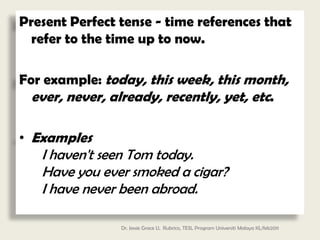
Present Perfect tense - time references that
 refer to the time up to now.

For example: today, this week, this month,
  ever, never, already, recently, yet, etc.

• Examples
   I haven't seen Tom today.
   Have you ever smoked a cigar?
   I have never been abroad.

                Dr. Jessie Grace U. Rubrico, TESL Program Universiti Malaya KL/feb2011
Past Perfect Tense


 Structure:    had + Verben


 Usage: X had happened
        before Y happened

               Dr. Jessie Grace U. Rubrico, TESL Program Universiti Malaya KL/feb 2011
When the professor finally showed up, the students had
waited for more than twenty minutes. He apologized and
told them that he had misplaced his watch. He asked one
of the students for the time, but the student replied that he
had misplaced his watch, too. Another student announced
that she had seen Big Ben the summer before if that was
any help. By the time the students had really settled down,
it was almost a quarter to four. The professor proceeded to
ask the students some questions which he had prepared for
them. When he had finished, he asked them to turn in a
composition which he had assigned two weeks earlier. After
he had given them another assignment for the week, he
dismissed the class right on time. Most of the students were
used to this because they had the same professor the
previous semester.
                            Source: Master, P. (1996), p.73.
Future Perfect Tense
 Structure:
         will have + Verben


 Usage: V1 will have happened
         before V2 happens

             Dr. Jessie Grace U. Rubrico, TESL Program Universiti Malaya KL/feb 2011
Going to a Conference in Japan
By the time they get to Tokyo, the doctors will have flown for
more than 14 hours. They will have crossed six thousand miles of
ocean and have eaten at least four meals. They will not have
taken a shower since they left Chicago, so they are bound to
make their presence known. Hopefully, before they attend the
conference, they will have had time to bathe, to rest, and to
recover from jetlag. They will also have met the hosts and will no
doubt have introduced themselves to the other members of the
international panel, which is the highlight of the conference and
their principal reason for coming to Japan. The leader of this
group says that, when it is over, this will have been the third
conference he has participated in this year, although it is the first
one at which he will have presented a paper. The Japanese hosts
say that, at the conclusion of this meeting, it will have been the
second conference in as many years that has taken place in
Tokyo, and they hope to host many more such meetings in the
future. (Master, 1996; p. 76)
PERFECT CONTINUOUS TENSES

 PRESENT PERFECT CONTINUOUS

 PAST PERFECT CONTINUOUS

 FUTURE PERFECT CONTINUOUS


          Dr. Jessie Grace U. Rubrico, TESL Program Universiti Malaya KL/feb 2011
PRESENT PERFECT CONTINUOUS

 STRUCTURE
  have {has, have} + been + Verb-ing

 USAGE :
  X began happening and
  has continued until NOW

              Dr. Jessie Grace U. Rubrico, TESL Program Universiti Malaya KL/feb 2011
Examples: Present Perfect Continuous

• They have been waiting at the Café for
  over an hour.
• I have been working here for two years.
• She has not been reporting to work since
  Monday.
• Peter and Nona have been quarreling
  over money lately.
              Dr. Jessie Grace U. Rubrico, TESL Program Universiti Malaya KL/feb 2011
Past Perfect Continuous Tense
 STRUCTURE
  had been + Verb-ing

 USAGE
  X (past perfect continuous) started
  happening and continued to happen
  before Y happened (simple past)
              Dr. Jessie Grace U. Rubrico, TESL Program Universiti Malaya KL/feb 2011
Examples: Past Perfect Continuous
• Joni and John had been discussing the
  problem for three hours before Cindy arrived.
• They failed PBET 1103 because they had not
  been attending class.
• The customers had been waiting for three
  months before their orders were finally
  shipped.


                Dr. Jessie Grace U. Rubrico, TESL Program Universiti Malaya KL/feb 2011
Future Perfect Continuous Tense

 STRUCTURE: will have been + Verb-ing

 USAGE:
  X will continue to happen until
  Y happens at a particular future time

              Dr. Jessie Grace U. Rubrico, TESL Program Universiti Malaya KL/feb 2011
Examples: Future Perfect Cont
• When you get to Kelantan, you will have
  been driving for over five hours.

• By the time we finish the semester, we shall
  have been meeting continuously for 14 weeks.

• If the runner finishes within the next five
  minutes, he will have been running for 2
  hours.
                 Dr. Jessie Grace U. Rubrico, TESL Program Universiti Malaya KL/feb 2011
References
• Carter, R. Hughes, R. & McCarthy, M. 2002
  (2007, 8th printing). Exploring Grammar in
  Context. NY: Cambridge University Press.

• Master, P. 1996. Systems in English Grammar:
  An Introduction for Language Teachers. NJ:
  Prentice Hall Regents.
               Dr. Jessie Grace U. Rubrico, TESL Program Universiti Malaya KL/feb 2011

English verb system

  • 1.
    ENGLISH VERB SYSTEM Jessie Grace U. Rubrico, PhD TESL PROGRAM University of Malaya 14 February 2011
  • 2.
    verbs main aux dynamic/ static/state action of being be, do, have, modals cognition, perception, Dr. Jessie Grace U. Rubrico, TESL Program emotion, relation Universiti Malaya KL/feb 2011
  • 3.
    TENSE TIME ASPECT PAST SIMPLE FUTURE PERFECT PRESENT CONTINUOUS RUBRICO, Jessie Grace/PBET 1103 2011
  • 4.
    TIME FUTURE PRESENT PAST Dr. Jessie Grace U. Rubrico, TESL Program Universiti Malaya KL/feb 2011
  • 5.
    ASPECT SIMPLE CONTINUOUS PERFECT PERFECT CONTINUOUS Dr. Jessie Grace U. Rubrico, TESL Program Universiti Malaya KL/feb 2011
  • 6.
    TENSES IN ENGLISH TIME ASPECT PAST PRESENT FUTURE SIMPLE Simple Past Simple Pres Simple Fut CONTINUOUS Past Cont Pres Cont Future Cont PERFECT Past Perf Pres Perf Future Perf PERFECT Past Perfect Pres Perf Future Perf CONTINUOUS Continuous Continuous Contunuous Jessie Grace U. Rubrico, PhD Source: Master, P. (1996), p.48. TESL Program Universiti Malaya KL
  • 7.
    Inflections of verbs Ø -s SUFFIXES -ing -ed -en Inflection: number (Subj-V agr); tense Dr. Jessie Grace U. Rubrico, TESL Program Universiti Malaya KL/feb 2011
  • 8.
    Simple Tenses •SIMPLE PRESENT •SIMPLEPAST •SIMPLE FUTURE Dr. Jessie Grace U. Rubrico, TESL Program Universiti Malaya KL/feb 2011
  • 9.
    Simple Present Tense Usage •habitual action; recurring action Structure: Verbbase -S -Ø > adverbs of frequency: often, always, frequently, usually, sometimes, seldom, rarely, never, etc. Dr. Jessie Grace U. Rubrico, TESL Program Universiti Malaya KL/feb 2011
  • 10.
    Simple FutureTense  Usage:action/states in a future time  Structure will + Verbbase be going to Simple Pres + future time expression: We leave for Kelantan tomorrow. Dr. Jessie Grace U. Rubrico, TESL Program Universiti Malaya KL/feb 2011
  • 11.
    Will or Begoing to? Making prediction • will : for general prediction > It will rain tomorrow • be going to: linking prediction to present circumstance > They are going to find it difficult to get tickets to Manila. Dr. Jessie Grace U. Rubrico, TESL Program Universiti Malaya KL/feb 2011
  • 12.
    Will or Begoing to? Making decisions • will: in the process of making > When will you get the ticket? • be going to: decisions are already made > I’m going to drive up North tomorrow. Dr. Jessie Grace U. Rubrico, TESL Program Universiti Malaya KL/feb 2011
  • 13.
    Simple Past Tense Usage: actions that happened in the past that has no connection to the present  Structure: Verbbase -ed (regular) -irregular Subject-Verb Agr > NIL, except for BE Dr. Jessie Grace U. Rubrico, TESL Program Universiti Malaya KL/feb 2011
  • 14.
    Dr. Jessie GraceU. Rubrico, TESL Program Universiti Malaya KL/feb 2011
  • 15.
    Present Continuous Tense •STRUCTURE: – BE {am, is, are} + Verb-ing • USAGE: ongoing actions Dr. Jessie Grace U. Rubrico, TESL Program Universiti Malaya KL/feb 2011
  • 16.
    Past Continuous Tense •STRUCTURE: - BE {was, were} + Verb-ing USAGE: V1 was happening when V2 happened V2 > simple past: reference time Dr. Jessie Grace U. Rubrico, TESL Program Universiti Malaya KL/feb 2011
  • 17.
    We came toMalaysia on 27 June 2009. Our friend was waiting for us when our plane touched down at KLIA. It was raining when we arrived but the sun was still up at 7PM. We were hungry, so we went to a restaurant near the Hilton. While we were ordering, our friend called my boss to let him know that we were here. As we were leaving the restaurant, we saw a friend in a taxi but he did not see us. We were going back to the Hilton when we met another friend and we went for coffee. Dr. Jessie Grace U. Rubrico, TESL Program Universiti Malaya KL/feb 2011
  • 18.
    Notes: PCT PCT isgenerally NOT used in English unless there are TWO verbs present:  PAST CONTINUOUS  SIMPLE PAST - reference time Dr. Jessie Grace U. Rubrico, TESL Program Universiti Malaya KL/feb 2011
  • 19.
    Future Continuous Tense •STRUCTURE: WILL BE { is, am, are} going to + be Verb-ing • USAGE: X will be happening when Y takes place Dr. Jessie Grace U. Rubrico, TESL Program Universiti Malaya KL/feb 2011
  • 20.
    Kevin is veryexcited because next year he is going to be working for the Peace Corps in Sudan. The plan is as follows: When he arrives, he will be living in Khartoum for a short while until he becomes accustomed to the life and culture of this desert nation. After two weeks, he will be moving into a house with other volunteers in a village near Juba. There they will be helping the local population to learn new techniques of growing cotton. He will also be teaching an English class in the village school because he has an MA degree in teaching English. Later he will be training young adults to work in a food processing plant. Of course, while he is there he will be learning Arabic. It will be a difficult assignment, but he knows that he and his colleagues are going to be experiencing a completely different culture, and he knows the rewards will be tremendous. (Source: Master, 1996; p65).
  • 21.
    PERFECT TENSES :completed action • Present Perfect: Action is completed vis-à-vis the present. > I have read it. • Past Perfect: Action is completed vis-à-vis the past. > I had read it. • Future Perfect: Action is completed vis-à-vis the future. > I will have read it. Dr. Jessie Grace U. Rubrico, TESL Program Universiti Malaya KL/feb 2011
  • 22.
    Present Perfect Tense Structure : {has/have} + Verben • actions that occurred sometime in the past but have relevance in the present • Verben - past participle of the verb Dr. Jessie Grace U. Rubrico, TESL Program Universiti Malaya KL/feb 2011
  • 23.
    USAGE - 1. Totalk about experiences. • Examples I have been to Spain. She has never visited us. Have you ever tried crabs? • never and ever -often used with the Present Perfect Tense to talk about experiences. Dr. Jessie Grace U. Rubrico, TESL Program Universiti Malaya KL/feb 2011
  • 24.
    2. To talkabout an action which started in the past and continues up to now.  Examples I have been a teacher for more than ten years. We haven't seen the President since Friday. How long have you been in UM? • since and for - express how long the action has lasted. Dr. Jessie Grace U. Rubrico, TESL Program Universiti Malaya KL/feb 2011
  • 25.
    3. To talkabout a past action that has an effect in the present. Examples • I have lost my card. > I don't have it now. • June has gone to London. > She isn't here now. Dr. Jessie Grace U. Rubrico, TESL Program Universiti Malaya KL/feb 2011
  • 26.
    Present Perfect &Past Simple tenses Past Simple tense - definite finished time in the past. For example: yesterday, last week, when I was abroad, then, after etc. • Examples I finished college twenty years ago. Where did they first meet? I didn't study Mandarin then. Dr. Jessie Grace U. Rubrico, TESL Program Universiti Malaya KL/feb 2011
  • 27.
    Present Perfect tense- time references that refer to the time up to now. For example: today, this week, this month, ever, never, already, recently, yet, etc. • Examples I haven't seen Tom today. Have you ever smoked a cigar? I have never been abroad. Dr. Jessie Grace U. Rubrico, TESL Program Universiti Malaya KL/feb2011
  • 28.
    Past Perfect Tense Structure: had + Verben  Usage: X had happened before Y happened Dr. Jessie Grace U. Rubrico, TESL Program Universiti Malaya KL/feb 2011
  • 29.
    When the professorfinally showed up, the students had waited for more than twenty minutes. He apologized and told them that he had misplaced his watch. He asked one of the students for the time, but the student replied that he had misplaced his watch, too. Another student announced that she had seen Big Ben the summer before if that was any help. By the time the students had really settled down, it was almost a quarter to four. The professor proceeded to ask the students some questions which he had prepared for them. When he had finished, he asked them to turn in a composition which he had assigned two weeks earlier. After he had given them another assignment for the week, he dismissed the class right on time. Most of the students were used to this because they had the same professor the previous semester. Source: Master, P. (1996), p.73.
  • 30.
    Future Perfect Tense Structure: will have + Verben  Usage: V1 will have happened before V2 happens Dr. Jessie Grace U. Rubrico, TESL Program Universiti Malaya KL/feb 2011
  • 31.
    Going to aConference in Japan By the time they get to Tokyo, the doctors will have flown for more than 14 hours. They will have crossed six thousand miles of ocean and have eaten at least four meals. They will not have taken a shower since they left Chicago, so they are bound to make their presence known. Hopefully, before they attend the conference, they will have had time to bathe, to rest, and to recover from jetlag. They will also have met the hosts and will no doubt have introduced themselves to the other members of the international panel, which is the highlight of the conference and their principal reason for coming to Japan. The leader of this group says that, when it is over, this will have been the third conference he has participated in this year, although it is the first one at which he will have presented a paper. The Japanese hosts say that, at the conclusion of this meeting, it will have been the second conference in as many years that has taken place in Tokyo, and they hope to host many more such meetings in the future. (Master, 1996; p. 76)
  • 32.
    PERFECT CONTINUOUS TENSES PRESENT PERFECT CONTINUOUS  PAST PERFECT CONTINUOUS  FUTURE PERFECT CONTINUOUS Dr. Jessie Grace U. Rubrico, TESL Program Universiti Malaya KL/feb 2011
  • 33.
    PRESENT PERFECT CONTINUOUS STRUCTURE have {has, have} + been + Verb-ing  USAGE : X began happening and has continued until NOW Dr. Jessie Grace U. Rubrico, TESL Program Universiti Malaya KL/feb 2011
  • 34.
    Examples: Present PerfectContinuous • They have been waiting at the Café for over an hour. • I have been working here for two years. • She has not been reporting to work since Monday. • Peter and Nona have been quarreling over money lately. Dr. Jessie Grace U. Rubrico, TESL Program Universiti Malaya KL/feb 2011
  • 35.
    Past Perfect ContinuousTense  STRUCTURE had been + Verb-ing  USAGE X (past perfect continuous) started happening and continued to happen before Y happened (simple past) Dr. Jessie Grace U. Rubrico, TESL Program Universiti Malaya KL/feb 2011
  • 36.
    Examples: Past PerfectContinuous • Joni and John had been discussing the problem for three hours before Cindy arrived. • They failed PBET 1103 because they had not been attending class. • The customers had been waiting for three months before their orders were finally shipped. Dr. Jessie Grace U. Rubrico, TESL Program Universiti Malaya KL/feb 2011
  • 37.
    Future Perfect ContinuousTense  STRUCTURE: will have been + Verb-ing  USAGE: X will continue to happen until Y happens at a particular future time Dr. Jessie Grace U. Rubrico, TESL Program Universiti Malaya KL/feb 2011
  • 38.
    Examples: Future PerfectCont • When you get to Kelantan, you will have been driving for over five hours. • By the time we finish the semester, we shall have been meeting continuously for 14 weeks. • If the runner finishes within the next five minutes, he will have been running for 2 hours. Dr. Jessie Grace U. Rubrico, TESL Program Universiti Malaya KL/feb 2011
  • 39.
    References • Carter, R.Hughes, R. & McCarthy, M. 2002 (2007, 8th printing). Exploring Grammar in Context. NY: Cambridge University Press. • Master, P. 1996. Systems in English Grammar: An Introduction for Language Teachers. NJ: Prentice Hall Regents. Dr. Jessie Grace U. Rubrico, TESL Program Universiti Malaya KL/feb 2011