TEACHING
BY
PRINCIPLES
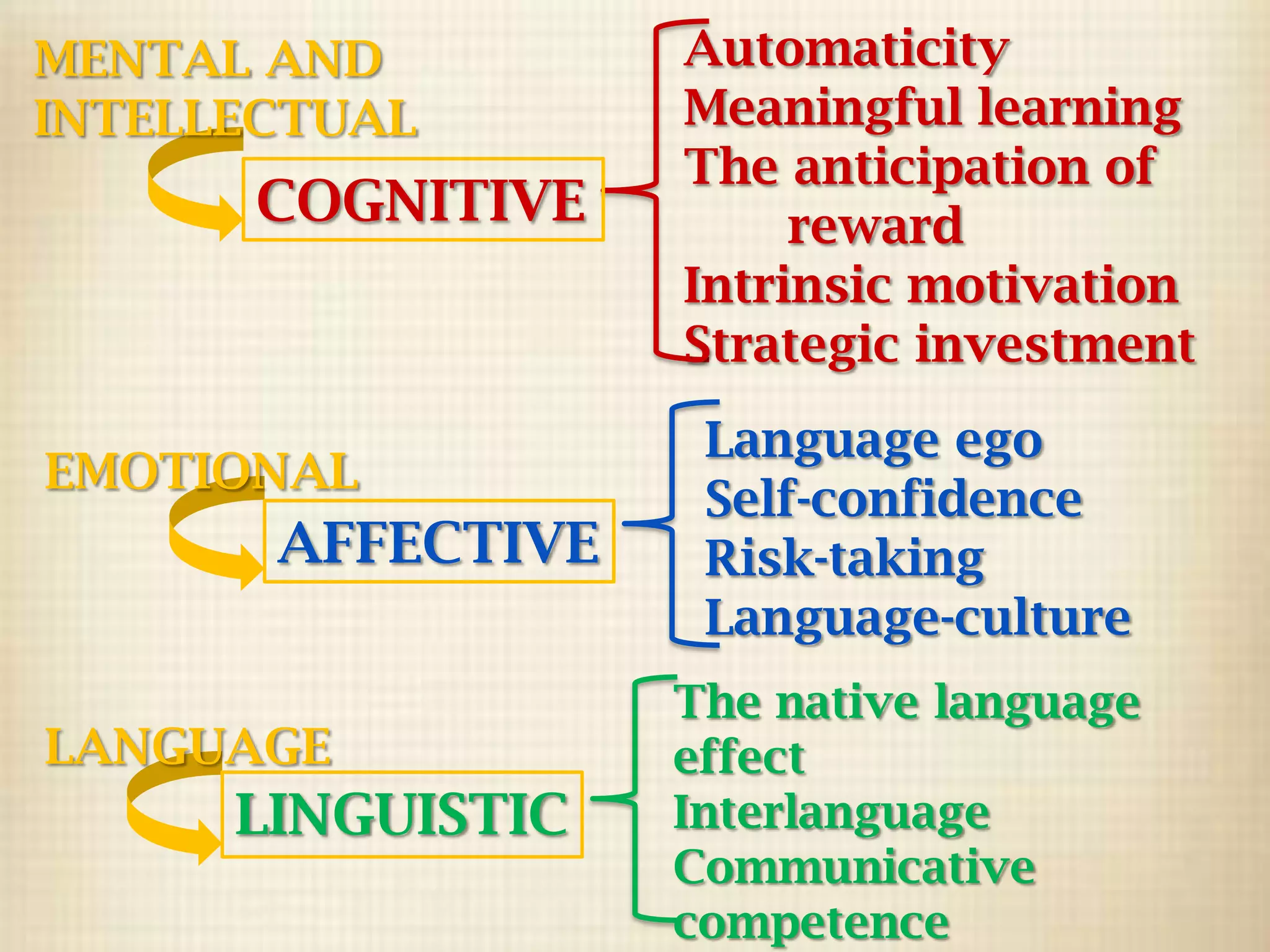
MENTAL AND
INTELLECTUAL

COGNITIVE

EMOTIONAL

AFFECTIVE

LANGUAGE

LINGUISTIC

Automaticity
Meaningful learning
The anticipation of
reward
Intrinsic motivation
Strategic investment
Language ego
Self-confidence
Risk-taking
Language-culture
The native language
effect
Interlanguage
Communicative
competence
COGNITIVE PRINCIPLES
Principle 1: Automaticity
It is the ability to do things without occupying
the mind with the low-level details required,
allowing it to become an automatic response pattern
or habit. It is usually the result of learning,
repetition, and practice.

Examples:
Walk

Drive a bicycle
This principle includes:
Subconscious absorption
through meaningful use.

of

language

Efficient and rapid movement away from
a focus on the forms of language to a
focus on the purpose to which language
is used,
Resistance to the temptation to analyze
language forms.
Some possible application of the principle to
adult instruction:
You need to have your lessons
are focused on the “use” of
language for purposes that are as
genuine as classroom context will
permit.
You need to exercise patience
with students as you slowly help
them to achieve fluency.
Principle 2: Meaningful Learning
Meaningful learning refers to a
learning way where the new
knowledge to acquire is related with
previous knowledge.
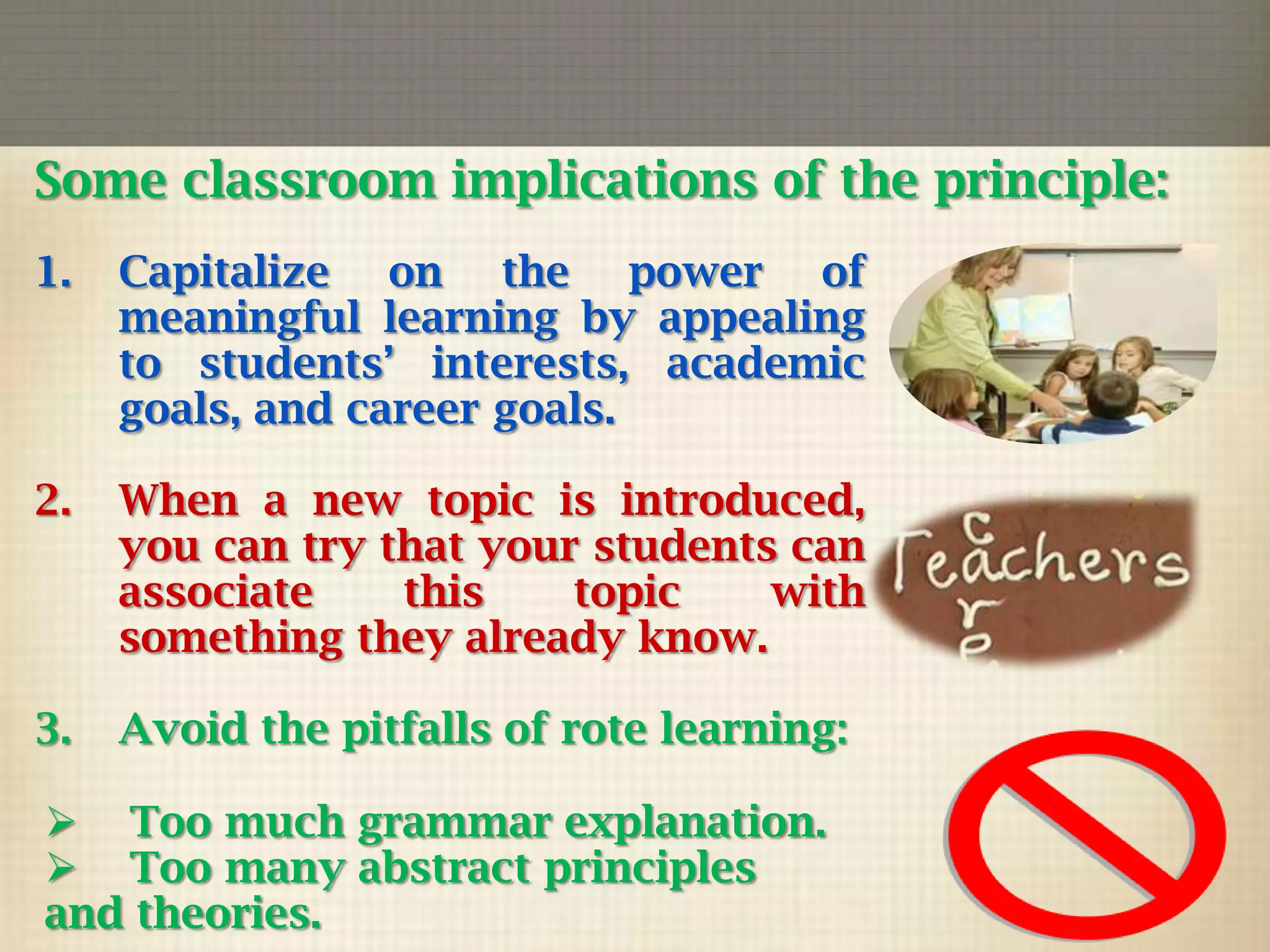
Some classroom implications of the principle:
1.

Capitalize on the power of
meaningful learning by appealing
to students’ interests, academic
goals, and career goals.

2.

When a new topic is introduced,
you can try that your students can
associate
this
topic
with
something they already know.

3.

Avoid the pitfalls of rote learning:

 Too much grammar explanation.
 Too many abstract principles
and theories.
Principle 3: The Anticipation of Reward
Human
beings
are
universally driven to act,
or
―behave,‖
by
the
anticipation of some sort of
reward—tangible
or
intangible, short term or
long term– that will ensue
as a result of the behavior.
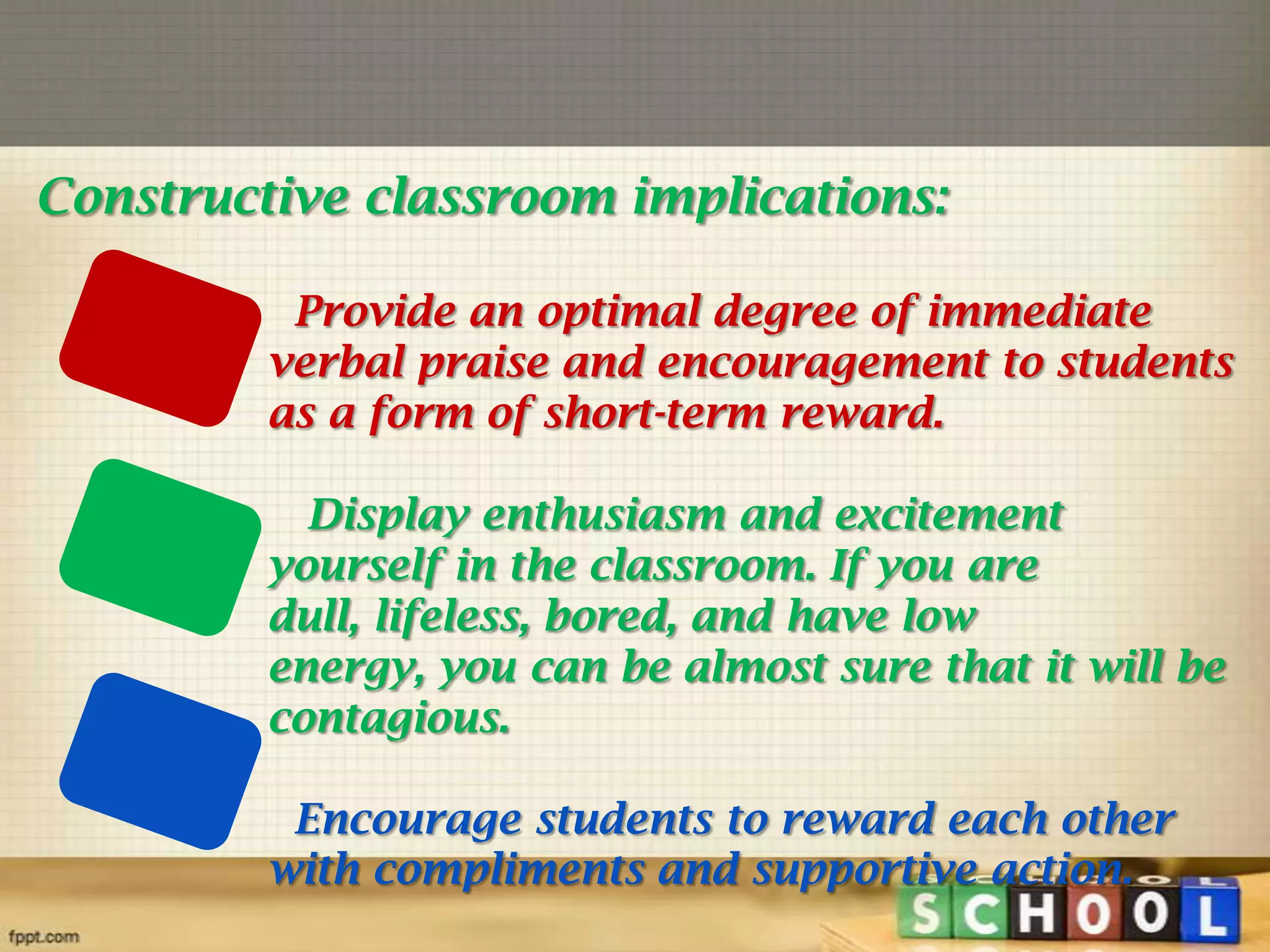
Constructive classroom implications:
Provide an optimal degree of immediate
verbal praise and encouragement to students
as a form of short-term reward.
Display enthusiasm and excitement
yourself in the classroom. If you are
dull, lifeless, bored, and have low
energy, you can be almost sure that it will be
contagious.
Encourage students to reward each other
with compliments and supportive action.
Principle 4: Intrinsic Motivation

It refers to motivation that comes
from inside an individual rather than
from any external or outside
rewards, such as money or grades.
Learners
perform
task
because
it
is
fun, interesting, useful, or challenging, and not
because they anticipate some cognitive or affective
rewards from the teacher.
Principle 5: Strategic Investment

Investment of time, effort, and
attention to the second language to
help you to can be comprehend
and produce the language.
Principle 6: Autonomy
Successful mastery of the
foreign language will depend to
a great extent on learner’s
autonomous ability both to take
initiative in the classroom and
to continue their journey to
success beyond the classroom
and the teacher.
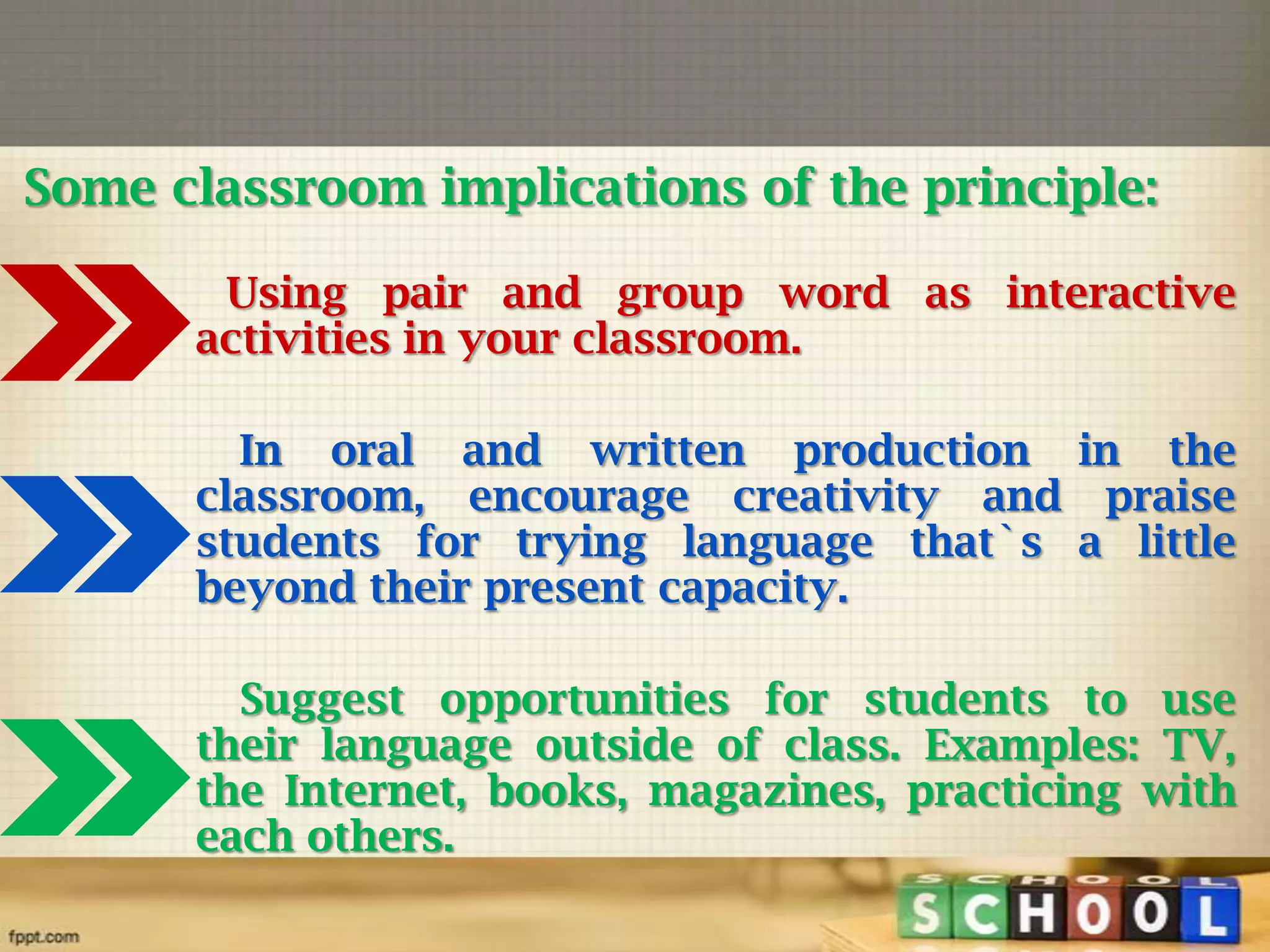
Some classroom implications of the principle:
Using pair and group word as interactive
activities in your classroom.
In oral and written production in the
classroom, encourage creativity and praise
students for trying language that`s a little
beyond their present capacity.
Suggest opportunities for students to use
their language outside of class. Examples: TV,
the Internet, books, magazines, practicing with
each others.
AFFECTIVE PRINCIPLES
Principle 7: Language Ego
It creates within the learners a sense of fragility, a
defensiveness, and a raising of inhibitions.
All second language learners need to be treated
with affective tender loving care because it will help
you to be fine although they do not understand all
the lessons.
Principle 8: Willingness to Communicate
Learners

believe
in
themselves and in their capacity
to accomplish communicative
tasks, and are therefore willing
risk takers in their attempts to
produce
and
to
interpret
language that is a bit beyond
their absolute certainly.
How can your classrooms reflect the Principle of
WTC?
Give ample verbal and nonverbal assurances
to students, affirming your belief in the
student`s ability.
Create an atmosphere in the classroom that
encourages students to try out language, to
venture a response, and not to wait for someone
else to volunteer language.

Help your students to understand what risktaking is, lest some feel that they must blurt out
any old response.
Principle 9: The Language-Culture Connection
Whenever
you
teach
a
language, you also teach a
complex system of cultural
customs, values, and ways of
thinking.
Some classroom applications :
Discuss cross-cultural differences with
your students, emphasizing that no culture
is “better” than another, but that crosscultural understanding is an important
facet of learning a language.
Teach
your
students
the
culture
connotations, especially the sociolinguistic
aspects, of language.
LINGUISTIC PRINCIPLES
Principle 10: The Native Language Effect
The native language of learners exerts a strong
influence on the acquisition of the target language
system. While that native system will exercise both
facilitating and interfering effects on the production
and comprehension of the new language, the
interfering effects are likely to be the most salient.
Some classroom suggestions stemming from the
Native Language Effect are as follows:
1. Regard learners’ errors as important windows to
their underlying system and provide appropriate
feedback on them. Errors of native language
interference may be repaired by acquainting the
learner with the native language cause of the error.
2. Ideally every successful learner will hold on to the
facilitating effects of the native language and
discard the interference.
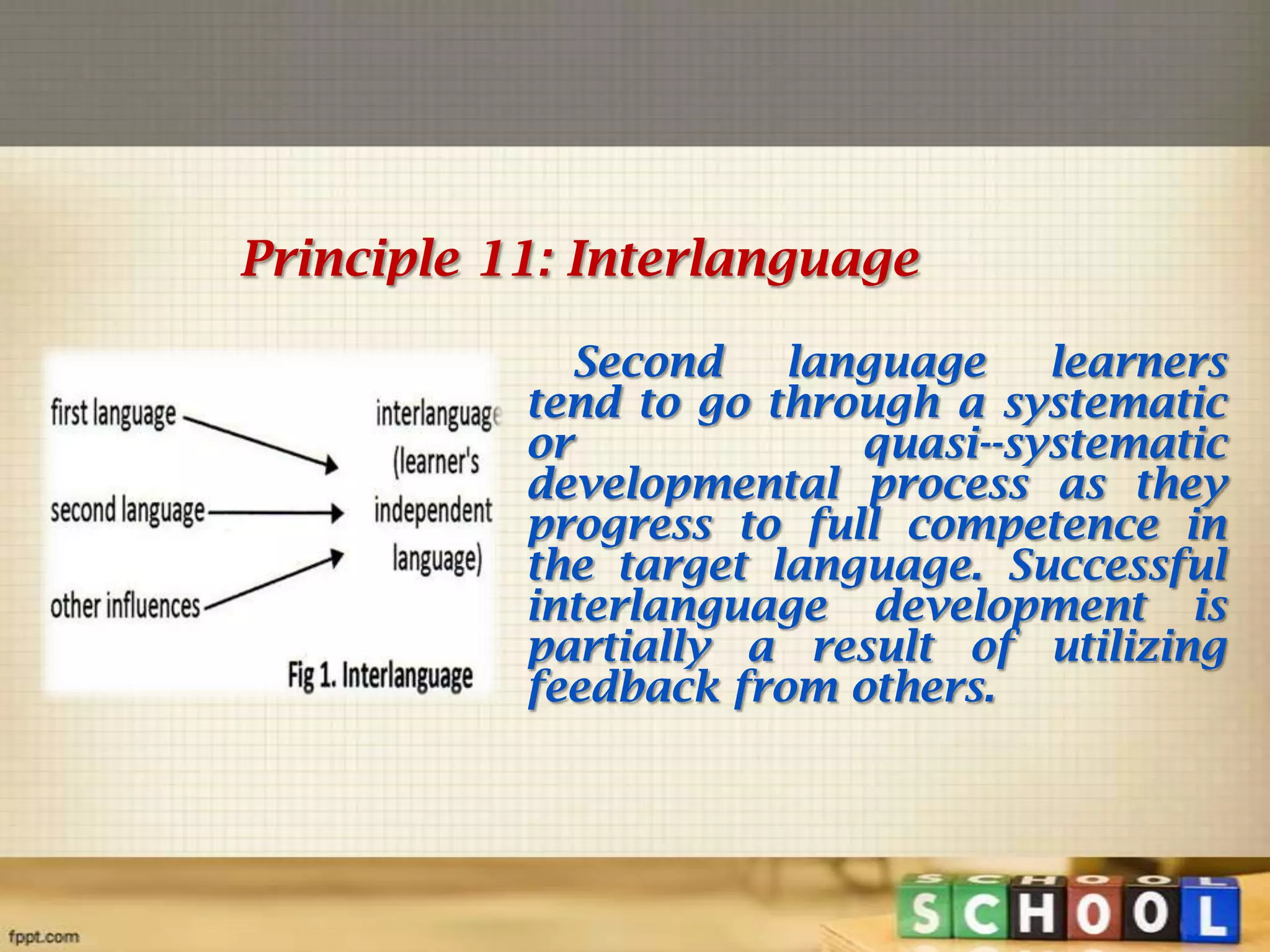
Principle 11: Interlanguage
Second
language
learners
tend to go through a systematic
or
quasi--systematic
developmental process as they
progress to full competence in
the target language. Successful
interlanguage development is
partially a result of utilizing
feedback from others.
Classroom implications that deserve the teachers’
attention:
 Try to distinguish between the student’s
systematic inter-language errors (stemming from
the native language or target language) and other
errors; the former will probably have a logical
source that the student can become aware of.
 Teachers need to exercise some tolerance for
certain inter-language forms that may arise out of
student’s logical development process.
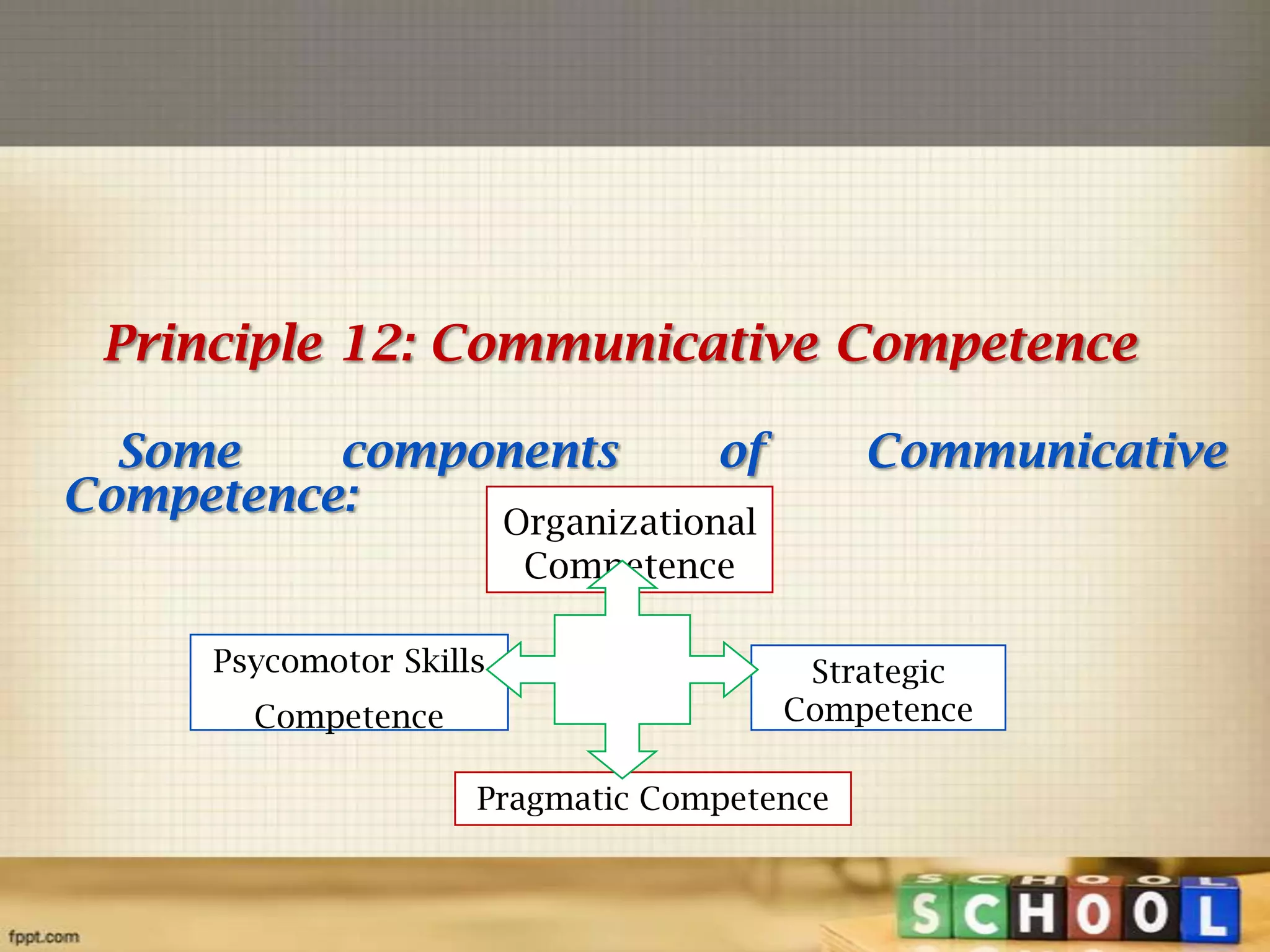
Principle 12: Communicative Competence
Some
components
Competence:

of

Communicative

Organizational
Competence

Psycomotor Skills
Competence

Strategic
Competence

Pragmatic Competence
Communicative Competence is the goal of a
language classroom.
Communicative goals are best achieved by giving
due attention to language use and not just usage, to
fluency and not just accuracy, to authentic language
and contexts, and to students’ eventual need to apply
classroom learning to previously unrehearsed
contexts in the real world.
Liz

Teaching by principles

  • 1.
  • 2.
    MENTAL AND INTELLECTUAL COGNITIVE EMOTIONAL AFFECTIVE LANGUAGE LINGUISTIC Automaticity Meaningful learning Theanticipation of reward Intrinsic motivation Strategic investment Language ego Self-confidence Risk-taking Language-culture The native language effect Interlanguage Communicative competence
  • 3.
    COGNITIVE PRINCIPLES Principle 1:Automaticity It is the ability to do things without occupying the mind with the low-level details required, allowing it to become an automatic response pattern or habit. It is usually the result of learning, repetition, and practice. Examples: Walk Drive a bicycle
  • 4.
    This principle includes: Subconsciousabsorption through meaningful use. of language Efficient and rapid movement away from a focus on the forms of language to a focus on the purpose to which language is used, Resistance to the temptation to analyze language forms.
  • 5.
    Some possible applicationof the principle to adult instruction: You need to have your lessons are focused on the “use” of language for purposes that are as genuine as classroom context will permit. You need to exercise patience with students as you slowly help them to achieve fluency.
  • 6.
    Principle 2: MeaningfulLearning Meaningful learning refers to a learning way where the new knowledge to acquire is related with previous knowledge.
  • 7.
    Some classroom implicationsof the principle: 1. Capitalize on the power of meaningful learning by appealing to students’ interests, academic goals, and career goals. 2. When a new topic is introduced, you can try that your students can associate this topic with something they already know. 3. Avoid the pitfalls of rote learning:  Too much grammar explanation.  Too many abstract principles and theories.
  • 8.
    Principle 3: TheAnticipation of Reward Human beings are universally driven to act, or ―behave,‖ by the anticipation of some sort of reward—tangible or intangible, short term or long term– that will ensue as a result of the behavior.
  • 9.
    Constructive classroom implications: Providean optimal degree of immediate verbal praise and encouragement to students as a form of short-term reward. Display enthusiasm and excitement yourself in the classroom. If you are dull, lifeless, bored, and have low energy, you can be almost sure that it will be contagious. Encourage students to reward each other with compliments and supportive action.
  • 10.
    Principle 4: IntrinsicMotivation It refers to motivation that comes from inside an individual rather than from any external or outside rewards, such as money or grades. Learners perform task because it is fun, interesting, useful, or challenging, and not because they anticipate some cognitive or affective rewards from the teacher.
  • 11.
    Principle 5: StrategicInvestment Investment of time, effort, and attention to the second language to help you to can be comprehend and produce the language.
  • 12.
    Principle 6: Autonomy Successfulmastery of the foreign language will depend to a great extent on learner’s autonomous ability both to take initiative in the classroom and to continue their journey to success beyond the classroom and the teacher.
  • 13.
    Some classroom implicationsof the principle: Using pair and group word as interactive activities in your classroom. In oral and written production in the classroom, encourage creativity and praise students for trying language that`s a little beyond their present capacity. Suggest opportunities for students to use their language outside of class. Examples: TV, the Internet, books, magazines, practicing with each others.
  • 14.
    AFFECTIVE PRINCIPLES Principle 7:Language Ego It creates within the learners a sense of fragility, a defensiveness, and a raising of inhibitions. All second language learners need to be treated with affective tender loving care because it will help you to be fine although they do not understand all the lessons.
  • 15.
    Principle 8: Willingnessto Communicate Learners believe in themselves and in their capacity to accomplish communicative tasks, and are therefore willing risk takers in their attempts to produce and to interpret language that is a bit beyond their absolute certainly.
  • 16.
    How can yourclassrooms reflect the Principle of WTC? Give ample verbal and nonverbal assurances to students, affirming your belief in the student`s ability. Create an atmosphere in the classroom that encourages students to try out language, to venture a response, and not to wait for someone else to volunteer language. Help your students to understand what risktaking is, lest some feel that they must blurt out any old response.
  • 17.
    Principle 9: TheLanguage-Culture Connection Whenever you teach a language, you also teach a complex system of cultural customs, values, and ways of thinking.
  • 18.
    Some classroom applications: Discuss cross-cultural differences with your students, emphasizing that no culture is “better” than another, but that crosscultural understanding is an important facet of learning a language. Teach your students the culture connotations, especially the sociolinguistic aspects, of language.
  • 19.
    LINGUISTIC PRINCIPLES Principle 10:The Native Language Effect The native language of learners exerts a strong influence on the acquisition of the target language system. While that native system will exercise both facilitating and interfering effects on the production and comprehension of the new language, the interfering effects are likely to be the most salient.
  • 20.
    Some classroom suggestionsstemming from the Native Language Effect are as follows: 1. Regard learners’ errors as important windows to their underlying system and provide appropriate feedback on them. Errors of native language interference may be repaired by acquainting the learner with the native language cause of the error. 2. Ideally every successful learner will hold on to the facilitating effects of the native language and discard the interference.
  • 21.
    Principle 11: Interlanguage Second language learners tendto go through a systematic or quasi--systematic developmental process as they progress to full competence in the target language. Successful interlanguage development is partially a result of utilizing feedback from others.
  • 22.
    Classroom implications thatdeserve the teachers’ attention:  Try to distinguish between the student’s systematic inter-language errors (stemming from the native language or target language) and other errors; the former will probably have a logical source that the student can become aware of.  Teachers need to exercise some tolerance for certain inter-language forms that may arise out of student’s logical development process.
  • 23.
    Principle 12: CommunicativeCompetence Some components Competence: of Communicative Organizational Competence Psycomotor Skills Competence Strategic Competence Pragmatic Competence
  • 24.
    Communicative Competence isthe goal of a language classroom. Communicative goals are best achieved by giving due attention to language use and not just usage, to fluency and not just accuracy, to authentic language and contexts, and to students’ eventual need to apply classroom learning to previously unrehearsed contexts in the real world.
  • 25.