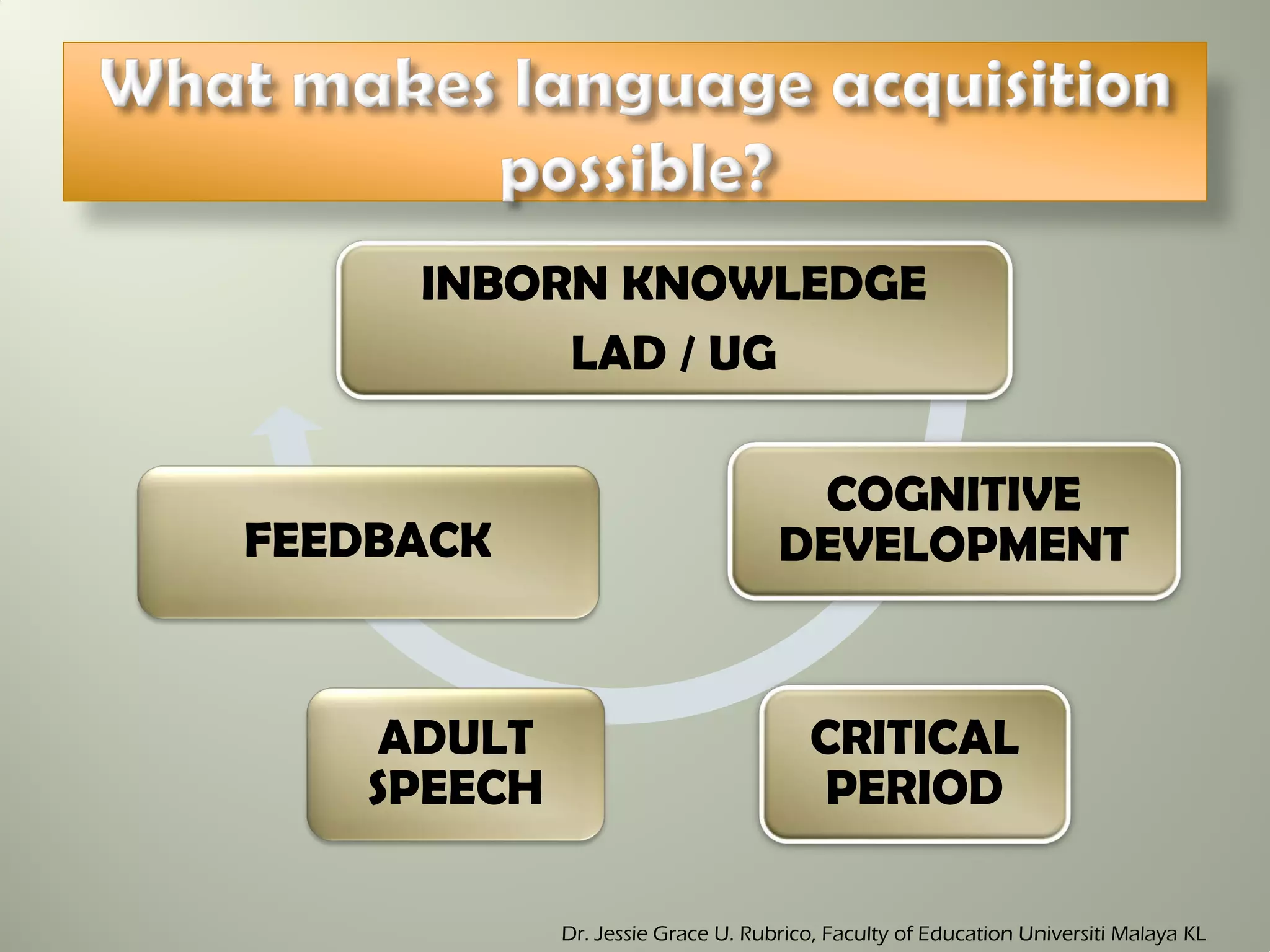
INBORN KNOWLEDGE
          LAD / UG

                                    COGNITIVE
FEEDBACK                           DEVELOPMENT


   ADULT                               CRITICAL
   SPEECH                               PERIOD

            Dr. Jessie Grace U. Rubrico, Faculty of Education Universiti Malaya KL
COGNITIVE
           DEVELOPMENT


             Inborn
                                                         CRITICAL
FEEDBACK   knowledge :                                    PERIOD
              LAD


              ADULT
              SPEECH


             Dr. Jessie Grace U. Rubrico, Faculty of Education Universiti Malaya KL
   nativism : grammatical knowledge – inborn
    LAD (Language Acquisition Device)

   children are born with prior knowledge of
    categories, operations, principles common
     to all human languages:
    UG (Universal Grammar)

                  Dr. Jessie Grace U. Rubrico, Faculty of Education Universiti Malaya KL
   Principle of word order
    UG         X’ consists of X & Complement

    Principle (UG)   : inborn

   Parameter : X + complement [head-initial]
                Complement + X [head final]
   parameters – language-specific/acquired


                      Dr. Jessie Grace U. Rubrico, Faculty of Education Universiti Malaya KL
XP


spec                                 X’

         x                                        comp
       Dr. Jessie Grace U. Rubrico, Faculty of Education Universiti Malaya KL
   language acquisition – autonomous cognitive
                               development
   15 year old retardate:
    general cognitive ability – deficient
    non-linguistic ability – preschool child
    linguistic ability –fully developed
   cases of people normal IQ – have difficulty in
    inflections for past tense & plural
     The boys eat four apple.


                    Dr. Jessie Grace U. Rubrico, Faculty of Education Universiti Malaya KL
   normal linguistic development is possible
    only if children are exposed to language
    during a particular time frame.


                      Dr. Jessie Grace U. Rubrico, Faculty of Education Universiti Malaya KL
   phonetic : slow carefully articulated higher pitched
                with longer pauses
   lexical & semantic : restricted vocabulary;
                       concrete reference to here & now
   syntactic: few incomplete short sentences;
                imperative questions
   conversational: more repetitions;
                   few utterances per conversation turn

                     Dr. Jessie Grace U. Rubrico, Faculty of Education Universiti Malaya KL
   correcting errors:
    Child:  Want other one spoon, Daddy.
    Father: You mean, you want the other spoon.
    Child:  Yes, I want other one spoon, please Daddy.
    Father: Can you say “the other spoon”?
    Child:  Other . . . one . . . spoon.
    Father: Say “other”.
    Child:  Other.
    Father: Spoon.
    Child:  Spoon.
    Father: “Other spoon”.
    Child: Other. . .spoon. Now give me the other one spoon?
                  (O’Grady & Archibald, 2009; p. 362)


                        Dr. Jessie Grace U. Rubrico, Faculty of Education Universiti Malaya KL
   recast : repeating the utterance,
              making adjustment to its form/content
    Child:    Daddy here
    Mother:   Yes, Daddy is here.
    Child:    Him go.
    Mother:   Yes, he is going.
    Child:    Boy chasing dog.
    Mother:   Yes, the boy is chasing the dog.
    Child:    The dog is barking
    Mother:   Yes, he is barking at the kitty.
                                      (O’Grady & Archibald, 2009; p. 363)

                     Dr. Jessie Grace U. Rubrico, Faculty of Education Universiti Malaya KL
   important factor in the child’s language
    acquisition process: actual use of sound and
    word combination in interaction or in word
    play.

   one, two, tie my shoe; three, four, shut the
    door; five, six, pick up sticks; seven, eight, lay
    them straight; nine, ten, a big fat hen.


                      Dr. Jessie Grace U. Rubrico, Faculty of Education Universiti Malaya KL
Stage           Typical age                             Description

Babbling and Cooing     1 to 8 months         Repetitive CV patterns – ba, pa, ma
                                              Hear the difference between [i] and
                                              [a] and syllables like [ba] and [pa]
One-word stage          9-18 months           Single terms: milk, cat, cup

holophrastic stage                            Single form functioning as a phrase or
                                              sentence
Two-word stage          18-24 months          clauses with simple semantic relations –
                                              baby eat, dog bad, cat drink
Telegraphic stage or    24-30 months          sentence structures of lexical rather
early multiword stage                         than functional or grammatical
                                              morphemes- cat drink milk, this baby
                                              all wet, daddy go
Later multiword stage   30+ months            Grammatical or functional structures
                                              emerge
                            Dr. Jessie Grace U. Rubrico, Faculty of Education Universiti Malaya KL
Brown, H. Douglas. 2007. Principles of Language Learning
  and Teaching, 5th Edition. White Plains, NY: Pearson
  Education.

O’Grady, William and John Archibald. 2009.
  Contemporary Linguistics: An Introduction, 6th Edition.
  Canada: Pearson Education.

Dr. Jessie Grace U. Rubrico
www.languagelinks.org


                     Dr. Jessie Grace U. Rubrico, Faculty of Education Universiti Malaya KL

First Language Acquisition

  • 2.
    INBORN KNOWLEDGE LAD / UG COGNITIVE FEEDBACK DEVELOPMENT ADULT CRITICAL SPEECH PERIOD Dr. Jessie Grace U. Rubrico, Faculty of Education Universiti Malaya KL
  • 3.
    COGNITIVE DEVELOPMENT Inborn CRITICAL FEEDBACK knowledge : PERIOD LAD ADULT SPEECH Dr. Jessie Grace U. Rubrico, Faculty of Education Universiti Malaya KL
  • 4.
    nativism : grammatical knowledge – inborn LAD (Language Acquisition Device)  children are born with prior knowledge of categories, operations, principles common to all human languages: UG (Universal Grammar) Dr. Jessie Grace U. Rubrico, Faculty of Education Universiti Malaya KL
  • 5.
    Principle of word order UG X’ consists of X & Complement Principle (UG) : inborn  Parameter : X + complement [head-initial] Complement + X [head final]  parameters – language-specific/acquired Dr. Jessie Grace U. Rubrico, Faculty of Education Universiti Malaya KL
  • 6.
    XP spec X’ x comp Dr. Jessie Grace U. Rubrico, Faculty of Education Universiti Malaya KL
  • 7.
    language acquisition – autonomous cognitive development  15 year old retardate: general cognitive ability – deficient non-linguistic ability – preschool child linguistic ability –fully developed  cases of people normal IQ – have difficulty in inflections for past tense & plural  The boys eat four apple. Dr. Jessie Grace U. Rubrico, Faculty of Education Universiti Malaya KL
  • 8.
    normal linguistic development is possible only if children are exposed to language during a particular time frame. Dr. Jessie Grace U. Rubrico, Faculty of Education Universiti Malaya KL
  • 9.
    phonetic : slow carefully articulated higher pitched with longer pauses  lexical & semantic : restricted vocabulary; concrete reference to here & now  syntactic: few incomplete short sentences; imperative questions  conversational: more repetitions; few utterances per conversation turn Dr. Jessie Grace U. Rubrico, Faculty of Education Universiti Malaya KL
  • 10.
    correcting errors: Child: Want other one spoon, Daddy. Father: You mean, you want the other spoon. Child: Yes, I want other one spoon, please Daddy. Father: Can you say “the other spoon”? Child: Other . . . one . . . spoon. Father: Say “other”. Child: Other. Father: Spoon. Child: Spoon. Father: “Other spoon”. Child: Other. . .spoon. Now give me the other one spoon? (O’Grady & Archibald, 2009; p. 362) Dr. Jessie Grace U. Rubrico, Faculty of Education Universiti Malaya KL
  • 11.
    recast : repeating the utterance, making adjustment to its form/content Child: Daddy here Mother: Yes, Daddy is here. Child: Him go. Mother: Yes, he is going. Child: Boy chasing dog. Mother: Yes, the boy is chasing the dog. Child: The dog is barking Mother: Yes, he is barking at the kitty. (O’Grady & Archibald, 2009; p. 363) Dr. Jessie Grace U. Rubrico, Faculty of Education Universiti Malaya KL
  • 12.
    important factor in the child’s language acquisition process: actual use of sound and word combination in interaction or in word play.  one, two, tie my shoe; three, four, shut the door; five, six, pick up sticks; seven, eight, lay them straight; nine, ten, a big fat hen. Dr. Jessie Grace U. Rubrico, Faculty of Education Universiti Malaya KL
  • 13.
    Stage Typical age Description Babbling and Cooing 1 to 8 months Repetitive CV patterns – ba, pa, ma Hear the difference between [i] and [a] and syllables like [ba] and [pa] One-word stage 9-18 months Single terms: milk, cat, cup holophrastic stage Single form functioning as a phrase or sentence Two-word stage 18-24 months clauses with simple semantic relations – baby eat, dog bad, cat drink Telegraphic stage or 24-30 months sentence structures of lexical rather early multiword stage than functional or grammatical morphemes- cat drink milk, this baby all wet, daddy go Later multiword stage 30+ months Grammatical or functional structures emerge Dr. Jessie Grace U. Rubrico, Faculty of Education Universiti Malaya KL
  • 14.
    Brown, H. Douglas.2007. Principles of Language Learning and Teaching, 5th Edition. White Plains, NY: Pearson Education. O’Grady, William and John Archibald. 2009. Contemporary Linguistics: An Introduction, 6th Edition. Canada: Pearson Education. Dr. Jessie Grace U. Rubrico www.languagelinks.org Dr. Jessie Grace U. Rubrico, Faculty of Education Universiti Malaya KL