Word Grammar Unit 1   By:    Julio Vangel Pérez
1.5 Word Grammar Hudson (1984), tells us that WG is a theory of language which touches on almost all aspects of synchronic linguistics and unifies them all through a single general claim. Hudson (2005), Word Grammar is a theory of language structure.
1.5 Word Grammar Grammar has been regarded as operating principally at the level of the sentence, with words as simply options that fit into established grammatical ‘slots’. Example: Students may be taught the Past Continuous using as an example, John was seeing a movie. Then they are asked to produce sentences based on this model, by slotting in these words: Sam, running, very fast, The Group, taking, a class.
1.5 Word Grammar Words can be classified according to the slot that they can go into, this is also called, Parts of Speech: Nouns Verbs Pronouns Adjectives Adverbs Prepositions Conjunctions Interjections
Pair work In pairs define the 8 parts of speech and give 5 examples of each. 10-15 minutes.
Open class words Word Grammar is more than just parts of speech, some of these word classes, such as nouns, verbs, and adjectives are open classes: This means that their expansion is potentially unlimited, some new words come to mind: Blog, yuppify and air bag.
Closed class words Other word classes, such as pronouns, determiners, prepositions, and conjunctions, are closed classes, meaning their expansion is limited—in the case of pronouns, very limited— and new items cannot just be invented.
Which are grammar words? Closed class words function as grammar words, that means, unlike open class words, they have no “dictionary” meaning, but serve more to provide the grammatical “glue” that holds the content words together.
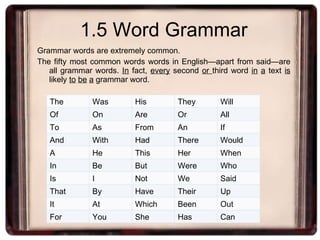
1.5 Word Grammar Grammar words are extremely common.  The fifty most common words words in English—apart from said—are all grammar words.  In  fact,  every  second  or  third word  in   a  text  is  likely  to   be   a  grammar word. The Was His They Will Of On Are Or All To As From An If And With Had There Would A He This Her When In Be But Were Who Is I Not We Said That By Have Their Up It At Which Been Out For You She Has Can
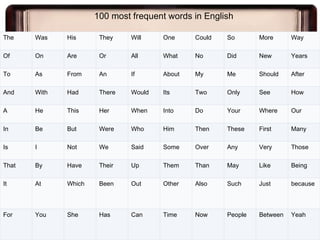
100 most frequent words in English The Was His They Will One Could So More Way Of On Are Or All What No Did New Years To As From An If About My Me Should After And With Had There Would Its Two Only See How A He This Her When Into Do Your Where Our In Be But Were Who Him Then These First Many Is I Not We Said Some Over Any Very Those That By Have Their Up Them Than May Like Being  It At Which Been Out Other Also Such Just because For You She Has Can Time Now People Between Yeah
1.6 Sentence Grammar Sentence Grammar is the domain of most grammar teaching, and essentially involves what is commonly know as “sentence structure”, or more technically as  syntax.
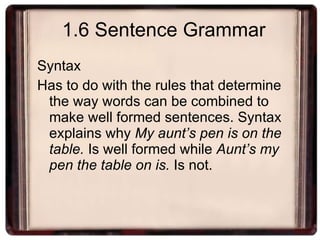
1.6 Sentence Grammar Syntax  Has to do with the rules that determine the way words can be combined to make well formed sentences. Syntax explains why  My aunt’s pen is on the table.  Is well formed while  Aunt’s my pen the table on is.  Is not.
1.6 Sentence Grammar Sentence Grammar not only governs the correctness of sentences, but also this sentences have express the meaning that the speaker or writer intends. Sentence Grammar, then, is not simply concerned with putting any words in the right order, but with putting the right words in the right order. Therefore tasks with sentence grammar need to maintain a balance between form and meaning.
Issues in sentence grammar The main preoccupation of sentence grammar has always been with the verb phrase. A verb phrase is a group of one or more verbs, as in did, was doing, had done, haven’t done.
Issues in sentence grammar The verb phrase gathers together a great deal of information about states, actions, and processes, including the time of occurrence, likelihood, whether the situation is finished or not. Knowing how to construct verb phrases also involves knowing the rules of morphology, that is the way words can change their form to convey different grammatical distinctions, for example, from is to was, or from work to working.
1.7 Text Grammar Just like sentence grammar,  text grammar  is a perspective on this subject that largely deals with the study of texts and that its functions and characteristics are properly understood. Text grammar is also known as context grammar and to a larger extent discourse grammar.
1.7 Text Grammar A lot of grammar is intelligible only in context, keeping this in mind, it is probably best studied and practiced only in context. However, for reasons of convenience and economy, a great deal of traditional grammar teaching has been limited to the study of grammar as single, decontextualized sentences, despite the fact that most language in use occurs, not as sentences, but as a cohesive text.
What is a text? According to Cornbleet and Carter (2001): “ Texts can be used for both written and spoken language. It usually refers to a stretch, an extract or complete piece of writing or speech. Texts generally adhere to broad conventions and rules which determine the language and structure used in particular text types”. Cornbleet and Carter  The Language of Speech and Writing   (2001, p 3)
Characteristics of a text Thorbury (2005), describes texts as: Self-contained. Well-formed. Hang together.(cohesive) Make sense. (coherent) Have a clear communicative purpose. Are recognisable text types. Are appropriate to their contexts of use.
Word grammar

  • 1.
    Word Grammar Unit1 By: Julio Vangel Pérez
  • 2.
    1.5 Word GrammarHudson (1984), tells us that WG is a theory of language which touches on almost all aspects of synchronic linguistics and unifies them all through a single general claim. Hudson (2005), Word Grammar is a theory of language structure.
  • 3.
    1.5 Word GrammarGrammar has been regarded as operating principally at the level of the sentence, with words as simply options that fit into established grammatical ‘slots’. Example: Students may be taught the Past Continuous using as an example, John was seeing a movie. Then they are asked to produce sentences based on this model, by slotting in these words: Sam, running, very fast, The Group, taking, a class.
  • 4.
    1.5 Word GrammarWords can be classified according to the slot that they can go into, this is also called, Parts of Speech: Nouns Verbs Pronouns Adjectives Adverbs Prepositions Conjunctions Interjections
  • 5.
    Pair work Inpairs define the 8 parts of speech and give 5 examples of each. 10-15 minutes.
  • 6.
    Open class wordsWord Grammar is more than just parts of speech, some of these word classes, such as nouns, verbs, and adjectives are open classes: This means that their expansion is potentially unlimited, some new words come to mind: Blog, yuppify and air bag.
  • 7.
    Closed class wordsOther word classes, such as pronouns, determiners, prepositions, and conjunctions, are closed classes, meaning their expansion is limited—in the case of pronouns, very limited— and new items cannot just be invented.
  • 8.
    Which are grammarwords? Closed class words function as grammar words, that means, unlike open class words, they have no “dictionary” meaning, but serve more to provide the grammatical “glue” that holds the content words together.
  • 9.
    1.5 Word GrammarGrammar words are extremely common. The fifty most common words words in English—apart from said—are all grammar words. In fact, every second or third word in a text is likely to be a grammar word. The Was His They Will Of On Are Or All To As From An If And With Had There Would A He This Her When In Be But Were Who Is I Not We Said That By Have Their Up It At Which Been Out For You She Has Can
  • 10.
    100 most frequentwords in English The Was His They Will One Could So More Way Of On Are Or All What No Did New Years To As From An If About My Me Should After And With Had There Would Its Two Only See How A He This Her When Into Do Your Where Our In Be But Were Who Him Then These First Many Is I Not We Said Some Over Any Very Those That By Have Their Up Them Than May Like Being It At Which Been Out Other Also Such Just because For You She Has Can Time Now People Between Yeah
  • 11.
    1.6 Sentence GrammarSentence Grammar is the domain of most grammar teaching, and essentially involves what is commonly know as “sentence structure”, or more technically as syntax.
  • 12.
    1.6 Sentence GrammarSyntax Has to do with the rules that determine the way words can be combined to make well formed sentences. Syntax explains why My aunt’s pen is on the table. Is well formed while Aunt’s my pen the table on is. Is not.
  • 13.
    1.6 Sentence GrammarSentence Grammar not only governs the correctness of sentences, but also this sentences have express the meaning that the speaker or writer intends. Sentence Grammar, then, is not simply concerned with putting any words in the right order, but with putting the right words in the right order. Therefore tasks with sentence grammar need to maintain a balance between form and meaning.
  • 14.
    Issues in sentencegrammar The main preoccupation of sentence grammar has always been with the verb phrase. A verb phrase is a group of one or more verbs, as in did, was doing, had done, haven’t done.
  • 15.
    Issues in sentencegrammar The verb phrase gathers together a great deal of information about states, actions, and processes, including the time of occurrence, likelihood, whether the situation is finished or not. Knowing how to construct verb phrases also involves knowing the rules of morphology, that is the way words can change their form to convey different grammatical distinctions, for example, from is to was, or from work to working.
  • 16.
    1.7 Text GrammarJust like sentence grammar, text grammar is a perspective on this subject that largely deals with the study of texts and that its functions and characteristics are properly understood. Text grammar is also known as context grammar and to a larger extent discourse grammar.
  • 17.
    1.7 Text GrammarA lot of grammar is intelligible only in context, keeping this in mind, it is probably best studied and practiced only in context. However, for reasons of convenience and economy, a great deal of traditional grammar teaching has been limited to the study of grammar as single, decontextualized sentences, despite the fact that most language in use occurs, not as sentences, but as a cohesive text.
  • 18.
    What is atext? According to Cornbleet and Carter (2001): “ Texts can be used for both written and spoken language. It usually refers to a stretch, an extract or complete piece of writing or speech. Texts generally adhere to broad conventions and rules which determine the language and structure used in particular text types”. Cornbleet and Carter The Language of Speech and Writing (2001, p 3)
  • 19.
    Characteristics of atext Thorbury (2005), describes texts as: Self-contained. Well-formed. Hang together.(cohesive) Make sense. (coherent) Have a clear communicative purpose. Are recognisable text types. Are appropriate to their contexts of use.