BY: Saumya Ranjan Behura
Talk Flow:
Introduction.
Concept of clock.
Working of synchronous circuits.
Problem of synchronous circuits.
Concept of clockless chip.
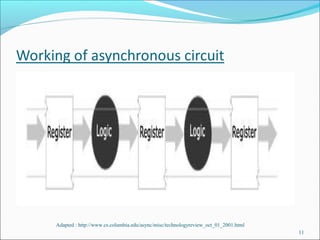
Working of asynchronous circuit.
Advantages of clockless design.
Applications.
Challenges.
Conclusion.
References. 2
Concept of clock
CLOCK:
Tiny crystal oscillator.
Sets basic rhythm used throughout the machine.
ADVANTAGES:
 Signals the device of the chip when to i/p or o/p.
This functionality makes designing of synchronous chip easier.
3
Adapted : http://www.cs.columbia.edu/async/misc/technologyreview_oct_01_2001.html
4
continued…
This circuit looks for a particular signal(leading edge)
of the clock.
All actions takes place only at this part of clock cycle.
When transferring data to registers the computation
settles down and wait till the next leading edge
Designer’ challenge: to complete one operation
before next clock tick.
5
Problems of synchronous circuit
Speed
 chip can only work as fast as its slowest component.
 leads to wasting of computation time.
 to traverse the chip’s longest wire in one clock cycle.
 so one alternate solution: Second clock incur
overhead and power consumption.
6
continued…
Power consumption
Consume more power than any other component.
Not associated with direct computation.
If no. of transistors more power consumption more.
EMI(Electro Magnetic Interference)
It is more in synchronous elements.
7
8
Concept of Clockless chip
Clockless chip/asynchronous/self timed/event driven.
Do not have a global clock.
Rely upon handshaking signals , hand-off signals and
sometimes a local clock to synchronize all actions.
Draw power only when there is useful work to do.
9
Continued…
Chip can run at the average speed of all components.
Different part work at different speeds.
Hand-off the result immediately.
Very low Electro Magnetic Noise.
10
Adapted : http://www.cs.columbia.edu/async/misc/technologyreview_oct_01_2001.html
11
Continued…
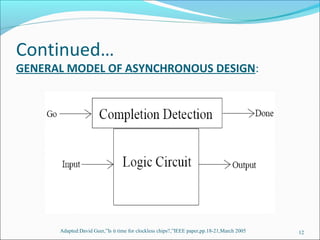
GENERAL MODEL OF ASYNCHRONOUS DESIGN:
Adapted:David Geer,”Is it time for clockless chips?,”IEEE paper,pp.18-21,March 2005 12
Continued…
TYPES OF IMPLEMENTATION:
BOUNDED DELAY METHOD
similar to synchronous design
DELAY INSENSITIVE METHOD
opposite of bounded delay method
NULL CONVENTIONAL LOGIC(NCL)
it uses a NULL state when data is in reset
phase,
as opposed to data in set phase. 13
Continued…
BOUNDED DELAY METHOD:
Simplest implementation of asynchronous design.
Assumption: we know the largest amount of time for
each component to perform its task.
Very similar to synchronous design.
Prototype delay is introduced here.
14
Adapted:David Geer,”Is it time for clockless chips?,”IEEE paper,pp.18-21,March 2005 15
Continued…
DELAY INSENSITIVE METHOD:
Does not assume any
bound on time.
One method of this
type is : Dual-rail
method.
16
XH=O XL=O Data not
ready
XH=O XL=I Logical O
XH=I XL=O Logical I
XH=I XL=I Not used
Adapted:David Geer,”Is it time for clockless chips?,”IEEE paper,pp.18-21,March 2005 17
BLBL
Continued…
NULL CONVENTIONAL LOGIC:
NCL integrates data transformation and control into
a single expression.
It gives solutions for power , noise and system
integration issue.
NCL uses threshold gates with hysteresis.
18
Continued…
NCL:
Adapted:David Geer,”Is it time for clockless chips?,”IEEE paper,pp.18-21,March 2005 19
Advantages of clockless design:
Increase in speed
Reduced power consumption
Less Electro Magnetic Noise
Flexible design
Provide superior encryption
20
Adapted: Ivan E Sutherland and J Ebergen,”Computers without clocks,”2nd
edition,p.405,2000. 21
Applications:
In the lab.
In mobile electronics.
In personal computers.
In encryption devices.
22
Adapted : http://www.cs.columbia.edu/async/misc/technologyreview_oct_01_2001.html
23
Challenges
Design difficulties.
Lack of good tools.
Engineers are not trained in these fields.
Academically, no courses available.
24
Conclusion:
Clocks are getting faster , while chips are getting
bigger, both of which make clock distribution harder.
There are also various other problems associated with
it. So we could only get out of it , if more focus ,
especially at the university level is given to the
asynchronous design. It is certainly a challenge , but
as software community is moving towards
concurrency, hardware community must move to
incorporate asynchronous logic.
25
References:
David Geer , “ Is it time for clockless chips? , ” IEEE paper, pp. 18-
20,March 2005.
Tadao Murata ,et al, “Petri nets:properties ,analysis and applications,”
IEEE Proceedings, Vol. 77, No. 4, April 1989.
Robert L. Boylestad and Louis Nashelsky ,“Electronic Devices and
Circuit Theory ,” 6th
edition , pp. 798-801 ,1997.
Ivan E Sutherland and Jo Ebergen ,“ Computers without clocks,” 2nd
edition ,p. 405 ,2000.
http://www.cs.columbia.edu/async/technologyreview_oct_01_2001.ht
ml.
http://www.eetimes.com/story/OEG20030606S0033 26
27
QUERIES??

Clockless chips

  • 1.
  • 2.
    Talk Flow: Introduction. Concept ofclock. Working of synchronous circuits. Problem of synchronous circuits. Concept of clockless chip. Working of asynchronous circuit. Advantages of clockless design. Applications. Challenges. Conclusion. References. 2
  • 3.
    Concept of clock CLOCK: Tinycrystal oscillator. Sets basic rhythm used throughout the machine. ADVANTAGES:  Signals the device of the chip when to i/p or o/p. This functionality makes designing of synchronous chip easier. 3
  • 4.
  • 5.
    continued… This circuit looksfor a particular signal(leading edge) of the clock. All actions takes place only at this part of clock cycle. When transferring data to registers the computation settles down and wait till the next leading edge Designer’ challenge: to complete one operation before next clock tick. 5
  • 6.
    Problems of synchronouscircuit Speed  chip can only work as fast as its slowest component.  leads to wasting of computation time.  to traverse the chip’s longest wire in one clock cycle.  so one alternate solution: Second clock incur overhead and power consumption. 6
  • 7.
    continued… Power consumption Consume morepower than any other component. Not associated with direct computation. If no. of transistors more power consumption more. EMI(Electro Magnetic Interference) It is more in synchronous elements. 7
  • 8.
  • 9.
    Concept of Clocklesschip Clockless chip/asynchronous/self timed/event driven. Do not have a global clock. Rely upon handshaking signals , hand-off signals and sometimes a local clock to synchronize all actions. Draw power only when there is useful work to do. 9
  • 10.
    Continued… Chip can runat the average speed of all components. Different part work at different speeds. Hand-off the result immediately. Very low Electro Magnetic Noise. 10
  • 11.
  • 12.
    Continued… GENERAL MODEL OFASYNCHRONOUS DESIGN: Adapted:David Geer,”Is it time for clockless chips?,”IEEE paper,pp.18-21,March 2005 12
  • 13.
    Continued… TYPES OF IMPLEMENTATION: BOUNDEDDELAY METHOD similar to synchronous design DELAY INSENSITIVE METHOD opposite of bounded delay method NULL CONVENTIONAL LOGIC(NCL) it uses a NULL state when data is in reset phase, as opposed to data in set phase. 13
  • 14.
    Continued… BOUNDED DELAY METHOD: Simplestimplementation of asynchronous design. Assumption: we know the largest amount of time for each component to perform its task. Very similar to synchronous design. Prototype delay is introduced here. 14
  • 15.
    Adapted:David Geer,”Is ittime for clockless chips?,”IEEE paper,pp.18-21,March 2005 15
  • 16.
    Continued… DELAY INSENSITIVE METHOD: Doesnot assume any bound on time. One method of this type is : Dual-rail method. 16 XH=O XL=O Data not ready XH=O XL=I Logical O XH=I XL=O Logical I XH=I XL=I Not used
  • 17.
    Adapted:David Geer,”Is ittime for clockless chips?,”IEEE paper,pp.18-21,March 2005 17 BLBL
  • 18.
    Continued… NULL CONVENTIONAL LOGIC: NCLintegrates data transformation and control into a single expression. It gives solutions for power , noise and system integration issue. NCL uses threshold gates with hysteresis. 18
  • 19.
    Continued… NCL: Adapted:David Geer,”Is ittime for clockless chips?,”IEEE paper,pp.18-21,March 2005 19
  • 20.
    Advantages of clocklessdesign: Increase in speed Reduced power consumption Less Electro Magnetic Noise Flexible design Provide superior encryption 20
  • 21.
    Adapted: Ivan ESutherland and J Ebergen,”Computers without clocks,”2nd edition,p.405,2000. 21
  • 22.
    Applications: In the lab. Inmobile electronics. In personal computers. In encryption devices. 22
  • 23.
  • 24.
    Challenges Design difficulties. Lack ofgood tools. Engineers are not trained in these fields. Academically, no courses available. 24
  • 25.
    Conclusion: Clocks are gettingfaster , while chips are getting bigger, both of which make clock distribution harder. There are also various other problems associated with it. So we could only get out of it , if more focus , especially at the university level is given to the asynchronous design. It is certainly a challenge , but as software community is moving towards concurrency, hardware community must move to incorporate asynchronous logic. 25
  • 26.
    References: David Geer ,“ Is it time for clockless chips? , ” IEEE paper, pp. 18- 20,March 2005. Tadao Murata ,et al, “Petri nets:properties ,analysis and applications,” IEEE Proceedings, Vol. 77, No. 4, April 1989. Robert L. Boylestad and Louis Nashelsky ,“Electronic Devices and Circuit Theory ,” 6th edition , pp. 798-801 ,1997. Ivan E Sutherland and Jo Ebergen ,“ Computers without clocks,” 2nd edition ,p. 405 ,2000. http://www.cs.columbia.edu/async/technologyreview_oct_01_2001.ht ml. http://www.eetimes.com/story/OEG20030606S0033 26
  • 27.