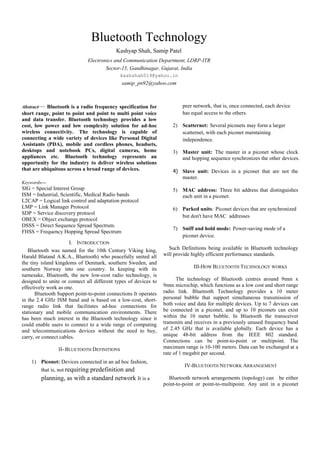
Bluetooth Technology
                                           Kashyap Shah, Samip Patel
                              Electronics and Communication Department, LDRP-ITR
                                      Sector-15, Gandhinagar, Gujarat, India
                                             kashshah019@yahoo.in
                                             samip_pn92@yahoo.com


Abstract— Bluetooth is a radio frequency specification for               peer network, that is, once connected, each device
short range, point to point and point to multi point voice               has equal access to the others.
and data transfer. Bluetooth technology provides a low
cost, low power and low complexity solution for ad-hoc               2) Scatternet: Several piconets may form a larger
wireless connectivity. The technology is capable of                     scatternet, with each piconet maintaining
connecting a wide variety of devices like Personal Digital              independence.
Assistants (PDA), mobile and cordless phones, headsets,
desktops and notebook PCs, digital cameras, home                     3) Master unit: The master in a piconet whose clock
appliances etc. Bluetooth technology represents an                      and hopping sequence synchronizes the other devices.
opportunity for the industry to deliver wireless solutions
that are ubiquitous across a broad range of devices.                 4) Slave unit: Devices in a piconet that are not the
                                                                        master.
Keywords—
SIG = Special Interest Group                                         5) MAC address: Three bit address that distinguishes
ISM = Industrial, Scientific, Medical Radio bands                       each unit in a piconet.
L2CAP = Logical link control and adaptation protocol
LMP = Link Manager Protocol                                          6) Parked units: Piconet devices that are synchronized
SDP = Service discovery protocol
                                                                        but don't have MAC addresses
OBEX = Object exchange protocol
DSSS = Direct Sequence Spread Spectrum.
                                                                     7) Sniff and hold mode: Power-saving mode of a
FHSS = Frequency Hopping Spread Spectrum
                                                                        piconet device.
                      I. INTRODUCTION
   Bluetooth was named for the 10th Century Viking king,           Such Definitions being available in Bluetooth technology
Harald Blatand A.K.A., Bluetooth) who peacefully united all      will provide highly efficient performance standards.
the tiny island kingdoms of Denmark, southern Sweden, and
southern Norway into one country. In keeping with its                         III-HOW BLUETOOTH TECHNOLOGY WORKS
namesake, Bluetooth, the new low-cost radio technology, is
designed to unite or connect all different types of devices to         The technology of Bluetooth centres around 9mm x
effectively work as one.                                         9mm microchip, which functions as a low cost and short range
      Bluetooth Support point-to-point connections It operates   radio link. Bluetooth Technology provides a 10 meter
in the 2.4 GHz ISM band and is based on a low-cost, short-       personal bubble that support simultaneous transmission of
range radio link that facilitates ad-hoc connections for         both voice and data for multiple devices. Up to 7 devices can
stationary and mobile communication environments. There          be connected in a piconet, and up to 10 piconets can exist
has been much interest in the Bluetooth technology since it      within the 10 meter bubble. In Bluetooth the transceiver
could enable users to connect to a wide range of computing       transmits and receives in a previously unused frequency band
and telecommunications devices without the need to buy,          of 2.45 GHz that is available globally. Each device has a
carry, or connect cables.                                        unique 48-bit address from the IEEE 802 standard.
                                                                 Connections can be point-to-point or multipoint. The
                II- BLUETOOTH DEFINITIONS                        maximum range is 10-100 meters. Data can be exchanged at a
                                                                 rate of 1 megabit per second.
    1) Piconet: Devices connected in an ad hoc fashion,
                                                                          IV-BLUETOOTH NETWORK ARRANGEMENT
        that is, not requiring predefinition
                                         and
        planning, as with a standard network It is a               Bluetooth network arrangements (topology) can be either
                                                                 point-to-point or point-to-multipoint. Any unit in a piconet
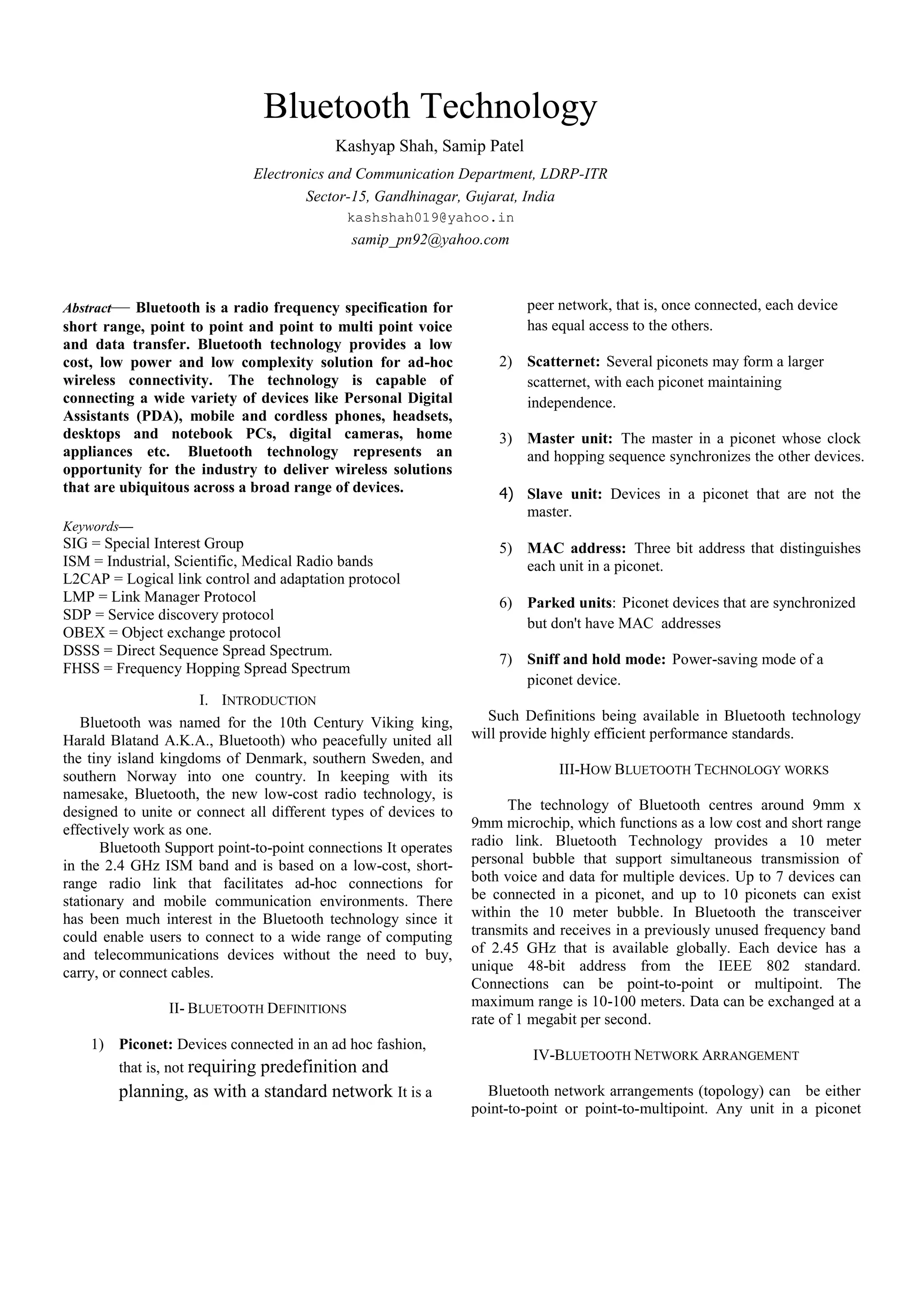
can establish a connection to another piconet to form a                Both synchronous and asynchronous applications are
scatternet.                                                            supported, making it easy to implement on a variety
                                                                       of devices and for a variety of services, such as voice
                                                                       and Internet.

                                                                       Governments worldwide regulate it, so it is possible
                                                                       to utilize the same standard wherever one travels.

                                                                                   VII-APPLICATIONS

                                                                   1) Hands free devices, music players, car-driving
                                                                      system to ensure safety.

                                                                   2) In Gaming consoles. i.e. PSPs.

                                                                   3) Wireless connection of input/output devices like key-
    See the figure, In which scatternet is shown having               board, Monitor, mouse, Printer etc with PC.
piconet A, (consists of four units), and connected to piconet B,
(consisting of two units). Note that the master unit of A is       4) Wireless internet access using Bluetooth Dongle.
1,whereas 2,3,4 will acts as slaves. But, In unit B master/slave
can be either 1 / 2.                                               5) Smart sensor devices, In medical, sports field.

                  V-BLUETOOTH SECURITY                             6) Latest version used In Apple iPad, iPhone 4S.

      By default, most Bluetooth devices operate in
unprotected "non-secure" mode. Security is provided in three
ways: through pseudo-random frequency band hops,                     VIII-ADVANTAGES OF BLUETOOTH TECHNOLOGY
authentication, and encryption.
       When link security is enabled, Bluetooth devices must       1) No line of site restrictions for signal transmitting.
complete an initial "bonding" exchange to derive pair wise
link authentication and encryption keys. The user must give        2) Interoperability.
both devices the same PIN code, which is then mixed with a
factory-defined unit key. But this pairing process can be          3) Mass Production at Low Cost
compromised by use of weak or predictable PIN codes. To
reduce risk, devices should be paired in a private location,       4) Ease of Use
using a long, random PIN code. Avoid default PIN codes,
easily guessed PIN codes ("0000") and devices that do not          5) End User Experience
support configurable PIN codes. After bonding, paired
Bluetooth devices associate to each other whenever they want       6) Less power consumption makes its usage in battery
to exchange data.
                                                                      powered devices very practical.
              VI-BLUETOOTH CHARACTERISTICS
                                                                   7) 2.4 GHz radio frequency ensures worldwide
                                                                      operability.
         It separates the frequency band into hops. This
         spread spectrum is used to hop from one channel to
         another, which adds a strong layer of security.                          IX-BLUETOOTH IN FUTURE
         Seven to eight devices can be networked in a piconet.            Bluetooth is a continually expanding technology.
                                                                       There are plans to add many new application profiles.
   Signals can be transmitted even through walls and                   With over 15000 companies working on Bluetooth,
briefcases, thus eliminating the need for line-of-sight.               the future is very bright. With a strong special
                                                                       interest group behind Bluetooth, the standardization
         Devices do not need to be pointed at each other, as           of the application profiles is almost assured. But, to
         signals are Omni-directional.                                 sustain Bluetooth should keep on adding consumer
needed applications. Because in the era of Android,
         people prefer applications rather than technology.                            REFERENCE

                                                                   1) The official Bluetooth site:
                     ACKNOWLEDGMENT                                   http://www.bluetooth.com

   I wish to express sincere thanks to my EC department for        2) http://www.wikipedia.org/wiki/Bluetooth
arranging such a nice event. So that I researched all this about
Bluetooth. I also extend my heartfelt thanks to my colleagues,
family members and well-wishers.

Bluetooth paper (IEEE)

  • 1.
    Bluetooth Technology Kashyap Shah, Samip Patel Electronics and Communication Department, LDRP-ITR Sector-15, Gandhinagar, Gujarat, India kashshah019@yahoo.in samip_pn92@yahoo.com Abstract— Bluetooth is a radio frequency specification for peer network, that is, once connected, each device short range, point to point and point to multi point voice has equal access to the others. and data transfer. Bluetooth technology provides a low cost, low power and low complexity solution for ad-hoc 2) Scatternet: Several piconets may form a larger wireless connectivity. The technology is capable of scatternet, with each piconet maintaining connecting a wide variety of devices like Personal Digital independence. Assistants (PDA), mobile and cordless phones, headsets, desktops and notebook PCs, digital cameras, home 3) Master unit: The master in a piconet whose clock appliances etc. Bluetooth technology represents an and hopping sequence synchronizes the other devices. opportunity for the industry to deliver wireless solutions that are ubiquitous across a broad range of devices. 4) Slave unit: Devices in a piconet that are not the master. Keywords— SIG = Special Interest Group 5) MAC address: Three bit address that distinguishes ISM = Industrial, Scientific, Medical Radio bands each unit in a piconet. L2CAP = Logical link control and adaptation protocol LMP = Link Manager Protocol 6) Parked units: Piconet devices that are synchronized SDP = Service discovery protocol but don't have MAC addresses OBEX = Object exchange protocol DSSS = Direct Sequence Spread Spectrum. 7) Sniff and hold mode: Power-saving mode of a FHSS = Frequency Hopping Spread Spectrum piconet device. I. INTRODUCTION Bluetooth was named for the 10th Century Viking king, Such Definitions being available in Bluetooth technology Harald Blatand A.K.A., Bluetooth) who peacefully united all will provide highly efficient performance standards. the tiny island kingdoms of Denmark, southern Sweden, and southern Norway into one country. In keeping with its III-HOW BLUETOOTH TECHNOLOGY WORKS namesake, Bluetooth, the new low-cost radio technology, is designed to unite or connect all different types of devices to The technology of Bluetooth centres around 9mm x effectively work as one. 9mm microchip, which functions as a low cost and short range Bluetooth Support point-to-point connections It operates radio link. Bluetooth Technology provides a 10 meter in the 2.4 GHz ISM band and is based on a low-cost, short- personal bubble that support simultaneous transmission of range radio link that facilitates ad-hoc connections for both voice and data for multiple devices. Up to 7 devices can stationary and mobile communication environments. There be connected in a piconet, and up to 10 piconets can exist has been much interest in the Bluetooth technology since it within the 10 meter bubble. In Bluetooth the transceiver could enable users to connect to a wide range of computing transmits and receives in a previously unused frequency band and telecommunications devices without the need to buy, of 2.45 GHz that is available globally. Each device has a carry, or connect cables. unique 48-bit address from the IEEE 802 standard. Connections can be point-to-point or multipoint. The II- BLUETOOTH DEFINITIONS maximum range is 10-100 meters. Data can be exchanged at a rate of 1 megabit per second. 1) Piconet: Devices connected in an ad hoc fashion, IV-BLUETOOTH NETWORK ARRANGEMENT that is, not requiring predefinition and planning, as with a standard network It is a Bluetooth network arrangements (topology) can be either point-to-point or point-to-multipoint. Any unit in a piconet
  • 2.
    can establish aconnection to another piconet to form a Both synchronous and asynchronous applications are scatternet. supported, making it easy to implement on a variety of devices and for a variety of services, such as voice and Internet. Governments worldwide regulate it, so it is possible to utilize the same standard wherever one travels. VII-APPLICATIONS 1) Hands free devices, music players, car-driving system to ensure safety. 2) In Gaming consoles. i.e. PSPs. 3) Wireless connection of input/output devices like key- See the figure, In which scatternet is shown having board, Monitor, mouse, Printer etc with PC. piconet A, (consists of four units), and connected to piconet B, (consisting of two units). Note that the master unit of A is 4) Wireless internet access using Bluetooth Dongle. 1,whereas 2,3,4 will acts as slaves. But, In unit B master/slave can be either 1 / 2. 5) Smart sensor devices, In medical, sports field. V-BLUETOOTH SECURITY 6) Latest version used In Apple iPad, iPhone 4S. By default, most Bluetooth devices operate in unprotected "non-secure" mode. Security is provided in three ways: through pseudo-random frequency band hops, VIII-ADVANTAGES OF BLUETOOTH TECHNOLOGY authentication, and encryption. When link security is enabled, Bluetooth devices must 1) No line of site restrictions for signal transmitting. complete an initial "bonding" exchange to derive pair wise link authentication and encryption keys. The user must give 2) Interoperability. both devices the same PIN code, which is then mixed with a factory-defined unit key. But this pairing process can be 3) Mass Production at Low Cost compromised by use of weak or predictable PIN codes. To reduce risk, devices should be paired in a private location, 4) Ease of Use using a long, random PIN code. Avoid default PIN codes, easily guessed PIN codes ("0000") and devices that do not 5) End User Experience support configurable PIN codes. After bonding, paired Bluetooth devices associate to each other whenever they want 6) Less power consumption makes its usage in battery to exchange data. powered devices very practical. VI-BLUETOOTH CHARACTERISTICS 7) 2.4 GHz radio frequency ensures worldwide operability. It separates the frequency band into hops. This spread spectrum is used to hop from one channel to another, which adds a strong layer of security. IX-BLUETOOTH IN FUTURE Seven to eight devices can be networked in a piconet. Bluetooth is a continually expanding technology. There are plans to add many new application profiles. Signals can be transmitted even through walls and With over 15000 companies working on Bluetooth, briefcases, thus eliminating the need for line-of-sight. the future is very bright. With a strong special interest group behind Bluetooth, the standardization Devices do not need to be pointed at each other, as of the application profiles is almost assured. But, to signals are Omni-directional. sustain Bluetooth should keep on adding consumer
  • 3.
    needed applications. Becausein the era of Android, people prefer applications rather than technology. REFERENCE 1) The official Bluetooth site: ACKNOWLEDGMENT http://www.bluetooth.com I wish to express sincere thanks to my EC department for 2) http://www.wikipedia.org/wiki/Bluetooth arranging such a nice event. So that I researched all this about Bluetooth. I also extend my heartfelt thanks to my colleagues, family members and well-wishers.