www.oeclib.in
Submitted By:
Odisha Electronic Digital Library
Seminar
On
Asynchronous Chips
CONTENTS
 INTRODUCTION
 PROBLEMS WITH SYNCHRONOUS
 Approach ASYNCHRONOUS LOGIC
 HOW DO THEY WORK?
 SOME FEATURES
 A CHALLENGING TIME
 CONCLUSION
 REFERENCES
INTRODUCTION
 Computer chips of today are synchronous.
 They contain a main clock, which controls the timing of
the entire chips.
 There are problems, however, involved with these
clocked designs that are common today.
 One problem is speed. A chip can only work as fast as its
slowest component.
Problems with Synchronous Approach
 Distributing the clock globally.
 Wastage of energy.
 Traverse the chip’s longest wires in one clock cycle.
 Order of arrival of the signals is unimportant.
 Clocks themselves consume lot of energy (~30%).
Asynchronous logic circuits
 Colckless chips/Asynchronous/self-timed circuits.
 Functions away from the clock.
 Different parts work at different speeds.
 Hand-off the result immediately.
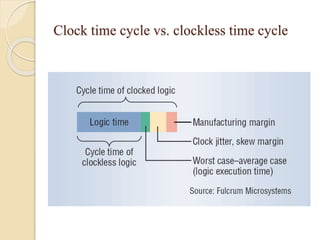
Clock time cycle vs. clockless time cycle
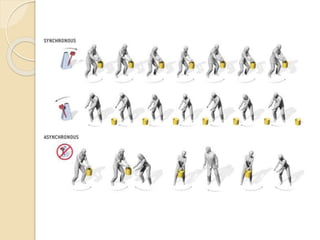
RENDEZVOUS CIRCUITS
How do they work?
 No pure asynchronous chips are available.
 Uses handshake signals for the data exchange.
 Data moves only when required, not always.
◦ Minimizes power consumption.
◦ Less EMI  less noise  more applications.
◦ Stream data applications.
Some features
 Integrated pipelining mode.
◦ Domino logic.
◦ Delay – insensitive.
 Two different implementation details
◦ Dual rail.
◦ Bundled data.
Challenges
 Interfacing between synchronous and
asynchronous
◦ Many devices available now are synchronous in
nature.
◦ Special circuits are needed to align them.
 Lack of expertise.
 Lack of tools.
 Engineers are not trained in these fields.
 Academically, no courses available.
CONCLUSION
 Clocks have served the electronics
design industry very well for a long time,
but there are insignificant difficulties
looming for clocked design in future.
These difficulties are most obvious in
complex SOC development, where
electrical noise, power and design costs
threaten to render the potential of future
process technologies inaccessible to
clocked design.
REFERNCES
 www.google.com
 www.wikipedia.com
 www.oeclib.in
Asynchronous Chips ppt

Asynchronous Chips ppt

  • 1.
    www.oeclib.in Submitted By: Odisha ElectronicDigital Library Seminar On Asynchronous Chips
  • 2.
    CONTENTS  INTRODUCTION  PROBLEMSWITH SYNCHRONOUS  Approach ASYNCHRONOUS LOGIC  HOW DO THEY WORK?  SOME FEATURES  A CHALLENGING TIME  CONCLUSION  REFERENCES
  • 3.
    INTRODUCTION  Computer chipsof today are synchronous.  They contain a main clock, which controls the timing of the entire chips.  There are problems, however, involved with these clocked designs that are common today.  One problem is speed. A chip can only work as fast as its slowest component.
  • 4.
    Problems with SynchronousApproach  Distributing the clock globally.  Wastage of energy.  Traverse the chip’s longest wires in one clock cycle.  Order of arrival of the signals is unimportant.  Clocks themselves consume lot of energy (~30%).
  • 5.
    Asynchronous logic circuits Colckless chips/Asynchronous/self-timed circuits.  Functions away from the clock.  Different parts work at different speeds.  Hand-off the result immediately.
  • 6.
    Clock time cyclevs. clockless time cycle
  • 8.
  • 9.
    How do theywork?  No pure asynchronous chips are available.  Uses handshake signals for the data exchange.  Data moves only when required, not always. ◦ Minimizes power consumption. ◦ Less EMI  less noise  more applications. ◦ Stream data applications.
  • 10.
    Some features  Integratedpipelining mode. ◦ Domino logic. ◦ Delay – insensitive.  Two different implementation details ◦ Dual rail. ◦ Bundled data.
  • 11.
    Challenges  Interfacing betweensynchronous and asynchronous ◦ Many devices available now are synchronous in nature. ◦ Special circuits are needed to align them.  Lack of expertise.  Lack of tools.  Engineers are not trained in these fields.  Academically, no courses available.
  • 12.
    CONCLUSION  Clocks haveserved the electronics design industry very well for a long time, but there are insignificant difficulties looming for clocked design in future. These difficulties are most obvious in complex SOC development, where electrical noise, power and design costs threaten to render the potential of future process technologies inaccessible to clocked design.
  • 13.

Editor's Notes