This document summarizes a seminar presentation on AppleTalk. It describes AppleTalk as a network operating system designed to connect Apple computers. It discusses AppleTalk's components, addressing scheme, sockets, nodes, networks, zones, implications of the end of AppleTalk routing, security issues, advantages like ease of setup, and disadvantages like low bandwidth. The conclusion notes AppleTalk uses AARP like ARP to resolve node addresses through broadcasts.
Content
Introduction
Rulesof Engagement
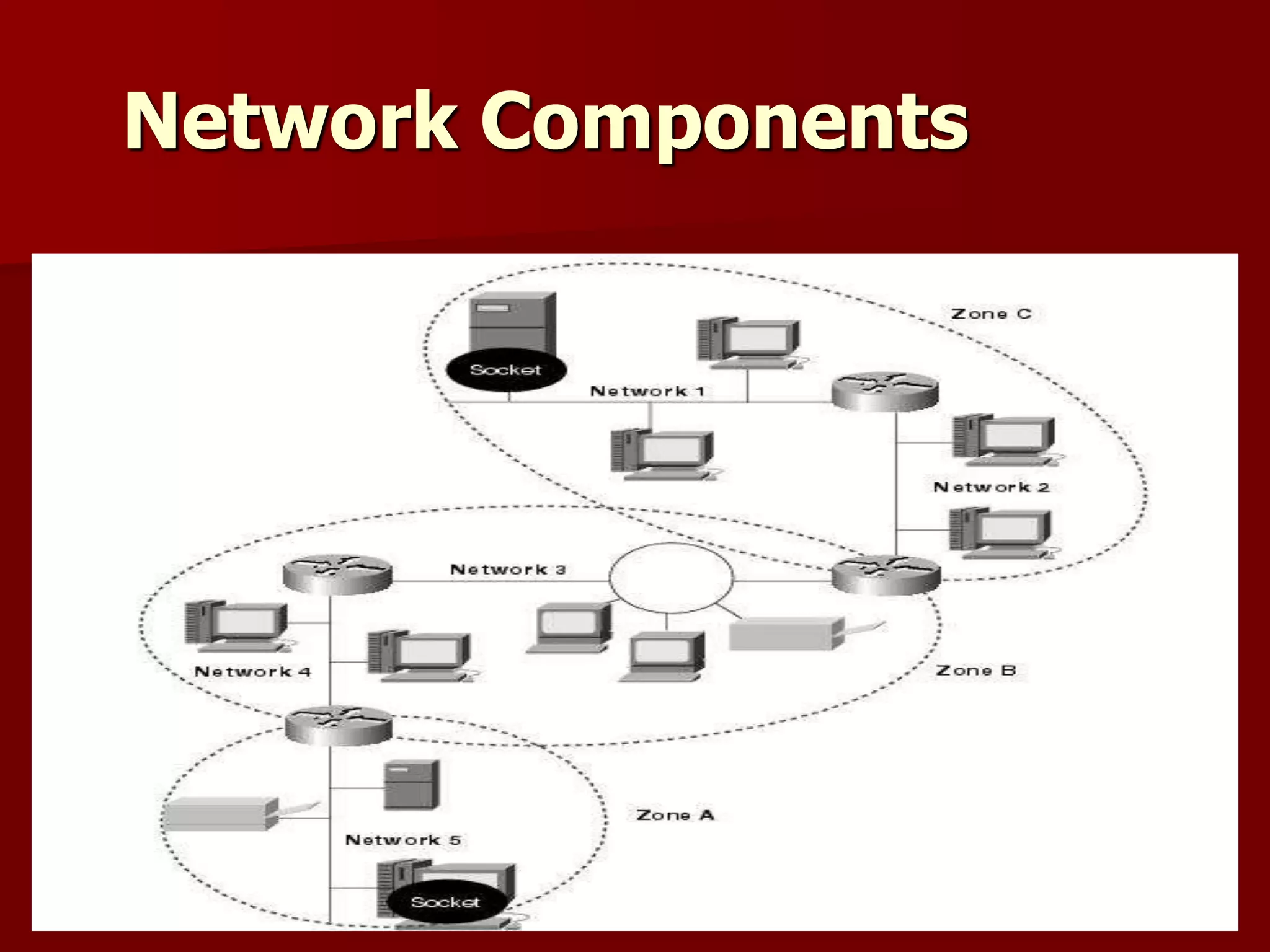
Network Components
Sockets
Nodes
Implications of the end of AppleTalk routing
Security
Advantages
Disadvantages
Conclusion
3.
Introduction
AppleTalk isa network operating system designed to
connect Apple computers. Its components are built on
Macintosh operating systems. There are two main
versions of AppleTalk depending on how many years in
the past the network was implemented, Phase 1 and
Phase 2.
4.
Rules of Engagement
AppleTalk networks make use of an addressing
scheme in which each computer
when it comes online.
Looks for a stored address that it used in a
previous session.
If one isn't available then it chooses an address
at random from those that are available .
Then it broadcasts the address to make sure no
other computer is using it.
If it is being used then it tries another .
Sockets
An AppleTalksocket is a unique, addressable location in
an AppleTalk node. It is the logical point at which upper-
layer AppleTalk software processes and the network
layer Datagram Delivery Protocol (DDP) interact.
7.
Nodes
An AppleTalknode is a device that is connected
to an AppleTalk network.
This device might be a Macintosh computer, a
printer, an IBM PC, a router, or some other
similar device.
8.
Networks
It consistsof a single logical cable and
multiple attached nodes.
A single physical cable or multiple physical
cables interconnected by using bridges or
routers may be found.
9.
Networks…
Non extendedNetworks
It is a physical network segment that is assigned
only a single network number, which can range
between 1 and 1024.
Extended Networks
Also known as a cable range. It is a physical
network segment that can be assigned multiple
network numbers.
10.
Zones
An AppleTalkzone is a logical group of nodes or
networks that is defined when the network
administrator configures the network.
The nodes or networks need not be physically
contiguous to belong to the same AppleTalk
zone.
11.
Implications of theend of
AppleTalk routing
Legacy operating systems and devices that only support
AppleTalk should be replaced if at all possible. If they
cannot be replaced, they need to be placed on the RIT
network with forethought.
As long as any two legacy AppleTalk devices are within
the same network segment, AppleTalk communications
between them will still work. However, after July 24,
2006, the addresses change because AppleTalk zones
will no longer be present.
There will no longer be a way to use two AppleTalk-only
devices between campus buildings, and in many cases,
between hallways within buildings.
12.
Security
AppleTalk, likemany network protocols, makes
no provisions for network security. The design of
the AppleTalk protocol architecture requires that
security measures be implemented at higher
application levels. Cisco supports AppleTalk
distribution lists, allowing control of routing
updates on a per-interface basis. This security
feature is similar to those that Cisco provides for
other protocols.
13.
Advantages
Apple automaticallyincludes AppleTalk in
the Macintosh operating system.
Easy to implement and configure
Setting up a small workgroup is simple
and inexpensive
14.
Disadvantages
It isnot suitable for very large networks
It is very slow compared to other LAN
links at 230.4 Kbps
It is unsuitable for bandwidth intensive
applications
15.
Conclusion
AppleTalk includes anaddress-resolution
method much like TCP/IP's ARP. The
AppleTalk version is called AARP. AARP
uses broadcasts to discover the hardware
address of a node.












![Apple%20Talk%20ppt[1].pptx](https://cdn.slidesharecdn.com/ss_thumbnails/apple20talk20ppt1-221006090937-318335c4-thumbnail.jpg?width=640&height=640&fit=bounds)


