INTRODUCTION.
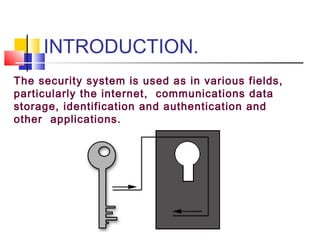
The security system is used as in various fields,
particularly the internet, communications data
storage, identification and authentication and
other applications.
WHAT IS WIRE-LESS NETWORK?
 Wireless technologies, in the simplest
sense, enable one or more devices to
communicate without physical connections
—without requiring network or peripheral
cabling.
 Wireless networks serve as the transport
mechanism between devices and among
devices and the traditional wired networks
TYPES OF WIRE-LESS
NETWORK.
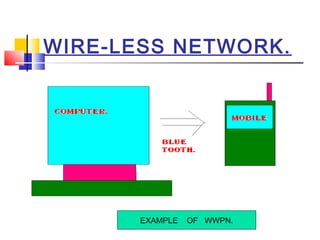
 Wireless Personal Area Networks
(WPAN)
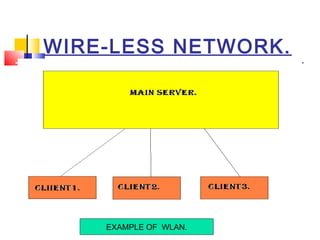
 Wireless local area networks (WLAN)
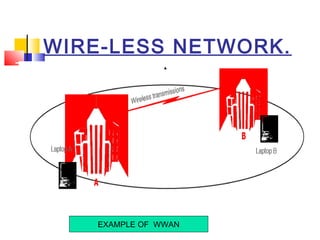
 Wireless Wide Area Networks
(WWAN)
WIRE-LESS NETWORK.
EXAMPLE OF WWPN.
WIRE-LESS NETWORK.
EXAMPLE OF WLAN.
WIRE-LESS NETWORK.
EXAMPLE OF WWAN
WHY WE NEED SECURITY
SYSTEM
 when an unauthorized user gains
access to the network and consumes
network resources.
 Malicious hackers, sometimes called
crackers, are individuals who break into
a system without authorization, usually
for personal gain or to do harm.
WHY WE NEED SECURITY
SYSTEM
 Malicious code involves viruses,Trojan
horses, logic bombs, or other unwanted
software that is designed to damage files or
bring down a system.
Different types of threats
to network:
 Application backdoors .
 Operating system bugs .
 E-mail bombs .
 Macros .
 Viruses .
 Spam .
 Trojan/key logger attacks.
Threats to network:
Application backdoors:
Some programs have special features that
allow for backdoor or hidden access , that
provides some level of access of data.
Operating system bugs:
some operating systems Have backdoors with
insufficient security controls .
Threats to network:
E-mail bombs :
An e-mail bomb is usually a personal attack . Someone
sends you the same e-mail hundreds or thousands of
times until your e-mail system cannot accept any more
messages.
Macros:
A script of commands that the application can run.
Hackers have taken advantage of this to create their
own macros that , depending on the application , can
destroy your data or crash your computer.
Threats to network:
VIRSUSES:
Probably the most well-known threat is
computer viruses .
A virus is a small program that can copy itself to
other computers .
SPAM:
spam is the electronic equivalent of mail.
TROJAN / KEY ATTACKS:
Trojan is a tool which when installed in a system, can be
misused for malicious purposes by the attacker.
Network security can be
done by various methods.
 Virtual Private Network.
 Firewalls.
 Internet Protocol Security
(IP Sec).
 AAA Server.
Virtual Private Network
(VPN).
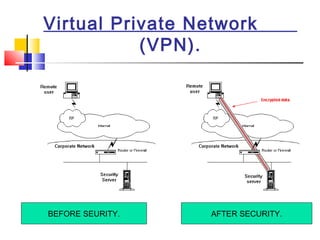
 A virtual private network ( VPN ) is a way to use
a public telecommunication infrastructure.
 In Internet , to provide remote offices or
individual users with secure access to their
organization's network.
 The goal of a VPN is to provide the
organization with the security , but at a much
lower cost.
Virtual Private Network
(VPN).
BEFORE SEURITY. AFTER SECURITY.
INTERNET FIREWALLS.
FireWallFireWall
A firewall provides a strong barrier between your private network and the
Internet .
Set firewalls to restrict the number of open ports , what type of packets are
passed and what are blocked .
INTERNET PROTOCOL
SECURITY. (IP SEC)
 It provides enhanced security features
such as better encryption algorithms
and more comprehensive
authentication.
 IP Sec can encrypt data between
various devices , such as :
 Firewall to server
 Server to PC
AAA Server.
 AAA (authentication , authorization and
accounting)
 When a request to establish a session comes
in from a dial up client ,the Request is proxies to
the AAA server.
 AAA then checks the following :
 Who you are (authentication)
 What you are allowed to do (authorization)
 What you actually do (accounting)
CONCLUSION:
 There is no gain saying the fact that
SECURITY plays an essential role in
protecting the privacy of electronic
information against threats from a
variety of potential attackers.
REFERENCES:
 WWW.GOOGLE.COM
 WWW.INTERNET SECURITY.COM
 DATA COMMUNICATIONS &
NETWORKING (A.FOROUZAN)
Security system wireless technology

Security system wireless technology

  • 2.
    INTRODUCTION. The security systemis used as in various fields, particularly the internet, communications data storage, identification and authentication and other applications.
  • 3.
    WHAT IS WIRE-LESSNETWORK?  Wireless technologies, in the simplest sense, enable one or more devices to communicate without physical connections —without requiring network or peripheral cabling.  Wireless networks serve as the transport mechanism between devices and among devices and the traditional wired networks
  • 4.
    TYPES OF WIRE-LESS NETWORK. Wireless Personal Area Networks (WPAN)  Wireless local area networks (WLAN)  Wireless Wide Area Networks (WWAN)
  • 5.
  • 6.
  • 7.
  • 8.
    WHY WE NEEDSECURITY SYSTEM  when an unauthorized user gains access to the network and consumes network resources.  Malicious hackers, sometimes called crackers, are individuals who break into a system without authorization, usually for personal gain or to do harm.
  • 9.
    WHY WE NEEDSECURITY SYSTEM  Malicious code involves viruses,Trojan horses, logic bombs, or other unwanted software that is designed to damage files or bring down a system.
  • 10.
    Different types ofthreats to network:  Application backdoors .  Operating system bugs .  E-mail bombs .  Macros .  Viruses .  Spam .  Trojan/key logger attacks.
  • 11.
    Threats to network: Applicationbackdoors: Some programs have special features that allow for backdoor or hidden access , that provides some level of access of data. Operating system bugs: some operating systems Have backdoors with insufficient security controls .
  • 12.
    Threats to network: E-mailbombs : An e-mail bomb is usually a personal attack . Someone sends you the same e-mail hundreds or thousands of times until your e-mail system cannot accept any more messages. Macros: A script of commands that the application can run. Hackers have taken advantage of this to create their own macros that , depending on the application , can destroy your data or crash your computer.
  • 13.
    Threats to network: VIRSUSES: Probablythe most well-known threat is computer viruses . A virus is a small program that can copy itself to other computers . SPAM: spam is the electronic equivalent of mail. TROJAN / KEY ATTACKS: Trojan is a tool which when installed in a system, can be misused for malicious purposes by the attacker.
  • 14.
    Network security canbe done by various methods.  Virtual Private Network.  Firewalls.  Internet Protocol Security (IP Sec).  AAA Server.
  • 15.
    Virtual Private Network (VPN). A virtual private network ( VPN ) is a way to use a public telecommunication infrastructure.  In Internet , to provide remote offices or individual users with secure access to their organization's network.  The goal of a VPN is to provide the organization with the security , but at a much lower cost.
  • 16.
    Virtual Private Network (VPN). BEFORESEURITY. AFTER SECURITY.
  • 17.
    INTERNET FIREWALLS. FireWallFireWall A firewallprovides a strong barrier between your private network and the Internet . Set firewalls to restrict the number of open ports , what type of packets are passed and what are blocked .
  • 18.
    INTERNET PROTOCOL SECURITY. (IPSEC)  It provides enhanced security features such as better encryption algorithms and more comprehensive authentication.  IP Sec can encrypt data between various devices , such as :  Firewall to server  Server to PC
  • 19.
    AAA Server.  AAA(authentication , authorization and accounting)  When a request to establish a session comes in from a dial up client ,the Request is proxies to the AAA server.  AAA then checks the following :  Who you are (authentication)  What you are allowed to do (authorization)  What you actually do (accounting)
  • 20.
    CONCLUSION:  There isno gain saying the fact that SECURITY plays an essential role in protecting the privacy of electronic information against threats from a variety of potential attackers.
  • 21.
    REFERENCES:  WWW.GOOGLE.COM  WWW.INTERNETSECURITY.COM  DATA COMMUNICATIONS & NETWORKING (A.FOROUZAN)