



Asynchronous
Microprocessor
The Clockless Future
Computer Science Architecture
Presentation By :
AkshitArora (101303012)
Ankit Goyal (101303022)
“Designers are realizing that distributing a
clock across ever more complicated systems is
becoming more and more difficult, and that
sooner or later it won't work”
Alain Martin
Professor
Computer Science
Caltech
built the first clockless microprocessor in 1989
What are Asynchronous Processors ?
• An asynchronous circuit, or self-timed circuit, is a sequential
digital logic circuit which is not governed by a clock circuit or
global clock signal.
• Unlike a conventional processor, a clockless processor
(asynchronous CPU) has no central clock to coordinate the
progress of data through the pipeline.
It may actually be even easier to implement
high performance devices in asynchronous, as
opposed to clocked, because:
Components can run at different speeds on an asynchronousCPU. All major
components of a clocked CPU must remain synchronized with the central
clock.
A traditional CPU cannot “GO FASTER" than the expected worst-case
performance of the slowest stage/instruction/component. When an
asynchronousCPU completes an operation more quickly than anticipated,
the next stage can immediately begin processing the results, rather than
waiting for synchronization with a central clock.
Why Asynchronous Design
• Better Power Efficiency
• Only activating functional units consume power
• Inactivated parts remain in “stand-by” state
• No wasteful power dissipation by glitches
• Higher Performance
• No global clock
• proceed data at appropriate rate of environment
• Do not propagate local delay globally
• Smaller Chip Size
• Less high-frequency EMI components due to small amplitude and wide
current peaks
Disadvantages
• Fewer people are trained in this style compared to synchronous design.
• Performance (speed) of asynchronous circuits may be reduced in
architectures that require input-completeness (more complex data path).
• Incompatible with commercial EDA tools
Brief History of Asynchronous Processors
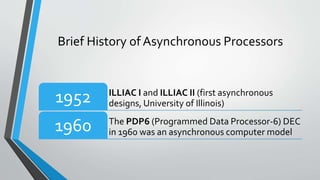
ILLIAC I and ILLIAC II (first asynchronous
designs, University of Illinois)1952
The PDP6 (Programmed Data Processor-6) DEC
in 1960 was an asynchronous computer model1960
Brief History of Asynchronous Processors
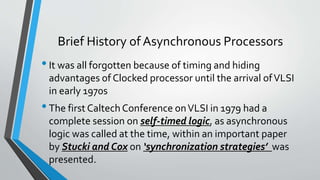
•It was all forgotten because of timing and hiding
advantages of Clocked processor until the arrival ofVLSI
in early 1970s
•The first Caltech Conference onVLSI in 1979 had a
complete session on self-timed logic, as asynchronous
logic was called at the time, within an important paper
by Stucki and Cox on ‘synchronization strategies’ was
presented.
Brief History of Asynchronous Processors
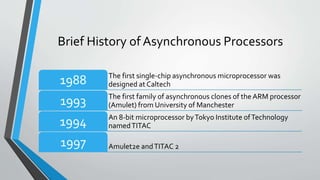
The first single-chip asynchronous microprocessor was
designed at Caltech1988
The first family of asynchronous clones of the ARM processor
(Amulet) from University of Manchester1993
An 8-bit microprocessor byTokyo Institute ofTechnology
namedTITAC1994
Amulet2e andTITAC 21997
Brief History of Asynchronous Processors
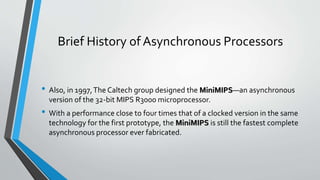
• Also, in 1997,The Caltech group designed the MiniMIPS—an asynchronous
version of the 32-bit MIPS R3000 microprocessor.
• With a performance close to four times that of a clocked version in the same
technology for the first prototype, the MiniMIPS is still the fastest complete
asynchronous processor ever fabricated.
Brief History of Asynchronous Processors
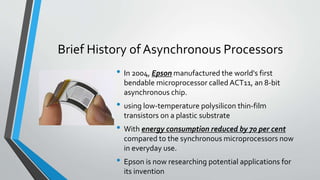
• In 2004, Epson manufactured the world's first
bendable microprocessor called ACT11, an 8-bit
asynchronous chip.
• using low-temperature polysilicon thin-film
transistors on a plastic substrate
• With energy consumption reduced by 70 per cent
compared to the synchronous microprocessors now
in everyday use.
• Epson is now researching potential applications for
its invention
Conclusion
• It is entirely practical to design a processor without a clock.
• Quality of such processors have improved with time. Some are
commercially available
• Clockless and selftimed processors opens up horizons for a radical departure
in the main stream architectures to new and exciting areas.
• Asynchronous design is competitive with the best synchronous design in
power efficiency and is close in performance to them.
References
• http://www.electronicsforu.com/EFYLinux/efyhome/cover/January2008/Asy
nchronous%20Microprocessor.pdf
• http://en.wikipedia.org/wiki/Asynchronous_circuit#Asynchronous_CPU
• http://www.ubergizmo.com/2005/02/epson-develops-the-worldacutes-first-
flexible-8-bit-asynchronous-microprocessor/
THANKYOU

Asynchronous Processors - The Clock less Future

  • 1.
    Asynchronous Microprocessor The Clockless Future ComputerScience Architecture Presentation By : AkshitArora (101303012) Ankit Goyal (101303022)
  • 2.
    “Designers are realizingthat distributing a clock across ever more complicated systems is becoming more and more difficult, and that sooner or later it won't work” Alain Martin Professor Computer Science Caltech built the first clockless microprocessor in 1989
  • 3.
    What are AsynchronousProcessors ? • An asynchronous circuit, or self-timed circuit, is a sequential digital logic circuit which is not governed by a clock circuit or global clock signal. • Unlike a conventional processor, a clockless processor (asynchronous CPU) has no central clock to coordinate the progress of data through the pipeline.
  • 4.
    It may actuallybe even easier to implement high performance devices in asynchronous, as opposed to clocked, because: Components can run at different speeds on an asynchronousCPU. All major components of a clocked CPU must remain synchronized with the central clock. A traditional CPU cannot “GO FASTER" than the expected worst-case performance of the slowest stage/instruction/component. When an asynchronousCPU completes an operation more quickly than anticipated, the next stage can immediately begin processing the results, rather than waiting for synchronization with a central clock.
  • 5.
    Why Asynchronous Design •Better Power Efficiency • Only activating functional units consume power • Inactivated parts remain in “stand-by” state • No wasteful power dissipation by glitches • Higher Performance • No global clock • proceed data at appropriate rate of environment • Do not propagate local delay globally • Smaller Chip Size • Less high-frequency EMI components due to small amplitude and wide current peaks
  • 6.
    Disadvantages • Fewer peopleare trained in this style compared to synchronous design. • Performance (speed) of asynchronous circuits may be reduced in architectures that require input-completeness (more complex data path). • Incompatible with commercial EDA tools
  • 7.
    Brief History ofAsynchronous Processors ILLIAC I and ILLIAC II (first asynchronous designs, University of Illinois)1952 The PDP6 (Programmed Data Processor-6) DEC in 1960 was an asynchronous computer model1960
  • 8.
    Brief History ofAsynchronous Processors •It was all forgotten because of timing and hiding advantages of Clocked processor until the arrival ofVLSI in early 1970s •The first Caltech Conference onVLSI in 1979 had a complete session on self-timed logic, as asynchronous logic was called at the time, within an important paper by Stucki and Cox on ‘synchronization strategies’ was presented.
  • 9.
    Brief History ofAsynchronous Processors The first single-chip asynchronous microprocessor was designed at Caltech1988 The first family of asynchronous clones of the ARM processor (Amulet) from University of Manchester1993 An 8-bit microprocessor byTokyo Institute ofTechnology namedTITAC1994 Amulet2e andTITAC 21997
  • 10.
    Brief History ofAsynchronous Processors • Also, in 1997,The Caltech group designed the MiniMIPS—an asynchronous version of the 32-bit MIPS R3000 microprocessor. • With a performance close to four times that of a clocked version in the same technology for the first prototype, the MiniMIPS is still the fastest complete asynchronous processor ever fabricated.
  • 11.
    Brief History ofAsynchronous Processors • In 2004, Epson manufactured the world's first bendable microprocessor called ACT11, an 8-bit asynchronous chip. • using low-temperature polysilicon thin-film transistors on a plastic substrate • With energy consumption reduced by 70 per cent compared to the synchronous microprocessors now in everyday use. • Epson is now researching potential applications for its invention
  • 12.
    Conclusion • It isentirely practical to design a processor without a clock. • Quality of such processors have improved with time. Some are commercially available • Clockless and selftimed processors opens up horizons for a radical departure in the main stream architectures to new and exciting areas. • Asynchronous design is competitive with the best synchronous design in power efficiency and is close in performance to them.
  • 13.
  • 14.