Seminar
on
SMART CARD
(The Technology Of Secure Information Exchange)
PRESENTED
BY
Saumya Ranjan Behura
Adapted from : http://www.citi.umich.edu/projects/smartcard/smartcard_seminar/14.html
Talk Flow :
 What is smart card ?
 Construction of Smart card
 Typical smart card dimension
 Functional chip of smart card
 Basic components of smart card
 ISO Specifications
 How does a smart card works ?
 Smart card Technology
 Categories of Smart Card
 Advantages & Disadvantages
 Applications
 Conclusion
Introduction :
Smart cards were introduced in Europe in the beginning of
1990s,basically to reduce theft and fraud in payphones.
WHAT IS A SMART CARD ?
 It is like an “electronic wallet”.
 A standard credit card sized plastic intelligent token within
which Si microchip is embedded.
 It has a memory & an operating system.
 Operating system provides standard way of exchanging information.
 Memory provides the space for storage of data.
 The chip also contains advanced security features that protects card’s
data.
Construction of Smart card :
 The main storage area in the
card is normally EEPROM,
which can have its contents
updated, and retains current
contents when external power
is removed.
 The information or application
stored in the IC chip is
transferred through an
electronic module.
Adapted from : http://www.ewh.ieee.org/r10/bombay/news5/SmartCards.htm
Smart Card Construction.
Typical smart card dimension:
Adapted from : http://www.smartcomputing.com/articles/archive/r0403/35r03/35r03.pdfguid=
Functional chip of smart card :
Adapted from : http://www.smartcomputing.com/articles/archive/r0403/35r03/35r03.pdfguid=
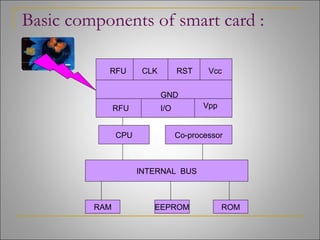
Basic components of smart card :
RFU
RFU
GND
CLK
I/O Vpp
VccRST
CPU
INTERNAL BUS
EEPROMRAM ROM
Co-processor
ISO Specifications :
 ISO has created standard #7816,that specifies the standards regarding
Smart Card chip organization.
 ISO specification for an 8-bit microprocessor card :
 Contact field #1 always supplies voltage to power the card.
 Contact field #2 resets the information on the card.
 Contact field #3 regulates the microprocessor speed by changing
clock frequency.
 Contact field #5 supplies the ground potential.
 Contact field #7 monitors all communications (serial input/output )
to and from the card.
 These 5 fields are fixed out of 8 & the rest 3 can be designed by the
manufacturers.
 Contact field #6 is given an external voltage for any programming
that needs to be done by the card.
 Contact field # 4 & Contact field #8 are reserved for future use.
How does a smart card works ?
CARD IS INSERTED IN
THE TERMINAL
CARD GETS POWER ,OS
BOOTS UP, SENDS ATR
(ANSWER TO RESET)
CARD RESPONDS WITH
AN ERROR (BECAUSE MF
SELECTION IS ONLY ON
PASSWORD PRESENTATION)
TERMINAL SENDS PASSWORD
FOR VERIFICATION
TERMINAL ASKS THE USER
FOR PASSWORD
TERMINAL SENDS FIRST
COMMAND TO SELECT MF
ATR NEGOTIATES TO SETUP
DATA TRANSFER SPEEDS,
CAPABILITY
TERMINAL SENDS COMMAND
TO SELECT MF AGAIN
TERMINAL SENDS PASSWORD FOR
VERIFICATION
CARD VERIFIES PW,STORES
A STATUS ‘PW VERIFIED’
RESPONDS’OK’
CARD RESPONDS ‘OK’
CARD SUPPLIES
PERSONAL DATA
AND RESPONDS ‘OK’
Smart card Technology :
 The information or application
stored in the IC chip is transferred
through an electronic module that
interconnects with a terminal or card
reader.
 Two general categories of smart
cards according to compactness of
card with card reader ;
 A. CONTACT SMART CARD
 It must be inserted into a
smart card reader with a
direct
connection to a conductive gold
plated electrical contacts
embedded inside it.
 E.g., GSM SIM CARD in
mobile phone.
Adapted from : http://www.smartcardalliance.org/pages/smart-cards-intro-primer
 B.CONTACTLESS
SMART CARD
 It requires only close
proximity
to a card reader
 Card must have a micro
strip antenna.
 Communicates using RF
technology.
 The card derive power for
the chip form
electromagnetic signal.
 E.g., Mass transit toll
collection
Adapted from : http://www.smartcardalliance.org/pages/smart-cards-intro-primer
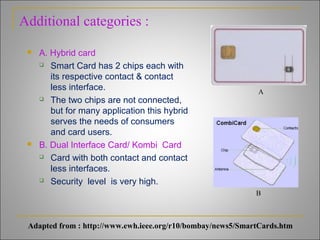
Additional categories :
 A. Hybrid card
 Smart Card has 2 chips each with
its respective contact & contact
less interface.
 The two chips are not connected,
but for many application this hybrid
serves the needs of consumers
and card users.
 B. Dual Interface Card/ Kombi Card
 Card with both contact and contact
less interfaces.
 Security level is very high.
Adapted from : http://www.ewh.ieee.org/r10/bombay/news5/SmartCards.htm
A
B
According to functionality of chip :
 A. IC Microprocessor Cards
 Both storage & data processing (addition, deletion
&manipulation) is possible.
 8-bit processor,32KB ROM,512Bytes of RAM is present.
 B. IC Memory Cards
 It is a memory chip with non programmable logic.
 Only storage of data is possible.
 1-4KB data can be stored.
 C. Optical Memory Cards
 It is a card with a piece of a CD glued on the top.
 Once written , data cannot be changed or removed.
 Data storage is up to 4MB.
Advantages :
 Proven to be more reliable than the magnetic stripe
card .
 Can store up to thousands of times of the information
than the magnetic stripe card.
 Reduces tampering through high security mechanism.
 Can be disposable or reusable.
 Performs multiple functions.
 Compatible with portable electronic devices (e.g.,
PCs, telephones)
Disadvantages :
 Smart card technologies will prove to be the killer
application for the networked economy.
 It may replace the magnetic stripe card technology
which is most popularly used now-a-days.
Adapted from : http://www.iec.org/online/tutorials/smartcard/topic02.html
Applications of Smart Card :
 Telephony
 Healthcare Services
 Registration Certificates
 Driving License
 Institute ID Card
 ATM
 Shopping
 Computer Networks
Contd…
Adapted from : http://www.smartcomputing.com/articles/archive/r0403/35r03/35r03.pdfguid=
Contd…
Adapted from : http://www.smartcomputing.com/articles/archive/r0403/35r03/35r03.pdfguid=
An Application showing Institute ID
card :
MF
DF1
(LIBRARY)
EF1(ISSUED RECORD )
Books
Book1
Book2
Book3
Date Of
issue
Date of
return
EF2(Inforation)
Max.Duration:
21 DAYS
Max.Books:4
EF3:Keys
K1: Issue Staff Key
K2:Admin Staff Key
Modifiable by issue
Staff Read :ALL
EF1(Personal Data)
EF1(Address)
EF1(Password)
EF1(Key)
Conclusion :
 The Biometrics (i.e., fingerprint, voice etc.) will help to
identify a person which may prove to be the boon for
security of information.
 Thus the “Smartness” of smart cards comes from the
integrated circuit embedded in the plastic card.
References :
[1] http://www.iec.org/online/tutorials/smartcard/topic02.html
[2] http://www.ewh.ieee.org/r10/bombay/news5/SmartCards.htm
[3] http://www.smartcardalliance.org/pages/smart-cards-intro-primer
[4] http:://w:/www.smartcomputing.com/articles/archive/r0403/35r03/35r03.pdfguid=
[5] http://home.dei.polimi.it/zanero/papers/security.pdf
[6] http://www.citi.umich.edu/projects/smartcard/smartcard_seminar/14.html
Smart card

Smart card

  • 1.
    Seminar on SMART CARD (The TechnologyOf Secure Information Exchange) PRESENTED BY Saumya Ranjan Behura Adapted from : http://www.citi.umich.edu/projects/smartcard/smartcard_seminar/14.html
  • 2.
    Talk Flow : What is smart card ?  Construction of Smart card  Typical smart card dimension  Functional chip of smart card  Basic components of smart card  ISO Specifications  How does a smart card works ?  Smart card Technology  Categories of Smart Card  Advantages & Disadvantages  Applications  Conclusion
  • 3.
    Introduction : Smart cardswere introduced in Europe in the beginning of 1990s,basically to reduce theft and fraud in payphones. WHAT IS A SMART CARD ?  It is like an “electronic wallet”.  A standard credit card sized plastic intelligent token within which Si microchip is embedded.  It has a memory & an operating system.  Operating system provides standard way of exchanging information.  Memory provides the space for storage of data.  The chip also contains advanced security features that protects card’s data.
  • 4.
    Construction of Smartcard :  The main storage area in the card is normally EEPROM, which can have its contents updated, and retains current contents when external power is removed.  The information or application stored in the IC chip is transferred through an electronic module. Adapted from : http://www.ewh.ieee.org/r10/bombay/news5/SmartCards.htm Smart Card Construction.
  • 5.
    Typical smart carddimension: Adapted from : http://www.smartcomputing.com/articles/archive/r0403/35r03/35r03.pdfguid=
  • 6.
    Functional chip ofsmart card : Adapted from : http://www.smartcomputing.com/articles/archive/r0403/35r03/35r03.pdfguid=
  • 7.
    Basic components ofsmart card : RFU RFU GND CLK I/O Vpp VccRST CPU INTERNAL BUS EEPROMRAM ROM Co-processor
  • 8.
    ISO Specifications : ISO has created standard #7816,that specifies the standards regarding Smart Card chip organization.  ISO specification for an 8-bit microprocessor card :  Contact field #1 always supplies voltage to power the card.  Contact field #2 resets the information on the card.  Contact field #3 regulates the microprocessor speed by changing clock frequency.  Contact field #5 supplies the ground potential.  Contact field #7 monitors all communications (serial input/output ) to and from the card.  These 5 fields are fixed out of 8 & the rest 3 can be designed by the manufacturers.  Contact field #6 is given an external voltage for any programming that needs to be done by the card.  Contact field # 4 & Contact field #8 are reserved for future use.
  • 9.
    How does asmart card works ? CARD IS INSERTED IN THE TERMINAL CARD GETS POWER ,OS BOOTS UP, SENDS ATR (ANSWER TO RESET) CARD RESPONDS WITH AN ERROR (BECAUSE MF SELECTION IS ONLY ON PASSWORD PRESENTATION) TERMINAL SENDS PASSWORD FOR VERIFICATION TERMINAL ASKS THE USER FOR PASSWORD TERMINAL SENDS FIRST COMMAND TO SELECT MF ATR NEGOTIATES TO SETUP DATA TRANSFER SPEEDS, CAPABILITY TERMINAL SENDS COMMAND TO SELECT MF AGAIN TERMINAL SENDS PASSWORD FOR VERIFICATION CARD VERIFIES PW,STORES A STATUS ‘PW VERIFIED’ RESPONDS’OK’ CARD RESPONDS ‘OK’ CARD SUPPLIES PERSONAL DATA AND RESPONDS ‘OK’
  • 10.
    Smart card Technology:  The information or application stored in the IC chip is transferred through an electronic module that interconnects with a terminal or card reader.  Two general categories of smart cards according to compactness of card with card reader ;  A. CONTACT SMART CARD  It must be inserted into a smart card reader with a direct connection to a conductive gold plated electrical contacts embedded inside it.  E.g., GSM SIM CARD in mobile phone. Adapted from : http://www.smartcardalliance.org/pages/smart-cards-intro-primer
  • 11.
     B.CONTACTLESS SMART CARD It requires only close proximity to a card reader  Card must have a micro strip antenna.  Communicates using RF technology.  The card derive power for the chip form electromagnetic signal.  E.g., Mass transit toll collection Adapted from : http://www.smartcardalliance.org/pages/smart-cards-intro-primer
  • 12.
    Additional categories : A. Hybrid card  Smart Card has 2 chips each with its respective contact & contact less interface.  The two chips are not connected, but for many application this hybrid serves the needs of consumers and card users.  B. Dual Interface Card/ Kombi Card  Card with both contact and contact less interfaces.  Security level is very high. Adapted from : http://www.ewh.ieee.org/r10/bombay/news5/SmartCards.htm A B
  • 13.
    According to functionalityof chip :  A. IC Microprocessor Cards  Both storage & data processing (addition, deletion &manipulation) is possible.  8-bit processor,32KB ROM,512Bytes of RAM is present.  B. IC Memory Cards  It is a memory chip with non programmable logic.  Only storage of data is possible.  1-4KB data can be stored.  C. Optical Memory Cards  It is a card with a piece of a CD glued on the top.  Once written , data cannot be changed or removed.  Data storage is up to 4MB.
  • 14.
    Advantages :  Provento be more reliable than the magnetic stripe card .  Can store up to thousands of times of the information than the magnetic stripe card.  Reduces tampering through high security mechanism.  Can be disposable or reusable.  Performs multiple functions.  Compatible with portable electronic devices (e.g., PCs, telephones)
  • 15.
    Disadvantages :  Smartcard technologies will prove to be the killer application for the networked economy.  It may replace the magnetic stripe card technology which is most popularly used now-a-days.
  • 16.
    Adapted from :http://www.iec.org/online/tutorials/smartcard/topic02.html
  • 17.
    Applications of SmartCard :  Telephony  Healthcare Services  Registration Certificates  Driving License  Institute ID Card  ATM  Shopping  Computer Networks
  • 18.
    Contd… Adapted from :http://www.smartcomputing.com/articles/archive/r0403/35r03/35r03.pdfguid=
  • 19.
    Contd… Adapted from :http://www.smartcomputing.com/articles/archive/r0403/35r03/35r03.pdfguid=
  • 20.
    An Application showingInstitute ID card : MF DF1 (LIBRARY) EF1(ISSUED RECORD ) Books Book1 Book2 Book3 Date Of issue Date of return EF2(Inforation) Max.Duration: 21 DAYS Max.Books:4 EF3:Keys K1: Issue Staff Key K2:Admin Staff Key Modifiable by issue Staff Read :ALL EF1(Personal Data) EF1(Address) EF1(Password) EF1(Key)
  • 21.
    Conclusion :  TheBiometrics (i.e., fingerprint, voice etc.) will help to identify a person which may prove to be the boon for security of information.  Thus the “Smartness” of smart cards comes from the integrated circuit embedded in the plastic card.
  • 22.
    References : [1] http://www.iec.org/online/tutorials/smartcard/topic02.html [2]http://www.ewh.ieee.org/r10/bombay/news5/SmartCards.htm [3] http://www.smartcardalliance.org/pages/smart-cards-intro-primer [4] http:://w:/www.smartcomputing.com/articles/archive/r0403/35r03/35r03.pdfguid= [5] http://home.dei.polimi.it/zanero/papers/security.pdf [6] http://www.citi.umich.edu/projects/smartcard/smartcard_seminar/14.html