Oscilloscope Tutorial
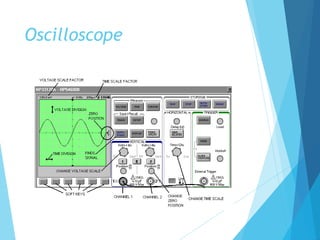
 The oscilloscope is basically a graph-displaying device
 It draws a graph of an electrical signal.
 In most applications the graph shows how signals change
over time:
 the vertical (Y) axis represents voltage
 the horizontal (X) axis represents time. 65
 56
 45
 453
 6
 56
 35
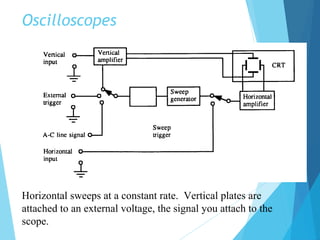
Oscilloscopes
Horizontal sweeps at a constant rate. Vertical plates are
attached to an external voltage, the signal you attach to the
scope.
Scope (Con’t)
 This simple graph can tell you many things
about a signal:
 You can determine the time and voltage values of
a signal.
 You can calculate the frequency of an oscillating
signal.
 You can see the "moving parts" of a circuit
represented by the signal.
 You can tell if a malfunctioning component is
distorting the signal.
 You can find out how much of a signal is direct
current (DC) or alternating current (AC).
 You can tell how much of the signal is noise and
whether the noise is changing with time.
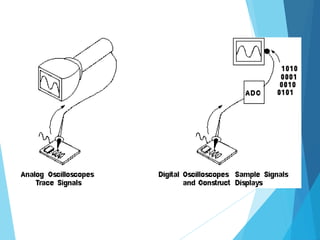
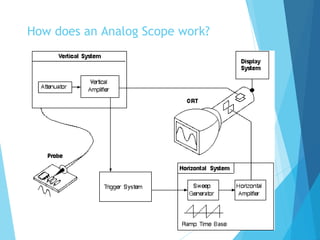
How does an Analog Scope work?
How does a Digital Scope work?
Triggering Stabilizes a Repeating
Waveform
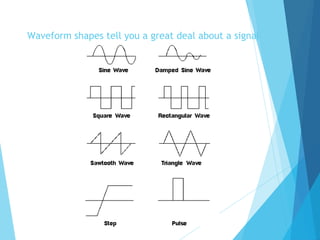
Waveform shapes tell you a great deal about a signal
If a signal repeats, it has a frequency. The frequency is
measured in Hertz (Hz) and equals the number of times the
signal repeats itself in one second
Voltage, Current, & Phase
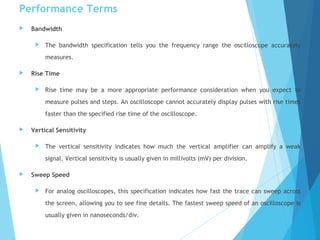
Performance Terms
 Bandwidth
 The bandwidth specification tells you the frequency range the oscilloscope accurately
measures.
 Rise Time
 Rise time may be a more appropriate performance consideration when you expect to
measure pulses and steps. An oscilloscope cannot accurately display pulses with rise times
faster than the specified rise time of the oscilloscope.
 Vertical Sensitivity
 The vertical sensitivity indicates how much the vertical amplifier can amplify a weak
signal. Vertical sensitivity is usually given in millivolts (mV) per division.
 Sweep Speed
 For analog oscilloscopes, this specification indicates how fast the trace can sweep across
the screen, allowing you to see fine details. The fastest sweep speed of an oscilloscope is
usually given in nanoseconds/div.
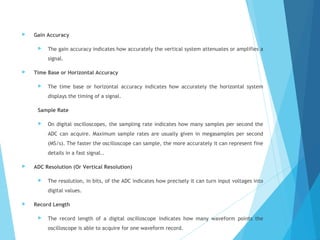
 Gain Accuracy
 The gain accuracy indicates how accurately the vertical system attenuates or amplifies a
signal.
 Time Base or Horizontal Accuracy
 The time base or horizontal accuracy indicates how accurately the horizontal system
displays the timing of a signal.
Sample Rate
 On digital oscilloscopes, the sampling rate indicates how many samples per second the
ADC can acquire. Maximum sample rates are usually given in megasamples per second
(MS/s). The faster the oscilloscope can sample, the more accurately it can represent fine
details in a fast signal..
 ADC Resolution (Or Vertical Resolution)
 The resolution, in bits, of the ADC indicates how precisely it can turn input voltages into
digital values.
 Record Length
 The record length of a digital oscilloscope indicates how many waveform points the
oscilloscope is able to acquire for one waveform record.
Grounding
 Proper grounding is an important step when setting up to take measurements.
 Properly grounding the oscilloscope protects you from a hazardous shock and protects
your circuits from damage.
 Grounding the oscilloscope is necessary for safety. If a high voltage contacts the case of
an ungrounded oscilloscope, any part of the case, including knobs that appear
insulated, it can give you a shock. However, with a properly grounded oscilloscope, the
current travels through the grounding path to earth ground rather than through you to
earth ground.
 To ground the oscilloscope means to connect it to an electrically neutral reference
point (such as earth ground). Ground your oscilloscope by plugging its three-pronged
power cord into an outlet grounded to earth ground.
 Grounding is also necessary for taking accurate measurements with your oscilloscope.
The oscilloscope needs to share the same ground as any circuits you are testing.
 Some oscilloscopes do not require the separate connection to earth ground. These
oscilloscopes have insulated cases and controls, which keeps any possible shock hazard
away from the user.
Scope Probes
Most passive probes have some degree of attenuation factor, such as
10X, 100X, and so on. By convention, attenuation factors, such as for the
10X attenuator probe, have the X after the factor.
In contrast, magnification factors like X10 have the X first
Vertical Controls
 Position and Volts per Division
 The vertical position control lets you move the
waveform up or down to exactly where you want it
on the screen.
 The volts per division (usually written volts/div)
setting varies the size of the waveform on the
screen. A good general purpose oscilloscope can
accurately display signal levels from about 4
millivolts to 40 volts.
 Often the volts/div scale has either a variable gain
or a fine gain control for scaling a displayed signal to
a certain number of divisions.
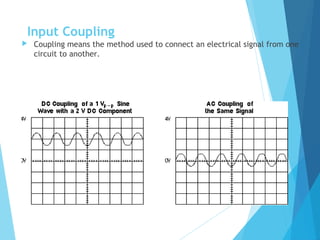
Input Coupling
 Coupling means the method used to connect an electrical signal from one
circuit to another.
Horizontal Controls
 Position and Seconds per Division
 The horizontal position control moves the waveform from left
and right to exactly where you want it on the screen.
 The seconds per division (usually written as sec/div) setting
lets you select the rate at which the waveform is drawn
across the screen (also known as the time base setting or
sweep speed). This setting is a scale factor. For example, if
the setting is 1 ms, each horizontal division represents 1 ms
and the total screen width represents 10 ms (ten divisions).
Changing the sec/div setting lets you look at longer or shorter
time intervals of the input signal.
Trigger Position
 The trigger position control may be located in the horizontal control section of
your oscilloscope. It actually represents "the horizontal position of the trigger in
the waveform record." Horizontal trigger position control is only available on
digital oscilloscopes.
 Varying the horizontal trigger position allows you to capture what a signal did
before a trigger event (called pretrigger viewing).
 Digital oscilloscopes can provide pretrigger viewing because they constantly
process the input signal whether a trigger has been received or not. A steady
stream of data flows through the oscilloscope; the trigger merely tells the
oscilloscope to save the present data in memory. I
 n contrast, analog oscilloscopes only display the signal after receiving the
trigger.
Trigger Controls (con’t)
Pulse and Rise Time Measurements
Multimeter tutorial
 A meter is a measuring instrument. An ammeter
measures current, a voltmeter measures the potential
difference (voltage) between two points, and an
ohmmeter measures resistance.
 A multimeter combines these functions, and possibly
some additional ones as well, into a single instrument.
To measure current, the circuit must be broken to allow
the
ammeter to be connected in series
Ammeters must have a LOW resistance
To measure potential difference (voltage), the circuit is not
changed: the voltmeter is connected in parallel
Voltmeters must have a HIGH resistance
To measure resistance, the component must be removed
from the circuit altogether
Ohmmeters work by passing a current through the
component being tested
Digital Multimeters
Digital meters give an output in numbers, usually on a liquid
crystal display.
Most modern multimeters are digital and traditional
analogue types are destined to become obsolete.
Digital multimeters come in a wide range of sizes and
capability. Everything from simple 3 ½ digit auto ranging
pocket meters to larger 8 ½ digit bench model with
operator or computer (IEEE488 compatible) settable range
selection
Function Generator
 An electronic instrument that generates various
waveforms such as
 Sine wave
 Square wave
 Pulse trains
 Sawtooth
 The amplitude, DC offset, frequency are adjustable.
Function Generators (con’t)
 Like multimeters there is a wide variety of device
offering various
 Amplitude characteristics
 Bandwidth
 Adjustments of rise and fall times
 Modulation capability (AM, FM, Pulse, etc.)
Power Supply
 This is the device that transfers electric power from a source to a load using
electronic circuits.
 Typical application of power supplies is to convert utility's AC input power to a
regulated voltage(s) required for electronic equipment.
 Depending on the mode of operation of power semiconductors PS can be linear or
switching.
 In a switched-mode power supply, or SMPS power handling electronic
components are continuously switching on and off with high frequency in order to
provide the transfer of electric energy. By varying duty cycle, frequency or a
phase of these transitions an output parameter (such as output voltage) is
controlled. Typical frequency range of SMPS is from 20 kHz to several MHz.
Power Supply (con’t)
 Power supplies like many of the other electronic instruments, come in
many varieties with a wide range of capabilities:
 Parameters that are Power Supply specific include:
 Voltage levels
 Current
 Regulation
 Protection
 Output impedance
 Noise (ripple)
 It’s the designer (or researcher) responsibility to identify the
characteristics required.
Oscilloscope
Oscilloscope(continue)
DEMO…….Lab3a
Oscilloscope tutorial

Oscilloscope tutorial

  • 1.
    Oscilloscope Tutorial  Theoscilloscope is basically a graph-displaying device  It draws a graph of an electrical signal.  In most applications the graph shows how signals change over time:  the vertical (Y) axis represents voltage  the horizontal (X) axis represents time. 65  56  45  453  6  56  35
  • 2.
    Oscilloscopes Horizontal sweeps ata constant rate. Vertical plates are attached to an external voltage, the signal you attach to the scope.
  • 4.
    Scope (Con’t)  Thissimple graph can tell you many things about a signal:  You can determine the time and voltage values of a signal.  You can calculate the frequency of an oscillating signal.  You can see the "moving parts" of a circuit represented by the signal.  You can tell if a malfunctioning component is distorting the signal.  You can find out how much of a signal is direct current (DC) or alternating current (AC).  You can tell how much of the signal is noise and whether the noise is changing with time.
  • 6.
    How does anAnalog Scope work?
  • 7.
    How does aDigital Scope work?
  • 8.
    Triggering Stabilizes aRepeating Waveform
  • 9.
    Waveform shapes tellyou a great deal about a signal
  • 10.
    If a signalrepeats, it has a frequency. The frequency is measured in Hertz (Hz) and equals the number of times the signal repeats itself in one second
  • 11.
  • 12.
    Performance Terms  Bandwidth The bandwidth specification tells you the frequency range the oscilloscope accurately measures.  Rise Time  Rise time may be a more appropriate performance consideration when you expect to measure pulses and steps. An oscilloscope cannot accurately display pulses with rise times faster than the specified rise time of the oscilloscope.  Vertical Sensitivity  The vertical sensitivity indicates how much the vertical amplifier can amplify a weak signal. Vertical sensitivity is usually given in millivolts (mV) per division.  Sweep Speed  For analog oscilloscopes, this specification indicates how fast the trace can sweep across the screen, allowing you to see fine details. The fastest sweep speed of an oscilloscope is usually given in nanoseconds/div.
  • 13.
     Gain Accuracy The gain accuracy indicates how accurately the vertical system attenuates or amplifies a signal.  Time Base or Horizontal Accuracy  The time base or horizontal accuracy indicates how accurately the horizontal system displays the timing of a signal. Sample Rate  On digital oscilloscopes, the sampling rate indicates how many samples per second the ADC can acquire. Maximum sample rates are usually given in megasamples per second (MS/s). The faster the oscilloscope can sample, the more accurately it can represent fine details in a fast signal..  ADC Resolution (Or Vertical Resolution)  The resolution, in bits, of the ADC indicates how precisely it can turn input voltages into digital values.  Record Length  The record length of a digital oscilloscope indicates how many waveform points the oscilloscope is able to acquire for one waveform record.
  • 14.
    Grounding  Proper groundingis an important step when setting up to take measurements.  Properly grounding the oscilloscope protects you from a hazardous shock and protects your circuits from damage.  Grounding the oscilloscope is necessary for safety. If a high voltage contacts the case of an ungrounded oscilloscope, any part of the case, including knobs that appear insulated, it can give you a shock. However, with a properly grounded oscilloscope, the current travels through the grounding path to earth ground rather than through you to earth ground.  To ground the oscilloscope means to connect it to an electrically neutral reference point (such as earth ground). Ground your oscilloscope by plugging its three-pronged power cord into an outlet grounded to earth ground.  Grounding is also necessary for taking accurate measurements with your oscilloscope. The oscilloscope needs to share the same ground as any circuits you are testing.  Some oscilloscopes do not require the separate connection to earth ground. These oscilloscopes have insulated cases and controls, which keeps any possible shock hazard away from the user.
  • 15.
    Scope Probes Most passiveprobes have some degree of attenuation factor, such as 10X, 100X, and so on. By convention, attenuation factors, such as for the 10X attenuator probe, have the X after the factor. In contrast, magnification factors like X10 have the X first
  • 16.
    Vertical Controls  Positionand Volts per Division  The vertical position control lets you move the waveform up or down to exactly where you want it on the screen.  The volts per division (usually written volts/div) setting varies the size of the waveform on the screen. A good general purpose oscilloscope can accurately display signal levels from about 4 millivolts to 40 volts.  Often the volts/div scale has either a variable gain or a fine gain control for scaling a displayed signal to a certain number of divisions.
  • 17.
    Input Coupling  Couplingmeans the method used to connect an electrical signal from one circuit to another.
  • 18.
    Horizontal Controls  Positionand Seconds per Division  The horizontal position control moves the waveform from left and right to exactly where you want it on the screen.  The seconds per division (usually written as sec/div) setting lets you select the rate at which the waveform is drawn across the screen (also known as the time base setting or sweep speed). This setting is a scale factor. For example, if the setting is 1 ms, each horizontal division represents 1 ms and the total screen width represents 10 ms (ten divisions). Changing the sec/div setting lets you look at longer or shorter time intervals of the input signal.
  • 19.
    Trigger Position  Thetrigger position control may be located in the horizontal control section of your oscilloscope. It actually represents "the horizontal position of the trigger in the waveform record." Horizontal trigger position control is only available on digital oscilloscopes.  Varying the horizontal trigger position allows you to capture what a signal did before a trigger event (called pretrigger viewing).  Digital oscilloscopes can provide pretrigger viewing because they constantly process the input signal whether a trigger has been received or not. A steady stream of data flows through the oscilloscope; the trigger merely tells the oscilloscope to save the present data in memory. I  n contrast, analog oscilloscopes only display the signal after receiving the trigger.
  • 20.
  • 21.
    Pulse and RiseTime Measurements
  • 22.
    Multimeter tutorial  Ameter is a measuring instrument. An ammeter measures current, a voltmeter measures the potential difference (voltage) between two points, and an ohmmeter measures resistance.  A multimeter combines these functions, and possibly some additional ones as well, into a single instrument.
  • 23.
    To measure current,the circuit must be broken to allow the ammeter to be connected in series Ammeters must have a LOW resistance
  • 24.
    To measure potentialdifference (voltage), the circuit is not changed: the voltmeter is connected in parallel Voltmeters must have a HIGH resistance
  • 25.
    To measure resistance,the component must be removed from the circuit altogether Ohmmeters work by passing a current through the component being tested
  • 26.
    Digital Multimeters Digital metersgive an output in numbers, usually on a liquid crystal display. Most modern multimeters are digital and traditional analogue types are destined to become obsolete. Digital multimeters come in a wide range of sizes and capability. Everything from simple 3 ½ digit auto ranging pocket meters to larger 8 ½ digit bench model with operator or computer (IEEE488 compatible) settable range selection
  • 27.
    Function Generator  Anelectronic instrument that generates various waveforms such as  Sine wave  Square wave  Pulse trains  Sawtooth  The amplitude, DC offset, frequency are adjustable.
  • 28.
    Function Generators (con’t) Like multimeters there is a wide variety of device offering various  Amplitude characteristics  Bandwidth  Adjustments of rise and fall times  Modulation capability (AM, FM, Pulse, etc.)
  • 29.
    Power Supply  Thisis the device that transfers electric power from a source to a load using electronic circuits.  Typical application of power supplies is to convert utility's AC input power to a regulated voltage(s) required for electronic equipment.  Depending on the mode of operation of power semiconductors PS can be linear or switching.  In a switched-mode power supply, or SMPS power handling electronic components are continuously switching on and off with high frequency in order to provide the transfer of electric energy. By varying duty cycle, frequency or a phase of these transitions an output parameter (such as output voltage) is controlled. Typical frequency range of SMPS is from 20 kHz to several MHz.
  • 30.
    Power Supply (con’t) Power supplies like many of the other electronic instruments, come in many varieties with a wide range of capabilities:  Parameters that are Power Supply specific include:  Voltage levels  Current  Regulation  Protection  Output impedance  Noise (ripple)  It’s the designer (or researcher) responsibility to identify the characteristics required.
  • 31.
  • 32.