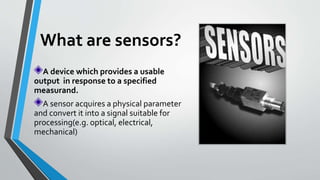
What are sensors?
A device which provides a usable
output in response to a specified
measurand.
A sensor acquires a physical parameter
and convert it into a signal suitable for
processing(e.g. optical, electrical,
mechanical)
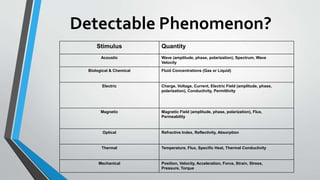
Detectable Phenomenon?
Stimulus Quantity
Acoustic Wave (amplitude, phase, polarization), Spectrum, Wave
Velocity
Biological & Chemical Fluid Concentrations (Gas or Liquid)
Electric Charge, Voltage, Current, Electric Field (amplitude, phase,
polarization), Conductivity, Permittivity
Magnetic Magnetic Field (amplitude, phase, polarization), Flux,
Permeability
Optical Refractive Index, Reflectivity, Absorption
Thermal Temperature, Flux, Specific Heat, Thermal Conductivity
Mechanical Position, Velocity, Acceleration, Force, Strain, Stress,
Pressure, Torque
Why we required?
Sensors are omnipresent. They
embedded in our bodies, automobiles,
airplanes, cellular telephones, radios,
chemical plants, industrial plants and
countless other applications.
Without the use of sensors, there
would be no
AUTOMATION!!
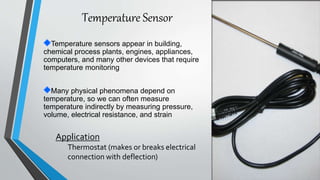
Temperature Sensor
Temperature sensors appear in building,
chemical process plants, engines, appliances,
computers, and many other devices that require
temperature monitoring
Many physical phenomena depend on
temperature, so we can often measure
temperature indirectly by measuring pressure,
volume, electrical resistance, and strain
Application
Thermostat (makes or breaks electrical
connection with deflection)
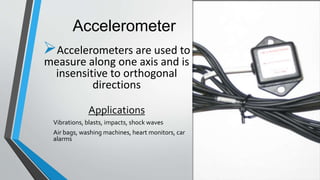
Accelerometer
Accelerometers are used to
measure along one axis and is
insensitive to orthogonal
directions
Applications
Vibrations, blasts, impacts, shock waves
Air bags, washing machines, heart monitors, car
alarms
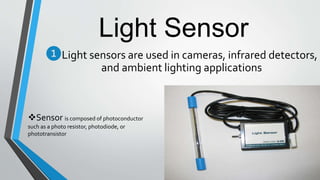
Light Sensor
❶Light sensors are used in cameras, infrared detectors,
and ambient lighting applications
Sensor is composed of photoconductor
such as a photo resistor, photodiode, or
phototransistor
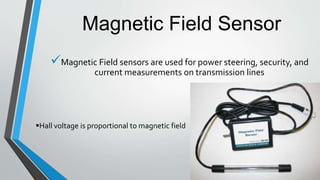
Magnetic Field Sensor
Magnetic Field sensors are used for power steering, security, and
current measurements on transmission lines
Hall voltage is proportional to magnetic field
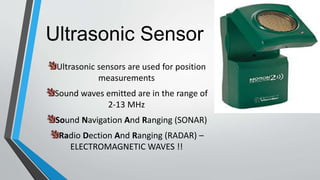
Ultrasonic Sensor
Ultrasonic sensors are used for position
measurements
Sound waves emitted are in the range of
2-13 MHz
Sound Navigation And Ranging (SONAR)
Radio Dection And Ranging (RADAR) –
ELECTROMAGNETIC WAVES !!
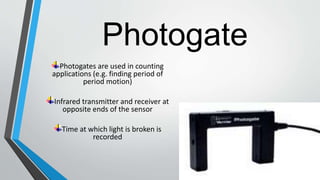
Photogate
Photogates are used in counting
applications (e.g. finding period of
period motion)
Infrared transmitter and receiver at
opposite ends of the sensor
Time at which light is broken is
recorded
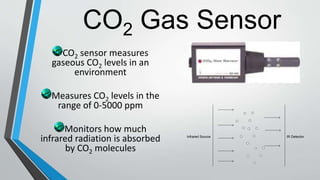
CO2 Gas Sensor
CO2 sensor measures
gaseous CO2 levels in an
environment
Measures CO2 levels in the
range of 0-5000 ppm
Monitors how much
infrared radiation is absorbed
by CO2 molecules
Infrared Source IR Detector
Sensors

Sensors

  • 2.
    What are sensors? Adevice which provides a usable output in response to a specified measurand. A sensor acquires a physical parameter and convert it into a signal suitable for processing(e.g. optical, electrical, mechanical)
  • 3.
    Detectable Phenomenon? Stimulus Quantity AcousticWave (amplitude, phase, polarization), Spectrum, Wave Velocity Biological & Chemical Fluid Concentrations (Gas or Liquid) Electric Charge, Voltage, Current, Electric Field (amplitude, phase, polarization), Conductivity, Permittivity Magnetic Magnetic Field (amplitude, phase, polarization), Flux, Permeability Optical Refractive Index, Reflectivity, Absorption Thermal Temperature, Flux, Specific Heat, Thermal Conductivity Mechanical Position, Velocity, Acceleration, Force, Strain, Stress, Pressure, Torque
  • 4.
    Why we required? Sensorsare omnipresent. They embedded in our bodies, automobiles, airplanes, cellular telephones, radios, chemical plants, industrial plants and countless other applications. Without the use of sensors, there would be no AUTOMATION!!
  • 5.
    Temperature Sensor Temperature sensorsappear in building, chemical process plants, engines, appliances, computers, and many other devices that require temperature monitoring Many physical phenomena depend on temperature, so we can often measure temperature indirectly by measuring pressure, volume, electrical resistance, and strain Application Thermostat (makes or breaks electrical connection with deflection)
  • 6.
    Accelerometer Accelerometers are usedto measure along one axis and is insensitive to orthogonal directions Applications Vibrations, blasts, impacts, shock waves Air bags, washing machines, heart monitors, car alarms
  • 7.
    Light Sensor ❶Light sensorsare used in cameras, infrared detectors, and ambient lighting applications Sensor is composed of photoconductor such as a photo resistor, photodiode, or phototransistor
  • 8.
    Magnetic Field Sensor MagneticField sensors are used for power steering, security, and current measurements on transmission lines Hall voltage is proportional to magnetic field
  • 9.
    Ultrasonic Sensor Ultrasonic sensorsare used for position measurements Sound waves emitted are in the range of 2-13 MHz Sound Navigation And Ranging (SONAR) Radio Dection And Ranging (RADAR) – ELECTROMAGNETIC WAVES !!
  • 10.
    Photogate Photogates are usedin counting applications (e.g. finding period of period motion) Infrared transmitter and receiver at opposite ends of the sensor Time at which light is broken is recorded
  • 11.
    CO2 Gas Sensor CO2sensor measures gaseous CO2 levels in an environment Measures CO2 levels in the range of 0-5000 ppm Monitors how much infrared radiation is absorbed by CO2 molecules Infrared Source IR Detector