RaoLal SinghCollegeof Education, Sidhrawali, Gurugram, Haryana
Topic: PavlovclassicalConditioning
MADE BY – KHEMA (2nd year)
Learning
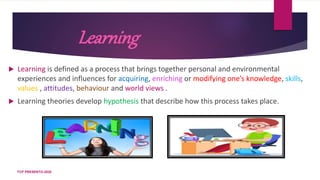
 Learning is defined as a process that brings together personal and environmental
experiences and influences for acquiring, enriching or modifying one’s knowledge, skills,
values , attitudes, behaviour and world views .
 Learning theories develop hypothesis that describe how this process takes place.
TCP PRESENTO-2020
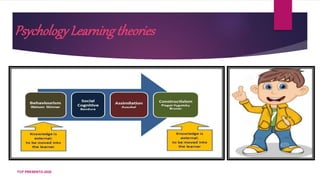
Psychology Learningtheories
TCP PRESENTO-2020
Conditioning
introduction
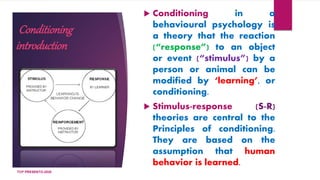
 Conditioning in a
behavioural psychology is
a theory that the reaction
(“response”) to an object
or event (“stimulus”) by a
person or animal can be
modified by ‘learning’, or
conditioning.
 Stimulus-response (S-R)
theories are central to the
Principles of conditioning.
They are based on the
assumption that human
behavior is learned.
TCP PRESENTO-2020
Classical ConditioningTheory
 Classical Conditioning is a type of learning that had a major influence on
the school of thought in psychology known as behaviourism discovered
by Russian psychologist Ivan Pavlov, classical conditioning is a learning
process that occurs through associations between an environmental
stimulus and a naturally occurring stimulus.
 This theories is also known as Classical Conditioning Theory,
Conditioning Response Theory, Conditioned Reflex Theory, Substitution
Of Response Theory, S-Type Conditioning Theory.
TCP PRESENTO-2020
BackgroundinformationOf
Ivanpavlov
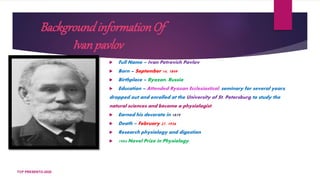
 Full Name – Ivan Petrovich Pavlov
 Born – September 14, 1849
 Birthplace – Ryazan, Russia
 Education – Attended Ryazan Ecclesiastical, seminary for several years,
dropped out and enrolled at the University of St. Petersburg to study the
natural sciences and become a physiologist.
 Earned his decorate in 1879
 Death – February 27, 1936
 Research physiology and digestion
 1904 Novel Prize in Physiology.
TCP PRESENTO-2020
BasicsOf
ClassicalConditioning
 Classical Conditioning was not discovered by a psychologist at all, it had a
tremendous influence over the school of thought in psychology known as
Behaviourism.
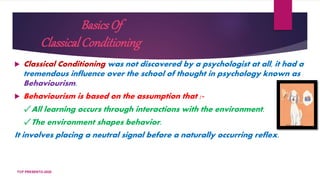
 Behaviourism is based on the assumption that :-
✓ All learning occurs through interactions with the environment.
✓ The environment shapes behavior.
It involves placing a neutral signal before a naturally occurring reflex.
TCP PRESENTO-2020
ThePavlovDog’sEXPERIMENT
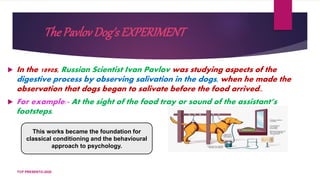
 In the 1890s, Russian Scientist Ivan Pavlov was studying aspects of the
digestive process by observing salivation in the dogs, when he made the
observation that dogs began to salivate before the food arrived..
 For example:- At the sight of the food tray or sound of the assistant’s
footsteps.
This works became the foundation for
classical conditioning and the behavioural
approach to psychology.
TCP PRESENTO-2020
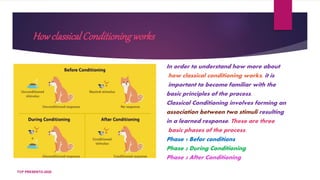
Howclassical Conditioningworks
In order to understand how more about
how classical conditioning works, it is
important to become familiar with the
basic principles of the process.
Classical Conditioning involves forming an
association between two stimuli resulting
in a learned response. These are three
basic phases of the process.
Phase 1 Befor conditions
Phase 2 During Conditioning
Phase 3 After Conditioning
TCP PRESENTO-2020
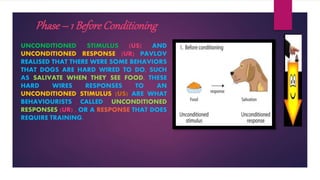
Phase – 1 BeforeConditioning
UNCONDITIONED STIMULUS (US) AND
UNCONDITIONED RESPONSE (UR) PAVLOV
REALISED THAT THERE WERE SOME BEHAVIORS
THAT DOGS ARE HARD WIRED TO DO, SUCH
AS SALIVATE WHEN THEY SEE FOOD. THESE
HARD WIRES RESPONSES TO AN
UNCONDITIONED STIMULUS (US) ARE WHAT
BEHAVIOURISTS CALLED UNCONDITIONED
RESPONSES (UR) , OR A RESPONSE THAT DOES
REQUIRE TRAINING.
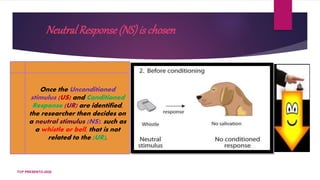
Neutral Response (NS) is chosen
Once the Unconditioned
stimulus (US) and Conditioned
Response (UR) are identified,
the researcher then decides on
a neutral stimulus (NS), such as
a whistle or bell, that is not
related to the (UR).
TCP PRESENTO-2020
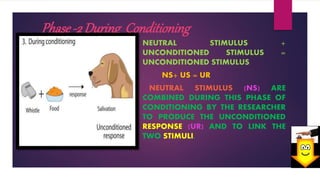
Phase -2 During Conditioning
NEUTRAL STIMULUS +
UNCONDITIONED STIMULUS =
UNCONDITIONED STIMULUS
. NS+ US = UR
NEUTRAL STIMULUS (NS) ARE
COMBINED DURING THIS PHASE OF
CONDITIONING BY THE RESEARCHER
TO PRODUCE THE UNCONDITIONED
RESPONSE (UR) AND TO LINK THE
TWO STIMULI.
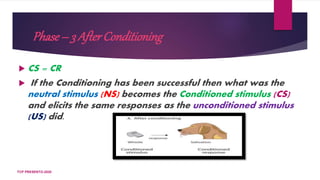
Phase– 3 AfterConditioning
 CS = CR
 If the Conditioning has been successful then what was the
neutral stimulus (NS) becomes the Conditioned stimulus (CS)
and elicits the same responses as the unconditioned stimulus
(US) did.
TCP PRESENTO-2020
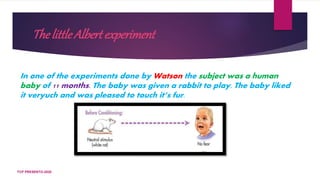
ThelittleAlbertexperiment
In one of the experiments done by Watson the subject was a human
baby of 11 months. The baby was given a rabbit to play. The baby liked
it veryuch and was pleased to touch it’s fur.
TCP PRESENTO-2020
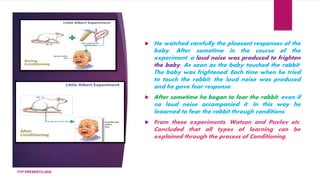
 He watched carefully the pleasant responses of the
baby. After sometime in the course of the
experiment, a loud noise was produced to frighten
the baby. As soon as the baby touched the rabbit.
The baby was frightened. Each time when he tried
to touch the rabbit, the loud noise was produced
and he gave fear response.
 After sometime he began to fear the rabbit, even if
no loud noise accompanied it. In this way he
leaarned to fear the rabbit through conditions.
 From these experiments, Watson and Pavlov etc.
Concluded that all types of learning can be
explained through the process of Conditioning.
TCP PRESENTO-2020
Principlesof
classical Conditioning
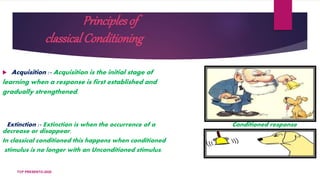
 Acquisition :- Acquisition is the initial stage of
learning when a response is first established and
gradually strengthened.
Extinction :- Extinction is when the occurrence of a Conditioned response
decrease or disappear.
In classical conditioned this happens when conditioned
stimulus is no longer with an Unconditioned stimulus.
TCP PRESENTO-2020
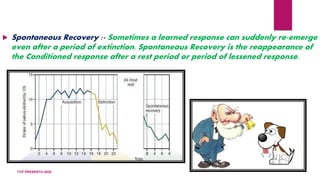
 Spontaneous Recovery :- Sometimes a learned response can suddenly re-emerge
even after a period of extinction. Spontaneous Recovery is the reappearance of
the Conditioned response after a rest period or period of lessened response.
TCP PRESENTO-2020
 Stimulus Generalization :- Stimulus generalization is the
tendency for the Conditioned stimulus to evoke similar
responses after the response has baeen conditioned.
 Stimulus Discrimination :- Discrimination is the ability to
differentiate between a conditioned stimulus and other
stimuli that have not been paired with an Unconditioned
stimulus.
TCP PRESENTO-2020
Factorsof Conditioning
 Relationship of time with two stimuli:- In Pavlov’s experiment, natural stimulus i.e, food
and ringing of bell, i.e, artificial stimulus go simultaneously from “time” point if view for.
This reason the artificial stimulus creates the similar effect.
 Intensity of stimuli :- It has been found that a response will occur when the natural stimulus
along with artificial stimulus would be sufficiently strong.
 Repetition of stimuli. :- When the stimuli are repeated i.e, when the stimuli are presented
again and again. Then the response gets associated with it.
controlled response gets continued, the learnt behaviour becomes strong.
Controlled environment should be necessary for the process of Conditioning
TCP PRESENTO-2020
 Strong artificial stimulus :- CS evokes a conditioned response CR or conditioned reflex.
The purpose of the experiment was to motivate or condition the dog to react to the
bell in the same way as it reacted to the meat powder only.
 Mental and physical health :- Mental and physical health are essential for human
being. Example :- In Pavlov’s experiment, if the dog does not have good health and if
the dog does not have interest in food, then the response in the form of secretion of
saliva would have not been Conditioned to the ringing of bell.
 Individual differences:- There are individual differences in the view points or attitudes
to words conditioned response.
TCP PRESENTO-2020
Educational implications
 This theory is helpful in developing different types of
aptitudes in children.
 Good habits can be developed in children on the basis of
conditioned response theory.
 The spirit of discipline can be inculcated in children with the
help of this theory.
 The teacher can use this theory to conduct teaching work
keeping the individual differences of the children in mind.
 The teacher can also use this theory for eradicading
children’s fear etc.
TCP PRESENTO-2020
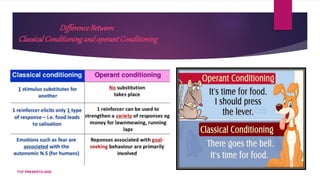
DifferenceBetween
ClassicalConditioningandoperantConditioning
TCP PRESENTO-2020
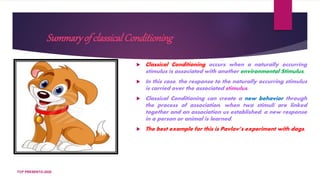
SummaryofclassicalConditioning
 Classical Conditioning occurs when a naturally occurring
stimulus is associated with another environmental Stimulus.
 In this case, the response to the naturally occurring stimulus
is carried over the associated stimulus.
 Classical Conditioning can create a new behavior through
the process of association, when two stimuli are linked
together and an association us established, a new response
in a person or animal is learned.
 The best example for this is Pavlov’s experiment with dogs.
TCP PRESENTO-2020

CLASSICAL CONDITIONING THEORY

  • 1.
    RaoLal SinghCollegeof Education,Sidhrawali, Gurugram, Haryana Topic: PavlovclassicalConditioning MADE BY – KHEMA (2nd year)
  • 2.
    Learning  Learning isdefined as a process that brings together personal and environmental experiences and influences for acquiring, enriching or modifying one’s knowledge, skills, values , attitudes, behaviour and world views .  Learning theories develop hypothesis that describe how this process takes place. TCP PRESENTO-2020
  • 3.
  • 4.
    Conditioning introduction  Conditioning ina behavioural psychology is a theory that the reaction (“response”) to an object or event (“stimulus”) by a person or animal can be modified by ‘learning’, or conditioning.  Stimulus-response (S-R) theories are central to the Principles of conditioning. They are based on the assumption that human behavior is learned. TCP PRESENTO-2020
  • 5.
    Classical ConditioningTheory  ClassicalConditioning is a type of learning that had a major influence on the school of thought in psychology known as behaviourism discovered by Russian psychologist Ivan Pavlov, classical conditioning is a learning process that occurs through associations between an environmental stimulus and a naturally occurring stimulus.  This theories is also known as Classical Conditioning Theory, Conditioning Response Theory, Conditioned Reflex Theory, Substitution Of Response Theory, S-Type Conditioning Theory. TCP PRESENTO-2020
  • 6.
    BackgroundinformationOf Ivanpavlov  Full Name– Ivan Petrovich Pavlov  Born – September 14, 1849  Birthplace – Ryazan, Russia  Education – Attended Ryazan Ecclesiastical, seminary for several years, dropped out and enrolled at the University of St. Petersburg to study the natural sciences and become a physiologist.  Earned his decorate in 1879  Death – February 27, 1936  Research physiology and digestion  1904 Novel Prize in Physiology. TCP PRESENTO-2020
  • 7.
    BasicsOf ClassicalConditioning  Classical Conditioningwas not discovered by a psychologist at all, it had a tremendous influence over the school of thought in psychology known as Behaviourism.  Behaviourism is based on the assumption that :- ✓ All learning occurs through interactions with the environment. ✓ The environment shapes behavior. It involves placing a neutral signal before a naturally occurring reflex. TCP PRESENTO-2020
  • 8.
    ThePavlovDog’sEXPERIMENT  In the1890s, Russian Scientist Ivan Pavlov was studying aspects of the digestive process by observing salivation in the dogs, when he made the observation that dogs began to salivate before the food arrived..  For example:- At the sight of the food tray or sound of the assistant’s footsteps. This works became the foundation for classical conditioning and the behavioural approach to psychology. TCP PRESENTO-2020
  • 9.
    Howclassical Conditioningworks In orderto understand how more about how classical conditioning works, it is important to become familiar with the basic principles of the process. Classical Conditioning involves forming an association between two stimuli resulting in a learned response. These are three basic phases of the process. Phase 1 Befor conditions Phase 2 During Conditioning Phase 3 After Conditioning TCP PRESENTO-2020
  • 10.
    Phase – 1BeforeConditioning UNCONDITIONED STIMULUS (US) AND UNCONDITIONED RESPONSE (UR) PAVLOV REALISED THAT THERE WERE SOME BEHAVIORS THAT DOGS ARE HARD WIRED TO DO, SUCH AS SALIVATE WHEN THEY SEE FOOD. THESE HARD WIRES RESPONSES TO AN UNCONDITIONED STIMULUS (US) ARE WHAT BEHAVIOURISTS CALLED UNCONDITIONED RESPONSES (UR) , OR A RESPONSE THAT DOES REQUIRE TRAINING.
  • 11.
    Neutral Response (NS)is chosen Once the Unconditioned stimulus (US) and Conditioned Response (UR) are identified, the researcher then decides on a neutral stimulus (NS), such as a whistle or bell, that is not related to the (UR). TCP PRESENTO-2020
  • 12.
    Phase -2 DuringConditioning NEUTRAL STIMULUS + UNCONDITIONED STIMULUS = UNCONDITIONED STIMULUS . NS+ US = UR NEUTRAL STIMULUS (NS) ARE COMBINED DURING THIS PHASE OF CONDITIONING BY THE RESEARCHER TO PRODUCE THE UNCONDITIONED RESPONSE (UR) AND TO LINK THE TWO STIMULI.
  • 13.
    Phase– 3 AfterConditioning CS = CR  If the Conditioning has been successful then what was the neutral stimulus (NS) becomes the Conditioned stimulus (CS) and elicits the same responses as the unconditioned stimulus (US) did. TCP PRESENTO-2020
  • 14.
    ThelittleAlbertexperiment In one ofthe experiments done by Watson the subject was a human baby of 11 months. The baby was given a rabbit to play. The baby liked it veryuch and was pleased to touch it’s fur. TCP PRESENTO-2020
  • 15.
     He watchedcarefully the pleasant responses of the baby. After sometime in the course of the experiment, a loud noise was produced to frighten the baby. As soon as the baby touched the rabbit. The baby was frightened. Each time when he tried to touch the rabbit, the loud noise was produced and he gave fear response.  After sometime he began to fear the rabbit, even if no loud noise accompanied it. In this way he leaarned to fear the rabbit through conditions.  From these experiments, Watson and Pavlov etc. Concluded that all types of learning can be explained through the process of Conditioning. TCP PRESENTO-2020
  • 16.
    Principlesof classical Conditioning  Acquisition:- Acquisition is the initial stage of learning when a response is first established and gradually strengthened. Extinction :- Extinction is when the occurrence of a Conditioned response decrease or disappear. In classical conditioned this happens when conditioned stimulus is no longer with an Unconditioned stimulus. TCP PRESENTO-2020
  • 17.
     Spontaneous Recovery:- Sometimes a learned response can suddenly re-emerge even after a period of extinction. Spontaneous Recovery is the reappearance of the Conditioned response after a rest period or period of lessened response. TCP PRESENTO-2020
  • 18.
     Stimulus Generalization:- Stimulus generalization is the tendency for the Conditioned stimulus to evoke similar responses after the response has baeen conditioned.  Stimulus Discrimination :- Discrimination is the ability to differentiate between a conditioned stimulus and other stimuli that have not been paired with an Unconditioned stimulus. TCP PRESENTO-2020
  • 19.
    Factorsof Conditioning  Relationshipof time with two stimuli:- In Pavlov’s experiment, natural stimulus i.e, food and ringing of bell, i.e, artificial stimulus go simultaneously from “time” point if view for. This reason the artificial stimulus creates the similar effect.  Intensity of stimuli :- It has been found that a response will occur when the natural stimulus along with artificial stimulus would be sufficiently strong.  Repetition of stimuli. :- When the stimuli are repeated i.e, when the stimuli are presented again and again. Then the response gets associated with it. controlled response gets continued, the learnt behaviour becomes strong. Controlled environment should be necessary for the process of Conditioning TCP PRESENTO-2020
  • 20.
     Strong artificialstimulus :- CS evokes a conditioned response CR or conditioned reflex. The purpose of the experiment was to motivate or condition the dog to react to the bell in the same way as it reacted to the meat powder only.  Mental and physical health :- Mental and physical health are essential for human being. Example :- In Pavlov’s experiment, if the dog does not have good health and if the dog does not have interest in food, then the response in the form of secretion of saliva would have not been Conditioned to the ringing of bell.  Individual differences:- There are individual differences in the view points or attitudes to words conditioned response. TCP PRESENTO-2020
  • 21.
    Educational implications  Thistheory is helpful in developing different types of aptitudes in children.  Good habits can be developed in children on the basis of conditioned response theory.  The spirit of discipline can be inculcated in children with the help of this theory.  The teacher can use this theory to conduct teaching work keeping the individual differences of the children in mind.  The teacher can also use this theory for eradicading children’s fear etc. TCP PRESENTO-2020
  • 22.
  • 23.
    SummaryofclassicalConditioning  Classical Conditioningoccurs when a naturally occurring stimulus is associated with another environmental Stimulus.  In this case, the response to the naturally occurring stimulus is carried over the associated stimulus.  Classical Conditioning can create a new behavior through the process of association, when two stimuli are linked together and an association us established, a new response in a person or animal is learned.  The best example for this is Pavlov’s experiment with dogs. TCP PRESENTO-2020