P. TARA VANDANA
PG 1ST YEAR
CONTENTS
Classical conditioning theory
Introduction
Principles
Applications
Merits
Demerits
Social learning theory
Introduction
Principles
Applications
Merits
Demerits
Conclusions
References
INTRODUCTION
• Behavior- is the response of system or organism to various stimuli
whether internal or external, conscious or subconscious, voluntary
and involuntary
• Learning: The acquisition of knowledge or skills through study,
experience, or being taught
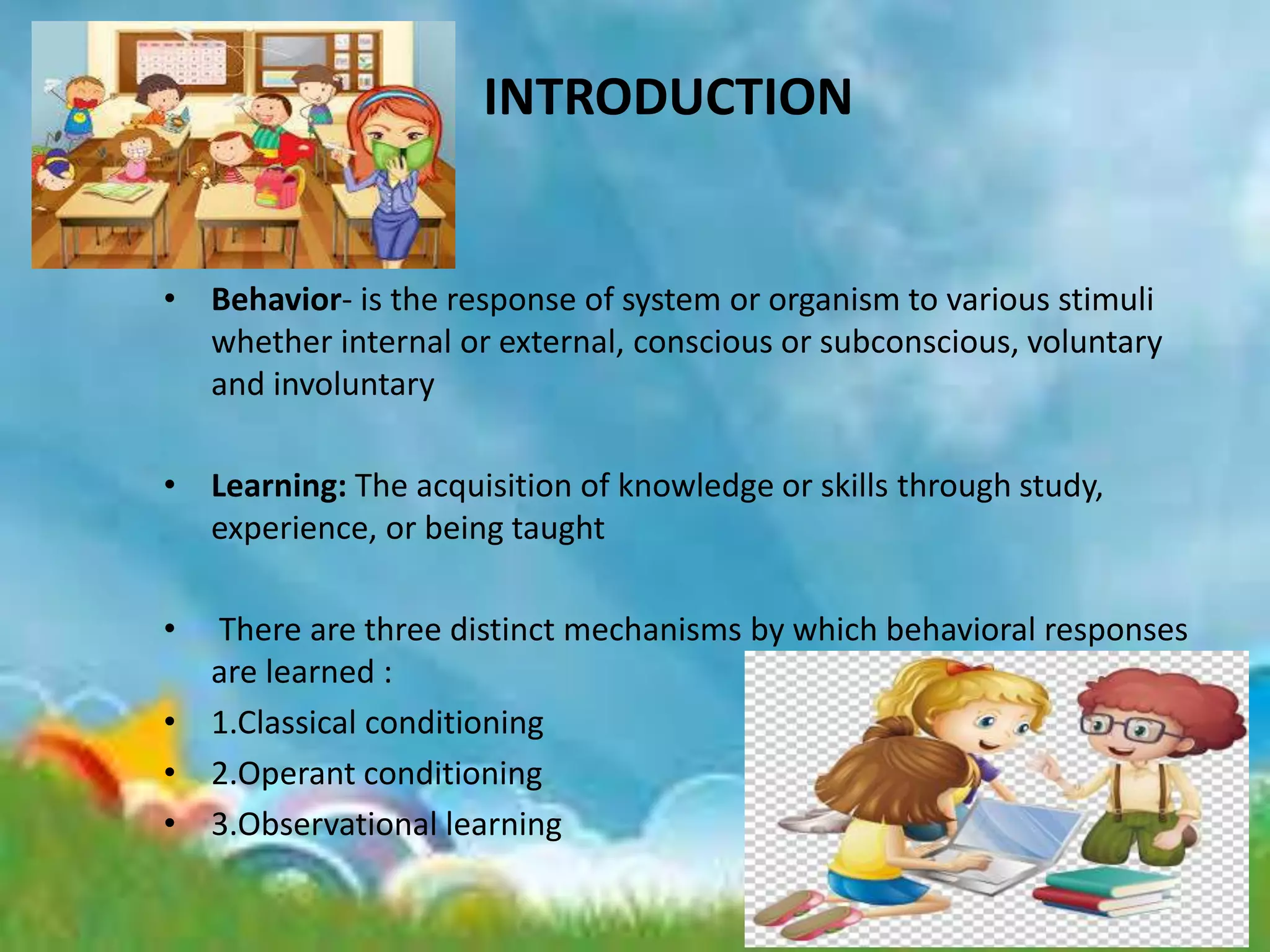
• There are three distinct mechanisms by which behavioral responses
are learned :
• 1.Classical conditioning
• 2.Operant conditioning
• 3.Observational learning
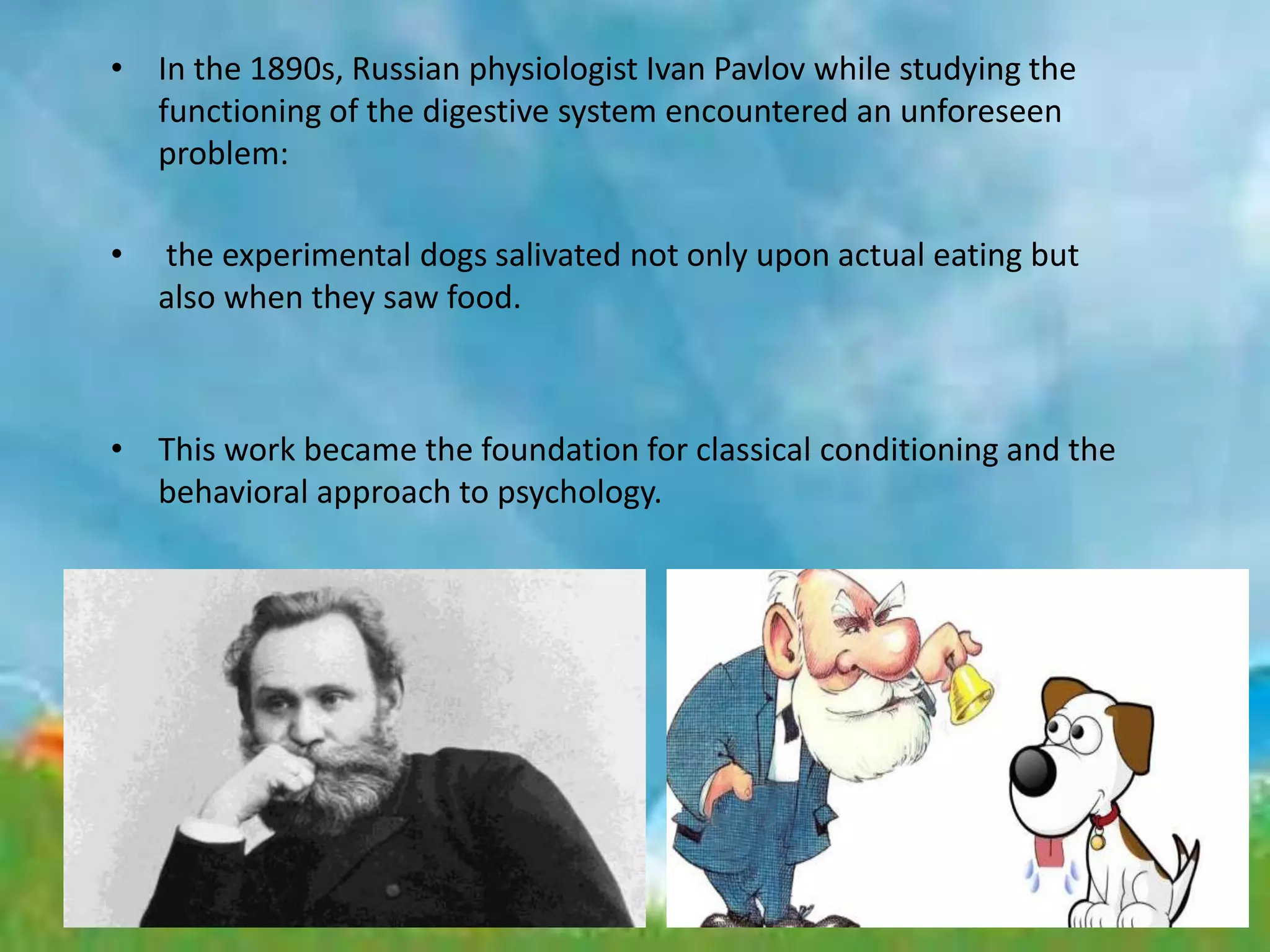
• In the 1890s, Russian physiologist Ivan Pavlov while studying the
functioning of the digestive system encountered an unforeseen
problem:
• the experimental dogs salivated not only upon actual eating but
also when they saw food.
• This work became the foundation for classical conditioning and the
behavioral approach to psychology.
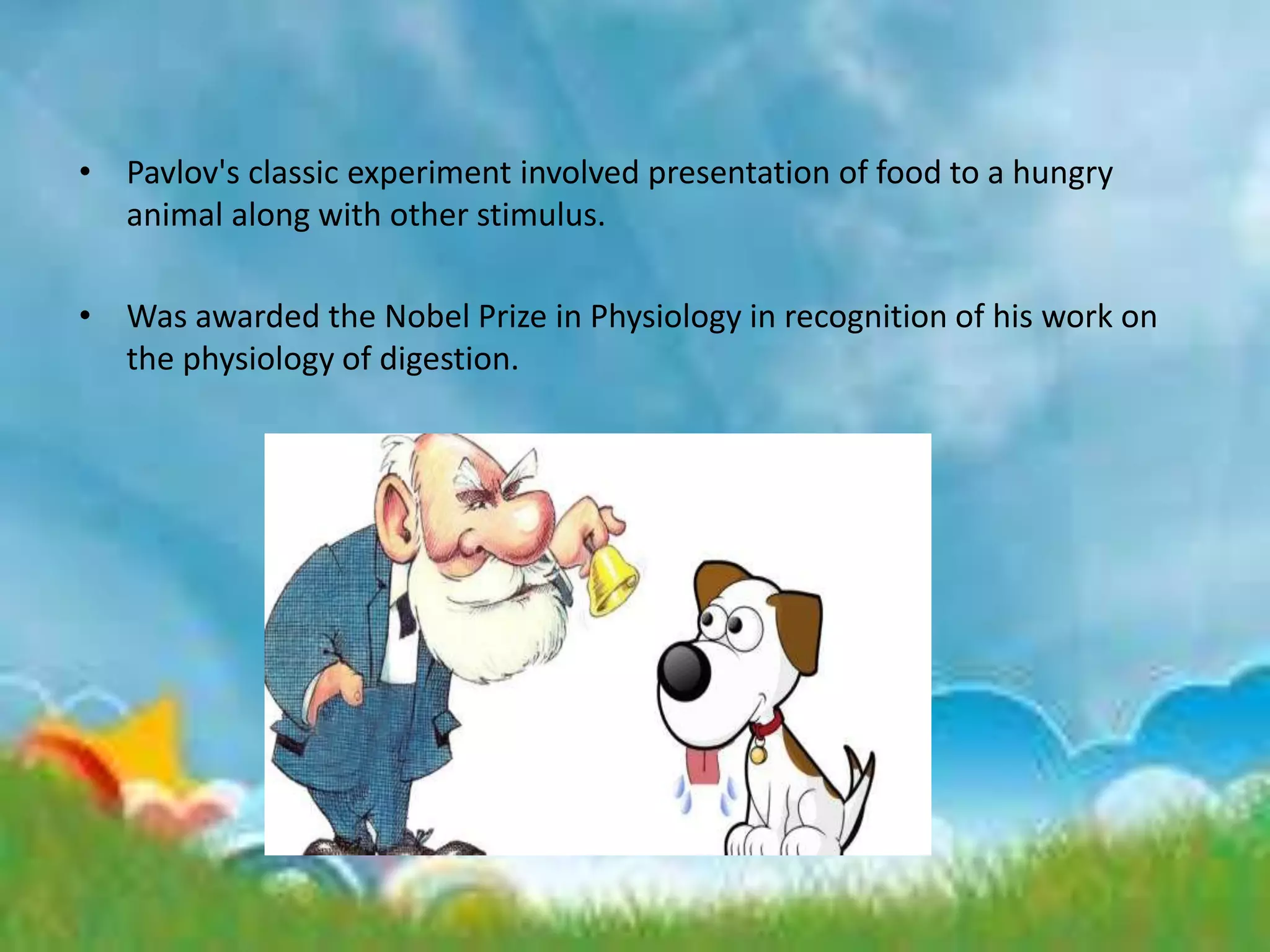
• Pavlov's classic experiment involved presentation of food to a hungry
animal along with other stimulus.
• Was awarded the Nobel Prize in Physiology in recognition of his work on
the physiology of digestion.
CLASSICAL CONDITIONING
• Classical conditioning is a learning process that occurs through
associations between an environmental stimulus and a naturally
occurring stimulus.
• It had a major influence on behaviorism which is based on the
assumption that learning occurs through interactions with the
environment.
• For this reason this mode of learning is sometimes referred to as
learning by association.
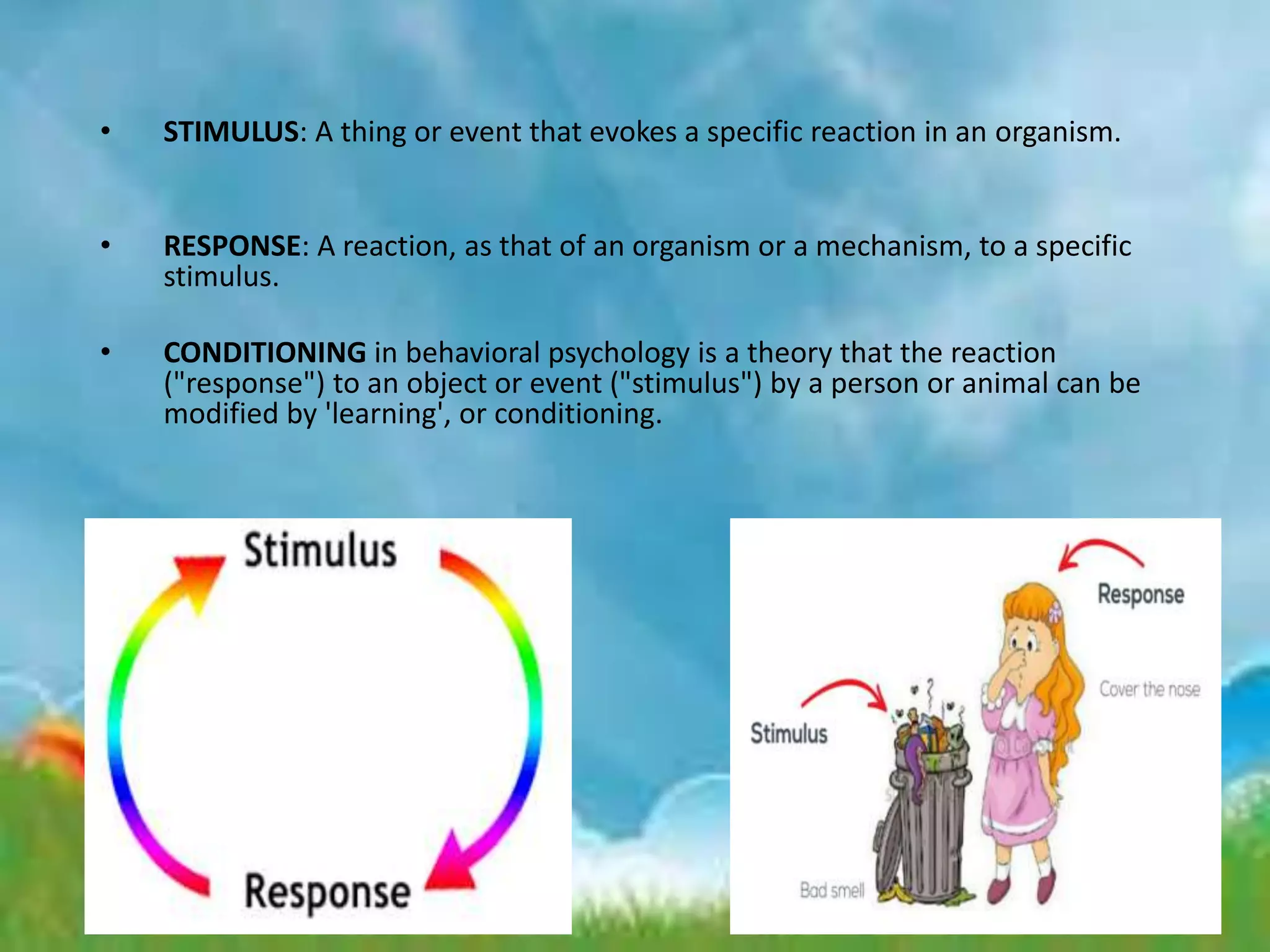
• STIMULUS: A thing or event that evokes a specific reaction in an organism.
• RESPONSE: A reaction, as that of an organism or a mechanism, to a specific
stimulus.
• CONDITIONING in behavioral psychology is a theory that the reaction
("response") to an object or event ("stimulus") by a person or animal can be
modified by 'learning', or conditioning.
COMPONENTS OF CLASSICAL CONDITIONING
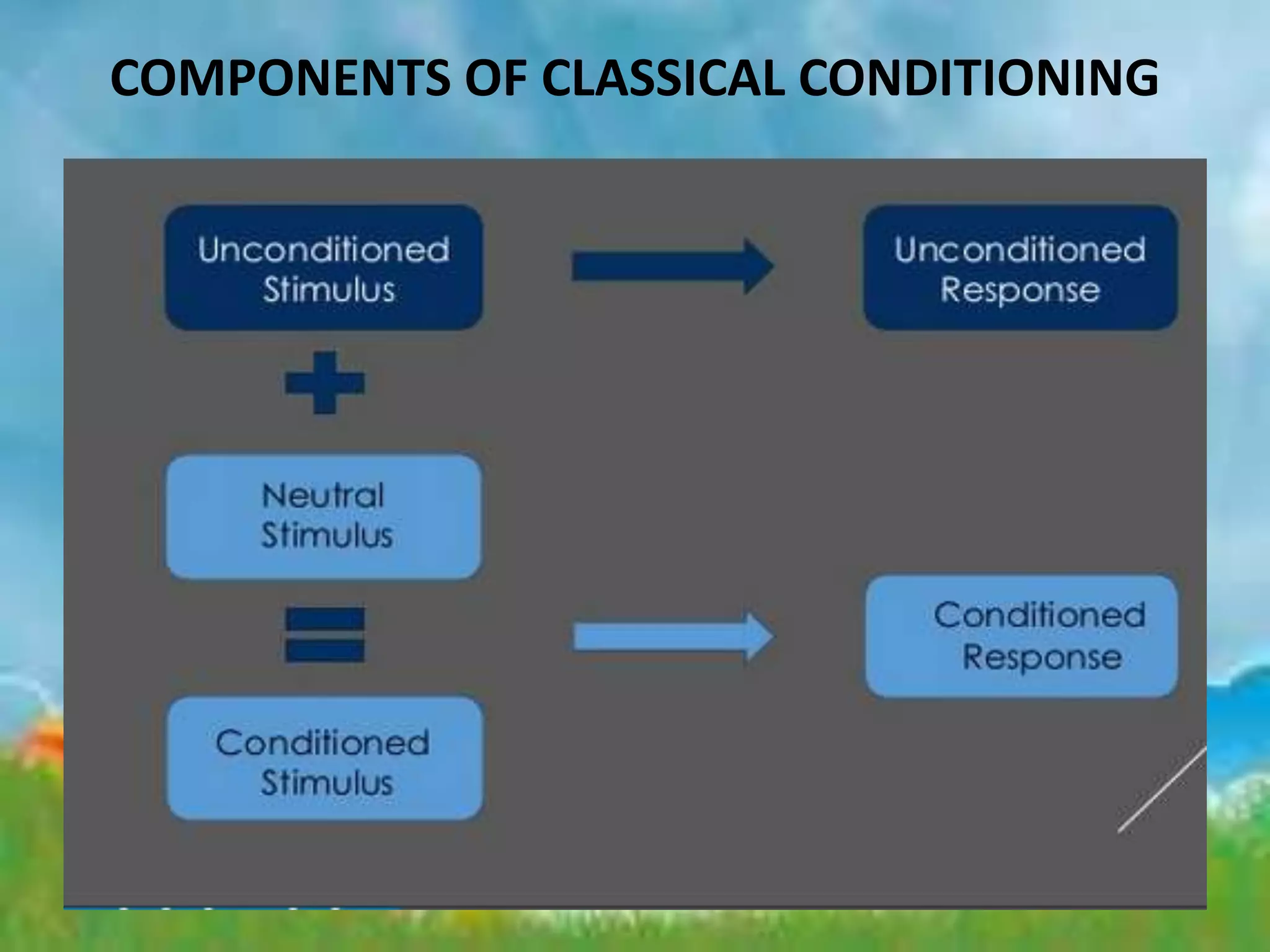
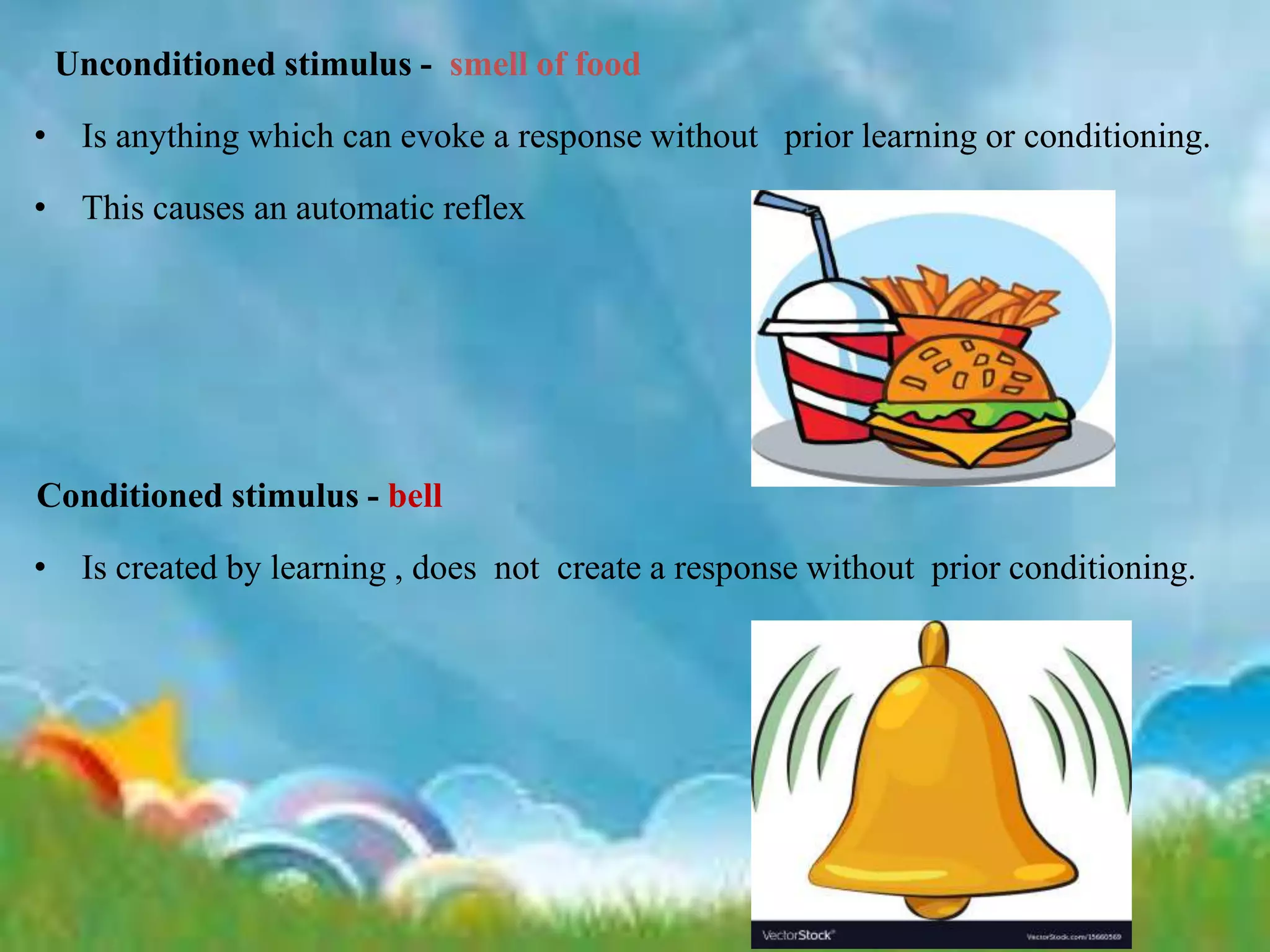
Unconditioned stimulus - smell of food
• Is anything which can evoke a response without prior learning or conditioning.
• This causes an automatic reflex
Conditioned stimulus - bell
• Is created by learning , does not create a response without prior conditioning.
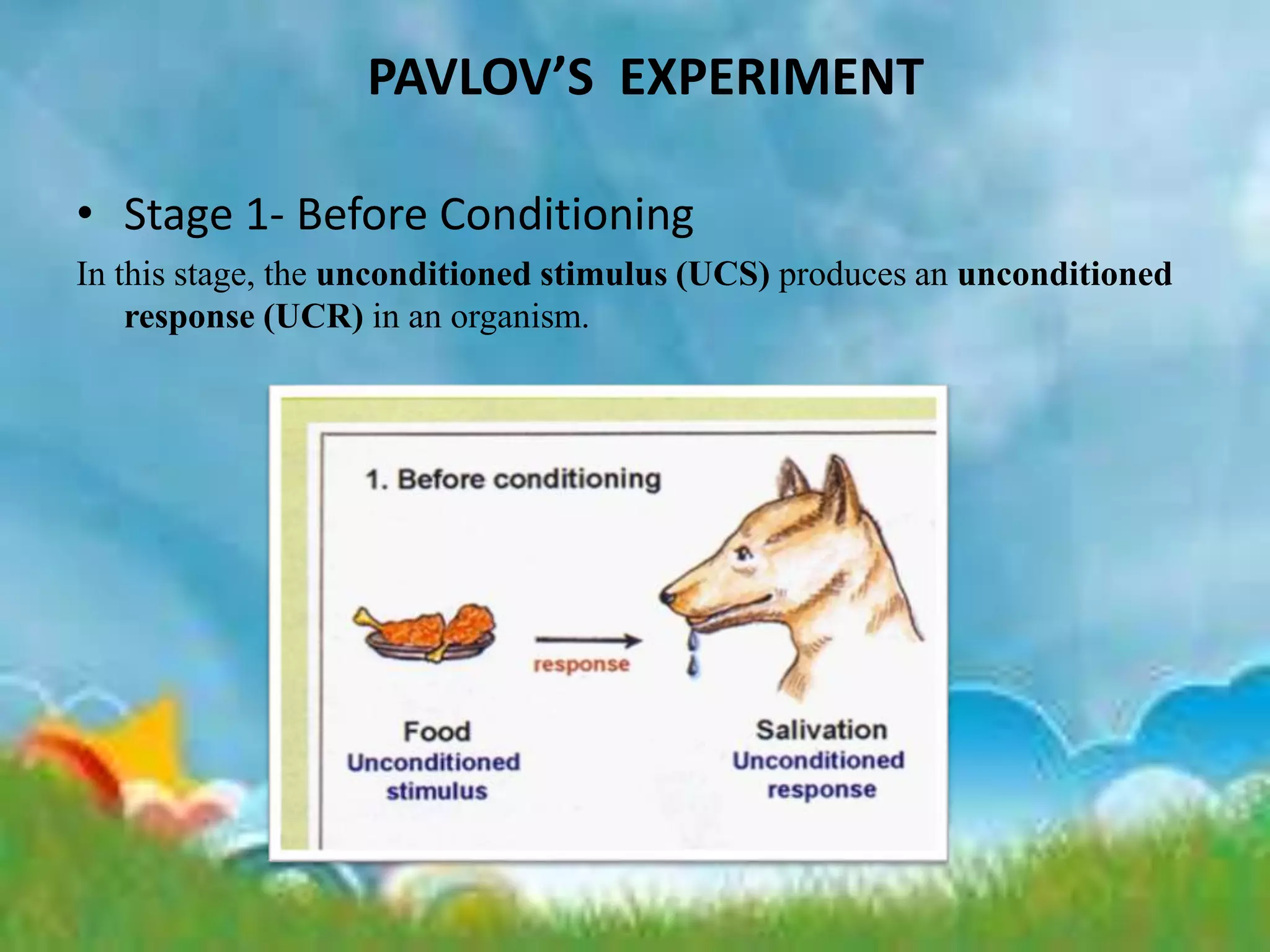
• Unconditioned Response- salivation
• Is anything that happens without even
• thinking about that.
• Conditioned Response –salivation in response to bell
• Is a reflex which you have learnt
• to associate with something
PAVLOV’S EXPERIMENT
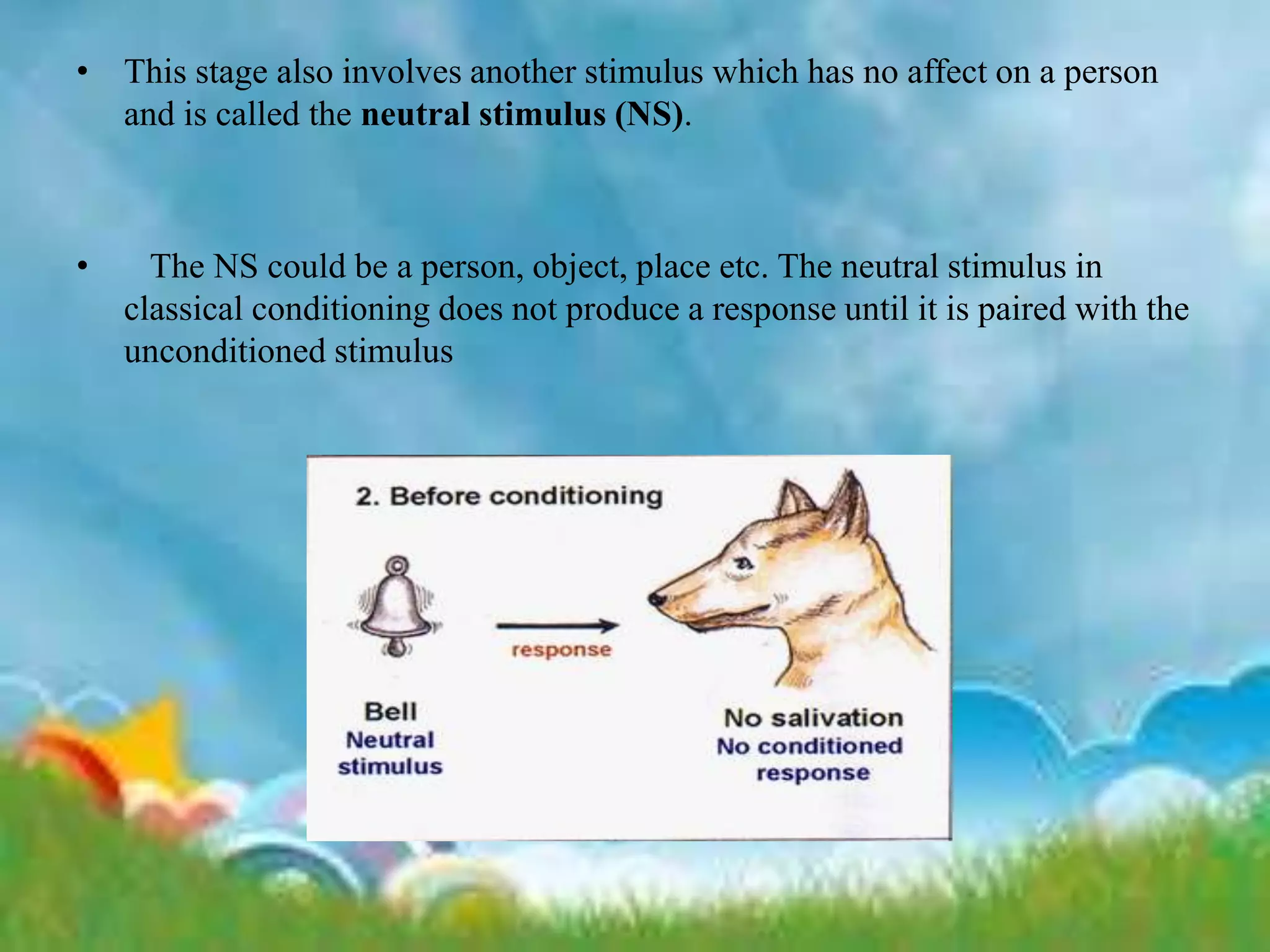
• Stage 1- Before Conditioning
In this stage, the unconditioned stimulus (UCS) produces an unconditioned
response (UCR) in an organism.
• This stage also involves another stimulus which has no affect on a person
and is called the neutral stimulus (NS).
• The NS could be a person, object, place etc. The neutral stimulus in
classical conditioning does not produce a response until it is paired with the
unconditioned stimulus
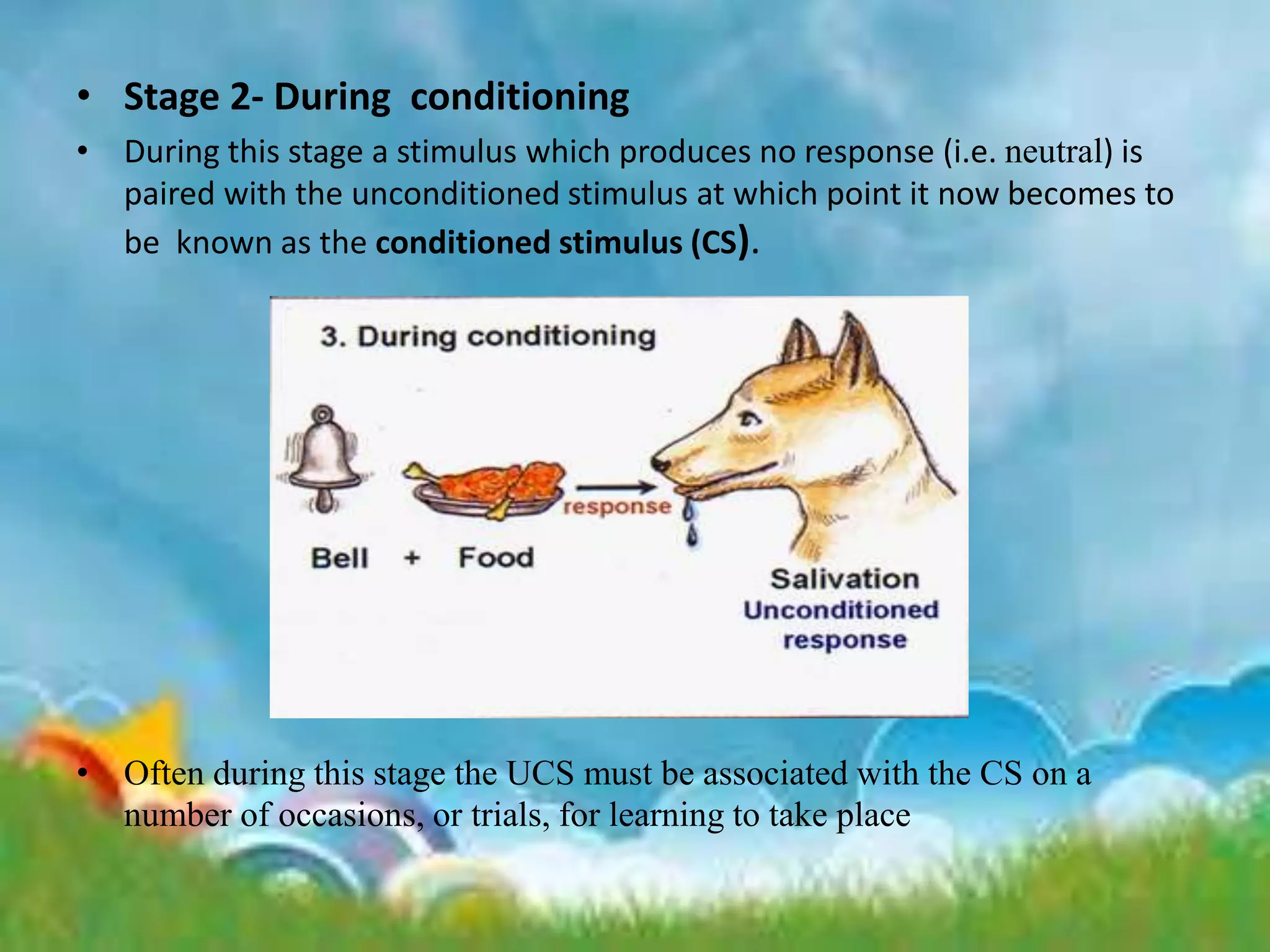
• Stage 2- During conditioning
• During this stage a stimulus which produces no response (i.e. neutral) is
paired with the unconditioned stimulus at which point it now becomes to
be known as the conditioned stimulus (CS).
• Often during this stage the UCS must be associated with the CS on a
number of occasions, or trials, for learning to take place
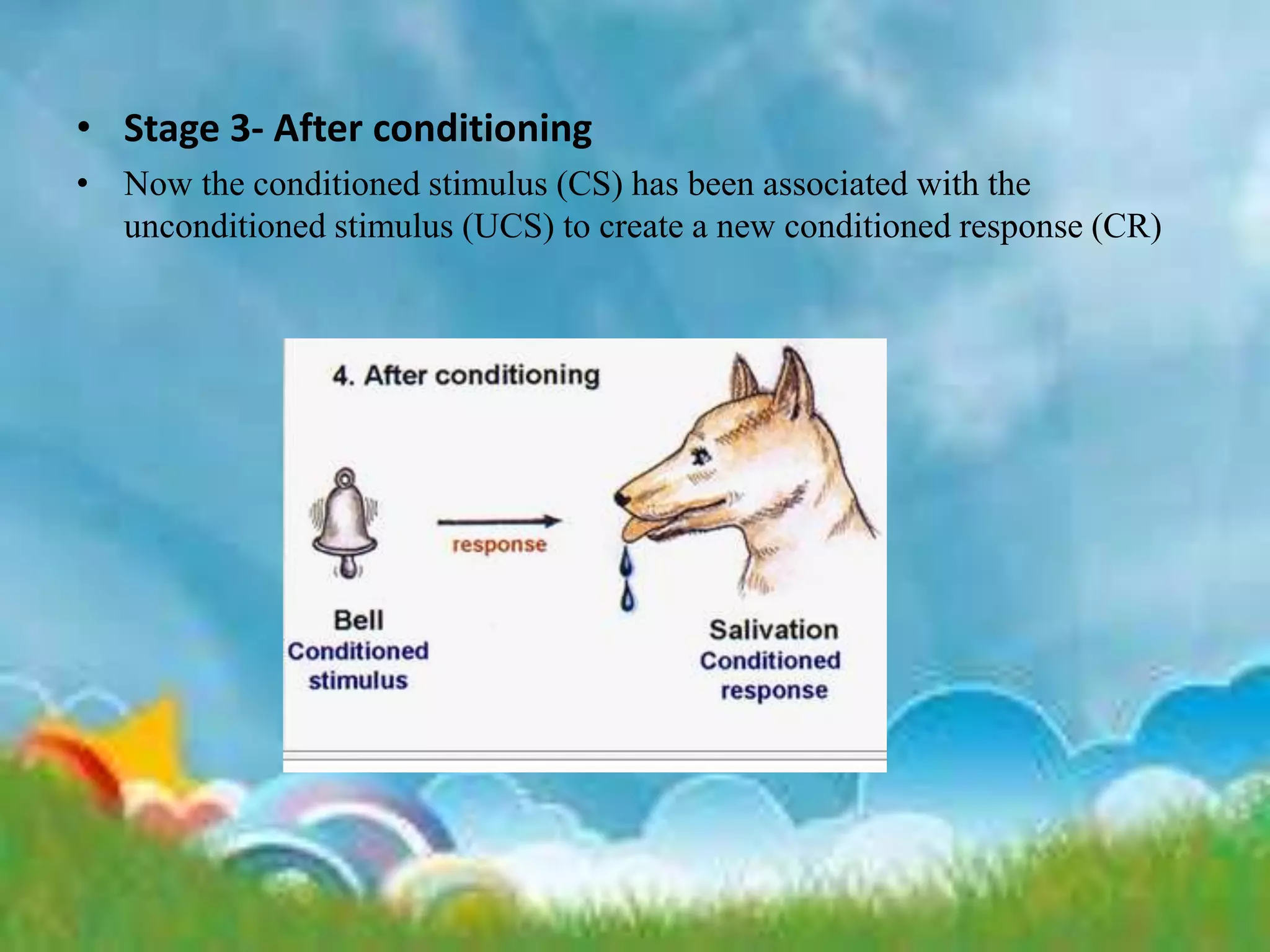
• Stage 3- After conditioning
• Now the conditioned stimulus (CS) has been associated with the
unconditioned stimulus (UCS) to create a new conditioned response (CR)
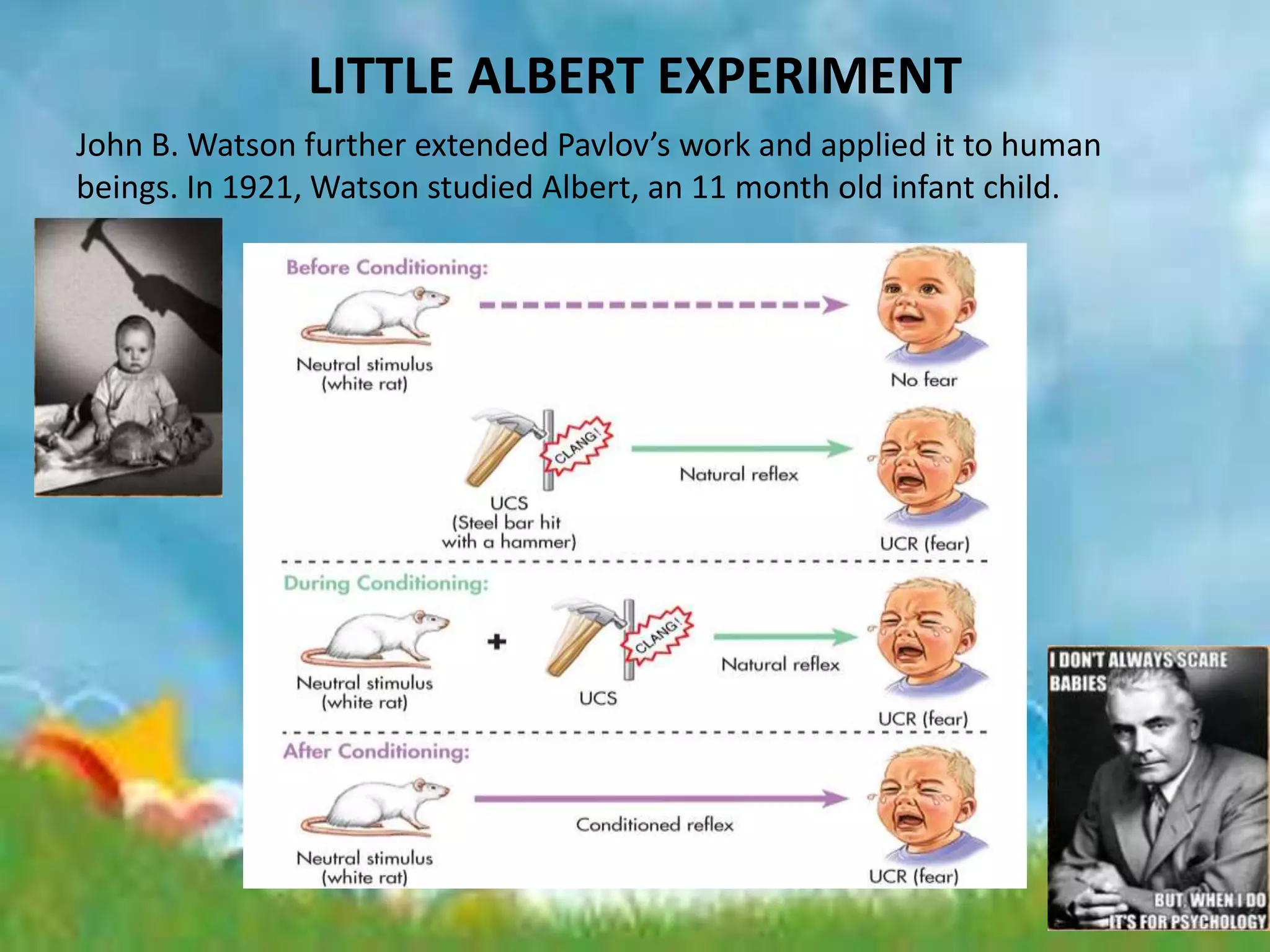
LITTLE ALBERT EXPERIMENT
John B. Watson further extended Pavlov’s work and applied it to human
beings. In 1921, Watson studied Albert, an 11 month old infant child.
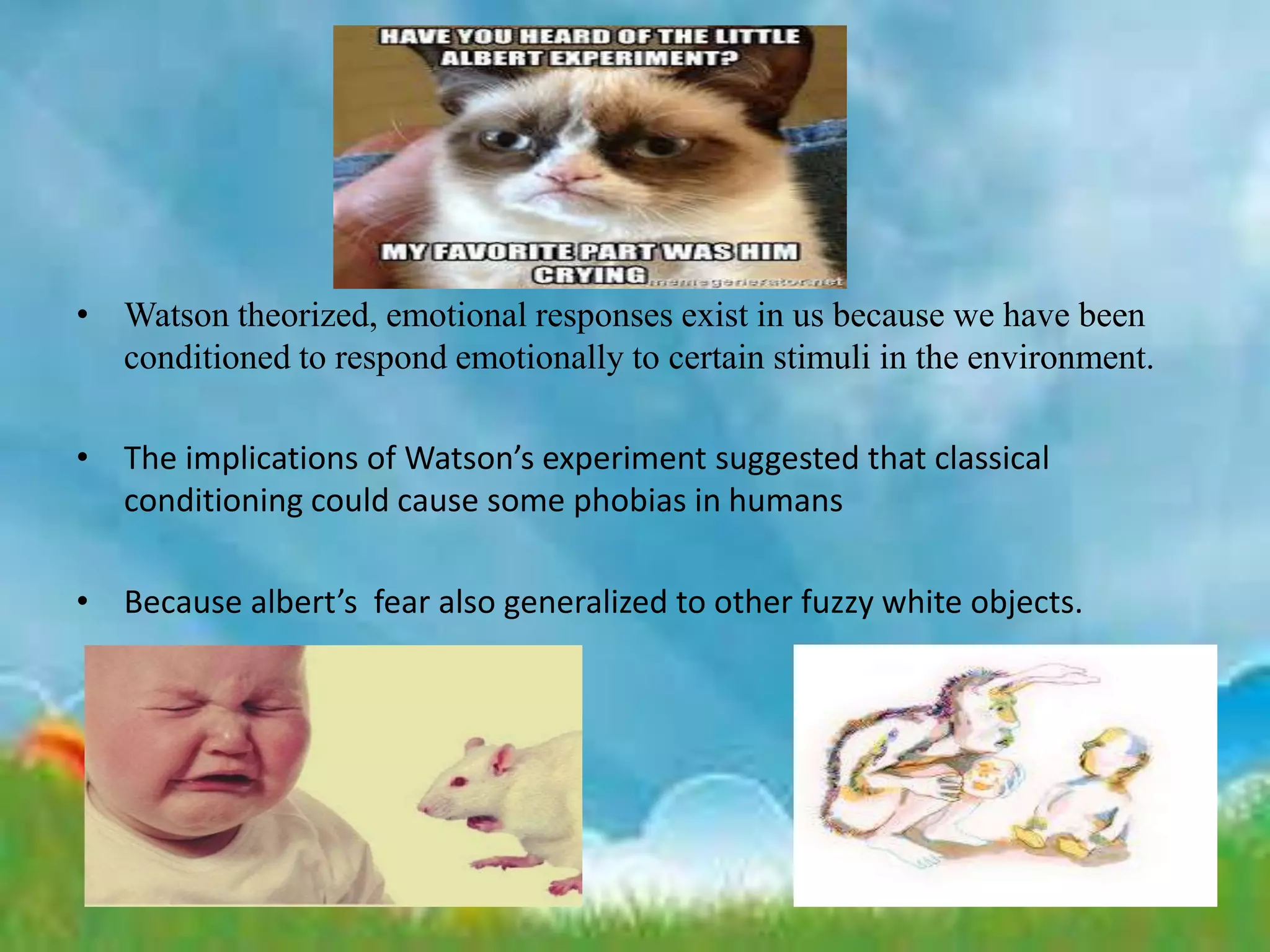
• Watson theorized, emotional responses exist in us because we have been
conditioned to respond emotionally to certain stimuli in the environment.
• The implications of Watson’s experiment suggested that classical
conditioning could cause some phobias in humans
• Because albert’s fear also generalized to other fuzzy white objects.
• An infant sucking the nipple if paired with hearing a lullaby, eventually
leads the infant to initiate sucking when he hears the lullaby.
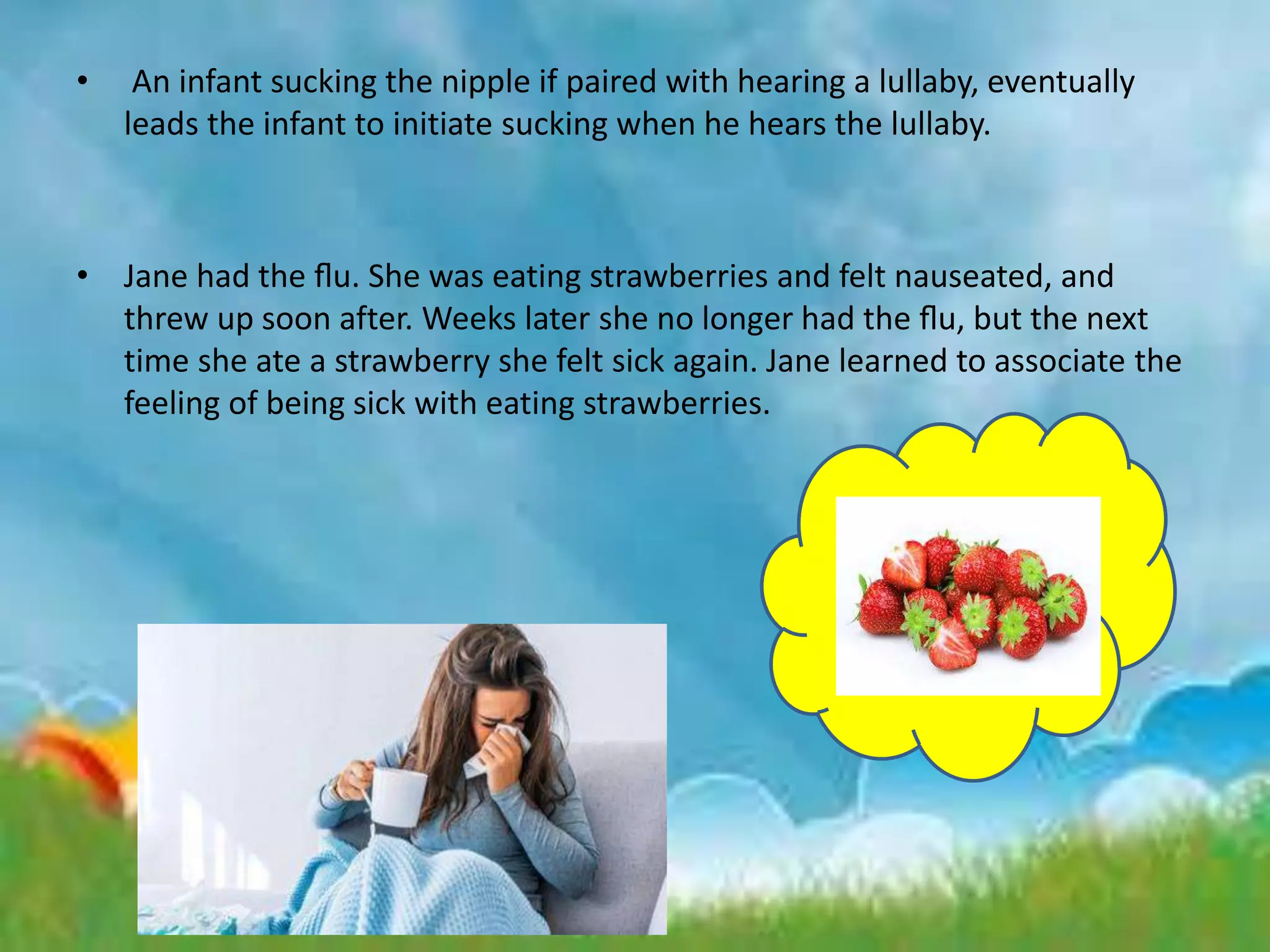
• Jane had the flu. She was eating strawberries and felt nauseated, and
threw up soon after. Weeks later she no longer had the flu, but the next
time she ate a strawberry she felt sick again. Jane learned to associate the
feeling of being sick with eating strawberries.
PRINCIPLES OF CLASSICAL CONDITIONING
• ACQUISITION-: learning a new response from the environment by
conditioning
• it is the initial stage of learning when a response is first established and
gradually strengthened
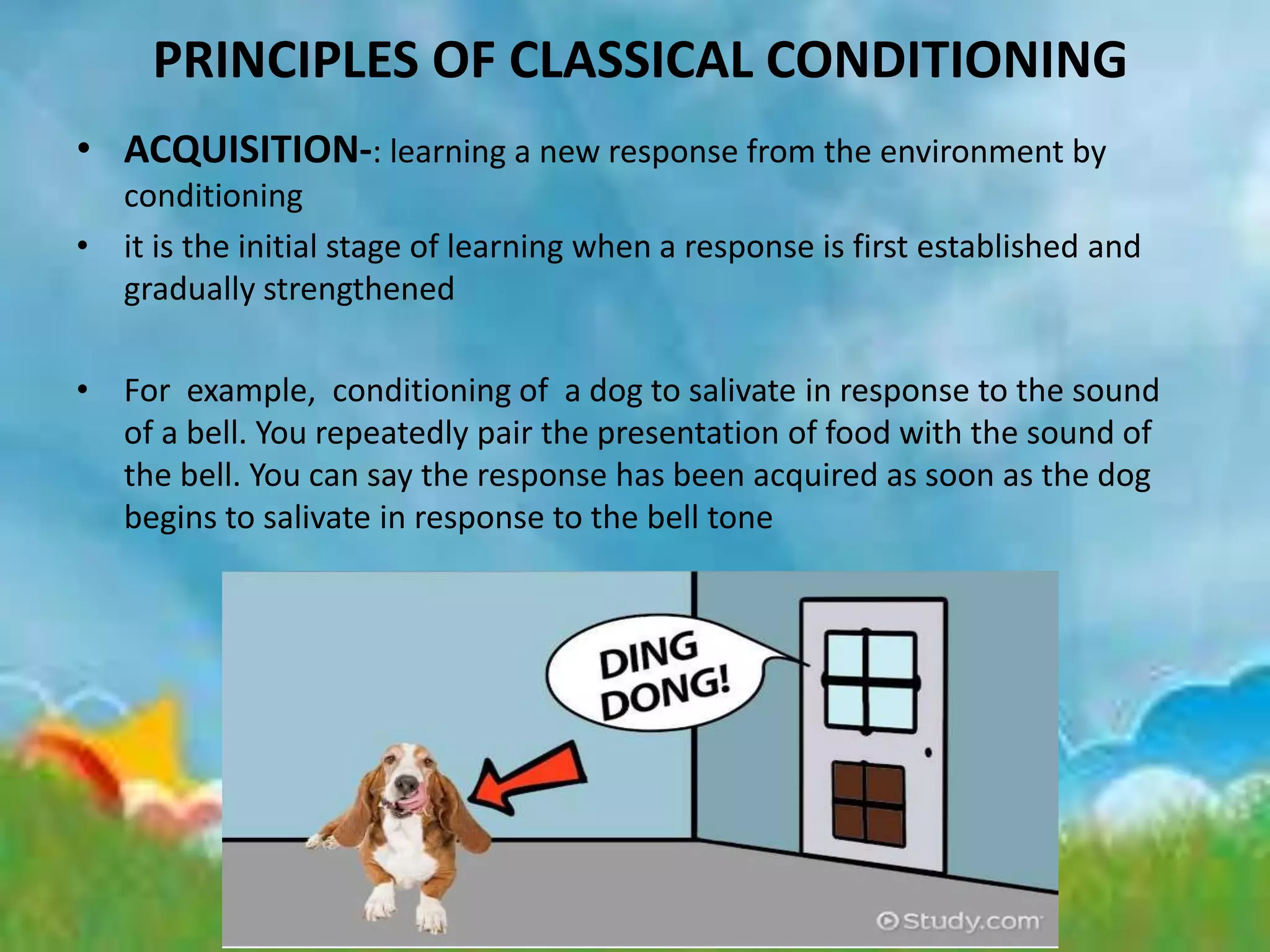
• For example, conditioning of a dog to salivate in response to the sound
of a bell. You repeatedly pair the presentation of food with the sound of
the bell. You can say the response has been acquired as soon as the dog
begins to salivate in response to the bell tone
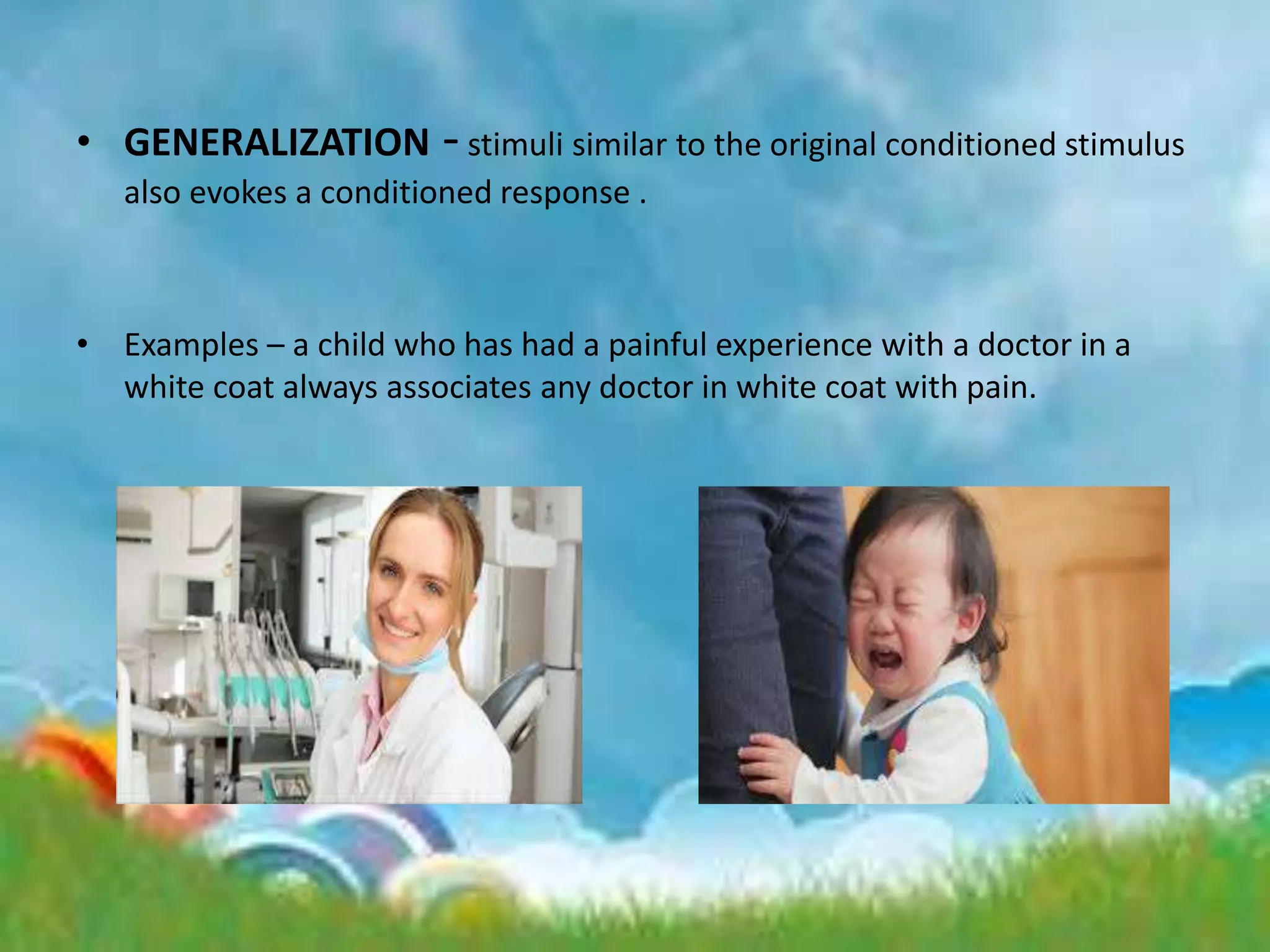
• GENERALIZATION -stimuli similar to the original conditioned stimulus
also evokes a conditioned response .
• Examples – a child who has had a painful experience with a doctor in a
white coat always associates any doctor in white coat with pain.
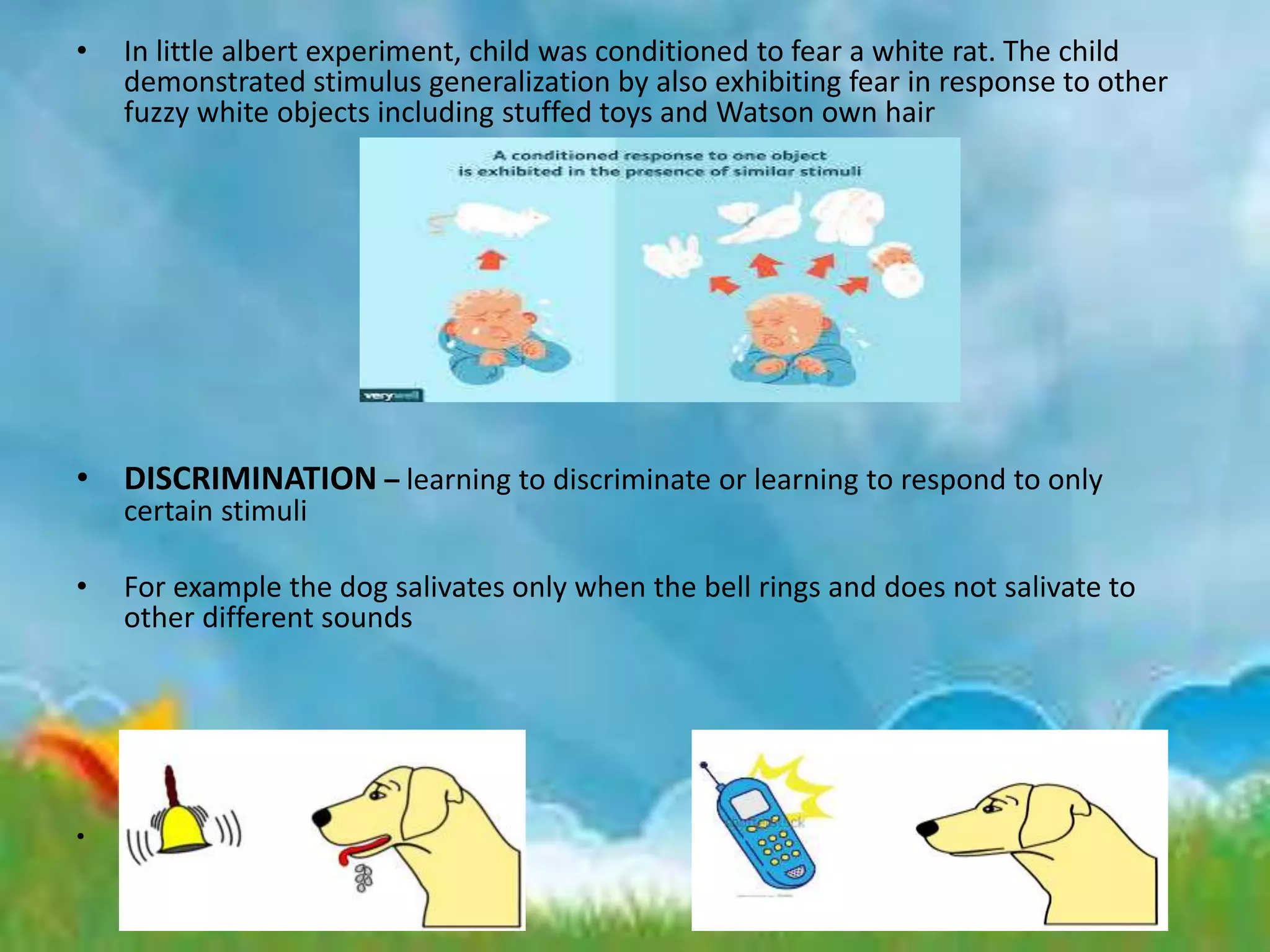
• In little albert experiment, child was conditioned to fear a white rat. The child
demonstrated stimulus generalization by also exhibiting fear in response to other
fuzzy white objects including stuffed toys and Watson own hair
• DISCRIMINATION – learning to discriminate or learning to respond to only
certain stimuli
• For example the dog salivates only when the bell rings and does not salivate to
other different sounds
• .
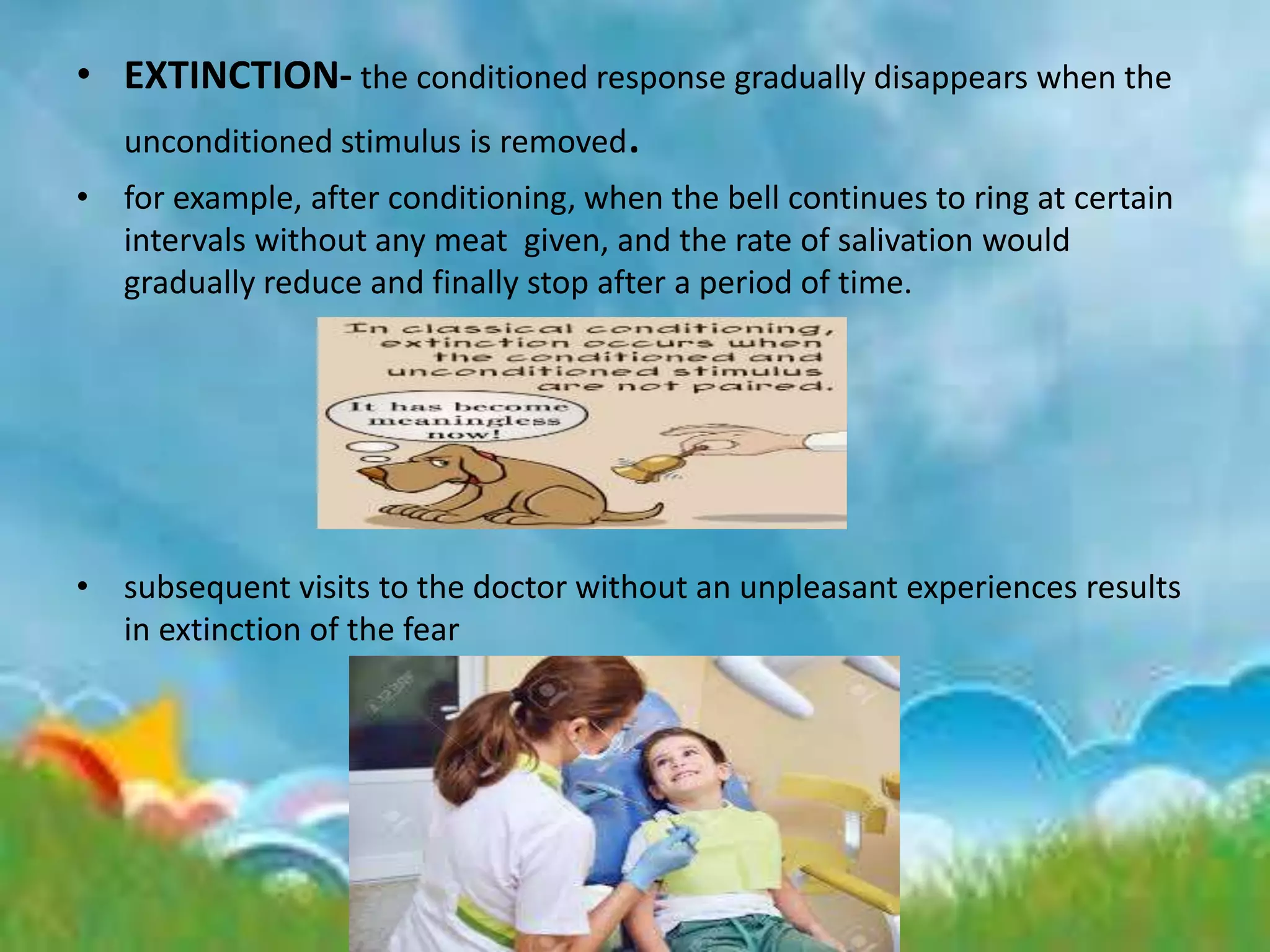
• EXTINCTION- the conditioned response gradually disappears when the
unconditioned stimulus is removed.
• for example, after conditioning, when the bell continues to ring at certain
intervals without any meat given, and the rate of salivation would
gradually reduce and finally stop after a period of time.
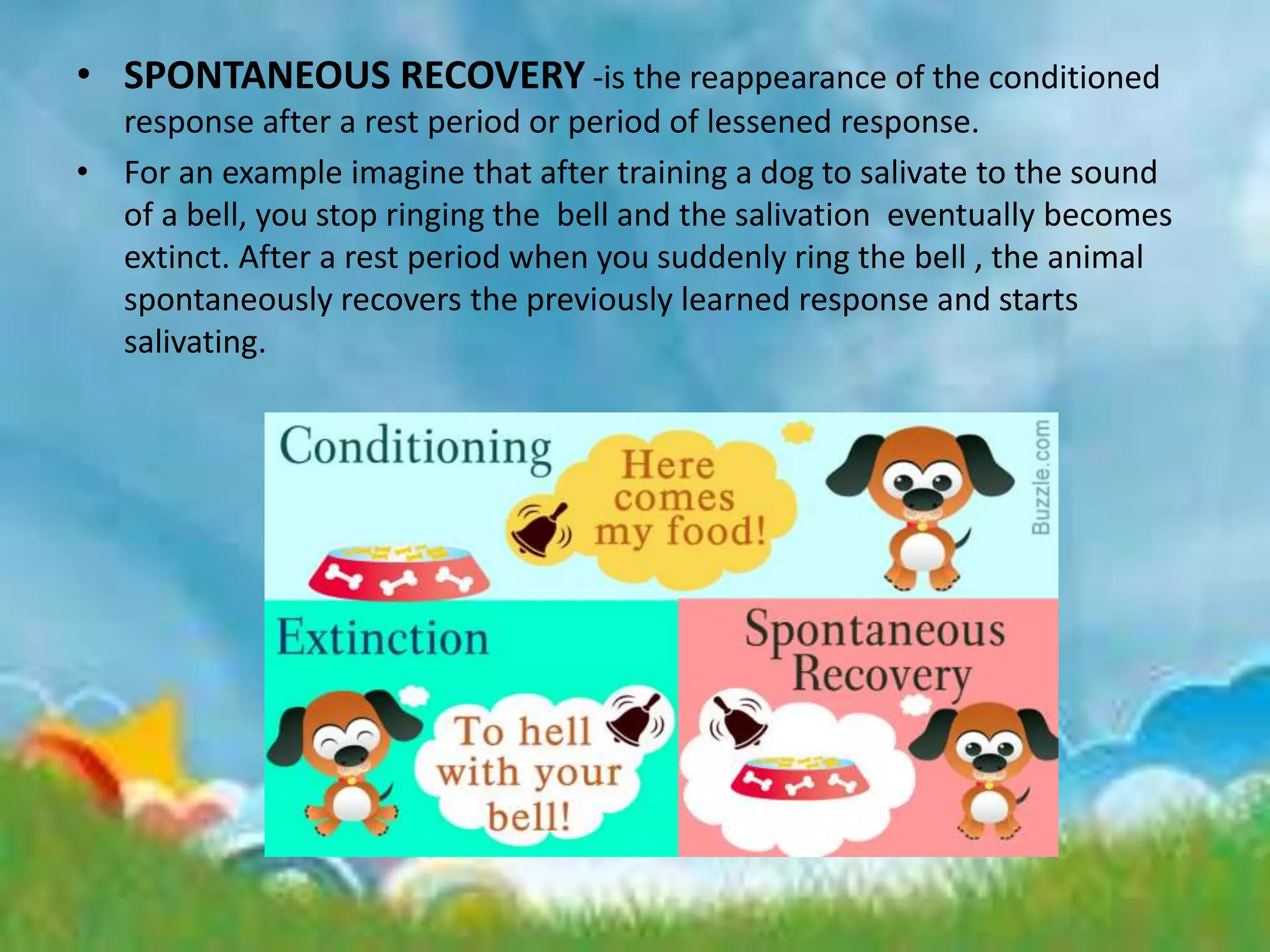
• subsequent visits to the doctor without an unpleasant experiences results
in extinction of the fear
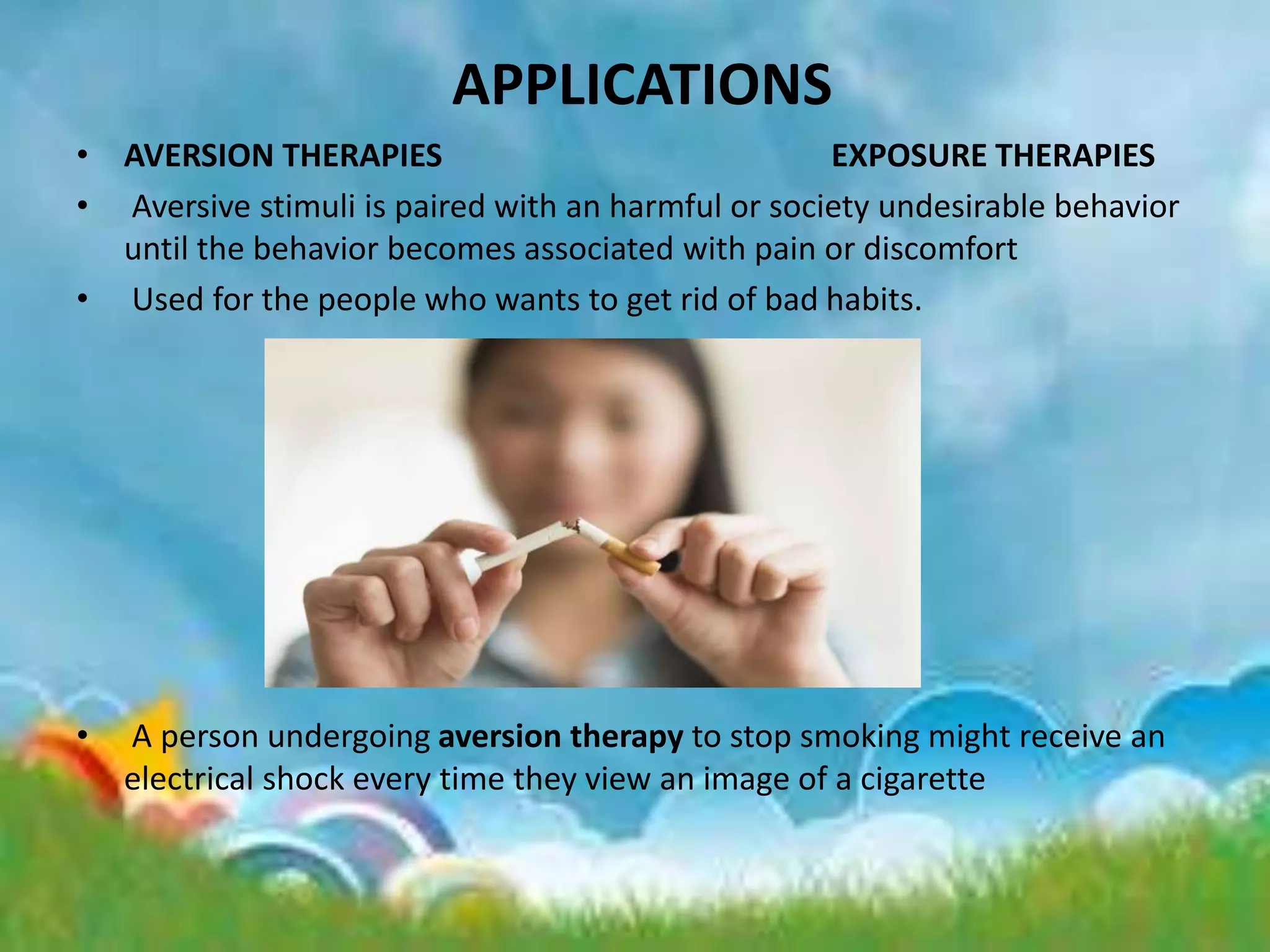
• SPONTANEOUS RECOVERY -is the reappearance of the conditioned
response after a rest period or period of lessened response.
• For an example imagine that after training a dog to salivate to the sound
of a bell, you stop ringing the bell and the salivation eventually becomes
extinct. After a rest period when you suddenly ring the bell , the animal
spontaneously recovers the previously learned response and starts
salivating.
APPLICATIONS
• AVERSION THERAPIES EXPOSURE THERAPIES
• Aversive stimuli is paired with an harmful or society undesirable behavior
until the behavior becomes associated with pain or discomfort
• Used for the people who wants to get rid of bad habits.
• A person undergoing aversion therapy to stop smoking might receive an
electrical shock every time they view an image of a cigarette
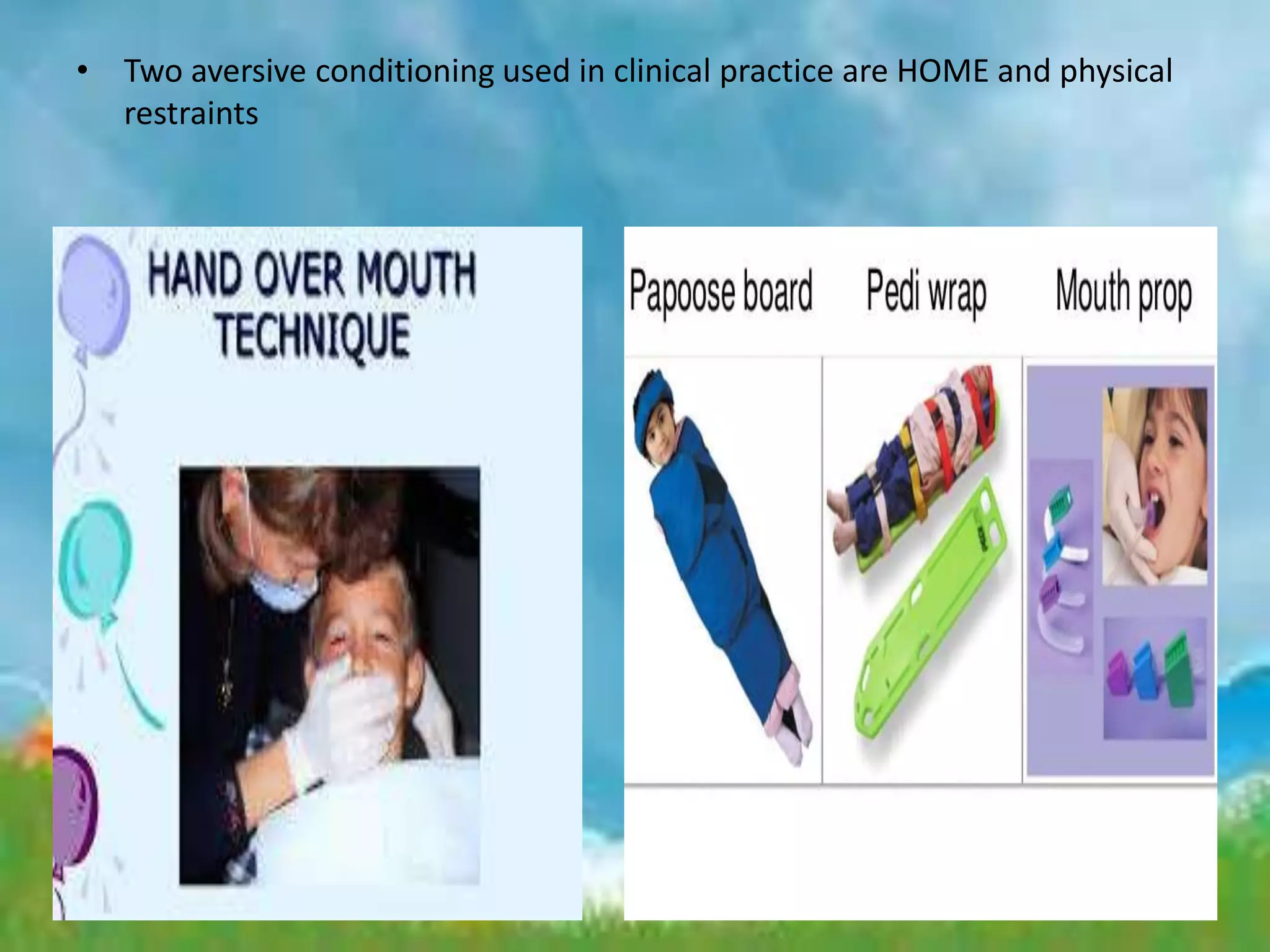
• Two aversive conditioning used in clinical practice are HOME and physical
restraints
MAIN TYPES OF EXPOSURE THERAPIES
• SYSTEMATIC DESENSITIZATION
• IMPLOSION
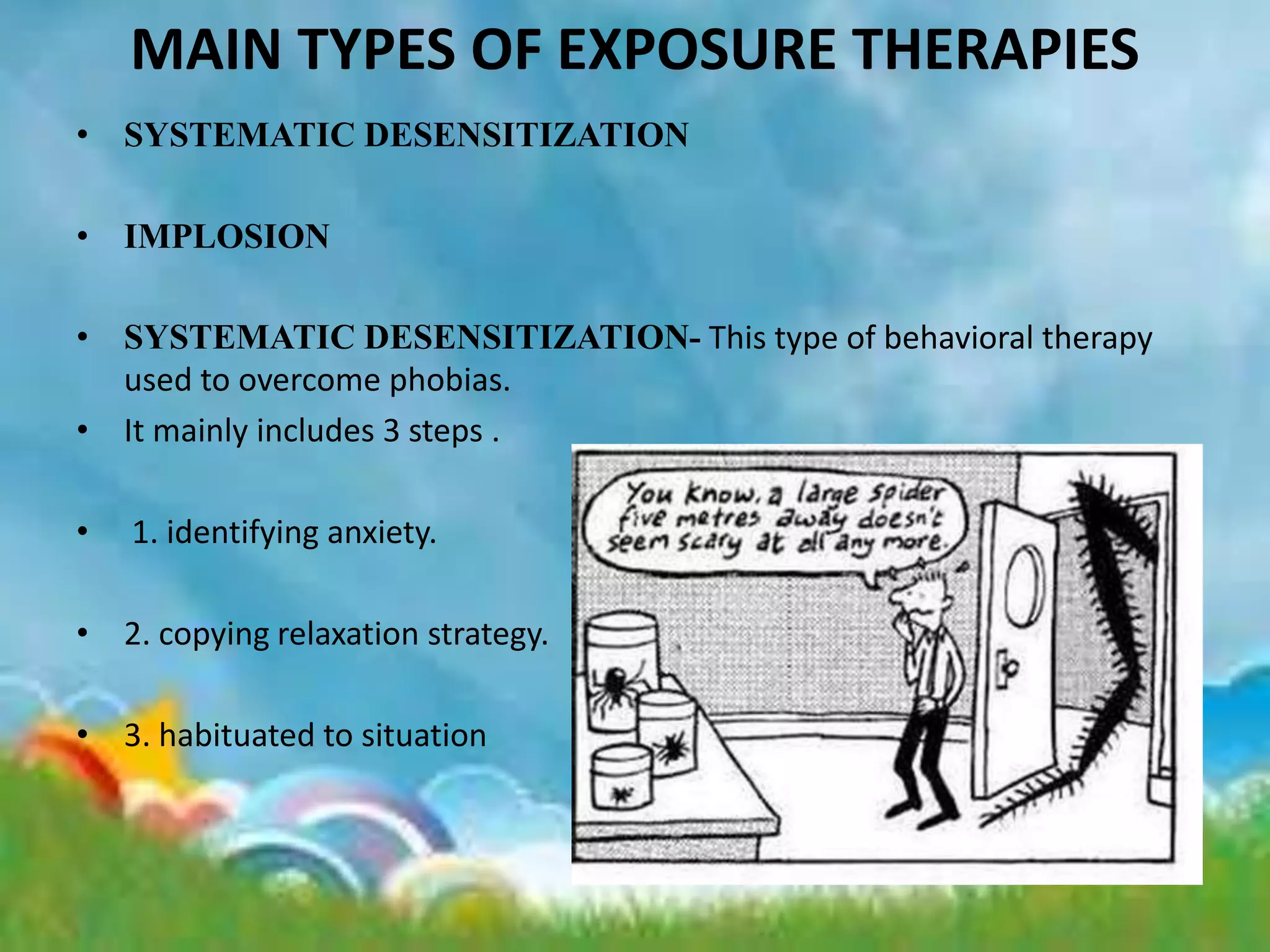
• SYSTEMATIC DESENSITIZATION- This type of behavioral therapy
used to overcome phobias.
• It mainly includes 3 steps .
• 1. identifying anxiety.
• 2. copying relaxation strategy.
• 3. habituated to situation
• DESENSITIZATION
• Joseph wolpe used to remove fears and tension in children who have had
previous unpleasant dental experience .
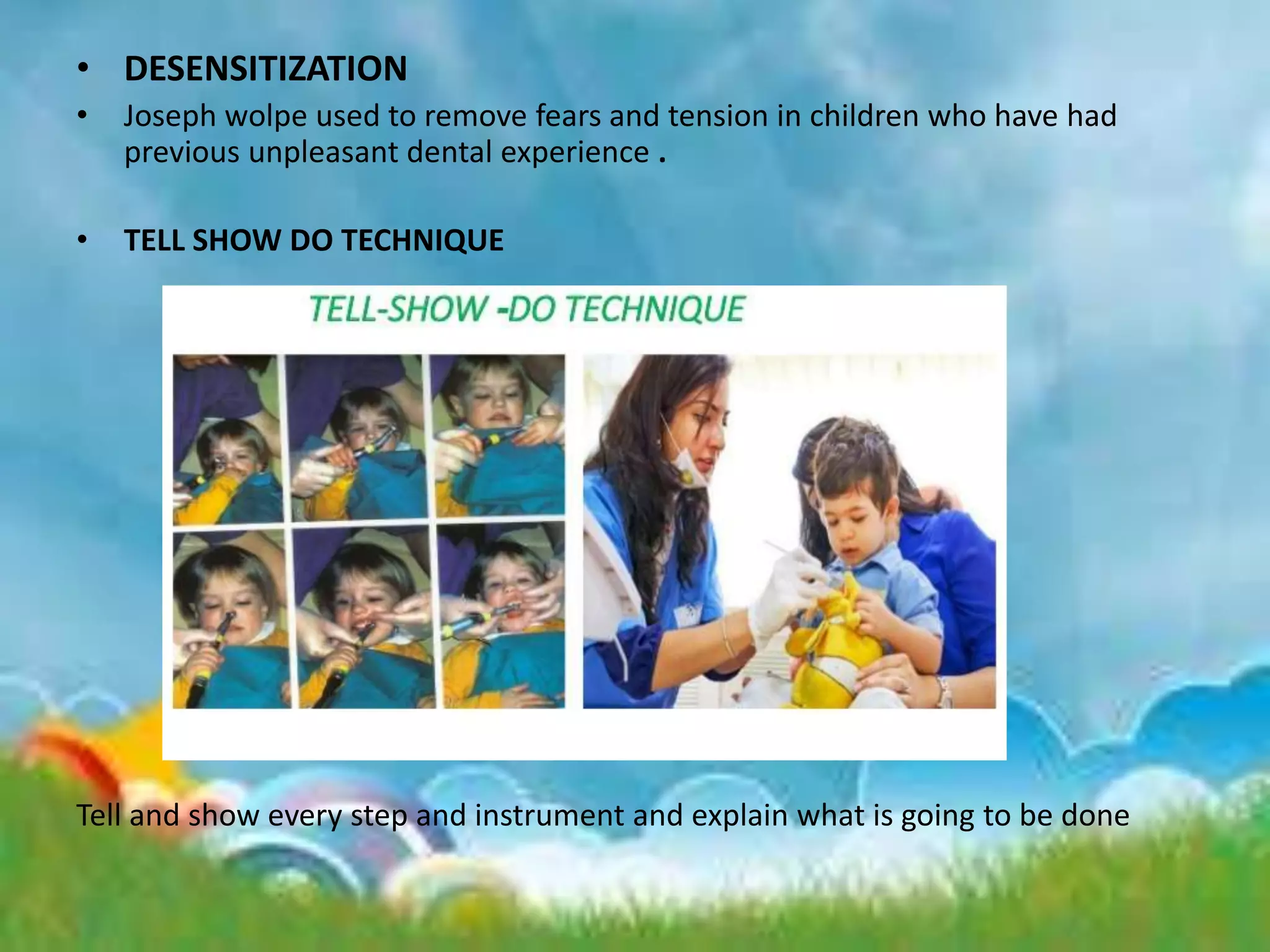
• TELL SHOW DO TECHNIQUE
Tell and show every step and instrument and explain what is going to be done
• IMPLOSION
• Exposing the person to intensely fear-evoking imagined stimuli, which lie
at the top of the fear hierarchy
• Sudden flooding with a barrage of stimuli which affect the child adversely
and they has no choice rather to face the stimuli until the negative behavior
vanishes
•
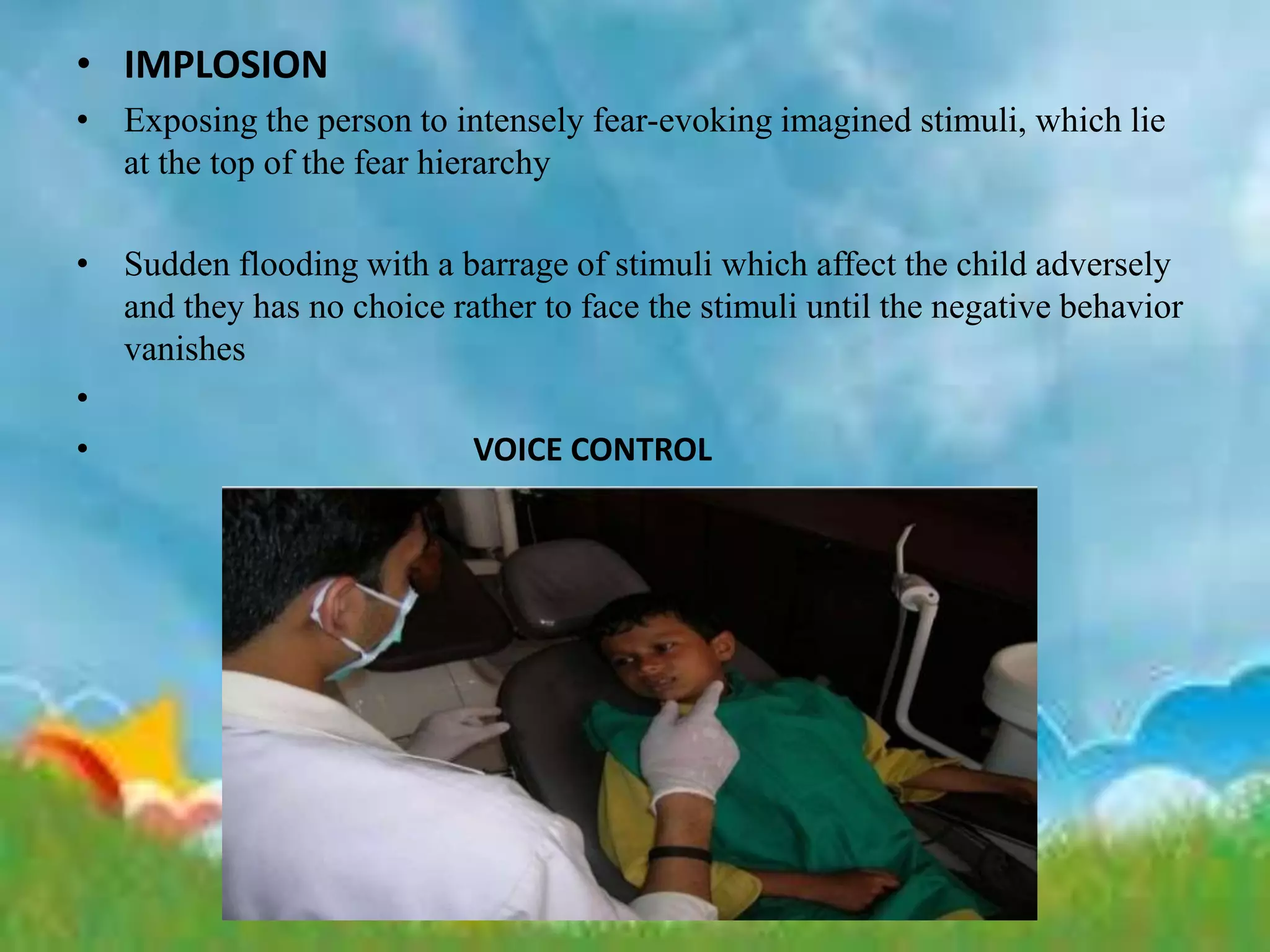
• VOICE CONTROL
MERITS
• A strength of classical conditioning theory is that it is scientific. This is
because it's based on empirical evidence carried out by controlled
experiments
• Classical conditioning is also a reductionist explanation of behavior.
• This is because complex behavior is broken down into smaller stimulus -
response units of behavior.
DEMERITS
• Classical conditioning emphasizes the importance of learning from the
environment, and supports nurture (learning from environment) over
nature.
• A final criticism of classical conditioning theory is that it is deterministic.
• This means that it does not allow for any degree of freewill in the
individual, a person has no control over the reactions they have learned
from classical conditioning.
CLASSICAL VS OPERANT CONDITIONING
Classical
• involves associating an
involuntary response and a
stimulus
• classical conditioning involves no
such enticements.
• classical conditioning is passive
on the part of the learner
Operant
• associating a voluntary behavior
and a consequence
• the learner is also rewarded with
incentives
• requires the learner to actively
participate and perform some
type of action in order to be
rewarded or punished
SOCIAL LEARNING THEORY
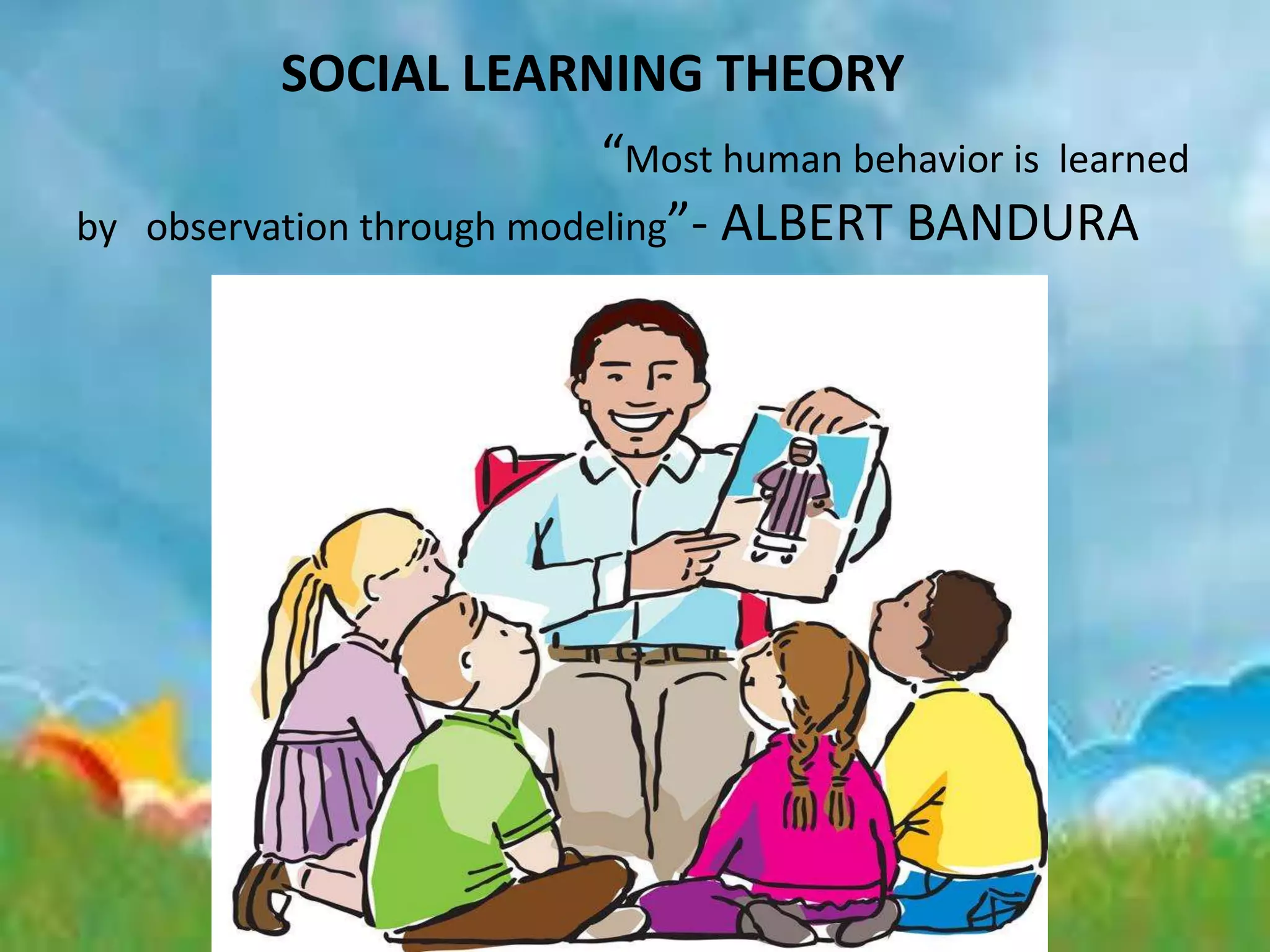
“Most human behavior is learned
by observation through modeling”- ALBERT BANDURA
• Albert bandura is a Canadian-American psychologist
• He is known as the originator of social learning theory (renamed the social
cognitive theory)
• Bandura believed the sole behavioral modifiers of reward and punishment
in classical and operant conditioning were inadequate as a framework,
and that many human behaviors were learned from other humans.
• Bandura began to analyze means of treating aggressive children by
identifying sources of violence in their lives.
• Bandura strongly believed that people learn through observing others
behavior and attitudes, and outcomes of those behavior.
• He believes that the behavior is largely motivated by social needs.
• Learning by observation is modeling Individual learns by observing and
thinking. Reinforcing is nothing
but strengthening
MODELING REINFORCEMENT
BOBO DOLL EXPERIMENT
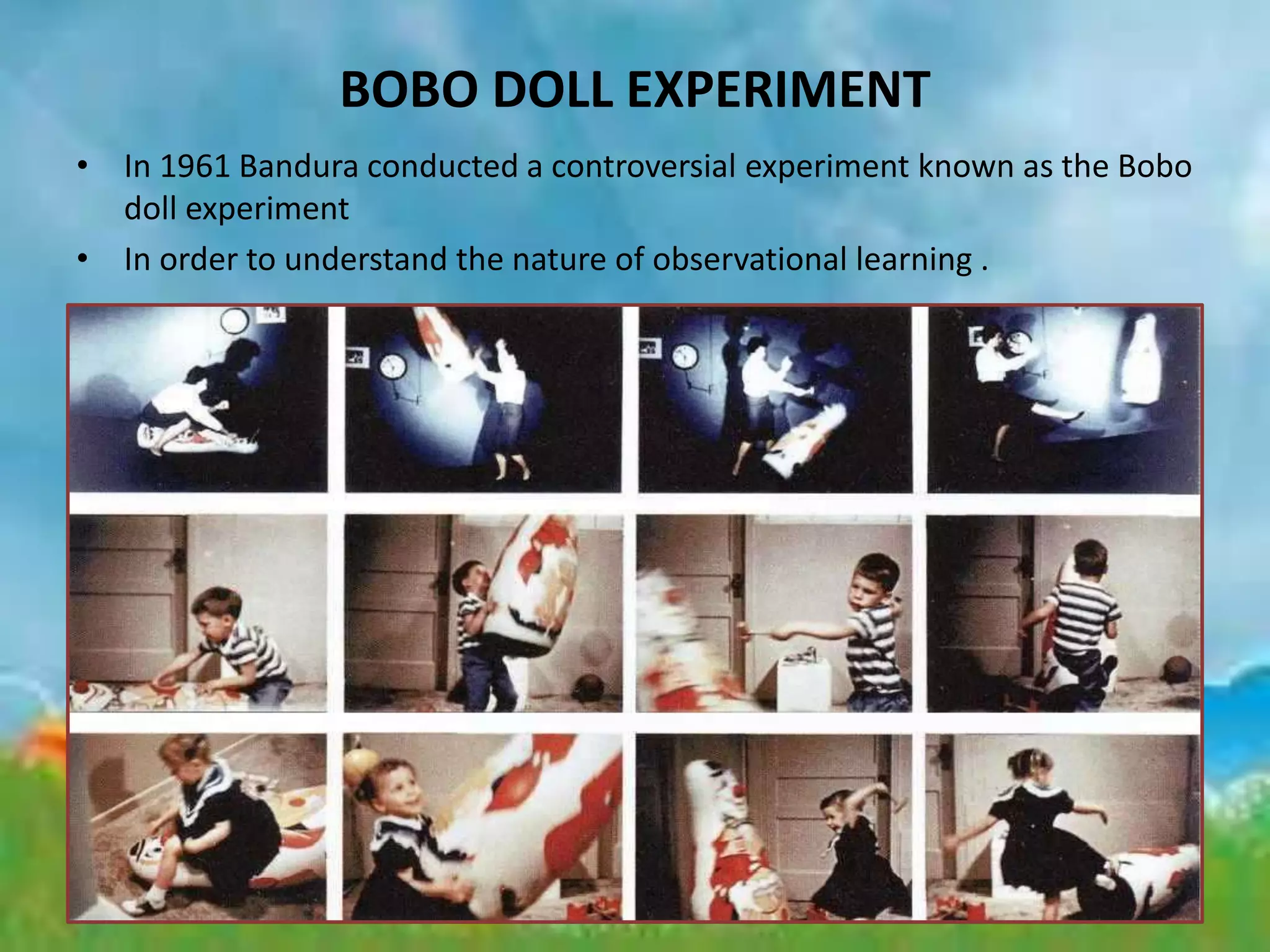
• In 1961 Bandura conducted a controversial experiment known as the Bobo
doll experiment
• In order to understand the nature of observational learning .
• Bandura showed a film of five minutes’ duration to children. The film
shows that in a large room there are numerous toys including a large sized
‘Bobo’ doll.
• Now a grown-up boy enters the room and looks around. The boy starts
showing aggressive behaviour towards the toys and in general and bobo
doll in particular. He hits the doll, throw it on the floor, kicking it and
sitting on it.
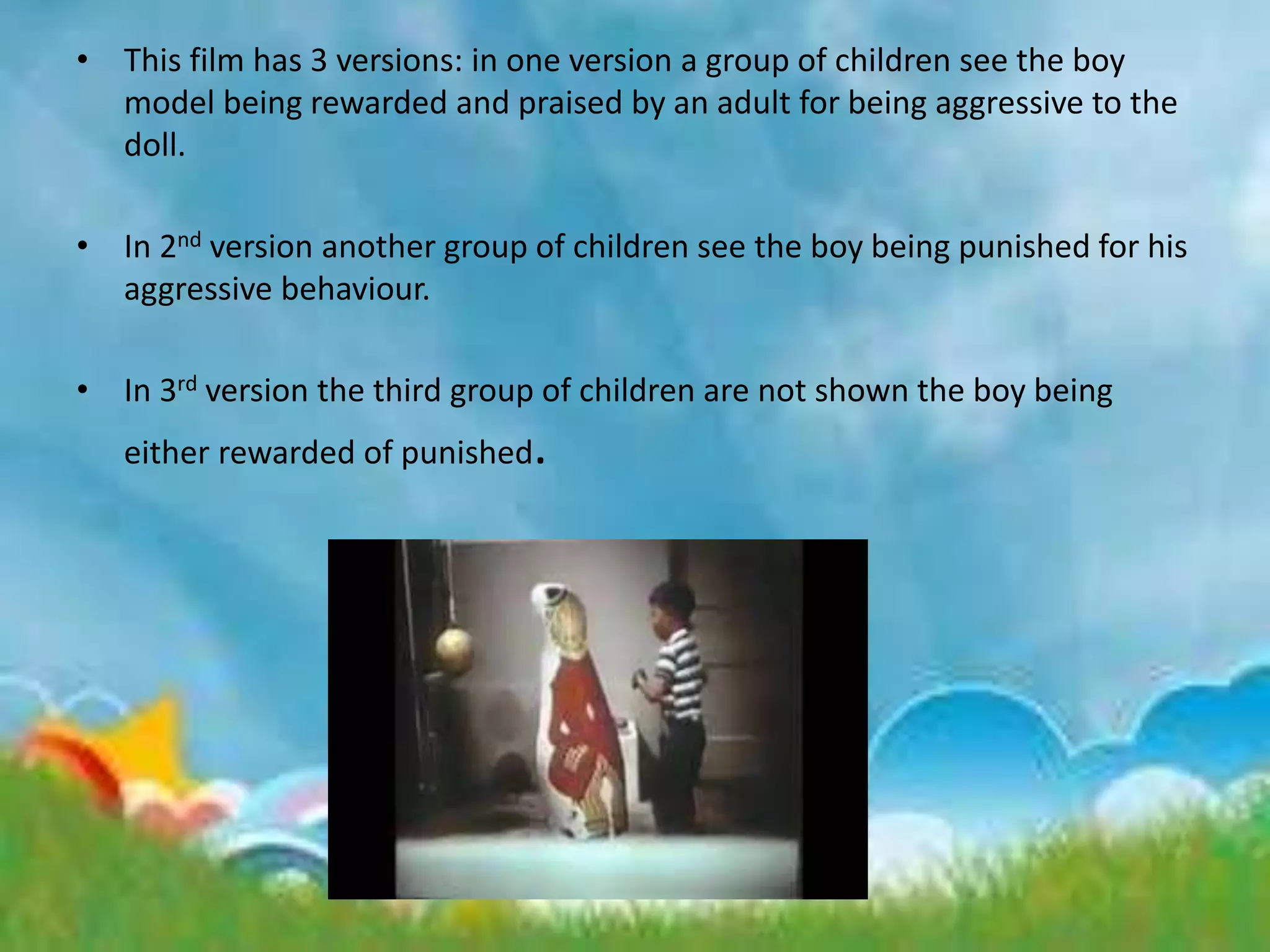
• This film has 3 versions: in one version a group of children see the boy
model being rewarded and praised by an adult for being aggressive to the
doll.
• In 2nd version another group of children see the boy being punished for his
aggressive behaviour.
• In 3rd version the third group of children are not shown the boy being
either rewarded of punished.
• After viewing specific version of the film all the three groups of children
were placed in an experimental room in which similar toys were placed
around, the children were allowed to play with the toys. These groups
were secretly observed and their behaviours noted.
• It was found that those children who saw aggressive behaviour being
rewarded were most aggressive; children who had seen the aggressive
model being punished were least aggressive.
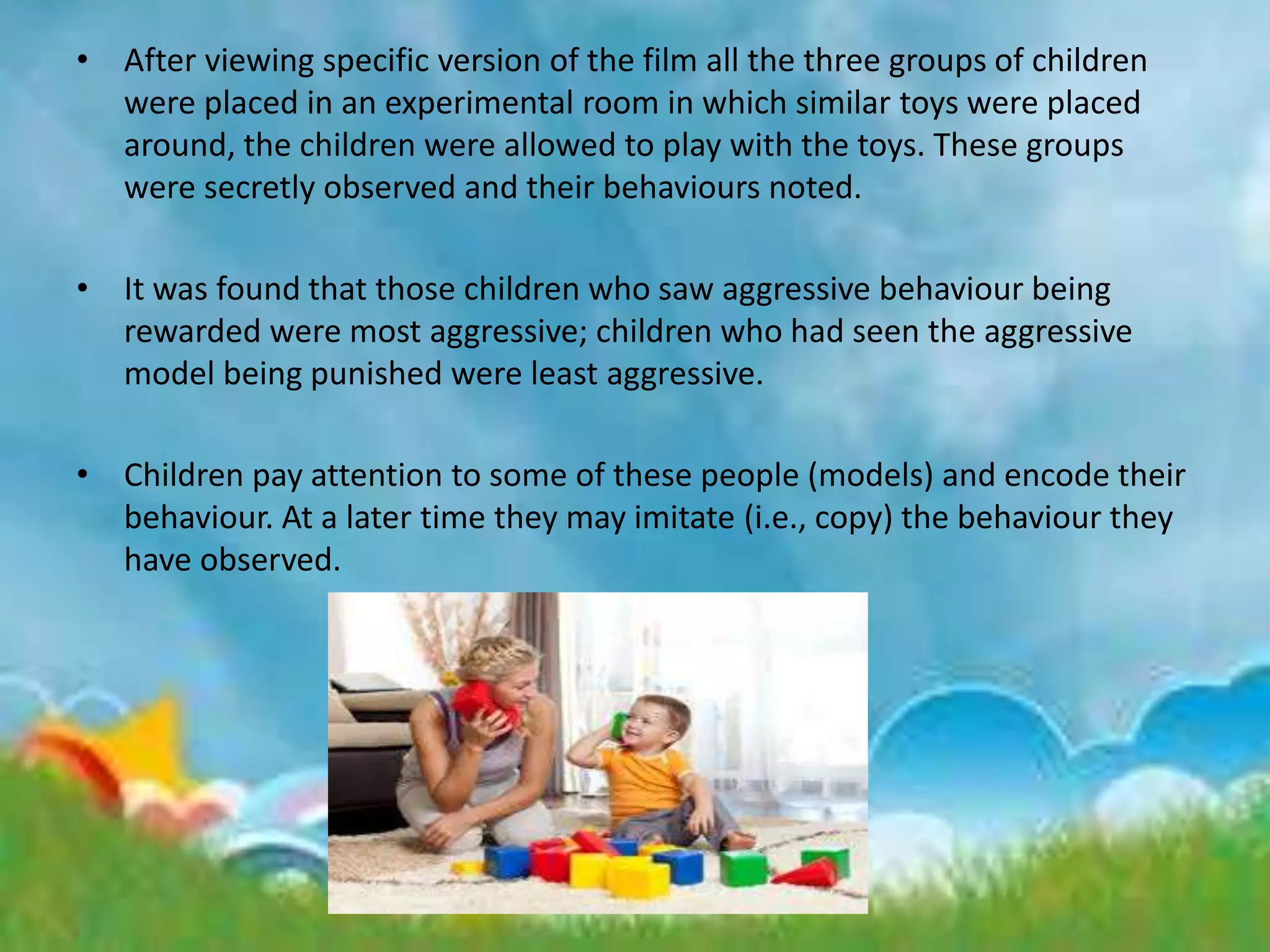
• Children pay attention to some of these people (models) and encode their
behaviour. At a later time they may imitate (i.e., copy) the behaviour they
have observed.
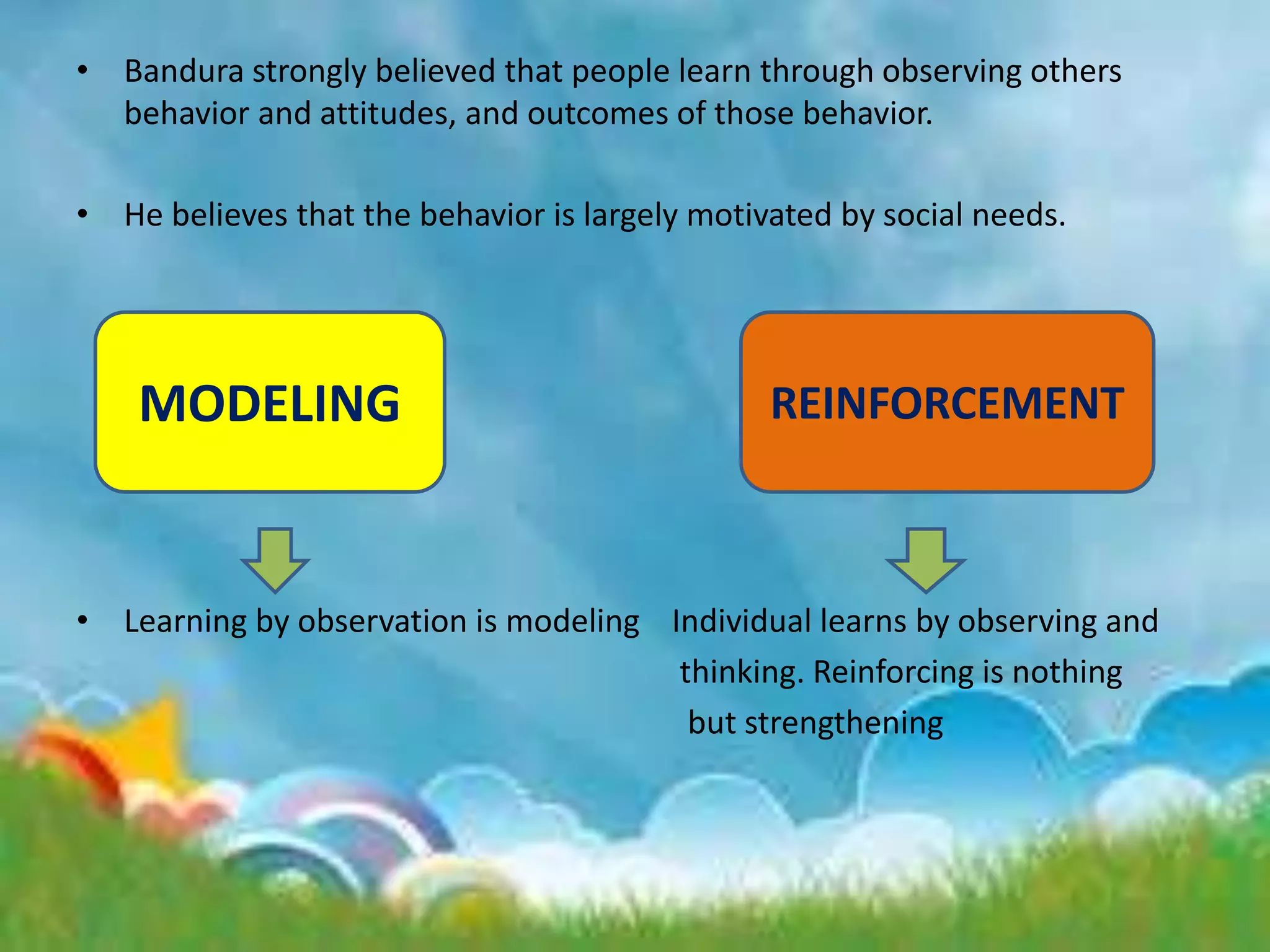
PRINCIPLES OF SOCIAL LEARNING THEORY
ATTENTION
• To learn through observation, one must pay attention to another person’s
behavior and its consequences so as to repeat the same if required.
• Simply exposing the child to a model does not assure his attention.
• This means the observing child must be able to relate with the model
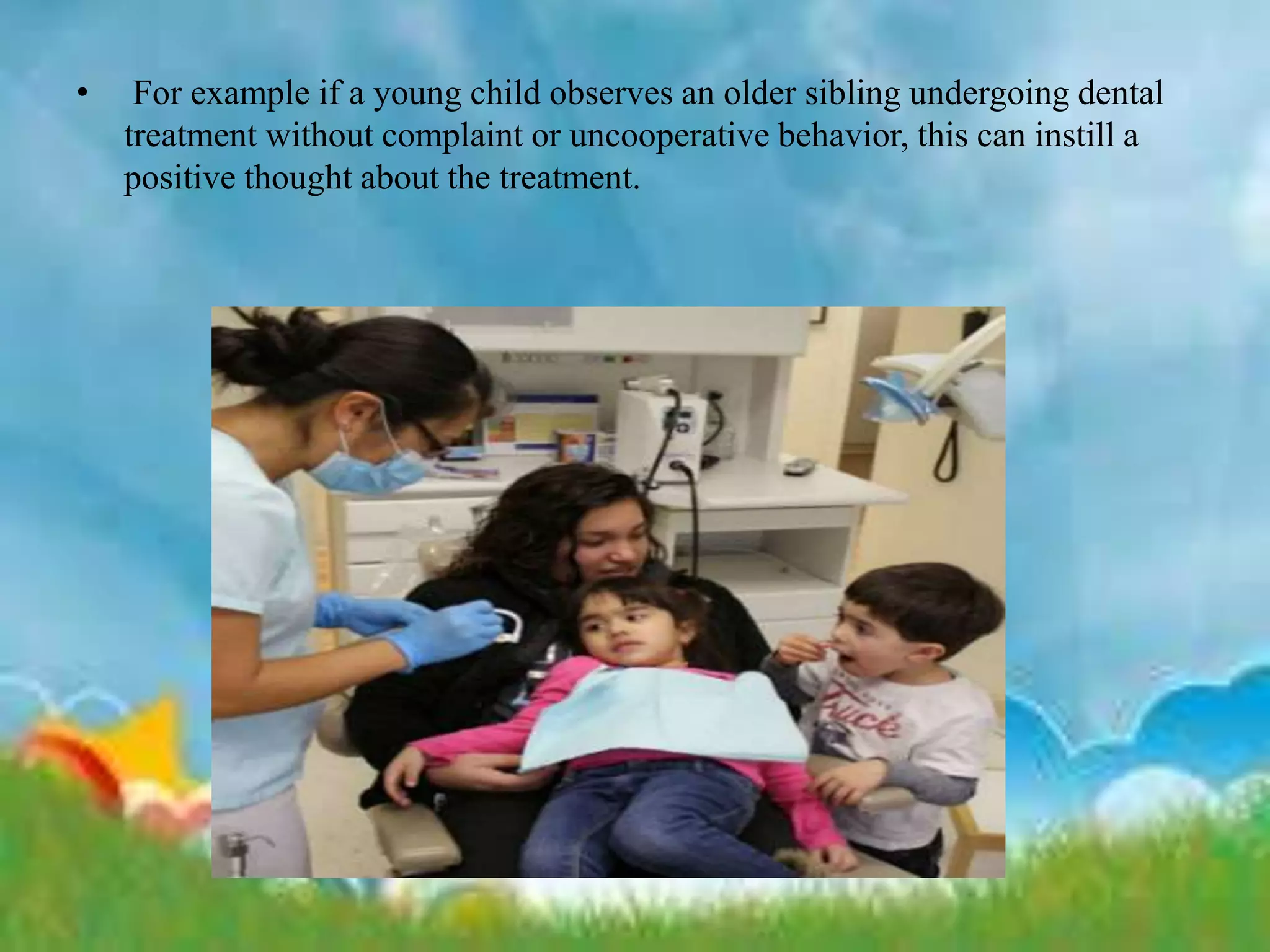
• For example if a young child observes an older sibling undergoing dental
treatment without complaint or uncooperative behavior, this can instill a
positive thought about the treatment.
RETENTION
• To encode the behavior in the memory, ability to store information .
• remembering what you paid attention to. Includes symbolic coding,
mental images, cognitive organization, symbolic rehearsal, motor
rehearsal.
MOTORIC REPRODUCTION
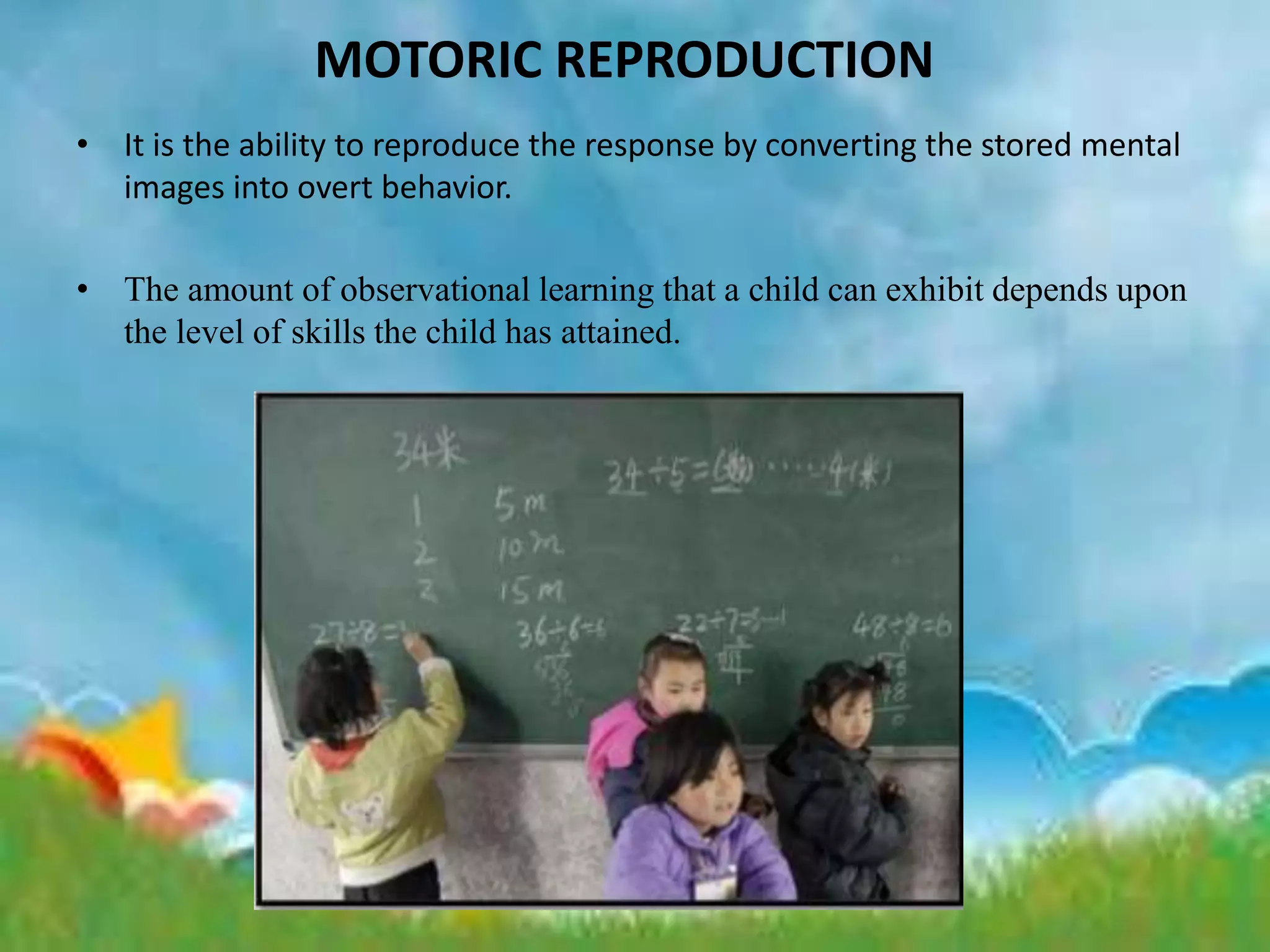
• It is the ability to reproduce the response by converting the stored mental
images into overt behavior.
• The amount of observational learning that a child can exhibit depends upon
the level of skills the child has attained.
MOTIVATION
• One is likely to reproduce an observed response when motivated to do so.
• The rewards and punishment that follow a behaviour will be considered
by the observer.
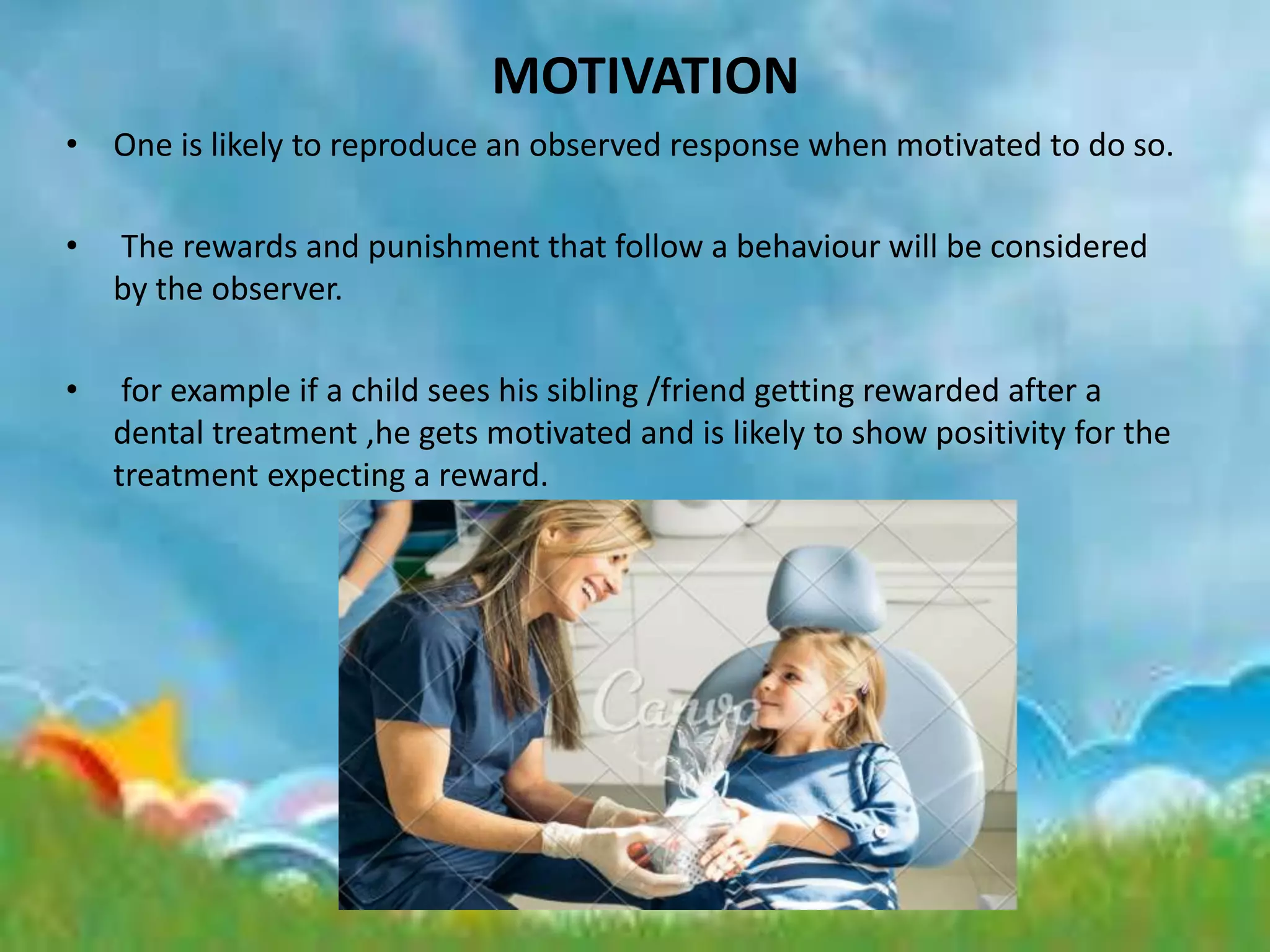
• for example if a child sees his sibling /friend getting rewarded after a
dental treatment ,he gets motivated and is likely to show positivity for the
treatment expecting a reward.
APPLICATION
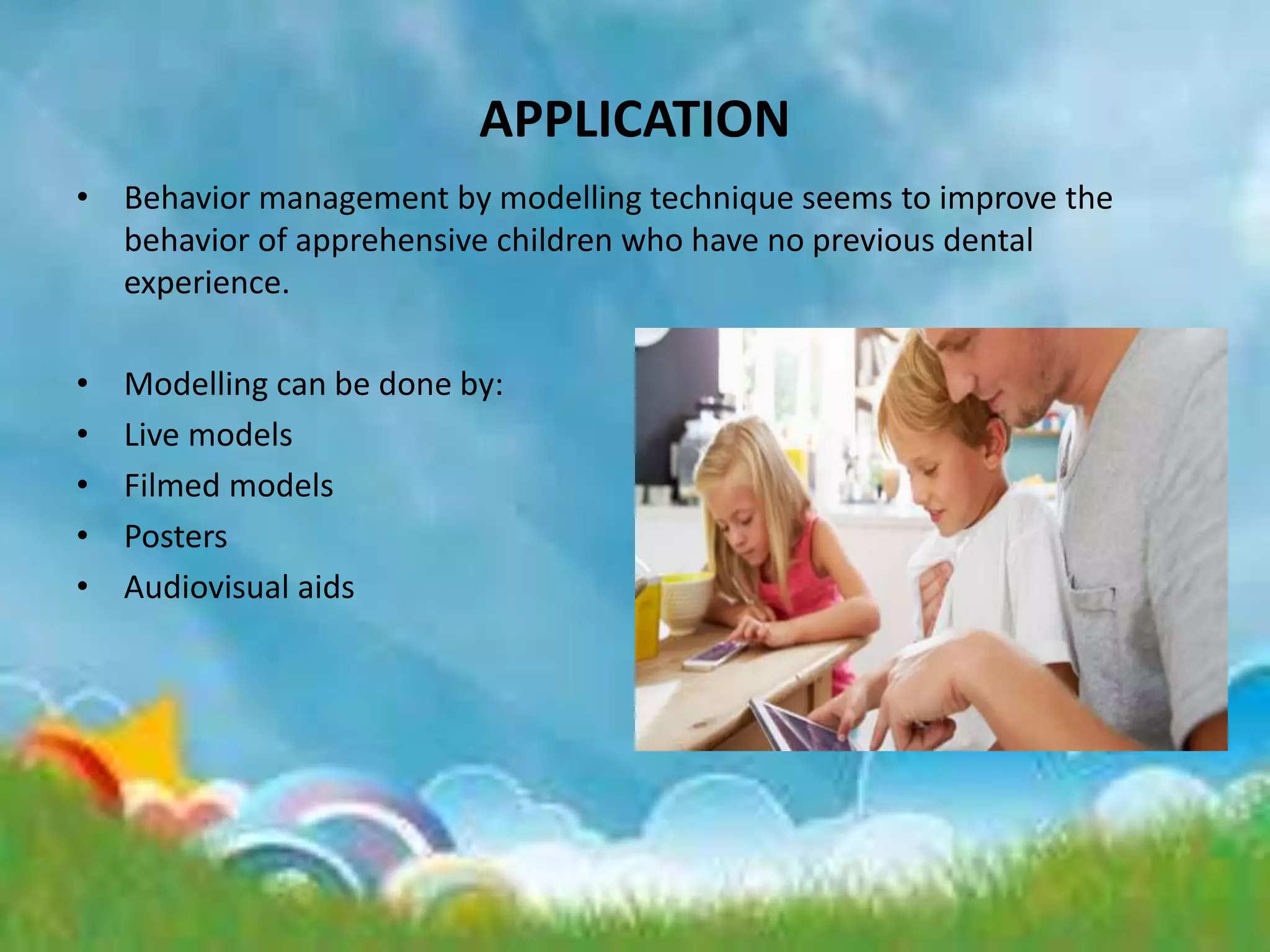
• Behavior management by modelling technique seems to improve the
behavior of apprehensive children who have no previous dental
experience.
• Modelling can be done by:
• Live models
• Filmed models
• Posters
• Audiovisual aids
MERITS
• Provides more explanatory concepts
• Encompasses a broader range of phenomena
DEMERITS
• Social learning theory is not a full explanation for all behaviour.
• This is particularly the case when there is no apparent role model in the
person’s life to imitate for a given behaviour.
CONCLUSION
• These theories help in understanding how developmental changes occur
in the behaviour and understanding of a child.
• A thorough knowledge and understanding of these theories helps in
effective behaviour management of a child in dental operatory
REFERNCES
• Contemporary orthodontics, 5th edition: William. R. Profitt
• Paediatric dentistry: Infancy through adolescence, 3rd edition:
Pinkham
• Textbook of pedodontics: Shobha Tondon
• Paediatric dentistry: principles and practice: Muthu and Siva Kumar
• Textbook of paediatric and preventive dentistry 2nd edition: Nikhil
marwah

Classical conditioning theory and social learning theory

  • 1.
  • 2.
    CONTENTS Classical conditioning theory Introduction Principles Applications Merits Demerits Sociallearning theory Introduction Principles Applications Merits Demerits Conclusions References
  • 3.
    INTRODUCTION • Behavior- isthe response of system or organism to various stimuli whether internal or external, conscious or subconscious, voluntary and involuntary • Learning: The acquisition of knowledge or skills through study, experience, or being taught • There are three distinct mechanisms by which behavioral responses are learned : • 1.Classical conditioning • 2.Operant conditioning • 3.Observational learning
  • 4.
    • In the1890s, Russian physiologist Ivan Pavlov while studying the functioning of the digestive system encountered an unforeseen problem: • the experimental dogs salivated not only upon actual eating but also when they saw food. • This work became the foundation for classical conditioning and the behavioral approach to psychology.
  • 5.
    • Pavlov's classicexperiment involved presentation of food to a hungry animal along with other stimulus. • Was awarded the Nobel Prize in Physiology in recognition of his work on the physiology of digestion.
  • 6.
    CLASSICAL CONDITIONING • Classicalconditioning is a learning process that occurs through associations between an environmental stimulus and a naturally occurring stimulus. • It had a major influence on behaviorism which is based on the assumption that learning occurs through interactions with the environment. • For this reason this mode of learning is sometimes referred to as learning by association.
  • 7.
    • STIMULUS: Athing or event that evokes a specific reaction in an organism. • RESPONSE: A reaction, as that of an organism or a mechanism, to a specific stimulus. • CONDITIONING in behavioral psychology is a theory that the reaction ("response") to an object or event ("stimulus") by a person or animal can be modified by 'learning', or conditioning.
  • 8.
  • 9.
    Unconditioned stimulus -smell of food • Is anything which can evoke a response without prior learning or conditioning. • This causes an automatic reflex Conditioned stimulus - bell • Is created by learning , does not create a response without prior conditioning.
  • 10.
    • Unconditioned Response-salivation • Is anything that happens without even • thinking about that. • Conditioned Response –salivation in response to bell • Is a reflex which you have learnt • to associate with something
  • 11.
    PAVLOV’S EXPERIMENT • Stage1- Before Conditioning In this stage, the unconditioned stimulus (UCS) produces an unconditioned response (UCR) in an organism.
  • 12.
    • This stagealso involves another stimulus which has no affect on a person and is called the neutral stimulus (NS). • The NS could be a person, object, place etc. The neutral stimulus in classical conditioning does not produce a response until it is paired with the unconditioned stimulus
  • 13.
    • Stage 2-During conditioning • During this stage a stimulus which produces no response (i.e. neutral) is paired with the unconditioned stimulus at which point it now becomes to be known as the conditioned stimulus (CS). • Often during this stage the UCS must be associated with the CS on a number of occasions, or trials, for learning to take place
  • 14.
    • Stage 3-After conditioning • Now the conditioned stimulus (CS) has been associated with the unconditioned stimulus (UCS) to create a new conditioned response (CR)
  • 15.
    LITTLE ALBERT EXPERIMENT JohnB. Watson further extended Pavlov’s work and applied it to human beings. In 1921, Watson studied Albert, an 11 month old infant child.
  • 16.
    • Watson theorized,emotional responses exist in us because we have been conditioned to respond emotionally to certain stimuli in the environment. • The implications of Watson’s experiment suggested that classical conditioning could cause some phobias in humans • Because albert’s fear also generalized to other fuzzy white objects.
  • 17.
    • An infantsucking the nipple if paired with hearing a lullaby, eventually leads the infant to initiate sucking when he hears the lullaby. • Jane had the flu. She was eating strawberries and felt nauseated, and threw up soon after. Weeks later she no longer had the flu, but the next time she ate a strawberry she felt sick again. Jane learned to associate the feeling of being sick with eating strawberries.
  • 18.
    PRINCIPLES OF CLASSICALCONDITIONING • ACQUISITION-: learning a new response from the environment by conditioning • it is the initial stage of learning when a response is first established and gradually strengthened • For example, conditioning of a dog to salivate in response to the sound of a bell. You repeatedly pair the presentation of food with the sound of the bell. You can say the response has been acquired as soon as the dog begins to salivate in response to the bell tone
  • 19.
    • GENERALIZATION -stimulisimilar to the original conditioned stimulus also evokes a conditioned response . • Examples – a child who has had a painful experience with a doctor in a white coat always associates any doctor in white coat with pain.
  • 20.
    • In littlealbert experiment, child was conditioned to fear a white rat. The child demonstrated stimulus generalization by also exhibiting fear in response to other fuzzy white objects including stuffed toys and Watson own hair • DISCRIMINATION – learning to discriminate or learning to respond to only certain stimuli • For example the dog salivates only when the bell rings and does not salivate to other different sounds • .
  • 21.
    • EXTINCTION- theconditioned response gradually disappears when the unconditioned stimulus is removed. • for example, after conditioning, when the bell continues to ring at certain intervals without any meat given, and the rate of salivation would gradually reduce and finally stop after a period of time. • subsequent visits to the doctor without an unpleasant experiences results in extinction of the fear
  • 22.
    • SPONTANEOUS RECOVERY-is the reappearance of the conditioned response after a rest period or period of lessened response. • For an example imagine that after training a dog to salivate to the sound of a bell, you stop ringing the bell and the salivation eventually becomes extinct. After a rest period when you suddenly ring the bell , the animal spontaneously recovers the previously learned response and starts salivating.
  • 23.
    APPLICATIONS • AVERSION THERAPIESEXPOSURE THERAPIES • Aversive stimuli is paired with an harmful or society undesirable behavior until the behavior becomes associated with pain or discomfort • Used for the people who wants to get rid of bad habits. • A person undergoing aversion therapy to stop smoking might receive an electrical shock every time they view an image of a cigarette
  • 24.
    • Two aversiveconditioning used in clinical practice are HOME and physical restraints
  • 25.
    MAIN TYPES OFEXPOSURE THERAPIES • SYSTEMATIC DESENSITIZATION • IMPLOSION • SYSTEMATIC DESENSITIZATION- This type of behavioral therapy used to overcome phobias. • It mainly includes 3 steps . • 1. identifying anxiety. • 2. copying relaxation strategy. • 3. habituated to situation
  • 26.
    • DESENSITIZATION • Josephwolpe used to remove fears and tension in children who have had previous unpleasant dental experience . • TELL SHOW DO TECHNIQUE Tell and show every step and instrument and explain what is going to be done
  • 27.
    • IMPLOSION • Exposingthe person to intensely fear-evoking imagined stimuli, which lie at the top of the fear hierarchy • Sudden flooding with a barrage of stimuli which affect the child adversely and they has no choice rather to face the stimuli until the negative behavior vanishes • • VOICE CONTROL
  • 28.
    MERITS • A strengthof classical conditioning theory is that it is scientific. This is because it's based on empirical evidence carried out by controlled experiments • Classical conditioning is also a reductionist explanation of behavior. • This is because complex behavior is broken down into smaller stimulus - response units of behavior.
  • 29.
    DEMERITS • Classical conditioningemphasizes the importance of learning from the environment, and supports nurture (learning from environment) over nature. • A final criticism of classical conditioning theory is that it is deterministic. • This means that it does not allow for any degree of freewill in the individual, a person has no control over the reactions they have learned from classical conditioning.
  • 30.
    CLASSICAL VS OPERANTCONDITIONING Classical • involves associating an involuntary response and a stimulus • classical conditioning involves no such enticements. • classical conditioning is passive on the part of the learner Operant • associating a voluntary behavior and a consequence • the learner is also rewarded with incentives • requires the learner to actively participate and perform some type of action in order to be rewarded or punished
  • 31.
    SOCIAL LEARNING THEORY “Mosthuman behavior is learned by observation through modeling”- ALBERT BANDURA
  • 32.
    • Albert bandurais a Canadian-American psychologist • He is known as the originator of social learning theory (renamed the social cognitive theory) • Bandura believed the sole behavioral modifiers of reward and punishment in classical and operant conditioning were inadequate as a framework, and that many human behaviors were learned from other humans. • Bandura began to analyze means of treating aggressive children by identifying sources of violence in their lives.
  • 33.
    • Bandura stronglybelieved that people learn through observing others behavior and attitudes, and outcomes of those behavior. • He believes that the behavior is largely motivated by social needs. • Learning by observation is modeling Individual learns by observing and thinking. Reinforcing is nothing but strengthening MODELING REINFORCEMENT
  • 34.
    BOBO DOLL EXPERIMENT •In 1961 Bandura conducted a controversial experiment known as the Bobo doll experiment • In order to understand the nature of observational learning .
  • 35.
    • Bandura showeda film of five minutes’ duration to children. The film shows that in a large room there are numerous toys including a large sized ‘Bobo’ doll. • Now a grown-up boy enters the room and looks around. The boy starts showing aggressive behaviour towards the toys and in general and bobo doll in particular. He hits the doll, throw it on the floor, kicking it and sitting on it.
  • 36.
    • This filmhas 3 versions: in one version a group of children see the boy model being rewarded and praised by an adult for being aggressive to the doll. • In 2nd version another group of children see the boy being punished for his aggressive behaviour. • In 3rd version the third group of children are not shown the boy being either rewarded of punished.
  • 37.
    • After viewingspecific version of the film all the three groups of children were placed in an experimental room in which similar toys were placed around, the children were allowed to play with the toys. These groups were secretly observed and their behaviours noted. • It was found that those children who saw aggressive behaviour being rewarded were most aggressive; children who had seen the aggressive model being punished were least aggressive. • Children pay attention to some of these people (models) and encode their behaviour. At a later time they may imitate (i.e., copy) the behaviour they have observed.
  • 38.
    PRINCIPLES OF SOCIALLEARNING THEORY
  • 39.
    ATTENTION • To learnthrough observation, one must pay attention to another person’s behavior and its consequences so as to repeat the same if required. • Simply exposing the child to a model does not assure his attention. • This means the observing child must be able to relate with the model
  • 40.
    • For exampleif a young child observes an older sibling undergoing dental treatment without complaint or uncooperative behavior, this can instill a positive thought about the treatment.
  • 41.
    RETENTION • To encodethe behavior in the memory, ability to store information . • remembering what you paid attention to. Includes symbolic coding, mental images, cognitive organization, symbolic rehearsal, motor rehearsal.
  • 42.
    MOTORIC REPRODUCTION • Itis the ability to reproduce the response by converting the stored mental images into overt behavior. • The amount of observational learning that a child can exhibit depends upon the level of skills the child has attained.
  • 43.
    MOTIVATION • One islikely to reproduce an observed response when motivated to do so. • The rewards and punishment that follow a behaviour will be considered by the observer. • for example if a child sees his sibling /friend getting rewarded after a dental treatment ,he gets motivated and is likely to show positivity for the treatment expecting a reward.
  • 44.
    APPLICATION • Behavior managementby modelling technique seems to improve the behavior of apprehensive children who have no previous dental experience. • Modelling can be done by: • Live models • Filmed models • Posters • Audiovisual aids
  • 45.
    MERITS • Provides moreexplanatory concepts • Encompasses a broader range of phenomena DEMERITS • Social learning theory is not a full explanation for all behaviour. • This is particularly the case when there is no apparent role model in the person’s life to imitate for a given behaviour.
  • 46.
    CONCLUSION • These theorieshelp in understanding how developmental changes occur in the behaviour and understanding of a child. • A thorough knowledge and understanding of these theories helps in effective behaviour management of a child in dental operatory
  • 47.
    REFERNCES • Contemporary orthodontics,5th edition: William. R. Profitt • Paediatric dentistry: Infancy through adolescence, 3rd edition: Pinkham • Textbook of pedodontics: Shobha Tondon • Paediatric dentistry: principles and practice: Muthu and Siva Kumar • Textbook of paediatric and preventive dentistry 2nd edition: Nikhil marwah

Editor's Notes

  • #4 As the learning proceeds more complex behaviour occurs.
  • #16 The goal of the study to condition albert by pairing the wite rat with a loud noice. It could be the loud noice that induced fear in im.
  • #27 Most popularly used now a days for behaviour modifying by desensitization is tell show do . Introduced by andellson. Indicated during first visit,fearfull child, when introducing new dental proceedure.
  • #31 Classical conditioning and operant conditioning are both important learning concepts that originated in behavioral psychology. While these two types of conditioning share some similarities, it is important to understand some of the key differences in order to best determine which approach is best for certain learning situations
  • #38 Boys imitated more physically aggressive acts than girls. There was little difference in the verbal aggression between boys and girls