Insightful Learning
What is Insightful Learning?
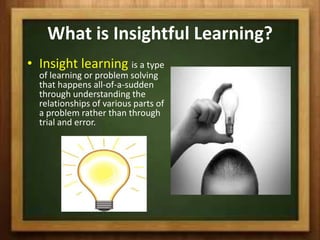
• Insight learning is a type
  of learning or problem solving
  that happens all-of-a-sudden
  through understanding the
  relationships of various parts of
  a problem rather than through
  trial and error.
Wolfgang Kohler and his contribution
       to Insightful Learning
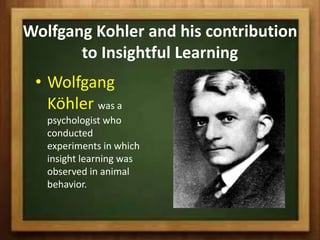
 • Wolfgang
   Köhler was a
   psychologist who
   conducted
   experiments in which
   insight learning was
   observed in animal
   behavior.
Epiphany

Another noteworthy term that describes
insight learning is "epiphany." Epiphanies
involve a sudden revelation or abrupt
awareness bringing seemingly chaotic data
into symmetry.
Eureka!
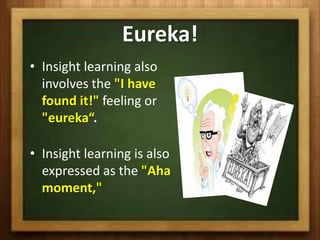
• Insight learning also
  involves the "I have
  found it!" feeling or
  "eureka“.

• Insight learning is also
  expressed as the "Aha
  moment,"
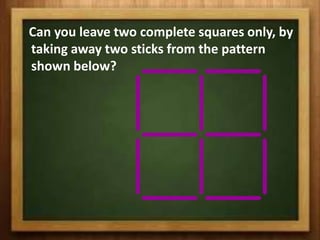
Can you leave two complete squares only, by
taking away two sticks from the pattern
shown below?
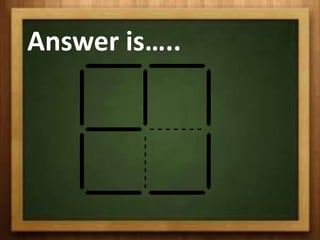
Answer is…..
Insightful learning depends on certain factors:
intelligence
Learning Situation
Initial Efforts
Repetition


      Generalization
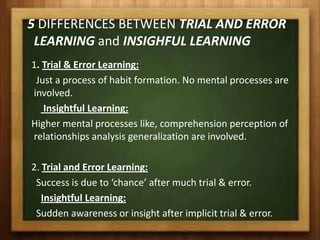
5 DIFFERENCES BETWEEN TRIAL AND ERROR
 LEARNING and INSIGHFUL LEARNING
1. Trial & Error Learning:
 Just a process of habit formation. No mental processes are
involved.
   Insightful Learning:
Higher mental processes like, comprehension perception of
relationships analysis generalization are involved.

2. Trial and Error Learning:
 Success is due to ‘chance’ after much trial & error.
   Insightful Learning:
 Sudden awareness or insight after implicit trial & error.
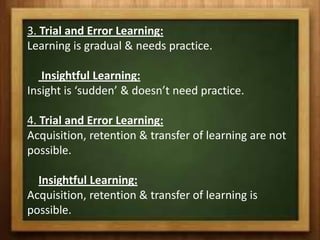
3. Trial and Error Learning:
Learning is gradual & needs practice.

   Insightful Learning:
Insight is ‘sudden’ & doesn’t need practice.

4. Trial and Error Learning:
Acquisition, retention & transfer of learning are not
possible.

  Insightful Learning:
Acquisition, retention & transfer of learning is
possible.
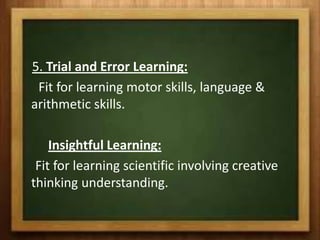
5. Trial and Error Learning:
 Fit for learning motor skills, language &
arithmetic skills.

    Insightful Learning:
 Fit for learning scientific involving creative
thinking understanding.
Kohler’s Experiment Involving
        Insightful Learning

An experiment was conducted by Kohler to
show the occurrence and importance of
perceptual organization and insight in
learning.
So how Insightful Learning Occurs:
1. The nature of the situation is very important for
   insightful learning.

2. The organism reacts to the whole situation, not
   to its component parts.

3. The organism perceives the relationships
  between means and the goal, and restructures
  the perceptual field.
4. Insight follows a period of trial and error
   behavior.

5. The insightful solution comes all on a
   sudden.

6. Once the insightful solution is reached, the
   organism shows high degree of retention
   and transfer to similar problems.

7. Insight is closely related to the organism's
   capacity to learn.
Educational Implications of Insight
       Theory of Learning:
An individual has insight into a learning
situation to the extent that he is able to
understand the situation as a whole. A
solution to a problem is an example of
insight that results from integration of all
the mental processes. All the higher
learning takes place by this method.
EUREKA! It is done!
    Group members:
     Raisa Clemente Ubas
        Lezyl C. Coloso
         Keiko Mizuno
       Kristel Mae Lao

           BSPS 2A

Insightful learning...

  • 1.
  • 2.
    What is InsightfulLearning? • Insight learning is a type of learning or problem solving that happens all-of-a-sudden through understanding the relationships of various parts of a problem rather than through trial and error.
  • 3.
    Wolfgang Kohler andhis contribution to Insightful Learning • Wolfgang Köhler was a psychologist who conducted experiments in which insight learning was observed in animal behavior.
  • 4.
    Epiphany Another noteworthy termthat describes insight learning is "epiphany." Epiphanies involve a sudden revelation or abrupt awareness bringing seemingly chaotic data into symmetry.
  • 5.
    Eureka! • Insight learningalso involves the "I have found it!" feeling or "eureka“. • Insight learning is also expressed as the "Aha moment,"
  • 6.
    Can you leavetwo complete squares only, by taking away two sticks from the pattern shown below?
  • 7.
  • 8.
    Insightful learning dependson certain factors:
  • 9.
  • 10.
  • 11.
  • 12.
    Repetition Generalization
  • 13.
    5 DIFFERENCES BETWEENTRIAL AND ERROR LEARNING and INSIGHFUL LEARNING 1. Trial & Error Learning: Just a process of habit formation. No mental processes are involved. Insightful Learning: Higher mental processes like, comprehension perception of relationships analysis generalization are involved. 2. Trial and Error Learning: Success is due to ‘chance’ after much trial & error. Insightful Learning: Sudden awareness or insight after implicit trial & error.
  • 14.
    3. Trial andError Learning: Learning is gradual & needs practice. Insightful Learning: Insight is ‘sudden’ & doesn’t need practice. 4. Trial and Error Learning: Acquisition, retention & transfer of learning are not possible. Insightful Learning: Acquisition, retention & transfer of learning is possible.
  • 15.
    5. Trial andError Learning: Fit for learning motor skills, language & arithmetic skills. Insightful Learning: Fit for learning scientific involving creative thinking understanding.
  • 16.
    Kohler’s Experiment Involving Insightful Learning An experiment was conducted by Kohler to show the occurrence and importance of perceptual organization and insight in learning.
  • 19.
    So how InsightfulLearning Occurs: 1. The nature of the situation is very important for insightful learning. 2. The organism reacts to the whole situation, not to its component parts. 3. The organism perceives the relationships between means and the goal, and restructures the perceptual field.
  • 20.
    4. Insight followsa period of trial and error behavior. 5. The insightful solution comes all on a sudden. 6. Once the insightful solution is reached, the organism shows high degree of retention and transfer to similar problems. 7. Insight is closely related to the organism's capacity to learn.
  • 21.
    Educational Implications ofInsight Theory of Learning: An individual has insight into a learning situation to the extent that he is able to understand the situation as a whole. A solution to a problem is an example of insight that results from integration of all the mental processes. All the higher learning takes place by this method.
  • 22.
    EUREKA! It isdone! Group members: Raisa Clemente Ubas Lezyl C. Coloso Keiko Mizuno Kristel Mae Lao BSPS 2A

Editor's Notes