Mr. H Zwide
2018
Pavlov’s classical conditioning
 Classical conditioning was accidentally discovered
around the beginning of the 20th century by Russian
physiologist Ivan Pavlov.
 Pavlov was studying digestive process in dogs when he
discovered that the dogs salivated before they received
their food.
 In fact, after repeated pairing of the lab attendant and
the food, the dogs started to salivate at the sight of the
lab assistants
Pavlov’s classical conditioning cont’d
 He noted that dogs were not only responding to a
biological need (hunger), but also a need developed by
learning.
 Pavlov spent the rest of life researching why this
associate learning occurred, which is now called
classical conditioning.
 To experiment on classical conditioning, Pavlov
utilized a tuning fork and meat powder. He hit the
tuning fork and followed the sound with the meat
powder.
Classical conditioning cont’d
 Pavlov presented the sound (tuning fork) with the
meat powder at the exact same time increments.
 In the beginning, the dog salivated only to the meat
powder, but after this was repeated, salivated at the
sound of the tuning fork.
 Even when Pavlov took away the meat powder, the dog
continued to salivate at the sound of the tuning fork.
Principles of classical conditioning
 In classical conditioning, an organism learns to
associate one stimulus with another.
 The organism learns that the first stimulus is a cue for
the second stimulus.
 In Pavlov’s experiment above, the tuning fork cued the
dogs that food might be coming.
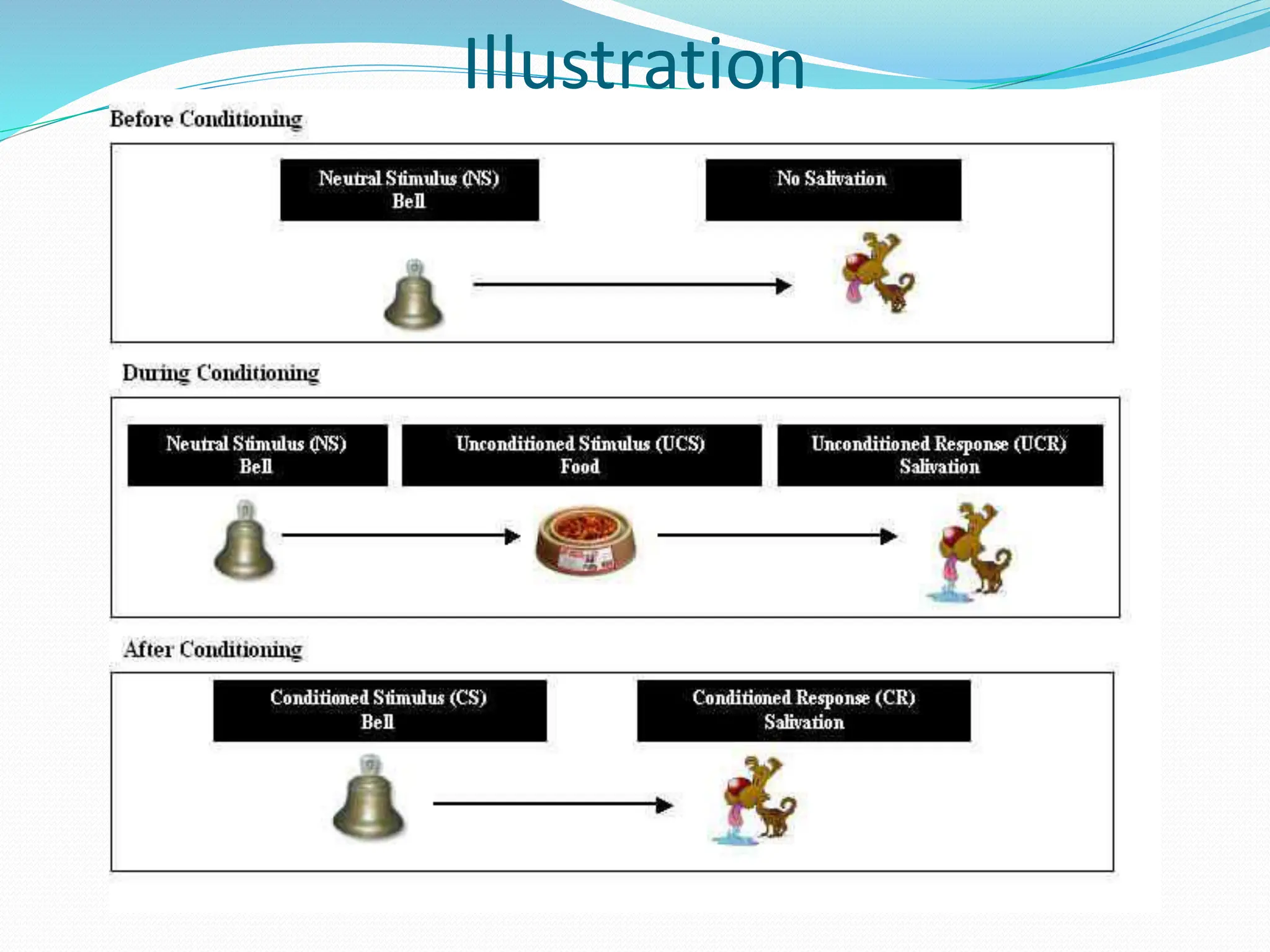
 Following is an example of classical conditioning:
Illustration
Illustration cont’d
 In technical terms, the food is an unconditioned
stimulus (UCS) and the salivation is the
unconditioned response (UCR).
 The bell is a neutral stimulus until the dog learns to
associate the bell with food.
 Then the bell becomes a conditioned stimulus (CS)
which produces the conditioned response (CR) of
salivation after repeated pairings between the bell and
food.
Watson’s Baby Albert
 John B. Watson was interested in how classical
conditioning could be applied to humans. In 1921,
Watson and his research assistant Rosalie Rayner
experimented on a 11-month-old infant named Albert.
 The goal was to condition Albert to fear a white rat by
paring the white rat with a loud bang (UCS).
 Initially, Albert showed no fear of rats, but once the rat
was repeatedly paired with the loud noise (UCS),
Albert developed a fear of rats.
Watson’s Baby Albert cont’d
 The noise (UCS) induced fear (UCR).
 After pairings between the loud noise (UCS) and the
rat (CS), Albert started to fear the rat.
 Watson’s experiment suggested that classical
conditioning could cause some phobias.
Key concepts of classical conditioning
 Unconditioned Stimulus (UCS)
A stimulus that elicits a response without conditioning
 Unconditioned Response (UCR)
Automatic response elicited by the unconditioned
stimulus
 Conditioned Stimulus (CS)
A neutral stimulus that when paired with an
unconditioned stimulus (UCS) elicits a similar
response
Key concepts of classical conditioning cont’d
 Conditioned Response (CR)
A response that is learned by pairing the originally
neutral conditioned stimulus (CS) with the
unconditioned stimulus (UCS)
 Acquisition
The acquisition phase is the consistent parings of the
CS (bell) and the UCS (food) that produces a CR
(salivation). In the example above, this phase occurs
when the dog begins to salivate at the sound of the
bell. Conditioning occurs more rapidly when the food
follows the bell by a half a second.
Key concepts of classical conditioning cont’d
 Extinction
The extinction phase is when the conditioned
response no longer occurs after repeated pairings
without the unconditioned stimulus. The dog’s
response to the bell can be extinguished by repeatedly
presenting the bell (CS) without the food (UCS). The
dog has not completely forgotten the association
between the bell and the food. If the experimenter
waits a day, the dog may have a spontaneous recovery
of the conditioned response and salivate again to the
bell.
Key concepts of classical conditioning cont’d
 Generalization
Occurs when there is a small difference in the presented
stimulus and the original conditioned stimulus. If Pavlov’s
dog heard a bell of a similar tone, the dog would still
salivate.
 Discrimination
The opposite of generalization, discrimination happens
when a conditioned response does not occur when there is
a difference between the presented stimulus and the
original conditioned stimulus. If Pavlov’s dog heard a bell
with a different tone and was not awarded the
unconditioned stimulus (food), the dog would learn not to
salivate to the second tone.

-classical conditioning.pptx

  • 1.
  • 2.
    Pavlov’s classical conditioning Classical conditioning was accidentally discovered around the beginning of the 20th century by Russian physiologist Ivan Pavlov.  Pavlov was studying digestive process in dogs when he discovered that the dogs salivated before they received their food.  In fact, after repeated pairing of the lab attendant and the food, the dogs started to salivate at the sight of the lab assistants
  • 3.
    Pavlov’s classical conditioningcont’d  He noted that dogs were not only responding to a biological need (hunger), but also a need developed by learning.  Pavlov spent the rest of life researching why this associate learning occurred, which is now called classical conditioning.  To experiment on classical conditioning, Pavlov utilized a tuning fork and meat powder. He hit the tuning fork and followed the sound with the meat powder.
  • 4.
    Classical conditioning cont’d Pavlov presented the sound (tuning fork) with the meat powder at the exact same time increments.  In the beginning, the dog salivated only to the meat powder, but after this was repeated, salivated at the sound of the tuning fork.  Even when Pavlov took away the meat powder, the dog continued to salivate at the sound of the tuning fork.
  • 5.
    Principles of classicalconditioning  In classical conditioning, an organism learns to associate one stimulus with another.  The organism learns that the first stimulus is a cue for the second stimulus.  In Pavlov’s experiment above, the tuning fork cued the dogs that food might be coming.  Following is an example of classical conditioning:
  • 6.
  • 7.
    Illustration cont’d  Intechnical terms, the food is an unconditioned stimulus (UCS) and the salivation is the unconditioned response (UCR).  The bell is a neutral stimulus until the dog learns to associate the bell with food.  Then the bell becomes a conditioned stimulus (CS) which produces the conditioned response (CR) of salivation after repeated pairings between the bell and food.
  • 8.
    Watson’s Baby Albert John B. Watson was interested in how classical conditioning could be applied to humans. In 1921, Watson and his research assistant Rosalie Rayner experimented on a 11-month-old infant named Albert.  The goal was to condition Albert to fear a white rat by paring the white rat with a loud bang (UCS).  Initially, Albert showed no fear of rats, but once the rat was repeatedly paired with the loud noise (UCS), Albert developed a fear of rats.
  • 9.
    Watson’s Baby Albertcont’d  The noise (UCS) induced fear (UCR).  After pairings between the loud noise (UCS) and the rat (CS), Albert started to fear the rat.  Watson’s experiment suggested that classical conditioning could cause some phobias.
  • 10.
    Key concepts ofclassical conditioning  Unconditioned Stimulus (UCS) A stimulus that elicits a response without conditioning  Unconditioned Response (UCR) Automatic response elicited by the unconditioned stimulus  Conditioned Stimulus (CS) A neutral stimulus that when paired with an unconditioned stimulus (UCS) elicits a similar response
  • 11.
    Key concepts ofclassical conditioning cont’d  Conditioned Response (CR) A response that is learned by pairing the originally neutral conditioned stimulus (CS) with the unconditioned stimulus (UCS)  Acquisition The acquisition phase is the consistent parings of the CS (bell) and the UCS (food) that produces a CR (salivation). In the example above, this phase occurs when the dog begins to salivate at the sound of the bell. Conditioning occurs more rapidly when the food follows the bell by a half a second.
  • 12.
    Key concepts ofclassical conditioning cont’d  Extinction The extinction phase is when the conditioned response no longer occurs after repeated pairings without the unconditioned stimulus. The dog’s response to the bell can be extinguished by repeatedly presenting the bell (CS) without the food (UCS). The dog has not completely forgotten the association between the bell and the food. If the experimenter waits a day, the dog may have a spontaneous recovery of the conditioned response and salivate again to the bell.
  • 13.
    Key concepts ofclassical conditioning cont’d  Generalization Occurs when there is a small difference in the presented stimulus and the original conditioned stimulus. If Pavlov’s dog heard a bell of a similar tone, the dog would still salivate.  Discrimination The opposite of generalization, discrimination happens when a conditioned response does not occur when there is a difference between the presented stimulus and the original conditioned stimulus. If Pavlov’s dog heard a bell with a different tone and was not awarded the unconditioned stimulus (food), the dog would learn not to salivate to the second tone.