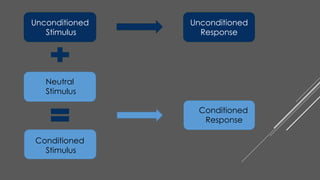
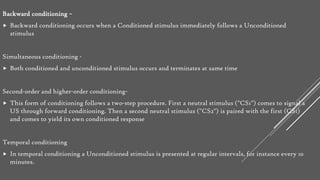
Pavlov's experiment demonstrated classical conditioning, where a dog learns to associate food with the sound of a metronome through repeated pairings. Classical conditioning is a form of learning where a neutral stimulus becomes associated with an unconditioned stimulus to elicit a conditioned response. Pavlov showed that dogs could be conditioned to salivate in response to a previously neutral stimulus like a bell through repeated pairing with food. His findings established the basic principles of classical conditioning, including acquisition, extinction, spontaneous recovery, stimulus generalization, and discrimination. Classical conditioning forms the basis for explaining many types of learned behaviors and has applications in treating phobias and anxiety disorders.