PAVLOV’S CLASSICAL
CONDITIONING
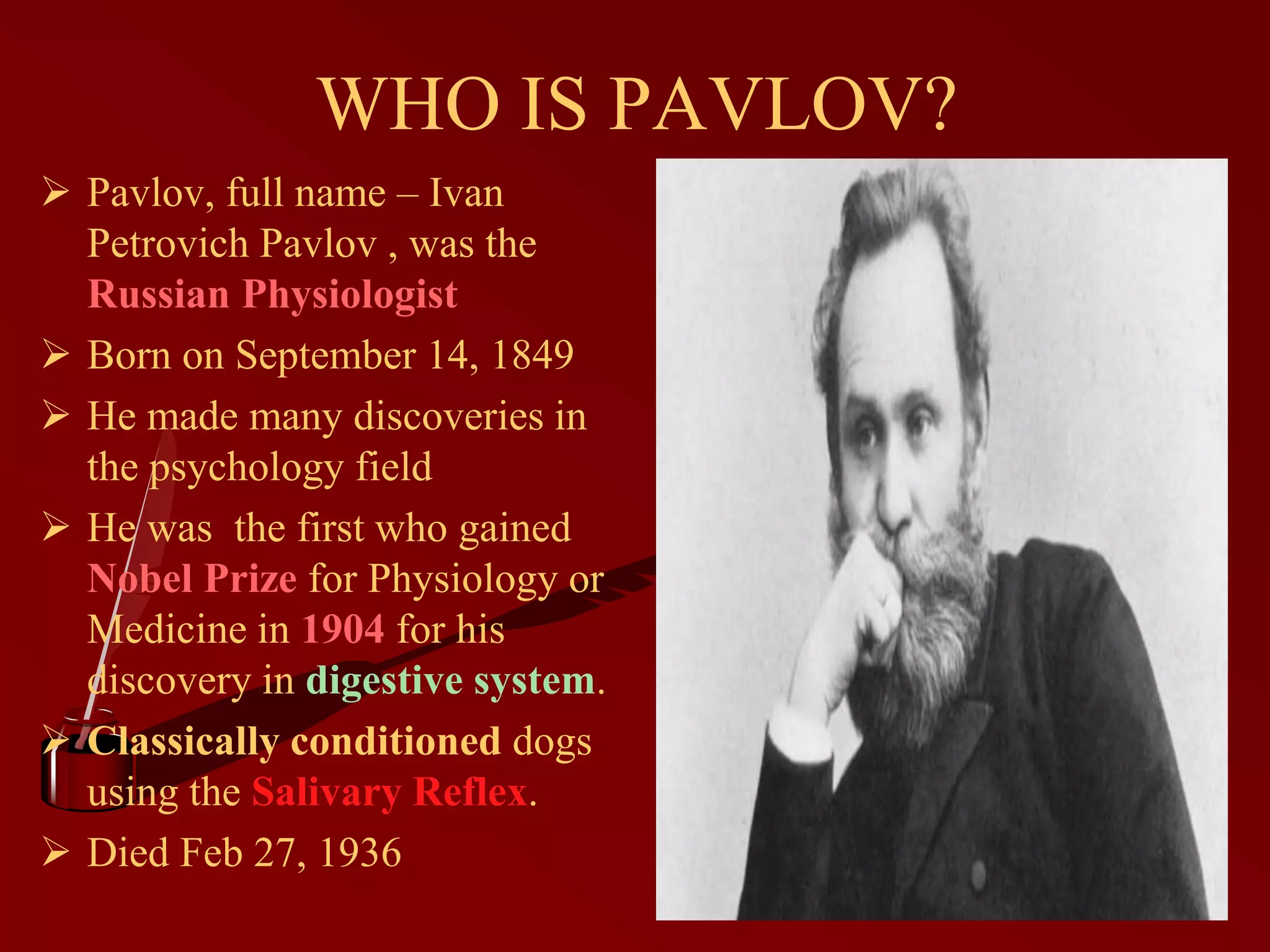
WHO IS PAVLOV?
 Pavlov, full name – Ivan
Petrovich Pavlov , was the
Russian Physiologist
 Born on September 14, 1849
 He made many discoveries in
the psychology field
 He was the first who gained
Nobel Prize for Physiology or
Medicine in 1904 for his
discovery in digestive system.
 Classically conditioned dogs
using the Salivary Reflex.
 Died Feb 27, 1936
LEARNING
• Learning is a process of acquiring and stabilizing
successful or rewarded responses and of
eliminating the unsuccessful or unrewarded
responses.
• Learning is acquisition of knowledge, attitudes
and values, emotional responses and motor skills.
• Learning is a modification of behaviour through
experiences and instruction for future life.
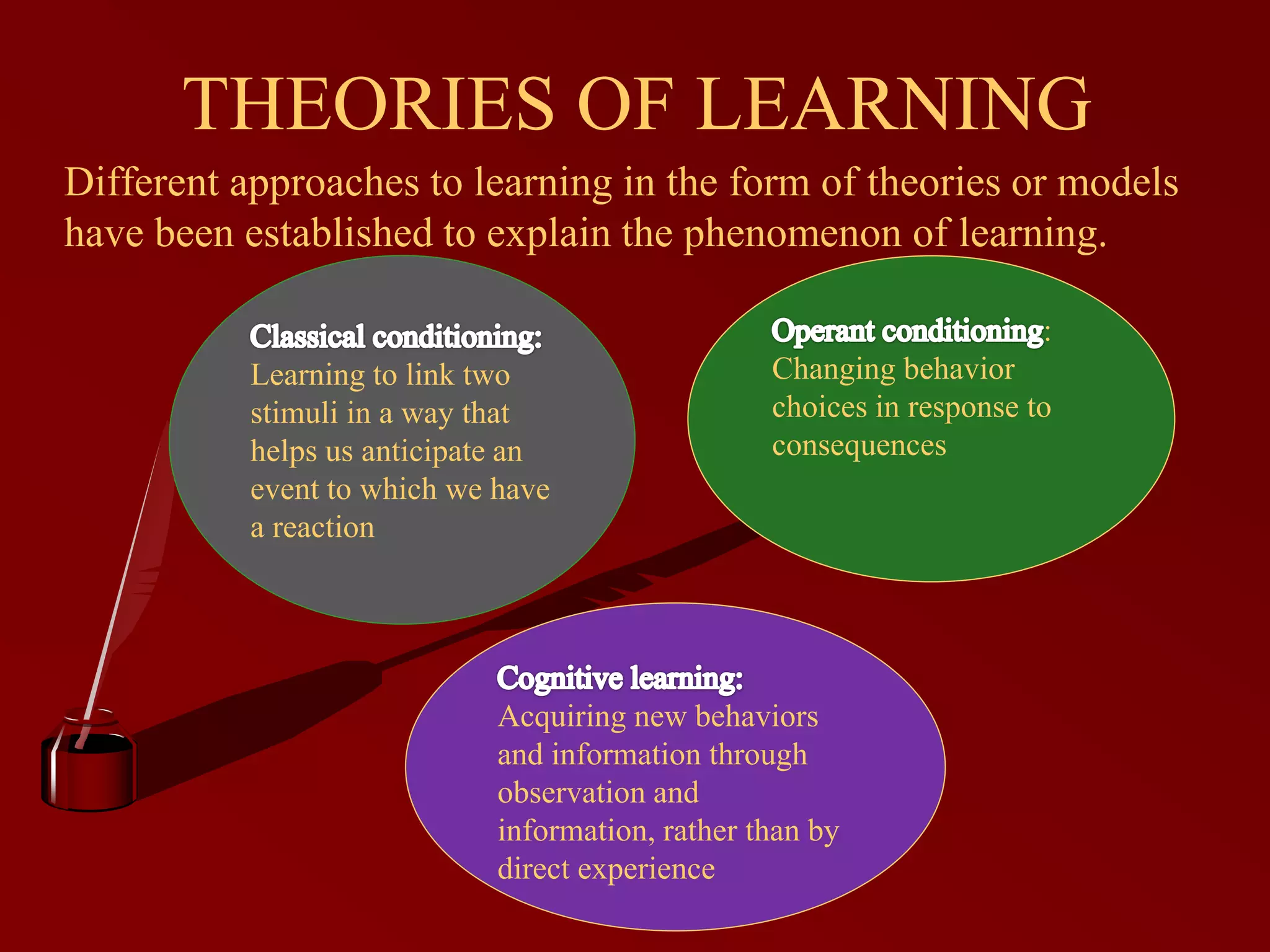
THEORIES OF LEARNING
Different approaches to learning in the form of theories or models
have been established to explain the phenomenon of learning.
Learning to link two
stimuli in a way that
helps us anticipate an
event to which we have
a reaction
:
Changing behavior
choices in response to
consequences
Acquiring new behaviors
and information through
observation and
information, rather than by
direct experience
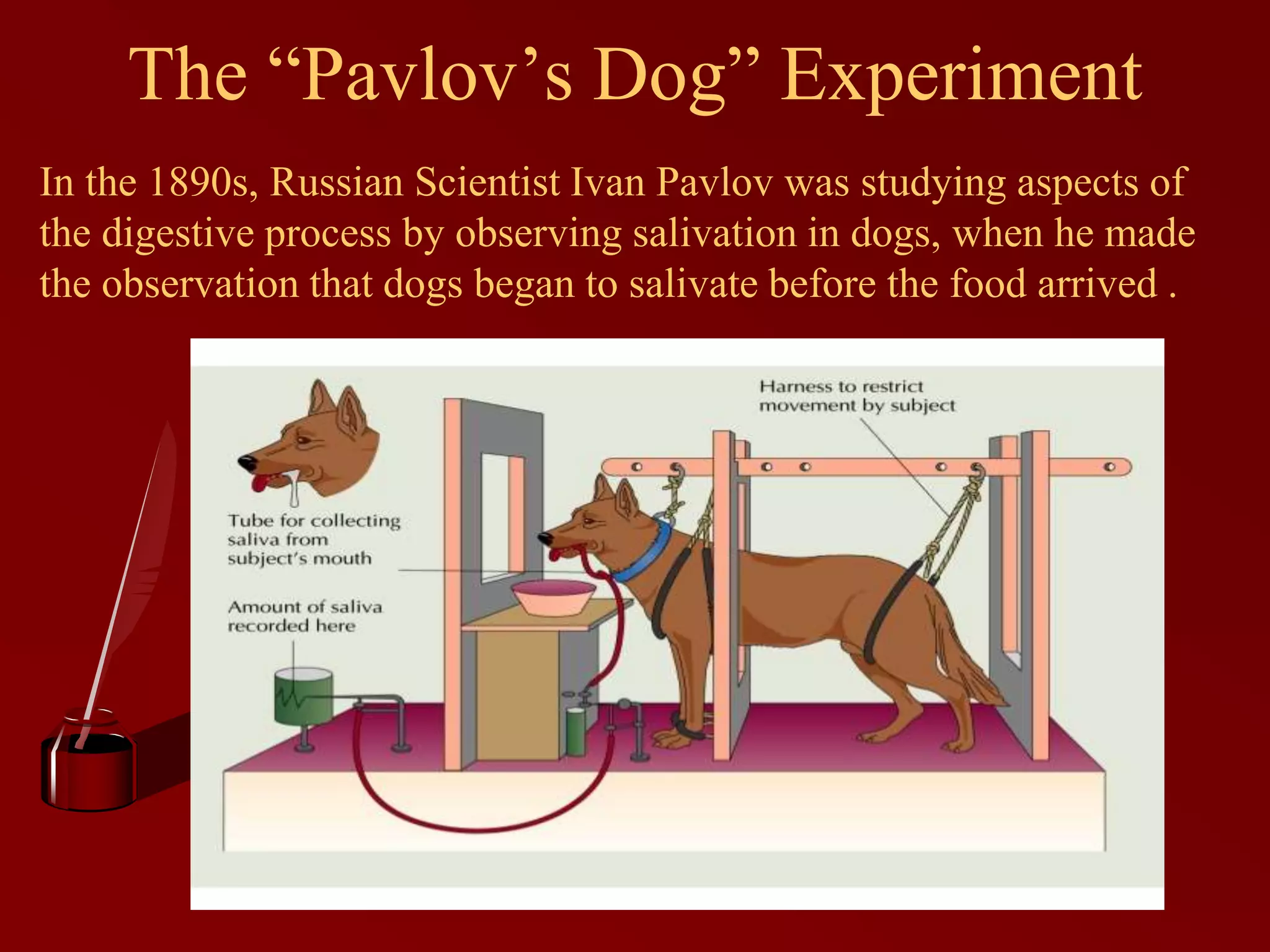
The “Pavlov’s Dog” Experiment
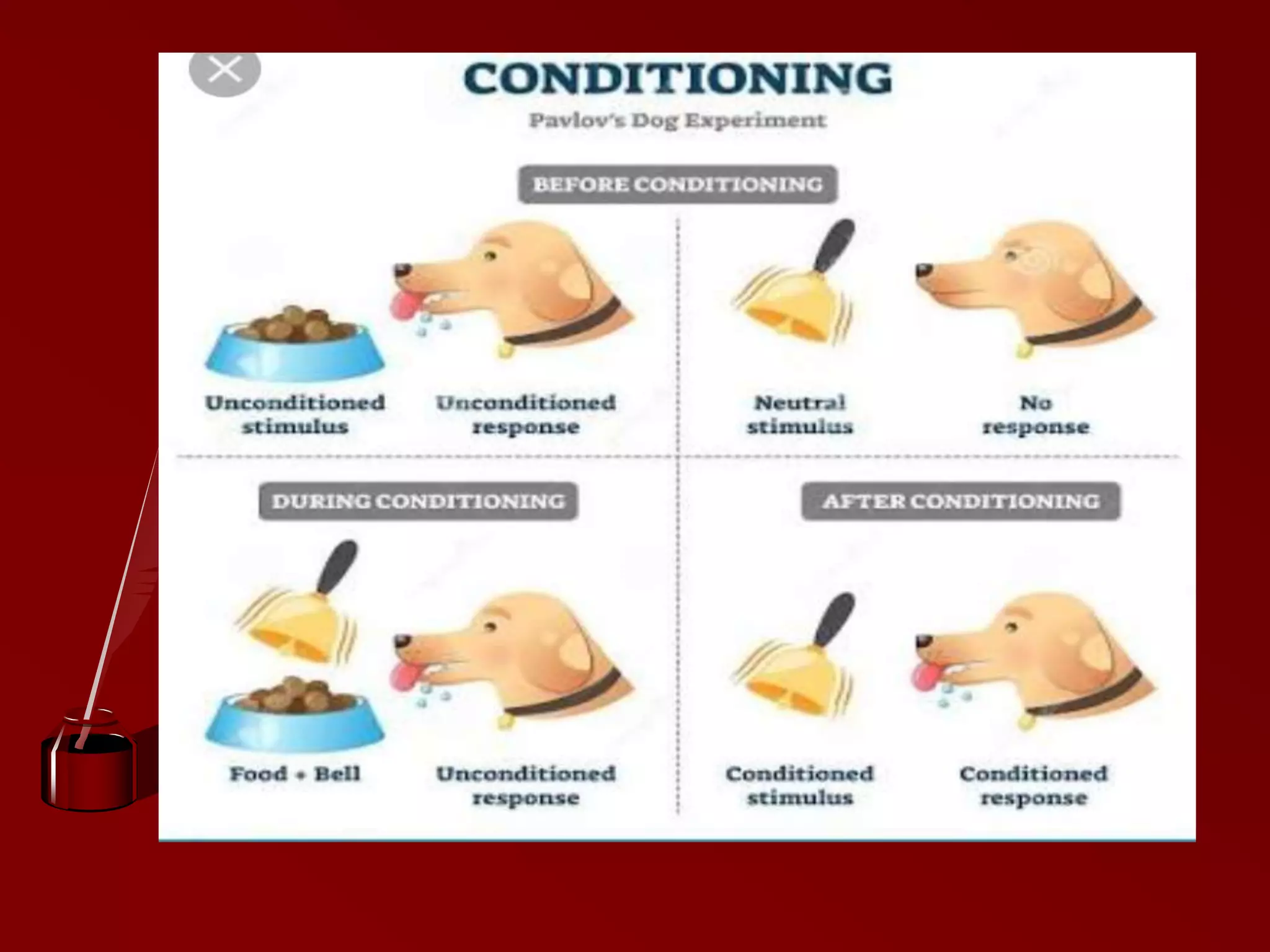
In the 1890s, Russian Scientist Ivan Pavlov was studying aspects of
the digestive process by observing salivation in dogs, when he made
the observation that dogs began to salivate before the food arrived .
WHAT IS CLASSICAL
CONDITIONING?
• Classification Conditioning can be defined as
a type of learning in which a
acquires the capacity to evoke a
response that was originally evoked by a
different stimulus.
• This occurs when the two stimuli have been
associated with each other.
KEY CONCEPTS OF CLASSICAL
CONDITIONING
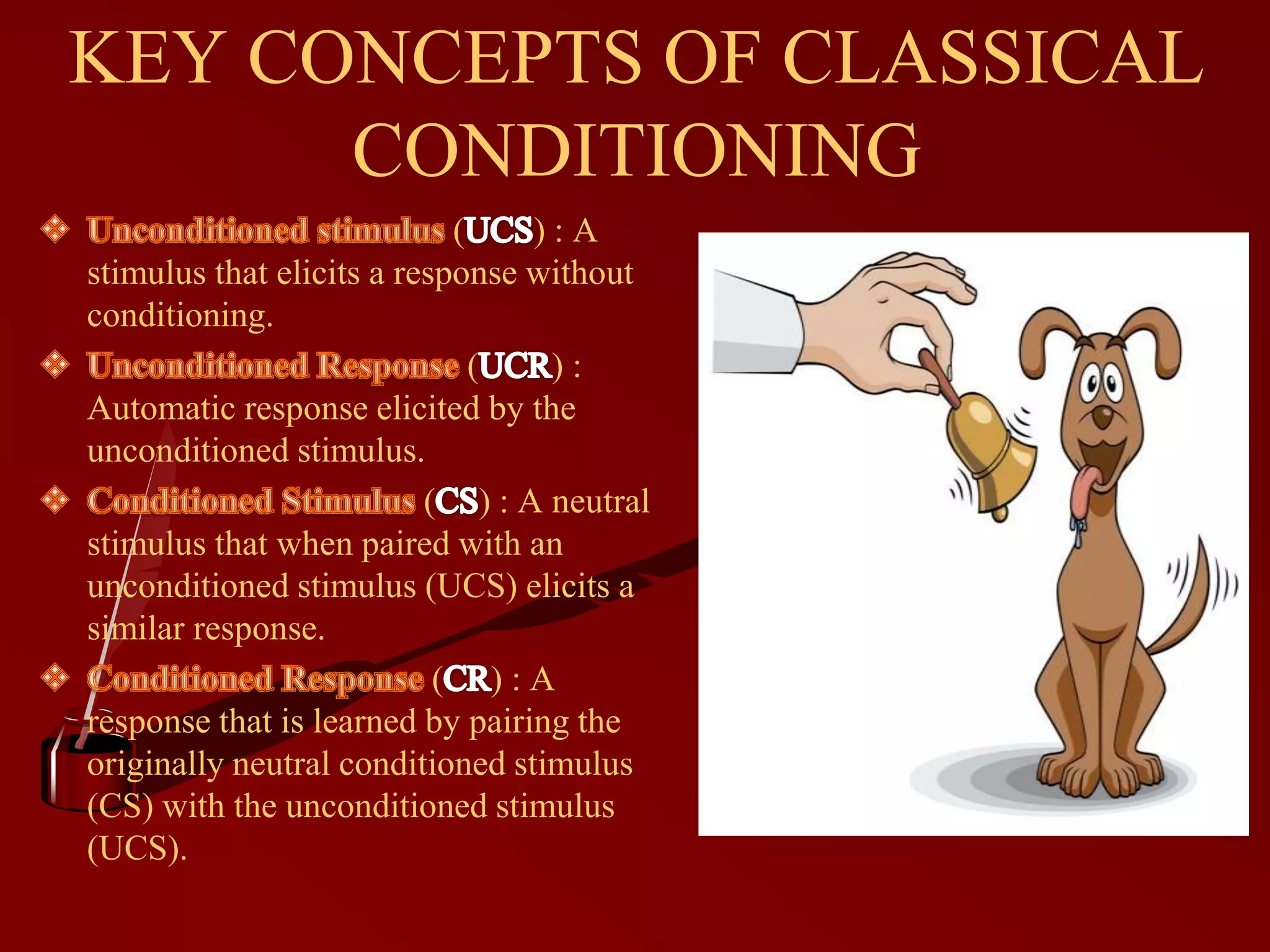
( ) : A
stimulus that elicits a response without
conditioning.
( ) :
Automatic response elicited by the
unconditioned stimulus.
( ) : A neutral
stimulus that when paired with an
unconditioned stimulus (UCS) elicits a
similar response.
( ) : A
response that is learned by pairing the
originally neutral conditioned stimulus
(CS) with the unconditioned stimulus
(UCS).
KEY PRINCIPLES OF CLASSICAL
CONDITIONING
Behaviorists have described a number of different phenomena
associated with classical conditioning. Some of these elements
involve the initial establishment of the response while others describe
the disappearance of a response. These elements are important in
understanding the classical conditioning process.
Five key principles of classical conditioning are as follows:-
Acquisition
Extinction
Spontaneous Recovery
Stimulus Generation
Stimulus Discrimination
CONCLUSION
• According to Pavlov, conditioned reflexes were
temporary or unstable.
• Pavlov himself said that it is not an ideal
education theory.
• Classical conditioning is not a change in the
behaviour but a similar response to a different
stimulus.
• Classical conditioning = Ineffective for classroom
purposes.
CLASSICAL CONDITIONING IN
THE CLASSROOM
• Classical conditioning is a type of learning that
had a major influence on the school of thought in
psychology known as behaviorism.
• Teachers can use classical conditioning to quiet
down the students.
• Students will be conditioned in a positive
manner.
• Students will learn the expectations of the
teachers
• Students will learn the expectation of their school
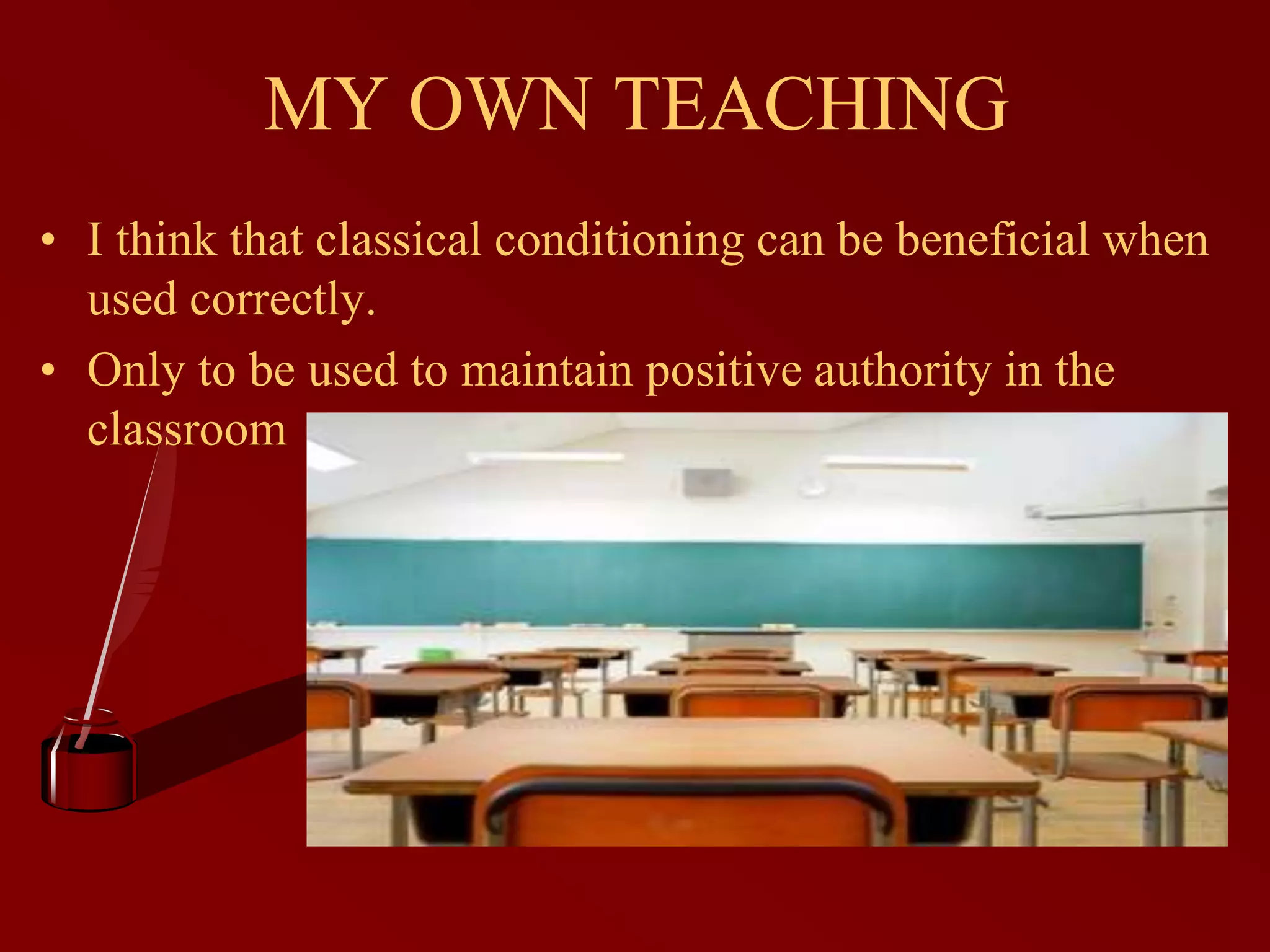
MY OWN TEACHING
• I think that classical conditioning can be beneficial when
used correctly.
• Only to be used to maintain positive authority in the
classroom
Thank you

PAVLOV’S CLASSICAL CONDITIONING .pptx

  • 1.
  • 3.
    WHO IS PAVLOV? Pavlov, full name – Ivan Petrovich Pavlov , was the Russian Physiologist  Born on September 14, 1849  He made many discoveries in the psychology field  He was the first who gained Nobel Prize for Physiology or Medicine in 1904 for his discovery in digestive system.  Classically conditioned dogs using the Salivary Reflex.  Died Feb 27, 1936
  • 4.
    LEARNING • Learning isa process of acquiring and stabilizing successful or rewarded responses and of eliminating the unsuccessful or unrewarded responses. • Learning is acquisition of knowledge, attitudes and values, emotional responses and motor skills. • Learning is a modification of behaviour through experiences and instruction for future life.
  • 5.
    THEORIES OF LEARNING Differentapproaches to learning in the form of theories or models have been established to explain the phenomenon of learning. Learning to link two stimuli in a way that helps us anticipate an event to which we have a reaction : Changing behavior choices in response to consequences Acquiring new behaviors and information through observation and information, rather than by direct experience
  • 6.
    The “Pavlov’s Dog”Experiment In the 1890s, Russian Scientist Ivan Pavlov was studying aspects of the digestive process by observing salivation in dogs, when he made the observation that dogs began to salivate before the food arrived .
  • 7.
    WHAT IS CLASSICAL CONDITIONING? •Classification Conditioning can be defined as a type of learning in which a acquires the capacity to evoke a response that was originally evoked by a different stimulus. • This occurs when the two stimuli have been associated with each other.
  • 9.
    KEY CONCEPTS OFCLASSICAL CONDITIONING ( ) : A stimulus that elicits a response without conditioning. ( ) : Automatic response elicited by the unconditioned stimulus. ( ) : A neutral stimulus that when paired with an unconditioned stimulus (UCS) elicits a similar response. ( ) : A response that is learned by pairing the originally neutral conditioned stimulus (CS) with the unconditioned stimulus (UCS).
  • 11.
    KEY PRINCIPLES OFCLASSICAL CONDITIONING Behaviorists have described a number of different phenomena associated with classical conditioning. Some of these elements involve the initial establishment of the response while others describe the disappearance of a response. These elements are important in understanding the classical conditioning process. Five key principles of classical conditioning are as follows:- Acquisition Extinction Spontaneous Recovery Stimulus Generation Stimulus Discrimination
  • 12.
    CONCLUSION • According toPavlov, conditioned reflexes were temporary or unstable. • Pavlov himself said that it is not an ideal education theory. • Classical conditioning is not a change in the behaviour but a similar response to a different stimulus. • Classical conditioning = Ineffective for classroom purposes.
  • 13.
    CLASSICAL CONDITIONING IN THECLASSROOM • Classical conditioning is a type of learning that had a major influence on the school of thought in psychology known as behaviorism. • Teachers can use classical conditioning to quiet down the students. • Students will be conditioned in a positive manner. • Students will learn the expectations of the teachers • Students will learn the expectation of their school
  • 14.
    MY OWN TEACHING •I think that classical conditioning can be beneficial when used correctly. • Only to be used to maintain positive authority in the classroom
  • 15.