OPERANT CONDITIONING THEORY
- B.F. SKINNER’S
Submitted
by
Maheswari.S
St. Ignatius College of
Education,Tirunelveli
INTRODUCTION
 This theory was given by skinner in 1938.
 According to him, the behaviour of human being or animal is
not a passive reflex.
 Skinner revolt against no stimulus, no response theory.
 In their life we do not wait for things to happen.
 Most of our responses cannot be attributed to known
stimulus.
TCP PRESENTO-2020
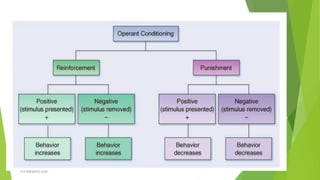
OPERANT CONDITIONING
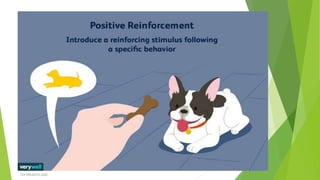
Operant conditioning is the type of learning in which
behaviours are emitted to earn rewards or avoid
punishments.
“Instrumental Learning”
 Operant -> Operant is an act which constitute an
organism for doing something.
 Responses -> Skinner put forward the idea that most of
our responses cannot be attributed to unknown stimulus.
TCP PRESENTO-2020
TCP PRESENTO-2020
TCP PRESENTO-2020
TCP PRESENTO-2020
SKINNER’S EXPERIMENT WITH RAT
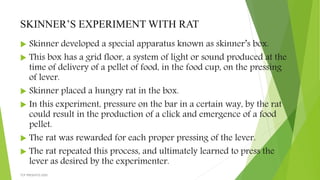
 Skinner developed a special apparatus known as skinner’s box.
 This box has a grid floor, a system of light or sound produced at the
time of delivery of a pellet of food, in the food cup, on the pressing
of lever.
 Skinner placed a hungry rat in the box.
 In this experiment, pressure on the bar in a certain way, by the rat
could result in the production of a click and emergence of a food
pellet.
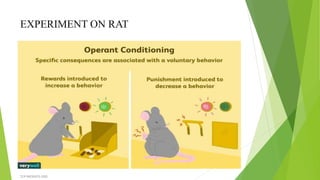
 The rat was rewarded for each proper pressing of the lever.
 The rat repeated this process, and ultimately learned to press the
lever as desired by the experimenter.
TCP PRESENTO-2020
EXPERIMENT ON RAT
TCP PRESENTO-2020
ANOTHER EXPERIMENT
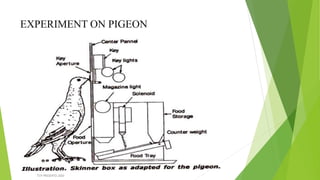
 Skinner conducted another experiment on pigeon, the
pigeon moves about the cage.
 It was trained to peck a disk.
 Every time when it pecked, food was supplied.
 Thus, food reinforced the behaviour of pecking the disk,
called an operant.
TCP PRESENTO-2020
EXPERIMENT ON PIGEON
TCP PRESENTO-2020
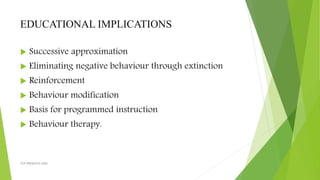
EDUCATIONAL IMPLICATIONS
 Successive approximation
 Eliminating negative behaviour through extinction
 Reinforcement
 Behaviour modification
 Basis for programmed instruction
 Behaviour therapy.
TCP PRESENTO-2020
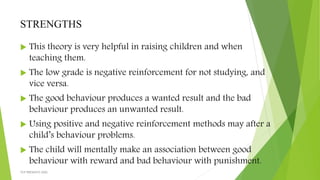
STRENGTHS
 This theory is very helpful in raising children and when
teaching them.
 The low grade is negative reinforcement for not studying, and
vice versa.
 The good behaviour produces a wanted result and the bad
behaviour produces an unwanted result.
 Using positive and negative reinforcement methods may after a
child’s behaviour problems.
 The child will mentally make an association between good
behaviour with reward and bad behaviour with punishment.
TCP PRESENTO-2020
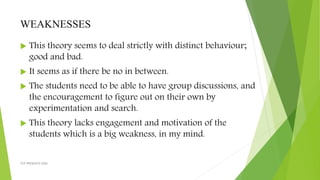
WEAKNESSES
 This theory seems to deal strictly with distinct behaviour;
good and bad.
 It seems as if there be no in between.
 The students need to be able to have group discussions, and
the encouragement to figure out on their own by
experimentation and search.
 This theory lacks engagement and motivation of the
students which is a big weakness, in my mind.
TCP PRESENTO-2020
CONCLUSION
 Both the experiment clearly explains the working of operant
conditioning.
 The important part in any operant conditioning learning is to
recognize the operant behaviour and the consequence resulted
in that particular environment.
TCP PRESENTO-2020
REFERENCES
 Sharma, R.A.(2008). Fundamentals of Educational
Psychology
 Mangal, S.K. (2015) Advanced Educational Psychology
 www.simplypsychology.org
 www.psychology.wikia.com
TCP PRESENTO-2020

OPERANT CONDITIONING THEORY

  • 1.
    OPERANT CONDITIONING THEORY -B.F. SKINNER’S Submitted by Maheswari.S St. Ignatius College of Education,Tirunelveli
  • 2.
    INTRODUCTION  This theorywas given by skinner in 1938.  According to him, the behaviour of human being or animal is not a passive reflex.  Skinner revolt against no stimulus, no response theory.  In their life we do not wait for things to happen.  Most of our responses cannot be attributed to known stimulus. TCP PRESENTO-2020
  • 3.
    OPERANT CONDITIONING Operant conditioningis the type of learning in which behaviours are emitted to earn rewards or avoid punishments. “Instrumental Learning”  Operant -> Operant is an act which constitute an organism for doing something.  Responses -> Skinner put forward the idea that most of our responses cannot be attributed to unknown stimulus. TCP PRESENTO-2020
  • 4.
  • 5.
  • 6.
  • 7.
    SKINNER’S EXPERIMENT WITHRAT  Skinner developed a special apparatus known as skinner’s box.  This box has a grid floor, a system of light or sound produced at the time of delivery of a pellet of food, in the food cup, on the pressing of lever.  Skinner placed a hungry rat in the box.  In this experiment, pressure on the bar in a certain way, by the rat could result in the production of a click and emergence of a food pellet.  The rat was rewarded for each proper pressing of the lever.  The rat repeated this process, and ultimately learned to press the lever as desired by the experimenter. TCP PRESENTO-2020
  • 8.
    EXPERIMENT ON RAT TCPPRESENTO-2020
  • 9.
    ANOTHER EXPERIMENT  Skinnerconducted another experiment on pigeon, the pigeon moves about the cage.  It was trained to peck a disk.  Every time when it pecked, food was supplied.  Thus, food reinforced the behaviour of pecking the disk, called an operant. TCP PRESENTO-2020
  • 10.
  • 11.
    EDUCATIONAL IMPLICATIONS  Successiveapproximation  Eliminating negative behaviour through extinction  Reinforcement  Behaviour modification  Basis for programmed instruction  Behaviour therapy. TCP PRESENTO-2020
  • 12.
    STRENGTHS  This theoryis very helpful in raising children and when teaching them.  The low grade is negative reinforcement for not studying, and vice versa.  The good behaviour produces a wanted result and the bad behaviour produces an unwanted result.  Using positive and negative reinforcement methods may after a child’s behaviour problems.  The child will mentally make an association between good behaviour with reward and bad behaviour with punishment. TCP PRESENTO-2020
  • 13.
    WEAKNESSES  This theoryseems to deal strictly with distinct behaviour; good and bad.  It seems as if there be no in between.  The students need to be able to have group discussions, and the encouragement to figure out on their own by experimentation and search.  This theory lacks engagement and motivation of the students which is a big weakness, in my mind. TCP PRESENTO-2020
  • 14.
    CONCLUSION  Both theexperiment clearly explains the working of operant conditioning.  The important part in any operant conditioning learning is to recognize the operant behaviour and the consequence resulted in that particular environment. TCP PRESENTO-2020
  • 15.
    REFERENCES  Sharma, R.A.(2008).Fundamentals of Educational Psychology  Mangal, S.K. (2015) Advanced Educational Psychology  www.simplypsychology.org  www.psychology.wikia.com TCP PRESENTO-2020