Pavlov’s
Classical
Conditioning
By; GABE, JUSTINE
FERRER, HAZEL
APIGO, BABY GEL
At the end of the lesson the student will be able
to:
• explain how behavior are learned
according to Pavlovian and Watsonian
theory.
• discuss the salient processes and
phenomena of the Pavlovian and
Watsonian; and
• cite classroom applicates of the association
theory
LEARNING OBJECTIVE’S
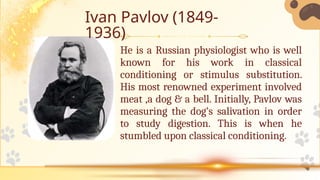
He is a Russian physiologist who is well
known for his work in classical
conditioning or stimulus substitution.
His most renowned experiment involved
meat ,a dog & a bell. Initially, Pavlov was
measuring the dog’s salivation in order
to study digestion. This is when he
stumbled upon classical conditioning.
Ivan Pavlov (1849-
1936)
-is a learning process that occurs
through associations between an
environmental stimulus and a naturally
occurring stimulus.
-basically involves forming an
association between two stimuli
resulting in a learned response.
.
Classical Conditioning
Main Components of Classical
Conditioning
-is one that unconditionally, naturally, and automatically
triggers a response
-is the unlearned response that occurs naturally in
response to the unconditioned stimulus
Unconditioned Stimulus
Unconditioned Response
Main Components of Classical
Conditioning
-is a previously neutral stimulus that, after becoming associated
with the unconditioned stimulus, eventually comes to trigger a
conditioned response.
– is the learned response to the previously neutral
stimulus
Conditioned Stimulus
Conditioned Response
Nathan was chased and assaulted
by an aggressive rooster when he
was just barely three years old. As
an adult he still won’t go near or
even be around a rooster. And he
even gets a little anxious when he
hears the word rooster.
Example;
Example;
Identify the following in the
example.
Neutral Stimulus:
Unconditioned
Stimulus:
Unconditioned
Response:
Conditioned Stimulus:
Key Principles of Classical
Conditioning
-is when the occurrences of a conditionedresponse decreases or
disappears.
Extinction
-is the reappearance of the conditioned response after a
rest period or period of lessened response.
Spontaneous Recovery
-is a situation in which a neutral stimulus is paired with a
conditioned stimulus to produce the same conditioned
response as the conditioned stimulus.
-is the ability to differentiatebetween a conditioned stimulus
and other stimulithat have not been paired with an
unconditionedstimulus.
Discrimination
Higher-Order
Conditioning
Stimulus Generalization
-is the tendency for the conditioned stimulus to evoke similar
responses after the response has been conditioned.
Thank You

PAVLOVS-CLASSICAL-CONDITIONING-----.pptx

  • 1.
  • 2.
    At the endof the lesson the student will be able to: • explain how behavior are learned according to Pavlovian and Watsonian theory. • discuss the salient processes and phenomena of the Pavlovian and Watsonian; and • cite classroom applicates of the association theory LEARNING OBJECTIVE’S
  • 3.
    He is aRussian physiologist who is well known for his work in classical conditioning or stimulus substitution. His most renowned experiment involved meat ,a dog & a bell. Initially, Pavlov was measuring the dog’s salivation in order to study digestion. This is when he stumbled upon classical conditioning. Ivan Pavlov (1849- 1936)
  • 4.
    -is a learningprocess that occurs through associations between an environmental stimulus and a naturally occurring stimulus. -basically involves forming an association between two stimuli resulting in a learned response. . Classical Conditioning
  • 5.
    Main Components ofClassical Conditioning -is one that unconditionally, naturally, and automatically triggers a response -is the unlearned response that occurs naturally in response to the unconditioned stimulus Unconditioned Stimulus Unconditioned Response
  • 6.
    Main Components ofClassical Conditioning -is a previously neutral stimulus that, after becoming associated with the unconditioned stimulus, eventually comes to trigger a conditioned response. – is the learned response to the previously neutral stimulus Conditioned Stimulus Conditioned Response
  • 7.
    Nathan was chasedand assaulted by an aggressive rooster when he was just barely three years old. As an adult he still won’t go near or even be around a rooster. And he even gets a little anxious when he hears the word rooster. Example;
  • 8.
    Example; Identify the followingin the example. Neutral Stimulus: Unconditioned Stimulus: Unconditioned Response: Conditioned Stimulus:
  • 10.
    Key Principles ofClassical Conditioning -is when the occurrences of a conditionedresponse decreases or disappears. Extinction -is the reappearance of the conditioned response after a rest period or period of lessened response. Spontaneous Recovery
  • 11.
    -is a situationin which a neutral stimulus is paired with a conditioned stimulus to produce the same conditioned response as the conditioned stimulus. -is the ability to differentiatebetween a conditioned stimulus and other stimulithat have not been paired with an unconditionedstimulus. Discrimination Higher-Order Conditioning Stimulus Generalization -is the tendency for the conditioned stimulus to evoke similar responses after the response has been conditioned.
  • 12.