THEORIES OF LEARNING

Nur Shafiqah Mohamad Shukri


Nur Syafiqah Abd Kadar


Khartika Balachandran


Jeisri Vijian


Nur Atikah Manan
CLASSICAL CONDITIONING
PAVLOV’S CLASSICAL CONDITIONING


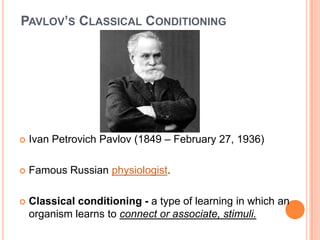
   Ivan Petrovich Pavlov (1849 – February 27, 1936)

   Famous Russian physiologist.

   Classical conditioning - a type of learning in which an
    organism learns to connect or associate, stimuli.
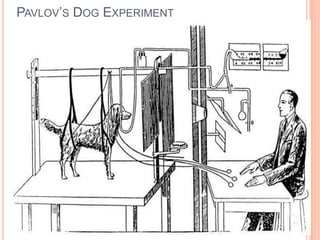
PAVLOV‟S DOG EXPERIMENT
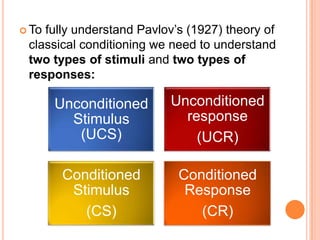
 Tofully understand Pavlov‟s (1927) theory of
 classical conditioning we need to understand
 two types of stimuli and two types of
 responses:

       Unconditioned      Unconditioned
         Stimulus           response
          (UCS)               (UCR)

        Conditioned         Conditioned
         Stimulus            Response
           (CS)                (CR)
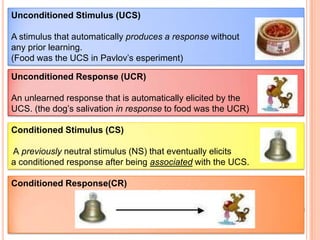
Unconditioned Stimulus (UCS)

A stimulus that automatically produces a response without
any prior learning.
(Food was the UCS in Pavlov‟s esperiment)

Unconditioned Response (UCR)

An unlearned response that is automatically elicited by the
UCS. (the dog‟s salivation in response to food was the UCR)

Conditioned Stimulus (CS)

A previously neutral stimulus (NS) that eventually elicits
a conditioned response after being associated with the UCS.

Conditioned Response(CR)
CLASSICAL CONDITIONING IN THE REAL WORLD
   In reality, people do not respond exactly like Pavlov‟s
    dogs. There are, however, numerous real-world
    applications for classical conditioning.:

e.g.
 In Training Animals:
  Training a cat to come to it‟s food when it hears it‟s food
  bowl being tapped.

   In Advertising:
    Walking past the Mc Donnalds golden arches and feeling
    hungry because you associate the golden arches sign
    with the food they serve in the Mc Donnalds restaurant.
1. ACQUISITION : FORMING NEW RESPONSES.


 Pavlov : acquisition of a conditioned
 response depends on the time factor that
 linked between two events.

 Kamin  (1965) : discovered that
 conditioning is most likely to occur when
 the conditioned stimulus (CS) begins
 about a half-second before the
 unconditioned stimulus (UCS) and stops
 at the same time as UCS.
Not every linking of CS and USC will
 produce acquisition of classical
 conditioning.

Only  stimuli that are,
    - SPECIAL
    - NOVEL
    - INTENSE
2.EXTINCTION : WEAKENING CONDITIONED
RESPONSES
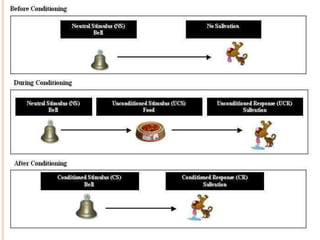
   a conditioned response (salivation) will disappear over
    time when the conditioned stimulus (bell) is no longer
    presented.

    The response is the result of gradual weakening and
    vanishing of a conditioned response.

   As an example, after conditioning, the bell continues to
    ring at certain intermission without any meat powder
    given, and the rate of salivation would gradually reduce
    and finally stop after a period of time.
3. SPONTANEOUS RECOVERY : RESURRECTING
RESPONSES.

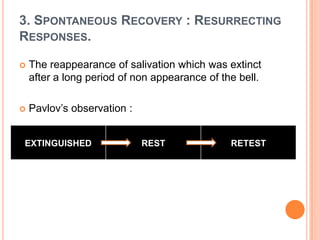
   The reappearance of salivation which was extinct
    after a long period of non appearance of the bell.

   Pavlov‟s observation :


EXTINGUISHED                 REST              RETEST
4. STIMULUS GENERALIZATION.
   refers to the conditioned response of an organism that
    applies not only to the real, original conditioned stimulus,
    but also to other stimuli that are alike.

   after conditioning, there are possibilities for Pavlov‟s dog
    to respond to different kind of bell sound in different
    situation.

    stimulus generalization occurs when an individual is able
    to respond the same way to any other stimuli that are
    similar with the original stimuli.
5. STIMULUS DISCRIMINATION.
   an individual will not respond the same way as the
    original stimuli when they met with a new stimuli that are
    similar.

   The lesser similarities of the new stimuli is to the original
    conditioned stimuli, the greater is the chance for stimulus
    discrimination to occur.

   As an example, the sound of the gong compared with the
    bell.

   On the other hand, if the new stimulus were quite similar
    with the original conditioned stimulus, then stimulus
    generalization would take place.
6. HIGHER-ORDER CONDITIONING.
   It refers to a new conditioned response which is built on
    the foundation of learned response.

   It is a conditioned response which functions as an
    unconditioned stimulus.

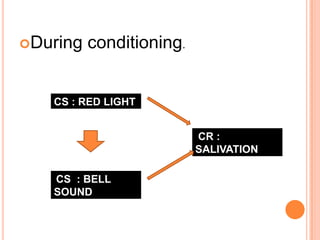
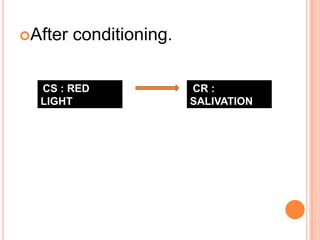
   As an example, in Pavlov‟s experiment, he links the
    conditioned stimulus (sound of the bell) with red light.
During   conditioning.


   CS : RED LIGHT


                          CR :
                          SALIVATION

   CS : BELL
   SOUND
After   conditioning.

  CS : RED               CR :
  LIGHT                  SALIVATION
IMPLICATIONS OF PAVLOV‟S CONDITIONING
     THEORY IN TEACHING LEARNING
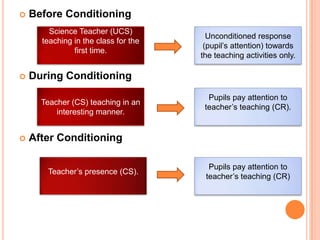
   Before Conditioning
        Science Teacher (UCS)
                                        Unconditioned response
      teaching in the class for the
                                       (pupil‟s attention) towards
               first time.
                                      the teaching activities only.

   During Conditioning
                                        Pupils pay attention to
      Teacher (CS) teaching in an
                                       teacher‟s teaching (CR).
          interesting manner.


   After Conditioning

                                        Pupils pay attention to
       Teacher‟s presence (CS).
                                       teacher‟s teaching (CR)
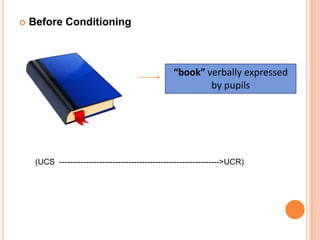
   Before Conditioning


                                                   “book” verbally expressed
                                                           by pupils


     (UCS ------------------------------------------------------------>UCR)
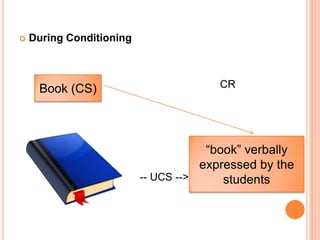
   During Conditioning


     Book (CS)                          CR


                                      “book” verbally
                                     expressed by the
                          -- UCS -->     students
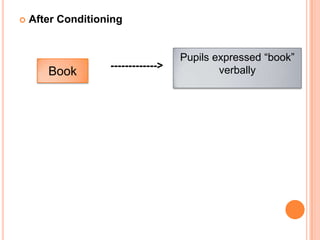
   After Conditioning


                                    Pupils expressed “book”
                   ------------->           verbally
       Book
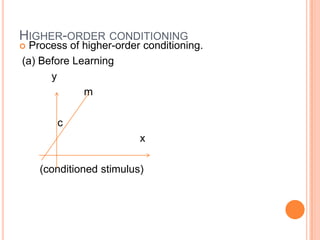
HIGHER-ORDER CONDITIONING
 Process of higher-order conditioning.
(a) Before Learning
      y
             m

       c
                         x

    (conditioned stimulus)
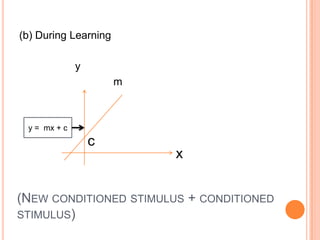
(b) During Learning

              y
                      m


 y = mx + c
                  c
                          x


(NEW CONDITIONED STIMULUS + CONDITIONED
STIMULUS)
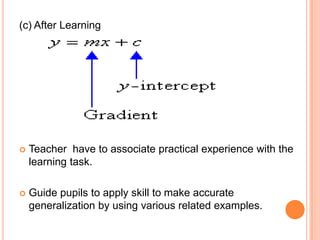
(c) After Learning


   Teacher have to associate practical experience with the
    learning task.

   Guide pupils to apply skill to make accurate
    generalization by using various related examples.
   Guide pupils to use skill to make discrimination such as
    determine the different specific characteristics of
    parallelogram and rhombus.

   Use secondary reinforcement to sustain conditioned
    response to avoid process of extinction.

   Guide pupils to restore their memory by allowing
    sufficient resting time until all existing interferences in
    learning have been removed.
WATSON’S CONDITIONING THEORY
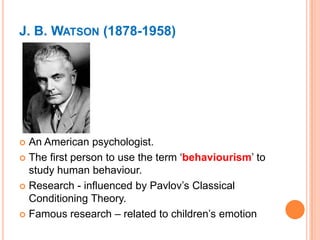
J. B. WATSON (1878-1958)


 An American psychologist.
 The first person to use the term „behaviourism‟ to
  study human behaviour.
 Research - influenced by Pavlov‟s Classical
  Conditioning Theory.
 Famous research – related to children‟s emotion
EMOTION LEARNING: STIMULUS
GENERALIZATION
   People inherit three kinds of basic emotions:
     Fear
     Anger
     Love


   Human emotion can be learned through the
    process called conditioning.
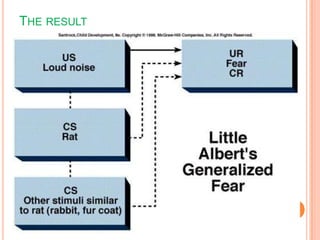
THE EXPERIMENT
   Together with colleague, Rosalie Rayner (1920),
    they used a nine-month old baby, named Little
    Albert and a white tame mouse to conduct the
    experiment.
1.   A white mouse was brought to Little Albert whom he
     showed interest to play with.

1.   As soon as the white mouse was shown to Albert the
     second time, a loud, startling sound was emitted all of a
     sudden from the back.

1.   Immediately, Albert‟s reaction was panic and frightened.

2.   After conditioned response was established, Little
     Albert began to show fear of the white mouse itself.
THE RESULT
IMPLICATIONS OF WATSON‟S LEARNING
     THEORY IN TEACHING AND LEARNING

1.   All types of behaviour can be learned through
     conditioning process. Positive behaviour can be taught
     by using suitable stimulus.

2.   Pupils ought to relate the relationship between all
     responses systematically in order to master the skill of
     solving problems.
3. More exercises should be carried out after learning in
   order to strengthen what has been learned in the
   memory

4. Teacher should use suitable stimulus during the
   teaching process to motivate pupils in learning, and at
   the same time, avoid using stimulus which will produce
   negative effect.

Classical Conditioning

  • 1.
    THEORIES OF LEARNING NurShafiqah Mohamad Shukri Nur Syafiqah Abd Kadar Khartika Balachandran Jeisri Vijian Nur Atikah Manan
  • 2.
  • 3.
    PAVLOV’S CLASSICAL CONDITIONING  Ivan Petrovich Pavlov (1849 – February 27, 1936)  Famous Russian physiologist.  Classical conditioning - a type of learning in which an organism learns to connect or associate, stimuli.
  • 4.
  • 5.
     Tofully understandPavlov‟s (1927) theory of classical conditioning we need to understand two types of stimuli and two types of responses: Unconditioned Unconditioned Stimulus response (UCS) (UCR) Conditioned Conditioned Stimulus Response (CS) (CR)
  • 7.
    Unconditioned Stimulus (UCS) Astimulus that automatically produces a response without any prior learning. (Food was the UCS in Pavlov‟s esperiment) Unconditioned Response (UCR) An unlearned response that is automatically elicited by the UCS. (the dog‟s salivation in response to food was the UCR) Conditioned Stimulus (CS) A previously neutral stimulus (NS) that eventually elicits a conditioned response after being associated with the UCS. Conditioned Response(CR)
  • 8.
    CLASSICAL CONDITIONING INTHE REAL WORLD  In reality, people do not respond exactly like Pavlov‟s dogs. There are, however, numerous real-world applications for classical conditioning.: e.g.  In Training Animals: Training a cat to come to it‟s food when it hears it‟s food bowl being tapped.  In Advertising: Walking past the Mc Donnalds golden arches and feeling hungry because you associate the golden arches sign with the food they serve in the Mc Donnalds restaurant.
  • 9.
    1. ACQUISITION :FORMING NEW RESPONSES.  Pavlov : acquisition of a conditioned response depends on the time factor that linked between two events.  Kamin (1965) : discovered that conditioning is most likely to occur when the conditioned stimulus (CS) begins about a half-second before the unconditioned stimulus (UCS) and stops at the same time as UCS.
  • 10.
    Not every linkingof CS and USC will produce acquisition of classical conditioning. Only stimuli that are, - SPECIAL - NOVEL - INTENSE
  • 11.
    2.EXTINCTION : WEAKENINGCONDITIONED RESPONSES  a conditioned response (salivation) will disappear over time when the conditioned stimulus (bell) is no longer presented.  The response is the result of gradual weakening and vanishing of a conditioned response.  As an example, after conditioning, the bell continues to ring at certain intermission without any meat powder given, and the rate of salivation would gradually reduce and finally stop after a period of time.
  • 12.
    3. SPONTANEOUS RECOVERY: RESURRECTING RESPONSES.  The reappearance of salivation which was extinct after a long period of non appearance of the bell.  Pavlov‟s observation : EXTINGUISHED REST RETEST
  • 13.
    4. STIMULUS GENERALIZATION.  refers to the conditioned response of an organism that applies not only to the real, original conditioned stimulus, but also to other stimuli that are alike.  after conditioning, there are possibilities for Pavlov‟s dog to respond to different kind of bell sound in different situation.  stimulus generalization occurs when an individual is able to respond the same way to any other stimuli that are similar with the original stimuli.
  • 14.
    5. STIMULUS DISCRIMINATION.  an individual will not respond the same way as the original stimuli when they met with a new stimuli that are similar.  The lesser similarities of the new stimuli is to the original conditioned stimuli, the greater is the chance for stimulus discrimination to occur.  As an example, the sound of the gong compared with the bell.  On the other hand, if the new stimulus were quite similar with the original conditioned stimulus, then stimulus generalization would take place.
  • 15.
    6. HIGHER-ORDER CONDITIONING.  It refers to a new conditioned response which is built on the foundation of learned response.  It is a conditioned response which functions as an unconditioned stimulus.  As an example, in Pavlov‟s experiment, he links the conditioned stimulus (sound of the bell) with red light.
  • 16.
    During conditioning. CS : RED LIGHT CR : SALIVATION CS : BELL SOUND
  • 17.
    After conditioning. CS : RED CR : LIGHT SALIVATION
  • 18.
    IMPLICATIONS OF PAVLOV‟SCONDITIONING THEORY IN TEACHING LEARNING
  • 19.
    Before Conditioning Science Teacher (UCS) Unconditioned response teaching in the class for the (pupil‟s attention) towards first time. the teaching activities only.  During Conditioning Pupils pay attention to Teacher (CS) teaching in an teacher‟s teaching (CR). interesting manner.  After Conditioning Pupils pay attention to Teacher‟s presence (CS). teacher‟s teaching (CR)
  • 20.
    Before Conditioning “book” verbally expressed by pupils (UCS ------------------------------------------------------------>UCR)
  • 21.
    During Conditioning Book (CS) CR “book” verbally expressed by the -- UCS --> students
  • 22.
    After Conditioning Pupils expressed “book” -------------> verbally Book
  • 23.
    HIGHER-ORDER CONDITIONING  Processof higher-order conditioning. (a) Before Learning y m c x (conditioned stimulus)
  • 24.
    (b) During Learning y m y = mx + c c x (NEW CONDITIONED STIMULUS + CONDITIONED STIMULUS)
  • 25.
    (c) After Learning  Teacher have to associate practical experience with the learning task.  Guide pupils to apply skill to make accurate generalization by using various related examples.
  • 26.
    Guide pupils to use skill to make discrimination such as determine the different specific characteristics of parallelogram and rhombus.  Use secondary reinforcement to sustain conditioned response to avoid process of extinction.  Guide pupils to restore their memory by allowing sufficient resting time until all existing interferences in learning have been removed.
  • 27.
  • 28.
    J. B. WATSON(1878-1958)  An American psychologist.  The first person to use the term „behaviourism‟ to study human behaviour.  Research - influenced by Pavlov‟s Classical Conditioning Theory.  Famous research – related to children‟s emotion
  • 29.
    EMOTION LEARNING: STIMULUS GENERALIZATION  People inherit three kinds of basic emotions:  Fear  Anger  Love  Human emotion can be learned through the process called conditioning.
  • 30.
    THE EXPERIMENT  Together with colleague, Rosalie Rayner (1920), they used a nine-month old baby, named Little Albert and a white tame mouse to conduct the experiment.
  • 31.
    1. A white mouse was brought to Little Albert whom he showed interest to play with. 1. As soon as the white mouse was shown to Albert the second time, a loud, startling sound was emitted all of a sudden from the back. 1. Immediately, Albert‟s reaction was panic and frightened. 2. After conditioned response was established, Little Albert began to show fear of the white mouse itself.
  • 32.
  • 33.
    IMPLICATIONS OF WATSON‟SLEARNING THEORY IN TEACHING AND LEARNING 1. All types of behaviour can be learned through conditioning process. Positive behaviour can be taught by using suitable stimulus. 2. Pupils ought to relate the relationship between all responses systematically in order to master the skill of solving problems.
  • 34.
    3. More exercisesshould be carried out after learning in order to strengthen what has been learned in the memory 4. Teacher should use suitable stimulus during the teaching process to motivate pupils in learning, and at the same time, avoid using stimulus which will produce negative effect.