SOUND
S.PRIYADHARSHINI II B.Ed YEAR
SOUND
 Sound is a form of energy which produces sensation
of hearing in our ears. Some sounds are pleasant to
hear and some others are not.
 All sounds are produced by vibrations of the
substances.
 These vibrations travel as disturbances in a medium
and reach our ear as sound.
 Human ear can hear only a particular range of
frequency of sound that too with a certain range of
energy.
 we cannot hear sound clearly if it is below certain
intensity.
PRODUCTION OF SOUND
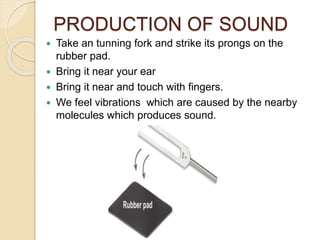
 Take an tunning fork and strike its prongs on the
rubber pad.
 Bring it near your ear
 Bring it near and touch with fingers.
 We feel vibrations which are caused by the nearby
molecules which produces sound.
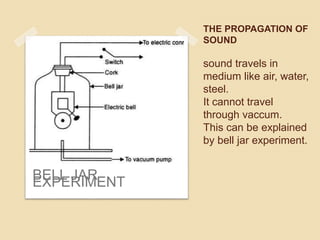
THE PROPAGATION OF
SOUND
sound travels in
medium like air, water,
steel.
It cannot travel
through vaccum.
This can be explained
by bell jar experiment.
BELL JAR
EXPERIMENT
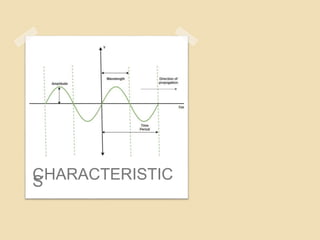
CHARACTERISTIC
S
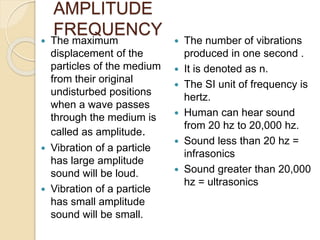
AMPLITUDE
FREQUENCY
 The maximum
displacement of the
particles of the medium
from their original
undisturbed positions
when a wave passes
through the medium is
called as amplitude.
 Vibration of a particle
has large amplitude
sound will be loud.
 Vibration of a particle
has small amplitude
sound will be small.
 The number of vibrations
produced in one second .
 It is denoted as n.
 The SI unit of frequency is
hertz.
 Human can hear sound
from 20 hz to 20,000 hz.
 Sound less than 20 hz =
infrasonics
 Sound greater than 20,000
hz = ultrasonics
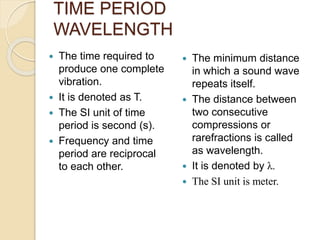
TIME PERIOD
WAVELENGTH
 The time required to
produce one complete
vibration.
 It is denoted as T.
 The SI unit of time
period is second (s).
 Frequency and time
period are reciprocal
to each other.
 The minimum distance
in which a sound wave
repeats itself.
 The distance between
two consecutive
compressions or
rarefractions is called
as wavelength.
 It is denoted by λ.
 The SI unit is meter.
VELOCITY OR SPEEDE (V)
 The distance travelled by the sound wave in
one second is called as velocity of the
sound.
 The S iunit of velocity of the sound is meter
per second.
SPEED OF SOUND
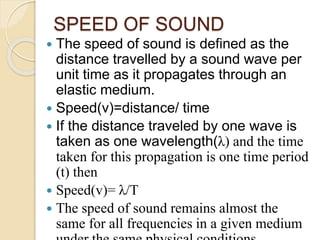
 The speed of sound is defined as the
distance travelled by a sound wave per
unit time as it propagates through an
elastic medium.
 Speed(v)=distance/ time
 If the distance traveled by one wave is
taken as one wavelength(λ) and the time
taken for this propagation is one time period
(t) then
 Speed(v)= λ/T
 The speed of sound remains almost the
same for all frequencies in a given medium
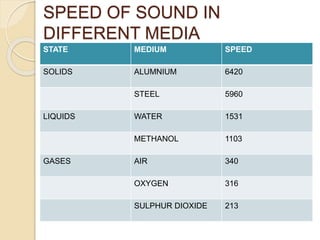
SPEED OF SOUND IN
DIFFERENT MEDIA
STATE MEDIUM SPEED
SOLIDS ALUMNIUM 6420
STEEL 5960
LIQUIDS WATER 1531
METHANOL 1103
GASES AIR 340
OXYGEN 316
SULPHUR DIOXIDE 213
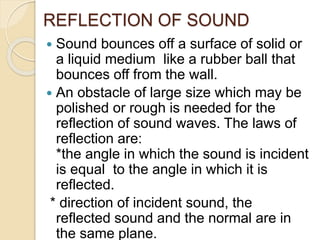
REFLECTION OF SOUND
 Sound bounces off a surface of solid or
a liquid medium like a rubber ball that
bounces off from the wall.
 An obstacle of large size which may be
polished or rough is needed for the
reflection of sound waves. The laws of
reflection are:
*the angle in which the sound is incident
is equal to the angle in which it is
reflected.
* direction of incident sound, the
reflected sound and the normal are in
the same plane.
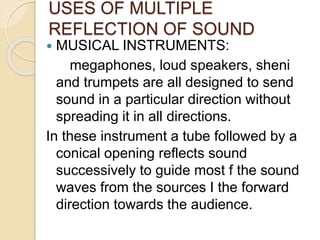
USES OF MULTIPLE
REFLECTION OF SOUND
 MUSICAL INSTRUMENTS:
megaphones, loud speakers, sheni
and trumpets are all designed to send
sound in a particular direction without
spreading it in all directions.
In these instrument a tube followed by a
conical opening reflects sound
successively to guide most f the sound
waves from the sources I the forward
direction towards the audience.
ECHO
 When we shout or clap near a suitable
reflecting surface such as a tall building
or a mountain, we will hear the same
sound again a little later. This sound
which we hear is called as an echo.
 The sensation of sound persists in our
brain for about 0.1s.
 Echoes may be heard more than once
due multiple reflections .
REVEBRATION
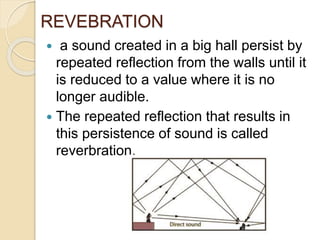
 a sound created in a big hall persist by
repeated reflection from the walls until it
is reduced to a value where it is no
longer audible.
 The repeated reflection that results in
this persistence of sound is called
reverbration.
ULTRASOUND
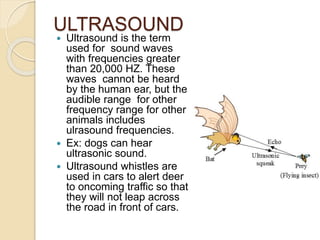
 Ultrasound is the term
used for sound waves
with frequencies greater
than 20,000 HZ. These
waves cannot be heard
by the human ear, but the
audible range for other
frequency range for other
animals includes
ulrasound frequencies.
 Ex: dogs can hear
ultrasonic sound.
 Ultrasound whistles are
used in cars to alert deer
to oncoming traffic so that
they will not leap across
the road in front of cars.
APPLICATIONS
 They are used in cleaning technology.
Minute foreign particles can be removed
from objects placed in a liquid bath
through which ultrasound is passed.
 They are used to detect cracks and
flaws in metal blocks.
 They are made to reflect from various
parts of the heart and sound form the
image of the heart.
 They are used in breaking kidney
stones.
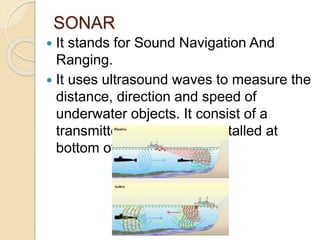
SONAR
 It stands for Sound Navigation And
Ranging.
 It uses ultrasound waves to measure the
distance, direction and speed of
underwater objects. It consist of a
transmitter and detector installed at
bottom of ships.
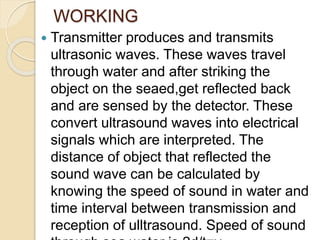
WORKING
 Transmitter produces and transmits
ultrasonic waves. These waves travel
through water and after striking the
object on the seaed,get reflected back
and are sensed by the detector. These
convert ultrasound waves into electrical
signals which are interpreted. The
distance of object that reflected the
sound wave can be calculated by
knowing the speed of sound in water and
time interval between transmission and
reception of ulltrasound. Speed of sound
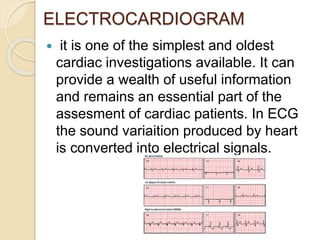
ELECTROCARDIOGRAM
 it is one of the simplest and oldest
cardiac investigations available. It can
provide a wealth of useful information
and remains an essential part of the
assesment of cardiac patients. In ECG
the sound variaition produced by heart
is converted into electrical signals.
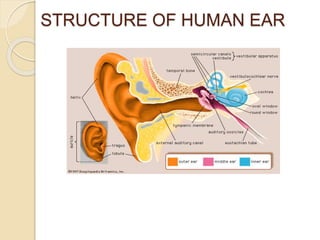
STRUCTURE OF HUMAN EAR
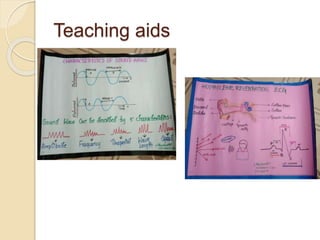
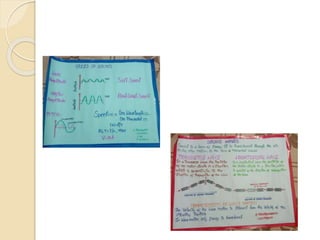
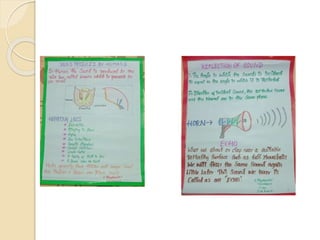
Teaching aids
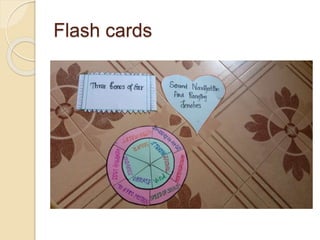
Flash cards
THANK YOU

sound

  • 1.
  • 2.
    SOUND  Sound isa form of energy which produces sensation of hearing in our ears. Some sounds are pleasant to hear and some others are not.  All sounds are produced by vibrations of the substances.  These vibrations travel as disturbances in a medium and reach our ear as sound.  Human ear can hear only a particular range of frequency of sound that too with a certain range of energy.  we cannot hear sound clearly if it is below certain intensity.
  • 3.
    PRODUCTION OF SOUND Take an tunning fork and strike its prongs on the rubber pad.  Bring it near your ear  Bring it near and touch with fingers.  We feel vibrations which are caused by the nearby molecules which produces sound.
  • 4.
    THE PROPAGATION OF SOUND soundtravels in medium like air, water, steel. It cannot travel through vaccum. This can be explained by bell jar experiment. BELL JAR EXPERIMENT
  • 5.
  • 6.
    AMPLITUDE FREQUENCY  The maximum displacementof the particles of the medium from their original undisturbed positions when a wave passes through the medium is called as amplitude.  Vibration of a particle has large amplitude sound will be loud.  Vibration of a particle has small amplitude sound will be small.  The number of vibrations produced in one second .  It is denoted as n.  The SI unit of frequency is hertz.  Human can hear sound from 20 hz to 20,000 hz.  Sound less than 20 hz = infrasonics  Sound greater than 20,000 hz = ultrasonics
  • 7.
    TIME PERIOD WAVELENGTH  Thetime required to produce one complete vibration.  It is denoted as T.  The SI unit of time period is second (s).  Frequency and time period are reciprocal to each other.  The minimum distance in which a sound wave repeats itself.  The distance between two consecutive compressions or rarefractions is called as wavelength.  It is denoted by λ.  The SI unit is meter.
  • 8.
    VELOCITY OR SPEEDE(V)  The distance travelled by the sound wave in one second is called as velocity of the sound.  The S iunit of velocity of the sound is meter per second.
  • 9.
    SPEED OF SOUND The speed of sound is defined as the distance travelled by a sound wave per unit time as it propagates through an elastic medium.  Speed(v)=distance/ time  If the distance traveled by one wave is taken as one wavelength(λ) and the time taken for this propagation is one time period (t) then  Speed(v)= λ/T  The speed of sound remains almost the same for all frequencies in a given medium
  • 10.
    SPEED OF SOUNDIN DIFFERENT MEDIA STATE MEDIUM SPEED SOLIDS ALUMNIUM 6420 STEEL 5960 LIQUIDS WATER 1531 METHANOL 1103 GASES AIR 340 OXYGEN 316 SULPHUR DIOXIDE 213
  • 11.
    REFLECTION OF SOUND Sound bounces off a surface of solid or a liquid medium like a rubber ball that bounces off from the wall.  An obstacle of large size which may be polished or rough is needed for the reflection of sound waves. The laws of reflection are: *the angle in which the sound is incident is equal to the angle in which it is reflected. * direction of incident sound, the reflected sound and the normal are in the same plane.
  • 12.
    USES OF MULTIPLE REFLECTIONOF SOUND  MUSICAL INSTRUMENTS: megaphones, loud speakers, sheni and trumpets are all designed to send sound in a particular direction without spreading it in all directions. In these instrument a tube followed by a conical opening reflects sound successively to guide most f the sound waves from the sources I the forward direction towards the audience.
  • 13.
    ECHO  When weshout or clap near a suitable reflecting surface such as a tall building or a mountain, we will hear the same sound again a little later. This sound which we hear is called as an echo.  The sensation of sound persists in our brain for about 0.1s.  Echoes may be heard more than once due multiple reflections .
  • 14.
    REVEBRATION  a soundcreated in a big hall persist by repeated reflection from the walls until it is reduced to a value where it is no longer audible.  The repeated reflection that results in this persistence of sound is called reverbration.
  • 15.
    ULTRASOUND  Ultrasound isthe term used for sound waves with frequencies greater than 20,000 HZ. These waves cannot be heard by the human ear, but the audible range for other frequency range for other animals includes ulrasound frequencies.  Ex: dogs can hear ultrasonic sound.  Ultrasound whistles are used in cars to alert deer to oncoming traffic so that they will not leap across the road in front of cars.
  • 16.
    APPLICATIONS  They areused in cleaning technology. Minute foreign particles can be removed from objects placed in a liquid bath through which ultrasound is passed.  They are used to detect cracks and flaws in metal blocks.  They are made to reflect from various parts of the heart and sound form the image of the heart.  They are used in breaking kidney stones.
  • 17.
    SONAR  It standsfor Sound Navigation And Ranging.  It uses ultrasound waves to measure the distance, direction and speed of underwater objects. It consist of a transmitter and detector installed at bottom of ships.
  • 18.
    WORKING  Transmitter producesand transmits ultrasonic waves. These waves travel through water and after striking the object on the seaed,get reflected back and are sensed by the detector. These convert ultrasound waves into electrical signals which are interpreted. The distance of object that reflected the sound wave can be calculated by knowing the speed of sound in water and time interval between transmission and reception of ulltrasound. Speed of sound
  • 19.
    ELECTROCARDIOGRAM  it isone of the simplest and oldest cardiac investigations available. It can provide a wealth of useful information and remains an essential part of the assesment of cardiac patients. In ECG the sound variaition produced by heart is converted into electrical signals.
  • 20.
  • 21.
  • 24.
  • 25.