S.PRIYADHARSHINI
II B.ED YEAR PHYSICAL SCIENCE
HEAT
TRANSFER OF HEAT
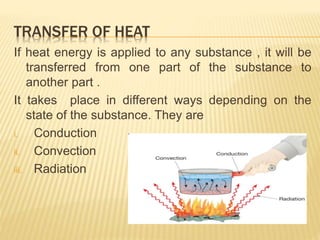
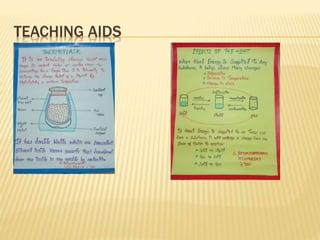
If heat energy is applied to any substance , it will be
transferred from one part of the substance to
another part .
It takes place in different ways depending on the
state of the substance. They are
i. Conduction
ii. Convection
iii. Radiation
CONDUCTION
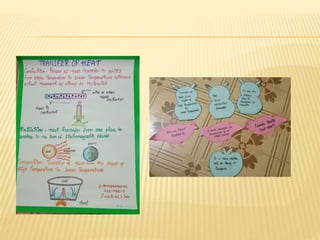
It is a process of heat transfer in solids from
the region of higher temperature to the region
of lower temperature without the actual
movement of the atoms or molecules.
CONDUCTION IN DAILY LIFE :
 Handles of cooking utensils are made up of
plastic or wood because they are poor
conductors of heat.
 When we iron dresses , heat is transferred
from iron to the cloth.
CONDUCTION
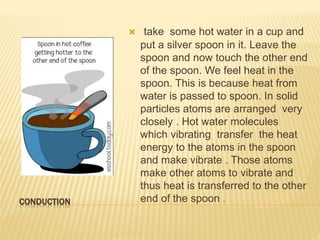
 take some hot water in a cup and
put a silver spoon in it. Leave the
spoon and now touch the other end
of the spoon. We feel heat in the
spoon. This is because heat from
water is passed to spoon. In solid
particles atoms are arranged very
closely . Hot water molecules
which vibrating transfer the heat
energy to the atoms in the spoon
and make vibrate . Those atoms
make other atoms to vibrate and
thus heat is transferred to the other
end of the spoon .
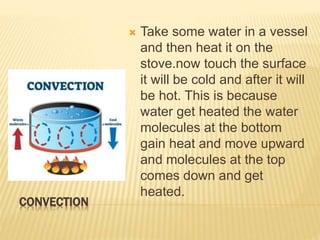
 Take some water in a vessel
and then heat it on the
stove.now touch the surface
it will be cold and after it will
be hot. This is because
water get heated the water
molecules at the bottom
gain heat and move upward
and molecules at the top
comes down and get
heated.
CONVECTION
CONVECTION
 Form of heat transfer from places of high
temperature to places of low temperatures by
the actual movement of the molecules is
called as convection. It takes place in solids
and liquids.
CONVECTION IN DAILY LIFE
 Formation of sea and land breeze is due to
convection
 Wind blows from one region to the other by
the by convection.
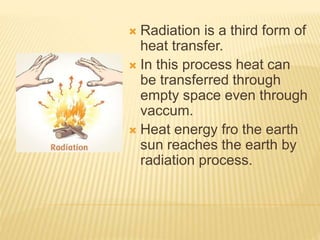
 Radiation is a third form of
heat transfer.
 In this process heat can
be transferred through
empty space even through
vaccum.
 Heat energy fro the earth
sun reaches the earth by
radiation process.
RADIATION
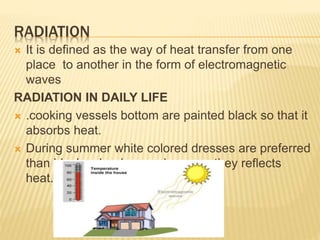
 It is defined as the way of heat transfer from one
place to another in the form of electromagnetic
waves
RADIATION IN DAILY LIFE
 .cooking vessels bottom are painted black so that it
absorbs heat.
 During summer white colored dresses are preferred
than black color dresses because they reflects
heat.
CALORIMETERY
 The technique used to measure the amount
of heat involved in a physical or a chemical
process is known as calorimetry.
 TEMPERATURE:
It is a physical quantity which expresses
whether an object is hot or cold. It is
measured with the help of thermometer.
There are 3 scales to measure temperature:
*celsius scale * fahrenheit scale * kelvin
scale
UNITS OF HEAT
 the unit of energy in SI system is joule.
 Heat is also measured in joule.
 It is expressed by the symbol J.
 The most commonly used heat is calorie.
 One calorie is the amount of heat energy
required to raise the temperature of 1 gram of
water through 1 degree celcius.
 The relation between one calorie and joule is 1
calorie=4.186J.
CALORIMETER
 A calorimeter is a device used to measure
the amount of heat gained or lost by a
substance.
 It consists of vessel made up of metals like
copper or aluminium which are good
conductors of heat and electricity.
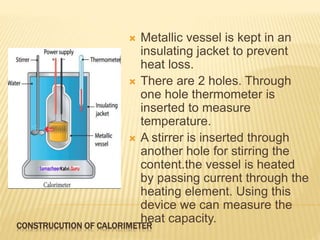
CONSTRUCUTION OF CALORIMETER
 Metallic vessel is kept in an
insulating jacket to prevent
heat loss.
 There are 2 holes. Through
one hole thermometer is
inserted to measure
temperature.
 A stirrer is inserted through
another hole for stirring the
content.the vessel is heated
by passing current through the
heating element. Using this
device we can measure the
heat capacity.
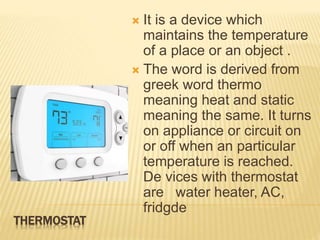
THERMOSTAT
 It is a device which
maintains the temperature
of a place or an object .
 The word is derived from
greek word thermo
meaning heat and static
meaning the same. It turns
on appliance or circuit on
or off when an particular
temperature is reached.
De vices with thermostat
are water heater, AC,
fridgde
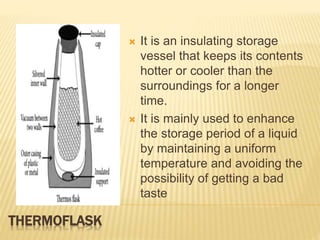
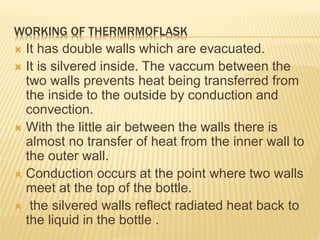
THERMOFLASK
 It is an insulating storage
vessel that keeps its contents
hotter or cooler than the
surroundings for a longer
time.
 It is mainly used to enhance
the storage period of a liquid
by maintaining a uniform
temperature and avoiding the
possibility of getting a bad
taste
WORKING OF THERMRMOFLASK
 It has double walls which are evacuated.
 It is silvered inside. The vaccum between the
two walls prevents heat being transferred from
the inside to the outside by conduction and
convection.
 With the little air between the walls there is
almost no transfer of heat from the inner wall to
the outer wall.
 Conduction occurs at the point where two walls
meet at the top of the bottle.
 the silvered walls reflect radiated heat back to
the liquid in the bottle .
TEACHING AIDS
THANK YOU

Heat

  • 1.
  • 2.
  • 4.
    TRANSFER OF HEAT Ifheat energy is applied to any substance , it will be transferred from one part of the substance to another part . It takes place in different ways depending on the state of the substance. They are i. Conduction ii. Convection iii. Radiation
  • 5.
    CONDUCTION It is aprocess of heat transfer in solids from the region of higher temperature to the region of lower temperature without the actual movement of the atoms or molecules. CONDUCTION IN DAILY LIFE :  Handles of cooking utensils are made up of plastic or wood because they are poor conductors of heat.  When we iron dresses , heat is transferred from iron to the cloth.
  • 6.
    CONDUCTION  take somehot water in a cup and put a silver spoon in it. Leave the spoon and now touch the other end of the spoon. We feel heat in the spoon. This is because heat from water is passed to spoon. In solid particles atoms are arranged very closely . Hot water molecules which vibrating transfer the heat energy to the atoms in the spoon and make vibrate . Those atoms make other atoms to vibrate and thus heat is transferred to the other end of the spoon .
  • 7.
     Take somewater in a vessel and then heat it on the stove.now touch the surface it will be cold and after it will be hot. This is because water get heated the water molecules at the bottom gain heat and move upward and molecules at the top comes down and get heated. CONVECTION
  • 8.
    CONVECTION  Form ofheat transfer from places of high temperature to places of low temperatures by the actual movement of the molecules is called as convection. It takes place in solids and liquids. CONVECTION IN DAILY LIFE  Formation of sea and land breeze is due to convection  Wind blows from one region to the other by the by convection.
  • 9.
     Radiation isa third form of heat transfer.  In this process heat can be transferred through empty space even through vaccum.  Heat energy fro the earth sun reaches the earth by radiation process.
  • 10.
    RADIATION  It isdefined as the way of heat transfer from one place to another in the form of electromagnetic waves RADIATION IN DAILY LIFE  .cooking vessels bottom are painted black so that it absorbs heat.  During summer white colored dresses are preferred than black color dresses because they reflects heat.
  • 11.
    CALORIMETERY  The techniqueused to measure the amount of heat involved in a physical or a chemical process is known as calorimetry.  TEMPERATURE: It is a physical quantity which expresses whether an object is hot or cold. It is measured with the help of thermometer. There are 3 scales to measure temperature: *celsius scale * fahrenheit scale * kelvin scale
  • 12.
    UNITS OF HEAT the unit of energy in SI system is joule.  Heat is also measured in joule.  It is expressed by the symbol J.  The most commonly used heat is calorie.  One calorie is the amount of heat energy required to raise the temperature of 1 gram of water through 1 degree celcius.  The relation between one calorie and joule is 1 calorie=4.186J.
  • 13.
    CALORIMETER  A calorimeteris a device used to measure the amount of heat gained or lost by a substance.  It consists of vessel made up of metals like copper or aluminium which are good conductors of heat and electricity.
  • 14.
    CONSTRUCUTION OF CALORIMETER Metallic vessel is kept in an insulating jacket to prevent heat loss.  There are 2 holes. Through one hole thermometer is inserted to measure temperature.  A stirrer is inserted through another hole for stirring the content.the vessel is heated by passing current through the heating element. Using this device we can measure the heat capacity.
  • 15.
    THERMOSTAT  It isa device which maintains the temperature of a place or an object .  The word is derived from greek word thermo meaning heat and static meaning the same. It turns on appliance or circuit on or off when an particular temperature is reached. De vices with thermostat are water heater, AC, fridgde
  • 16.
    THERMOFLASK  It isan insulating storage vessel that keeps its contents hotter or cooler than the surroundings for a longer time.  It is mainly used to enhance the storage period of a liquid by maintaining a uniform temperature and avoiding the possibility of getting a bad taste
  • 17.
    WORKING OF THERMRMOFLASK It has double walls which are evacuated.  It is silvered inside. The vaccum between the two walls prevents heat being transferred from the inside to the outside by conduction and convection.  With the little air between the walls there is almost no transfer of heat from the inner wall to the outer wall.  Conduction occurs at the point where two walls meet at the top of the bottle.  the silvered walls reflect radiated heat back to the liquid in the bottle .
  • 18.
  • 20.