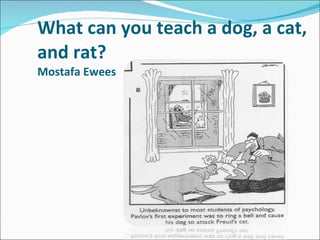
What can you teach a dog, a cat, and rat? Mostafa Ewees
Behaviorism Key Ideas Deterministic - The way you act is determined by external stimuli provided by the culture in which you live. Observable - Over time the individual develops a “behavioral repertoire” (Steinberg, 1980) that can be used to predict behavior. Controllable - Desirable behaviors can be brought about by incentives; undesirable behaviors can be eradicated by consequences or punishment.
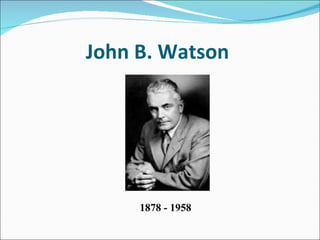
John B. Watson  1878 - 1958
John B. Watson  Watson changed the focus of psychology from introspection, to environmentalism. The principles of learning would account for the largest share of behavioral development and are exercised almost exclusively through environmental learning opportunities provided for children. (reflected in cultural diversity & learning studies)
John B. Watson He believed that environmental shaping of behavior began prenatally, and focused his studies on infants and children.  He  demonstrated the conditioned response in the case of “Little Albert”(Watson, 1925),  who was exposed to an alarming noise and a rat at the same time, and developed not only a fear of rats, but transferred the fear to all furry objects.
John B. Watson   Credited with “Definitional standards for  stimuli and response and criteria for making objective and reliable observations can be traced back to Watson and continue to characterize acceptable investigatory practices today.”(Horowitz, 1992)
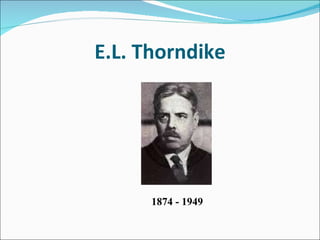
E.L. Thorndike 1874 - 1949
E.L. Thorndike First scientific theory of learning- Theory of Connectionism   Comprehensive analogy of human learning- Three volume work,  Educational Psychology  ( 1913a, 1913b, 1914 )   Initial work with animal learning in laboratory setting- cat in box experiment”  
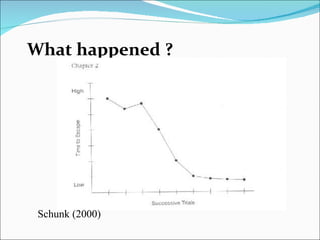
What happened ?   Schunk (2000)
The Cat Learned !!! Behavior Change = Learning
Thorndike’s Theory of Connectionism   Law of Effect   If Situation + Response is followed by a positive consequence then the connection between the Situation  +   Response is strengthened.   If Situation + Response is followed by a negative consequence then the connection between the Situation + Response is weakened.
In Thorndike’s words: “ When a modifiable connection between an situation and a response is made and is accompanied or followed by a satisfying state of affairs, that connection’s strength is increased: When made or accompanied or followed by an annoying state of affairs, the strength is decreased.” (Thorndike, 1913b)  Note: Thorndike(1932)  later modified the Law of  Effect when research showed that while positive consequences strengthened connections, negative consequences did not necessarily weaken them.  “ Spare the reward, spoil the child”  by E.L. Thorndike
The Big Idea Consequences of behavior effect behavior,  responses resulting in satisfying consequences are learned.  Behavioral theories explain learning in terms of environmental events.
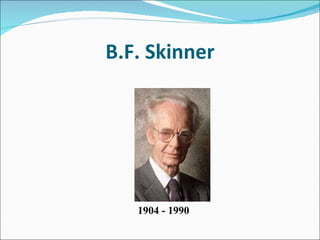
B.F. Skinner 1904 - 1990
 
Operant Conditioning As an organism is operating in its environment, it happens upon a reinforcing stimulus, or reinforcer.  This reinforcer then causes the organism to continue the operant, or event that occurred right before the stimulus.  If an operant is no longer followed by a reinforcer, extinction of the operant behavior will occur.
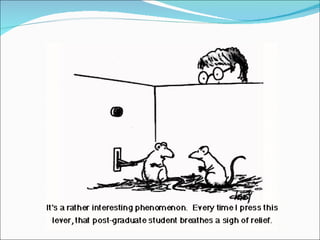
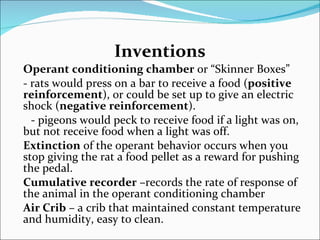
Inventions Operant conditioning chamber  or “Skinner Boxes” - rats would press on a bar to receive a food ( positive reinforcement ), or could be set up to give an electric shock ( negative reinforcement ). - pigeons would peck to receive food if a light was on, but not receive food when a light was off. Extinction  of the operant behavior occurs when you stop giving the rat a food pellet as a reward for pushing the pedal. Cumulative recorder  –records the rate of response of the animal in the operant conditioning chamber Air Crib  – a crib that maintained constant temperature and humidity, easy to clean.
 
 
Continuous Reinforcement  – every time the rat does the correct behavior, it is reinforced with food. Fixed Ratio Schedule  – there is a fixed ratio between correct behaviors and reinforcement, i.e., 5 pedal pushes to one food pellet. Fixed Interval Schedule  – rat can push the pedal at least once or possibly many more of times per every 30 seconds, but will get only one food pellet. Variable Schedules  – variable ratio means you change the amount of pedal pushes needed to receive the food pellet, and variable interval means you change the time period.

Shaping Shaping  can be used to help an animal to behave in a manner that it would never do in its ordinary daily patterns. Shaping occurs when a reward is given if the animal does a behavior that is even slightly close to the desired behavior.  Then, as the animal continues to exhibit the behavior that closer and closer resembles the desired action, rewards are given.  Eventually, the desired behavior will exist. (ie. Pigeons that bowl or play ping pong.)
Think Like a Behaviorist 1. In groups of 3 or 4 develop a behaviorist  theory of learning. 2. Compare and contrast your behaviorist  theory of learning with an earlier  learning theory developed in class last  week.
Behaviorism in the  Math Classroom 3. In your groups, give specific  examples of how behavior theories  are applied to the learning of  mathematics?
Robert Gagne   1916 - 2002
Robert M. Gagne Types of Learning Outcomes:  Gagne identified several types of learning as behaviors students demonstrate after acquiring knowledge: Intellectual Skills (such as Problem solving, Higher order rules, Defined concepts, Concrete concepts, and Discriminations)  Cognitive Strategies  Verbal information  Motor Skills  Attitudes
Learning Hierarchies: Learning is a process; you must know and understand lower level skills before advancing to higher level skills.  Therefore to teach a skill a teacher must first identify its prerequisite skills and make sure that the students posses them.
It may be that some theoretical basis will one day be proposed to replace the “common- sense logic” which now underlies the designing of sequences of topics for courses. The idea of the “spiral curriculum” (Bruner, 1960, p. 52), for example, proposes that content topics be systematically reintroduced at periodic intervals. Two purposes areas served by such a scheme: First, the previously learned knowledge of the topic is given a review, which tends to improve retention. A second the topic may be progressively elaborated when it is reintroduced leading to broadened understanding and be explicated in detail, but it appears to hold much promise for future curriculum design efforts. (Gagne, 1974)
Robert M. Gagne The 9 Events of Instruction:   These guidelines will allow teachers to reach optimal conditions of learning: Gaining Attention  Informing the learner of the objective  Stimulating recall of prerequisite learning  Presenting new material  Providing learning guidance  Eliciting performance  Providing feedback about correctness  Assessing performance  Enhancing retention and recall
Pros and Cons of Behaviorism   Pro- Observable behavior is observable and measurable. We can infer whether changes have been made in student’s understanding from behavioral change. Con- Some of our most important goals for students learning involve changes in internal (cognitive, affective) things which cannot be directly observed.
Pros and Cons of Behaviorism Pro- It is easily implemented. Such things as positive verbal reinforcement, or that look of “I’m tired of your nonsense” take little time or effort and usually bring about the desired behavior quickly. Con-  It has its limits. Michael Shayer and Philip Adey made the observation: “In two studies it was found that no evidence of formal thinking capacity could be found in children under the age of 10, no matter how clever they were.”(Shayer & Adey ,1981) – By clever they mean measured IQ scores in the 160 range.
Behaviorism in a Rural Education Context In rural school districts, the center of the cultural environment for the community as well as the students is the school.  The school is influential in community values.   
Corporal punishment is more prevalent in rural areas. “Corporal punishment in public schools is indeed legal in Alabama, Arizona, Arkansas, Colorado, Delaware, Florida, Georgia, Idaho, Indiana, Kansas, Kentucky, Louisiana, Mississippi, Missouri, New Mexico, North Carolina, Ohio, Oklahoma, Pennsylvania, South Carolina, Tennessee, Texas, and Wyoming (Starr, 2002)
Bibliography Adey, Philip and Shayer, Michael (1981), “Toward a Science of Science Teaching:  Cognitive Developments and Curriculum Demand” (London: Heinmann Educational Books), pp.135-136.  deGroot, A.D. (1969), Methodology:  Foundations of Inference and Research in the Behavioral Sciences.  New York and the Hague, the Netherlands.  Mouton  Gagne, Robert M. (1985), The Conditions of Learning and Theory of Instruction (4th edition), New York, Holt, Rinehart, and Winston. Gagne, Robert M., Briggs, L.J. & Wager, W.W. (1992), Priciples of Instructional Design (4th edition), New York, Holt, Rhinehart, and Winston.
Bibliography Hearst, Elliot. (1999). After the puzzle boxes: Thorndike in the 20th century. Journal of Experimental Analysis of Behavior .72, 441-446 Horowitz, Frances Degen (1992), “John B. Watson’s Legacy:  Learning and Environment”  Developmental Psychology, V0l. 28m No. 3, pp.360-367  Hull, C.L. (1943), Principles of Behavior.  New York.  Appleton-Century-Crofts. Saettler, P. (1990). The evolution of American educational technology . Englewood, CO: Libraries Unlimited, Inc.
Bibliography Schunk, Dale H. (2000).Learning theories: an educational perspective. Upper Saddle River, NJ: Prentice Hall Inc. Skinner, B.F. (1938),  The Behavior of Organisms, An Experimental Analysis.  New York:  Appleton-Century Crofts. Skinner, B.F. (1950), Are Learning Theories Necessary?  Psychological Review 57:193-216  Skinner, B.F. (1953), Science and Human Behavior.  New York:  Macmillan
Bibliography Starr, Linda (2002), “Corporal Punishment:  Teaching Violence Through Violence”. Education World.   Steinberg, Ira S (1980), “Behaviorism and Schooling”. (New York:  St. Martin’s Press Inc.) Pp.126  Thorndike, E. L. (1913b). Educational psychology: Vol 2 .The psychology of learning. New York: Teachers College Press Thorndike, E. L. (1932) . The fundamentals of learning. New York; Teachers College Press. Thorndike, E.L. (1911).  Animal Intelligence.  New York:  Macmillan
Bibliography Thorndike, E.L. (1913),  Educational Psychology (Vols. 1 and 2).  New York:  Columbia University Press  Watson, John.B, (1913), Psychology As A Behaviorist Views It.  Psychological Review 20:158-177 Watson, John B, (1925)., “Behaviorism” (New York: Norton) p.117
Mostafa Khaireldin Ewees (PhD)

Behaviorist Theory Presentation

  • 1.
    What can youteach a dog, a cat, and rat? Mostafa Ewees
  • 2.
    Behaviorism Key IdeasDeterministic - The way you act is determined by external stimuli provided by the culture in which you live. Observable - Over time the individual develops a “behavioral repertoire” (Steinberg, 1980) that can be used to predict behavior. Controllable - Desirable behaviors can be brought about by incentives; undesirable behaviors can be eradicated by consequences or punishment.
  • 3.
    John B. Watson 1878 - 1958
  • 4.
    John B. Watson Watson changed the focus of psychology from introspection, to environmentalism. The principles of learning would account for the largest share of behavioral development and are exercised almost exclusively through environmental learning opportunities provided for children. (reflected in cultural diversity & learning studies)
  • 5.
    John B. WatsonHe believed that environmental shaping of behavior began prenatally, and focused his studies on infants and children. He demonstrated the conditioned response in the case of “Little Albert”(Watson, 1925), who was exposed to an alarming noise and a rat at the same time, and developed not only a fear of rats, but transferred the fear to all furry objects.
  • 6.
    John B. Watson Credited with “Definitional standards for stimuli and response and criteria for making objective and reliable observations can be traced back to Watson and continue to characterize acceptable investigatory practices today.”(Horowitz, 1992)
  • 7.
  • 8.
    E.L. Thorndike Firstscientific theory of learning- Theory of Connectionism   Comprehensive analogy of human learning- Three volume work, Educational Psychology ( 1913a, 1913b, 1914 )   Initial work with animal learning in laboratory setting- cat in box experiment”  
  • 9.
    What happened ? Schunk (2000)
  • 10.
    The Cat Learned!!! Behavior Change = Learning
  • 11.
    Thorndike’s Theory ofConnectionism Law of Effect   If Situation + Response is followed by a positive consequence then the connection between the Situation + Response is strengthened.   If Situation + Response is followed by a negative consequence then the connection between the Situation + Response is weakened.
  • 12.
    In Thorndike’s words:“ When a modifiable connection between an situation and a response is made and is accompanied or followed by a satisfying state of affairs, that connection’s strength is increased: When made or accompanied or followed by an annoying state of affairs, the strength is decreased.” (Thorndike, 1913b) Note: Thorndike(1932) later modified the Law of Effect when research showed that while positive consequences strengthened connections, negative consequences did not necessarily weaken them. “ Spare the reward, spoil the child” by E.L. Thorndike
  • 13.
    The Big IdeaConsequences of behavior effect behavior, responses resulting in satisfying consequences are learned. Behavioral theories explain learning in terms of environmental events.
  • 14.
  • 15.
  • 16.
    Operant Conditioning Asan organism is operating in its environment, it happens upon a reinforcing stimulus, or reinforcer. This reinforcer then causes the organism to continue the operant, or event that occurred right before the stimulus. If an operant is no longer followed by a reinforcer, extinction of the operant behavior will occur.
  • 17.
    Inventions Operant conditioningchamber or “Skinner Boxes” - rats would press on a bar to receive a food ( positive reinforcement ), or could be set up to give an electric shock ( negative reinforcement ). - pigeons would peck to receive food if a light was on, but not receive food when a light was off. Extinction of the operant behavior occurs when you stop giving the rat a food pellet as a reward for pushing the pedal. Cumulative recorder –records the rate of response of the animal in the operant conditioning chamber Air Crib – a crib that maintained constant temperature and humidity, easy to clean.
  • 18.
  • 19.
  • 20.
    Continuous Reinforcement – every time the rat does the correct behavior, it is reinforced with food. Fixed Ratio Schedule – there is a fixed ratio between correct behaviors and reinforcement, i.e., 5 pedal pushes to one food pellet. Fixed Interval Schedule – rat can push the pedal at least once or possibly many more of times per every 30 seconds, but will get only one food pellet. Variable Schedules – variable ratio means you change the amount of pedal pushes needed to receive the food pellet, and variable interval means you change the time period.
  • 21.
    Shaping Shaping can be used to help an animal to behave in a manner that it would never do in its ordinary daily patterns. Shaping occurs when a reward is given if the animal does a behavior that is even slightly close to the desired behavior. Then, as the animal continues to exhibit the behavior that closer and closer resembles the desired action, rewards are given. Eventually, the desired behavior will exist. (ie. Pigeons that bowl or play ping pong.)
  • 22.
    Think Like aBehaviorist 1. In groups of 3 or 4 develop a behaviorist theory of learning. 2. Compare and contrast your behaviorist theory of learning with an earlier learning theory developed in class last week.
  • 23.
    Behaviorism in the Math Classroom 3. In your groups, give specific examples of how behavior theories are applied to the learning of mathematics?
  • 24.
    Robert Gagne 1916 - 2002
  • 25.
    Robert M. GagneTypes of Learning Outcomes: Gagne identified several types of learning as behaviors students demonstrate after acquiring knowledge: Intellectual Skills (such as Problem solving, Higher order rules, Defined concepts, Concrete concepts, and Discriminations) Cognitive Strategies Verbal information Motor Skills Attitudes
  • 26.
    Learning Hierarchies: Learningis a process; you must know and understand lower level skills before advancing to higher level skills.  Therefore to teach a skill a teacher must first identify its prerequisite skills and make sure that the students posses them.
  • 27.
    It may bethat some theoretical basis will one day be proposed to replace the “common- sense logic” which now underlies the designing of sequences of topics for courses. The idea of the “spiral curriculum” (Bruner, 1960, p. 52), for example, proposes that content topics be systematically reintroduced at periodic intervals. Two purposes areas served by such a scheme: First, the previously learned knowledge of the topic is given a review, which tends to improve retention. A second the topic may be progressively elaborated when it is reintroduced leading to broadened understanding and be explicated in detail, but it appears to hold much promise for future curriculum design efforts. (Gagne, 1974)
  • 28.
    Robert M. GagneThe 9 Events of Instruction: These guidelines will allow teachers to reach optimal conditions of learning: Gaining Attention Informing the learner of the objective Stimulating recall of prerequisite learning Presenting new material Providing learning guidance Eliciting performance Providing feedback about correctness Assessing performance Enhancing retention and recall
  • 29.
    Pros and Consof Behaviorism   Pro- Observable behavior is observable and measurable. We can infer whether changes have been made in student’s understanding from behavioral change. Con- Some of our most important goals for students learning involve changes in internal (cognitive, affective) things which cannot be directly observed.
  • 30.
    Pros and Consof Behaviorism Pro- It is easily implemented. Such things as positive verbal reinforcement, or that look of “I’m tired of your nonsense” take little time or effort and usually bring about the desired behavior quickly. Con- It has its limits. Michael Shayer and Philip Adey made the observation: “In two studies it was found that no evidence of formal thinking capacity could be found in children under the age of 10, no matter how clever they were.”(Shayer & Adey ,1981) – By clever they mean measured IQ scores in the 160 range.
  • 31.
    Behaviorism in aRural Education Context In rural school districts, the center of the cultural environment for the community as well as the students is the school. The school is influential in community values.  
  • 32.
    Corporal punishment ismore prevalent in rural areas. “Corporal punishment in public schools is indeed legal in Alabama, Arizona, Arkansas, Colorado, Delaware, Florida, Georgia, Idaho, Indiana, Kansas, Kentucky, Louisiana, Mississippi, Missouri, New Mexico, North Carolina, Ohio, Oklahoma, Pennsylvania, South Carolina, Tennessee, Texas, and Wyoming (Starr, 2002)
  • 33.
    Bibliography Adey, Philipand Shayer, Michael (1981), “Toward a Science of Science Teaching: Cognitive Developments and Curriculum Demand” (London: Heinmann Educational Books), pp.135-136. deGroot, A.D. (1969), Methodology: Foundations of Inference and Research in the Behavioral Sciences. New York and the Hague, the Netherlands. Mouton Gagne, Robert M. (1985), The Conditions of Learning and Theory of Instruction (4th edition), New York, Holt, Rinehart, and Winston. Gagne, Robert M., Briggs, L.J. & Wager, W.W. (1992), Priciples of Instructional Design (4th edition), New York, Holt, Rhinehart, and Winston.
  • 34.
    Bibliography Hearst, Elliot.(1999). After the puzzle boxes: Thorndike in the 20th century. Journal of Experimental Analysis of Behavior .72, 441-446 Horowitz, Frances Degen (1992), “John B. Watson’s Legacy: Learning and Environment” Developmental Psychology, V0l. 28m No. 3, pp.360-367 Hull, C.L. (1943), Principles of Behavior. New York. Appleton-Century-Crofts. Saettler, P. (1990). The evolution of American educational technology . Englewood, CO: Libraries Unlimited, Inc.
  • 35.
    Bibliography Schunk, DaleH. (2000).Learning theories: an educational perspective. Upper Saddle River, NJ: Prentice Hall Inc. Skinner, B.F. (1938), The Behavior of Organisms, An Experimental Analysis. New York: Appleton-Century Crofts. Skinner, B.F. (1950), Are Learning Theories Necessary? Psychological Review 57:193-216 Skinner, B.F. (1953), Science and Human Behavior. New York: Macmillan
  • 36.
    Bibliography Starr, Linda(2002), “Corporal Punishment: Teaching Violence Through Violence”. Education World. Steinberg, Ira S (1980), “Behaviorism and Schooling”. (New York: St. Martin’s Press Inc.) Pp.126 Thorndike, E. L. (1913b). Educational psychology: Vol 2 .The psychology of learning. New York: Teachers College Press Thorndike, E. L. (1932) . The fundamentals of learning. New York; Teachers College Press. Thorndike, E.L. (1911). Animal Intelligence. New York: Macmillan
  • 37.
    Bibliography Thorndike, E.L.(1913), Educational Psychology (Vols. 1 and 2). New York: Columbia University Press Watson, John.B, (1913), Psychology As A Behaviorist Views It. Psychological Review 20:158-177 Watson, John B, (1925)., “Behaviorism” (New York: Norton) p.117
  • 38.

Editor's Notes

  • #2 Our objective is that by the end of our presentation you will be able to describe and their relation to learning. You will be able to articulate the issues and applications of behavioral learning theory in the mathematics classroom.