Learning
& Classical Conditioning
Behavioral Approach
How do rewards and punishments throughout a person’s life affect
their behavior?
We learn to associate certain acts with
the responses they produce… so if my
parents want me to stop sucking my
thumb, they can cover my thumb in
something that tastes bad! Thus, sucking
my thumb produces a negative response,
and I will eventually stop doing it.
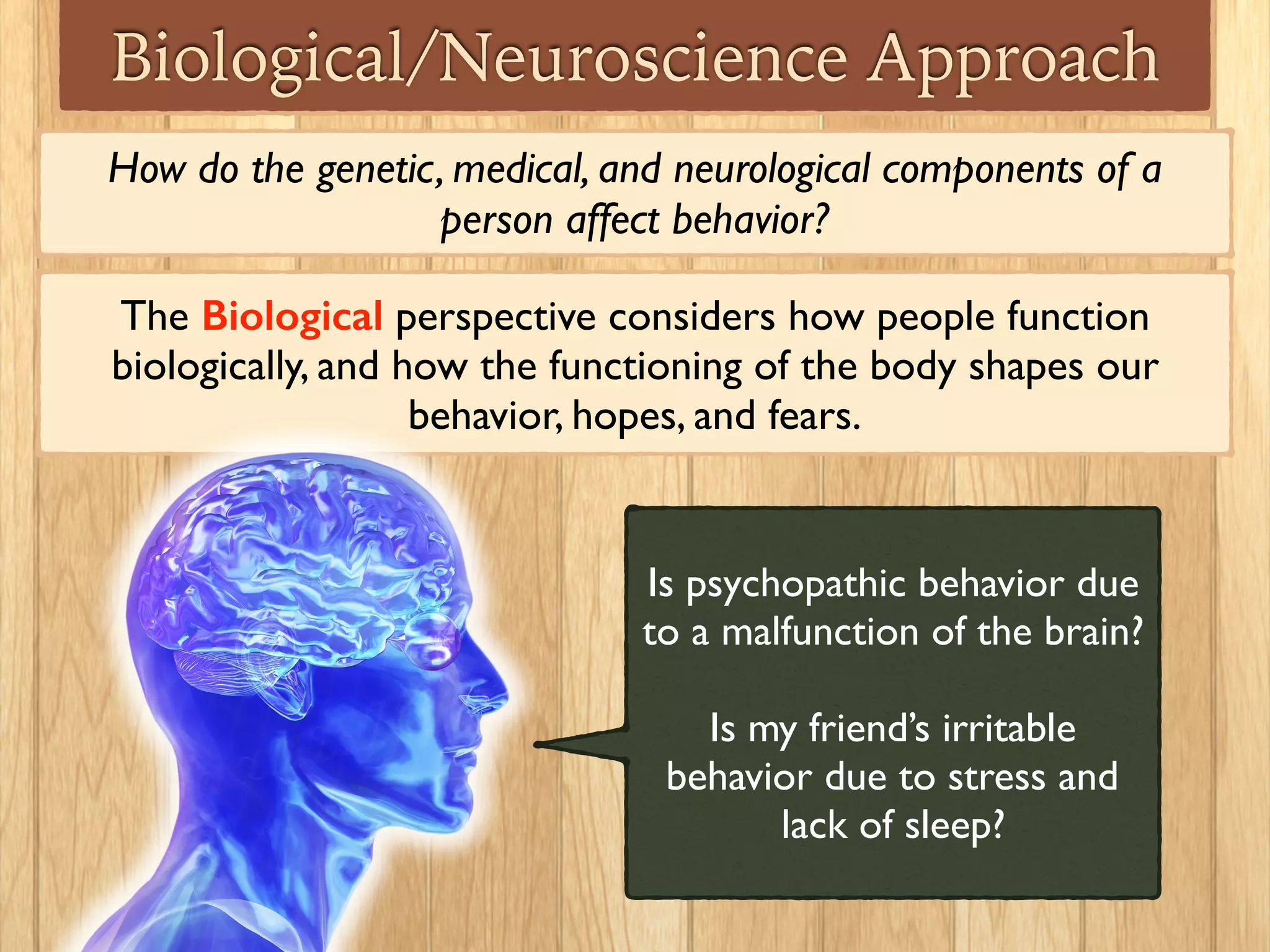
The Behavioral perspective focuses on observable behaviors that
can be measured objectively. Behaviorists believe that our behavior
is related to our environment, and we can modify behavior by
modifying the environment.
How do we learn behavior?
Learning: a relatively permanent change in behavior
brought about by experience.
Remember the nature vs.
nurture debate? Learning is
what results from nurturing.
During this unit, just remember that
behavior is not 100% the result of
nurture. For example, you might get
better at soccer as you grow older not
only because you have learned to
improve your skills, but also because your
body is becoming physically stronger.
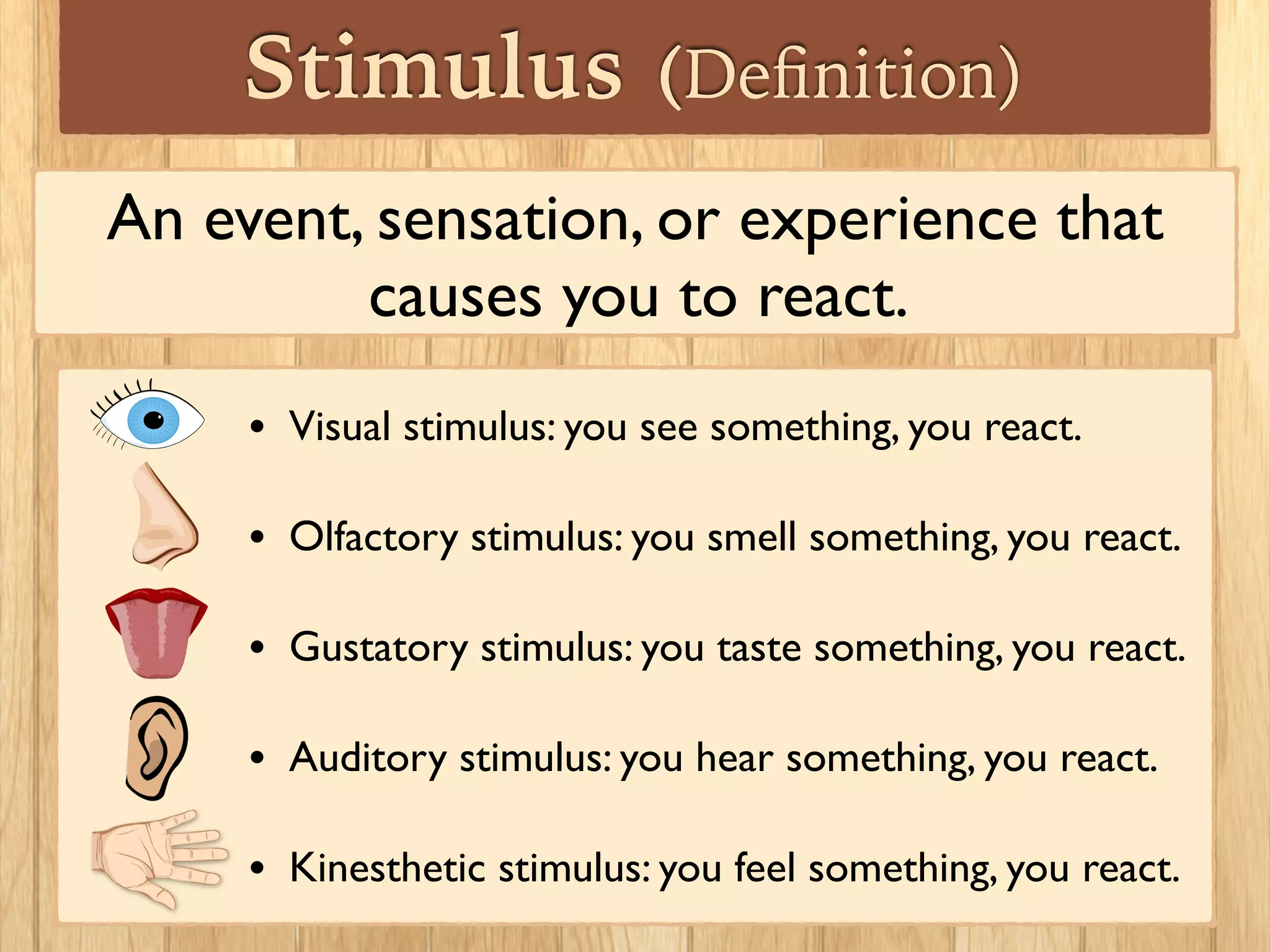
Stimulus (Definition)
An event, sensation, or experience that
causes you to react.
• Visual stimulus: you see something, you react.
• Olfactory stimulus: you smell something, you react.
• Gustatory stimulus: you taste something, you react.
• Auditory stimulus: you hear something, you react.
• Kinesthetic stimulus: you feel something, you react.
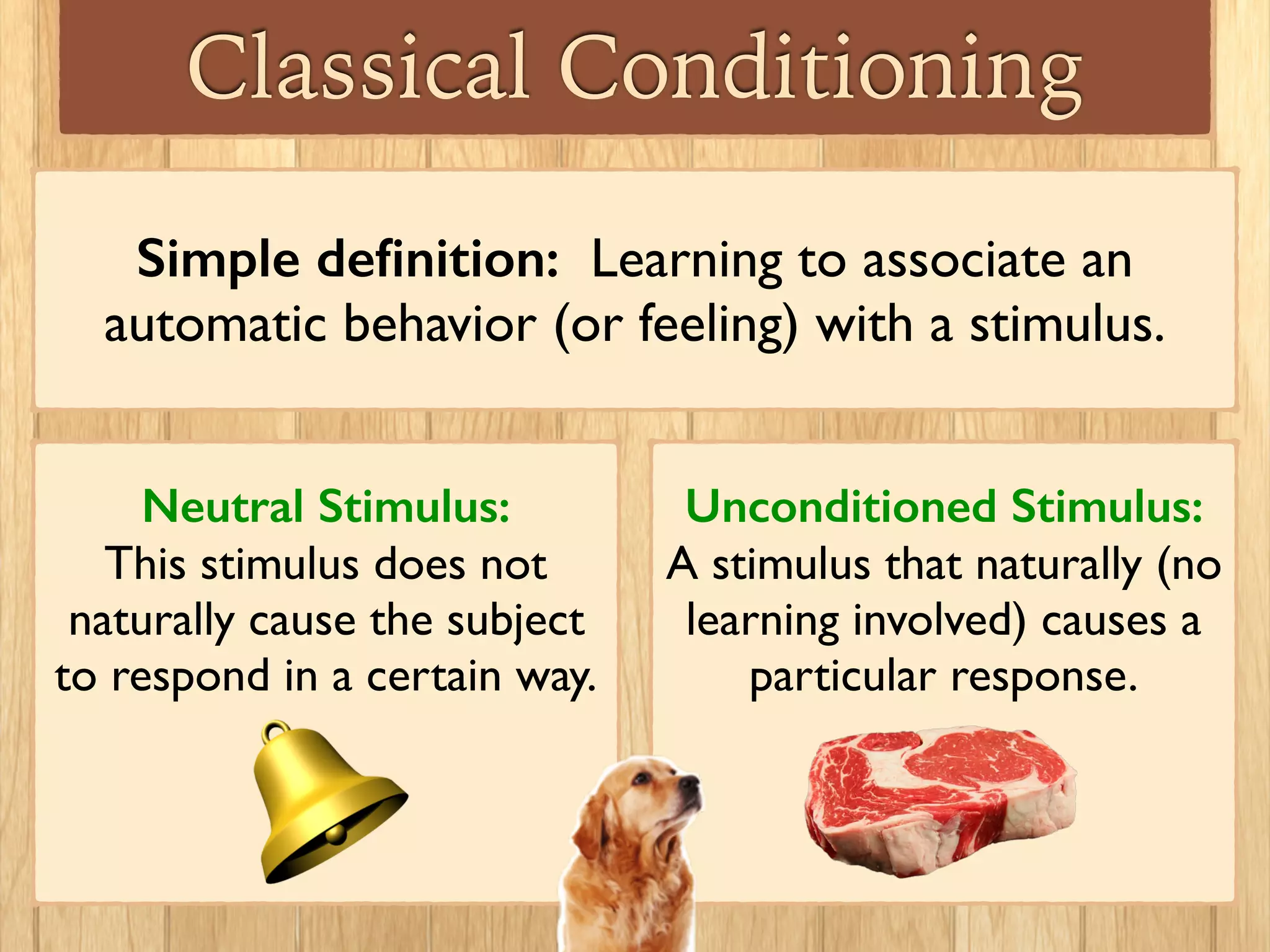
Classical Conditioning
A type of learning in which a neutral stimulus comes
to bring about a response after it is paired with a
stimulus that naturally brings that response.
Neutral Stimulus:
This stimulus does not
naturally cause the subject
to respond in a certain way.
Unconditioned Stimulus:
A stimulus that naturally (no
learning involved) causes a
particular response.
Classical Conditioning
Simple definition: Learning to associate an
automatic behavior (or feeling) with a stimulus.
Neutral Stimulus:
This stimulus does not
naturally cause the subject
to respond in a certain way.
Unconditioned Stimulus:
A stimulus that naturally (no
learning involved) causes a
particular response.
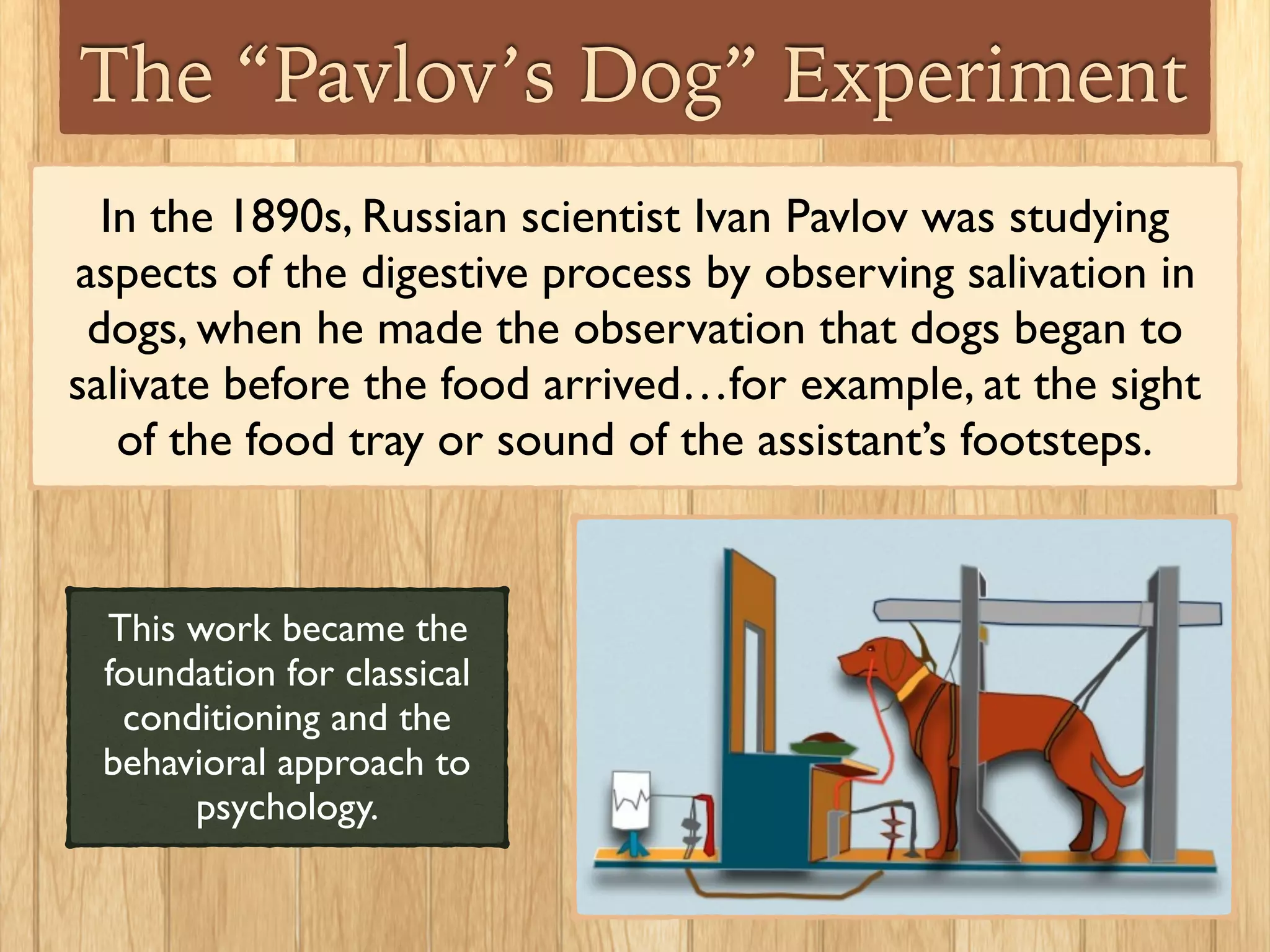
The “Pavlov’s Dog” Experiment
In the 1890s, Russian scientist Ivan Pavlov was studying
aspects of the digestive process by observing salivation in
dogs, when he made the observation that dogs began to
salivate before the food arrived…for example, at the sight
of the food tray or sound of the assistant’s footsteps.
This work became the
foundation for classical
conditioning and the
behavioral approach to
psychology.
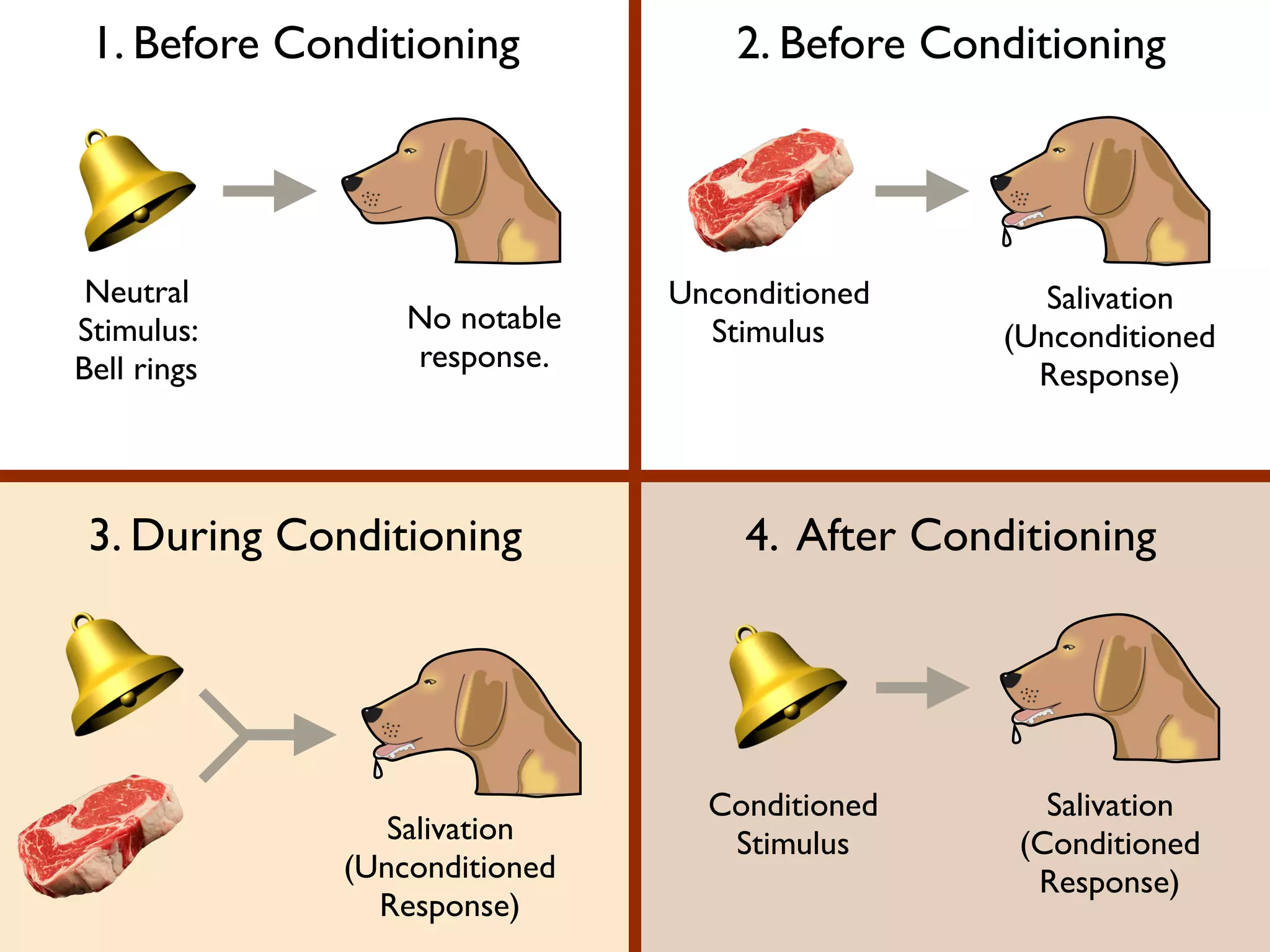
1. Before Conditioning 2. Before Conditioning
3. During Conditioning 4. After Conditioning
Neutral
Stimulus:
Bell rings
No notable
response.
Unconditioned
Stimulus
Salivation
(Unconditioned
Response)
Salivation
(Unconditioned
Response)
Salivation
(Conditioned
Response)
Conditioned
Stimulus
Classical Conditioning
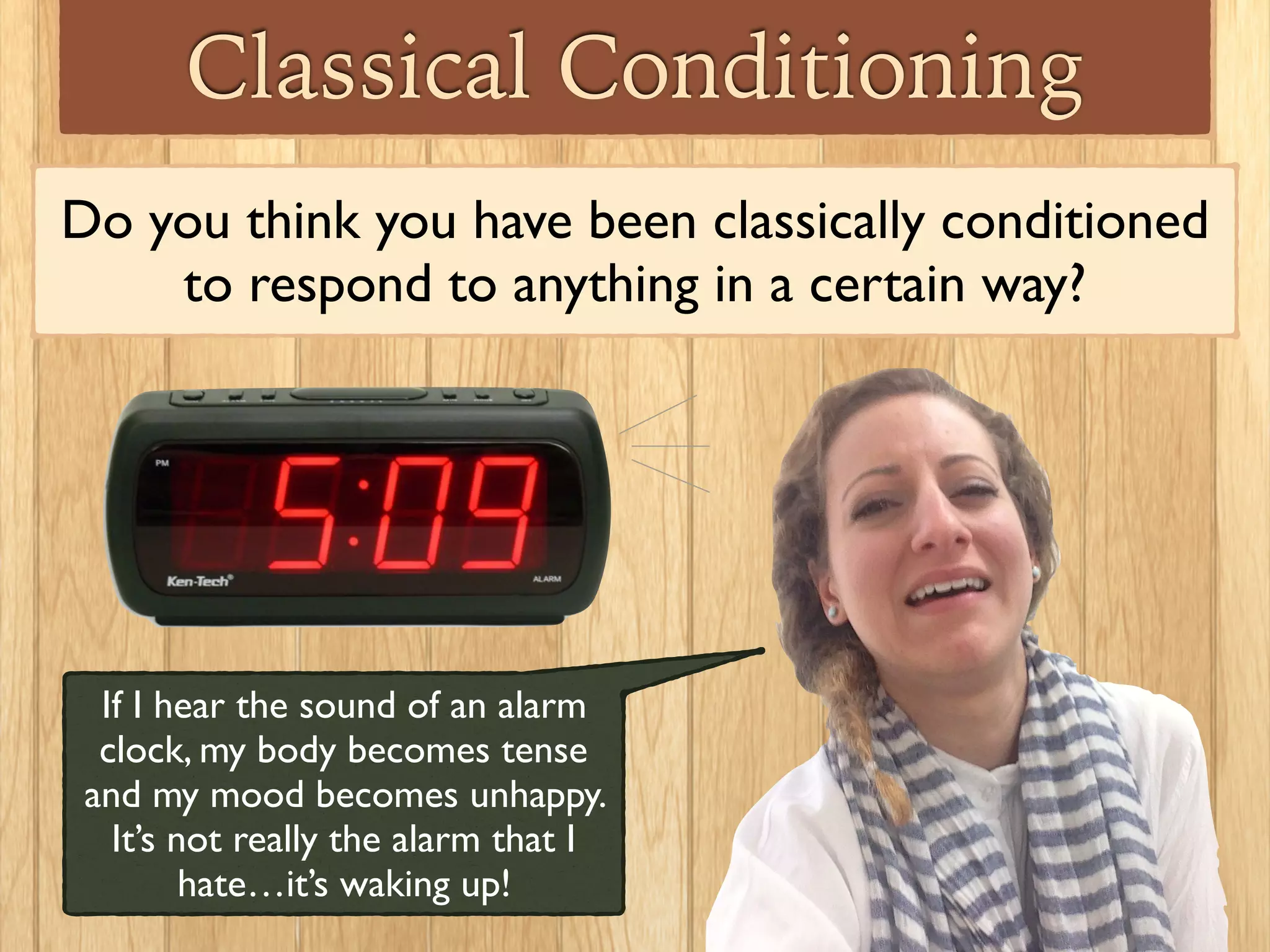
Do you think you have been classically conditioned
to respond to anything in a certain way?
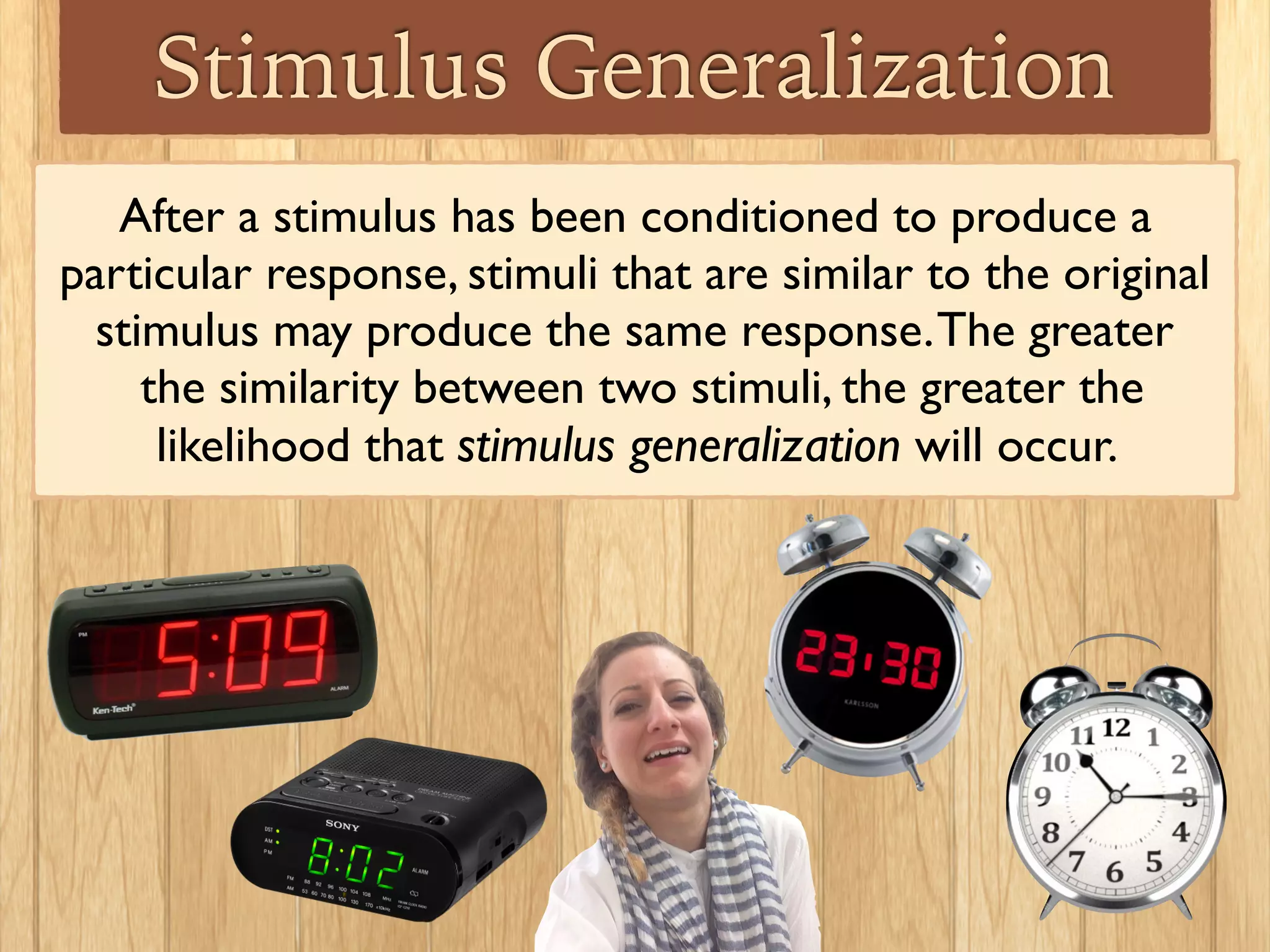
If I hear the sound of an alarm
clock, my body becomes tense
and my mood becomes unhappy.
It’s not really the alarm that I
hate…it’s waking up!
Classical Conditioning
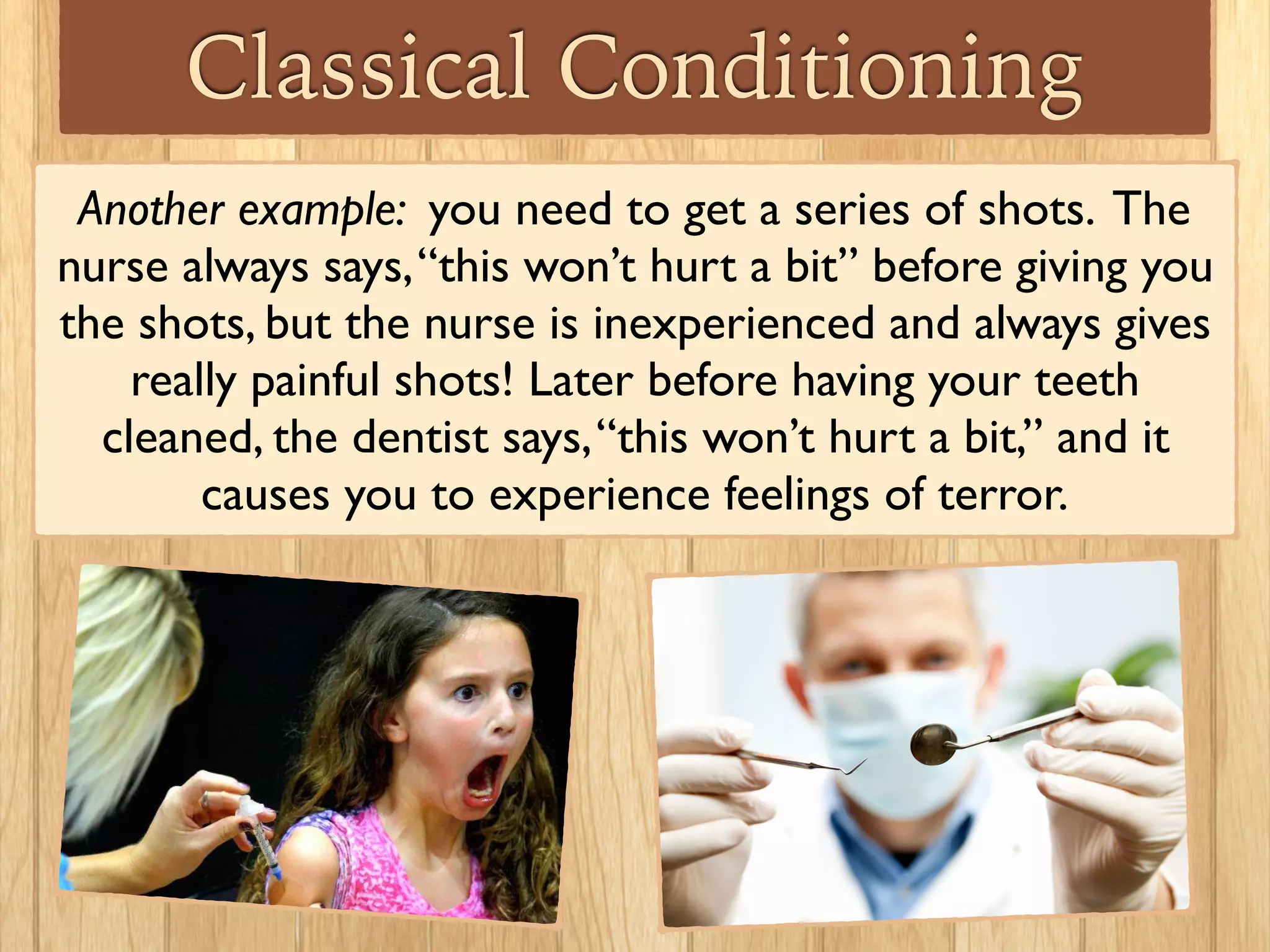
Another example: you need to get a series of shots. The
nurse always says,“this won’t hurt a bit” before giving you
the shots, but the nurse is inexperienced and always gives
really painful shots! Later before having your teeth
cleaned, the dentist says,“this won’t hurt a bit,” and it
causes you to experience feelings of terror.
Video
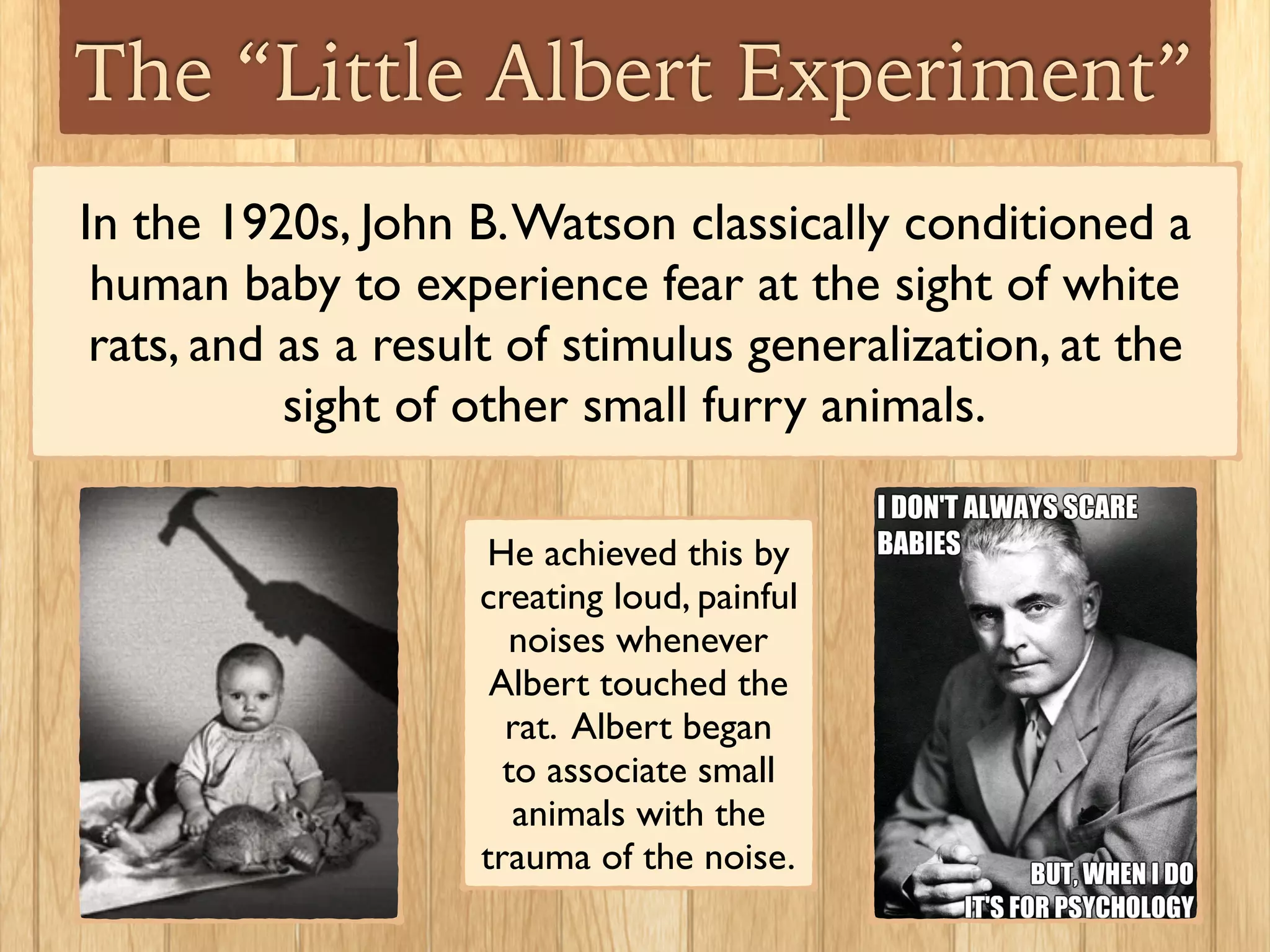
The “Little Albert Experiment”
In the 1920s, John B.Watson classically conditioned a
human baby to experience fear at the sight of white
rats, and as a result of stimulus generalization, at the
sight of other small furry animals.
He achieved this by
creating loud, painful
noises whenever
Albert touched the
rat. Albert began
to associate small
animals with the
trauma of the noise.
Classical Conditioning
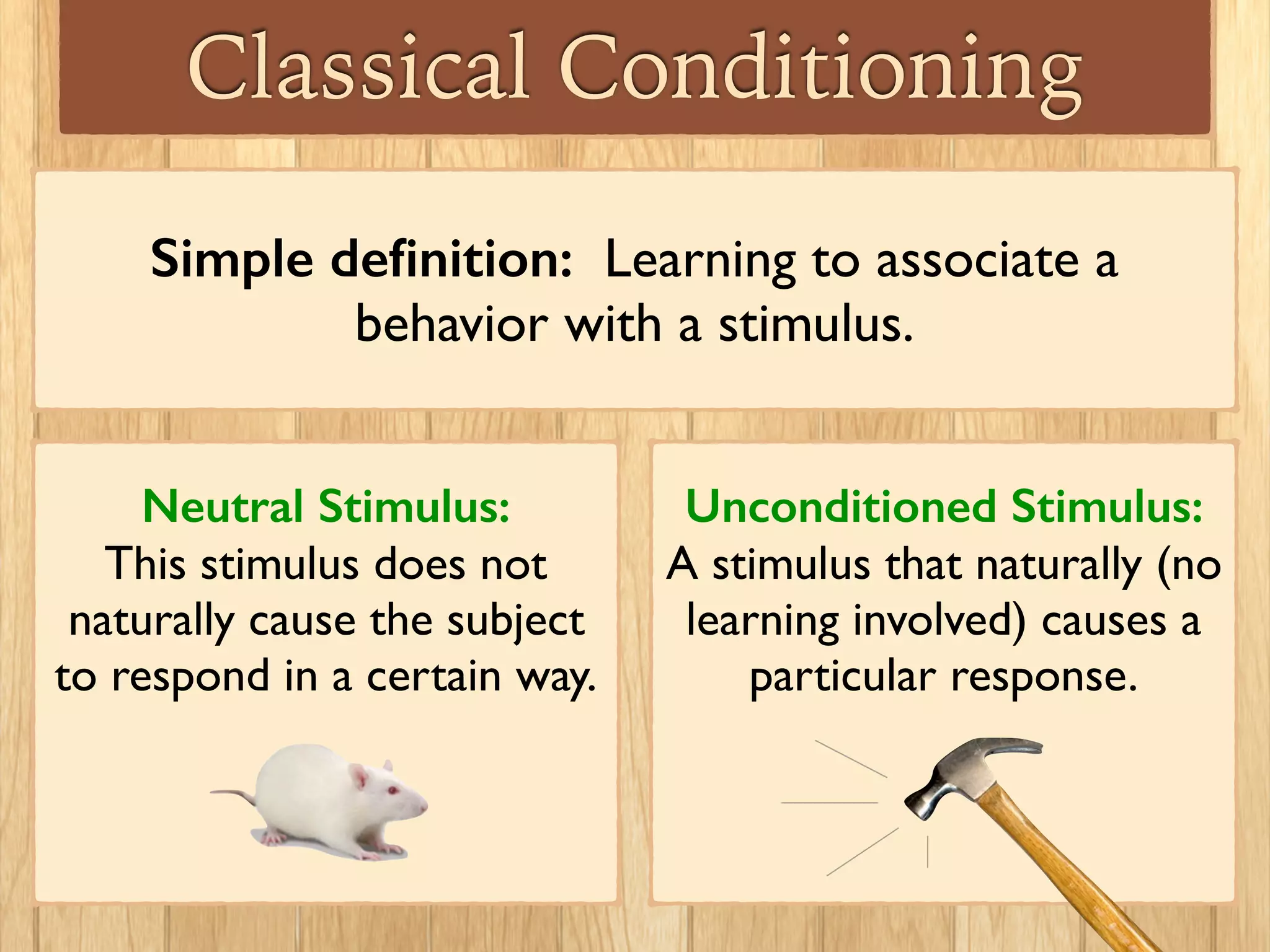
Simple definition: Learning to associate a
behavior with a stimulus.
Neutral Stimulus:
This stimulus does not
naturally cause the subject
to respond in a certain way.
Unconditioned Stimulus:
A stimulus that naturally (no
learning involved) causes a
particular response.
Stimulus Generalization
After a stimulus has been conditioned to produce a
particular response, stimuli that are similar to the original
stimulus may produce the same response.The greater
the similarity between two stimuli, the greater the
likelihood that stimulus generalization will occur.
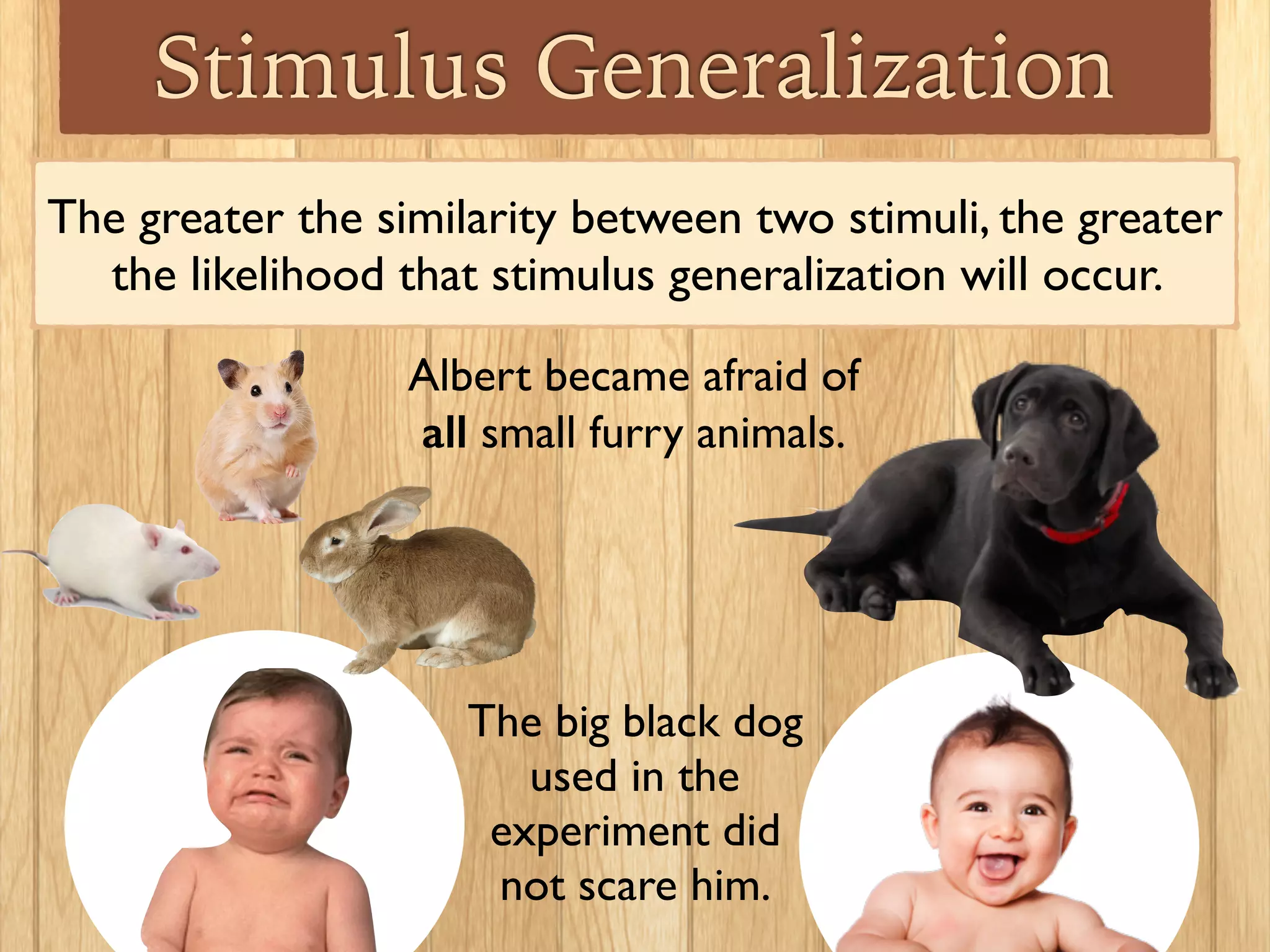
Stimulus Generalization
The greater the similarity between two stimuli, the greater
the likelihood that stimulus generalization will occur.
Albert became afraid of
all small furry animals.
The big black dog
used in the
experiment did
not scare him.
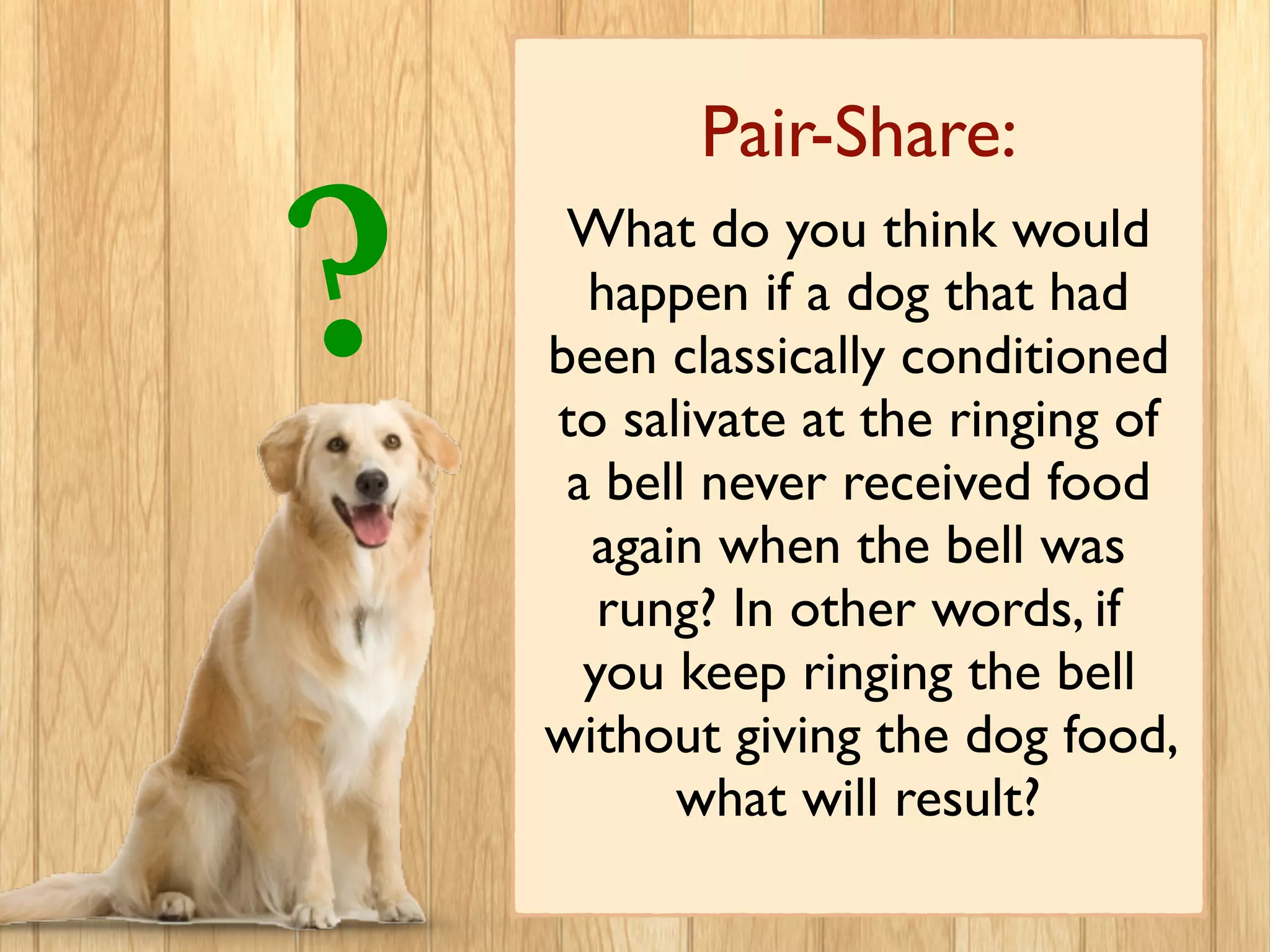
Pair-Share:
What do you think would
happen if a dog that had
been classically conditioned
to salivate at the ringing of
a bell never received food
again when the bell was
rung? In other words, if
you keep ringing the bell
without giving the dog food,
what will result?
?
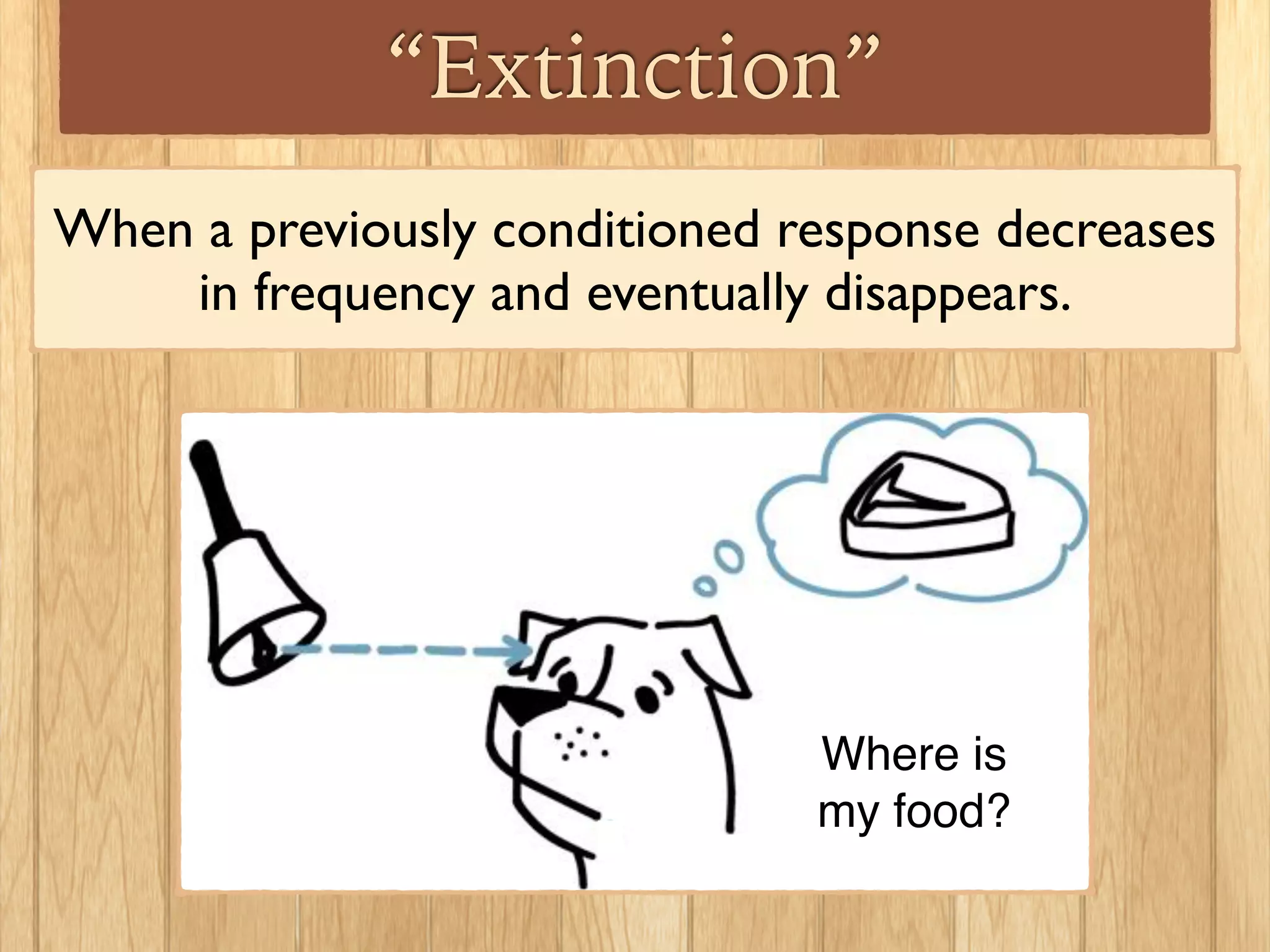
“Extinction”
When a previously conditioned response decreases
in frequency and eventually disappears.
Where is
my food?
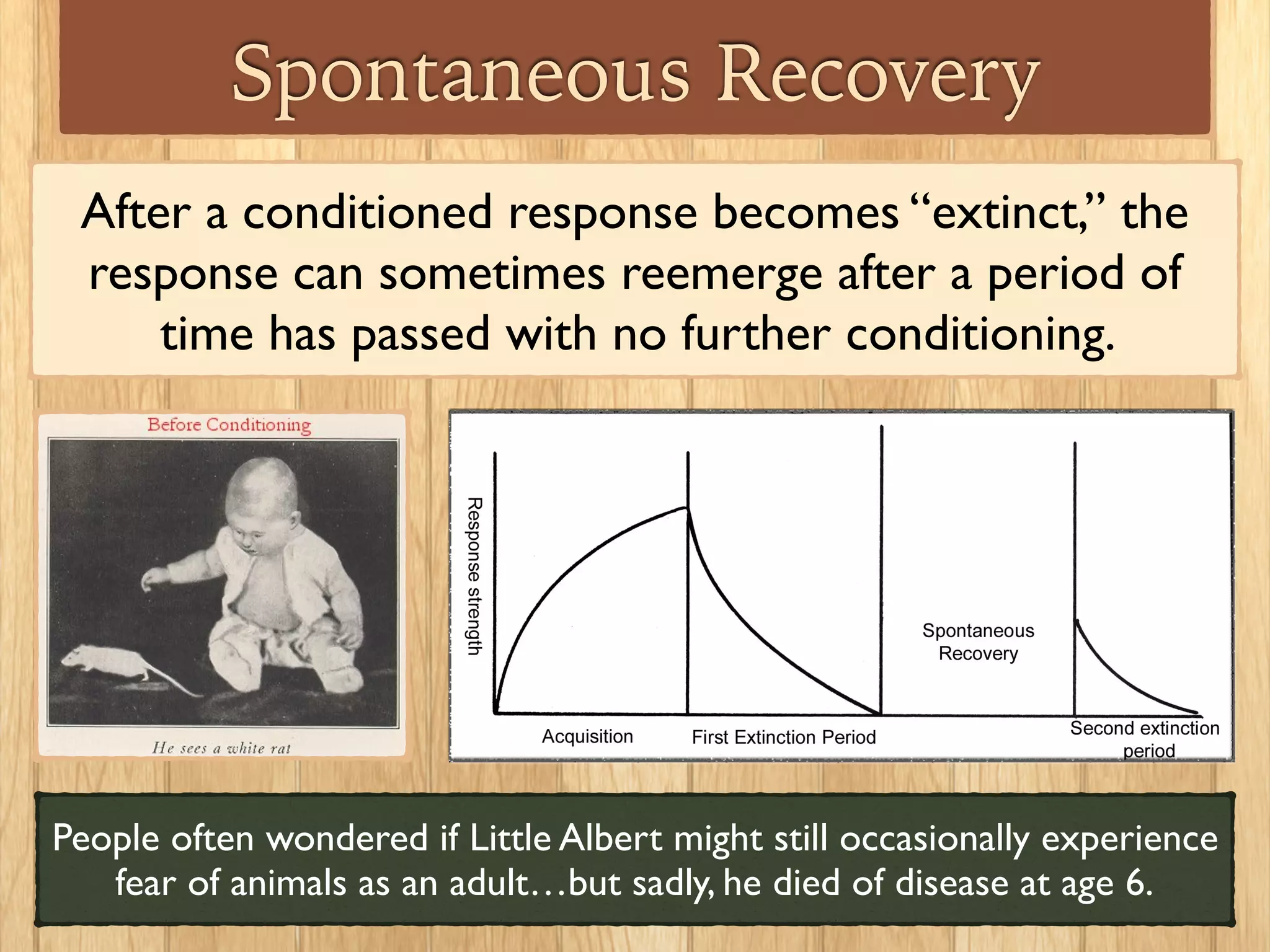
Spontaneous Recovery
After a conditioned response becomes “extinct,” the
response can sometimes reemerge after a period of
time has passed with no further conditioning.
People often wondered if Little Albert might still occasionally experience
fear of animals as an adult…but sadly, he died of disease at age 6.
Note This!
Classical conditioning relates to involuntary,
automatic reactions we have to a stimulus. (These
are usually emotional and biological reactions).
You cannot be classically conditioned to
perform a voluntary action (there is a
different concept called operant conditioning
that refers to the ability to make us more or less
likely to perform a certain voluntary action).
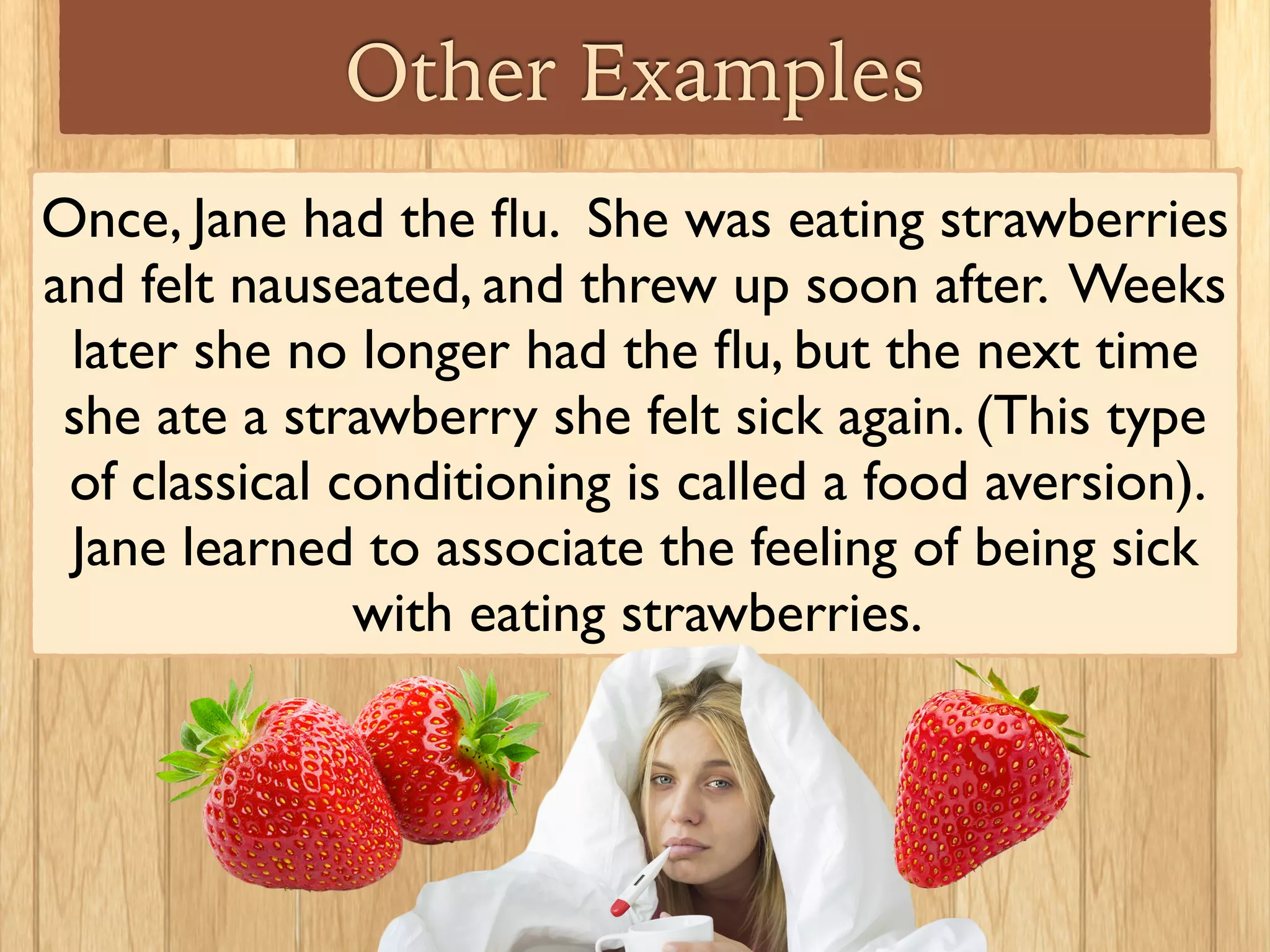
Other Examples
Once, Jane had the flu. She was eating strawberries
and felt nauseated, and threw up soon after. Weeks
later she no longer had the flu, but the next time
she ate a strawberry she felt sick again. (This type
of classical conditioning is called a food aversion).
Jane learned to associate the feeling of being sick
with eating strawberries.
Other Examples
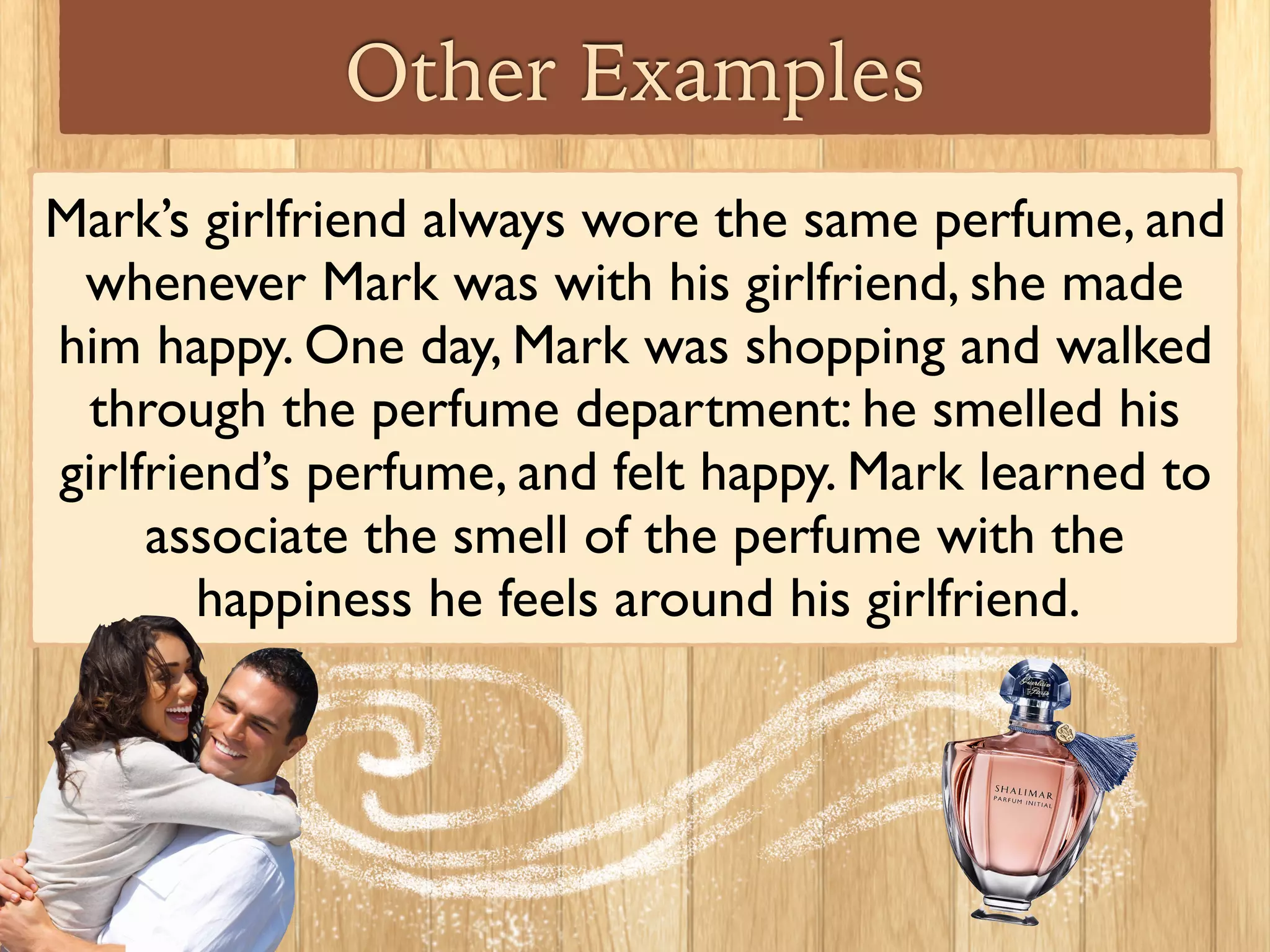
Mark’s girlfriend always wore the same perfume, and
whenever Mark was with his girlfriend, she made
him happy. One day, Mark was shopping and walked
through the perfume department: he smelled his
girlfriend’s perfume, and felt happy. Mark learned to
associate the smell of the perfume with the
happiness he feels around his girlfriend.
Other Examples
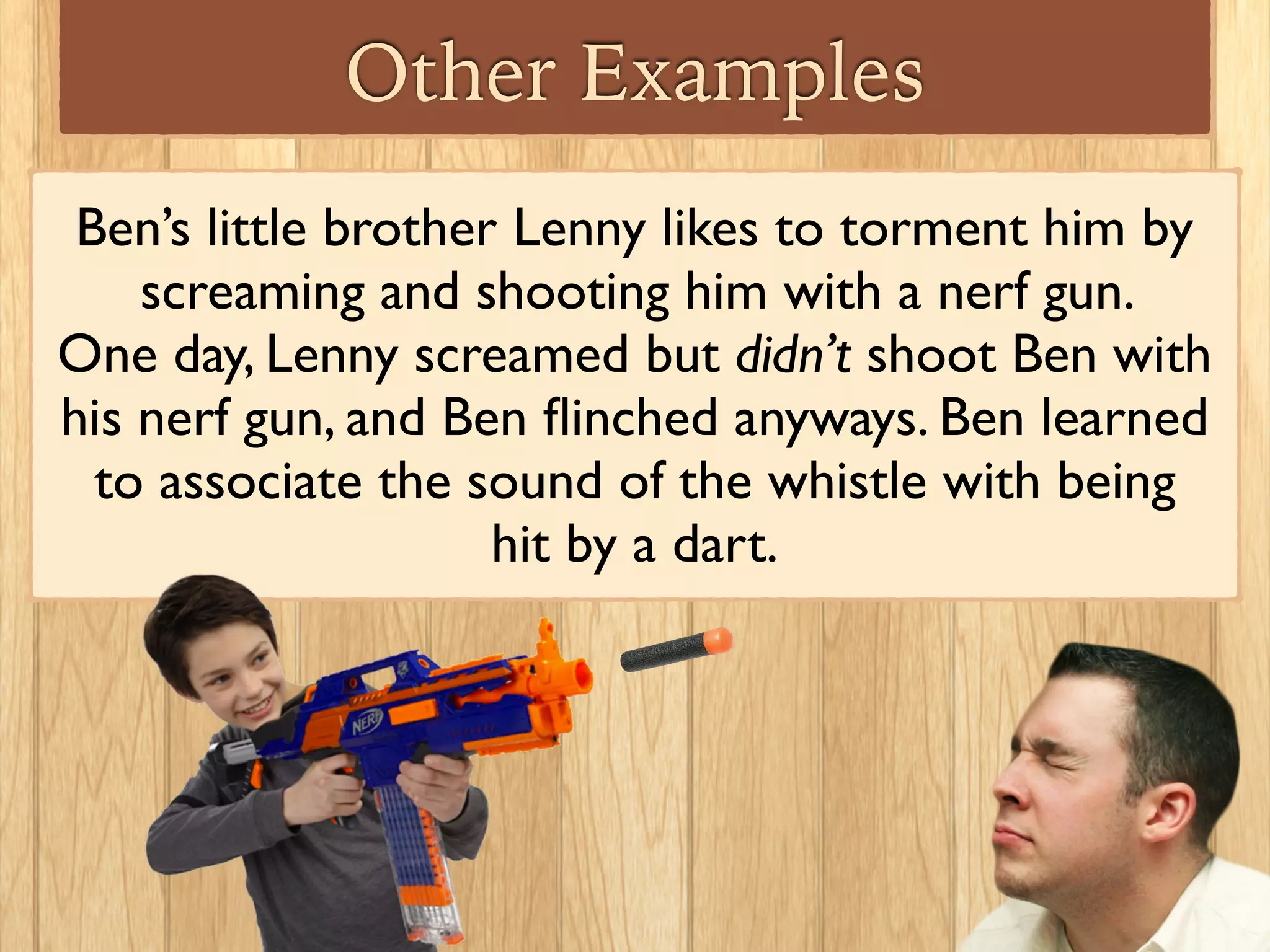
Ben’s little brother Lenny likes to torment him by
screaming and shooting him with a nerf gun.
One day, Lenny screamed but didn’t shoot Ben with
his nerf gun, and Ben flinched anyways. Ben learned
to associate the sound of Lenny’s screaming with
being hit by a dart.
Other Examples
Lilly grew up in an orphanage where she was
neglected and mistreated by the staff. The
orphanage was located in an big, historic manor
house. As an adult, Lilly still feels emotional pain
when she visits that house because she is associating
her negative memories with the place. In fact, Lilly
feels upset when she goes into any big old house
(due to stimulus generalization).

Classical Conditioning

  • 1.
  • 2.
    Behavioral Approach How dorewards and punishments throughout a person’s life affect their behavior? We learn to associate certain acts with the responses they produce… so if my parents want me to stop sucking my thumb, they can cover my thumb in something that tastes bad! Thus, sucking my thumb produces a negative response, and I will eventually stop doing it. The Behavioral perspective focuses on observable behaviors that can be measured objectively. Behaviorists believe that our behavior is related to our environment, and we can modify behavior by modifying the environment.
  • 3.
    How do welearn behavior? Learning: a relatively permanent change in behavior brought about by experience. Remember the nature vs. nurture debate? Learning is what results from nurturing. During this unit, just remember that behavior is not 100% the result of nurture. For example, you might get better at soccer as you grow older not only because you have learned to improve your skills, but also because your body is becoming physically stronger.
  • 4.
    Stimulus (Definition) An event,sensation, or experience that causes you to react. • Visual stimulus: you see something, you react. • Olfactory stimulus: you smell something, you react. • Gustatory stimulus: you taste something, you react. • Auditory stimulus: you hear something, you react. • Kinesthetic stimulus: you feel something, you react.
  • 5.
    Classical Conditioning A typeof learning in which a neutral stimulus comes to bring about a response after it is paired with a stimulus that naturally brings that response. Neutral Stimulus: This stimulus does not naturally cause the subject to respond in a certain way. Unconditioned Stimulus: A stimulus that naturally (no learning involved) causes a particular response.
  • 6.
    Classical Conditioning Simple definition:Learning to associate an automatic behavior (or feeling) with a stimulus. Neutral Stimulus: This stimulus does not naturally cause the subject to respond in a certain way. Unconditioned Stimulus: A stimulus that naturally (no learning involved) causes a particular response.
  • 7.
    The “Pavlov’s Dog”Experiment In the 1890s, Russian scientist Ivan Pavlov was studying aspects of the digestive process by observing salivation in dogs, when he made the observation that dogs began to salivate before the food arrived…for example, at the sight of the food tray or sound of the assistant’s footsteps. This work became the foundation for classical conditioning and the behavioral approach to psychology.
  • 8.
    1. Before Conditioning2. Before Conditioning 3. During Conditioning 4. After Conditioning Neutral Stimulus: Bell rings No notable response. Unconditioned Stimulus Salivation (Unconditioned Response) Salivation (Unconditioned Response) Salivation (Conditioned Response) Conditioned Stimulus
  • 9.
    Classical Conditioning Do youthink you have been classically conditioned to respond to anything in a certain way? If I hear the sound of an alarm clock, my body becomes tense and my mood becomes unhappy. It’s not really the alarm that I hate…it’s waking up!
  • 10.
    Classical Conditioning Another example:you need to get a series of shots. The nurse always says,“this won’t hurt a bit” before giving you the shots, but the nurse is inexperienced and always gives really painful shots! Later before having your teeth cleaned, the dentist says,“this won’t hurt a bit,” and it causes you to experience feelings of terror.
  • 11.
  • 12.
    The “Little AlbertExperiment” In the 1920s, John B.Watson classically conditioned a human baby to experience fear at the sight of white rats, and as a result of stimulus generalization, at the sight of other small furry animals. He achieved this by creating loud, painful noises whenever Albert touched the rat. Albert began to associate small animals with the trauma of the noise.
  • 13.
    Classical Conditioning Simple definition:Learning to associate a behavior with a stimulus. Neutral Stimulus: This stimulus does not naturally cause the subject to respond in a certain way. Unconditioned Stimulus: A stimulus that naturally (no learning involved) causes a particular response.
  • 14.
    Stimulus Generalization After astimulus has been conditioned to produce a particular response, stimuli that are similar to the original stimulus may produce the same response.The greater the similarity between two stimuli, the greater the likelihood that stimulus generalization will occur.
  • 15.
    Stimulus Generalization The greaterthe similarity between two stimuli, the greater the likelihood that stimulus generalization will occur. Albert became afraid of all small furry animals. The big black dog used in the experiment did not scare him.
  • 16.
    Pair-Share: What do youthink would happen if a dog that had been classically conditioned to salivate at the ringing of a bell never received food again when the bell was rung? In other words, if you keep ringing the bell without giving the dog food, what will result? ?
  • 17.
    “Extinction” When a previouslyconditioned response decreases in frequency and eventually disappears. Where is my food?
  • 18.
    Spontaneous Recovery After aconditioned response becomes “extinct,” the response can sometimes reemerge after a period of time has passed with no further conditioning. People often wondered if Little Albert might still occasionally experience fear of animals as an adult…but sadly, he died of disease at age 6.
  • 19.
    Note This! Classical conditioningrelates to involuntary, automatic reactions we have to a stimulus. (These are usually emotional and biological reactions). You cannot be classically conditioned to perform a voluntary action (there is a different concept called operant conditioning that refers to the ability to make us more or less likely to perform a certain voluntary action).
  • 20.
    Other Examples Once, Janehad the flu. She was eating strawberries and felt nauseated, and threw up soon after. Weeks later she no longer had the flu, but the next time she ate a strawberry she felt sick again. (This type of classical conditioning is called a food aversion). Jane learned to associate the feeling of being sick with eating strawberries.
  • 21.
    Other Examples Mark’s girlfriendalways wore the same perfume, and whenever Mark was with his girlfriend, she made him happy. One day, Mark was shopping and walked through the perfume department: he smelled his girlfriend’s perfume, and felt happy. Mark learned to associate the smell of the perfume with the happiness he feels around his girlfriend.
  • 22.
    Other Examples Ben’s littlebrother Lenny likes to torment him by screaming and shooting him with a nerf gun. One day, Lenny screamed but didn’t shoot Ben with his nerf gun, and Ben flinched anyways. Ben learned to associate the sound of Lenny’s screaming with being hit by a dart.
  • 23.
    Other Examples Lilly grewup in an orphanage where she was neglected and mistreated by the staff. The orphanage was located in an big, historic manor house. As an adult, Lilly still feels emotional pain when she visits that house because she is associating her negative memories with the place. In fact, Lilly feels upset when she goes into any big old house (due to stimulus generalization).