LEARNING
Anamika Basumatary
PhD Pursuing
M.Phil in Counseling Psychology
Meaning
• The term learning refers to a relatively permanent change
in behaviour which occurs due to practice or experience
and not due to growth or maturation. Some aspects of the
definition seems noteworthy to mention:
• A) Firstly, for learning to take place the change has to be
relatively permanent, exactly how long cannot be
specified but it should last for days, years, months and so
on. However, temporary change in behaviour which
occurs due to fatigue or drugs cannot be considered as
learning.
• B) Secondly, the change in behaviour which occurs due to
learning is due to practice or experience and not due to
growth or maturation. This aspect of the definition
differentiates learning from innately controlled species
typical behaviour.
• C) Thirdly, learning leads to a change in relatively
permanent change in behaviour which can be for better or
worse.
• D) Learning can be inferred from performance.
• E) Learning takes place through direct experience and
vicarious learning. We learn by observing the elements in
the environment and by directly participating in them.
CLASSICAL CONDITIONING
• A form of learning which was proposed by Ivan P Pavlov.
• It is known as type-I learning, Pavlovian conditioning, S-S
learning as the organism learns the association between
different stimuli.
• It is also known as respondent conditioning as the
organism responds to some specific stimuli in the
environment.
• Classical conditioning is a basic form of learning in which
one stimulus comes to serve as signal for the occurrence
of another stimulus. During classical conditioning
organisms acquire information about relations between
various stimuli and not simple association between them.
Concepts of Classical Conditioning
• A) Unconditioned Stimulus- It is a natural stimulus that will
automatically elicit a response. Example – Food.
• B) Conditioned Stimulus- It is a neutral stimulus that is
paired with UCS, if not paired it will not elicit any
response. Example- Bell
• C) Unconditioned Response: It is a response which is
made to the UCS. Example- Salivation at the sight of the
food.
• D) Conditioned Response: It is a response which is made
to the CS. Example- Salivation to the sound of the bell.
SOME BASIC PRINCIPLES OF
CLASSICAL CONDITIONING
Acquisition: It is a process where the CS acquires the
ability to elicit a CR when CS-UCS presentations are made
in a consistent and repeated manner. There is a limit to
acquisition, after a number of CS-UCS presentations it
gradually slows down and finally levels off.
FACTORS AFFECTING ACQUISITION
• A) Temporal contiguity or time relations between stimuli:
• Temporal arrangements are- Forward conditioning,
Simultaneous conditioning and backward conditioning.
• i) FORWARD CONDITIONING: Under this there are
trace and delay conditioning. In trace conditioning the CS
precedes UCS but with a reasonable time gap.
• In delay conditioning the onset of UCS starts when the CS
is still present. This is the most effective method of
conditioning.
• ii) In simultaneous conditioning the CS and UCS begins
and ends at the same time.
• iii) . In backward conditioning the UCS precedes CS and
is the least effective method of conditioning.
• B) Intensity: For conditioning to occur at a faster rate the
intensity of the CS and UCS should increase. The CS
should stand against the background stimuli.
• C) The time interval between CS-UCS presentations
should be between 0.2 to 2 seconds.
• D) The stimulus i.e., CS and UCS should be novel and
surprising. Thus, familiarity can greatly affect conditioning.
EXTINCTION
• The process through which a conditioned stimulus
gradually looses the ability to evoke conditioned
responses when it is no longer followed by the
unconditioned stimulus is known as extinction. For
example if the bell is not followed by food after a few trials
the dog will stop salivating to the sound of the bell.
However, it is important to note that extinction is not a
smooth process.
• RECONDITIONING: It refers to the quick reappearance of
CR when CS-UCS presentation is made again following
extinction.
• SPONTANEOUS RECOVERY: Reappearance of a
weakened CR to a CS after an interval of time following
extinction.
• STIMULUS GENERALIZATION: The tendency of stimuli
similar to a conditioned stimulus to evoke a conditioned
responses. For example the dog who has learnt to
salivate at the sound of the bell will also salivate to the
buzzer.
• STIMULUS DISCRIMINATION: The process by which
organisms learn to respond to certain stimuli but not to
others is known as stimulus discrimination.
BIOLOGICAL CONSTRAINTS IN
LEARNING
• Tendencies of some species to acquire some forms of
conditioning less readily than other species do is known
as biological constraints in learning. This concept was
proposed by Shettleworth.
CONDITIONED TASTE
AVERSION
• A type of conditioning in which the UCS (usually internal
cues associated with nausea or vomiting) occurs several
hours after the CS (often a novel food) and leads to a
strong CS-UCS association in a single trail. This type of
conditioning is also known as one trial learning and is
highly resistant to extinction. For example cancer patients
may develop an aversion towards the food (usually a new
food) consumed hours before the chemotherapy session.
CLASSICAL CONDITIONING A
COGNITIVE PERSPECTIVE
• 1) Expectation: The fact that expectation play an
important role in classical conditioning is a thesis
proposed by Rescorla and Wagner, 1972. They hold that
expectations occur when CS-UCS presentations are
made in a repeated and consistent manner, the fact that if
CS has occurred UCS will occur soon. However,
expectation gets distorted when CS-UCS presentations
are made in a random manner.
• 2) Blocking: The fact that conditioning to one stimulus
may be prevented by previous conditioning to another
stimulus.
• 3) Mental imagery also play an important role in classical
conditioning. Research shows the following:
• a) Cognitive processes underlying the generation,
manipulation, and scanning of mental images closely
mirror the processes involved in perceiving the actual
physical stimuli (Kosslyn,1994).
• b) Studies using brain imaging techniques also indicate
that the areas of the brain known to be involved in visual
processing is also active during visual imagery tasks
(Farah, 1988).
• To sum up we can say that active comparison processes
and memory also play an important role in classical
conditioning and it do not only include mere association
between different stimuli
THEORIES OF CLASSICAL
CONDITIONING
• Stimulus Substitution theory: This theory was originated by
Pavlov and relies upon the idea that the CS simply as a result
of pairing with UCS acquires the capacity to substitute for the
US in evoking a response. Pavlov thought that this association
took place in the brain. He thought that the CS and UCS
activates two areas of the brain, and that activation of the UCS
area resulted in reflex and automatic response. As a result of
the CS-UCS pairing the CS acquired the ability to excite the
UCS area thus leading to a reflex response. The theory faces
the limitation that it considers the fact that CR should be the
same or at least very similar to the UCR. For example, when
using a mild foot shock as the UCS and a tone as the CS, the
UCR of rats to the shock is an increase in running and activity,
but the CR to the tone is decrease in activity- a response
known as freezing.
• Information and Expectation: Other theories take the
viewpoint that CS becomes a signal for UCS. Thus, when
the CS is presented the UCS is expected and the learner
responds in accordance to the expectation. A question
arises that how the CS act as signal for the occurrence for
the UCS? Experiments have shown that the UCS is a
surprising or novel event. The surprising UCS induces the
learner to look back through the recent memory. The CS
is the event consistently found in memory on each trail
before the UCS. An association or link is thus formed
between the CS and UCS. Now when the CS is presented
the UCS is expected. Therefore an association or link is
thus said to be formed between the memory trace of CS
and UCS.
OPERANT CONDITIONING
• It is a form of learning which was proposed by B.F Skinner
and is based upon the assumption that behaviour is
determined by the consequence it follows.
• If a particular behaviour is followed by reward it gets
strengthened while if another behaviour leads to
punishment it gets weakened. It is known as operant
conditioning because the organisms operate on a specific
environment to produce an outcome. This is also known
as instrumental conditioning as the behaviour of the
organism is helpful in getting the reward.
CONCEPT OF REINFORCEMENT
AND PUNISHMENT
• Reinforcement refers to the application or removal of a
stimulus to increase the strength of a specific behaviour.
There are two types of reinforcement- Positive and
Negative.
• Positive reinforcement- a) Application of a desirable
stimulus (e.g. food, praise, sexual pleasure). The addition
of a reward.
• b) Strengthens responses that precede occurrence of
stimulus.
• c) Organisms learn to perform responses that lead to
positive outcome
• For eg., If you do a good job at work and your manager
gives you a bonus, that bonus is a positive reinforcer.
Negative Reinforcement
• A) Application of an undesirable (aversive) stimulus
• the removal of a punishment
• B) Strengthens responses that permit escape from or
avoidance of stimulus.
• C) Organisms learn to perform responses that permit
them to avoid or escape from negative reinforcers.
• For example, if you do not complete your homework, you
give your teacher £5. You will complete your homework to
avoid paying £5, thus strengthening the behavior of
completing your homework.
Premark Principle
• A more preferred activity is used to reinforce a least
preferred activity. For example: a father may say that if
you complete your homework (least preferred activity) you
will be allowed to go to the party.
PUNISHMENT AND ITS TYPES
• Punishment refers to the procedure by which the
application or removal of a stimulus decreases the
strength of a behaviour. It is two types- Positive and
negative punishment.
POSITIVE PUNISHMENT
• i) Application of an undesirable stimulus.
• The addition of a punishment.
• ii) Weakens response that precede occurrence of
stimulus.
• iii) Organisms learn to supress responses that lead to
unpleasant consequences.
• A Teacher Scolding A Student Publicly For Repeating
Mistakes. It’s A Positive Punishment For Coming Late To
Class Repeatedly Or Being Too Talkative.
NEGATIVE PUNISHMENT
• i) There is a loss or postponement of a desirable stimulus.
• the removal of a reward
• ii) Weakens responses that lead to loss or postponement
of stimulus.
• iii) Organisms learn to suppress responses that lead to
loss or postponement of desired stimulus.
• iv) It is also commonly known as “time-out”.
• Taking away a child's video game following misbehavior is
an example of negative punishment.
WHEN DOES PUNISHMENT
WORKS?
• A) The more intense the punishment is the more effective
it is, however mild punishment often suppresses a
behaviour often temporarily. But intense punishment has
a limitation that it can lead to conditioned fear towards the
punisher and if the punishers are parents the situation
becomes worse.
• B) The more consistently punishment is administered ,
even if mild the more effective it will be.
• C) The closer the punishment is in time and place to the
behaviour being punished the more effective it will be.
• D) Punishment even when it is mild can be quite effective
if it is used to suppress one behaviour while at the same
time is used to make another behaviour more likely to
occur.
SCHEDULE OF
REINFORCEMENT
• They are rules determining when and how reinforcements
are to be delivered. It is usually divided into – Continuous
and partial or intermittent reinforcement schedule.
• In a continuous schedule of reinforcement every correct
response leads to a reinforcement. Such kind of a
reinforcement leads to the strengthening of new
behaviour.
Partial or Intermittent Schedule
• A) Fixed Interval Schedule: Here reinforcements are
provided after a specific amount of time has elapsed. For
example: When placed in such a schedule of
reinforcement an individual’s response or effort increases
when the time for the reinforcement approaches but there
effort soon goes down after that again when the time for
the next reinforcement approaches again the effort
increases.
• B) Variable Interval Schedule: Here, the organism gets
the reinforcement after variable amount of time has
elapsed. In such a schedule there is a consistent
performance.
• C) Fixed Ratio Schedule: Here, the organisms gets the
reinforcement after a specific number of correct
responses has elapsed. Such schedule of reinforcement
leads to a high rate of response although there is a
tendency towards a brief pause like that of fixed interval
schedule.
• D) Variable Ratio Schedule: In this type reinforcement is
provided after a variable number of correct responses
have elapsed. It leads to high and steady responses and
is highly resistant to extinction.
• Concurrent Schedule of Reinforcement: In this type of
reinforcement schedule two or more behaviours having
their own reinforcement schedule of reinforcement is
simultaneously available. Then there is matching law, the
organisms will distribute its behaviour between
alternatives in such a way as to maximise the
reinforcement it receives for its effort. It is known as
matching law (Hernstein,1961).
SHAPING AND CHAINING
• A technique in which closer and closer approximations to
desired behaviour are required for the delivery of positive
reinforcement. The organism undergoing shaping
receives a reward for every small step towards a final
goal-the target response-rather than only the final
response. At first, actions remotely resembling the target
behaviour –termed successive approximations are
reinforced. Gradually closer and closer approximations of
the final target behaviour are required before the reward is
given.
• However, for complex activities the process of chaining is
used which refers to a procedure that establishes a
sequence of responses, which leads to a reward following
the final response in the chain. However, shaping and
chaining cannot be used to virtually shape any type of
behaviour there is Instinctive Drift- a tendency to return to
the type of behaviour one would show under normal
conditions.
OPERANT CONDITIONING: A
COGNITIVE PERSPECTIVE
Learned helplessness, a concept proposed by Seligman
which refers to the feelings of helplessness that develop
after exposure to situations in which no effort succeeds in
affecting outcomes.
Research has shown that its onset partly stems from our
perception of control; when we begin to believe that we
have no control over our environment or our lives we stop
trying to improve our situation. One reason for such learned
helplessness is hypohedonia which refers to a genetically
inherit impairment in the ability to experience pleasure.
(Meehl, 1975)
CONTRAST EFFECT
• Our behaviour is not only influenced by the level of
rewards we receive but by out evaluation of rewards
relative to our experience with previous rewards. There
are positive contrast effect where the group of rats whose
level of rewards were suddenly increased performed
better than the group of rats who constantly received
higher reward and vive versa. Both positive and negative
contrast effects are transient. Thus, the elevated or
depressed performance slowly give way to performance
levels similar to those of control animals that receive only
the consistent level of reward.
TOLMAN’S COGNITIVE MAP
• Edward Tolman did not agree with the concept of
reinforcement , rather he proposed that the rats have
acquired the cognitive map, which refers to the spatial
representation of the map.
• Applied Behaviour Analysis- It is a field of psychology
where the operant conditioning principles are used to
solve the problems of our everyday life.
EXTINCTION OF POSITIVELY
REINFORCED STIMULI
• The procedure of not reinforcing a particular behaviour is
known as extinction. For example- In classical
conditioning if the bell is not followed by food then the
dog’s salivation response will get extinguished. In operant
conditioning if the rats behaviour of pressing the lever if
not reinforced the rat will stop pressing the lever.
CONDITIONED POSITIVE
REINFORCERS
• Some positive reinforcers like food, water works for the
first time they are presented, they are known as primary
reinforcers while on the other hand there are reinforcers
which do not work naturally, for them to be effective the
learner must have experience with them, their ability to
reinforce instrumental responses depends upon learning.
Such learned responses are known as secondary
reinforcers. Stimuli become conditioned reinforcers in
instrumental conditioning by being paired with primary
reinforcers.
• EXAMPLE: Suppose a click occurs each time a food
pellet is presented in the operant chamber. The click
becomes the conditioned reinforcer. At first the click has
no reinforcing properties, but its presence every time the
primary reinforcer is delivered becomes a reinforcer in its
own right.
• Conditioned reinforcers being learned themselves
undergo extinction if they are paired occassionally with a
primary reinforcer. In our everyday life conditioned
reinforcers have an important role to play.
ESCAPE AND AVOIDANCE
LEARNING
• Escape learning is an example of instrumental learning
based on negative reinforcement.
• In avoidance learning, the learned response is made
before the onset of the noxious stimulus and thus
prevents the learner from being exposed to the noxious
event. In can be explained in terms of species-typical
defence reactions and safety signals. Extinction of
avoidance learning is quite slow.
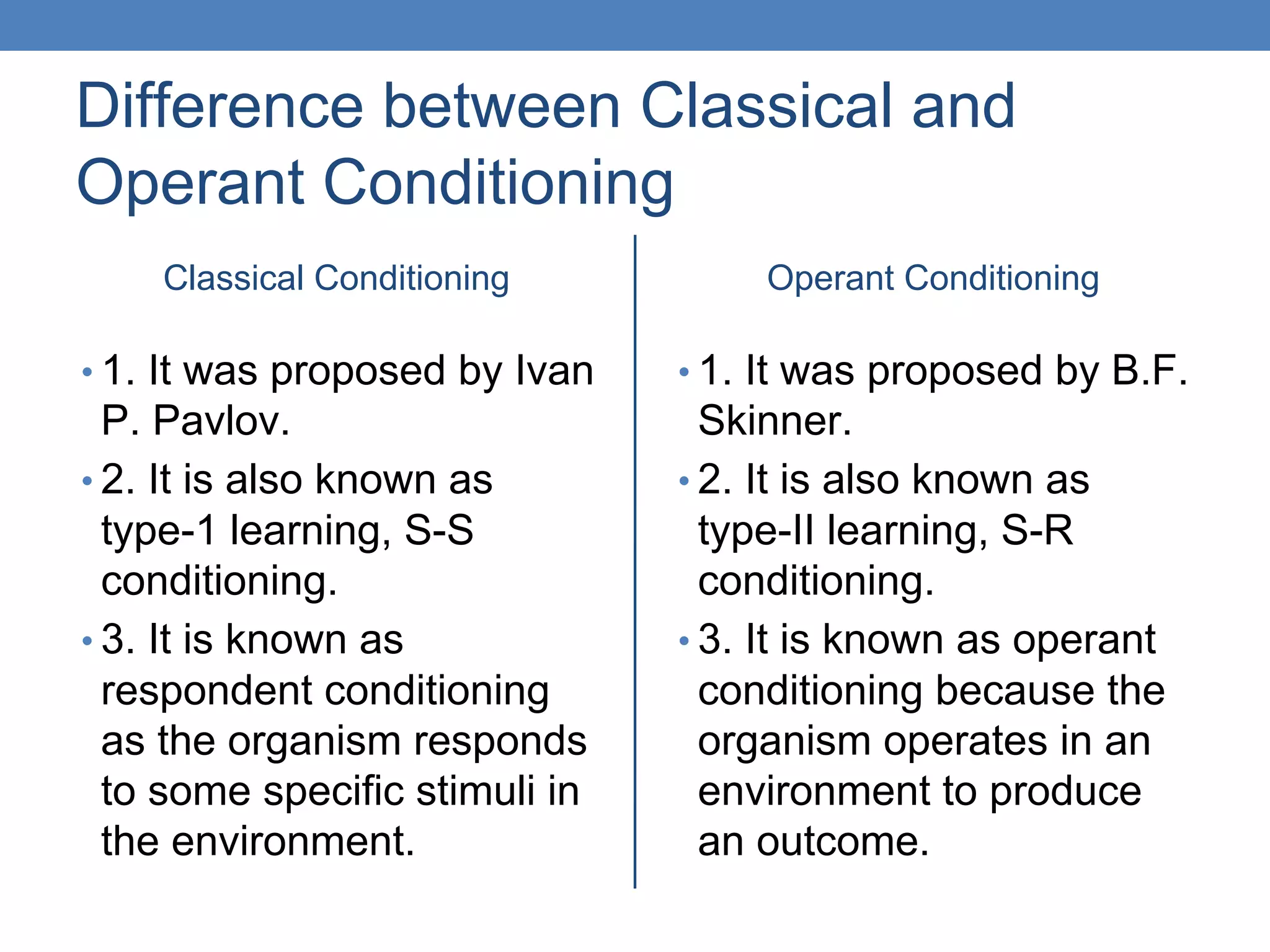
Difference between Classical and
Operant Conditioning
Classical Conditioning
• 1. It was proposed by Ivan
P. Pavlov.
• 2. It is also known as
type-1 learning, S-S
conditioning.
• 3. It is known as
respondent conditioning
as the organism responds
to some specific stimuli in
the environment.
Operant Conditioning
• 1. It was proposed by B.F.
Skinner.
• 2. It is also known as
type-II learning, S-R
conditioning.
• 3. It is known as operant
conditioning because the
organism operates in an
environment to produce
an outcome.
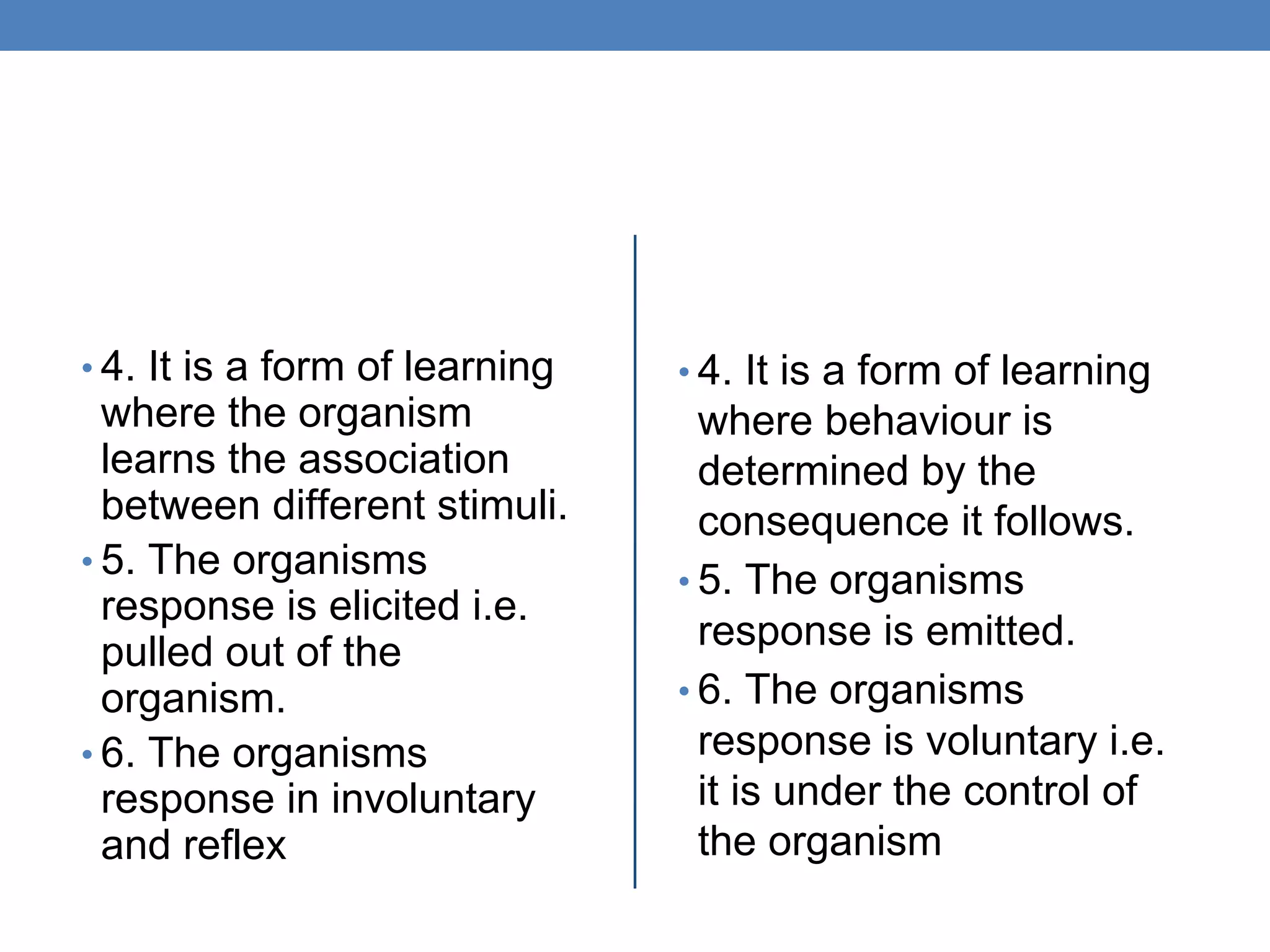
• 4. It is a form of learning
where the organism
learns the association
between different stimuli.
• 5. The organisms
response is elicited i.e.
pulled out of the
organism.
• 6. The organisms
response in involuntary
and reflex
• 4. It is a form of learning
where behaviour is
determined by the
consequence it follows.
• 5. The organisms
response is emitted.
• 6. The organisms
response is voluntary i.e.
it is under the control of
the organism
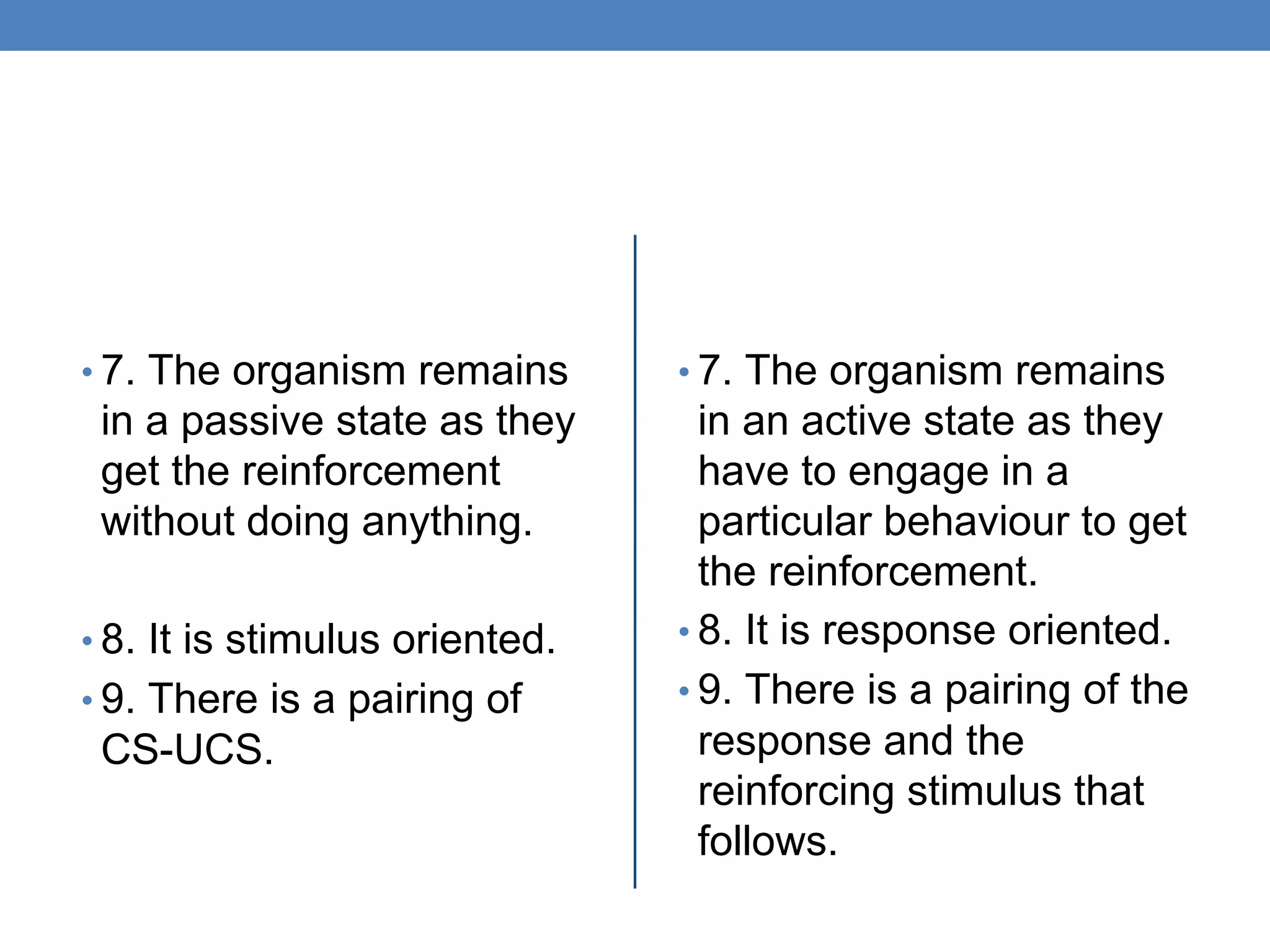
• 7. The organism remains
in a passive state as they
get the reinforcement
without doing anything.
• 8. It is stimulus oriented.
• 9. There is a pairing of
CS-UCS.
• 7. The organism remains
in an active state as they
have to engage in a
particular behaviour to get
the reinforcement.
• 8. It is response oriented.
• 9. There is a pairing of the
response and the
reinforcing stimulus that
follows.
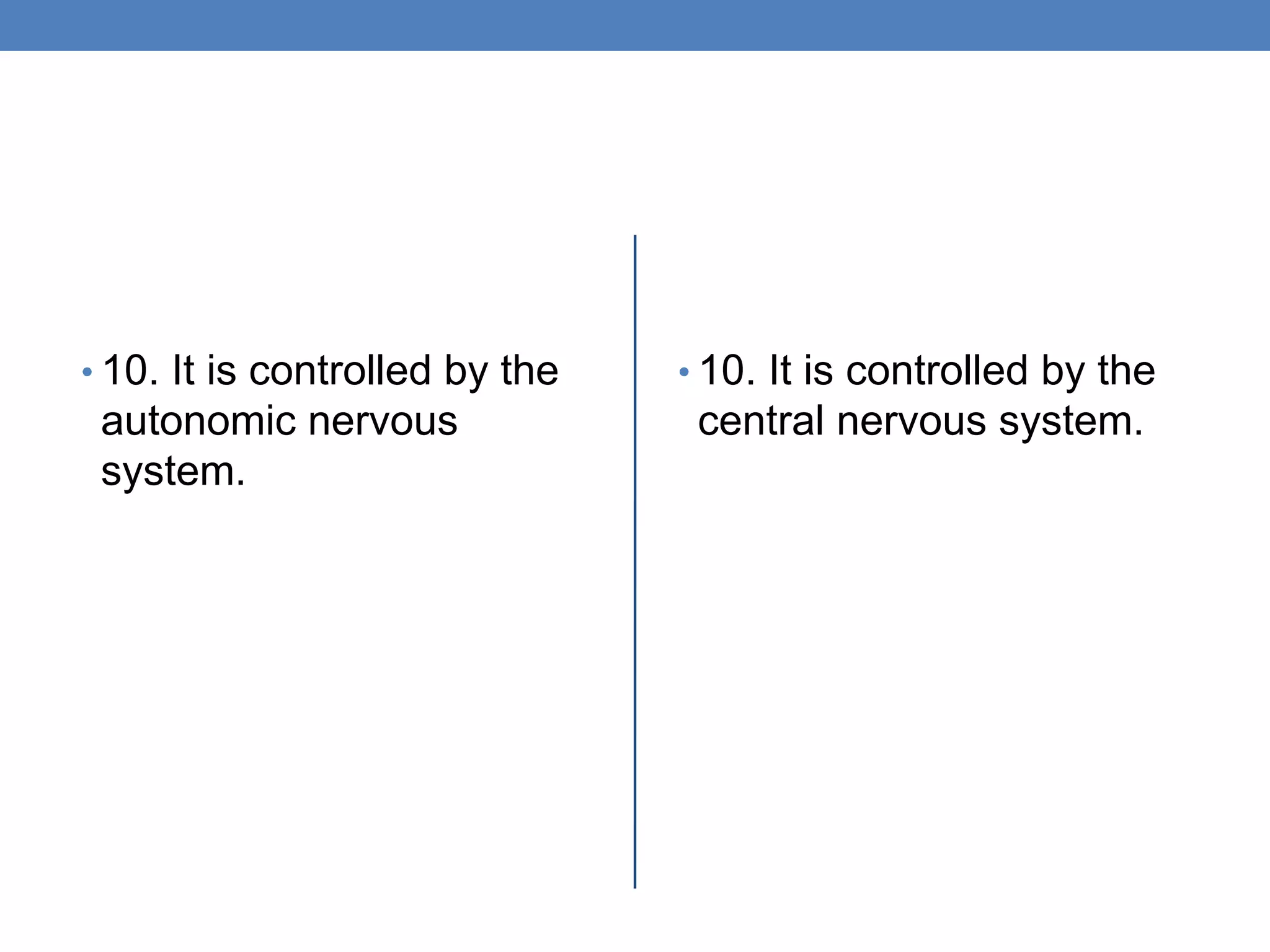
• 10. It is controlled by the
autonomic nervous
system.
• 10. It is controlled by the
central nervous system.
COGNITIVE LEARNING
• It refers to the processing of the information about the
environment that is received through our senses.
Cognitive processes involve: 1) the selection of
information 2) the making of alterations in the selected
information, 3) the association of items of information with
each other, 4) the elaboration of information in thought 5)
the storage of information in memory and when needed
and 6) the retrieval of stored information.
TYPES OF COGNITIVE
LEARNING
• 1. Latent learning: The word latent means hidden and
thus latent learning is learning that occurs but is not
evident in behaviour until later when the conditions for its
appearance are favourable. It is said to occur without
reinforcement of particular responses and seems to
involve changes in the way information is processed.
• 2. Insight Learning: In a typical insight solution, a problem
is posed, a period follows during which no apparent
progress is made, and then the solution comes suddenly.
A learning curve of insight learning would show no
evidence of learning for a time, then suddenly learning
would be almost complete. What has been learned can
also be applied easily to others, in other words there is a
great deal of generalization of insightful solutions to
similar problems. Human beings who solve a problem
insightfully experience a good feeling called an “aha
experience”.
• 1) Solutions come suddenly after a period during which
one tried various response strategies.
• 2) Perceptual rearrangement helped a great deal
• 3) Once we have the solution it can be generalized rather
easily to other similar problems.
How does insight leaning occurs?
• There is a perceptual reorganization of elements in the
environment such that new relationships among the
objects and events are suddenly seen,
OBSERVATIONAL LEARNING
• A form of learning which was proposed by Albert Bandura.
In observational learning the observer acquires
knowledge by observing the model’s behaviour, but
performance is influenced by model’s behaviour being
rewarded or punished. Bandura carried out an experiment
on BOBO DOLL which is an inflated balloon.
Steps in observational learning
• 1. Attention: The extent to which we focus on others
behaviour.
• 2) Retention: Our ability to retain a representation of
others behaviour in memory. An observer must also
retain, or remember, the behavior at a later time.
• 3) Production Processes- Our ability to act on these
memory representations. It depends on: a) one’s own
physical abilities and b) one’s capacity to monitor one’s
own performance and adjust it until it matches that of the
model.
• 4) Motivation: The usefulness to us of the information
acquired. The observer must be motivated to produce the
desired behavior.
• Bobo Doll Experiment-
• Bandura’s classic Bobo Doll experiment showed that
children would mimic violent behaviors, simply by
observing others.
• In the experiment, children were shown a video where a
model would act aggressively toward an inflatable doll –
hitting, punching, kicking, and verbally assaulting the doll.
There were three different endings:
• The model was punished for their behavior
• The model was rewarded for their behavior
• There were no consequences
• After watching the model, children were given a Bobo doll,
identical to that in the video. Their behaviors were
observed.
• Researchers found that children were more likely to mimic
violent behaviors when they observed the model receiving
a reward, or when no consequences occurred. On the flip
side – children that observed the model being punished
for violence showed less actual violence toward the doll.
• A child watches their mother eat dinner with a fork. They
observe the behavior and quickly learn how to use a fork
themselves.
INDIVIDUAL LEARNING
• It relates with leaning style.
• Learning style refers to the learners consistent way of
responding to and using stimuli in the context of learning.
In other ways ‘it is the way in which each learner begins to
concentrate, processes and retains new and complex
information’.
• Learning styles mainly derive from perceptual modality,
information processing and personality patterns
• 1. Perceptual Modality: They are biologically based
reactions to the physical environment. It refers to the
preferences of people through which they take in
information such as auditory, visual, smell, kinesthetic and
tactile.
• 2. Information Processing: It distinguishes between the
way we are structured to think, solve problems and
remember information. For example active/reflective,
sensing/intuition, serial/simultaneous , sequential/global
etc.
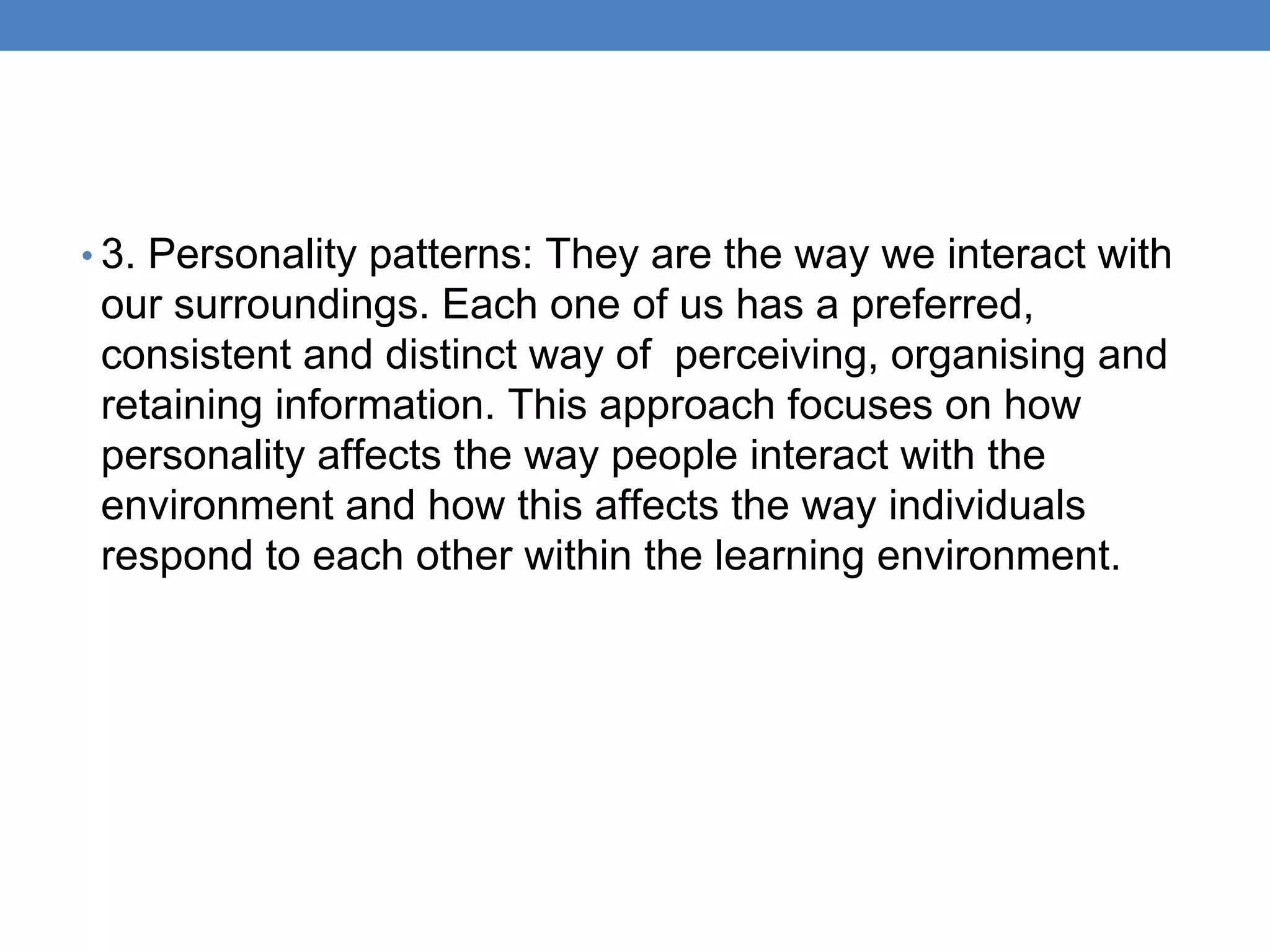
• 3. Personality patterns: They are the way we interact with
our surroundings. Each one of us has a preferred,
consistent and distinct way of perceiving, organising and
retaining information. This approach focuses on how
personality affects the way people interact with the
environment and how this affects the way individuals
respond to each other within the learning environment.
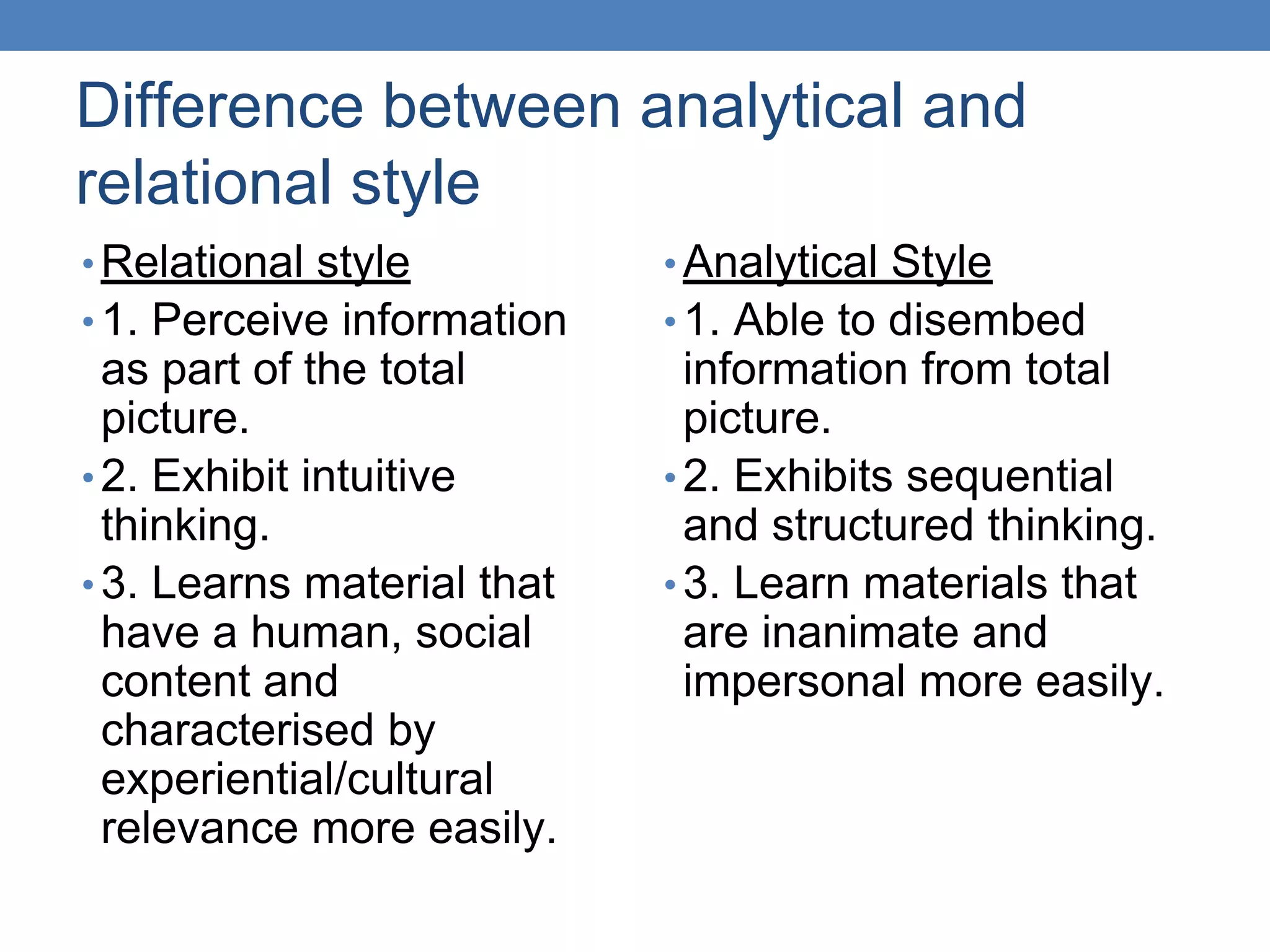
Difference between analytical and
relational style
• Relational style
• 1. Perceive information
as part of the total
picture.
• 2. Exhibit intuitive
thinking.
• 3. Learns material that
have a human, social
content and
characterised by
experiential/cultural
relevance more easily.
• Analytical Style
• 1. Able to disembed
information from total
picture.
• 2. Exhibits sequential
and structured thinking.
• 3. Learn materials that
are inanimate and
impersonal more easily.
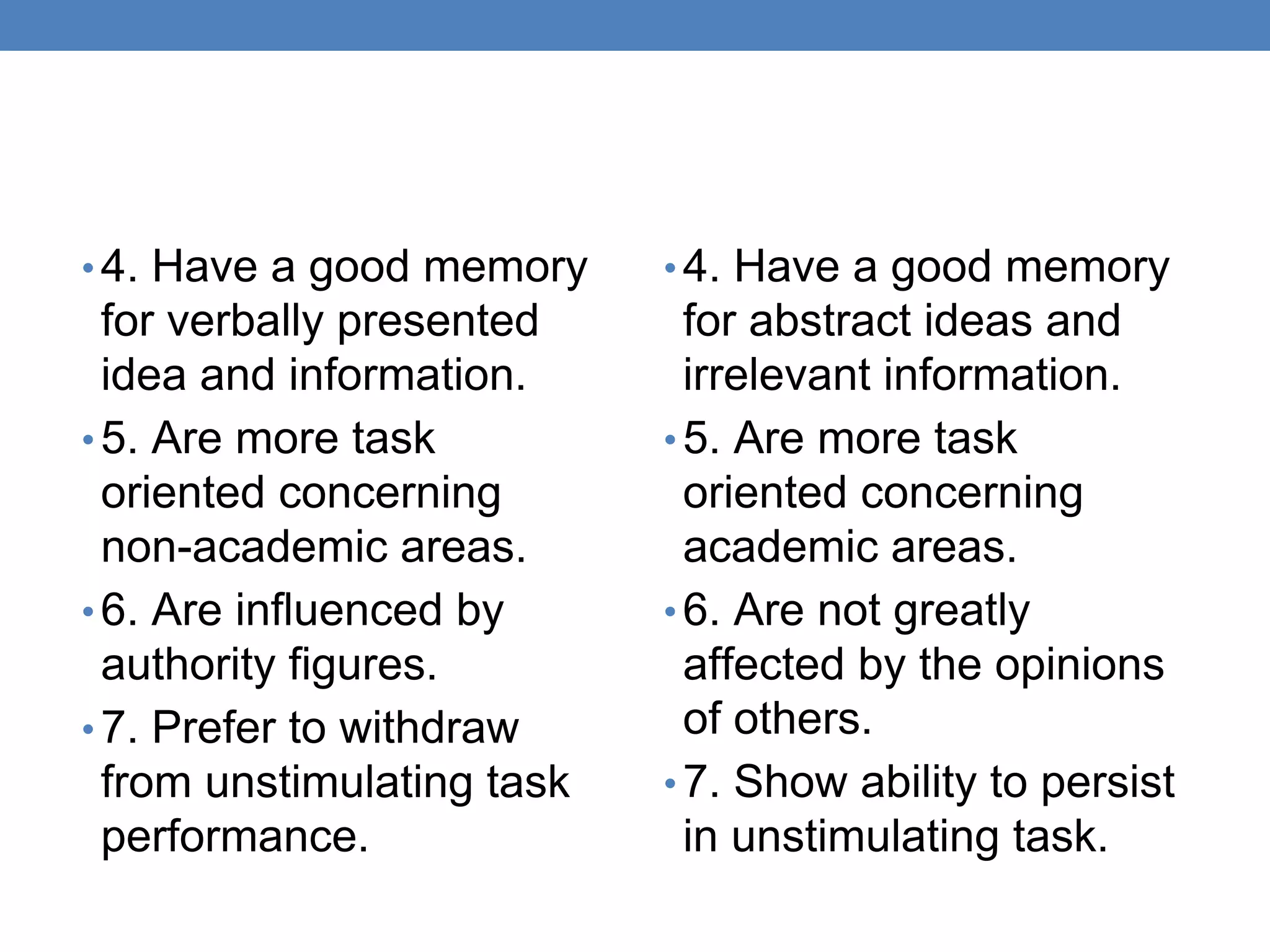
• 4. Have a good memory
for verbally presented
idea and information.
• 5. Are more task
oriented concerning
non-academic areas.
• 6. Are influenced by
authority figures.
• 7. Prefer to withdraw
from unstimulating task
performance.
• 4. Have a good memory
for abstract ideas and
irrelevant information.
• 5. Are more task
oriented concerning
academic areas.
• 6. Are not greatly
affected by the opinions
of others.
• 7. Show ability to persist
in unstimulating task.
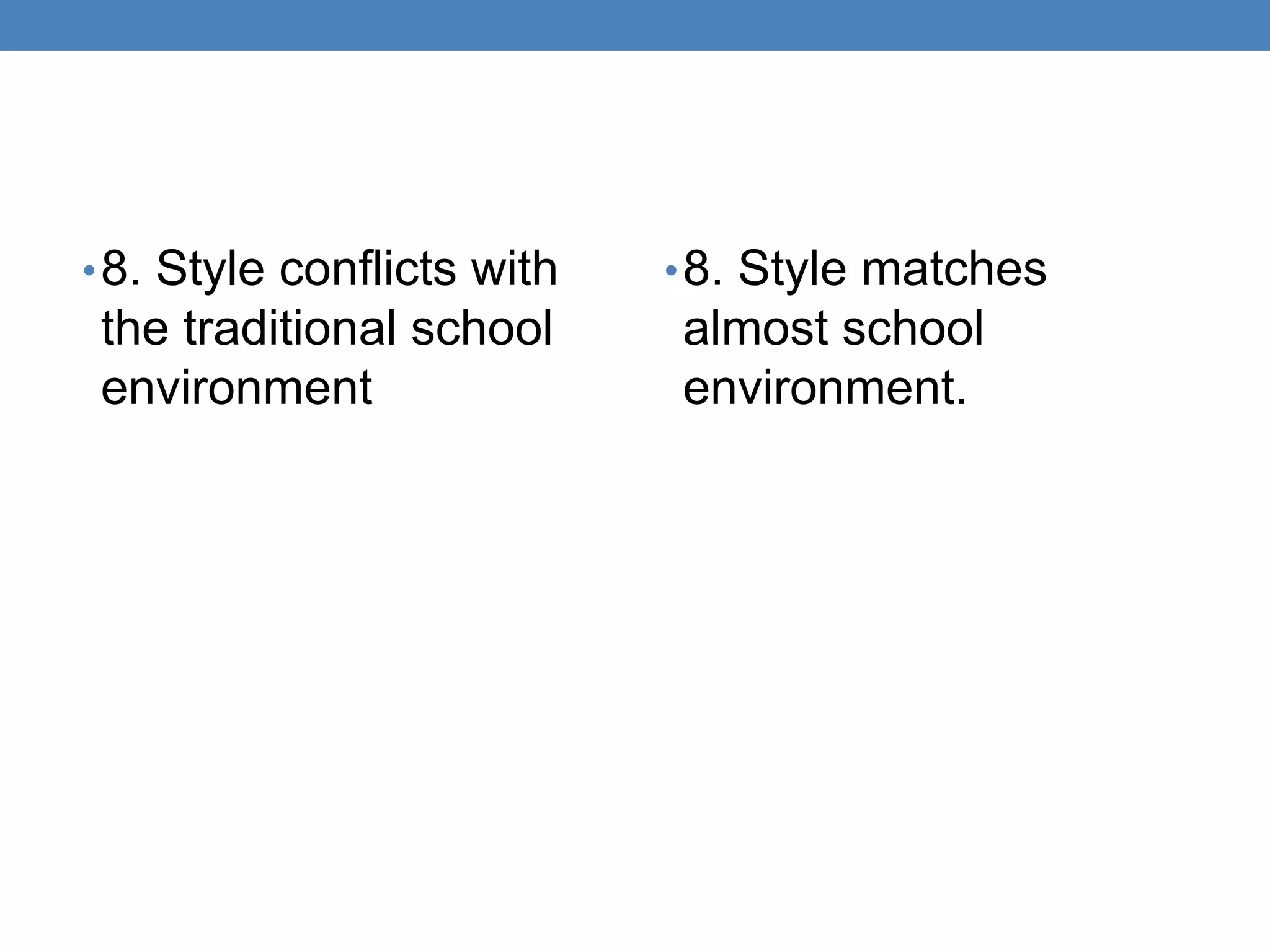
•8. Style conflicts with
the traditional school
environment
•8. Style matches
almost school
environment.
MEMORY
• Meaning: It refers to our cognitive system for storing and
retrieving information.
• The three basic tasks of memory is – a) Encoding- The
process through which information is converted into a form that
can be entered into memory. For example- if one wants to
remember an ice cream cone, he can encode it in the form of
an image.
• B) Storage- Information which was encoded must also be
stored so that it can be put to use later. The process through
information is retained in our memory.
• C) Retrieval- Information can be used only when one is able to
recover it from her/his memory. Retrieval refers to bringing the
stored information to her/his awareness so that it can be used
for performing various cognitive tasks such as problem solving
or decision-making. The process through which information
stored in memory is located.
MODELS OF MEMORY:
• 1. INFORMATION PROCESSING MODEL:
• This is proposed by Atkinson and Shriffin (1968).
According to this model human memory must accomplish
three tasks which are encoding, storage and retrieval.
They suggest that we have three distinct systems for
storing memory. They are sensory memory- A memory
system that retains representations of sensory input for
brief period of time.
• Short term memory- A memory system which holds
relatively small amount of information for a brief period of
time, usually 30 seconds or less. Most of the information
that gets into sensory memory is forgotten, but information
that we turn our attention to, with the goal of remembering
it, may pass into short-term memory.
• Long term memory- Another memory system for the
retention of large amount of information over long period
of time. It has been shown that once any information
enters the long-term memory store it is never forgotten
• A question that arises is how information move from one
memory system to another? The answer lies in the fact
that it involves active control processes that act as filters
determining which information will be retained.
• Information in sensory memory enters the short term
memory through the gateway of selective attention- our
ability to pay attention to only some aspects of the world
while largely ignoring others. In contrast information from
• Short term memory enters the long term memory through
elaborative rehearsal when we think about the meaning
and relate it to other information already stored in LTM.
Unless we engage in such cognitive effort information is
short term memory quickly fades away and is lost. Merely
repeating the information (maintenance rehearsal) does
not necessarily move information from STM to LTM.
Neural Network Model
• It was proposed by McClelland and Rumelhart.1981 who
suggests that it is the rich interconnectedness of our
neural units that accounts for our ability to process
information so quickly. It describes that parallel
(simultaneous) processing of information by numerous
neural modules in the brain each of these processing
units is dedicated to a specific task and all are
interconnected.
Levels of Processing Model
• This model was proposed by Craik and Lockhart,
1972.According to this model , incoming information can be
worked on at different levels of analysis, the deeper the
analysis the better the memory.
• The first level is simply perception which gives us immediate
awareness of our environment.
• At a somewhat deeper level, the structural features are
analysed and finally at the deepest level the meaning of the
input is analysed. Analysis to the deeper level of meaning
gives the best memory.
• The less we pay attention to information, and the less we think
about it, the less it is encoded.
• The more we manipulate the information, or attach an
emotional meaning to it, we encode it more.
• Rehearsal plays a role in the deeper processing of
information, according to this model maintenance
rehearsal is not enough for good memory.
• For depth to be reached the rehearsal must be
elaborative. Elaboration refers to the degree to which
incoming information is processed so that it can be tied to,
or integrated with existing memories. The greater the
degree of elaboration given to an item of incoming
information the more likely it is that it will be remembered.
SENSORY MEMORY
• A) Approximate Duration: For vision (iconic memory)
information is held upto 1 second, while for auditory
(echoic memory) information is held up to 5 seconds.
• B) Capacity : Relatively large-up to at least 16 items, but
probably much more.
• C) Transfer Process: Items attended to and recognized
move to short-term memory.
• D) The type of information stored is copy of the input.
• E) Major reason for information loss is decay of trace.
SHORT TERM MEMORY
• Information remains in short term memory for about 30
seconds, but it varies depending upon a number of
factors.
• The capacity of information stored is relatively small- upto
about 7 items or chunks (5 to 7 items).
• Information from sensory memory move to short term
memory through elaborative rehearsal.
• The type of information stored in short term memory are
sounds, visual images, words and sentences.
• Displacement of old information by incoming information
is one of the major cause of forgetting from STM.
What is the fate of information from
STM?
• Studies on retrieval of information from Short-term
memory show that we rapidly scan through short-term
memory when searching for an item of information. A
surprising feature of the scanning process is that we
examine everything in short-term memory when we are
trying to retrieve an item from it; the scanning process has
been found to be exhaustive. Instead of stopping when
the searched for item is located the scanning process
continues until all of the STM has been examined. Then, if
the item was found during the exhaustive scan it is
retrieved.
Long Term Memory
• It is the type of memory where information remains for
days, years , months and even lifetime.
• The capacity of the information that it holds is very large
and has no known limit.
• The type of information stored is primarily meaningful
sentences, life events and concepts; some images,
semantic and episodic memory.
• Forgetting from LTM take place due to faulty organization,
inappropriate retrieval cues, interference.
TYPES OF LTM
• Broadly speaking LTM is divided in two – Procedural or
non-declarative and declarative memory.
• Procedural- Memory system that retains information we
cannot readily express verbally-for example, information
necessary to perform skilled motor activities such as
riding a bike. It is also known as implicit memory.
• Priming- referring to the fact that having seen or heard a
stimulus will facilitate our recognition it on a later
occasion, even we are unaware of it is one of the
evidence for the existence of procedural memory.
• Declarative Memory is divided into – episodic and
semantic memory.
• Episodic memory are memory for factual information that
we acquired at a specific time, while semantic memory
refers to a memory system that stores general, abstract
knowledge about the world.
• Episodic memory is dated while semantic memory is not
dated.
• Episodic memory is not arranged in a logical hierarchy
and is there more susceptible to forgetting whereas
semantic memory have a logical organization and is
therefore more susceptible to forgetting
• Episodic memory may be incorporated in our network of
general knowledge about the world and thus become a
part of our semantic memory, we derive our knowledge
about the world from specific things that have happened
to us.
Factors Affecting Episodic Memory
• 1. Retrieval Cues: They are stimuli associated with
information stored in memory that can aid in its retrieval.
• 2. Context –dependent memory: It refers to the fact that
information entered into memory in one context or setting
is easier to recall in that context than in others.
• 3. State-dependent memory: It occurs when aspects of
our physical states serve as retrieval cues for information
stored in long term memory.
• 4. Encoding specificity principle: It is the principle stating
that retrieval of information is successful to the extent that
the retrieval cues match the cues the learner used during
the study phase.
Factors Affecting Semantic
Memory:
• 1. Concepts: It refers to a mental category for objects or
events that are similar to one another is certain ways.
• 2. Prototype: They are abstract, idealized representation
that captures an average or typical member of a category
of things. For instance, the prototype of professor in our
semantic memory represents all the professors one has
encountered and may suggest that they are average,
middle-aged, absent-minded, slightly rampled looking and
so on.
• 3. Exemplars: An example of a category of things that is
readily brought to mind. For example: when we read the
word fruit probably an apple or an orange come to mind.
ENCODING AND STORING IN LTM
• 1. Role of organization: One strategy in remembering
things well is to organize, or arrange the input so that it fits
into existing long-term memory categories and is grouped
in some logical manners or is arranged in some way that
makes sense. The organization encoding may be inherent
in the input itself or it may be applied by the individuals as
they learn and remember new things (subjective
organization).
The role of Imagery
• Experiments were conducted in which subjects learned a
list in which stimuli and responses of paired associates
varied in their image arousing capacities. C items evoked
concrete imagery (chair), while A or abstract items evoked
little imagery (honesty). The four types of paired
associates in the experiment are : C-C in which both
stimulus and response word evoke concrete imagery, C-A
where the stimulus word evoked concrete and the
response word evoked abstract imagery, A-C stimulus
word evoked abstract where response word evoked
concrete imagery and finally A-A where both stimulus and
response word evoked abstract imagery. Results are:
• C-C›C-A› A-C ›A-A
The Role of Constructive
Processes
• During encoding the to-be-remembered material is
modified. Certain details are accentuated, the material
may be simplified or it may be changed in many other
ways so that what is encoded and stored is far from the
literal copy of the input. Inference also play an important
role , we tend to remember what was inferred at the time
of encoding and storage. Sir Frederick Bartlett carried out
experiment.
Retrieval from LTM
• A) Retrieval Cues
• B) Reconstructive Processes in Retrieval: They are
modifications of already stored input. It is sometimes
called as confabulation in the case of people with memory
disorders who have stored very little and try to fill up these
gaps during retrieval. (Loftus & Palmer, 1974)
Forgetting
• Ebbinghaus carried out extensive work on forgetting
which refers to the apparent loss of information already
encoded and stored in Long Term Memory.
• CAUSES OF FORGETTING:
• A) Interference- A vast amount of experimental evidence
indicates that learning new things interferes with our
memory of what we learned earlier and prior learning
interferes with what we have learned later. The earlier is
known as retroactive inhibition while the later is known as
proactive inhibition.
• For interference to occur something potentially interfering
must occur between original and testing for memory.
Forgetting also occurs even if the researcher learns only a
single list or a single item. Such forgetting may be due to
sources outside the experimental setting which may be
difficult to identify. Thus. This theory is no longer assigned
the crucial role.
• B) Retrieval Inhibition: The inhibition of information is
memory we don’t try to remember produced by our
retrieval of other related information.
• C)Motivated Forgetting: According to this theory which
was proposed by Freud, we forget what we want to forget.
There is repression- the active elimination from
consciousness of experience we find threatening. This
view is criticised on the following grounds:
• i) Most evidences of repression drives from clinical cases
therefore the generalizability of the findings is limited.
• ii) Most therapists believe in the existence of repression
and its role in psychological disorders so the therapists
may act in ways that lead clients to report their repressed
memories even if they really do not have it.
• iii) As a result of exposure to media which focuses on
repression, person suffering from various psychological
disorders may begin to wonder if their problems stem from
such causes and perhaps conclude that they do- even if it
is not the case.
• Iv) Finally people often generate false memories.
• D) Forgetting due to trace decay: It is the earliest theory of
forgetting. The assumption here is that memory leads to
modification in the central nervous system which is akin to
physical changes in the brain called memory trace. When
these memory traces are not used for long time they
simply fade away and become unavailable.
• CRITICISMS: 1. If forgetting takes place due to trace
decay or disuse then people who go to sleep after
memorising should forget more compared to those who
remain awake, simply because there is no way in which
memory traces can be put to use during sleep.
• Results however show the opposite those remain awake
after memorising show greater forgetting than those who
sleep.
E) Forgetting due to retrieval failure: This view was
advanced by Tulving and his associates who carried out
several experiments to show that contents of memory may
become inaccessible either due to absence or
inappropriateness of retrieval cues that are available at the
time of recall. According to this forgetting may also occur
because at the time of recall either the retrieval cues are
absent or are inappropriate.
AMNESIA
• It is a profound memory deficit which stems from illness,
injury, drug abuse and other causes. It is of two types
retrograde amnesia and anterograde amnesia. In the
retrograde amnesia there is a loss of memory events
which occurred prior to an amnesia-inducing event. While
anterograde amnesia refers to the inability to store in the
long term memory information that occurs after an
amnesia- inducing event.
CLASSIFICATION OF AMNESIA
• Psychological amnesia:
• 1) Childhood Amnesia: Sigmund Freud used the term
“repression” to account for childhood amnesia. He said
that we are unable to recall childhood memories because
they are associated with forbidden, guilt-arousing, sexual
and aggressive urges he thought characterizes early
childhood.
• Another interpretation is that the way young children and
older people encode information is different.
• During childhood the brain is maturing and they are not
able to store the information in LTM unless the maturation
is finished
• 2. Dream Amnesia: Freud considered dreams to be
expressions of forbidden sexual or aggressive urges.
They can produce strong feelings of guilt of we become
aware of them, hence they are repressed.
• Secondly, there is a difference in the symbol system
between awaking and dreaming.
• Thirdly, we known in state dependent memory that
information stored in one state is difficult to retrieve in the
other state.
• 3. DEFENSIVE AMNESIA: People with this form of
amnesia may forget their names, where they have come
from, who their spouses are and many important details
from their early lives. It is called defensive because it
protects oneself from guilt and anxiety that can result from
intense, intolerable life situations and conflicts. These
amnesic episodes can last for days, years, months, weeks
BIOLOGICAL AMNESIA:
• They result from blows on the head
• Temporary disturbance in the brain’s blood supply
• Certain Drugs
• Brain diseases
• 1. Transient Global Amnesia: It is a profound memory
problem with no loss of consciousness.
• It comes on suddenly, lasts for a few hours or days and
becomes normal again
• It occurs only ones
• It is called as global because so much of what is already
stored in memory is forgotten and because even when the
victim is aware they are not able to form new memories.
• Both retrograde and anterograde amnesia is there
• The cause is not yet known but it may be due to
temporary alterations in the blood flow to the brain.
• 2.Marijuana, alcohol and Amnesia: Marijuana can hardly be
said to result in amnesia.
• Alcohol induced amnesia may be an example of state
dependent memory. Again the encoding and storage process
gets disrupted during the period of heavy drinking.
• Korsakoff’s Sndrome: An illness caused by long-term abuse of
alcohol, which often involves profound retrograde amnesia.
The symptoms include sensory and motor problems as well as
heart, lever, and gastrointestinal disorder. In addition the
syndrome is often accompanied by anterograde amnesia and
severe retrograde amnesia. Careful medical examinations
have shown that there is s damage to the thalamus and
hypothalamus.
• 3. Diseases of the Brain: It includes amnesia which results
syphilis of the brain, and other brain infections, strokes
and other permanent disorders of brain blood flow, brain
tumours, disorders of brain metabolism, multiple sclerosis,
various conditions caused by toxic chemicals, senile
dementia and primary degenerative dementia.
• Senile dementia is characterized by deficits in many
intellectual abilities-memory, attention, judgement and
abstract thought. Personality changes-the person
becomes excessive dependence and irritability. Delusions
and general disorientations- not knowing the time and
place.
• This amnesia is first anterograde,
• It results from the reduction of blood flow to the brain.
• Patients also have brain arteriosclerosis- narrowing of the
small arteries of the brain due to fatty accumulation in the
brain. They deprive brain cells of adequate supplies of
oxygen and nutrients so that some cells die and others
malfunction.
Primary Degenerative Dementia
• Under this there is Alzheimer’s Disease which stars at age
65 and begins with mild problems such as increases
difficulty in remembering names, phone number, or
appointments. Gradually though patients condition worsen
until they become totally confused are unable to perform
even simple tasks like dressing, grooming themselves and
experience total loss of memory. In the later stages they
even fail to recognize their children and spouse.
• Working memory. Semantic memory. Episodic memory ,
memory for skills and auto biographical memory are all
distubed
• Brains of Alzheimer patients reveal that they contain
tangles of amyloid beta proteins , a substance not found
in normal brains. Research evidence suggests that this
substance cause damage to the neurons that project from
nuclei in the basal forebrain to the hippocampus and
cerebral cortex.
• Their brains also contains lower than normal levels of
acetylcholine
MEMORY IMPROVING TECHNIQUES
• They are called as mnemonics which comes from the
Greek words “memory” and refers to memory
improvement techniques. Most mnemonics rely on the
linking or association of the to-be-remembered material
with a systematic and organised set of images or words
that are firmly established in LTM and can therefore serve
as reminder cues. Some of these techniques are:
• A) METHOD OF LOCI
• B) NUMBER AND LETTER PEG SYSTEM
• C) STORIES YOU TELL YOURSELF
• D) REMEMBERING NAMES AND FACES
• E) CHUNKING
METHOD OF LOCI
• The term loci means places; the memory pegs in this system
are parts of the image of a scene.
• Example : Suppose in a government course, one is asked to
describe in chronological manner, five landmark cases, dealing
with freedom of press. Using the method of loci , a person can
start by imagining a building with a number of rooms and
several items of furniture in each room. Then this image can
be rehearsed over and over again until it is well established in
one’s mind. After the image has been formed one can
associate the events one wishes to remember with the rooms
and items of furniture.
• For instance, if you are trying to memorize a recipe for banana
bread, you might imagine placing bananas on the couch, sugar
next to the lamp, milk on the piano bench, and so on. Then, in
your mind, you'll go back around the room and pick up the
bananas, sugar, and milk in the order you placed them.
Number and letter Peg System
• The main idea of these systems is to establish in our long term
memory, a well organised set of images to which the
to-be-remembered items can be linked. In numbers system we
form an image for each number.
• For example: 1 is bun, 2 is shoes, 3 is tree, 4 is door and five –
hive, six- sticks, seven – heaven, eight - bait (for fishing), nine-
wine, ten – pen and so on. Letter system are similar. We can
establish memory pegs by forming strong, distinctive images of
words that starts with the sounds of the letters of the alphabet.
• A — Alligator starts with A
• B — Bear starts with B
• C — Cow starts with C
• D — Duck starts with D
Stories you tell yourself
• If we have a list of unrelated words, a useful mnemonic
technique is to relate the items in a made up story. The
story will start with the first item in the list and in the order
each succeeding item is worked in. It is a form of
elaborative encoding.
Remembering Names and Faces:
• It is socially important of associating names with faces.
There are various steps in doing so:
• 1. First one should be sure that he/she has heard the
name properly when introduced.
• 2. Repeat the name when acknowledging the introduction.
• 3. If the name is unusual politely we can ask our
acquaintance to spell it.
• 4. when we are getting introduced we must also pay
attention to the individual’s face, the shape and size of the
head and other individual characteristics like hair,
forehead, eyebrows, eyelashes, eyes, cheekbones, nose,
ears. Lips, chin and skin should all be the focal point of
attention. Voice quality is also important.
CHUNKING:
• Chunk refers to a discrete series of information. Suppose
we have to remember the number 19141609001, here the
number can be broken into chunks. For instance, 1914-
the first four numbers may remind us about an important
date in the history. The next numbers can also be
chunked as a date, while the last numbers form a chunk
that is easy to remember by itself.
TIP OF THE TONGUE PHENOMENON
• The tip of the tongue phenomenon is an evidence for the role of
organization in long term memory. Suppose we are trying to
recall/retrieve a person’s name but we cannot remember it, the
name is on the tip of the tongue but we just cannot recall it. One way
to study the organization of information in LTM is to see what
happens when we search through our library of experience to
retrieve a memory. However, it is important to note that the memory
store in TOT state is not random.
• a state in which one cannot quite recall a familiar word but can
recall words of similar form and meaning
• Ex: Two women are discussing a particular new cream that is
believed to have amazing benefits. One of them has recently
purchased it, and is telling her friend to try it too. However, try as she
might, she cannot recall the name of this wondrous new cream,
though she can remember that it starts with an L. She knows the
benefits, she recalls how it feels and smells, she remembers what
letter is starts with, but cannot retrieve the name of the cream from
her memory.
EXAMPLE:
• If we are looking for the name “Martin” we may come up
with words like Morton and Mertin, but not Potzerbe.
Brown and McNeil brought up this phenomenon when the
subjects were in the TOT state and are not able to hit the
“target word”, they tended to retrieve words from their
LTM- a) sounded like the target word
• b) started with the same letter like the target word.
• C) Contained the same number of syllables and
• D) Had a meaning similar to the target word.
COGNITIVE ECONOMY:
• The maximum and efficient use of the capacity of long term
memory with minimum redundancy is known as cognitive
economy.
• DUAL CODING HYPOTHESIS: This hypothesis was
proposed by Paivio. According to this hypothesis concrete
nouns and information related to concrete nouns are encoded
and stored in the form of an images while information related
to the abstract concepts assume a verbal and descriptive
code. For example: If you are asked to describe a bird , the
first thing that happens is an image, but on the other hand
concepts like ‘truth’ or ‘honesty’ will not have such
accompanying images. So, any information that is encoded
verbally as well as in the form of an image is recalled with
greater ease.
WORKING MEMORY
• A memory system that holds information we are
processing at the moment formerly called as short term
memory. STM refers to the temporary storage of
information, in contrast working memory involves both
storage capacity and the capacity to transform information
held in the memory system. In a sense working memory is
the workbench of consciousess.
Research on working memory
• The existence of working memory comes from the
phenomenon of serial position effect. Where the words
which are in the begininng (primacy effect) and towards
the end (recency effect) are better recalled than the words
which are in the middle.
• Reason for this is that the words which are in the
beginning is already present in the long term memory
whereas the word towards the end of the list are present
in the working memory. However, the words which are
there in the middle are neither present in the Long term
memory nor in the working memory.
MULTIPLE COMPONENT MODEL:
• The multiple component model was proposed by
Baddeley (1992). According to this model, working
memory has three parts (a) phonological loop- that
process information relating to sounds of words (b) visuo
spatial sketch pad- that processes information relating to
visual and spatial information and (c) central executive-
that supervises and coordinates the other two
components.
• The existence of central executive can be supported by
the existence of concurrent task paradigm- in which
participants work on two tasks at the same time: a primary
task such as adding digits and at the same time a
distracting second task. The reasoning is that more similar
the distracting task is to the primary task the more it will
disrupt the planning and control functions of the central
executive.
• Another evidence is that people who suffer from extensive
injury to the frontal lobe suffers from dysexecutive
syndrome, are unable to make decisions, they also show
a tendency towards perseveration-they continue to pursue
an initial goal instead of switching to other goals ones the
initial goal is met.

Learning.pdf

  • 1.
  • 2.
    Meaning • The termlearning refers to a relatively permanent change in behaviour which occurs due to practice or experience and not due to growth or maturation. Some aspects of the definition seems noteworthy to mention: • A) Firstly, for learning to take place the change has to be relatively permanent, exactly how long cannot be specified but it should last for days, years, months and so on. However, temporary change in behaviour which occurs due to fatigue or drugs cannot be considered as learning.
  • 3.
    • B) Secondly,the change in behaviour which occurs due to learning is due to practice or experience and not due to growth or maturation. This aspect of the definition differentiates learning from innately controlled species typical behaviour. • C) Thirdly, learning leads to a change in relatively permanent change in behaviour which can be for better or worse.
  • 4.
    • D) Learningcan be inferred from performance. • E) Learning takes place through direct experience and vicarious learning. We learn by observing the elements in the environment and by directly participating in them.
  • 5.
    CLASSICAL CONDITIONING • Aform of learning which was proposed by Ivan P Pavlov. • It is known as type-I learning, Pavlovian conditioning, S-S learning as the organism learns the association between different stimuli. • It is also known as respondent conditioning as the organism responds to some specific stimuli in the environment.
  • 6.
    • Classical conditioningis a basic form of learning in which one stimulus comes to serve as signal for the occurrence of another stimulus. During classical conditioning organisms acquire information about relations between various stimuli and not simple association between them.
  • 7.
    Concepts of ClassicalConditioning • A) Unconditioned Stimulus- It is a natural stimulus that will automatically elicit a response. Example – Food. • B) Conditioned Stimulus- It is a neutral stimulus that is paired with UCS, if not paired it will not elicit any response. Example- Bell
  • 8.
    • C) UnconditionedResponse: It is a response which is made to the UCS. Example- Salivation at the sight of the food. • D) Conditioned Response: It is a response which is made to the CS. Example- Salivation to the sound of the bell.
  • 9.
    SOME BASIC PRINCIPLESOF CLASSICAL CONDITIONING Acquisition: It is a process where the CS acquires the ability to elicit a CR when CS-UCS presentations are made in a consistent and repeated manner. There is a limit to acquisition, after a number of CS-UCS presentations it gradually slows down and finally levels off.
  • 10.
    FACTORS AFFECTING ACQUISITION •A) Temporal contiguity or time relations between stimuli: • Temporal arrangements are- Forward conditioning, Simultaneous conditioning and backward conditioning. • i) FORWARD CONDITIONING: Under this there are trace and delay conditioning. In trace conditioning the CS precedes UCS but with a reasonable time gap. • In delay conditioning the onset of UCS starts when the CS is still present. This is the most effective method of conditioning.
  • 11.
    • ii) Insimultaneous conditioning the CS and UCS begins and ends at the same time. • iii) . In backward conditioning the UCS precedes CS and is the least effective method of conditioning. • B) Intensity: For conditioning to occur at a faster rate the intensity of the CS and UCS should increase. The CS should stand against the background stimuli.
  • 12.
    • C) Thetime interval between CS-UCS presentations should be between 0.2 to 2 seconds. • D) The stimulus i.e., CS and UCS should be novel and surprising. Thus, familiarity can greatly affect conditioning.
  • 13.
    EXTINCTION • The processthrough which a conditioned stimulus gradually looses the ability to evoke conditioned responses when it is no longer followed by the unconditioned stimulus is known as extinction. For example if the bell is not followed by food after a few trials the dog will stop salivating to the sound of the bell. However, it is important to note that extinction is not a smooth process.
  • 14.
    • RECONDITIONING: Itrefers to the quick reappearance of CR when CS-UCS presentation is made again following extinction. • SPONTANEOUS RECOVERY: Reappearance of a weakened CR to a CS after an interval of time following extinction.
  • 15.
    • STIMULUS GENERALIZATION:The tendency of stimuli similar to a conditioned stimulus to evoke a conditioned responses. For example the dog who has learnt to salivate at the sound of the bell will also salivate to the buzzer. • STIMULUS DISCRIMINATION: The process by which organisms learn to respond to certain stimuli but not to others is known as stimulus discrimination.
  • 16.
    BIOLOGICAL CONSTRAINTS IN LEARNING •Tendencies of some species to acquire some forms of conditioning less readily than other species do is known as biological constraints in learning. This concept was proposed by Shettleworth.
  • 17.
    CONDITIONED TASTE AVERSION • Atype of conditioning in which the UCS (usually internal cues associated with nausea or vomiting) occurs several hours after the CS (often a novel food) and leads to a strong CS-UCS association in a single trail. This type of conditioning is also known as one trial learning and is highly resistant to extinction. For example cancer patients may develop an aversion towards the food (usually a new food) consumed hours before the chemotherapy session.
  • 18.
    CLASSICAL CONDITIONING A COGNITIVEPERSPECTIVE • 1) Expectation: The fact that expectation play an important role in classical conditioning is a thesis proposed by Rescorla and Wagner, 1972. They hold that expectations occur when CS-UCS presentations are made in a repeated and consistent manner, the fact that if CS has occurred UCS will occur soon. However, expectation gets distorted when CS-UCS presentations are made in a random manner. • 2) Blocking: The fact that conditioning to one stimulus may be prevented by previous conditioning to another stimulus.
  • 19.
    • 3) Mentalimagery also play an important role in classical conditioning. Research shows the following: • a) Cognitive processes underlying the generation, manipulation, and scanning of mental images closely mirror the processes involved in perceiving the actual physical stimuli (Kosslyn,1994). • b) Studies using brain imaging techniques also indicate that the areas of the brain known to be involved in visual processing is also active during visual imagery tasks (Farah, 1988).
  • 20.
    • To sumup we can say that active comparison processes and memory also play an important role in classical conditioning and it do not only include mere association between different stimuli
  • 21.
    THEORIES OF CLASSICAL CONDITIONING •Stimulus Substitution theory: This theory was originated by Pavlov and relies upon the idea that the CS simply as a result of pairing with UCS acquires the capacity to substitute for the US in evoking a response. Pavlov thought that this association took place in the brain. He thought that the CS and UCS activates two areas of the brain, and that activation of the UCS area resulted in reflex and automatic response. As a result of the CS-UCS pairing the CS acquired the ability to excite the UCS area thus leading to a reflex response. The theory faces the limitation that it considers the fact that CR should be the same or at least very similar to the UCR. For example, when using a mild foot shock as the UCS and a tone as the CS, the UCR of rats to the shock is an increase in running and activity, but the CR to the tone is decrease in activity- a response known as freezing.
  • 22.
    • Information andExpectation: Other theories take the viewpoint that CS becomes a signal for UCS. Thus, when the CS is presented the UCS is expected and the learner responds in accordance to the expectation. A question arises that how the CS act as signal for the occurrence for the UCS? Experiments have shown that the UCS is a surprising or novel event. The surprising UCS induces the learner to look back through the recent memory. The CS is the event consistently found in memory on each trail before the UCS. An association or link is thus formed between the CS and UCS. Now when the CS is presented the UCS is expected. Therefore an association or link is thus said to be formed between the memory trace of CS and UCS.
  • 23.
    OPERANT CONDITIONING • Itis a form of learning which was proposed by B.F Skinner and is based upon the assumption that behaviour is determined by the consequence it follows. • If a particular behaviour is followed by reward it gets strengthened while if another behaviour leads to punishment it gets weakened. It is known as operant conditioning because the organisms operate on a specific environment to produce an outcome. This is also known as instrumental conditioning as the behaviour of the organism is helpful in getting the reward.
  • 24.
    CONCEPT OF REINFORCEMENT ANDPUNISHMENT • Reinforcement refers to the application or removal of a stimulus to increase the strength of a specific behaviour. There are two types of reinforcement- Positive and Negative. • Positive reinforcement- a) Application of a desirable stimulus (e.g. food, praise, sexual pleasure). The addition of a reward. • b) Strengthens responses that precede occurrence of stimulus. • c) Organisms learn to perform responses that lead to positive outcome • For eg., If you do a good job at work and your manager gives you a bonus, that bonus is a positive reinforcer.
  • 25.
    Negative Reinforcement • A)Application of an undesirable (aversive) stimulus • the removal of a punishment • B) Strengthens responses that permit escape from or avoidance of stimulus. • C) Organisms learn to perform responses that permit them to avoid or escape from negative reinforcers. • For example, if you do not complete your homework, you give your teacher £5. You will complete your homework to avoid paying £5, thus strengthening the behavior of completing your homework.
  • 26.
    Premark Principle • Amore preferred activity is used to reinforce a least preferred activity. For example: a father may say that if you complete your homework (least preferred activity) you will be allowed to go to the party.
  • 27.
    PUNISHMENT AND ITSTYPES • Punishment refers to the procedure by which the application or removal of a stimulus decreases the strength of a behaviour. It is two types- Positive and negative punishment.
  • 28.
    POSITIVE PUNISHMENT • i)Application of an undesirable stimulus. • The addition of a punishment. • ii) Weakens response that precede occurrence of stimulus. • iii) Organisms learn to supress responses that lead to unpleasant consequences. • A Teacher Scolding A Student Publicly For Repeating Mistakes. It’s A Positive Punishment For Coming Late To Class Repeatedly Or Being Too Talkative.
  • 29.
    NEGATIVE PUNISHMENT • i)There is a loss or postponement of a desirable stimulus. • the removal of a reward • ii) Weakens responses that lead to loss or postponement of stimulus. • iii) Organisms learn to suppress responses that lead to loss or postponement of desired stimulus. • iv) It is also commonly known as “time-out”. • Taking away a child's video game following misbehavior is an example of negative punishment.
  • 30.
    WHEN DOES PUNISHMENT WORKS? •A) The more intense the punishment is the more effective it is, however mild punishment often suppresses a behaviour often temporarily. But intense punishment has a limitation that it can lead to conditioned fear towards the punisher and if the punishers are parents the situation becomes worse. • B) The more consistently punishment is administered , even if mild the more effective it will be. • C) The closer the punishment is in time and place to the behaviour being punished the more effective it will be.
  • 31.
    • D) Punishmenteven when it is mild can be quite effective if it is used to suppress one behaviour while at the same time is used to make another behaviour more likely to occur.
  • 32.
    SCHEDULE OF REINFORCEMENT • Theyare rules determining when and how reinforcements are to be delivered. It is usually divided into – Continuous and partial or intermittent reinforcement schedule. • In a continuous schedule of reinforcement every correct response leads to a reinforcement. Such kind of a reinforcement leads to the strengthening of new behaviour.
  • 33.
    Partial or IntermittentSchedule • A) Fixed Interval Schedule: Here reinforcements are provided after a specific amount of time has elapsed. For example: When placed in such a schedule of reinforcement an individual’s response or effort increases when the time for the reinforcement approaches but there effort soon goes down after that again when the time for the next reinforcement approaches again the effort increases.
  • 34.
    • B) VariableInterval Schedule: Here, the organism gets the reinforcement after variable amount of time has elapsed. In such a schedule there is a consistent performance. • C) Fixed Ratio Schedule: Here, the organisms gets the reinforcement after a specific number of correct responses has elapsed. Such schedule of reinforcement leads to a high rate of response although there is a tendency towards a brief pause like that of fixed interval schedule.
  • 35.
    • D) VariableRatio Schedule: In this type reinforcement is provided after a variable number of correct responses have elapsed. It leads to high and steady responses and is highly resistant to extinction. • Concurrent Schedule of Reinforcement: In this type of reinforcement schedule two or more behaviours having their own reinforcement schedule of reinforcement is simultaneously available. Then there is matching law, the organisms will distribute its behaviour between alternatives in such a way as to maximise the reinforcement it receives for its effort. It is known as matching law (Hernstein,1961).
  • 36.
    SHAPING AND CHAINING •A technique in which closer and closer approximations to desired behaviour are required for the delivery of positive reinforcement. The organism undergoing shaping receives a reward for every small step towards a final goal-the target response-rather than only the final response. At first, actions remotely resembling the target behaviour –termed successive approximations are reinforced. Gradually closer and closer approximations of the final target behaviour are required before the reward is given.
  • 37.
    • However, forcomplex activities the process of chaining is used which refers to a procedure that establishes a sequence of responses, which leads to a reward following the final response in the chain. However, shaping and chaining cannot be used to virtually shape any type of behaviour there is Instinctive Drift- a tendency to return to the type of behaviour one would show under normal conditions.
  • 38.
    OPERANT CONDITIONING: A COGNITIVEPERSPECTIVE Learned helplessness, a concept proposed by Seligman which refers to the feelings of helplessness that develop after exposure to situations in which no effort succeeds in affecting outcomes. Research has shown that its onset partly stems from our perception of control; when we begin to believe that we have no control over our environment or our lives we stop trying to improve our situation. One reason for such learned helplessness is hypohedonia which refers to a genetically inherit impairment in the ability to experience pleasure. (Meehl, 1975)
  • 39.
    CONTRAST EFFECT • Ourbehaviour is not only influenced by the level of rewards we receive but by out evaluation of rewards relative to our experience with previous rewards. There are positive contrast effect where the group of rats whose level of rewards were suddenly increased performed better than the group of rats who constantly received higher reward and vive versa. Both positive and negative contrast effects are transient. Thus, the elevated or depressed performance slowly give way to performance levels similar to those of control animals that receive only the consistent level of reward.
  • 40.
    TOLMAN’S COGNITIVE MAP •Edward Tolman did not agree with the concept of reinforcement , rather he proposed that the rats have acquired the cognitive map, which refers to the spatial representation of the map. • Applied Behaviour Analysis- It is a field of psychology where the operant conditioning principles are used to solve the problems of our everyday life.
  • 41.
    EXTINCTION OF POSITIVELY REINFORCEDSTIMULI • The procedure of not reinforcing a particular behaviour is known as extinction. For example- In classical conditioning if the bell is not followed by food then the dog’s salivation response will get extinguished. In operant conditioning if the rats behaviour of pressing the lever if not reinforced the rat will stop pressing the lever.
  • 42.
    CONDITIONED POSITIVE REINFORCERS • Somepositive reinforcers like food, water works for the first time they are presented, they are known as primary reinforcers while on the other hand there are reinforcers which do not work naturally, for them to be effective the learner must have experience with them, their ability to reinforce instrumental responses depends upon learning. Such learned responses are known as secondary reinforcers. Stimuli become conditioned reinforcers in instrumental conditioning by being paired with primary reinforcers.
  • 43.
    • EXAMPLE: Supposea click occurs each time a food pellet is presented in the operant chamber. The click becomes the conditioned reinforcer. At first the click has no reinforcing properties, but its presence every time the primary reinforcer is delivered becomes a reinforcer in its own right. • Conditioned reinforcers being learned themselves undergo extinction if they are paired occassionally with a primary reinforcer. In our everyday life conditioned reinforcers have an important role to play.
  • 44.
    ESCAPE AND AVOIDANCE LEARNING •Escape learning is an example of instrumental learning based on negative reinforcement. • In avoidance learning, the learned response is made before the onset of the noxious stimulus and thus prevents the learner from being exposed to the noxious event. In can be explained in terms of species-typical defence reactions and safety signals. Extinction of avoidance learning is quite slow.
  • 45.
    Difference between Classicaland Operant Conditioning Classical Conditioning • 1. It was proposed by Ivan P. Pavlov. • 2. It is also known as type-1 learning, S-S conditioning. • 3. It is known as respondent conditioning as the organism responds to some specific stimuli in the environment. Operant Conditioning • 1. It was proposed by B.F. Skinner. • 2. It is also known as type-II learning, S-R conditioning. • 3. It is known as operant conditioning because the organism operates in an environment to produce an outcome.
  • 46.
    • 4. Itis a form of learning where the organism learns the association between different stimuli. • 5. The organisms response is elicited i.e. pulled out of the organism. • 6. The organisms response in involuntary and reflex • 4. It is a form of learning where behaviour is determined by the consequence it follows. • 5. The organisms response is emitted. • 6. The organisms response is voluntary i.e. it is under the control of the organism
  • 47.
    • 7. Theorganism remains in a passive state as they get the reinforcement without doing anything. • 8. It is stimulus oriented. • 9. There is a pairing of CS-UCS. • 7. The organism remains in an active state as they have to engage in a particular behaviour to get the reinforcement. • 8. It is response oriented. • 9. There is a pairing of the response and the reinforcing stimulus that follows.
  • 48.
    • 10. Itis controlled by the autonomic nervous system. • 10. It is controlled by the central nervous system.
  • 49.
    COGNITIVE LEARNING • Itrefers to the processing of the information about the environment that is received through our senses. Cognitive processes involve: 1) the selection of information 2) the making of alterations in the selected information, 3) the association of items of information with each other, 4) the elaboration of information in thought 5) the storage of information in memory and when needed and 6) the retrieval of stored information.
  • 50.
    TYPES OF COGNITIVE LEARNING •1. Latent learning: The word latent means hidden and thus latent learning is learning that occurs but is not evident in behaviour until later when the conditions for its appearance are favourable. It is said to occur without reinforcement of particular responses and seems to involve changes in the way information is processed.
  • 51.
    • 2. InsightLearning: In a typical insight solution, a problem is posed, a period follows during which no apparent progress is made, and then the solution comes suddenly. A learning curve of insight learning would show no evidence of learning for a time, then suddenly learning would be almost complete. What has been learned can also be applied easily to others, in other words there is a great deal of generalization of insightful solutions to similar problems. Human beings who solve a problem insightfully experience a good feeling called an “aha experience”.
  • 52.
    • 1) Solutionscome suddenly after a period during which one tried various response strategies. • 2) Perceptual rearrangement helped a great deal • 3) Once we have the solution it can be generalized rather easily to other similar problems.
  • 53.
    How does insightleaning occurs? • There is a perceptual reorganization of elements in the environment such that new relationships among the objects and events are suddenly seen,
  • 54.
    OBSERVATIONAL LEARNING • Aform of learning which was proposed by Albert Bandura. In observational learning the observer acquires knowledge by observing the model’s behaviour, but performance is influenced by model’s behaviour being rewarded or punished. Bandura carried out an experiment on BOBO DOLL which is an inflated balloon.
  • 55.
    Steps in observationallearning • 1. Attention: The extent to which we focus on others behaviour. • 2) Retention: Our ability to retain a representation of others behaviour in memory. An observer must also retain, or remember, the behavior at a later time. • 3) Production Processes- Our ability to act on these memory representations. It depends on: a) one’s own physical abilities and b) one’s capacity to monitor one’s own performance and adjust it until it matches that of the model.
  • 56.
    • 4) Motivation:The usefulness to us of the information acquired. The observer must be motivated to produce the desired behavior.
  • 57.
    • Bobo DollExperiment- • Bandura’s classic Bobo Doll experiment showed that children would mimic violent behaviors, simply by observing others. • In the experiment, children were shown a video where a model would act aggressively toward an inflatable doll – hitting, punching, kicking, and verbally assaulting the doll. There were three different endings: • The model was punished for their behavior • The model was rewarded for their behavior • There were no consequences
  • 58.
    • After watchingthe model, children were given a Bobo doll, identical to that in the video. Their behaviors were observed. • Researchers found that children were more likely to mimic violent behaviors when they observed the model receiving a reward, or when no consequences occurred. On the flip side – children that observed the model being punished for violence showed less actual violence toward the doll. • A child watches their mother eat dinner with a fork. They observe the behavior and quickly learn how to use a fork themselves.
  • 59.
    INDIVIDUAL LEARNING • Itrelates with leaning style. • Learning style refers to the learners consistent way of responding to and using stimuli in the context of learning. In other ways ‘it is the way in which each learner begins to concentrate, processes and retains new and complex information’. • Learning styles mainly derive from perceptual modality, information processing and personality patterns
  • 60.
    • 1. PerceptualModality: They are biologically based reactions to the physical environment. It refers to the preferences of people through which they take in information such as auditory, visual, smell, kinesthetic and tactile. • 2. Information Processing: It distinguishes between the way we are structured to think, solve problems and remember information. For example active/reflective, sensing/intuition, serial/simultaneous , sequential/global etc.
  • 61.
    • 3. Personalitypatterns: They are the way we interact with our surroundings. Each one of us has a preferred, consistent and distinct way of perceiving, organising and retaining information. This approach focuses on how personality affects the way people interact with the environment and how this affects the way individuals respond to each other within the learning environment.
  • 62.
    Difference between analyticaland relational style • Relational style • 1. Perceive information as part of the total picture. • 2. Exhibit intuitive thinking. • 3. Learns material that have a human, social content and characterised by experiential/cultural relevance more easily. • Analytical Style • 1. Able to disembed information from total picture. • 2. Exhibits sequential and structured thinking. • 3. Learn materials that are inanimate and impersonal more easily.
  • 63.
    • 4. Havea good memory for verbally presented idea and information. • 5. Are more task oriented concerning non-academic areas. • 6. Are influenced by authority figures. • 7. Prefer to withdraw from unstimulating task performance. • 4. Have a good memory for abstract ideas and irrelevant information. • 5. Are more task oriented concerning academic areas. • 6. Are not greatly affected by the opinions of others. • 7. Show ability to persist in unstimulating task.
  • 64.
    •8. Style conflictswith the traditional school environment •8. Style matches almost school environment.
  • 65.
    MEMORY • Meaning: Itrefers to our cognitive system for storing and retrieving information. • The three basic tasks of memory is – a) Encoding- The process through which information is converted into a form that can be entered into memory. For example- if one wants to remember an ice cream cone, he can encode it in the form of an image. • B) Storage- Information which was encoded must also be stored so that it can be put to use later. The process through information is retained in our memory. • C) Retrieval- Information can be used only when one is able to recover it from her/his memory. Retrieval refers to bringing the stored information to her/his awareness so that it can be used for performing various cognitive tasks such as problem solving or decision-making. The process through which information stored in memory is located.
  • 66.
    MODELS OF MEMORY: •1. INFORMATION PROCESSING MODEL: • This is proposed by Atkinson and Shriffin (1968). According to this model human memory must accomplish three tasks which are encoding, storage and retrieval. They suggest that we have three distinct systems for storing memory. They are sensory memory- A memory system that retains representations of sensory input for brief period of time. • Short term memory- A memory system which holds relatively small amount of information for a brief period of time, usually 30 seconds or less. Most of the information that gets into sensory memory is forgotten, but information that we turn our attention to, with the goal of remembering it, may pass into short-term memory.
  • 67.
    • Long termmemory- Another memory system for the retention of large amount of information over long period of time. It has been shown that once any information enters the long-term memory store it is never forgotten • A question that arises is how information move from one memory system to another? The answer lies in the fact that it involves active control processes that act as filters determining which information will be retained. • Information in sensory memory enters the short term memory through the gateway of selective attention- our ability to pay attention to only some aspects of the world while largely ignoring others. In contrast information from
  • 68.
    • Short termmemory enters the long term memory through elaborative rehearsal when we think about the meaning and relate it to other information already stored in LTM. Unless we engage in such cognitive effort information is short term memory quickly fades away and is lost. Merely repeating the information (maintenance rehearsal) does not necessarily move information from STM to LTM.
  • 69.
    Neural Network Model •It was proposed by McClelland and Rumelhart.1981 who suggests that it is the rich interconnectedness of our neural units that accounts for our ability to process information so quickly. It describes that parallel (simultaneous) processing of information by numerous neural modules in the brain each of these processing units is dedicated to a specific task and all are interconnected.
  • 70.
    Levels of ProcessingModel • This model was proposed by Craik and Lockhart, 1972.According to this model , incoming information can be worked on at different levels of analysis, the deeper the analysis the better the memory. • The first level is simply perception which gives us immediate awareness of our environment. • At a somewhat deeper level, the structural features are analysed and finally at the deepest level the meaning of the input is analysed. Analysis to the deeper level of meaning gives the best memory. • The less we pay attention to information, and the less we think about it, the less it is encoded. • The more we manipulate the information, or attach an emotional meaning to it, we encode it more.
  • 71.
    • Rehearsal playsa role in the deeper processing of information, according to this model maintenance rehearsal is not enough for good memory. • For depth to be reached the rehearsal must be elaborative. Elaboration refers to the degree to which incoming information is processed so that it can be tied to, or integrated with existing memories. The greater the degree of elaboration given to an item of incoming information the more likely it is that it will be remembered.
  • 72.
    SENSORY MEMORY • A)Approximate Duration: For vision (iconic memory) information is held upto 1 second, while for auditory (echoic memory) information is held up to 5 seconds. • B) Capacity : Relatively large-up to at least 16 items, but probably much more. • C) Transfer Process: Items attended to and recognized move to short-term memory. • D) The type of information stored is copy of the input. • E) Major reason for information loss is decay of trace.
  • 73.
    SHORT TERM MEMORY •Information remains in short term memory for about 30 seconds, but it varies depending upon a number of factors. • The capacity of information stored is relatively small- upto about 7 items or chunks (5 to 7 items). • Information from sensory memory move to short term memory through elaborative rehearsal. • The type of information stored in short term memory are sounds, visual images, words and sentences. • Displacement of old information by incoming information is one of the major cause of forgetting from STM.
  • 74.
    What is thefate of information from STM? • Studies on retrieval of information from Short-term memory show that we rapidly scan through short-term memory when searching for an item of information. A surprising feature of the scanning process is that we examine everything in short-term memory when we are trying to retrieve an item from it; the scanning process has been found to be exhaustive. Instead of stopping when the searched for item is located the scanning process continues until all of the STM has been examined. Then, if the item was found during the exhaustive scan it is retrieved.
  • 75.
    Long Term Memory •It is the type of memory where information remains for days, years , months and even lifetime. • The capacity of the information that it holds is very large and has no known limit. • The type of information stored is primarily meaningful sentences, life events and concepts; some images, semantic and episodic memory. • Forgetting from LTM take place due to faulty organization, inappropriate retrieval cues, interference.
  • 76.
    TYPES OF LTM •Broadly speaking LTM is divided in two – Procedural or non-declarative and declarative memory. • Procedural- Memory system that retains information we cannot readily express verbally-for example, information necessary to perform skilled motor activities such as riding a bike. It is also known as implicit memory. • Priming- referring to the fact that having seen or heard a stimulus will facilitate our recognition it on a later occasion, even we are unaware of it is one of the evidence for the existence of procedural memory.
  • 77.
    • Declarative Memoryis divided into – episodic and semantic memory. • Episodic memory are memory for factual information that we acquired at a specific time, while semantic memory refers to a memory system that stores general, abstract knowledge about the world. • Episodic memory is dated while semantic memory is not dated. • Episodic memory is not arranged in a logical hierarchy and is there more susceptible to forgetting whereas semantic memory have a logical organization and is therefore more susceptible to forgetting
  • 78.
    • Episodic memorymay be incorporated in our network of general knowledge about the world and thus become a part of our semantic memory, we derive our knowledge about the world from specific things that have happened to us.
  • 79.
    Factors Affecting EpisodicMemory • 1. Retrieval Cues: They are stimuli associated with information stored in memory that can aid in its retrieval. • 2. Context –dependent memory: It refers to the fact that information entered into memory in one context or setting is easier to recall in that context than in others. • 3. State-dependent memory: It occurs when aspects of our physical states serve as retrieval cues for information stored in long term memory. • 4. Encoding specificity principle: It is the principle stating that retrieval of information is successful to the extent that the retrieval cues match the cues the learner used during the study phase.
  • 80.
    Factors Affecting Semantic Memory: •1. Concepts: It refers to a mental category for objects or events that are similar to one another is certain ways. • 2. Prototype: They are abstract, idealized representation that captures an average or typical member of a category of things. For instance, the prototype of professor in our semantic memory represents all the professors one has encountered and may suggest that they are average, middle-aged, absent-minded, slightly rampled looking and so on. • 3. Exemplars: An example of a category of things that is readily brought to mind. For example: when we read the word fruit probably an apple or an orange come to mind.
  • 81.
    ENCODING AND STORINGIN LTM • 1. Role of organization: One strategy in remembering things well is to organize, or arrange the input so that it fits into existing long-term memory categories and is grouped in some logical manners or is arranged in some way that makes sense. The organization encoding may be inherent in the input itself or it may be applied by the individuals as they learn and remember new things (subjective organization).
  • 82.
    The role ofImagery • Experiments were conducted in which subjects learned a list in which stimuli and responses of paired associates varied in their image arousing capacities. C items evoked concrete imagery (chair), while A or abstract items evoked little imagery (honesty). The four types of paired associates in the experiment are : C-C in which both stimulus and response word evoke concrete imagery, C-A where the stimulus word evoked concrete and the response word evoked abstract imagery, A-C stimulus word evoked abstract where response word evoked concrete imagery and finally A-A where both stimulus and response word evoked abstract imagery. Results are: • C-C›C-A› A-C ›A-A
  • 83.
    The Role ofConstructive Processes • During encoding the to-be-remembered material is modified. Certain details are accentuated, the material may be simplified or it may be changed in many other ways so that what is encoded and stored is far from the literal copy of the input. Inference also play an important role , we tend to remember what was inferred at the time of encoding and storage. Sir Frederick Bartlett carried out experiment.
  • 84.
    Retrieval from LTM •A) Retrieval Cues • B) Reconstructive Processes in Retrieval: They are modifications of already stored input. It is sometimes called as confabulation in the case of people with memory disorders who have stored very little and try to fill up these gaps during retrieval. (Loftus & Palmer, 1974)
  • 85.
    Forgetting • Ebbinghaus carriedout extensive work on forgetting which refers to the apparent loss of information already encoded and stored in Long Term Memory. • CAUSES OF FORGETTING: • A) Interference- A vast amount of experimental evidence indicates that learning new things interferes with our memory of what we learned earlier and prior learning interferes with what we have learned later. The earlier is known as retroactive inhibition while the later is known as proactive inhibition.
  • 86.
    • For interferenceto occur something potentially interfering must occur between original and testing for memory. Forgetting also occurs even if the researcher learns only a single list or a single item. Such forgetting may be due to sources outside the experimental setting which may be difficult to identify. Thus. This theory is no longer assigned the crucial role.
  • 87.
    • B) RetrievalInhibition: The inhibition of information is memory we don’t try to remember produced by our retrieval of other related information. • C)Motivated Forgetting: According to this theory which was proposed by Freud, we forget what we want to forget. There is repression- the active elimination from consciousness of experience we find threatening. This view is criticised on the following grounds:
  • 88.
    • i) Mostevidences of repression drives from clinical cases therefore the generalizability of the findings is limited. • ii) Most therapists believe in the existence of repression and its role in psychological disorders so the therapists may act in ways that lead clients to report their repressed memories even if they really do not have it. • iii) As a result of exposure to media which focuses on repression, person suffering from various psychological disorders may begin to wonder if their problems stem from such causes and perhaps conclude that they do- even if it is not the case. • Iv) Finally people often generate false memories.
  • 89.
    • D) Forgettingdue to trace decay: It is the earliest theory of forgetting. The assumption here is that memory leads to modification in the central nervous system which is akin to physical changes in the brain called memory trace. When these memory traces are not used for long time they simply fade away and become unavailable. • CRITICISMS: 1. If forgetting takes place due to trace decay or disuse then people who go to sleep after memorising should forget more compared to those who remain awake, simply because there is no way in which memory traces can be put to use during sleep.
  • 90.
    • Results howevershow the opposite those remain awake after memorising show greater forgetting than those who sleep. E) Forgetting due to retrieval failure: This view was advanced by Tulving and his associates who carried out several experiments to show that contents of memory may become inaccessible either due to absence or inappropriateness of retrieval cues that are available at the time of recall. According to this forgetting may also occur because at the time of recall either the retrieval cues are absent or are inappropriate.
  • 91.
    AMNESIA • It isa profound memory deficit which stems from illness, injury, drug abuse and other causes. It is of two types retrograde amnesia and anterograde amnesia. In the retrograde amnesia there is a loss of memory events which occurred prior to an amnesia-inducing event. While anterograde amnesia refers to the inability to store in the long term memory information that occurs after an amnesia- inducing event.
  • 92.
    CLASSIFICATION OF AMNESIA •Psychological amnesia: • 1) Childhood Amnesia: Sigmund Freud used the term “repression” to account for childhood amnesia. He said that we are unable to recall childhood memories because they are associated with forbidden, guilt-arousing, sexual and aggressive urges he thought characterizes early childhood. • Another interpretation is that the way young children and older people encode information is different. • During childhood the brain is maturing and they are not able to store the information in LTM unless the maturation is finished
  • 93.
    • 2. DreamAmnesia: Freud considered dreams to be expressions of forbidden sexual or aggressive urges. They can produce strong feelings of guilt of we become aware of them, hence they are repressed. • Secondly, there is a difference in the symbol system between awaking and dreaming. • Thirdly, we known in state dependent memory that information stored in one state is difficult to retrieve in the other state.
  • 94.
    • 3. DEFENSIVEAMNESIA: People with this form of amnesia may forget their names, where they have come from, who their spouses are and many important details from their early lives. It is called defensive because it protects oneself from guilt and anxiety that can result from intense, intolerable life situations and conflicts. These amnesic episodes can last for days, years, months, weeks
  • 95.
    BIOLOGICAL AMNESIA: • Theyresult from blows on the head • Temporary disturbance in the brain’s blood supply • Certain Drugs • Brain diseases
  • 96.
    • 1. TransientGlobal Amnesia: It is a profound memory problem with no loss of consciousness. • It comes on suddenly, lasts for a few hours or days and becomes normal again • It occurs only ones • It is called as global because so much of what is already stored in memory is forgotten and because even when the victim is aware they are not able to form new memories. • Both retrograde and anterograde amnesia is there • The cause is not yet known but it may be due to temporary alterations in the blood flow to the brain.
  • 97.
    • 2.Marijuana, alcoholand Amnesia: Marijuana can hardly be said to result in amnesia. • Alcohol induced amnesia may be an example of state dependent memory. Again the encoding and storage process gets disrupted during the period of heavy drinking. • Korsakoff’s Sndrome: An illness caused by long-term abuse of alcohol, which often involves profound retrograde amnesia. The symptoms include sensory and motor problems as well as heart, lever, and gastrointestinal disorder. In addition the syndrome is often accompanied by anterograde amnesia and severe retrograde amnesia. Careful medical examinations have shown that there is s damage to the thalamus and hypothalamus.
  • 98.
    • 3. Diseasesof the Brain: It includes amnesia which results syphilis of the brain, and other brain infections, strokes and other permanent disorders of brain blood flow, brain tumours, disorders of brain metabolism, multiple sclerosis, various conditions caused by toxic chemicals, senile dementia and primary degenerative dementia. • Senile dementia is characterized by deficits in many intellectual abilities-memory, attention, judgement and abstract thought. Personality changes-the person becomes excessive dependence and irritability. Delusions and general disorientations- not knowing the time and place.
  • 99.
    • This amnesiais first anterograde, • It results from the reduction of blood flow to the brain. • Patients also have brain arteriosclerosis- narrowing of the small arteries of the brain due to fatty accumulation in the brain. They deprive brain cells of adequate supplies of oxygen and nutrients so that some cells die and others malfunction.
  • 100.
    Primary Degenerative Dementia •Under this there is Alzheimer’s Disease which stars at age 65 and begins with mild problems such as increases difficulty in remembering names, phone number, or appointments. Gradually though patients condition worsen until they become totally confused are unable to perform even simple tasks like dressing, grooming themselves and experience total loss of memory. In the later stages they even fail to recognize their children and spouse. • Working memory. Semantic memory. Episodic memory , memory for skills and auto biographical memory are all distubed
  • 101.
    • Brains ofAlzheimer patients reveal that they contain tangles of amyloid beta proteins , a substance not found in normal brains. Research evidence suggests that this substance cause damage to the neurons that project from nuclei in the basal forebrain to the hippocampus and cerebral cortex. • Their brains also contains lower than normal levels of acetylcholine
  • 102.
    MEMORY IMPROVING TECHNIQUES •They are called as mnemonics which comes from the Greek words “memory” and refers to memory improvement techniques. Most mnemonics rely on the linking or association of the to-be-remembered material with a systematic and organised set of images or words that are firmly established in LTM and can therefore serve as reminder cues. Some of these techniques are: • A) METHOD OF LOCI • B) NUMBER AND LETTER PEG SYSTEM • C) STORIES YOU TELL YOURSELF • D) REMEMBERING NAMES AND FACES • E) CHUNKING
  • 103.
    METHOD OF LOCI •The term loci means places; the memory pegs in this system are parts of the image of a scene. • Example : Suppose in a government course, one is asked to describe in chronological manner, five landmark cases, dealing with freedom of press. Using the method of loci , a person can start by imagining a building with a number of rooms and several items of furniture in each room. Then this image can be rehearsed over and over again until it is well established in one’s mind. After the image has been formed one can associate the events one wishes to remember with the rooms and items of furniture. • For instance, if you are trying to memorize a recipe for banana bread, you might imagine placing bananas on the couch, sugar next to the lamp, milk on the piano bench, and so on. Then, in your mind, you'll go back around the room and pick up the bananas, sugar, and milk in the order you placed them.
  • 104.
    Number and letterPeg System • The main idea of these systems is to establish in our long term memory, a well organised set of images to which the to-be-remembered items can be linked. In numbers system we form an image for each number. • For example: 1 is bun, 2 is shoes, 3 is tree, 4 is door and five – hive, six- sticks, seven – heaven, eight - bait (for fishing), nine- wine, ten – pen and so on. Letter system are similar. We can establish memory pegs by forming strong, distinctive images of words that starts with the sounds of the letters of the alphabet. • A — Alligator starts with A • B — Bear starts with B • C — Cow starts with C • D — Duck starts with D
  • 105.
    Stories you tellyourself • If we have a list of unrelated words, a useful mnemonic technique is to relate the items in a made up story. The story will start with the first item in the list and in the order each succeeding item is worked in. It is a form of elaborative encoding.
  • 106.
    Remembering Names andFaces: • It is socially important of associating names with faces. There are various steps in doing so: • 1. First one should be sure that he/she has heard the name properly when introduced. • 2. Repeat the name when acknowledging the introduction. • 3. If the name is unusual politely we can ask our acquaintance to spell it. • 4. when we are getting introduced we must also pay attention to the individual’s face, the shape and size of the head and other individual characteristics like hair, forehead, eyebrows, eyelashes, eyes, cheekbones, nose, ears. Lips, chin and skin should all be the focal point of attention. Voice quality is also important.
  • 107.
    CHUNKING: • Chunk refersto a discrete series of information. Suppose we have to remember the number 19141609001, here the number can be broken into chunks. For instance, 1914- the first four numbers may remind us about an important date in the history. The next numbers can also be chunked as a date, while the last numbers form a chunk that is easy to remember by itself.
  • 108.
    TIP OF THETONGUE PHENOMENON • The tip of the tongue phenomenon is an evidence for the role of organization in long term memory. Suppose we are trying to recall/retrieve a person’s name but we cannot remember it, the name is on the tip of the tongue but we just cannot recall it. One way to study the organization of information in LTM is to see what happens when we search through our library of experience to retrieve a memory. However, it is important to note that the memory store in TOT state is not random. • a state in which one cannot quite recall a familiar word but can recall words of similar form and meaning • Ex: Two women are discussing a particular new cream that is believed to have amazing benefits. One of them has recently purchased it, and is telling her friend to try it too. However, try as she might, she cannot recall the name of this wondrous new cream, though she can remember that it starts with an L. She knows the benefits, she recalls how it feels and smells, she remembers what letter is starts with, but cannot retrieve the name of the cream from her memory.
  • 109.
    EXAMPLE: • If weare looking for the name “Martin” we may come up with words like Morton and Mertin, but not Potzerbe. Brown and McNeil brought up this phenomenon when the subjects were in the TOT state and are not able to hit the “target word”, they tended to retrieve words from their LTM- a) sounded like the target word • b) started with the same letter like the target word. • C) Contained the same number of syllables and • D) Had a meaning similar to the target word.
  • 110.
    COGNITIVE ECONOMY: • Themaximum and efficient use of the capacity of long term memory with minimum redundancy is known as cognitive economy. • DUAL CODING HYPOTHESIS: This hypothesis was proposed by Paivio. According to this hypothesis concrete nouns and information related to concrete nouns are encoded and stored in the form of an images while information related to the abstract concepts assume a verbal and descriptive code. For example: If you are asked to describe a bird , the first thing that happens is an image, but on the other hand concepts like ‘truth’ or ‘honesty’ will not have such accompanying images. So, any information that is encoded verbally as well as in the form of an image is recalled with greater ease.
  • 111.
    WORKING MEMORY • Amemory system that holds information we are processing at the moment formerly called as short term memory. STM refers to the temporary storage of information, in contrast working memory involves both storage capacity and the capacity to transform information held in the memory system. In a sense working memory is the workbench of consciousess.
  • 112.
    Research on workingmemory • The existence of working memory comes from the phenomenon of serial position effect. Where the words which are in the begininng (primacy effect) and towards the end (recency effect) are better recalled than the words which are in the middle. • Reason for this is that the words which are in the beginning is already present in the long term memory whereas the word towards the end of the list are present in the working memory. However, the words which are there in the middle are neither present in the Long term memory nor in the working memory.
  • 113.
    MULTIPLE COMPONENT MODEL: •The multiple component model was proposed by Baddeley (1992). According to this model, working memory has three parts (a) phonological loop- that process information relating to sounds of words (b) visuo spatial sketch pad- that processes information relating to visual and spatial information and (c) central executive- that supervises and coordinates the other two components.
  • 114.
    • The existenceof central executive can be supported by the existence of concurrent task paradigm- in which participants work on two tasks at the same time: a primary task such as adding digits and at the same time a distracting second task. The reasoning is that more similar the distracting task is to the primary task the more it will disrupt the planning and control functions of the central executive. • Another evidence is that people who suffer from extensive injury to the frontal lobe suffers from dysexecutive syndrome, are unable to make decisions, they also show a tendency towards perseveration-they continue to pursue an initial goal instead of switching to other goals ones the initial goal is met.