NUR SYAFIQAH BT. ABDUL KADAR 4091008841 NUR SYAFIQAH BT. MOHD. SHUKRI  4091008291 JEISRI D/O VIJIAN  4091009841 NUR ATIKAH BT. MANAN  4091009311 DIGLOSSIA
Definition Charles A. Ferguson, (1959) : Diglossia is a relatively stable language situation, in which, in addition to the primary dialects of the language, there is a very divergent, highly codified superposed variety… which is learned largely by formal education and is used for most written and formal spoken purposes.
Function Standard ‘High’ (H) Vernacular ‘Low ‘ (L) Sermon X Instruction to servants X Speech in parliament X University lecture X Conversation with friends X Newspaper editorial X ‘ Serious’ work of literature X
Prestige Speakers consider H as the more powerful to L in a number of respects. E.g. H variety is more beautiful, logical and expressive than the L variety.
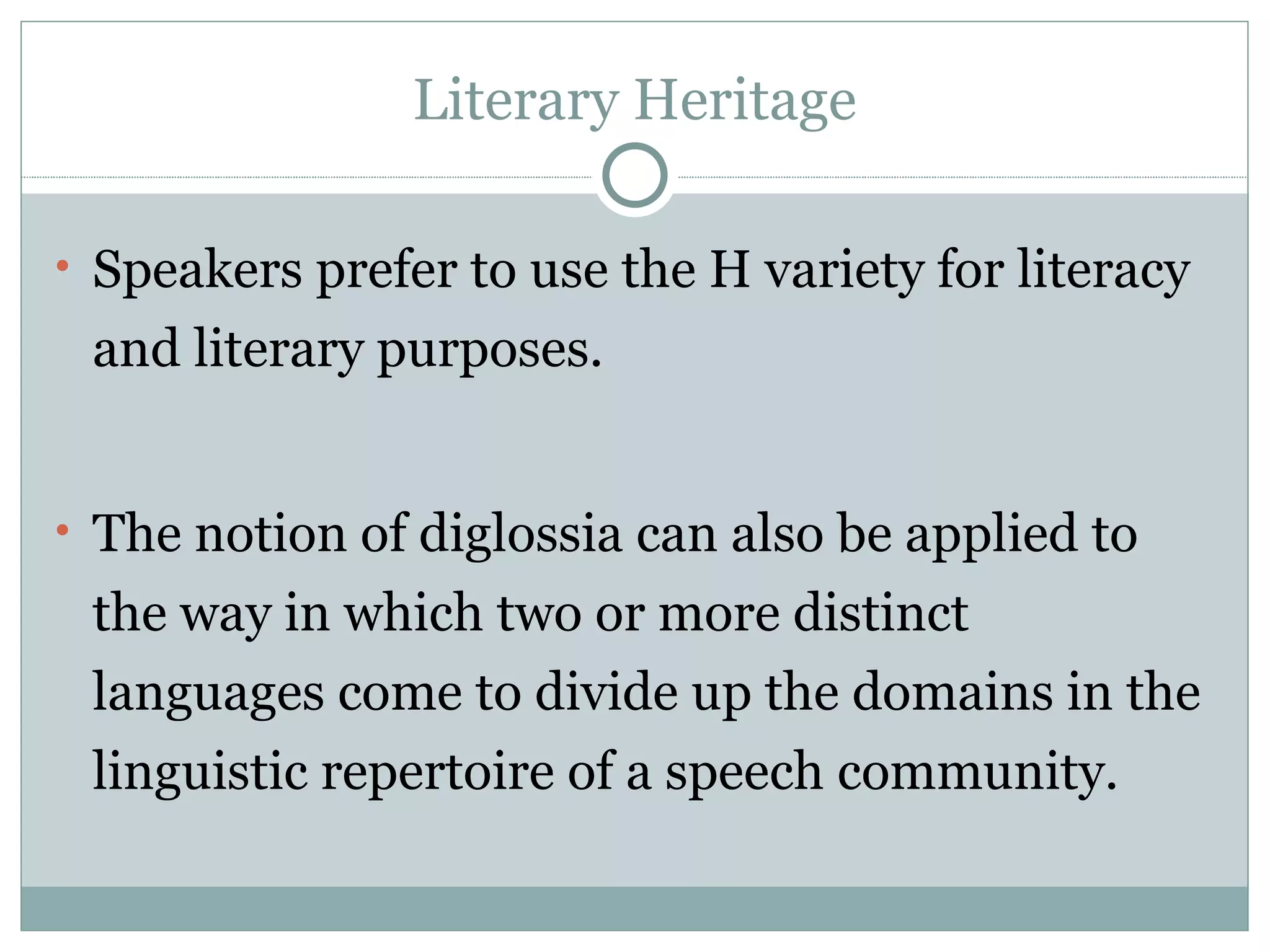
Literary Heritage Speakers prefer to use the H variety for literacy and literary purposes. The notion of diglossia can also be applied to the way in which two or more distinct languages come to divide up the domains in the linguistic repertoire of a speech community.
Acquisition L is usually used by adults while speaking to children and children use it among each other. The H variety is ‘taught’, whereas the L variety is ‘learned’.
Standardization There are usually no comparable grammars, dictionaries and standardized texts for the L variety, and any view of that variety is likely to be highly pejorative in nature. There is an established norm for pronunciation, grammar, and vocabulary which allows variation only within certain limits.
Stability Diglossia is more stable being protected from change by its association with written texts and by an educational system. Evidence in some cases seems to show that it can last well over a thousand years.
Grammar The grammar of the L variety is generally simpler. For instance, fewer distinctions in the L variety are marked by the use of grammatical suffixed. There are also major differences  in the vocabulary of the two varieties. E.g. Standard German has four cases in the noun; Swiss German has only three cases in the noun.
Lexicon    Generally, most of the vocabulary between the High and Low varieties is shared, with some variations in form and with several differences in use and meaning   For the most part, the High variety will contain technical terms and more ‘learned’ expressions.
Phonology  The sound systems of High and Low constitute a single phonological structure of which the Low variety phonology is the basic system and the divergent features of the High phonology are either a subsystem or a parasystem.
Fishman (1980, p.3 ) Diglossia is, ‘An enduring societal arrangement, extending at least beyond a three generation period, such that two “languages” each have their secure, phenomenologically  legitimate and widely implemented functions’. Eg.  In Fishman’s usage, even multilingual countries such as Nigeria, where English functions as a nationwide prestige language which is learnt in school and local languages such as Hausa and Yoruba are spoken natively, are described as being diglossic.
In many countries, the globalization of English has introduced a third significant language, so that triglossia or polyglossia is starting to emerge so that changes in one are reflected changes in the other.
Difference between Diglossia and Standard-with-dialects. In diglossia,  no-one  speaks the H-variety as a mother tongue, only the L-variety. In the Standard-with-dialects situation, some speakers speak H as a mother tongue, while others speak L-varieties as a mother tongue and acquire H as a second system.

Diglossia

  • 1.
    NUR SYAFIQAH BT.ABDUL KADAR 4091008841 NUR SYAFIQAH BT. MOHD. SHUKRI 4091008291 JEISRI D/O VIJIAN 4091009841 NUR ATIKAH BT. MANAN 4091009311 DIGLOSSIA
  • 2.
    Definition Charles A.Ferguson, (1959) : Diglossia is a relatively stable language situation, in which, in addition to the primary dialects of the language, there is a very divergent, highly codified superposed variety… which is learned largely by formal education and is used for most written and formal spoken purposes.
  • 3.
    Function Standard ‘High’(H) Vernacular ‘Low ‘ (L) Sermon X Instruction to servants X Speech in parliament X University lecture X Conversation with friends X Newspaper editorial X ‘ Serious’ work of literature X
  • 4.
    Prestige Speakers considerH as the more powerful to L in a number of respects. E.g. H variety is more beautiful, logical and expressive than the L variety.
  • 5.
    Literary Heritage Speakersprefer to use the H variety for literacy and literary purposes. The notion of diglossia can also be applied to the way in which two or more distinct languages come to divide up the domains in the linguistic repertoire of a speech community.
  • 6.
    Acquisition L isusually used by adults while speaking to children and children use it among each other. The H variety is ‘taught’, whereas the L variety is ‘learned’.
  • 7.
    Standardization There areusually no comparable grammars, dictionaries and standardized texts for the L variety, and any view of that variety is likely to be highly pejorative in nature. There is an established norm for pronunciation, grammar, and vocabulary which allows variation only within certain limits.
  • 8.
    Stability Diglossia ismore stable being protected from change by its association with written texts and by an educational system. Evidence in some cases seems to show that it can last well over a thousand years.
  • 9.
    Grammar The grammarof the L variety is generally simpler. For instance, fewer distinctions in the L variety are marked by the use of grammatical suffixed. There are also major differences in the vocabulary of the two varieties. E.g. Standard German has four cases in the noun; Swiss German has only three cases in the noun.
  • 10.
    Lexicon   Generally, most of the vocabulary between the High and Low varieties is shared, with some variations in form and with several differences in use and meaning   For the most part, the High variety will contain technical terms and more ‘learned’ expressions.
  • 11.
    Phonology Thesound systems of High and Low constitute a single phonological structure of which the Low variety phonology is the basic system and the divergent features of the High phonology are either a subsystem or a parasystem.
  • 12.
    Fishman (1980, p.3) Diglossia is, ‘An enduring societal arrangement, extending at least beyond a three generation period, such that two “languages” each have their secure, phenomenologically legitimate and widely implemented functions’. Eg. In Fishman’s usage, even multilingual countries such as Nigeria, where English functions as a nationwide prestige language which is learnt in school and local languages such as Hausa and Yoruba are spoken natively, are described as being diglossic.
  • 13.
    In many countries,the globalization of English has introduced a third significant language, so that triglossia or polyglossia is starting to emerge so that changes in one are reflected changes in the other.
  • 14.
    Difference between Diglossiaand Standard-with-dialects. In diglossia, no-one speaks the H-variety as a mother tongue, only the L-variety. In the Standard-with-dialects situation, some speakers speak H as a mother tongue, while others speak L-varieties as a mother tongue and acquire H as a second system.