Learning Through Association
▪ A type of learning where an organism
learns to associate two stimuli.
▪ Discovered by Russian physiologist
Ivan Pavlov in the late 19th/early 20th
century.
▪ Focuses on involuntary, automatic
responses.
▪ Often called "Pavlovian Conditioning."
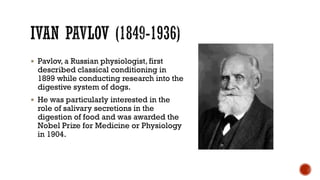
 Pavlov, a Russian physiologist, first
described classical conditioning in
1899 while conducting research into the
digestive system of dogs.
 He was particularly interested in the
role of salivary secretions in the
digestion of food and was awarded the
Nobel Prize for Medicine or Physiology
in 1904.
1. Unconditioned Stimulus (UCS): A stimulus that naturally and
automatically triggers a response without any learning.
Example: Food
2. Unconditioned Response (UCR): The unlearned, natural
response to the unconditioned stimulus.
Example: Salivation to food
3. Neutral Stimulus (NS): A stimulus that initially produces no
specific response other than focusing attention.
Example: Bell before conditioning
4. Conditioned Stimulus (CS): A previously neutral stimulus that,
after becoming associated with the unconditioned stimulus,
eventually comes to trigger a conditioned response.
Example: Bell after conditioning
5. Conditioned Response (CR): The learned response to the
previously neutral (now conditioned) stimulus.
Example: Salivation to the bell
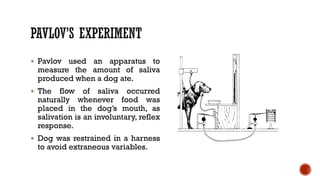
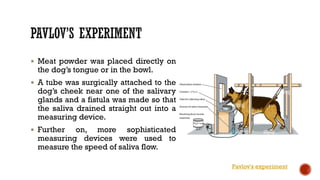
 Pavlov used an apparatus to
measure the amount of saliva
produced when a dog ate.
 The flow of saliva occurred
naturally whenever food was
placed in the dog’s mouth, as
salivation is an involuntary, reflex
response.
 Dog was restrained in a harness
to avoid extraneous variables.
 Meat powder was placed directly on
the dog’s tongue or in the bowl.
 A tube was surgically attached to the
dog’s cheek near one of the salivary
glands and a fistula was made so that
the saliva drained straight out into a
measuring device.
 Further on, more sophisticated
measuring devices were used to
measure the speed of saliva flow.
Pavlov's experiment
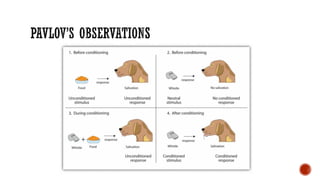
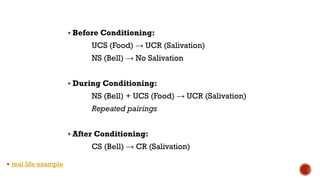
▪ Before Conditioning:
UCS (Food) → UCR (Salivation)
NS (Bell) → No Salivation
▪ During Conditioning:
NS (Bell) + UCS (Food) → UCR (Salivation)
Repeated pairings
▪ After Conditioning:
CS (Bell) → CR (Salivation)
▪ real life example
1. Identify the UCS, UCR, NS, CS, and CR
“A student feels sick every time they see a math textbook,
after getting food poisoning while studying for a test.”
2. Find another scenario where classical conditioning is
applicable.
❑ Acquisition is the process of learning an association between a
neutral stimulus and an unconditioned stimulus, resulting in a
new conditioned response.
❑ Extinction is the gradual disappearance of the conditioned
response when the conditioned stimulus is repeatedly
presented without the unconditioned stimulus.
❑ Spontaneous Recovery is the temporary reappearance of the
conditioned response after a rest period following extinction.
❑ Stimulus Generalization is the tendency to respond to
stimuli similar to the conditioned stimulus.
❑ Stimulus Discrimination is the ability to differentiate
between the conditioned stimulus and other similar stimuli,
responding only to the one that predicts the unconditioned
stimulus.
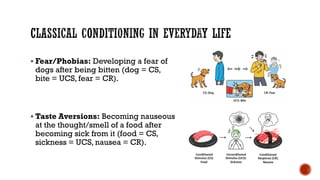
▪ Fear/Phobias: Developing a fear of
dogs after being bitten (dog = CS,
bite = UCS, fear = CR).
▪ Taste Aversions: Becoming nauseous
at the thought/smell of a food after
becoming sick from it (food = CS,
sickness = UCS, nausea = CR).
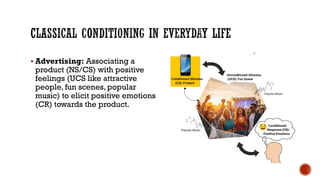
▪ Advertising: Associating a
product (NS/CS) with positive
feelings (UCS like attractive
people, fun scenes, popular
music) to elicit positive emotions
(CR) towards the product.
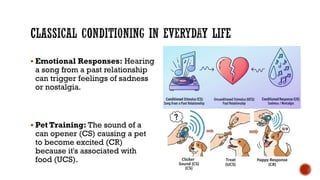
▪ Emotional Responses: Hearing
a song from a past relationship
can trigger feelings of sadness
or nostalgia.
▪ Pet Training: The sound of a
can opener (CS) causing a pet
to become excited (CR)
because it's associated with
food (UCS).
▪ Positive Classroom Environment:
Associating the classroom (CS) with
positive experiences (UCS like praise,
success, fun activities) to foster positive
feelings (CR) about school.
▪ Managing Test Anxiety: Test (CS)
associated with failure/stress (UCS) leads
to anxiety (CR). Strategies include creating
a supportive testing environment, reducing
pressure.
▪ Bell for Class Transition: The bell (CS)
signaling the end of class (UCS) causing
students to pack up (CR).
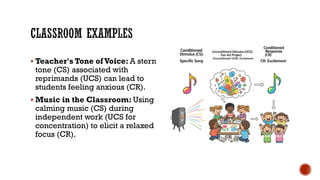
▪ Teacher's Tone of Voice: A stern
tone (CS) associated with
reprimands (UCS) can lead to
students feeling anxious (CR).
▪ Music in the Classroom: Using
calming music (CS) during
independent work (UCS for
concentration) to elicit a relaxed
focus (CR).
o Create Positive Associations: Pair learning with positive
experiences (e.g., praise, rewards, engaging activities) to help
students develop positive attitudes towards subjects and school.
o Address Anxiety and Phobias: Understand that some student
anxieties (e.g., test anxiety, school phobia) may be classically
conditioned responses.
o Desensitization: Gradually expose students to feared stimuli in a
safe, controlled environment, paired with relaxation techniques.
o Consistency: Be consistent in routines and expectations. Predictable
environments can reduce anxiety and build positive associations.
o Avoid Negative Associations: Be mindful of not inadvertently
conditioning negative responses (e.g., using sarcasm, public
shaming).
o Use Cues Effectively: Use clear signals for transitions, beginnings,
and ends of activities to help students adjust.
▪ Classical conditioning explains how we learn involuntary
emotional and physiological responses.
▪ It's based on the association of stimuli.
▪ Teachers can leverage its principles to create positive learning
environments and address student anxieties.
Any Questions?
Discussion Points: How have you observed classical conditioning in
your own life or in an educational setting?

Classical Conditioning theory ppt in pdf format

  • 1.
  • 2.
    ▪ A typeof learning where an organism learns to associate two stimuli. ▪ Discovered by Russian physiologist Ivan Pavlov in the late 19th/early 20th century. ▪ Focuses on involuntary, automatic responses. ▪ Often called "Pavlovian Conditioning."
  • 3.
     Pavlov, aRussian physiologist, first described classical conditioning in 1899 while conducting research into the digestive system of dogs.  He was particularly interested in the role of salivary secretions in the digestion of food and was awarded the Nobel Prize for Medicine or Physiology in 1904.
  • 4.
    1. Unconditioned Stimulus(UCS): A stimulus that naturally and automatically triggers a response without any learning. Example: Food 2. Unconditioned Response (UCR): The unlearned, natural response to the unconditioned stimulus. Example: Salivation to food 3. Neutral Stimulus (NS): A stimulus that initially produces no specific response other than focusing attention. Example: Bell before conditioning
  • 5.
    4. Conditioned Stimulus(CS): A previously neutral stimulus that, after becoming associated with the unconditioned stimulus, eventually comes to trigger a conditioned response. Example: Bell after conditioning 5. Conditioned Response (CR): The learned response to the previously neutral (now conditioned) stimulus. Example: Salivation to the bell
  • 6.
     Pavlov usedan apparatus to measure the amount of saliva produced when a dog ate.  The flow of saliva occurred naturally whenever food was placed in the dog’s mouth, as salivation is an involuntary, reflex response.  Dog was restrained in a harness to avoid extraneous variables.
  • 7.
     Meat powderwas placed directly on the dog’s tongue or in the bowl.  A tube was surgically attached to the dog’s cheek near one of the salivary glands and a fistula was made so that the saliva drained straight out into a measuring device.  Further on, more sophisticated measuring devices were used to measure the speed of saliva flow. Pavlov's experiment
  • 9.
    ▪ Before Conditioning: UCS(Food) → UCR (Salivation) NS (Bell) → No Salivation ▪ During Conditioning: NS (Bell) + UCS (Food) → UCR (Salivation) Repeated pairings ▪ After Conditioning: CS (Bell) → CR (Salivation) ▪ real life example
  • 10.
    1. Identify theUCS, UCR, NS, CS, and CR “A student feels sick every time they see a math textbook, after getting food poisoning while studying for a test.” 2. Find another scenario where classical conditioning is applicable.
  • 11.
    ❑ Acquisition isthe process of learning an association between a neutral stimulus and an unconditioned stimulus, resulting in a new conditioned response. ❑ Extinction is the gradual disappearance of the conditioned response when the conditioned stimulus is repeatedly presented without the unconditioned stimulus. ❑ Spontaneous Recovery is the temporary reappearance of the conditioned response after a rest period following extinction.
  • 12.
    ❑ Stimulus Generalizationis the tendency to respond to stimuli similar to the conditioned stimulus. ❑ Stimulus Discrimination is the ability to differentiate between the conditioned stimulus and other similar stimuli, responding only to the one that predicts the unconditioned stimulus.
  • 13.
    ▪ Fear/Phobias: Developinga fear of dogs after being bitten (dog = CS, bite = UCS, fear = CR). ▪ Taste Aversions: Becoming nauseous at the thought/smell of a food after becoming sick from it (food = CS, sickness = UCS, nausea = CR).
  • 14.
    ▪ Advertising: Associatinga product (NS/CS) with positive feelings (UCS like attractive people, fun scenes, popular music) to elicit positive emotions (CR) towards the product.
  • 15.
    ▪ Emotional Responses:Hearing a song from a past relationship can trigger feelings of sadness or nostalgia. ▪ Pet Training: The sound of a can opener (CS) causing a pet to become excited (CR) because it's associated with food (UCS).
  • 16.
    ▪ Positive ClassroomEnvironment: Associating the classroom (CS) with positive experiences (UCS like praise, success, fun activities) to foster positive feelings (CR) about school. ▪ Managing Test Anxiety: Test (CS) associated with failure/stress (UCS) leads to anxiety (CR). Strategies include creating a supportive testing environment, reducing pressure. ▪ Bell for Class Transition: The bell (CS) signaling the end of class (UCS) causing students to pack up (CR).
  • 17.
    ▪ Teacher's Toneof Voice: A stern tone (CS) associated with reprimands (UCS) can lead to students feeling anxious (CR). ▪ Music in the Classroom: Using calming music (CS) during independent work (UCS for concentration) to elicit a relaxed focus (CR).
  • 18.
    o Create PositiveAssociations: Pair learning with positive experiences (e.g., praise, rewards, engaging activities) to help students develop positive attitudes towards subjects and school. o Address Anxiety and Phobias: Understand that some student anxieties (e.g., test anxiety, school phobia) may be classically conditioned responses. o Desensitization: Gradually expose students to feared stimuli in a safe, controlled environment, paired with relaxation techniques.
  • 19.
    o Consistency: Beconsistent in routines and expectations. Predictable environments can reduce anxiety and build positive associations. o Avoid Negative Associations: Be mindful of not inadvertently conditioning negative responses (e.g., using sarcasm, public shaming). o Use Cues Effectively: Use clear signals for transitions, beginnings, and ends of activities to help students adjust.
  • 20.
    ▪ Classical conditioningexplains how we learn involuntary emotional and physiological responses. ▪ It's based on the association of stimuli. ▪ Teachers can leverage its principles to create positive learning environments and address student anxieties.
  • 21.
    Any Questions? Discussion Points:How have you observed classical conditioning in your own life or in an educational setting?