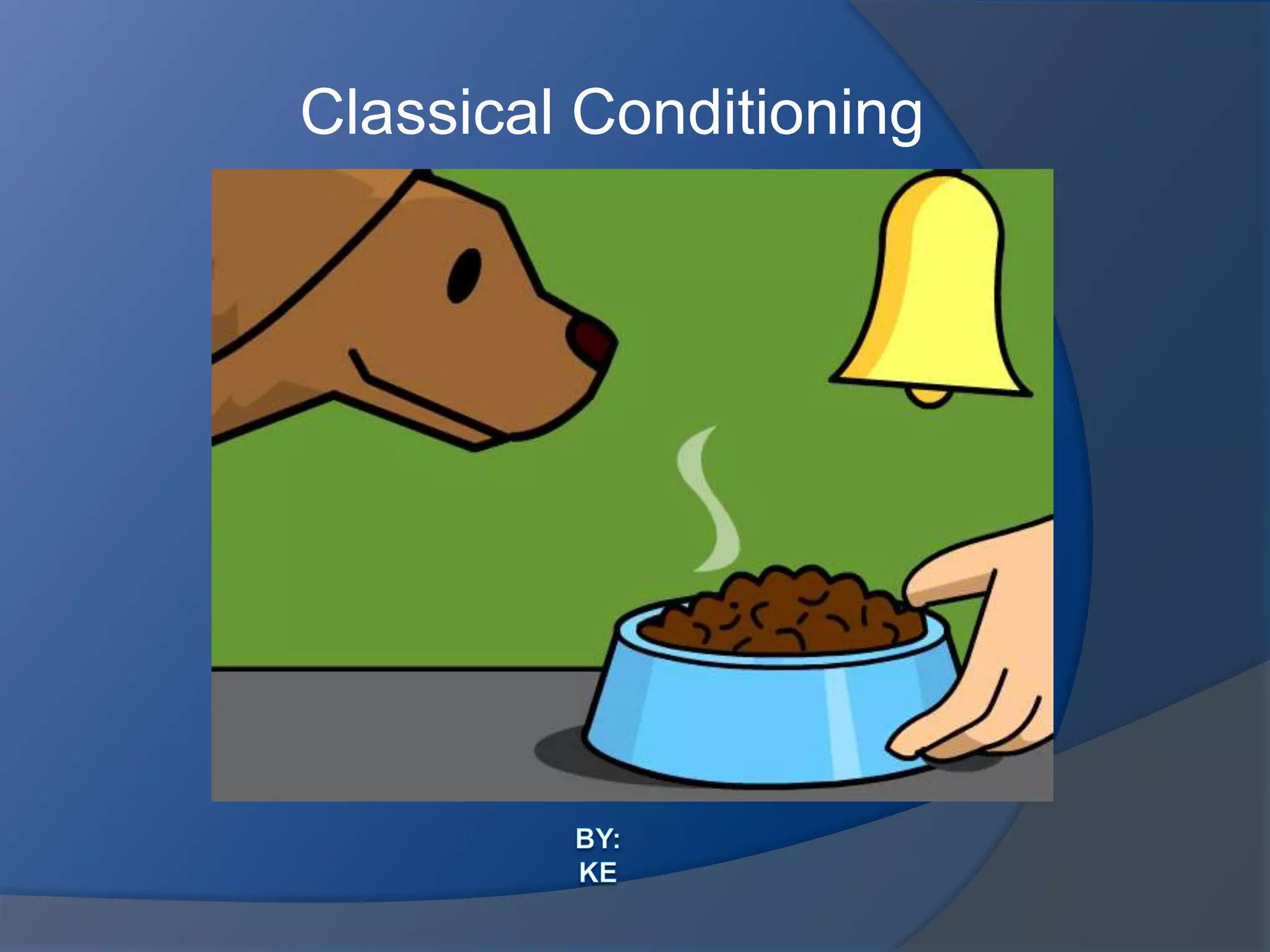
Classical Conditioning
   Classical Conditioning is a
    learning theory, first
    discovered by Ivan Pavlov
    in 1927.

   Pavlov was a Russian
    Behavioral Psychologist
    who actually stumbled
    upon the theory accidently       Pavlov realized his dogs
    in his own house using his        associated the bell with
    dogs as the subjects.             food, thus they began to
                                      salivate.
   He kept his dogs locked up
    for many hours due to his        Intrigued by this
    different research. When          phenomenon, Pavlov did
    he got the chance to feed         extensive research on this
    them, he would ring a bell        type of learning.
    and the dogs knew that it
    meant dinner time and
    responded by salivating.
How do his findings impact
         human learning
   Pavlov found that by creating a stimulus (the bell) one will
    learn and eventually respond in someway (his dog’s
    salivating). Humans can also be classically conditioned.

   For instance, a smoker wants to quit smoking but every time
    they get in the car they associate smoking while driving and
    buy a pack of cigarettes when they fill up next. A good idea
    to help the smoker quit could buying gum or sunflower seeds
    instead of cigarettes and keeping that in the car so they can
    slowly develop a healthier habit while driving.

   How is the example of a smoker trying to quit when driving
    similar to Pavlov’s dogs associating the bell with dinner?
Stimulus and Response
   An unconditioned stimulus (UCS) is something that creates an
    unconditioned response (UCR) on a subject.
   The food was the UCS and the salivation of the dogs was the UCR in Pavlov’s
    example, while driving was the UCS and smoking was the UCR in the example
    on the previous slide.


   A neutral stimulus (NS) is given to a subject until they respond,
    then the NS becomes the conditioned stimulus (CS).
   The ring of the bell and chewing gum as opposed to smoking are the NS and the
    CS in the previous examples. They subjects didn’t make the association till done
    consistently.


   A conditioned response (CR) is the response the subject has
    after being conditioned by a CS.
   The salivation the dogs and quitting smoking by chewing gum while driving are
    the CR’s.
Impact on teaching
   A great way a teacher
    could use it without
    technology would be if
    they had a final exam
    coming up and the teacher
    held an after school study
    session with free pizza but
    the students couldn’t eat it
    until have way into the
    study session.

   With technology, a
    language teacher could
    play an audio track of
    vocabulary at the
    beginning of each class.
Impact on students
            Students can create a
             specific night or day of the
             weekend where they get
             most of their homework
             done. They will eventually
             associate that day of the
             week with school work.

            By using computers every
             day for educational
             purposes, students can
             associate using the
             computer with homework
             and learning.
My Opinion on it’s effects on
             teaching

 I believe that it can be very helpful to
  know how to use different stimuli to help
  students respond unknowingly with
  more knowledge and better grades.
 It should be used for teachers to help
  the students succeed more.
Credits

All pictures from Google Images

Information from:
http://www.learning-theories.com/classical-
   conditioning-pavlov.html

Classical conditioning

  • 1.
  • 2.
    Classical Conditioning is a learning theory, first discovered by Ivan Pavlov in 1927.  Pavlov was a Russian Behavioral Psychologist who actually stumbled upon the theory accidently  Pavlov realized his dogs in his own house using his associated the bell with dogs as the subjects. food, thus they began to salivate.  He kept his dogs locked up for many hours due to his  Intrigued by this different research. When phenomenon, Pavlov did he got the chance to feed extensive research on this them, he would ring a bell type of learning. and the dogs knew that it meant dinner time and responded by salivating.
  • 3.
    How do hisfindings impact human learning  Pavlov found that by creating a stimulus (the bell) one will learn and eventually respond in someway (his dog’s salivating). Humans can also be classically conditioned.  For instance, a smoker wants to quit smoking but every time they get in the car they associate smoking while driving and buy a pack of cigarettes when they fill up next. A good idea to help the smoker quit could buying gum or sunflower seeds instead of cigarettes and keeping that in the car so they can slowly develop a healthier habit while driving.  How is the example of a smoker trying to quit when driving similar to Pavlov’s dogs associating the bell with dinner?
  • 4.
    Stimulus and Response  An unconditioned stimulus (UCS) is something that creates an unconditioned response (UCR) on a subject.  The food was the UCS and the salivation of the dogs was the UCR in Pavlov’s example, while driving was the UCS and smoking was the UCR in the example on the previous slide.  A neutral stimulus (NS) is given to a subject until they respond, then the NS becomes the conditioned stimulus (CS).  The ring of the bell and chewing gum as opposed to smoking are the NS and the CS in the previous examples. They subjects didn’t make the association till done consistently.  A conditioned response (CR) is the response the subject has after being conditioned by a CS.  The salivation the dogs and quitting smoking by chewing gum while driving are the CR’s.
  • 5.
    Impact on teaching  A great way a teacher could use it without technology would be if they had a final exam coming up and the teacher held an after school study session with free pizza but the students couldn’t eat it until have way into the study session.  With technology, a language teacher could play an audio track of vocabulary at the beginning of each class.
  • 6.
    Impact on students  Students can create a specific night or day of the weekend where they get most of their homework done. They will eventually associate that day of the week with school work.  By using computers every day for educational purposes, students can associate using the computer with homework and learning.
  • 7.
    My Opinion onit’s effects on teaching  I believe that it can be very helpful to know how to use different stimuli to help students respond unknowingly with more knowledge and better grades.  It should be used for teachers to help the students succeed more.
  • 8.
    Credits All pictures fromGoogle Images Information from: http://www.learning-theories.com/classical- conditioning-pavlov.html