Phylum: PlatyhelminthesPhylum: Platyhelminthes
Class: TurbellariaClass: Turbellaria
ByBy
Mr. “I wish I could regenerate” ChapmanMr. “I wish I could regenerate” Chapman
PlatyhelminthesPlatyhelminthes
Class Turbellaria –
Are free-living flatworms, are scavengers
that can be found in 3 different habitats:
1. Freshwater species like planaria
PlanariansPlanarians
Planarians are frequently used toPlanarians are frequently used to
demonstrate the regenerative capabilitiesdemonstrate the regenerative capabilities
of lower invertebrate animals.of lower invertebrate animals.
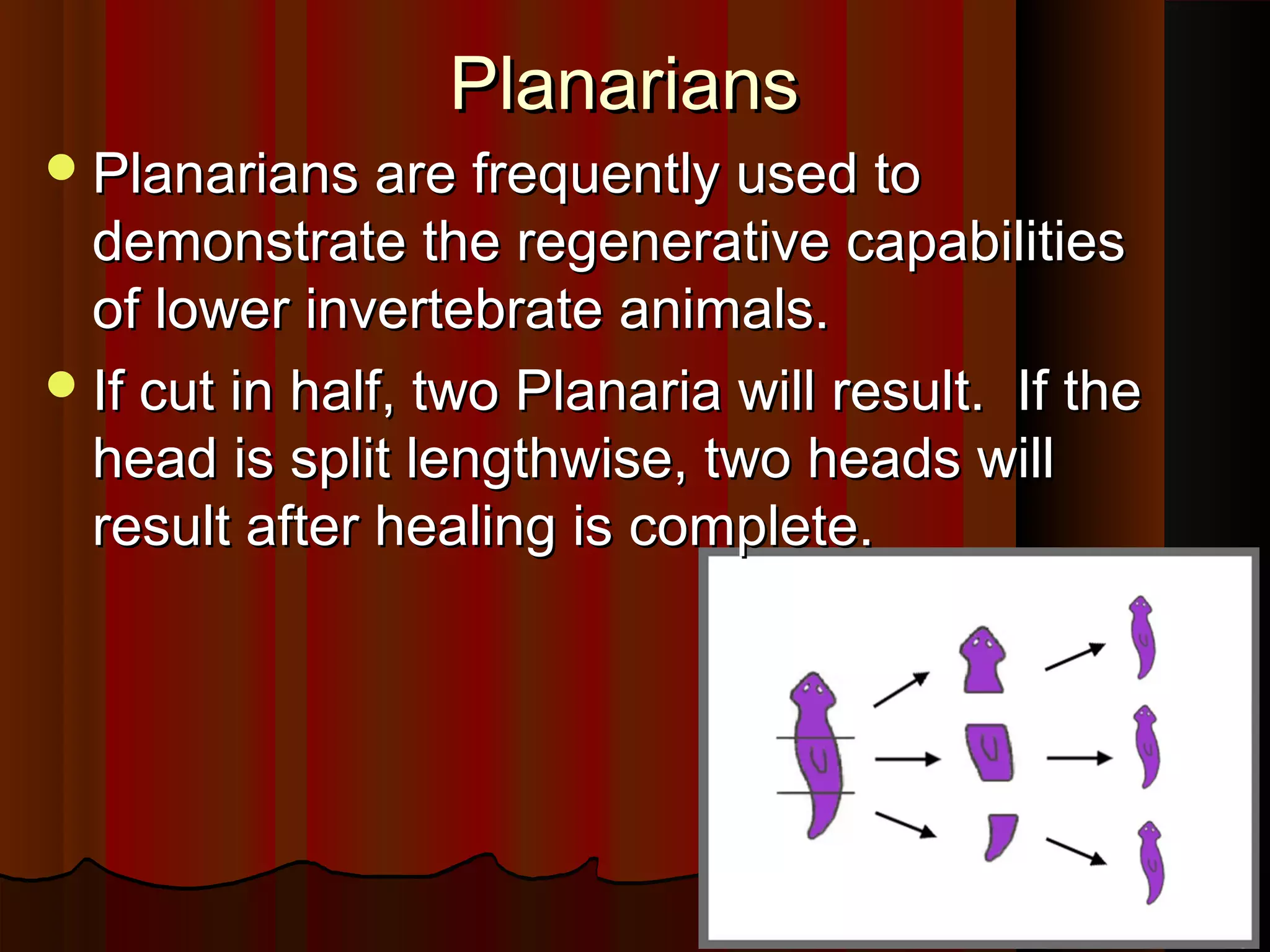
If cut in half, two Planaria will result. If theIf cut in half, two Planaria will result. If the
head is split lengthwise, two heads willhead is split lengthwise, two heads will
result after healing is complete.result after healing is complete.
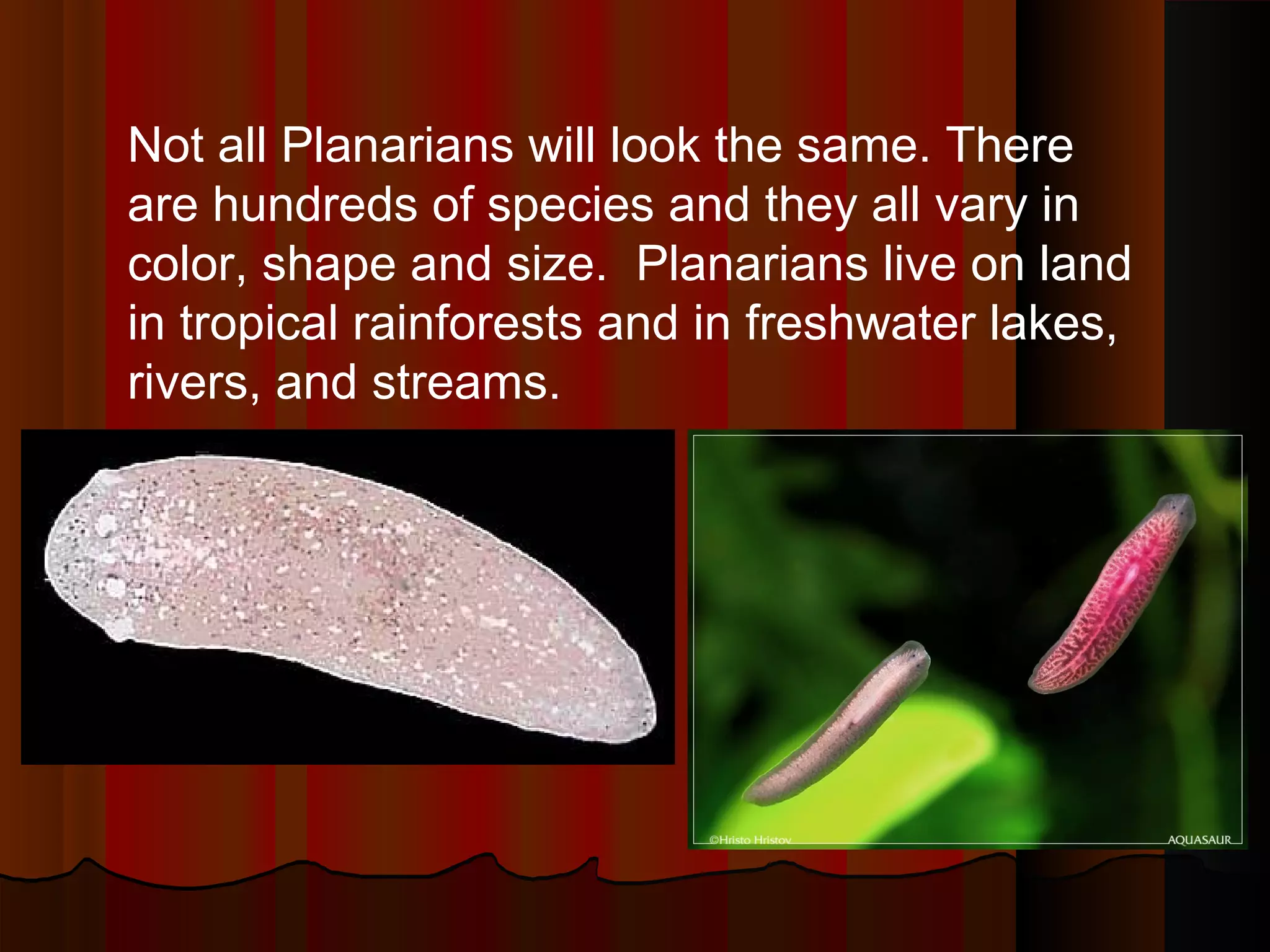
Not all Planarians will look the same. There
are hundreds of species and they all vary in
color, shape and size. Planarians live on land
in tropical rainforests and in freshwater lakes,
rivers, and streams.
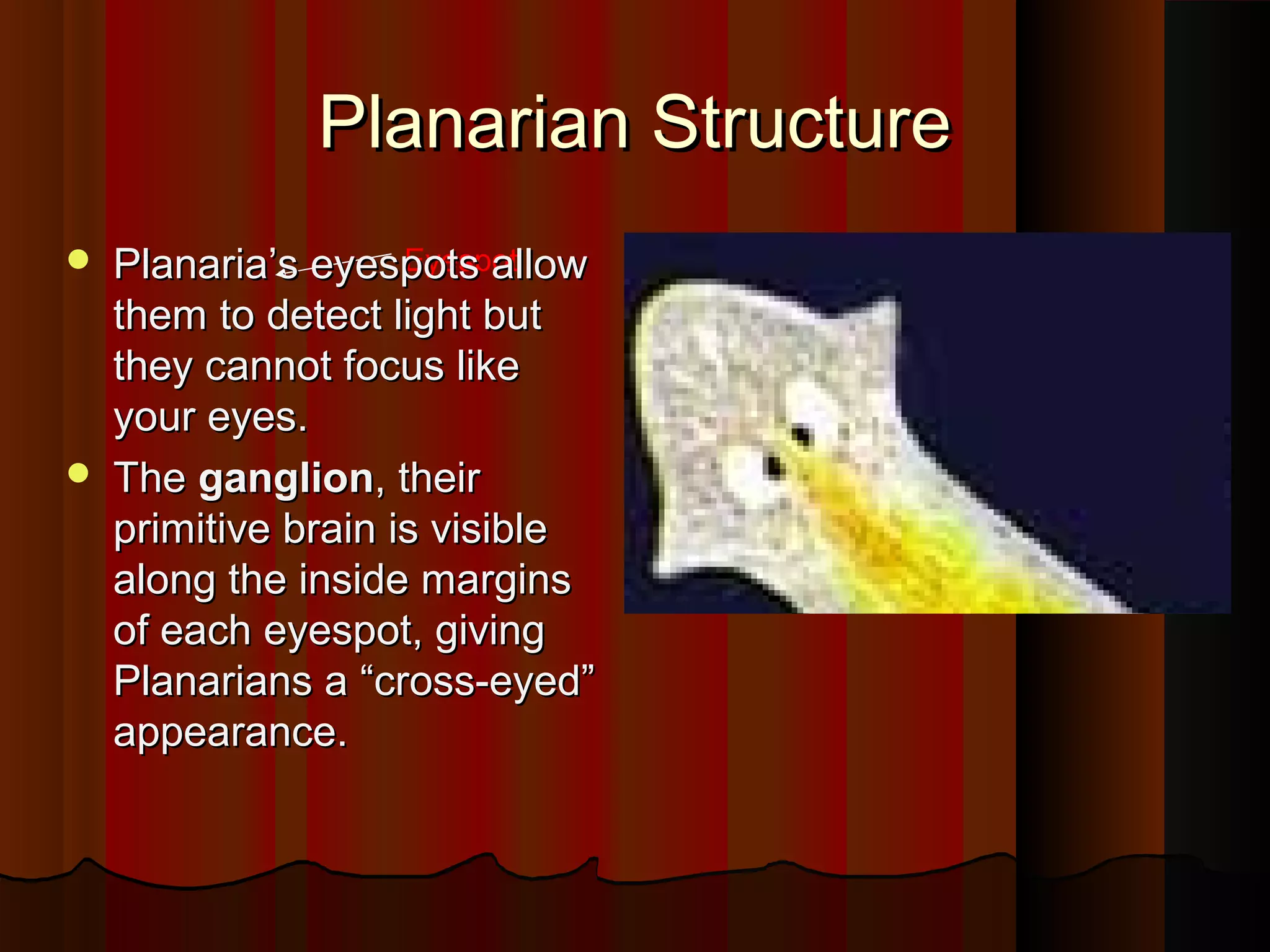
Eyespot
Planarian StructurePlanarian Structure
 Planaria’s eyespots allowPlanaria’s eyespots allow
them to detect light butthem to detect light but
they cannot focus likethey cannot focus like
your eyes.your eyes.
 TheThe ganglionganglion, their, their
primitive brain is visibleprimitive brain is visible
along the inside marginsalong the inside margins
of each eyespot, givingof each eyespot, giving
Planarians a “cross-eyed”Planarians a “cross-eyed”
appearance.appearance.
Planarian StructurePlanarian Structure
 Two long nerves that extendTwo long nerves that extend
from the Planarian’s head tofrom the Planarian’s head to
posterior end fuse at theposterior end fuse at the
anterior end to form theanterior end to form the
ganglion.ganglion.
 Having sensory organsHaving sensory organs
concentrated at the anteriorconcentrated at the anterior
end of an animal is calledend of an animal is called
cephalization.cephalization.
 Cephalus means head.Cephalus means head.
Planarian StructurePlanarian Structure
 Therefore flatworms are the first animals to have a head.Therefore flatworms are the first animals to have a head.
 Consequently if they have a head, they then have a right and leftConsequently if they have a head, they then have a right and left
side. Cephalization then, leads to a new kind of organization amongside. Cephalization then, leads to a new kind of organization among
animals called bilateral symmetry.animals called bilateral symmetry.
 Animals with bilateral symmetry have two sides. Bi = two andAnimals with bilateral symmetry have two sides. Bi = two and
lateral = sides.lateral = sides.
PlatyhelminthesPlatyhelminthes
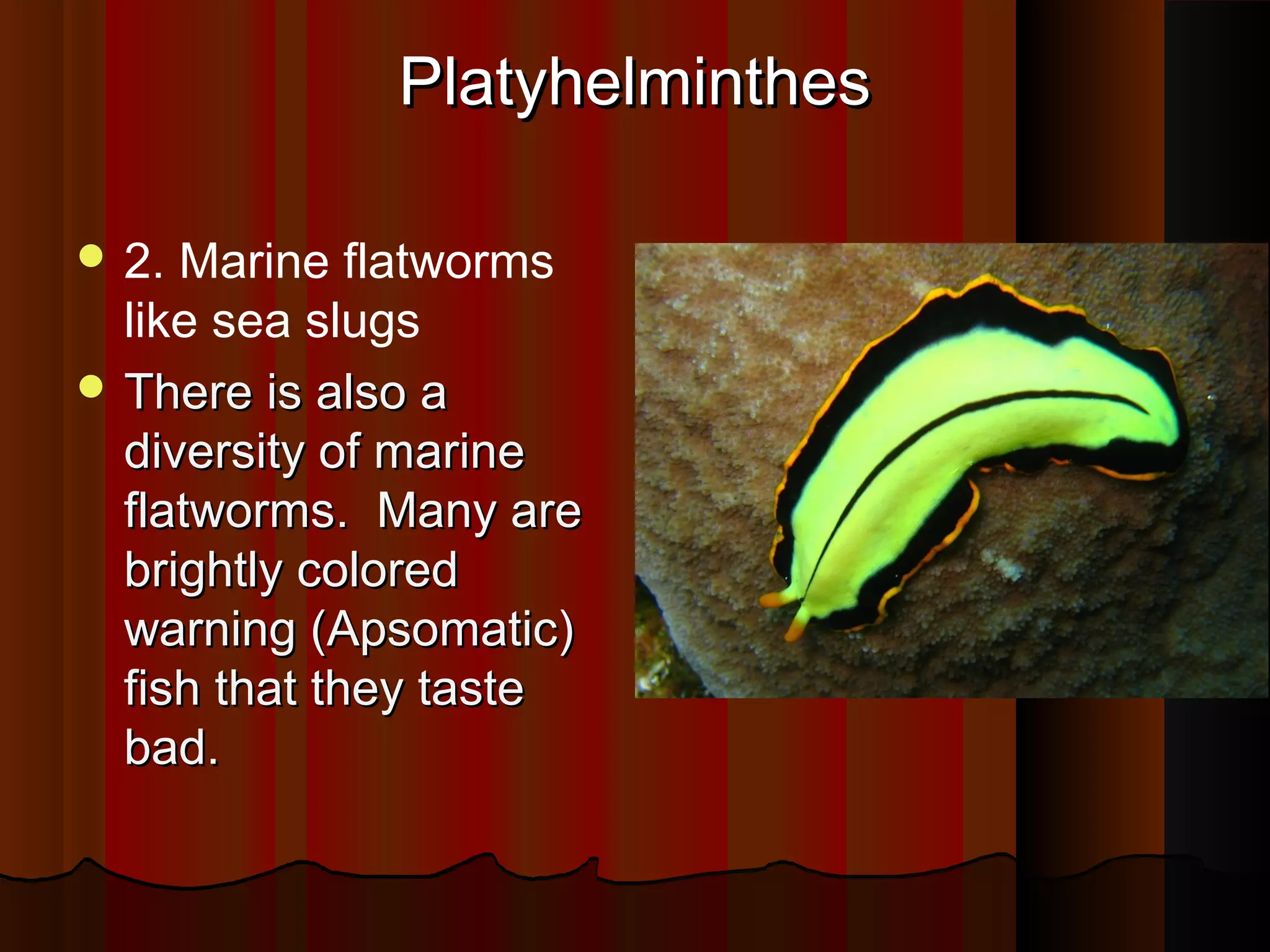
 2. Marine flatworms
like sea slugs
 There is also aThere is also a
diversity of marinediversity of marine
flatworms. Many areflatworms. Many are
brightly coloredbrightly colored
warning (Apsomatic)warning (Apsomatic)
fish that they tastefish that they taste
bad.bad.
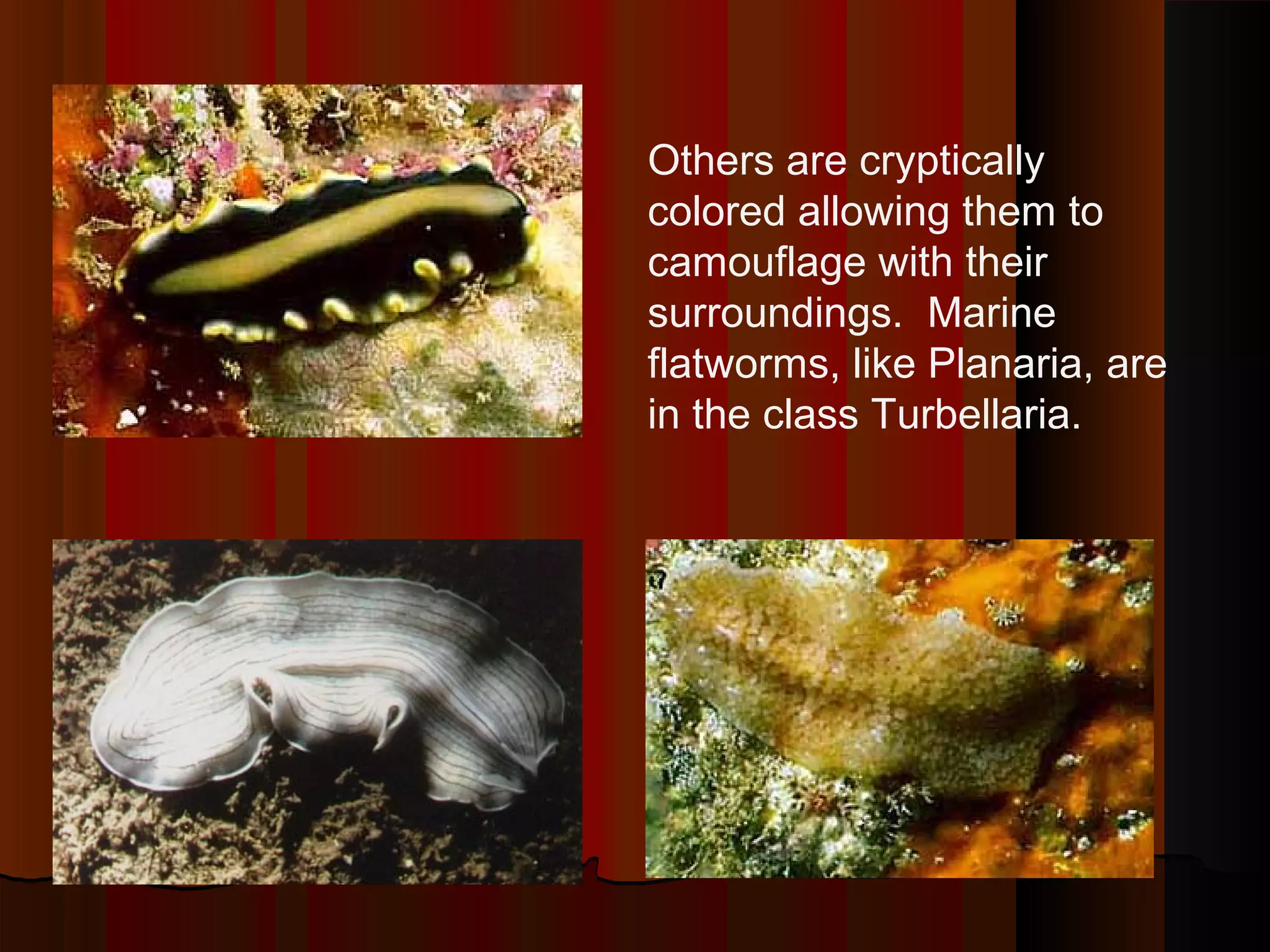
Others are cryptically
colored allowing them to
camouflage with their
surroundings. Marine
flatworms, like Planaria, are
in the class Turbellaria.
Examples of TurbellariansExamples of Turbellarians
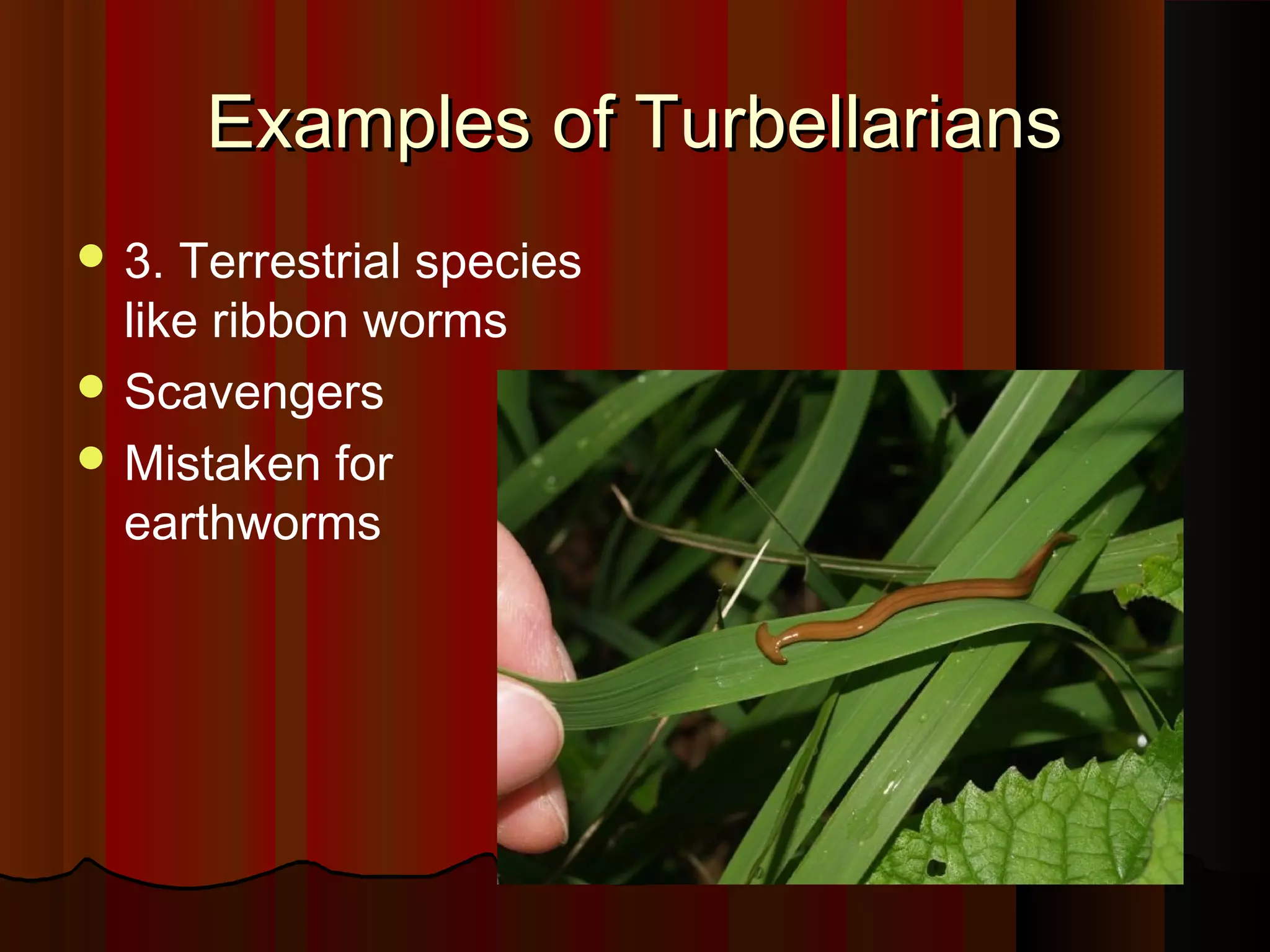
 3. Terrestrial species
like ribbon worms
 Scavengers
 Mistaken for
earthworms
The End

Class Turbellaria Notes

  • 1.
    Phylum: PlatyhelminthesPhylum: Platyhelminthes Class:TurbellariaClass: Turbellaria ByBy Mr. “I wish I could regenerate” ChapmanMr. “I wish I could regenerate” Chapman
  • 2.
    PlatyhelminthesPlatyhelminthes Class Turbellaria – Arefree-living flatworms, are scavengers that can be found in 3 different habitats: 1. Freshwater species like planaria
  • 3.
    PlanariansPlanarians Planarians are frequentlyused toPlanarians are frequently used to demonstrate the regenerative capabilitiesdemonstrate the regenerative capabilities of lower invertebrate animals.of lower invertebrate animals. If cut in half, two Planaria will result. If theIf cut in half, two Planaria will result. If the head is split lengthwise, two heads willhead is split lengthwise, two heads will result after healing is complete.result after healing is complete.
  • 4.
    Not all Planarianswill look the same. There are hundreds of species and they all vary in color, shape and size. Planarians live on land in tropical rainforests and in freshwater lakes, rivers, and streams.
  • 5.
    Eyespot Planarian StructurePlanarian Structure Planaria’s eyespots allowPlanaria’s eyespots allow them to detect light butthem to detect light but they cannot focus likethey cannot focus like your eyes.your eyes.  TheThe ganglionganglion, their, their primitive brain is visibleprimitive brain is visible along the inside marginsalong the inside margins of each eyespot, givingof each eyespot, giving Planarians a “cross-eyed”Planarians a “cross-eyed” appearance.appearance.
  • 6.
    Planarian StructurePlanarian Structure Two long nerves that extendTwo long nerves that extend from the Planarian’s head tofrom the Planarian’s head to posterior end fuse at theposterior end fuse at the anterior end to form theanterior end to form the ganglion.ganglion.  Having sensory organsHaving sensory organs concentrated at the anteriorconcentrated at the anterior end of an animal is calledend of an animal is called cephalization.cephalization.  Cephalus means head.Cephalus means head.
  • 7.
    Planarian StructurePlanarian Structure Therefore flatworms are the first animals to have a head.Therefore flatworms are the first animals to have a head.  Consequently if they have a head, they then have a right and leftConsequently if they have a head, they then have a right and left side. Cephalization then, leads to a new kind of organization amongside. Cephalization then, leads to a new kind of organization among animals called bilateral symmetry.animals called bilateral symmetry.  Animals with bilateral symmetry have two sides. Bi = two andAnimals with bilateral symmetry have two sides. Bi = two and lateral = sides.lateral = sides.
  • 8.
    PlatyhelminthesPlatyhelminthes  2. Marineflatworms like sea slugs  There is also aThere is also a diversity of marinediversity of marine flatworms. Many areflatworms. Many are brightly coloredbrightly colored warning (Apsomatic)warning (Apsomatic) fish that they tastefish that they taste bad.bad.
  • 9.
    Others are cryptically coloredallowing them to camouflage with their surroundings. Marine flatworms, like Planaria, are in the class Turbellaria.
  • 10.
    Examples of TurbellariansExamplesof Turbellarians  3. Terrestrial species like ribbon worms  Scavengers  Mistaken for earthworms
  • 11.