Phylum
Platyhelminthes
The Flatworms
CHARACTERISTICS
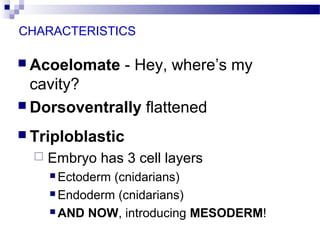
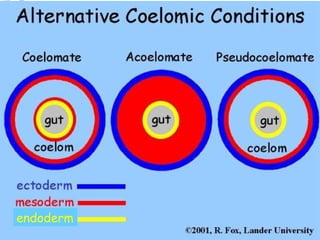
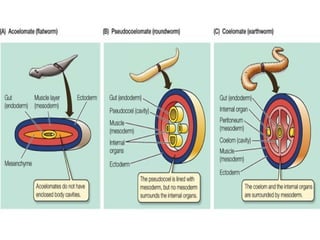
 Acoelomate - Hey, where’s my
cavity?
 Dorsoventrally flattened
 Triploblastic
 Embryo has 3 cell layers
 Ectoderm (cnidarians)
 Endoderm (cnidarians)
 AND NOW, introducing MESODERM!
endoderm
 Bilateral symmetry- with external and internal
features arranged symmetrically on either side
of a median or sagital plane
Bilateral symmetry: active mode; Biradial symmetry: sedentary life
ADVANCEMENTS:
 Nervous system
 Anterior brain
 Paired ventral nerve cords
 Longitudinal
 Incomplete gut (Digestive system)
 No anus
 Food exits via mouth
 Excretory system & osmoregulation
Diffusion across body wall
Protonephridia
 Specialized excretory organs
 May also help osmoregulate
 Formed reproductive organ
CLASSIFICATION
 Phylum Platyhelminthes
Classes
Turbellaria: free-living flatworms
Trematoda: flukes
All are parasites
Cestoda: tapeworms
All are parasites
CLASS
TURBELLARIA
Free-living flatworms
Class Turbellaria
 Free living
Freshwater
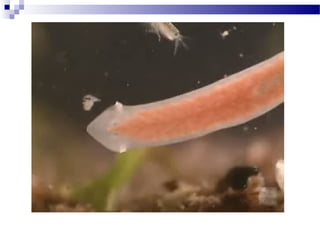
 Planarians
such as
Dugesia
A few inhabit
terrestrial
(moist) habitats
STRUCTURE
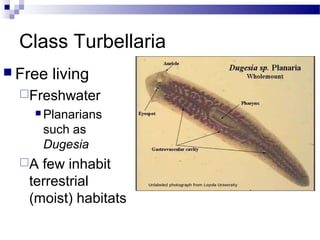
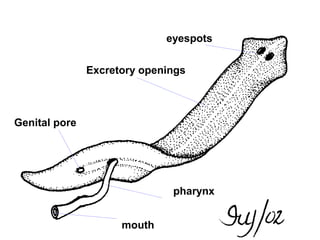
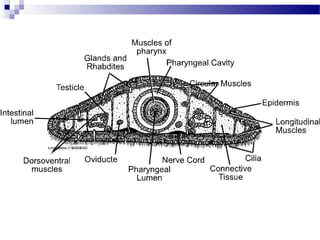
 Dugesia is a thin, slender, soft worm about
15mm long, bluntly triangular anterior end,
or “head,” and a tapered body patterned
with dark pigment.
 Head region bears two black eyespots
middorsally
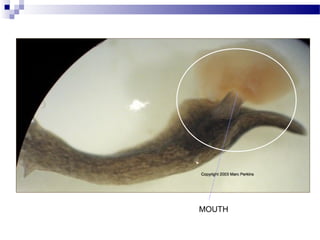
 The mouth is on ventral surface near the
middle of the body
 Through it a tubular pharynx, or
proboscis, with muscular walls can be
extended to capture food.
 Excretory openings, present laterally on
the dorsal surface but are difficult to see.
 Genital pore, mature worm has it on the
ventral surface behind the mouth.
 Body covered by epidermis of single layer
of cuboidal to columnar cells.
pharynx
Genital pore
eyespots
mouth
Excretory openings
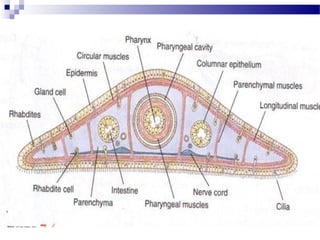
 The epidermal cells contain small bodies
called rhabdites, and many deep-lying
unicellular glands that open the surface.
 Gland cells produce mucus.
 Ventral epidermis is covered with cilia for
locomotion
 Beneath the basement membrane are the
layers of muscle fibers, circular,
longitudinal, and diagonal, also
dorsoventral fibers.
 Spaces between the muscles and internal
organs are filled with parenchyma
(mesenchyme)
 There is no body cavity
 In the parenchyma are scattered free
formative cells, which by mitosis produce
new parts in regeneration.
Class Turbellaria
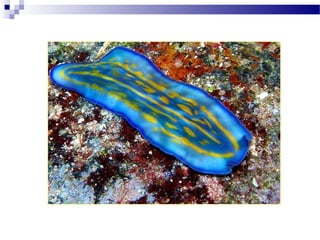
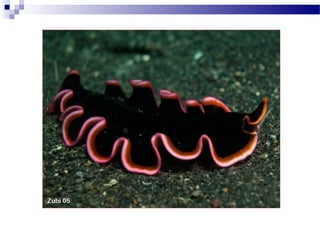
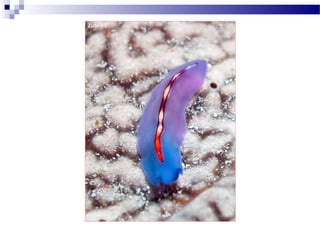
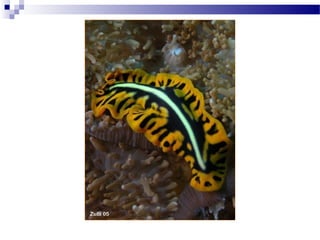
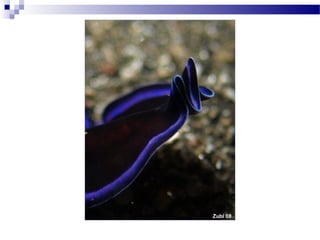
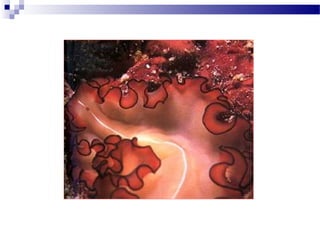
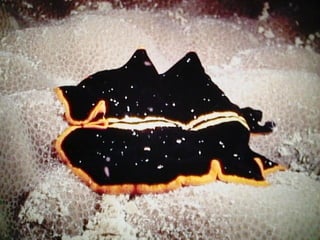
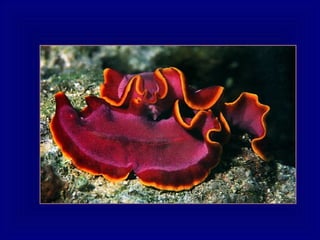
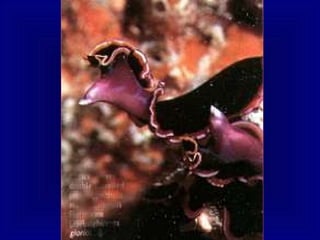
Marine species (beautiful colors)
 Significant members of coral reef
ecosystems
Some are major predators of colonial
ascidians (sea squirts)
Others are pests of commercial clams
and oysters
 Some live symbiotically on a variety of reef
invertebrates
Class Turbellaria
 Locomotion
Usually by cilia
 Dugesia can move at about 1.5 mm/sec
Peristaltic waves can achieve higher
velocities
 Marine flatworms can use this to swim
gracefully
Class Turbellaria
 Locomotion
Terrestrial planarians
 Glide smoothly on the substrate by the action of
powerful, closely spaced cilia in a special medial
ventral strip (creeping sole), on a thin coat of
mucus secreted on the substrate by glands
opening into the creeping sole
 Planarians that migrate on plants or objects above
the ground sometimes lower themselves to the
ground on a string of mucus.
ORGAN SYSTEMS
 NO Respiratory System
 NO Skeletal System
Muscular System
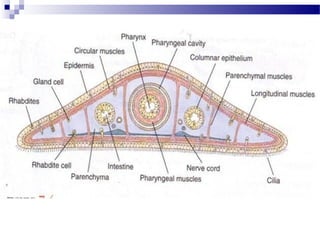
 Below the epidermis are layers of
circular and longitudinal
muscle fibers; used in
locomotion
Class Turbellaria
 Feeding Ecology
Most turbellarians are carnivorous predators or
scavengers.
 Carnivores feed on organisms that they can fit into
their mouths, such as protozoans, copepods, small
worms, and minute mollusks.
 Some species use mucus that may have poisonous
or narcotic chemicals to slow or entangle prey.
 Some have specific diets and feed on sponges,
ectoprocts, barnacles, and tunicates.
 Several species have commensal relationships with
various invertebrates
 Feeding and Digestion
The pharynx is protruded from the mouth and
into the prey.
 The pharynx and gut cells produce digestive
enzymes that breakdown food extracellularly.
 Because these worm lack a circulatory system,
larger species have extensive anastomosing guts to
aid in distribution.
 Since these worms have incomplete guts, all waste
must pass back out of the mouth.
MOUTH
 Nutrition
Planaria store food in digestive epithelium and
can survive many weeks shrinking slowly in size
without feeding.
They are capable of utilizing their own tissues
such as reproductive tissue for food when
reserves are exhausted.
Lab animals often tend to shrink in size when not
fed properly
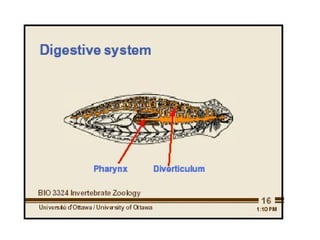
Digestive system
Ventral mouth
Muscular pharynx
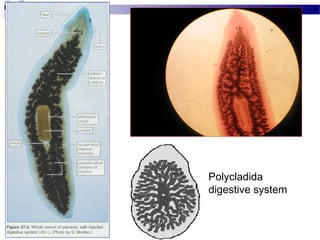
A blind intestine (details depend on order)
 Tricladida — 10-20 mm long
 Tripartite gut; one main anterior branch and two
main posterior branches with numerous blind
pockets off all three. Dugesia
 Polycladida — up to 5 cm long
 Gut has numerous branches ramifying
throughout the body.
Polycladida
digestive system
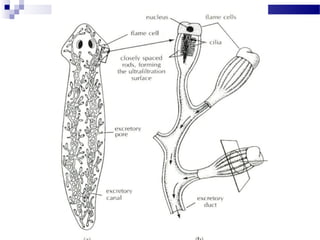
Excretory System
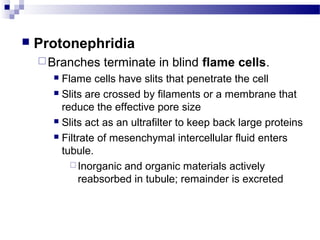
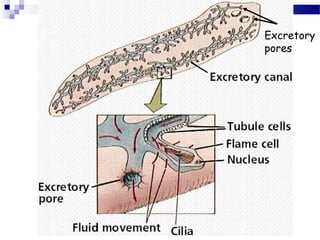
 Protonephridial System- comprises 2
longitudinal ducts connecting to a network
of tubules that branch throughout the body
and end in in many large flame cells.
 Flame cells- they collect excess water or
fluid wastes
 Osmoregulation-removing excess fluids
from the organism, although small
amounts of ammonia are also removed.
Class Turbellaria
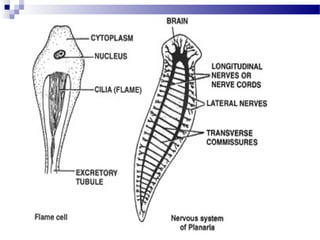
Protonephridia
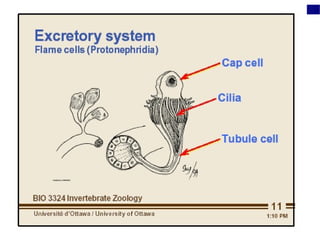
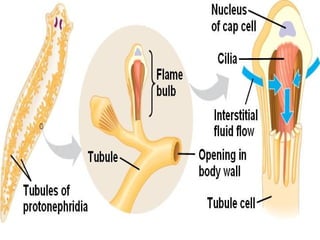
 One end of the tubule opens through a small pore
to the exterior. The other end of the tube ends
blindly within the body in a spherical structure
containing long cilia - these are called flame cells
 Excess water (and possibly wastes) enters the
flame cell system and is propelled through the
tubules toward the outside by the beating of the
cilia (the "flame").
 Protonephridia
Branches terminate in blind flame cells.
 Flame cells have slits that penetrate the cell
 Slits are crossed by filaments or a membrane that
reduce the effective pore size
 Slits act as an ultrafilter to keep back large proteins
 Filtrate of mesenchymal intercellular fluid enters
tubule.
 Inorganic and organic materials actively
reabsorbed in tubule; remainder is excreted
Excretory
pores
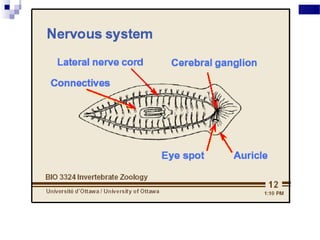
Nervous System
 More organized
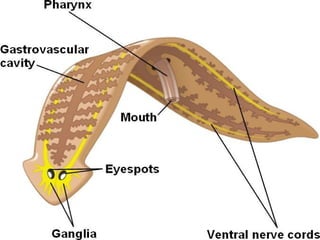
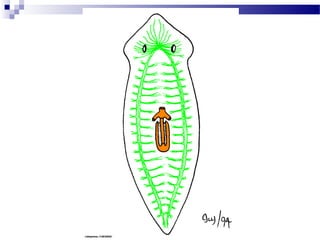
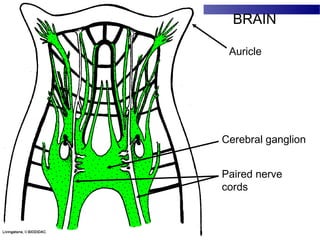
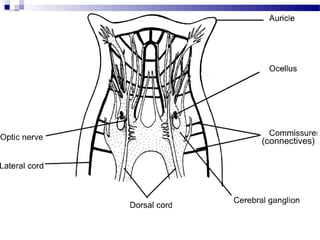
 Two cerebral ganglia= “brain”
 Short nerves extend to the anterior end
and the eyes, and two longitudinal nerve
cords pass back
 With many transverse connectives and
peripheral nerves
 Nervous system and sensory organs
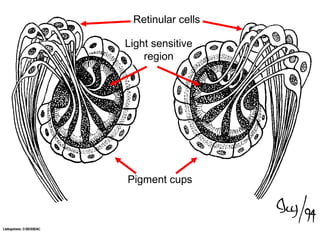
Dorsal, anterior eyes
Ciliated pits behind auricles on head are
probably chemosensors
Dorsal, bilobed brain underlays eyes
Primitively 3-4 pairs of longitudinal nerve
cords
 Reduced to two longitudinal ventral nerve cords
 Run down length of body with numerous cross
connections and branches in most groups.
Auricle
Cerebral ganglion
Paired nerve
cords
BRAIN
(connectives)
Retinular cells
Pigment cups
Light sensitive
region
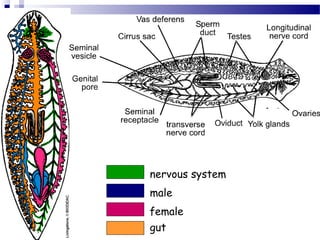
male
female
gut
nervous system
Reproductive System
and
Reproduction
 There are two types of reproduction;
 asexual reproduction
 sexual reproduction
Asexual Reproduction
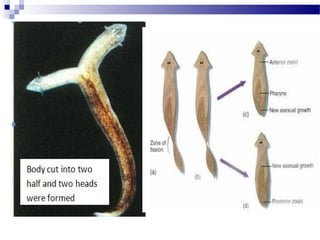
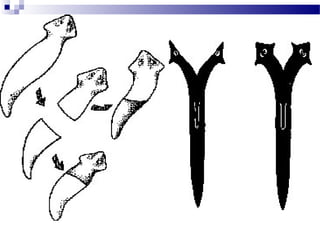
 They reproduce asexually by transverse
fission (split into two) and have great
regenerative capabilities. This means that
if a part of their body is cut into half, they
are able to grow the lost body part within a
period of time.
Sexual Reproduction
 Most Turbellarians are hermaphroditic,
meaning that they contain the male and
the female sex organs. However, they are
unable to self-fertilize and thus need the
sperm of other turbellarians to fertilize the
egg.
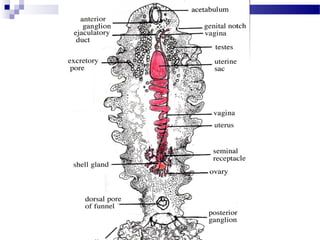
The MALE Reproductive System
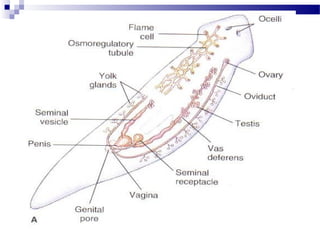
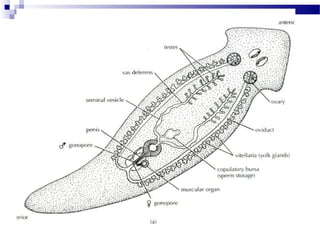
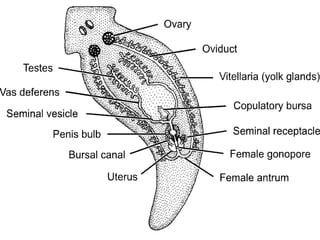
 Several hundred small spherical testes
along both sides of the body, each connected
by,
 a minute ductus eferens to,
 A larger ductus deferens: the 2 ducts enter
 Median seminal vesicle for sperm storage,
connects to,
 Muscular penis opening into.
 Genital atrium, just within the genital pore
The FEMALE Reproductive System
 2 rounded ovaries, connecting to,
 Two oviducts
 Along each duct are: many yolk or vitelline glands,
which supply yolk cells when eggs are produced
 the 2 oviducts join the median vagina opening into,
 The genital atrium, to the vagina is connected
 A bulbous copulatory sac that receives sperm at
mating
 Soon the sperm move to the seminal receptacles
which are slight enlargement between the ovaries
and oviducts.
REPRODUCTION
 Cross-fertilization- exchange of sex
products between separate individual
 Internal fertilization- direct transfer
of sperm from male to female organ
 Development is direct
Ecology and Evolution
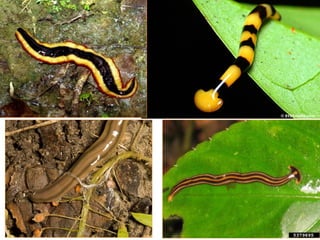
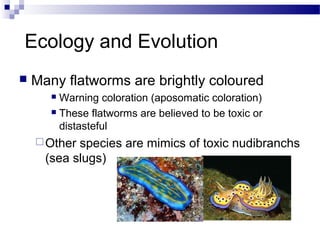
 Many flatworms are brightly coloured
 Warning coloration (aposomatic coloration)
 These flatworms are believed to be toxic or
distasteful
Other species are mimics of toxic nudibranchs
(sea slugs)
Other Turbellaria
 ACOELA
 Have mouth but without digestive cavity
 Lacks excretory organ
 Have no distinct gonads
 Nervous system is an epidermal net system
 Free living and others live in the intestines of
sea urchins and sea cucumbers
CLASS
TREMATODA
Flukes
Characteristics
 All parasitic, mostly in vertebrates
 Covered externally by a non-ciliated syncytium
(tegument)
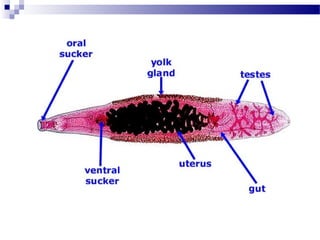
 Oral sucker surrounds mouth
 Ventral sucker used for attachment
 Mouth is anterior
 Digestive tract is -shaped,, with 2 main trunks
and smaller branches
 Complex life cycles (involving at least one
intermediate host)
 The food consists of the tissues or body fluids
of the host, which are sucked in by action of
the muscular pharynx
 Are more like turbellarians
 Complex muscle layers, excretory organs,
and a nervous system
 Parasitic life, the development of a resistant
cuticle, suckers, and hooks and general lack
of sense organs.
 Sensory organs, such as dorsal eyespots
occur in some larve and in some flukes that
are ectoparasites.
Subclass Monogenea
 Inhabit only one host
 Ectoparasites of fishes, amphibians, and
reptiles, but some inhabit the mouth
cavities or urinary bladders.
 At the posterior end is a well-developed
adhesive organ with one or more suckers
and chitinous hooks or anchors
 Cross-fertilization
 Development is direct adult form
Subclass Aspidobothrea
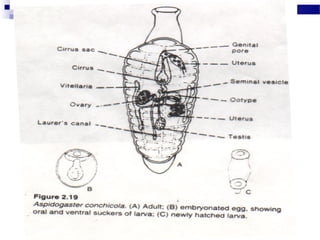
 Internal parasite of lower vertebrates
and mollusks and have but a single host
 Characterized by huge adhesive
structure (sucker) covering the whole
ventral part of the body
 They show features of both Monogenea
and Digenea and may have one or two
hosts.
Subclass Digenea
 Largest group of trematodes
 All internal parasites
 Must live in two or more host species to
complete the life cycle, larvae in a certain
snail (intermediate host) and the adult in
some vertebrate (primary host)
 Live in the parts of digestive tract, lungs,
urinary bladder, blood vessels, or other
organs
Sheep liver fluke
 Common liver fluke or Fasciola hepatica
 Inhabits the bile ducts and sometimes
invades other organs
 Commonest in sheep and cattle but is
sometimes found in other mammals and
occasionally in humans, producing the
disease known as liver rot or fasciolosis
 One of the largest flukes of the world,
reaching a length of 30mm and a width of
13mm
 It is leaf shaped, pointed posteriorly and wide
interiorly
 The anterior sucker is terminal surrounding
the mouth, and close behind is the ventral
(posterior) sucker for attachment in host
 Between them the genital opening
 Digestive system: mouth, muscular pharynx,
short esophagus, and two branched enteron.
Muscles are complex
Excretory has many flame cells
Nervous system: double ganglion,
2 lengthwise nerve cords, and
various nerves
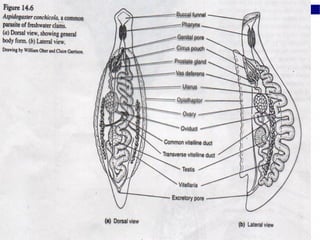
Hermaphroditic
 The testes are large and greatly
branched, arranged in tandem behind the
ovary.
 The smaller, dendritic ovary lies on the
right side, coiling between the ovary and
the preacetabular cirrus pouch. Vitelline
follicles are extensive, filling most of the
lateral body and becoming confluent
behind the testes.
Fasciola hepatica
 Commonly known as the sheep liver fluke
 Important parasite of sheep and cattle
(other grazers) can be found in humans.
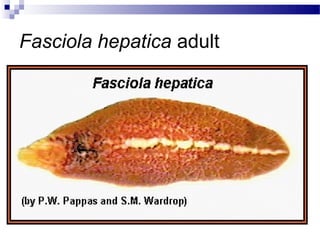
 Morphology
Large size, frequently over 30 mm long
Characteristic cone-shaped projection at
anterior end followed by wide shoulders
Fasciola hepatica adult
Fasciola hepatica: Trematode
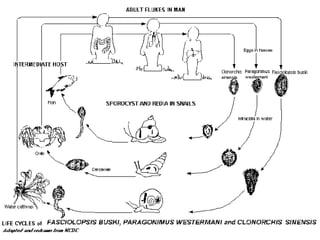
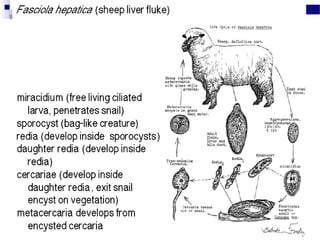
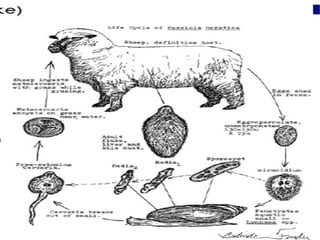
Life Cycle Representative
 Ova or egg
 Miracidium
 Sporocyst
 (Daughter sporocyst, or redia)
 Cercaria
 Metacercaria
 Adult
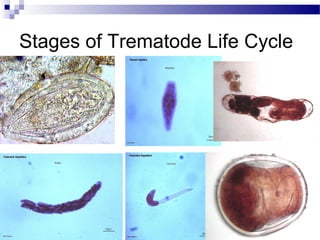
Stages of Trematode Life Cycle
 Ova or egg - shelled embryo.
Contains miracidium inside shell
Under appropriate conditions, the operculum
(cap on shell) opens to allow miracidium to
escape.
Many of flukes have very distinctive eggs.
Stages of Trematode Life Cycle
 Miracidium
Ciliated organism that can be mistaken for a
ciliated protozoan.
In species that hatch in water, it contains
penetration glands that release histolytic or
proteolytic enzymes to help penetrate snail
Some species do not hatch until eaten by
snail host.
Stages of Trematode Life Cycle
 Sporocyst
The miracidium develops into sporocyst often
in the digestive gland of the snail.
The sporocyst is an embryonic bag or
germinal sac.
The sporocyst will produce many daughter
stages called rediae or in some cases
daughter sporocysts.
Stages of Trematode Life Cycle
 Rediae or Daughter Sporocyst
In function they are very similar to sporocysts.
Contain digestive tract and are more active
Asexually reproduce to yield many cercariae.
Some species they can live for many years.
Stages of Trematode Life Cycle
 Cercariae
Usually escape snail and often swim by some
means of tail structure.
Responsible for transmission from snail to the
next host.
Stages of Trematode Life Cycle
 Metacercaria
Resistant stage that is formed in many
species
Cercaria that have this stage contain
cystogenic glands that helps the organism
encyst on vegetation.
Cercaria that form metacercaria in second
intermediate hosts, often have penetration
glands that enable them to penetrate the
second intermediate host.
Stages of Trematode Life Cycle
 Adult
Always found in the definitive host
Responsible for sexual reproduction
Often restricted to specific region of host.
Often very host specific.
Stages of Trematode Life Cycle
 .
Fasciola hepatica
 Adult in bile duct of definitive host passes
eggs in feces.
 If eggs land in water, they hatch into
miracidium that actively swims until it finds
an appropriate snail. (Galba truncatula)
 Penetrates snail, develops into germinal
sac (sporocyst), asexual stages of rediae
and cercariae formed.
Fasciola hepatica
 Cercariae leave snail, encyst on
vegetation, and form metacercaria.
 Herbivore infected when it ingests
vegetation with metacercaria.
 Metacercaria develop into adult
penetrates gut wall, moves to the liver.
 Humans infected by eating watercress that
has metacercaria on it.
Schistosoma sp.
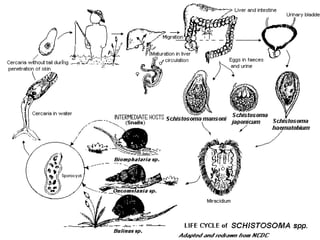
 Adult worms are found in blood vessels of
digestive tract or urinary bladder thus
called blood flukes
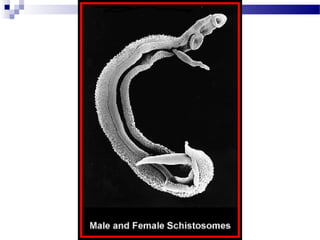
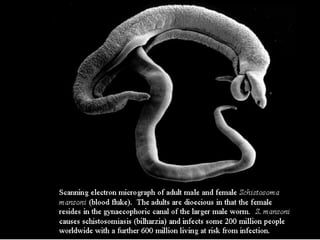
 male worm has a split body called the
gynecophoral canal. The female is
usually found within this canal “safe in the
arms of her lover.” She leaves only during
the egg laying period.
Schistosomiasis
 Migratory phase - 4-10 weeks after
infection. Is characterized by fever and
toxic or allergic reactions resulting from
migration of immature organisms. Often
results in bronchitis, hepatomegaly,
splenomegaly, and diarrhea.
Schistosomiasis
 Acute phase - 10 weeks to years. Eggs
can become trapped and produce
granulomas and scar tissue.
 Form fibrous nodules called pseudotubules.
Eggs may lodge in gastrointestinal, renal,
neural, and other systems.
 A person infected with 50 mating pairs would be
exposed to about 15,000 eggs per day for several
years. ½ of eggs might remain trapped in tissues.
Schistosomiasis
 Chronic phase - persons living in endemic
regions are often asymptotic. May have
mild, chronic bloody stools or urine. Often
have formation of granulomas.
Hepatomegaly, Spleenomegaly, Ascites
(accumulation of fluid in abdominal cavity
fig 16.17, page 245.
Epidemiology
 Human waste into water.
 Moslem religious practice of ablution
 Agricultural projects
 Irrigation extends snail habitats
 Use of night soil (human feces)
 Planting and harvesting of water crops
 Dependence of people on rivers.
Epidemiology
 Before the Aswan Dam was built, the
region between Cairo and Aswan was
subject to annual floods. The prevalence
of Schistosomiasis was only about 5%.
Four
 years after completion of the dam the
prevalence ranged from 19%-75%
(average 35%) or a 7 fold increase.
Schistosoma sp.
 Important parasites of man and some
domesticated animals
 Three species infect man
 Schistosoma mansoni
 Schistosoma japonicum
 Schistosoma haematobium
 similar see table 16.1 pg 237 for
differences
Schistosoma japonicum.
 Common in parts of Japan, China,
Taiwan, Philippines, Thailand, and other
parts of Southeast Asia.
 Most pathogenic and most difficult to
control
 Located in blood vessels of small
intestine.
 Eggs may lodge in brain causing CNS
damage, coma, and paralysis.
Schistosoma mansoni
 Common in Egypt, the Middle East, parts
of Africa, and parts of South and Central
America.
 Found in portal veins draining large
intestine
 The sharp lateral spine is distinctive
 Primary pathological effects come from
the damage done by eggs.
Schistosoma mansoni
 In heavy infections eggs become trapped
in the mucous and submucosa of the gut
and cause granuloma formation
 If extensive, they can cause colon
blockage and significant blood loss.
 In liver can cause hepatomegaly.
 Destruction of lungs and heart tissue.
 Reservoir hosts are of limited or no
importance
Schistosoma haematobium
 often referred to as Bilharzia after
Theodore Bilharz who discovered it.
 found in parts of Africa, and parts of the
Middle East, southern Europe and some
parts of Asia.
 Found primarily in the veins of the urinary
bladder. Eggs released in urine.
 They are least pathogenic
Diagnosis, Treatment, and
Control
 Finding eggs in feces or urine
 Biopsy - in chronic cases if eggs not
passed
 Treatment - very difficult - page 245-246.
 Control is very difficult
Customs and traditions
Agricultural practices
Socioeconomics
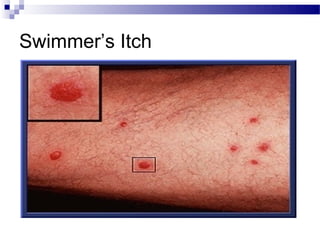
Schistosome cercarial
dermatitis or swimmers itch
 Schistosomes of animals other than man
(usually rodents and birds) try to penetrate
the skin of man, they can not establish
themselves in the blood vascular system
of man.
 Often cause a dermatitis which can be
severe and in some cases life threatening.
 Allergic reaction
Swimmer’s Itch
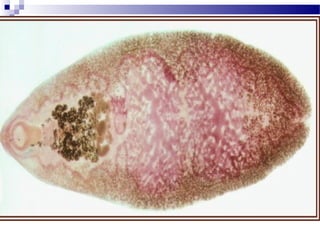
Fasciolopsis buski -
Intestinal fluke of man
 large fluke infects man when he ingests
metacercaria found on vegetation
including water chestnuts, bamboo, and
water caltrop.
 eat these raw or peel or crack with teeth.
 elimination of feces (human and animal)
into water and use of night soil for farming
Fasciolopsis buski -
 Pathology
Blockage of food passage or interference with
normal digestive processes
Destruction of intestinal tissue resulting in
ulcers, hemorrhages, and abscesses
formation
Chronic diarrhea
 Verminous intoxication - result of absorption
of parasite metabolites (waste products), can
lead to death.
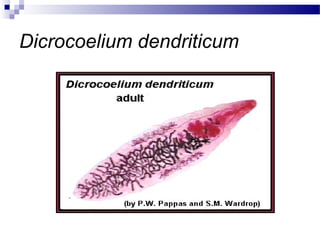
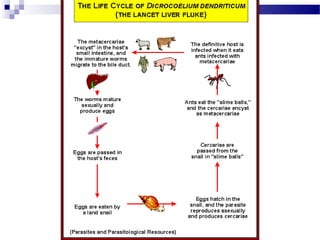
Dicrocoelium dendriticum
 Common parasite of herbivores, rare in
man
 Not dependent upon aquatic environment
 Eggs eaten by land snail (asexual
reproduction occurs producing cercariae.
 Cercariae surrounded forming slime balls.
 Ant eats slime ball and metacercaria
develop.
 Herbivore infected by ingesting ant.
Dicrocoelium dendriticum
 Modification of host behavior
 Causes ant to climb to tips of grasses
early morning and late evenings.
 Increases odds of ant being eaten.
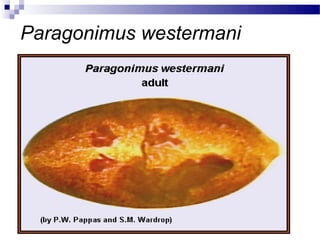
Paragonimus westermani
 the human lung fluke, it is found in the
Orient including India and Philippines
 Definitive host becomes infected by eating
improperly cooked crustacean. Adult
infections become established in lungs but
larval forms may wander into brain, pleura,
mesentery, etc.(ectopic infection).
Paragonimus westermani
 Reservoir hosts include - dogs, cats, pigs,
rodents, and other animals
 Man becomes infected by eating
improperly cooked crabs, ingestion of
metacercaria from cutting boards where
salads are fixed, medicinal use of crab
juices)
 Smoked or pickled crab do not kill
Paragonimus westermani
Pathology
 Early invasive stages usually asymptomatic.
 In the lung or ectopic site, connective tissue
forms pseudotubertules. In the CNS, they can
cause paralysis and in rare cases can be fatal.
In the heart they can cause severe damage and
can be fatal.
 Lung infections cause chronic cough, bloody
sputum, pneumonia -like conditions.
Paragonimus westermani
 Prevention includes
 Cooking of crabs, crayfish
 Care when eating salads, no crab juice.
 Proper disposal of feces and sputum.
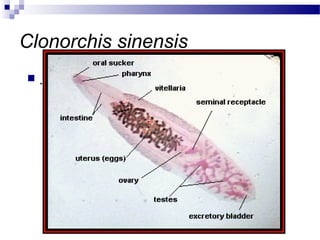
Clonorchis sinensis
(Opistochonorchis sinensis)
 Commonly called the Chinese liver fluke,
Asian liver fluke, Oriental liver fluke, and
Human liver fluke
 Common in Orient including Japan, China,
Korea, Taiwan, Viet Nam.
 Many immigrants from Orient living in the
United States are infected.
Clonorchis sinensis
 Man becomes infected by eating
improperly cooked fish containing
metacercaria.
 Metacercaria may contaminate other
foods such as salads, etc.
 Smoking, drying, pickling fish often fails to
kill the metacercaria.
Clonorchis sinensis
 .
CLASS
CESTODA
TAPEWORMS
Characteristics
 Mostly slender and elongate
 With flat body usually of many short similar
sections
 Complete lack of Digestive system
 They lack cilia
 Covered with tegument
 Have complex muscle layers, parenchyma,
paired excretory ducts with flame cells, and
nerve ring with 3 pairs of nerve cords.
 Food is absorbed directly through body
wall
 All are endoparasites, the adult worms is
in the intestines of vertebrates and the
larvae in tissues of some alternate host.
 Defining characteristics
 Scolex
 Proglottids
Subclass CESTODARIA
 Small worms lacking a scolex
 each with sucker for attachment
 the body undivided
 one set of reproductive organs
 Similar in outward appearance to
trematodes
 But the larva is like tapeworm and LACK
digestive tract.
Subclass EUCESTODA
 Have scolex
 Ex: Taenia solium (pork tapeworm of humans)
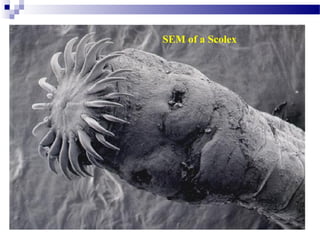
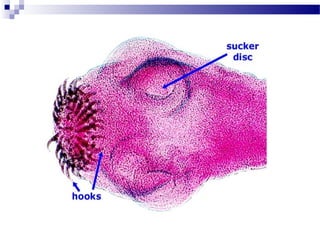
 SCOLEX “head” - a minute knoblike with four
muscular suckers or sucker disc on the side and
a circle of hooks on the elevated tip, or
rostellum.
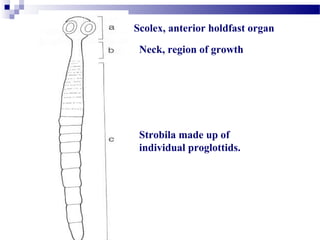
 A short “neck”, or budding zone, joins the scolex
to the body, or strobila, which consist s of a
series of up to 1000 proglottids.
Scolex, anterior holdfast organ
Neck, region of growth
Strobila made up of
individual proglottids.
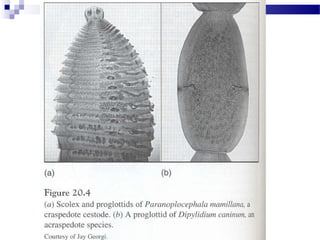
SEM of a Scolex
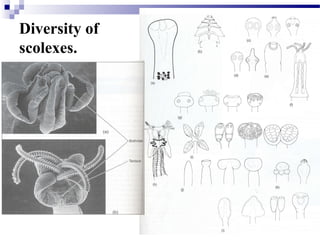
Diversity of
scolexes.
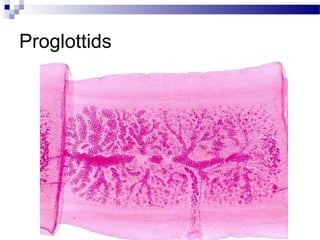
Proglottids
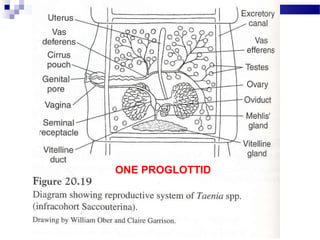
ONE PROGLOTTID
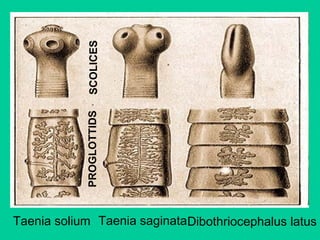
Taenia saginata
Taenia solium Dibothriocephalus latus
SCOLICES
PROGLOTTIDS
 The suckers and the hooks serve to fasten
the scolex to the intestinal wall of the host.
 Scolex contain nerve ring
 Each proglottid contains muscle,
parenchyma, sections of the excretory
canals connected by a cross canal, many
flame cells in the nerves
 Complete set of both male and female sex
organs develops in every prolottids
Since individual prolottid has a
complete set of both male and
female sex organs…
DO YOU THINK IT IS POSSIBLE
FOR EVERY PROGLOTTID TO
FERTILIZE ANOTHER
PROGLOTTID????
JUSTIFY!!!
Fact.
 Self-fertilization between the systems in
one proglottid or in sepatarete proglottids
or cross-fertilization between parts in two
worms in one host are all possible.
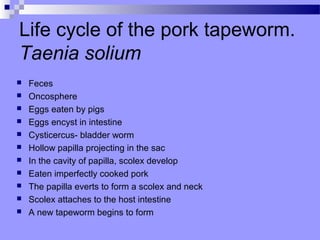
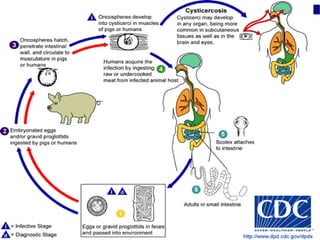
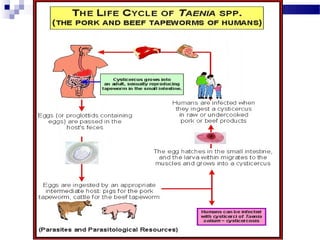
Life cycle of the pork tapeworm.
Taenia solium
 Feces
 Oncosphere
 Eggs eaten by pigs
 Eggs encyst in intestine
 Cysticercus- bladder worm
 Hollow papilla projecting in the sac
 In the cavity of papilla, scolex develop
 Eaten imperfectly cooked pork
 The papilla everts to form a scolex and neck
 Scolex attaches to the host intestine
 A new tapeworm begins to form
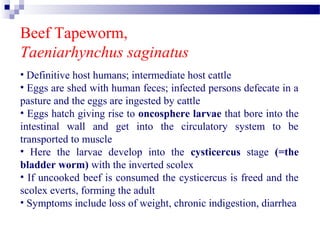
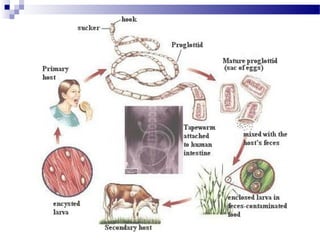
Beef Tapeworm,
Taeniarhynchus saginatus
• Definitive host humans; intermediate host cattle
• Eggs are shed with human feces; infected persons defecate in a
pasture and the eggs are ingested by cattle
• Eggs hatch giving rise to oncosphere larvae that bore into the
intestinal wall and get into the circulatory system to be
transported to muscle
• Here the larvae develop into the cysticercus stage (=the
bladder worm) with the inverted scolex
• If uncooked beef is consumed the cysticercus is freed and the
scolex everts, forming the adult
• Symptoms include loss of weight, chronic indigestion, diarrhea
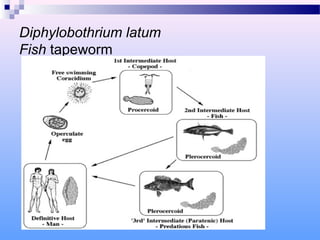
Diphylobothrium latum
Fish tapeworm
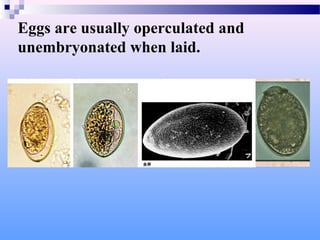
Eggs are usually operculated and
unembryonated when laid.
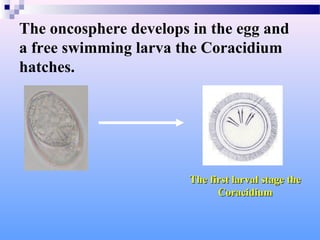
The oncosphere develops in the egg and
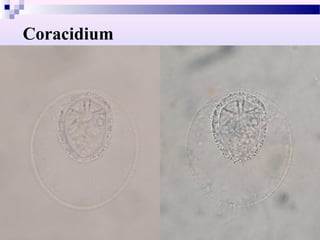
a free swimming larva the Coracidium
hatches.
The first larval stage the
Coracidium
Coracidium
Coracidium
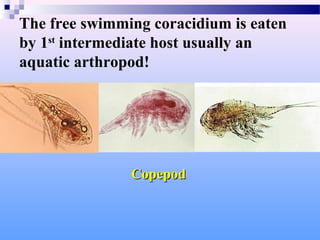
The free swimming coracidium is eaten
by 1st
intermediate host usually an
aquatic arthropod!
Copepod
Copepod
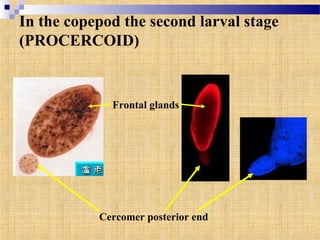
In the copepod the second larval stage
(PROCERCOID)
Frontal glands
Cercomer posterior end
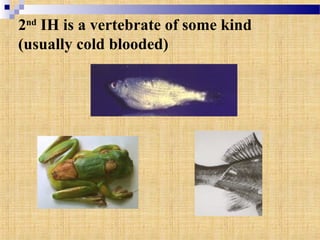
2nd
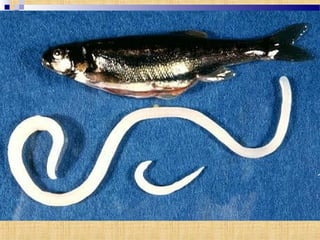
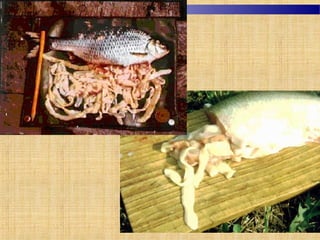
IH is a vertebrate of some kind
(usually cold blooded)
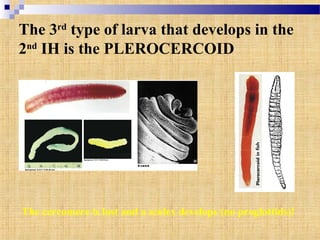
The 3rd
type of larva that develops in the
2nd
IH is the PLEROCERCOID
The cercomere is lost and a scolex develops (no proglottids)!
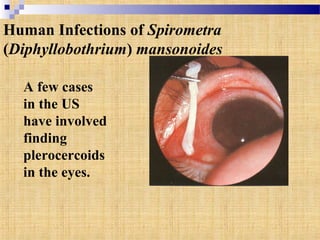
Human Infections of Spirometra
(Diphyllobothrium) mansonoides
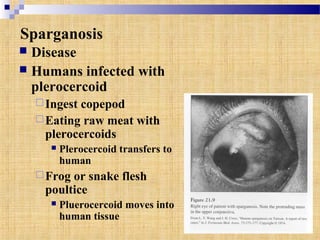
A few cases
in the US
have involved
finding
plerocercoids
in the eyes.
Sparganosis
 Disease
 Humans infected with
plerocercoid
Ingest copepod
Eating raw meat with
plerocercoids
 Plerocercoid transfers to
human
Frog or snake flesh
poultice
 Pluerocercoid moves into
human tissue
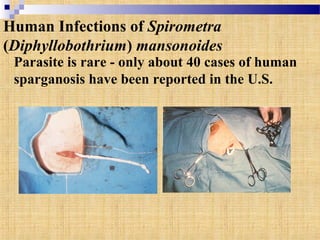
Parasite is rare - only about 40 cases of human
sparganosis have been reported in the U.S.
Human Infections of Spirometra
(Diphyllobothrium) mansonoides
Sparganosis
 Seriousness depends on
Where plerocercoid establishes
Number
If reproduction occurs
 Removed by surgery
ADJUSTMENT TO PARASITIC
LIFE
1. The integument protects against digestion
by host alkaline digestive juices but is
freely permeable to water and nutrients.
o Nutrients—mostly amino acids and simple
sugars broken down from complex molecules
by the host
o Adults—resistant to alkaline pancreatic juice
2. The internal osmotic pressure is lower
than that of the surrounding host fluid or
tissue.
3. The pH tolerance is high, 4 to 11.
4. The tissues have high glycogen content
(to 60% of dry weight) and much lipid but
far less protein.
 Fatty acid are derived from anaerobic metabolism of
glycogen
 Carbohydrates in the host diet induces growth ,
longevity , and production
5. Oxygen is used in respiration if
available, but anaerobic
predominates.
6. Eggs eaten by the intermediate host
must experience both acid and alkali.
Hence are released only in the
intestine.
Adaptations of parasites in
general:
1. Sense organs are usually much reduced
or absent
2. Some mechanism of attachment to the
host tissue is developed (hooks, suckers)
3. There is increased egg production
coupled with a larval stage to facilitate
survival and infection of new host.
Thank you for
listening!
flatwormscycycy-130318192346-phpapp02.pdf

flatwormscycycy-130318192346-phpapp02.pdf

  • 2.
  • 3.
    CHARACTERISTICS  Acoelomate -Hey, where’s my cavity?  Dorsoventrally flattened  Triploblastic  Embryo has 3 cell layers  Ectoderm (cnidarians)  Endoderm (cnidarians)  AND NOW, introducing MESODERM!
  • 4.
  • 6.
     Bilateral symmetry-with external and internal features arranged symmetrically on either side of a median or sagital plane Bilateral symmetry: active mode; Biradial symmetry: sedentary life ADVANCEMENTS:  Nervous system  Anterior brain  Paired ventral nerve cords  Longitudinal  Incomplete gut (Digestive system)  No anus  Food exits via mouth
  • 7.
     Excretory system& osmoregulation Diffusion across body wall Protonephridia  Specialized excretory organs  May also help osmoregulate  Formed reproductive organ
  • 8.
    CLASSIFICATION  Phylum Platyhelminthes Classes Turbellaria:free-living flatworms Trematoda: flukes All are parasites Cestoda: tapeworms All are parasites
  • 9.
  • 10.
    Class Turbellaria  Freeliving Freshwater  Planarians such as Dugesia A few inhabit terrestrial (moist) habitats
  • 11.
    STRUCTURE  Dugesia isa thin, slender, soft worm about 15mm long, bluntly triangular anterior end, or “head,” and a tapered body patterned with dark pigment.  Head region bears two black eyespots middorsally  The mouth is on ventral surface near the middle of the body
  • 12.
     Through ita tubular pharynx, or proboscis, with muscular walls can be extended to capture food.  Excretory openings, present laterally on the dorsal surface but are difficult to see.  Genital pore, mature worm has it on the ventral surface behind the mouth.  Body covered by epidermis of single layer of cuboidal to columnar cells.
  • 13.
  • 15.
     The epidermalcells contain small bodies called rhabdites, and many deep-lying unicellular glands that open the surface.  Gland cells produce mucus.  Ventral epidermis is covered with cilia for locomotion  Beneath the basement membrane are the layers of muscle fibers, circular, longitudinal, and diagonal, also dorsoventral fibers.
  • 17.
     Spaces betweenthe muscles and internal organs are filled with parenchyma (mesenchyme)  There is no body cavity  In the parenchyma are scattered free formative cells, which by mitosis produce new parts in regeneration.
  • 18.
    Class Turbellaria Marine species(beautiful colors)  Significant members of coral reef ecosystems Some are major predators of colonial ascidians (sea squirts) Others are pests of commercial clams and oysters  Some live symbiotically on a variety of reef invertebrates
  • 25.
    Class Turbellaria  Locomotion Usuallyby cilia  Dugesia can move at about 1.5 mm/sec Peristaltic waves can achieve higher velocities  Marine flatworms can use this to swim gracefully
  • 27.
    Class Turbellaria  Locomotion Terrestrialplanarians  Glide smoothly on the substrate by the action of powerful, closely spaced cilia in a special medial ventral strip (creeping sole), on a thin coat of mucus secreted on the substrate by glands opening into the creeping sole  Planarians that migrate on plants or objects above the ground sometimes lower themselves to the ground on a string of mucus.
  • 29.
    ORGAN SYSTEMS  NORespiratory System  NO Skeletal System
  • 30.
    Muscular System  Belowthe epidermis are layers of circular and longitudinal muscle fibers; used in locomotion
  • 33.
    Class Turbellaria  FeedingEcology Most turbellarians are carnivorous predators or scavengers.  Carnivores feed on organisms that they can fit into their mouths, such as protozoans, copepods, small worms, and minute mollusks.  Some species use mucus that may have poisonous or narcotic chemicals to slow or entangle prey.  Some have specific diets and feed on sponges, ectoprocts, barnacles, and tunicates.  Several species have commensal relationships with various invertebrates
  • 34.
     Feeding andDigestion The pharynx is protruded from the mouth and into the prey.  The pharynx and gut cells produce digestive enzymes that breakdown food extracellularly.  Because these worm lack a circulatory system, larger species have extensive anastomosing guts to aid in distribution.  Since these worms have incomplete guts, all waste must pass back out of the mouth.
  • 35.
  • 37.
     Nutrition Planaria storefood in digestive epithelium and can survive many weeks shrinking slowly in size without feeding. They are capable of utilizing their own tissues such as reproductive tissue for food when reserves are exhausted. Lab animals often tend to shrink in size when not fed properly
  • 39.
    Digestive system Ventral mouth Muscularpharynx A blind intestine (details depend on order)  Tricladida — 10-20 mm long  Tripartite gut; one main anterior branch and two main posterior branches with numerous blind pockets off all three. Dugesia  Polycladida — up to 5 cm long  Gut has numerous branches ramifying throughout the body.
  • 40.
  • 41.
    Excretory System  ProtonephridialSystem- comprises 2 longitudinal ducts connecting to a network of tubules that branch throughout the body and end in in many large flame cells.  Flame cells- they collect excess water or fluid wastes  Osmoregulation-removing excess fluids from the organism, although small amounts of ammonia are also removed.
  • 42.
    Class Turbellaria Protonephridia  Oneend of the tubule opens through a small pore to the exterior. The other end of the tube ends blindly within the body in a spherical structure containing long cilia - these are called flame cells  Excess water (and possibly wastes) enters the flame cell system and is propelled through the tubules toward the outside by the beating of the cilia (the "flame").
  • 43.
     Protonephridia Branches terminatein blind flame cells.  Flame cells have slits that penetrate the cell  Slits are crossed by filaments or a membrane that reduce the effective pore size  Slits act as an ultrafilter to keep back large proteins  Filtrate of mesenchymal intercellular fluid enters tubule.  Inorganic and organic materials actively reabsorbed in tubule; remainder is excreted
  • 44.
  • 48.
    Nervous System  Moreorganized  Two cerebral ganglia= “brain”  Short nerves extend to the anterior end and the eyes, and two longitudinal nerve cords pass back  With many transverse connectives and peripheral nerves
  • 49.
     Nervous systemand sensory organs Dorsal, anterior eyes Ciliated pits behind auricles on head are probably chemosensors Dorsal, bilobed brain underlays eyes Primitively 3-4 pairs of longitudinal nerve cords  Reduced to two longitudinal ventral nerve cords  Run down length of body with numerous cross connections and branches in most groups.
  • 52.
  • 53.
  • 54.
  • 55.
  • 57.
    Reproductive System and Reproduction  Thereare two types of reproduction;  asexual reproduction  sexual reproduction
  • 58.
    Asexual Reproduction  Theyreproduce asexually by transverse fission (split into two) and have great regenerative capabilities. This means that if a part of their body is cut into half, they are able to grow the lost body part within a period of time.
  • 61.
    Sexual Reproduction  MostTurbellarians are hermaphroditic, meaning that they contain the male and the female sex organs. However, they are unable to self-fertilize and thus need the sperm of other turbellarians to fertilize the egg.
  • 62.
    The MALE ReproductiveSystem  Several hundred small spherical testes along both sides of the body, each connected by,  a minute ductus eferens to,  A larger ductus deferens: the 2 ducts enter  Median seminal vesicle for sperm storage, connects to,  Muscular penis opening into.  Genital atrium, just within the genital pore
  • 63.
    The FEMALE ReproductiveSystem  2 rounded ovaries, connecting to,  Two oviducts  Along each duct are: many yolk or vitelline glands, which supply yolk cells when eggs are produced  the 2 oviducts join the median vagina opening into,  The genital atrium, to the vagina is connected  A bulbous copulatory sac that receives sperm at mating  Soon the sperm move to the seminal receptacles which are slight enlargement between the ovaries and oviducts.
  • 67.
    REPRODUCTION  Cross-fertilization- exchangeof sex products between separate individual  Internal fertilization- direct transfer of sperm from male to female organ  Development is direct
  • 71.
    Ecology and Evolution Many flatworms are brightly coloured  Warning coloration (aposomatic coloration)  These flatworms are believed to be toxic or distasteful Other species are mimics of toxic nudibranchs (sea slugs)
  • 72.
    Other Turbellaria  ACOELA Have mouth but without digestive cavity  Lacks excretory organ  Have no distinct gonads  Nervous system is an epidermal net system  Free living and others live in the intestines of sea urchins and sea cucumbers
  • 73.
  • 74.
    Characteristics  All parasitic,mostly in vertebrates  Covered externally by a non-ciliated syncytium (tegument)  Oral sucker surrounds mouth  Ventral sucker used for attachment  Mouth is anterior  Digestive tract is -shaped,, with 2 main trunks and smaller branches  Complex life cycles (involving at least one intermediate host)
  • 75.
     The foodconsists of the tissues or body fluids of the host, which are sucked in by action of the muscular pharynx  Are more like turbellarians  Complex muscle layers, excretory organs, and a nervous system  Parasitic life, the development of a resistant cuticle, suckers, and hooks and general lack of sense organs.  Sensory organs, such as dorsal eyespots occur in some larve and in some flukes that are ectoparasites.
  • 77.
    Subclass Monogenea  Inhabitonly one host  Ectoparasites of fishes, amphibians, and reptiles, but some inhabit the mouth cavities or urinary bladders.  At the posterior end is a well-developed adhesive organ with one or more suckers and chitinous hooks or anchors  Cross-fertilization  Development is direct adult form
  • 78.
    Subclass Aspidobothrea  Internalparasite of lower vertebrates and mollusks and have but a single host  Characterized by huge adhesive structure (sucker) covering the whole ventral part of the body  They show features of both Monogenea and Digenea and may have one or two hosts.
  • 81.
    Subclass Digenea  Largestgroup of trematodes  All internal parasites  Must live in two or more host species to complete the life cycle, larvae in a certain snail (intermediate host) and the adult in some vertebrate (primary host)  Live in the parts of digestive tract, lungs, urinary bladder, blood vessels, or other organs
  • 82.
    Sheep liver fluke Common liver fluke or Fasciola hepatica  Inhabits the bile ducts and sometimes invades other organs  Commonest in sheep and cattle but is sometimes found in other mammals and occasionally in humans, producing the disease known as liver rot or fasciolosis
  • 83.
     One ofthe largest flukes of the world, reaching a length of 30mm and a width of 13mm  It is leaf shaped, pointed posteriorly and wide interiorly  The anterior sucker is terminal surrounding the mouth, and close behind is the ventral (posterior) sucker for attachment in host  Between them the genital opening  Digestive system: mouth, muscular pharynx, short esophagus, and two branched enteron.
  • 84.
    Muscles are complex Excretoryhas many flame cells Nervous system: double ganglion, 2 lengthwise nerve cords, and various nerves Hermaphroditic
  • 85.
     The testesare large and greatly branched, arranged in tandem behind the ovary.  The smaller, dendritic ovary lies on the right side, coiling between the ovary and the preacetabular cirrus pouch. Vitelline follicles are extensive, filling most of the lateral body and becoming confluent behind the testes.
  • 86.
    Fasciola hepatica  Commonlyknown as the sheep liver fluke  Important parasite of sheep and cattle (other grazers) can be found in humans.  Morphology Large size, frequently over 30 mm long Characteristic cone-shaped projection at anterior end followed by wide shoulders
  • 87.
  • 88.
    Fasciola hepatica: Trematode LifeCycle Representative  Ova or egg  Miracidium  Sporocyst  (Daughter sporocyst, or redia)  Cercaria  Metacercaria  Adult
  • 89.
    Stages of TrematodeLife Cycle  Ova or egg - shelled embryo. Contains miracidium inside shell Under appropriate conditions, the operculum (cap on shell) opens to allow miracidium to escape. Many of flukes have very distinctive eggs.
  • 90.
    Stages of TrematodeLife Cycle  Miracidium Ciliated organism that can be mistaken for a ciliated protozoan. In species that hatch in water, it contains penetration glands that release histolytic or proteolytic enzymes to help penetrate snail Some species do not hatch until eaten by snail host.
  • 91.
    Stages of TrematodeLife Cycle  Sporocyst The miracidium develops into sporocyst often in the digestive gland of the snail. The sporocyst is an embryonic bag or germinal sac. The sporocyst will produce many daughter stages called rediae or in some cases daughter sporocysts.
  • 92.
    Stages of TrematodeLife Cycle  Rediae or Daughter Sporocyst In function they are very similar to sporocysts. Contain digestive tract and are more active Asexually reproduce to yield many cercariae. Some species they can live for many years.
  • 93.
    Stages of TrematodeLife Cycle  Cercariae Usually escape snail and often swim by some means of tail structure. Responsible for transmission from snail to the next host.
  • 94.
    Stages of TrematodeLife Cycle  Metacercaria Resistant stage that is formed in many species Cercaria that have this stage contain cystogenic glands that helps the organism encyst on vegetation. Cercaria that form metacercaria in second intermediate hosts, often have penetration glands that enable them to penetrate the second intermediate host.
  • 95.
    Stages of TrematodeLife Cycle  Adult Always found in the definitive host Responsible for sexual reproduction Often restricted to specific region of host. Often very host specific.
  • 96.
    Stages of TrematodeLife Cycle  .
  • 99.
    Fasciola hepatica  Adultin bile duct of definitive host passes eggs in feces.  If eggs land in water, they hatch into miracidium that actively swims until it finds an appropriate snail. (Galba truncatula)  Penetrates snail, develops into germinal sac (sporocyst), asexual stages of rediae and cercariae formed.
  • 100.
    Fasciola hepatica  Cercariaeleave snail, encyst on vegetation, and form metacercaria.  Herbivore infected when it ingests vegetation with metacercaria.  Metacercaria develop into adult penetrates gut wall, moves to the liver.  Humans infected by eating watercress that has metacercaria on it.
  • 101.
    Schistosoma sp.  Adultworms are found in blood vessels of digestive tract or urinary bladder thus called blood flukes  male worm has a split body called the gynecophoral canal. The female is usually found within this canal “safe in the arms of her lover.” She leaves only during the egg laying period.
  • 105.
    Schistosomiasis  Migratory phase- 4-10 weeks after infection. Is characterized by fever and toxic or allergic reactions resulting from migration of immature organisms. Often results in bronchitis, hepatomegaly, splenomegaly, and diarrhea.
  • 106.
    Schistosomiasis  Acute phase- 10 weeks to years. Eggs can become trapped and produce granulomas and scar tissue.  Form fibrous nodules called pseudotubules. Eggs may lodge in gastrointestinal, renal, neural, and other systems.  A person infected with 50 mating pairs would be exposed to about 15,000 eggs per day for several years. ½ of eggs might remain trapped in tissues.
  • 107.
    Schistosomiasis  Chronic phase- persons living in endemic regions are often asymptotic. May have mild, chronic bloody stools or urine. Often have formation of granulomas. Hepatomegaly, Spleenomegaly, Ascites (accumulation of fluid in abdominal cavity fig 16.17, page 245.
  • 108.
    Epidemiology  Human wasteinto water.  Moslem religious practice of ablution  Agricultural projects  Irrigation extends snail habitats  Use of night soil (human feces)  Planting and harvesting of water crops  Dependence of people on rivers.
  • 109.
    Epidemiology  Before theAswan Dam was built, the region between Cairo and Aswan was subject to annual floods. The prevalence of Schistosomiasis was only about 5%. Four  years after completion of the dam the prevalence ranged from 19%-75% (average 35%) or a 7 fold increase.
  • 110.
    Schistosoma sp.  Importantparasites of man and some domesticated animals  Three species infect man  Schistosoma mansoni  Schistosoma japonicum  Schistosoma haematobium  similar see table 16.1 pg 237 for differences
  • 111.
    Schistosoma japonicum.  Commonin parts of Japan, China, Taiwan, Philippines, Thailand, and other parts of Southeast Asia.  Most pathogenic and most difficult to control  Located in blood vessels of small intestine.  Eggs may lodge in brain causing CNS damage, coma, and paralysis.
  • 112.
    Schistosoma mansoni  Commonin Egypt, the Middle East, parts of Africa, and parts of South and Central America.  Found in portal veins draining large intestine  The sharp lateral spine is distinctive  Primary pathological effects come from the damage done by eggs.
  • 113.
    Schistosoma mansoni  Inheavy infections eggs become trapped in the mucous and submucosa of the gut and cause granuloma formation  If extensive, they can cause colon blockage and significant blood loss.  In liver can cause hepatomegaly.  Destruction of lungs and heart tissue.  Reservoir hosts are of limited or no importance
  • 114.
    Schistosoma haematobium  oftenreferred to as Bilharzia after Theodore Bilharz who discovered it.  found in parts of Africa, and parts of the Middle East, southern Europe and some parts of Asia.  Found primarily in the veins of the urinary bladder. Eggs released in urine.  They are least pathogenic
  • 115.
    Diagnosis, Treatment, and Control Finding eggs in feces or urine  Biopsy - in chronic cases if eggs not passed  Treatment - very difficult - page 245-246.  Control is very difficult Customs and traditions Agricultural practices Socioeconomics
  • 116.
    Schistosome cercarial dermatitis orswimmers itch  Schistosomes of animals other than man (usually rodents and birds) try to penetrate the skin of man, they can not establish themselves in the blood vascular system of man.  Often cause a dermatitis which can be severe and in some cases life threatening.  Allergic reaction
  • 117.
  • 118.
    Fasciolopsis buski - Intestinalfluke of man  large fluke infects man when he ingests metacercaria found on vegetation including water chestnuts, bamboo, and water caltrop.  eat these raw or peel or crack with teeth.  elimination of feces (human and animal) into water and use of night soil for farming
  • 120.
    Fasciolopsis buski - Pathology Blockage of food passage or interference with normal digestive processes Destruction of intestinal tissue resulting in ulcers, hemorrhages, and abscesses formation Chronic diarrhea  Verminous intoxication - result of absorption of parasite metabolites (waste products), can lead to death.
  • 121.
    Dicrocoelium dendriticum  Commonparasite of herbivores, rare in man  Not dependent upon aquatic environment  Eggs eaten by land snail (asexual reproduction occurs producing cercariae.  Cercariae surrounded forming slime balls.  Ant eats slime ball and metacercaria develop.  Herbivore infected by ingesting ant.
  • 122.
  • 124.
    Dicrocoelium dendriticum  Modificationof host behavior  Causes ant to climb to tips of grasses early morning and late evenings.  Increases odds of ant being eaten.
  • 125.
    Paragonimus westermani  thehuman lung fluke, it is found in the Orient including India and Philippines  Definitive host becomes infected by eating improperly cooked crustacean. Adult infections become established in lungs but larval forms may wander into brain, pleura, mesentery, etc.(ectopic infection).
  • 126.
  • 127.
    Paragonimus westermani  Reservoirhosts include - dogs, cats, pigs, rodents, and other animals  Man becomes infected by eating improperly cooked crabs, ingestion of metacercaria from cutting boards where salads are fixed, medicinal use of crab juices)  Smoked or pickled crab do not kill
  • 128.
    Paragonimus westermani Pathology  Earlyinvasive stages usually asymptomatic.  In the lung or ectopic site, connective tissue forms pseudotubertules. In the CNS, they can cause paralysis and in rare cases can be fatal. In the heart they can cause severe damage and can be fatal.  Lung infections cause chronic cough, bloody sputum, pneumonia -like conditions.
  • 129.
    Paragonimus westermani  Preventionincludes  Cooking of crabs, crayfish  Care when eating salads, no crab juice.  Proper disposal of feces and sputum.
  • 130.
    Clonorchis sinensis (Opistochonorchis sinensis) Commonly called the Chinese liver fluke, Asian liver fluke, Oriental liver fluke, and Human liver fluke  Common in Orient including Japan, China, Korea, Taiwan, Viet Nam.  Many immigrants from Orient living in the United States are infected.
  • 131.
    Clonorchis sinensis  Manbecomes infected by eating improperly cooked fish containing metacercaria.  Metacercaria may contaminate other foods such as salads, etc.  Smoking, drying, pickling fish often fails to kill the metacercaria.
  • 132.
  • 134.
  • 135.
    Characteristics  Mostly slenderand elongate  With flat body usually of many short similar sections  Complete lack of Digestive system  They lack cilia  Covered with tegument  Have complex muscle layers, parenchyma, paired excretory ducts with flame cells, and nerve ring with 3 pairs of nerve cords.
  • 136.
     Food isabsorbed directly through body wall  All are endoparasites, the adult worms is in the intestines of vertebrates and the larvae in tissues of some alternate host.  Defining characteristics  Scolex  Proglottids
  • 137.
    Subclass CESTODARIA  Smallworms lacking a scolex  each with sucker for attachment  the body undivided  one set of reproductive organs  Similar in outward appearance to trematodes  But the larva is like tapeworm and LACK digestive tract.
  • 139.
    Subclass EUCESTODA  Havescolex  Ex: Taenia solium (pork tapeworm of humans)  SCOLEX “head” - a minute knoblike with four muscular suckers or sucker disc on the side and a circle of hooks on the elevated tip, or rostellum.  A short “neck”, or budding zone, joins the scolex to the body, or strobila, which consist s of a series of up to 1000 proglottids.
  • 140.
    Scolex, anterior holdfastorgan Neck, region of growth Strobila made up of individual proglottids.
  • 141.
    SEM of aScolex
  • 143.
  • 144.
  • 145.
  • 147.
    Taenia saginata Taenia soliumDibothriocephalus latus SCOLICES PROGLOTTIDS
  • 148.
     The suckersand the hooks serve to fasten the scolex to the intestinal wall of the host.  Scolex contain nerve ring  Each proglottid contains muscle, parenchyma, sections of the excretory canals connected by a cross canal, many flame cells in the nerves  Complete set of both male and female sex organs develops in every prolottids
  • 149.
    Since individual prolottidhas a complete set of both male and female sex organs… DO YOU THINK IT IS POSSIBLE FOR EVERY PROGLOTTID TO FERTILIZE ANOTHER PROGLOTTID????
  • 150.
  • 151.
    Fact.  Self-fertilization betweenthe systems in one proglottid or in sepatarete proglottids or cross-fertilization between parts in two worms in one host are all possible.
  • 152.
    Life cycle ofthe pork tapeworm. Taenia solium  Feces  Oncosphere  Eggs eaten by pigs  Eggs encyst in intestine  Cysticercus- bladder worm  Hollow papilla projecting in the sac  In the cavity of papilla, scolex develop  Eaten imperfectly cooked pork  The papilla everts to form a scolex and neck  Scolex attaches to the host intestine  A new tapeworm begins to form
  • 154.
    Beef Tapeworm, Taeniarhynchus saginatus •Definitive host humans; intermediate host cattle • Eggs are shed with human feces; infected persons defecate in a pasture and the eggs are ingested by cattle • Eggs hatch giving rise to oncosphere larvae that bore into the intestinal wall and get into the circulatory system to be transported to muscle • Here the larvae develop into the cysticercus stage (=the bladder worm) with the inverted scolex • If uncooked beef is consumed the cysticercus is freed and the scolex everts, forming the adult • Symptoms include loss of weight, chronic indigestion, diarrhea
  • 157.
  • 158.
    Eggs are usuallyoperculated and unembryonated when laid.
  • 159.
    The oncosphere developsin the egg and a free swimming larva the Coracidium hatches. The first larval stage the The first larval stage the Coracidium Coracidium
  • 160.
  • 161.
    The free swimmingcoracidium is eaten by 1st intermediate host usually an aquatic arthropod! Copepod Copepod
  • 162.
    In the copepodthe second larval stage (PROCERCOID) Frontal glands Cercomer posterior end
  • 163.
    2nd IH is avertebrate of some kind (usually cold blooded)
  • 164.
    The 3rd type oflarva that develops in the 2nd IH is the PLEROCERCOID The cercomere is lost and a scolex develops (no proglottids)!
  • 167.
    Human Infections ofSpirometra (Diphyllobothrium) mansonoides A few cases in the US have involved finding plerocercoids in the eyes.
  • 168.
    Sparganosis  Disease  Humansinfected with plerocercoid Ingest copepod Eating raw meat with plerocercoids  Plerocercoid transfers to human Frog or snake flesh poultice  Pluerocercoid moves into human tissue
  • 169.
    Parasite is rare- only about 40 cases of human sparganosis have been reported in the U.S. Human Infections of Spirometra (Diphyllobothrium) mansonoides
  • 170.
    Sparganosis  Seriousness dependson Where plerocercoid establishes Number If reproduction occurs  Removed by surgery
  • 171.
    ADJUSTMENT TO PARASITIC LIFE 1.The integument protects against digestion by host alkaline digestive juices but is freely permeable to water and nutrients. o Nutrients—mostly amino acids and simple sugars broken down from complex molecules by the host o Adults—resistant to alkaline pancreatic juice
  • 172.
    2. The internalosmotic pressure is lower than that of the surrounding host fluid or tissue. 3. The pH tolerance is high, 4 to 11. 4. The tissues have high glycogen content (to 60% of dry weight) and much lipid but far less protein.  Fatty acid are derived from anaerobic metabolism of glycogen  Carbohydrates in the host diet induces growth , longevity , and production
  • 173.
    5. Oxygen isused in respiration if available, but anaerobic predominates. 6. Eggs eaten by the intermediate host must experience both acid and alkali. Hence are released only in the intestine.
  • 174.
    Adaptations of parasitesin general: 1. Sense organs are usually much reduced or absent 2. Some mechanism of attachment to the host tissue is developed (hooks, suckers) 3. There is increased egg production coupled with a larval stage to facilitate survival and infection of new host.
  • 175.