PassivePassive
Transport NotesTransport Notes
TransportTransport
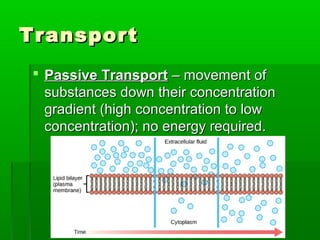
 Passive TransportPassive Transport – movement of– movement of
substances down their concentrationsubstances down their concentration
gradient (high concentration to lowgradient (high concentration to low
concentration); no energy required.concentration); no energy required.
Passive TransportPassive Transport
 4 types of passive transports4 types of passive transports::
 1. Diffusion1. Diffusion
 2. Osmosis2. Osmosis
 3. Facilitated Diffusion3. Facilitated Diffusion
 4. Diffusion through Ion Channels4. Diffusion through Ion Channels
DiffusionDiffusion
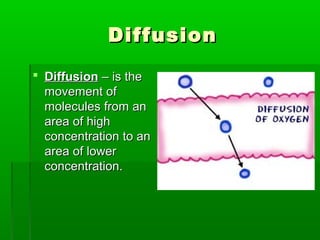
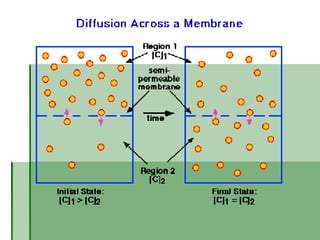
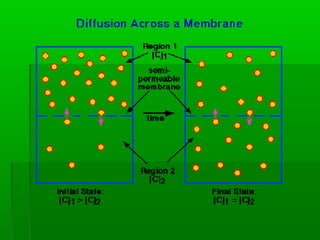
 DiffusionDiffusion – is the– is the
movement ofmovement of
molecules from anmolecules from an
area of higharea of high
concentration to anconcentration to an
area of lowerarea of lower
concentration.concentration.
EquilibriumEquilibrium
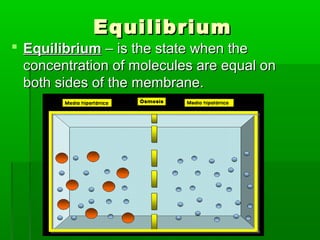
 EquilibriumEquilibrium – is the state when the– is the state when the
concentration of molecules are equal onconcentration of molecules are equal on
both sides of the membrane.both sides of the membrane.
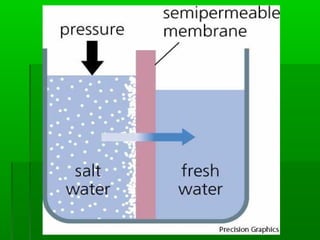
OsmosisOsmosis
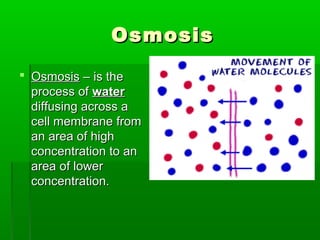
 OsmosisOsmosis – is the– is the
process ofprocess of waterwater
diffusing across adiffusing across a
cell membrane fromcell membrane from
an area of highan area of high
concentration to anconcentration to an
area of lowerarea of lower
concentration.concentration.
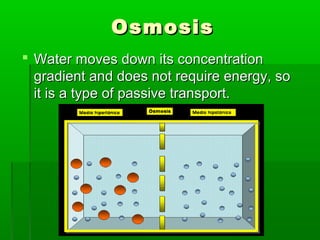
OsmosisOsmosis
 Water moves down its concentrationWater moves down its concentration
gradient and does not require energy, sogradient and does not require energy, so
it is a type of passive transport.it is a type of passive transport.
Passive TransportsPassive Transports
 To fully understand how diffusion andTo fully understand how diffusion and
osmosis works in a cell, you need toosmosis works in a cell, you need to
know a few vocabulary words that youknow a few vocabulary words that you
should have learned last year.should have learned last year.
SolutionsSolutions
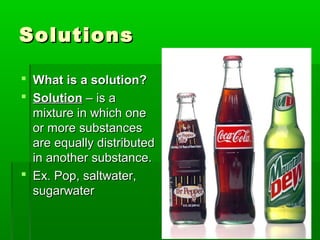
 What is a solution?What is a solution?
 SolutionSolution – is a– is a
mixture in which onemixture in which one
or more substancesor more substances
are equally distributedare equally distributed
in another substance.in another substance.
 Ex. Pop, saltwater,Ex. Pop, saltwater,
sugarwatersugarwater
Parts ofParts of
SolutionSolution
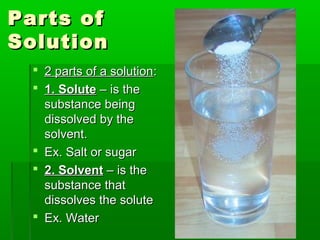
 2 parts of a solution2 parts of a solution::
 1. Solute1. Solute – is the– is the
substance beingsubstance being
dissolved by thedissolved by the
solvent.solvent.
 Ex. Salt or sugarEx. Salt or sugar
 2. Solvent2. Solvent – is the– is the
substance thatsubstance that
dissolves the solutedissolves the solute
 Ex. WaterEx. Water
MixturesMixtures
 Solutions can be made of variousSolutions can be made of various
proportions of solutes and solvents.proportions of solutes and solvents.
 ConcentrationConcentration – the amount of solute– the amount of solute
dissolved in a fixed amount of solution.dissolved in a fixed amount of solution.
 Ex: 1g. of salt in 10g. of water= 10% saltEx: 1g. of salt in 10g. of water= 10% salt
solutionsolution
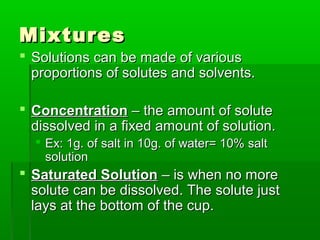
 Saturated SolutionSaturated Solution – is when no more– is when no more
solute can be dissolved. The solute justsolute can be dissolved. The solute just
lays at the bottom of the cup.lays at the bottom of the cup.
Passive TransportsPassive Transports
 A big part of understanding homeostasisA big part of understanding homeostasis
(body is at equilibrium), is understanding(body is at equilibrium), is understanding
how a cell will react in different solutions.how a cell will react in different solutions.
 So, we have special names for solutionsSo, we have special names for solutions
in how they affect cells.in how they affect cells.
Types of SolutionsTypes of Solutions
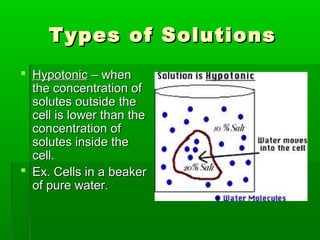
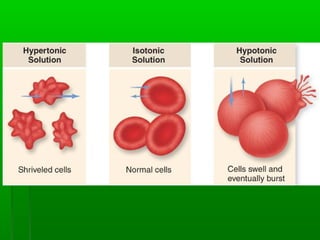
 HypotonicHypotonic – when– when
the concentration ofthe concentration of
solutes outside thesolutes outside the
cell is lower than thecell is lower than the
concentration ofconcentration of
solutes inside thesolutes inside the
cell.cell.
 Ex. Cells in a beakerEx. Cells in a beaker
of pure water.of pure water.
Types of SolutionsTypes of Solutions
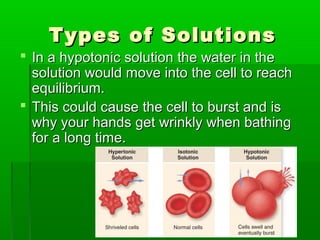
 In a hypotonic solution the water in theIn a hypotonic solution the water in the
solution would move into the cell to reachsolution would move into the cell to reach
equilibrium.equilibrium.
 This could cause the cell to burst and isThis could cause the cell to burst and is
why your hands get wrinkly when bathingwhy your hands get wrinkly when bathing
for a long time.for a long time.
Types of SolutionsTypes of Solutions
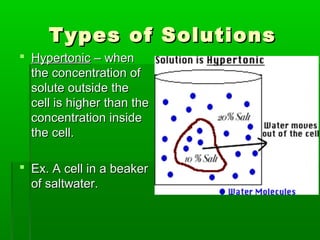
 HypertonicHypertonic – when– when
the concentration ofthe concentration of
solute outside thesolute outside the
cell is higher than thecell is higher than the
concentration insideconcentration inside
the cell.the cell.
 Ex. A cell in a beakerEx. A cell in a beaker
of saltwater.of saltwater.
Types of SolutionsTypes of Solutions
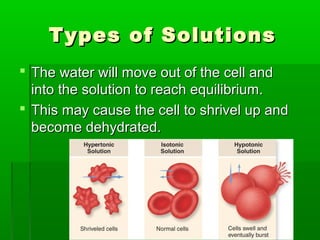
 The water will move out of the cell andThe water will move out of the cell and
into the solution to reach equilibrium.into the solution to reach equilibrium.
 This may cause the cell to shrivel up andThis may cause the cell to shrivel up and
become dehydrated.become dehydrated.
Types of SolutionsTypes of Solutions
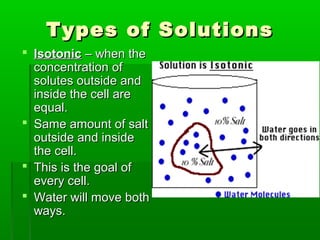
 IsotonicIsotonic – when the– when the
concentration ofconcentration of
solutes outside andsolutes outside and
inside the cell areinside the cell are
equal.equal.
 Same amount of saltSame amount of salt
outside and insideoutside and inside
the cell.the cell.
 This is the goal ofThis is the goal of
every cell.every cell.
 Water will move bothWater will move both
ways.ways.
VocabularyVocabulary
 Turgor PressureTurgor Pressure - is the pressure- is the pressure
inside the cells that give organisms thereinside the cells that give organisms there
form.form.
 Organisms without turgor pressure willOrganisms without turgor pressure will
have no form out of water.have no form out of water.
 Cells loose turgor pressure when theyCells loose turgor pressure when they
loose water.loose water.
Turgor PressureTurgor Pressure
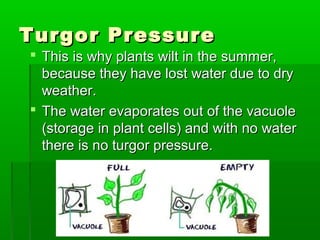
 This is why plants wilt in the summer,This is why plants wilt in the summer,
because they have lost water due to drybecause they have lost water due to dry
weather.weather.
 The water evaporates out of the vacuoleThe water evaporates out of the vacuole
(storage in plant cells) and with no water(storage in plant cells) and with no water
there is no turgor pressure.there is no turgor pressure.
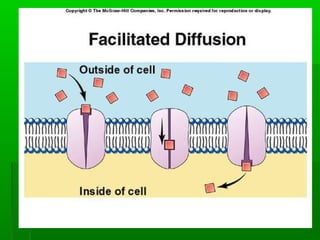
Facilitated DiffusionFacilitated Diffusion
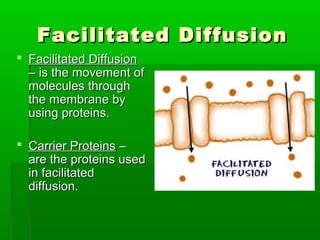
 Facilitated DiffusionFacilitated Diffusion
– is the movement of– is the movement of
molecules throughmolecules through
the membrane bythe membrane by
using proteins.using proteins.
 Carrier ProteinsCarrier Proteins ––
are the proteins usedare the proteins used
in facilitatedin facilitated
diffusion.diffusion.
DiffusionDiffusion ThroughThrough IonIon
ChannelChannel
 Is the process of transporting ionsIs the process of transporting ions
through membrane proteins known asthrough membrane proteins known as
ion channels.ion channels.
 Ex. ions are Sodium, potassium, calcium,Ex. ions are Sodium, potassium, calcium,
and chloride.and chloride.
 These ions use the proteins as a channelThese ions use the proteins as a channel
to move through the membrane and intoto move through the membrane and into
the cell.the cell.
Ion ChannelsIon Channels
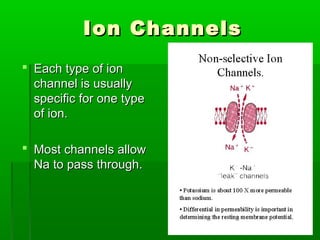
 Each type of ionEach type of ion
channel is usuallychannel is usually
specific for one typespecific for one type
of ion.of ion.
 Most channels allowMost channels allow
Na to pass through.Na to pass through.
Passive TransportPassive Transport
Question????Question????
 If you put a piece of potato into a beaker
of distilled water and another piece of
potato in a beaker of saltwater. The
piece of potato in the freshwater
becomes very stiff, while the piece of
potato in the saltwater became very
flexible.
 In complete sentences explain why the
potato in the freshwater became stiff and
the potato in the salt water became
Answer to PassiveAnswer to Passive
Transport QuestionTransport Question
 The piece of potato that was put into distilled waterThe piece of potato that was put into distilled water
swelled up and stiffened, because of an increase inswelled up and stiffened, because of an increase in
turgor pressure. The turgor pressure increasedturgor pressure. The turgor pressure increased
because the potato was in a hypotonic solution whichbecause the potato was in a hypotonic solution which
caused water to move into the potato by a processcaused water to move into the potato by a process
called osmosis. The piece of potato that was put intocalled osmosis. The piece of potato that was put into
the saltwater shrank and became flexible, because of athe saltwater shrank and became flexible, because of a
loss of turgor pressure. The turgor pressure was lost,loss of turgor pressure. The turgor pressure was lost,
because the potato was in a hypertonic solution whichbecause the potato was in a hypertonic solution which
caused water to move out of the potato by a processcaused water to move out of the potato by a process
called osmosis.called osmosis.

Passive Transport Notes

  • 1.
  • 2.
    TransportTransport  Passive TransportPassiveTransport – movement of– movement of substances down their concentrationsubstances down their concentration gradient (high concentration to lowgradient (high concentration to low concentration); no energy required.concentration); no energy required.
  • 3.
    Passive TransportPassive Transport 4 types of passive transports4 types of passive transports::  1. Diffusion1. Diffusion  2. Osmosis2. Osmosis  3. Facilitated Diffusion3. Facilitated Diffusion  4. Diffusion through Ion Channels4. Diffusion through Ion Channels
  • 4.
    DiffusionDiffusion  DiffusionDiffusion –is the– is the movement ofmovement of molecules from anmolecules from an area of higharea of high concentration to anconcentration to an area of lowerarea of lower concentration.concentration.
  • 6.
    EquilibriumEquilibrium  EquilibriumEquilibrium –is the state when the– is the state when the concentration of molecules are equal onconcentration of molecules are equal on both sides of the membrane.both sides of the membrane.
  • 8.
    OsmosisOsmosis  OsmosisOsmosis –is the– is the process ofprocess of waterwater diffusing across adiffusing across a cell membrane fromcell membrane from an area of highan area of high concentration to anconcentration to an area of lowerarea of lower concentration.concentration.
  • 10.
    OsmosisOsmosis  Water movesdown its concentrationWater moves down its concentration gradient and does not require energy, sogradient and does not require energy, so it is a type of passive transport.it is a type of passive transport.
  • 11.
    Passive TransportsPassive Transports To fully understand how diffusion andTo fully understand how diffusion and osmosis works in a cell, you need toosmosis works in a cell, you need to know a few vocabulary words that youknow a few vocabulary words that you should have learned last year.should have learned last year.
  • 12.
    SolutionsSolutions  What isa solution?What is a solution?  SolutionSolution – is a– is a mixture in which onemixture in which one or more substancesor more substances are equally distributedare equally distributed in another substance.in another substance.  Ex. Pop, saltwater,Ex. Pop, saltwater, sugarwatersugarwater
  • 13.
    Parts ofParts of SolutionSolution 2 parts of a solution2 parts of a solution::  1. Solute1. Solute – is the– is the substance beingsubstance being dissolved by thedissolved by the solvent.solvent.  Ex. Salt or sugarEx. Salt or sugar  2. Solvent2. Solvent – is the– is the substance thatsubstance that dissolves the solutedissolves the solute  Ex. WaterEx. Water
  • 14.
    MixturesMixtures  Solutions canbe made of variousSolutions can be made of various proportions of solutes and solvents.proportions of solutes and solvents.  ConcentrationConcentration – the amount of solute– the amount of solute dissolved in a fixed amount of solution.dissolved in a fixed amount of solution.  Ex: 1g. of salt in 10g. of water= 10% saltEx: 1g. of salt in 10g. of water= 10% salt solutionsolution  Saturated SolutionSaturated Solution – is when no more– is when no more solute can be dissolved. The solute justsolute can be dissolved. The solute just lays at the bottom of the cup.lays at the bottom of the cup.
  • 15.
    Passive TransportsPassive Transports A big part of understanding homeostasisA big part of understanding homeostasis (body is at equilibrium), is understanding(body is at equilibrium), is understanding how a cell will react in different solutions.how a cell will react in different solutions.  So, we have special names for solutionsSo, we have special names for solutions in how they affect cells.in how they affect cells.
  • 16.
    Types of SolutionsTypesof Solutions  HypotonicHypotonic – when– when the concentration ofthe concentration of solutes outside thesolutes outside the cell is lower than thecell is lower than the concentration ofconcentration of solutes inside thesolutes inside the cell.cell.  Ex. Cells in a beakerEx. Cells in a beaker of pure water.of pure water.
  • 17.
    Types of SolutionsTypesof Solutions  In a hypotonic solution the water in theIn a hypotonic solution the water in the solution would move into the cell to reachsolution would move into the cell to reach equilibrium.equilibrium.  This could cause the cell to burst and isThis could cause the cell to burst and is why your hands get wrinkly when bathingwhy your hands get wrinkly when bathing for a long time.for a long time.
  • 18.
    Types of SolutionsTypesof Solutions  HypertonicHypertonic – when– when the concentration ofthe concentration of solute outside thesolute outside the cell is higher than thecell is higher than the concentration insideconcentration inside the cell.the cell.  Ex. A cell in a beakerEx. A cell in a beaker of saltwater.of saltwater.
  • 19.
    Types of SolutionsTypesof Solutions  The water will move out of the cell andThe water will move out of the cell and into the solution to reach equilibrium.into the solution to reach equilibrium.  This may cause the cell to shrivel up andThis may cause the cell to shrivel up and become dehydrated.become dehydrated.
  • 20.
    Types of SolutionsTypesof Solutions  IsotonicIsotonic – when the– when the concentration ofconcentration of solutes outside andsolutes outside and inside the cell areinside the cell are equal.equal.  Same amount of saltSame amount of salt outside and insideoutside and inside the cell.the cell.  This is the goal ofThis is the goal of every cell.every cell.  Water will move bothWater will move both ways.ways.
  • 22.
    VocabularyVocabulary  Turgor PressureTurgorPressure - is the pressure- is the pressure inside the cells that give organisms thereinside the cells that give organisms there form.form.  Organisms without turgor pressure willOrganisms without turgor pressure will have no form out of water.have no form out of water.  Cells loose turgor pressure when theyCells loose turgor pressure when they loose water.loose water.
  • 23.
    Turgor PressureTurgor Pressure This is why plants wilt in the summer,This is why plants wilt in the summer, because they have lost water due to drybecause they have lost water due to dry weather.weather.  The water evaporates out of the vacuoleThe water evaporates out of the vacuole (storage in plant cells) and with no water(storage in plant cells) and with no water there is no turgor pressure.there is no turgor pressure.
  • 24.
    Facilitated DiffusionFacilitated Diffusion Facilitated DiffusionFacilitated Diffusion – is the movement of– is the movement of molecules throughmolecules through the membrane bythe membrane by using proteins.using proteins.  Carrier ProteinsCarrier Proteins –– are the proteins usedare the proteins used in facilitatedin facilitated diffusion.diffusion.
  • 26.
    DiffusionDiffusion ThroughThrough IonIon ChannelChannel Is the process of transporting ionsIs the process of transporting ions through membrane proteins known asthrough membrane proteins known as ion channels.ion channels.  Ex. ions are Sodium, potassium, calcium,Ex. ions are Sodium, potassium, calcium, and chloride.and chloride.  These ions use the proteins as a channelThese ions use the proteins as a channel to move through the membrane and intoto move through the membrane and into the cell.the cell.
  • 27.
    Ion ChannelsIon Channels Each type of ionEach type of ion channel is usuallychannel is usually specific for one typespecific for one type of ion.of ion.  Most channels allowMost channels allow Na to pass through.Na to pass through.
  • 28.
    Passive TransportPassive Transport Question????Question???? If you put a piece of potato into a beaker of distilled water and another piece of potato in a beaker of saltwater. The piece of potato in the freshwater becomes very stiff, while the piece of potato in the saltwater became very flexible.  In complete sentences explain why the potato in the freshwater became stiff and the potato in the salt water became
  • 29.
    Answer to PassiveAnswerto Passive Transport QuestionTransport Question  The piece of potato that was put into distilled waterThe piece of potato that was put into distilled water swelled up and stiffened, because of an increase inswelled up and stiffened, because of an increase in turgor pressure. The turgor pressure increasedturgor pressure. The turgor pressure increased because the potato was in a hypotonic solution whichbecause the potato was in a hypotonic solution which caused water to move into the potato by a processcaused water to move into the potato by a process called osmosis. The piece of potato that was put intocalled osmosis. The piece of potato that was put into the saltwater shrank and became flexible, because of athe saltwater shrank and became flexible, because of a loss of turgor pressure. The turgor pressure was lost,loss of turgor pressure. The turgor pressure was lost, because the potato was in a hypertonic solution whichbecause the potato was in a hypertonic solution which caused water to move out of the potato by a processcaused water to move out of the potato by a process called osmosis.called osmosis.