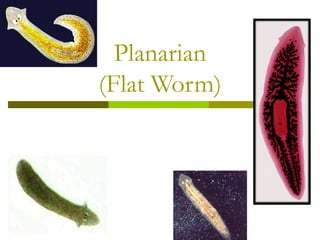
Planarian (Flat Worm)
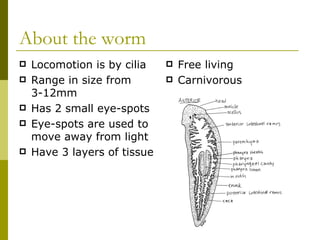
About the worm Locomotion is by cilia Range in size from 3-12mm Has 2 small eye-spots Eye-spots are used to move away from light Have 3 layers of tissue Free living Carnivorous
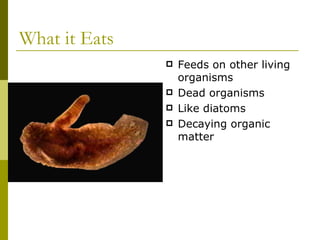
What it Eats  Feeds on other living organisms Dead organisms Like diatoms Decaying organic matter
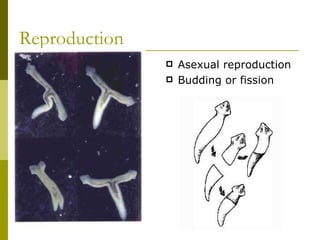
Reproduction Asexual reproduction Budding or fission
Reproduction (cont’d) Can reproduce either asexually or sexually. In asexual reproduction the planarian detaches its tail end and each half regrows the lost parts. In sexual reproduction each Planaria gives and receives sperm. Planaria have both testes and ovaries.  Eggs develop inside the body and are shed in capsules.  Weeks later the eggs hatch and grow into adults.  Planarians can also reproduce by regeneration.  If it is cut into two halves, both halves may become two new Planaria (regeneration).
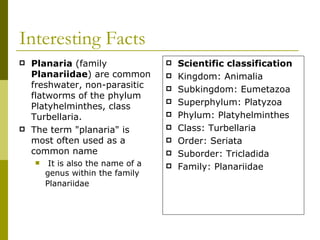
Where can you find them? Beneath rocks, logs, dead leaves in springs, wetlands, streams, lakes Found in cold water Common to many parts of the world  Also commonly found residing on plants
Interesting Facts Planaria  (family  Planariidae ) are common freshwater, non-parasitic flatworms of the phylum Platyhelminthes, class Turbellaria.  The term "planaria" is most often used as a common name It is also the name of a genus within the family Planariidae   Scientific classification Kingdom: Animalia Subkingdom: Eumetazoa Superphylum: Platyzoa Phylum: Platyhelminthes Class: Turbellaria Order: Seriata Suborder: Tricladida Family: Planariidae
More Cool Facts At the head there is a brain under the eyespots From the brain there are two nerve cords which connect at the tail  There are many transverse nerves connected to the nerve cords which make it look like a ladder  The excretory system is made of many tubes with many flame cells and excretory pores on them

Planarian[1]

  • 1.
  • 2.
    About the wormLocomotion is by cilia Range in size from 3-12mm Has 2 small eye-spots Eye-spots are used to move away from light Have 3 layers of tissue Free living Carnivorous
  • 3.
    What it Eats Feeds on other living organisms Dead organisms Like diatoms Decaying organic matter
  • 4.
  • 5.
    Reproduction (cont’d) Canreproduce either asexually or sexually. In asexual reproduction the planarian detaches its tail end and each half regrows the lost parts. In sexual reproduction each Planaria gives and receives sperm. Planaria have both testes and ovaries. Eggs develop inside the body and are shed in capsules. Weeks later the eggs hatch and grow into adults. Planarians can also reproduce by regeneration. If it is cut into two halves, both halves may become two new Planaria (regeneration).
  • 6.
    Where can youfind them? Beneath rocks, logs, dead leaves in springs, wetlands, streams, lakes Found in cold water Common to many parts of the world Also commonly found residing on plants
  • 7.
    Interesting Facts Planaria (family Planariidae ) are common freshwater, non-parasitic flatworms of the phylum Platyhelminthes, class Turbellaria. The term "planaria" is most often used as a common name It is also the name of a genus within the family Planariidae Scientific classification Kingdom: Animalia Subkingdom: Eumetazoa Superphylum: Platyzoa Phylum: Platyhelminthes Class: Turbellaria Order: Seriata Suborder: Tricladida Family: Planariidae
  • 8.
    More Cool FactsAt the head there is a brain under the eyespots From the brain there are two nerve cords which connect at the tail There are many transverse nerves connected to the nerve cords which make it look like a ladder The excretory system is made of many tubes with many flame cells and excretory pores on them