Polymorphism in
Coelenterate
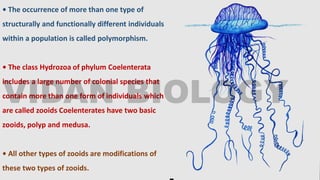
• The occurrence of more than one type of
structurally and functionally different individuals
within a population is called polymorphism.
• The class Hydrozoa of phylum Coelenterata
includes a large number of colonial species that
contain more than one form of individuals which
are called zooids Coelenterates have two basic
zooids, polyp and medusa.
• All other types of zooids are modifications of
these two types of zooids.
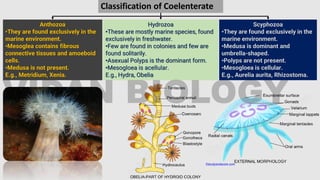
Hydrozoa
•These are mostly marine species, found
exclusively in freshwater.
•Few are found in colonies and few are
found solitarily.
•Asexual Polyps is the dominant form.
•Mesogloea is acellular.
E.g., Hydra, Obelia
Anthozoa
•They are found exclusively in the
marine environment.
•Mesoglea contains fibrous
connective tissues and amoeboid
cells.
•Medusa is not present.
E.g., Metridium, Xenia.
Scyphozoa
•They are found exclusively in the
marine environment.
•Medusa is dominant and
umbrella-shaped.
•Polyps are not present.
•Mesogloea is cellular.
E.g., Aurelia aurita, Rhizostoma.
Classification of Coelenterate
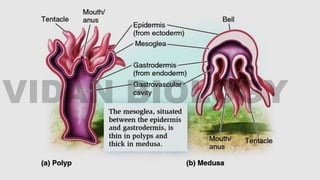
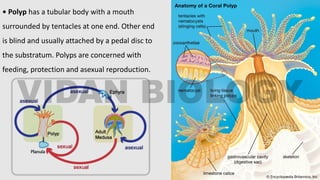
• Polyp has a tubular body with a mouth
surrounded by tentacles at one end. Other end
is blind and usually attached by a pedal disc to
the substratum. Polyps are concerned with
feeding, protection and asexual reproduction.
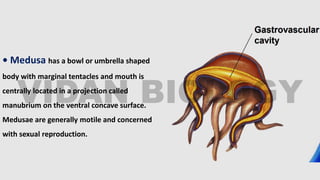
• Medusa has a bowl or umbrella shaped
body with marginal tentacles and mouth is
centrally located in a projection called
manubrium on the ventral concave surface.
Medusae are generally motile and concerned
with sexual reproduction.
Modifications of Polyp
• Gastrozooids or feeding zooids are typical
polyps with a mouth and surrounding
tentacles.
• Dactylozooids which are used for defence
are polyps without mouth and usually with a
long basal tentacle.
• Gonozooids are reproductive zooids
derived from polyp, which produce sexual
medusae or gonophores.
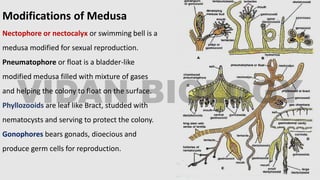
Modifications of Medusa
Nectophore or nectocalyx or swimming bell is a
medusa modified for sexual reproduction.
Pneumatophore or float is a bladder-like
modified medusa filled with mixture of gases
and helping the colony to float on the surface.
Phyllozooids are leaf like Bract, studded with
nematocysts and serving to protect the colony.
Gonophores bears gonads, dioecious and
produce germ cells for reproduction.
TYPES OF POLYMORPHISM
A few coelenterates, such as Hydra and sea anemone are monomorphic in which
only polyp stage is found but other coelenterates exhibit polymorphism.
Dimorphism: Many hydrozoan colonies like Tubularia and Campanularia have only
two types of zooids, the feeding zooids or gastrozooids and medusae or
nectophores that bud off from the stem or gastrozooids.
Trimorphism: Some species like Obelia and Plumularia are trimorphic because
besides gastrozooids and medusa, they also have medusa-producing gonozooids or
blastostyle.
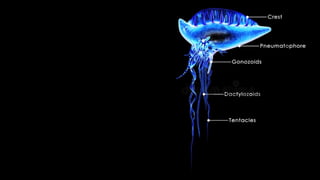
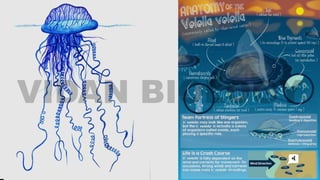
Polymorphism: In order Siphonophora, such as Diphyes, Halistemmia, Stephalia
and Physalia, zooids are so much modified that they appear like organs of a
single body rather than individuals of a colony.
▪ In Physalia, zooids are in units, which bear gastrozooids, small and large
dactylozooids with long and short tentacles and branched gonozooid with
gonophores.
▪ In Velella and Porpita, there is a single large central gastrozooid with a mouth,
around which are arranged concentric rows of gonozooids and dactylozooids.
The whole colony looks like a single individual.
POLYMORPHISM IN COELENTERATA

POLYMORPHISM IN COELENTERATA

  • 1.
  • 2.
    • The occurrenceof more than one type of structurally and functionally different individuals within a population is called polymorphism. • The class Hydrozoa of phylum Coelenterata includes a large number of colonial species that contain more than one form of individuals which are called zooids Coelenterates have two basic zooids, polyp and medusa. • All other types of zooids are modifications of these two types of zooids.
  • 3.
    Hydrozoa •These are mostlymarine species, found exclusively in freshwater. •Few are found in colonies and few are found solitarily. •Asexual Polyps is the dominant form. •Mesogloea is acellular. E.g., Hydra, Obelia Anthozoa •They are found exclusively in the marine environment. •Mesoglea contains fibrous connective tissues and amoeboid cells. •Medusa is not present. E.g., Metridium, Xenia. Scyphozoa •They are found exclusively in the marine environment. •Medusa is dominant and umbrella-shaped. •Polyps are not present. •Mesogloea is cellular. E.g., Aurelia aurita, Rhizostoma. Classification of Coelenterate
  • 5.
    • Polyp hasa tubular body with a mouth surrounded by tentacles at one end. Other end is blind and usually attached by a pedal disc to the substratum. Polyps are concerned with feeding, protection and asexual reproduction.
  • 6.
    • Medusa hasa bowl or umbrella shaped body with marginal tentacles and mouth is centrally located in a projection called manubrium on the ventral concave surface. Medusae are generally motile and concerned with sexual reproduction.
  • 7.
    Modifications of Polyp •Gastrozooids or feeding zooids are typical polyps with a mouth and surrounding tentacles. • Dactylozooids which are used for defence are polyps without mouth and usually with a long basal tentacle. • Gonozooids are reproductive zooids derived from polyp, which produce sexual medusae or gonophores.
  • 9.
    Modifications of Medusa Nectophoreor nectocalyx or swimming bell is a medusa modified for sexual reproduction. Pneumatophore or float is a bladder-like modified medusa filled with mixture of gases and helping the colony to float on the surface. Phyllozooids are leaf like Bract, studded with nematocysts and serving to protect the colony. Gonophores bears gonads, dioecious and produce germ cells for reproduction.
  • 10.
    TYPES OF POLYMORPHISM Afew coelenterates, such as Hydra and sea anemone are monomorphic in which only polyp stage is found but other coelenterates exhibit polymorphism. Dimorphism: Many hydrozoan colonies like Tubularia and Campanularia have only two types of zooids, the feeding zooids or gastrozooids and medusae or nectophores that bud off from the stem or gastrozooids. Trimorphism: Some species like Obelia and Plumularia are trimorphic because besides gastrozooids and medusa, they also have medusa-producing gonozooids or blastostyle.
  • 11.
    Polymorphism: In orderSiphonophora, such as Diphyes, Halistemmia, Stephalia and Physalia, zooids are so much modified that they appear like organs of a single body rather than individuals of a colony. ▪ In Physalia, zooids are in units, which bear gastrozooids, small and large dactylozooids with long and short tentacles and branched gonozooid with gonophores. ▪ In Velella and Porpita, there is a single large central gastrozooid with a mouth, around which are arranged concentric rows of gonozooids and dactylozooids. The whole colony looks like a single individual.