BiochemistryBiochemistry
ChemistryChemistry
 Why is chemistry important in biology?Why is chemistry important in biology?
 The structure and function of all livingThe structure and function of all living
things are governed by the laws ofthings are governed by the laws of
chemistry.chemistry.
ElementsElements
 ElementsElements – Pure substances that cannot– Pure substances that cannot
be broken down into simpler formsbe broken down into simpler forms
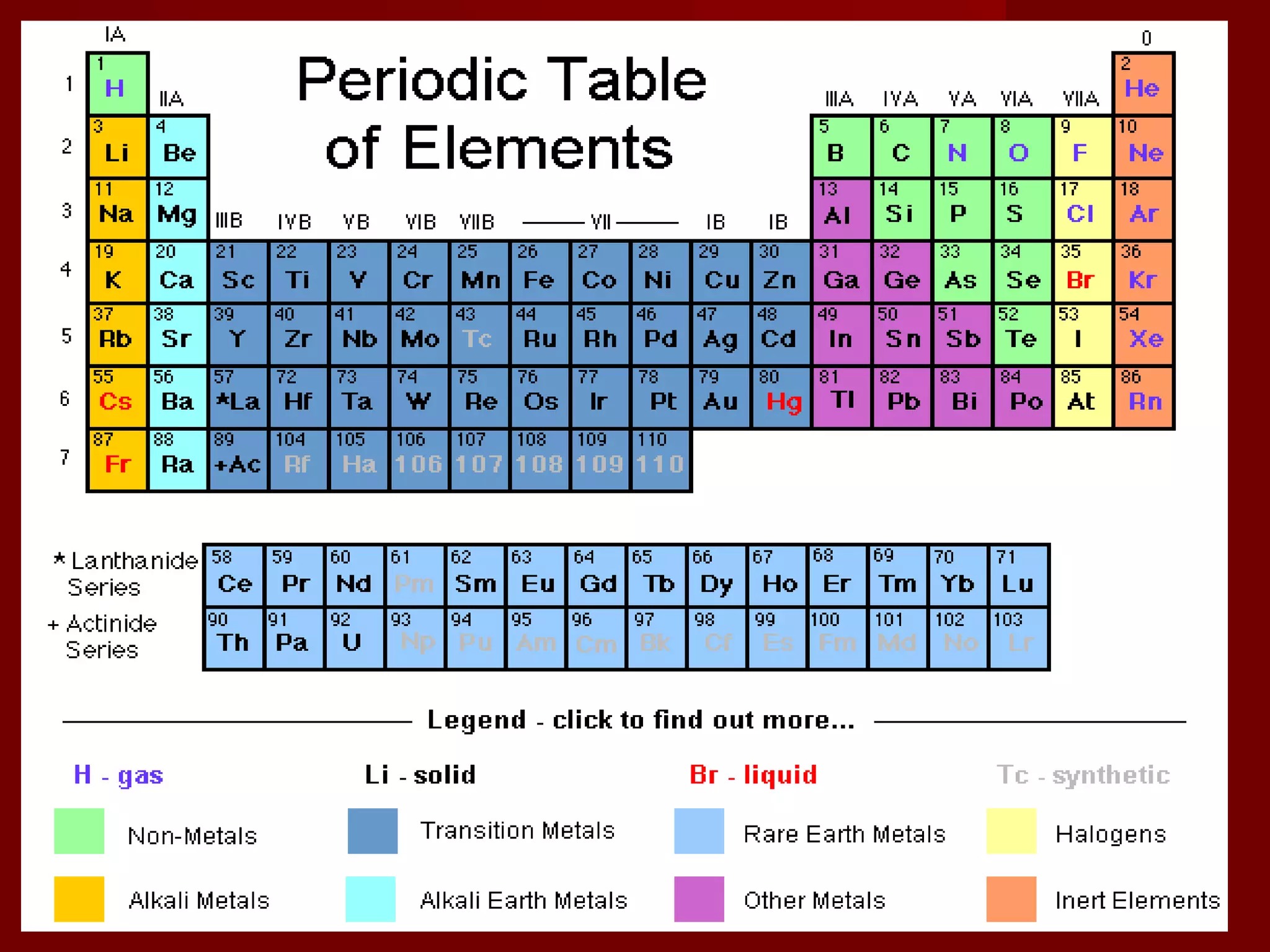
 Over 100 elements are identified and putOver 100 elements are identified and put
together on the periodic tabletogether on the periodic table
ElementsElements
 All living things composed of 6 elements:All living things composed of 6 elements:
 1. Carbon (C)1. Carbon (C)
 2. Hydrogen (H)2. Hydrogen (H)
 3. Oxygen (O)3. Oxygen (O)
 4. Nitrogen (N)4. Nitrogen (N)
 5. Phosphorous (P)5. Phosphorous (P)
 6. Sulfur (S)6. Sulfur (S)
ElectronsElectrons
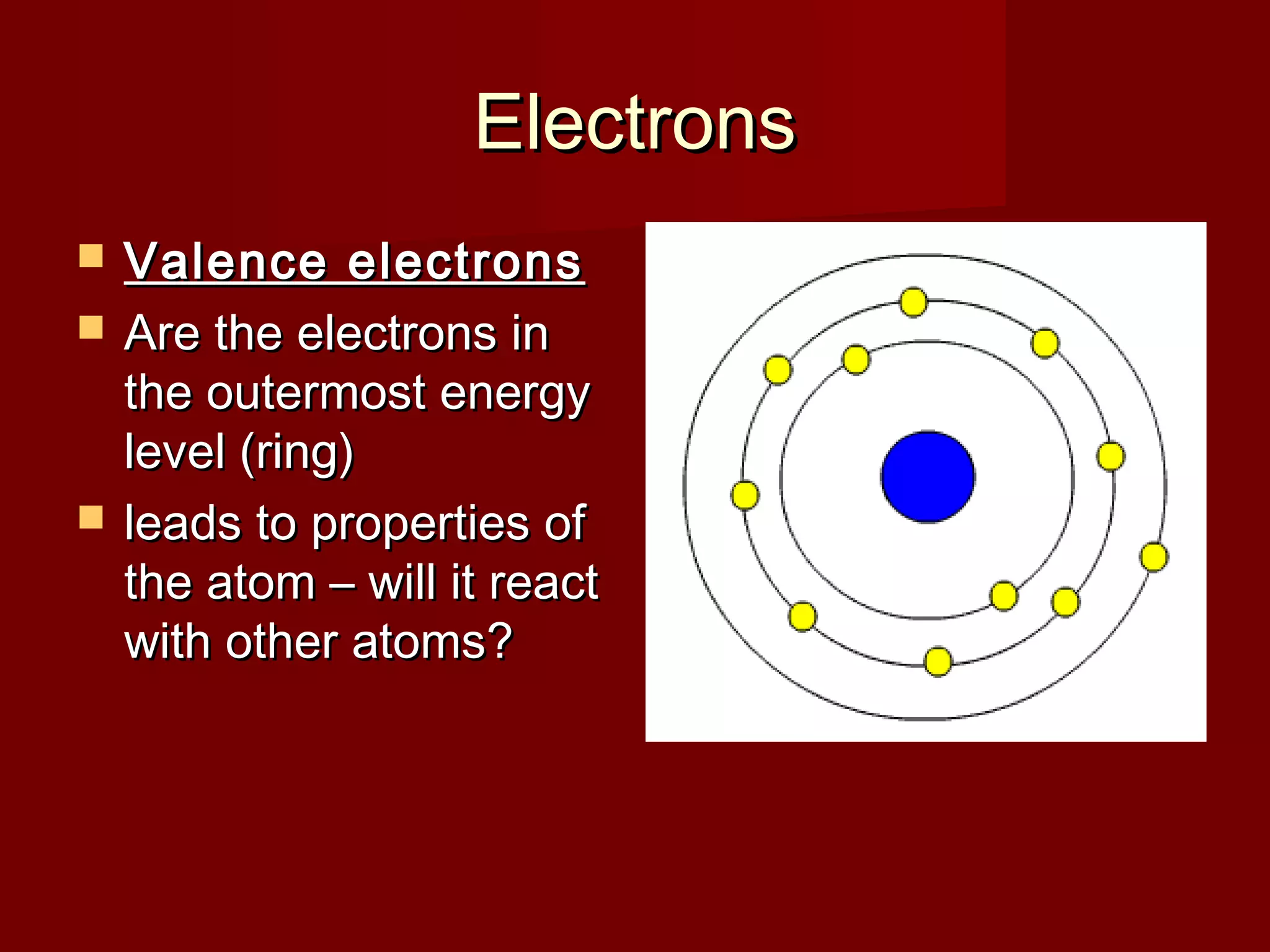
 Valence electronsValence electrons
 Are the electrons inAre the electrons in
the outermost energythe outermost energy
level (ring)level (ring)
 leads to properties ofleads to properties of
the atom – will it reactthe atom – will it react
with other atoms?with other atoms?
Periodic TablePeriodic Table
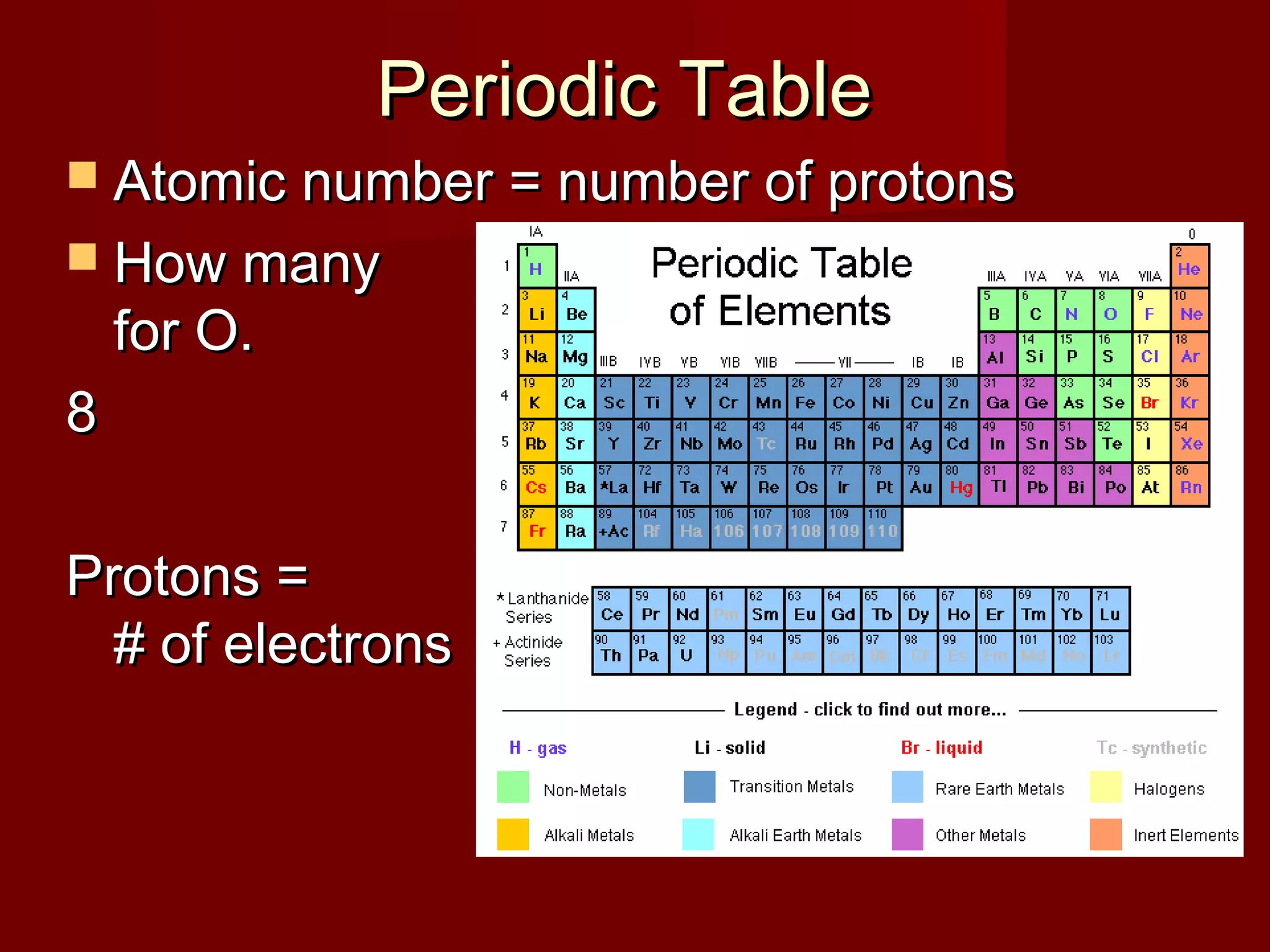
 Atomic number = number of protonsAtomic number = number of protons
 How many protonsHow many protons
for Ofor O
(Oxygen)(Oxygen)
 88
# of# of
Periodic TablePeriodic Table
 Atomic number = number of protonsAtomic number = number of protons
 How many protonsHow many protons
for O.for O.
88
Protons =Protons =
# of electrons# of electrons
Chemistry TermsChemistry Terms
 Chemical ReactionsChemical Reactions – combination of– combination of
atoms so they become stable.atoms so they become stable.
 In any chemical reaction, bonds are eitherIn any chemical reaction, bonds are either
formed or broken. (bonds a form offormed or broken. (bonds a form of
energy)energy)
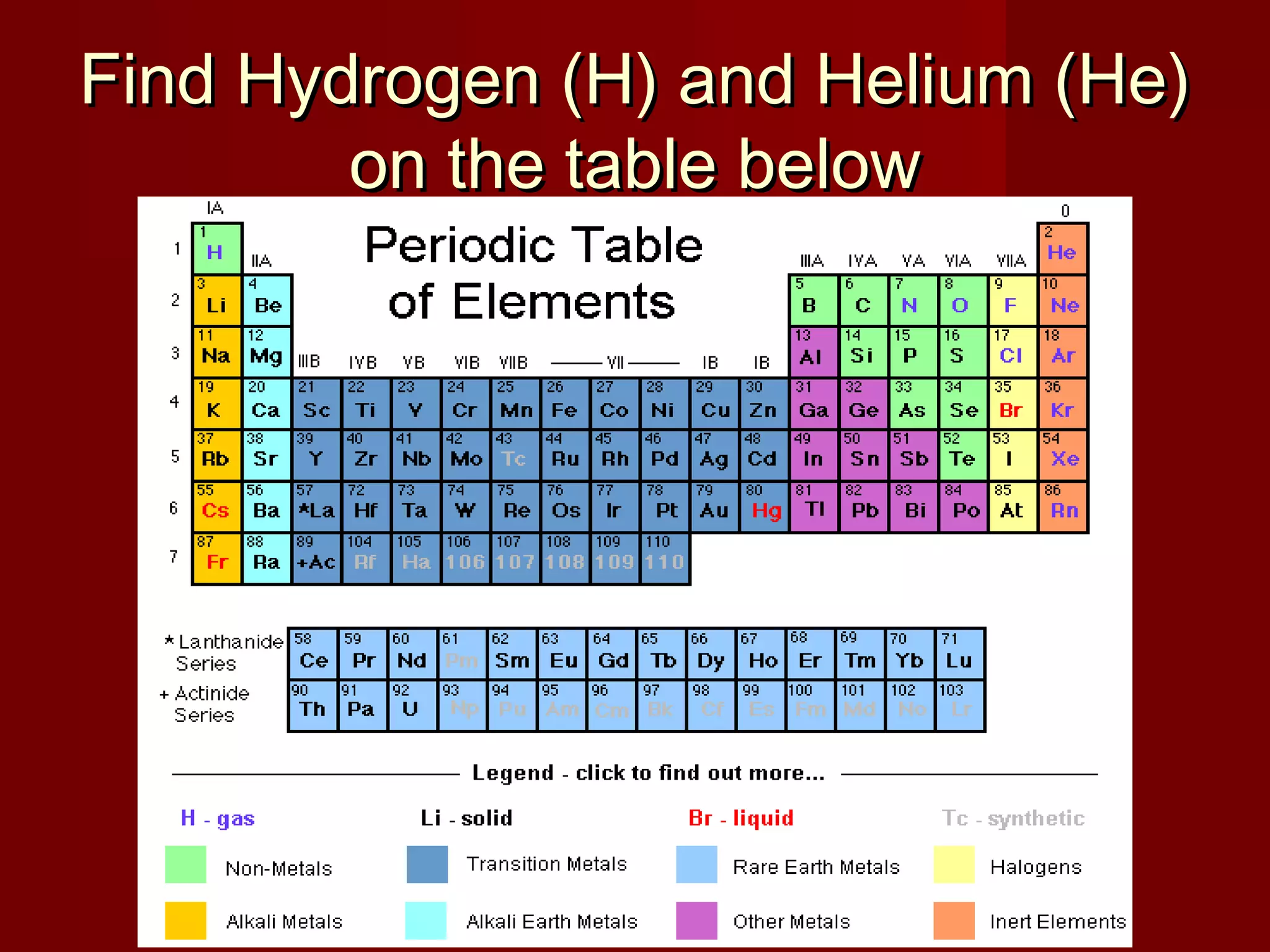
 Hydrogen is unstable and is very reactive,Hydrogen is unstable and is very reactive,
while Helium is stable and not reactive.while Helium is stable and not reactive.
Find Hydrogen (H) and Helium (He)Find Hydrogen (H) and Helium (He)
on the table belowon the table below
Chemical ReactionsChemical Reactions
 In every chemical reaction you haveIn every chemical reaction you have
reactants and products.reactants and products.
 Photosynthesis Reaction:Photosynthesis Reaction:
 ReactantsReactants – is what is being added (is on– is what is being added (is on
left side of the equation)left side of the equation)
 ProductProduct – is what is being produced (on– is what is being produced (on
right side)right side)
ExampleExample
 COCO22 + H+ H22 OO  HH22 COCO33
 Reactants = COReactants = CO22 + H+ H22OO
 Products = HProducts = H22COCO33
CompoundsCompounds
 CompoundsCompounds – two or more elements are– two or more elements are
bonded together in a specific ratio.bonded together in a specific ratio.
 Compounds are created from a chemicalCompounds are created from a chemical
reaction.reaction.
 Water is an example of compound.Water is an example of compound.
BondsBonds
 BondsBonds – attachments between atoms– attachments between atoms
 Covalent BondsCovalent Bonds – atoms SHARE– atoms SHARE
electronselectrons
– Ex. Water moleculeEx. Water molecule
 Ionic BondsIonic Bonds – atoms TRANSFER– atoms TRANSFER
electronselectrons
 Ex. Sodium Chloride (table salt)Ex. Sodium Chloride (table salt)
 Ion – an atom or molecule with a charge (positiveIon – an atom or molecule with a charge (positive
or negative)or negative)
ucuc
Carbon BondsCarbon Bonds
 Carbon (C) is very unique because it canCarbon (C) is very unique because it can
form 4 single bonds.form 4 single bonds.
 This allows Carbon to make moleculesThis allows Carbon to make molecules
with many different shapes like chains,with many different shapes like chains,
rings, and large complex molecules.rings, and large complex molecules.

Biochemistry Notes

  • 1.
  • 2.
    ChemistryChemistry  Why ischemistry important in biology?Why is chemistry important in biology?  The structure and function of all livingThe structure and function of all living things are governed by the laws ofthings are governed by the laws of chemistry.chemistry.
  • 3.
    ElementsElements  ElementsElements –Pure substances that cannot– Pure substances that cannot be broken down into simpler formsbe broken down into simpler forms  Over 100 elements are identified and putOver 100 elements are identified and put together on the periodic tabletogether on the periodic table
  • 5.
    ElementsElements  All livingthings composed of 6 elements:All living things composed of 6 elements:  1. Carbon (C)1. Carbon (C)  2. Hydrogen (H)2. Hydrogen (H)  3. Oxygen (O)3. Oxygen (O)  4. Nitrogen (N)4. Nitrogen (N)  5. Phosphorous (P)5. Phosphorous (P)  6. Sulfur (S)6. Sulfur (S)
  • 6.
    ElectronsElectrons  Valence electronsValenceelectrons  Are the electrons inAre the electrons in the outermost energythe outermost energy level (ring)level (ring)  leads to properties ofleads to properties of the atom – will it reactthe atom – will it react with other atoms?with other atoms?
  • 7.
    Periodic TablePeriodic Table Atomic number = number of protonsAtomic number = number of protons  How many protonsHow many protons for Ofor O (Oxygen)(Oxygen)  88 # of# of
  • 9.
    Periodic TablePeriodic Table Atomic number = number of protonsAtomic number = number of protons  How many protonsHow many protons for O.for O. 88 Protons =Protons = # of electrons# of electrons
  • 10.
    Chemistry TermsChemistry Terms Chemical ReactionsChemical Reactions – combination of– combination of atoms so they become stable.atoms so they become stable.  In any chemical reaction, bonds are eitherIn any chemical reaction, bonds are either formed or broken. (bonds a form offormed or broken. (bonds a form of energy)energy)  Hydrogen is unstable and is very reactive,Hydrogen is unstable and is very reactive, while Helium is stable and not reactive.while Helium is stable and not reactive.
  • 11.
    Find Hydrogen (H)and Helium (He)Find Hydrogen (H) and Helium (He) on the table belowon the table below
  • 12.
    Chemical ReactionsChemical Reactions In every chemical reaction you haveIn every chemical reaction you have reactants and products.reactants and products.  Photosynthesis Reaction:Photosynthesis Reaction:  ReactantsReactants – is what is being added (is on– is what is being added (is on left side of the equation)left side of the equation)  ProductProduct – is what is being produced (on– is what is being produced (on right side)right side)
  • 13.
    ExampleExample  COCO22 +H+ H22 OO  HH22 COCO33  Reactants = COReactants = CO22 + H+ H22OO  Products = HProducts = H22COCO33
  • 14.
    CompoundsCompounds  CompoundsCompounds –two or more elements are– two or more elements are bonded together in a specific ratio.bonded together in a specific ratio.  Compounds are created from a chemicalCompounds are created from a chemical reaction.reaction.  Water is an example of compound.Water is an example of compound.
  • 15.
    BondsBonds  BondsBonds –attachments between atoms– attachments between atoms  Covalent BondsCovalent Bonds – atoms SHARE– atoms SHARE electronselectrons – Ex. Water moleculeEx. Water molecule  Ionic BondsIonic Bonds – atoms TRANSFER– atoms TRANSFER electronselectrons  Ex. Sodium Chloride (table salt)Ex. Sodium Chloride (table salt)  Ion – an atom or molecule with a charge (positiveIon – an atom or molecule with a charge (positive or negative)or negative)
  • 16.
  • 17.
    Carbon BondsCarbon Bonds Carbon (C) is very unique because it canCarbon (C) is very unique because it can form 4 single bonds.form 4 single bonds.  This allows Carbon to make moleculesThis allows Carbon to make molecules with many different shapes like chains,with many different shapes like chains, rings, and large complex molecules.rings, and large complex molecules.