Transport NotesTransport Notes
HomeostasisHomeostasis
 How does your cells keep homeostasisHow does your cells keep homeostasis
(internal stable condition)?(internal stable condition)?
 By transporting molecules in and out ofBy transporting molecules in and out of
the cell, like water, sugar, salt, andthe cell, like water, sugar, salt, and
electrolytes.electrolytes.
 This is done by the passive or activeThis is done by the passive or active
transports.transports.
TransportsTransports
 To transport molecules in and out of theTo transport molecules in and out of the
cell, these molecules will have to passcell, these molecules will have to pass
through the cell membrane.through the cell membrane.
 So let’s learn more about the functionSo let’s learn more about the function
and structure of the cell membrane!!!and structure of the cell membrane!!!
Cell OrganelleCell Organelle
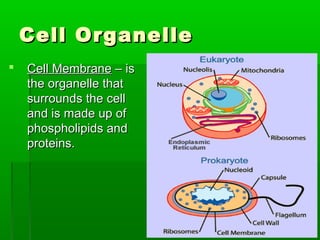
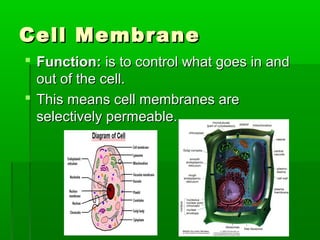
 Cell MembraneCell Membrane – is– is
the organelle thatthe organelle that
surrounds the cellsurrounds the cell
and is made up ofand is made up of
phospholipids andphospholipids and
proteins.proteins.
Cell MembraneCell Membrane
 Function:Function: is to control what goes in andis to control what goes in and
out of the cell.out of the cell.
 This means cell membranes areThis means cell membranes are
selectively permeable.selectively permeable.
Cell MembraneCell Membrane
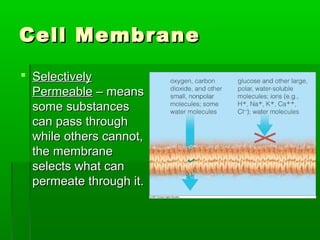
 SelectivelySelectively
PermeablePermeable – means– means
some substancessome substances
can pass throughcan pass through
while others cannot,while others cannot,
the membranethe membrane
selects what canselects what can
permeate through it.permeate through it.
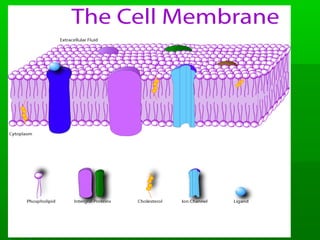
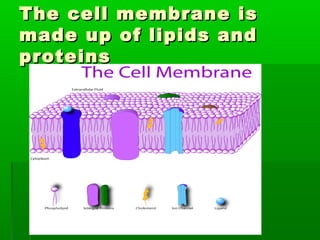
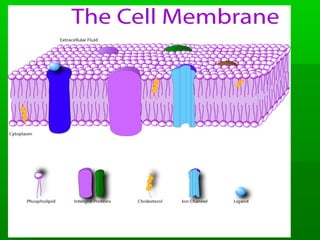
The cell membrane isThe cell membrane is
made up of lipids andmade up of lipids and
proteinsproteins
Membrane LipidsMembrane Lipids
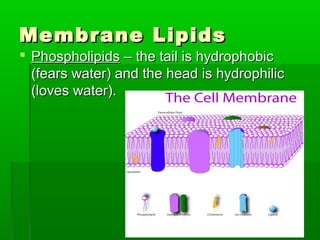
 PhospholipidsPhospholipids – the tail is hydrophobic– the tail is hydrophobic
(fears water) and the head is hydrophilic(fears water) and the head is hydrophilic
(loves water).(loves water).
Membrane LipidsMembrane Lipids
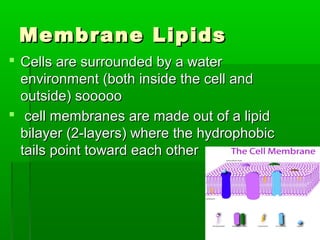
 Cells are surrounded by a waterCells are surrounded by a water
environment (both inside the cell andenvironment (both inside the cell and
outside) sooooooutside) sooooo
 cell membranes are made out of a lipidcell membranes are made out of a lipid
bilayer (2-layers) where the hydrophobicbilayer (2-layers) where the hydrophobic
tails point toward each othertails point toward each other
Important PartsImportant Parts
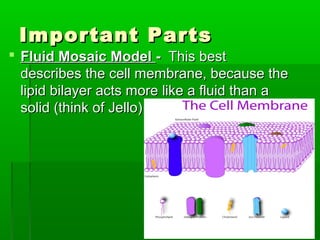
 Fluid Mosaic ModelFluid Mosaic Model -- This bestThis best
describes the cell membrane, because thedescribes the cell membrane, because the
lipid bilayer acts more like a fluid than alipid bilayer acts more like a fluid than a
solid (think of Jello)solid (think of Jello)
Important PartsImportant Parts
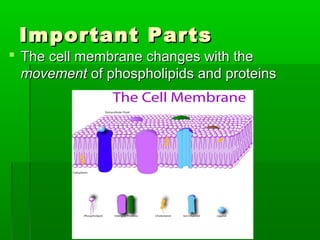
 The cell membrane changes with theThe cell membrane changes with the
movementmovement of phospholipids and proteinsof phospholipids and proteins
TransportTransport
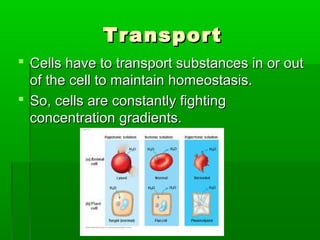
 Cells have to transport substances in or outCells have to transport substances in or out
of the cell to maintain homeostasis.of the cell to maintain homeostasis.
 So, cells are constantly fightingSo, cells are constantly fighting
concentration gradients.concentration gradients.
TransportsTransports
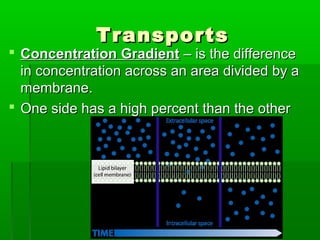
 Concentration GradientConcentration Gradient – is the difference– is the difference
in concentration across an area divided by ain concentration across an area divided by a
membrane.membrane.
 One side has a high percent than the otherOne side has a high percent than the other
TransportsTransports
 So, the job of transports are to get rid ofSo, the job of transports are to get rid of
concentration gradients by movingconcentration gradients by moving
molecules from one side of the cellmolecules from one side of the cell
membrane to the other.membrane to the other.
 When the sides have an equalWhen the sides have an equal
concentration you have now reachconcentration you have now reach
equilibrium (Homeostasis).equilibrium (Homeostasis).
EquilibriumEquilibrium
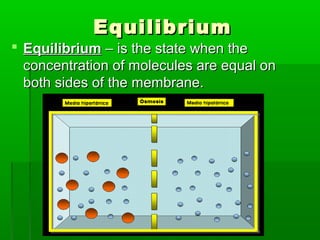
 EquilibriumEquilibrium – is the state when the– is the state when the
concentration of molecules are equal onconcentration of molecules are equal on
both sides of the membrane.both sides of the membrane.
TransportTransport
 There are 2 types of transports.There are 2 types of transports.
 1.1. Passive TransportPassive Transport – movement of– movement of
substances down their concentration gradientsubstances down their concentration gradient
(high concentration to low concentration); no(high concentration to low concentration); no
energyenergy
 2.2. Active Transport:Active Transport: movement ofmovement of
substances up their concentration gradientsubstances up their concentration gradient
(low concentration to high concentration);(low concentration to high concentration);
requires ENERGYrequires ENERGY

Introduction to Transport Notes

  • 1.
  • 2.
    HomeostasisHomeostasis  How doesyour cells keep homeostasisHow does your cells keep homeostasis (internal stable condition)?(internal stable condition)?  By transporting molecules in and out ofBy transporting molecules in and out of the cell, like water, sugar, salt, andthe cell, like water, sugar, salt, and electrolytes.electrolytes.  This is done by the passive or activeThis is done by the passive or active transports.transports.
  • 3.
    TransportsTransports  To transportmolecules in and out of theTo transport molecules in and out of the cell, these molecules will have to passcell, these molecules will have to pass through the cell membrane.through the cell membrane.  So let’s learn more about the functionSo let’s learn more about the function and structure of the cell membrane!!!and structure of the cell membrane!!!
  • 4.
    Cell OrganelleCell Organelle Cell MembraneCell Membrane – is– is the organelle thatthe organelle that surrounds the cellsurrounds the cell and is made up ofand is made up of phospholipids andphospholipids and proteins.proteins.
  • 6.
    Cell MembraneCell Membrane Function:Function: is to control what goes in andis to control what goes in and out of the cell.out of the cell.  This means cell membranes areThis means cell membranes are selectively permeable.selectively permeable.
  • 7.
    Cell MembraneCell Membrane SelectivelySelectively PermeablePermeable – means– means some substancessome substances can pass throughcan pass through while others cannot,while others cannot, the membranethe membrane selects what canselects what can permeate through it.permeate through it.
  • 8.
    The cell membraneisThe cell membrane is made up of lipids andmade up of lipids and proteinsproteins
  • 9.
    Membrane LipidsMembrane Lipids PhospholipidsPhospholipids – the tail is hydrophobic– the tail is hydrophobic (fears water) and the head is hydrophilic(fears water) and the head is hydrophilic (loves water).(loves water).
  • 10.
    Membrane LipidsMembrane Lipids Cells are surrounded by a waterCells are surrounded by a water environment (both inside the cell andenvironment (both inside the cell and outside) sooooooutside) sooooo  cell membranes are made out of a lipidcell membranes are made out of a lipid bilayer (2-layers) where the hydrophobicbilayer (2-layers) where the hydrophobic tails point toward each othertails point toward each other
  • 12.
    Important PartsImportant Parts Fluid Mosaic ModelFluid Mosaic Model -- This bestThis best describes the cell membrane, because thedescribes the cell membrane, because the lipid bilayer acts more like a fluid than alipid bilayer acts more like a fluid than a solid (think of Jello)solid (think of Jello)
  • 13.
    Important PartsImportant Parts The cell membrane changes with theThe cell membrane changes with the movementmovement of phospholipids and proteinsof phospholipids and proteins
  • 14.
    TransportTransport  Cells haveto transport substances in or outCells have to transport substances in or out of the cell to maintain homeostasis.of the cell to maintain homeostasis.  So, cells are constantly fightingSo, cells are constantly fighting concentration gradients.concentration gradients.
  • 15.
    TransportsTransports  Concentration GradientConcentrationGradient – is the difference– is the difference in concentration across an area divided by ain concentration across an area divided by a membrane.membrane.  One side has a high percent than the otherOne side has a high percent than the other
  • 16.
    TransportsTransports  So, thejob of transports are to get rid ofSo, the job of transports are to get rid of concentration gradients by movingconcentration gradients by moving molecules from one side of the cellmolecules from one side of the cell membrane to the other.membrane to the other.  When the sides have an equalWhen the sides have an equal concentration you have now reachconcentration you have now reach equilibrium (Homeostasis).equilibrium (Homeostasis).
  • 17.
    EquilibriumEquilibrium  EquilibriumEquilibrium –is the state when the– is the state when the concentration of molecules are equal onconcentration of molecules are equal on both sides of the membrane.both sides of the membrane.
  • 18.
    TransportTransport  There are2 types of transports.There are 2 types of transports.  1.1. Passive TransportPassive Transport – movement of– movement of substances down their concentration gradientsubstances down their concentration gradient (high concentration to low concentration); no(high concentration to low concentration); no energyenergy  2.2. Active Transport:Active Transport: movement ofmovement of substances up their concentration gradientsubstances up their concentration gradient (low concentration to high concentration);(low concentration to high concentration); requires ENERGYrequires ENERGY