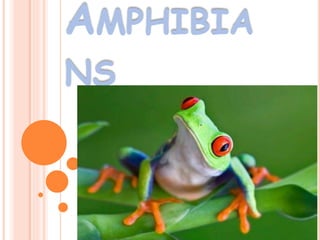
AMPHIBIA
NS
INTORDUCTION & EVOLUTION:
 Class of Chordates.
 The word amphibian means both sides of life.
(amphi= both bians=life)
 The amphibian begins its life in the water and then
finishes it mainly on land.
 Metamorphism:
The change of an animal in its appearance from
baby to adult is called metamorphosis.
An amphibian goes through metamorphosis as it
grows from a baby to an adult.
 Estivation:
“The amphibian, because it must be moist,
sometimes hides out in the summer as if
hibernating. This is called estivation.”
 Evolution:
-In the Devonian period of palaeozoic era they
were originated from fishes
-In the carboniferous period, they increased their
number, hence that period is called ‘Age of
amphibians’
 According to Romer Dipnoi fishes are the “uncles
of Amphibians” According to Newman “Dipnoi and
amphibians had same grand father.”
GENERAL CHARACTERS OF AMPHIBIANS:
 Amphibians are cold blooded vertebrates.
 Amphibians show four limbs with which they can
swim in water and jump or walk on the land.
 In Amphibians animals’ exoskeleton is absent.
 Amphibians the adult animals lungs are present.
But in some the gills are present.
 Amphibians Skin is a respiratory organ.
 The Amphibians skull is dicondylic.
 Amphibians Ribs are absent.
 In Amphibians The body divisible into head and
trunk Tail is present in, urodela animals.
 Amphibians Digestive system is well developed. A
well developed liver is present.
 External ear is absent. Middle and inner ears are
present, the middle ear is present.
 Amphibians Heart is 3 chambered with 2 auricles
and 1 ventricle.
 Blood vascular system contain hepatic and renal
portal systems.
 Central nervous system is well developed. 10 pairs
of cranial nerves will arise.
 Sexes are separate.
 Most frog larvae are herbivores, where as
salamander larvae are carnivores. However, adult
frogs and salamanders are predators and feed on
small invertebrates
DIGESTIVE SYSTEM:
 Parts of the digestive system of a amphibians
includes:
-Mouth.
-Pharynx.
-Oesophagus.
-Stomach.
-Small intestine.
-Large intestine.
-Cloaca.
-Accessory organs.
MECHANISM:
 After an amphibians eats, the food flows from its
mouth to its esophagus to its stomach.
 Digestion begins in the stomach of an amphibian.
Food then moves to the small intestine, where
enzymes from the pancreas start the digestion
process.
 From the small intestine, nutrients from the food are
absorbed into the bloodstream and delivered to
body cells.
 Food moves from the small intestine to the large
intestine before waste is eliminated.
 Digestive waste enters the cloaca before it exits the
body.
 Reabsorption:
Absorption unabsorbed nutrients and reabsorption of
water takes place in the large intestine.
 Liquid wastes are in frog is passed to the urinary
bladder, while solids are routed to the cloaca.
 Both liquid and solid wastes in frog are expelled out
through cloaca which is a slit that opens out finally in
digestive system of a frog.
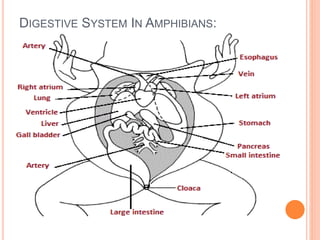
 The digestive system of amphibians consists of
digestive tract .
 The accessory organs which help to process the food
consumed into small molecules (nutrients) which then
can be easily absorbed and then utilized by the cells of
the body.
DIGESTIVE SYSTEM IN AMPHIBIANS:
EXCRETORY SYSTEM:
 Not vastly different from humans.
 It involves the alimentary canal and the kidney.
 In fact the first sustained evidence for ultrafiltration in the
kidney was produced by studying the kidney of frogs.
 The kidney's of an amphibian filter waste out of the
blood.
 Very Important System in order to expell waste materials
as if they remain in body they can cause serious
damages.
 It Includes:
-Kidneys.
-Ureters.
-Urinary Bladder.
-Cloaca.
MECHANISM:
 The Urine travels from the kidneys to the tubes
which are called ureters.
 From the ureters the urine travels into the cloaca.
 Next the urine can be passed outside the body or
the urine may be stored temporarily in a urinary
bladder just above the cloaca.
 Bile is excreted into the digestive system similar to
mammals.
 Solid wastes pass from the large intestine into the
cloaca.
 Both solid and liquid waste material is discharged
from the cloaca and the cloacal vent.
EXCRETORY SYSTEM IN MALE AMPHIBIAN:
RESPIRATORY:
 Amphibians can get oxygen into their bodies in three
different ways.
-Through Lungs.
-Through Skin.
-Through Gills.
 Both the lungs and the skin serve as primary respiratory
organs in amphibians.
 Skin:
“The skin of these animals is highly vascularized and
moist, with moisture maintained via secretion
of mucus from specialized cells.”
 Lungs:
“lungs are of primary importance to breathing control
and oxygen exchange.”
MECHANISM:
 Through the nostrills they breathe the air in side.
 The air than travels into trachea.
 After trachea the air reaches to bronchi
 Through bronchi the air reaches finally into lungs
 In the lungs the air enters the alveoli where oxygen
and carbon dioxide is exchanged.
 Similarly skin also exchanges gasses directly when
it comes in contact with water the water enters the
body with attached oxygen and skin then in turn
releases carbon dioxide.
RESPIRATION:
RESPIRATION THROUGH GILLS:
 Many amphibians have gills, at least when they're
young.
 Gills are made up of very thin blood vessels,
surrounded by water channels.
 When water flows through the gills, the oxygen it
contains crosses the very thin blood vessel walls,
and into the blood.
CIRCULATORY SYSTEM:
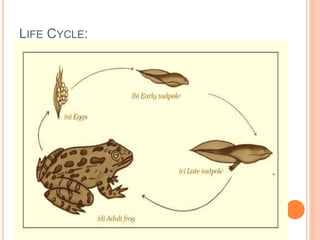
 Amphibians have a tadpole stage and an adult stage,
and the circulatory systems of the two are distinct.
 In the juvenile (or tadpole) stage, the circulation is
similar to that of a fish.
 In Tadpole Stage:
“The two-chambered heart pumps the blood through the
gills where it is oxygenated, around the body and back
to the heart in a single loop.”
 In Adult Stage:
“. In the adult stage, amphibians (especially frogs) lose
their gills and develop lungs. They have a heart that
consists of a single ventricle and two atria. When the
ventricle starts contracting, deoxygenated blood is
pumped through the pulmonary artery to the lungs.
Continued contraction then pumps oxygenated blood
around the rest of the body”
CIRCULATION OF BLOOD:
REPRODUCTION:
 Both male and female frogs have internal sex organs.
 Male:
-The male frog's foreleg muscles and first fingers swell.
-The reproductive system of the male frog includes two bean-
shaped white or yellowish testes located near the kidneys.
-Sperm cells develop in the testes and pass through tubes to
the kidneys and urinary ducts.
 Female:
-Female frogs a pair of large, lobed ovaries containing thou-
sands of tiny immature eggs lie near the kidneys.
-During the breeding season eggs enlarge, mature, and burst
through the thin ovarian walls into the body cavity. ---They
remain in structures called ovisacs until ovulation is complete
and then leave the body through the cloacae opening .
FERTILIZATION OF ZYGOTE:
 When a frog reproduces, the female frog releases
as many as 200 eggs.
 The male sperms can the fertilize the eggs. The
eggs of a frog do not have a shell and usually try
out if they are not kept moist.
 Because of this the eggs attach to underwater
plants using a transparent jelly that incases the
eggs.
 This also makes it harder for predators to reach the
eggs. So fertilization takes place in water and new
amphibians are born from the zygote.
LIFE CYCLE:
ODERS OF CLASS AMPHIBIA:
 Three orders of amphibians are :
Order Caudata (salamanders, 400 species)
Order Anura (frogs and toads, 3500 species)
Order Apoda (caecilians, 150 species)

Amphibians

  • 1.
  • 2.
    INTORDUCTION & EVOLUTION: Class of Chordates.  The word amphibian means both sides of life. (amphi= both bians=life)  The amphibian begins its life in the water and then finishes it mainly on land.  Metamorphism: The change of an animal in its appearance from baby to adult is called metamorphosis. An amphibian goes through metamorphosis as it grows from a baby to an adult.
  • 3.
     Estivation: “The amphibian,because it must be moist, sometimes hides out in the summer as if hibernating. This is called estivation.”  Evolution: -In the Devonian period of palaeozoic era they were originated from fishes -In the carboniferous period, they increased their number, hence that period is called ‘Age of amphibians’  According to Romer Dipnoi fishes are the “uncles of Amphibians” According to Newman “Dipnoi and amphibians had same grand father.”
  • 4.
    GENERAL CHARACTERS OFAMPHIBIANS:  Amphibians are cold blooded vertebrates.  Amphibians show four limbs with which they can swim in water and jump or walk on the land.  In Amphibians animals’ exoskeleton is absent.  Amphibians the adult animals lungs are present. But in some the gills are present.  Amphibians Skin is a respiratory organ.  The Amphibians skull is dicondylic.  Amphibians Ribs are absent.  In Amphibians The body divisible into head and trunk Tail is present in, urodela animals.
  • 5.
     Amphibians Digestivesystem is well developed. A well developed liver is present.  External ear is absent. Middle and inner ears are present, the middle ear is present.  Amphibians Heart is 3 chambered with 2 auricles and 1 ventricle.  Blood vascular system contain hepatic and renal portal systems.  Central nervous system is well developed. 10 pairs of cranial nerves will arise.  Sexes are separate.  Most frog larvae are herbivores, where as salamander larvae are carnivores. However, adult frogs and salamanders are predators and feed on small invertebrates
  • 6.
    DIGESTIVE SYSTEM:  Partsof the digestive system of a amphibians includes: -Mouth. -Pharynx. -Oesophagus. -Stomach. -Small intestine. -Large intestine. -Cloaca. -Accessory organs.
  • 7.
    MECHANISM:  After anamphibians eats, the food flows from its mouth to its esophagus to its stomach.  Digestion begins in the stomach of an amphibian. Food then moves to the small intestine, where enzymes from the pancreas start the digestion process.  From the small intestine, nutrients from the food are absorbed into the bloodstream and delivered to body cells.  Food moves from the small intestine to the large intestine before waste is eliminated.  Digestive waste enters the cloaca before it exits the body.
  • 8.
     Reabsorption: Absorption unabsorbednutrients and reabsorption of water takes place in the large intestine.  Liquid wastes are in frog is passed to the urinary bladder, while solids are routed to the cloaca.  Both liquid and solid wastes in frog are expelled out through cloaca which is a slit that opens out finally in digestive system of a frog.  The digestive system of amphibians consists of digestive tract .  The accessory organs which help to process the food consumed into small molecules (nutrients) which then can be easily absorbed and then utilized by the cells of the body.
  • 9.
  • 10.
    EXCRETORY SYSTEM:  Notvastly different from humans.  It involves the alimentary canal and the kidney.  In fact the first sustained evidence for ultrafiltration in the kidney was produced by studying the kidney of frogs.  The kidney's of an amphibian filter waste out of the blood.  Very Important System in order to expell waste materials as if they remain in body they can cause serious damages.  It Includes: -Kidneys. -Ureters. -Urinary Bladder. -Cloaca.
  • 11.
    MECHANISM:  The Urinetravels from the kidneys to the tubes which are called ureters.  From the ureters the urine travels into the cloaca.  Next the urine can be passed outside the body or the urine may be stored temporarily in a urinary bladder just above the cloaca.  Bile is excreted into the digestive system similar to mammals.  Solid wastes pass from the large intestine into the cloaca.  Both solid and liquid waste material is discharged from the cloaca and the cloacal vent.
  • 12.
    EXCRETORY SYSTEM INMALE AMPHIBIAN:
  • 13.
    RESPIRATORY:  Amphibians canget oxygen into their bodies in three different ways. -Through Lungs. -Through Skin. -Through Gills.  Both the lungs and the skin serve as primary respiratory organs in amphibians.  Skin: “The skin of these animals is highly vascularized and moist, with moisture maintained via secretion of mucus from specialized cells.”  Lungs: “lungs are of primary importance to breathing control and oxygen exchange.”
  • 14.
    MECHANISM:  Through thenostrills they breathe the air in side.  The air than travels into trachea.  After trachea the air reaches to bronchi  Through bronchi the air reaches finally into lungs  In the lungs the air enters the alveoli where oxygen and carbon dioxide is exchanged.  Similarly skin also exchanges gasses directly when it comes in contact with water the water enters the body with attached oxygen and skin then in turn releases carbon dioxide.
  • 15.
  • 16.
    RESPIRATION THROUGH GILLS: Many amphibians have gills, at least when they're young.  Gills are made up of very thin blood vessels, surrounded by water channels.  When water flows through the gills, the oxygen it contains crosses the very thin blood vessel walls, and into the blood.
  • 17.
    CIRCULATORY SYSTEM:  Amphibianshave a tadpole stage and an adult stage, and the circulatory systems of the two are distinct.  In the juvenile (or tadpole) stage, the circulation is similar to that of a fish.  In Tadpole Stage: “The two-chambered heart pumps the blood through the gills where it is oxygenated, around the body and back to the heart in a single loop.”  In Adult Stage: “. In the adult stage, amphibians (especially frogs) lose their gills and develop lungs. They have a heart that consists of a single ventricle and two atria. When the ventricle starts contracting, deoxygenated blood is pumped through the pulmonary artery to the lungs. Continued contraction then pumps oxygenated blood around the rest of the body”
  • 18.
  • 19.
    REPRODUCTION:  Both maleand female frogs have internal sex organs.  Male: -The male frog's foreleg muscles and first fingers swell. -The reproductive system of the male frog includes two bean- shaped white or yellowish testes located near the kidneys. -Sperm cells develop in the testes and pass through tubes to the kidneys and urinary ducts.  Female: -Female frogs a pair of large, lobed ovaries containing thou- sands of tiny immature eggs lie near the kidneys. -During the breeding season eggs enlarge, mature, and burst through the thin ovarian walls into the body cavity. ---They remain in structures called ovisacs until ovulation is complete and then leave the body through the cloacae opening .
  • 20.
    FERTILIZATION OF ZYGOTE: When a frog reproduces, the female frog releases as many as 200 eggs.  The male sperms can the fertilize the eggs. The eggs of a frog do not have a shell and usually try out if they are not kept moist.  Because of this the eggs attach to underwater plants using a transparent jelly that incases the eggs.  This also makes it harder for predators to reach the eggs. So fertilization takes place in water and new amphibians are born from the zygote.
  • 21.
  • 22.
    ODERS OF CLASSAMPHIBIA:  Three orders of amphibians are : Order Caudata (salamanders, 400 species) Order Anura (frogs and toads, 3500 species) Order Apoda (caecilians, 150 species)