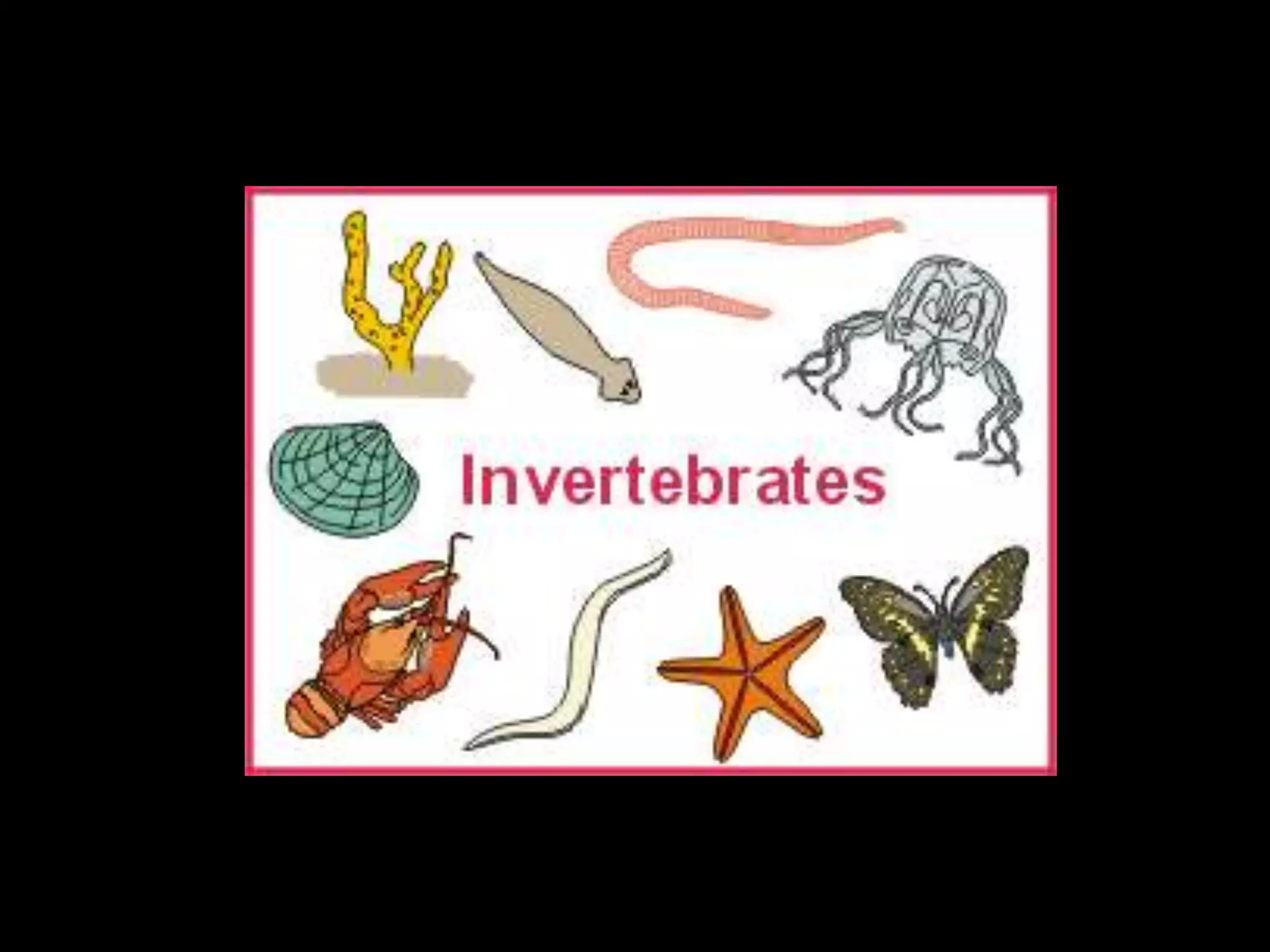
INVERTEBRATES
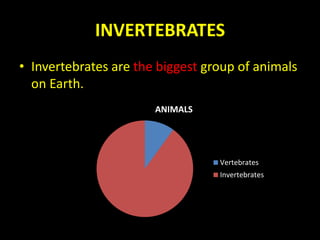
• Invertebrates are the biggest group of animals
on Earth.
ANIMALS
Vertebrates
Invertebrates
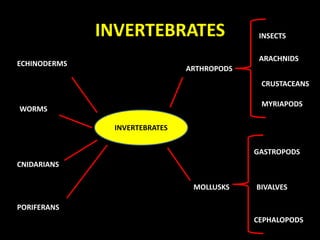
INVERTEBRATES
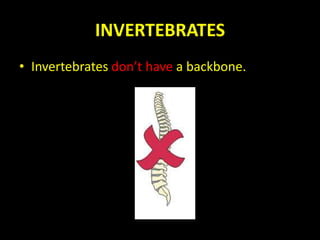
• Invertebrates don’t have a backbone.
INVERTEBRATES
INVERTEBRATES
ARTHROPODS
MOLLUSKS
WORMS
ECHINODERMS
PORIFERANS
CNIDARIANS
CEPHALOPODS
BIVALVES
GASTROPODS
INSECTS
ARACHNIDS
CRUSTACEANS
INVERTEBRATES
MYRIAPODS
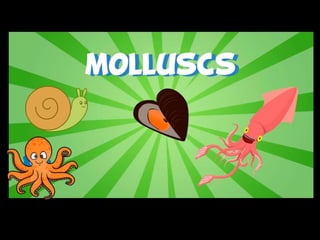
MOLLUSKS
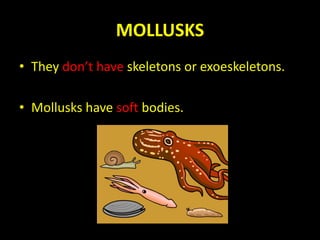
• They don’t have skeletons or exoeskeletons.
• Mollusks have soft bodies.
MOLLUSKS
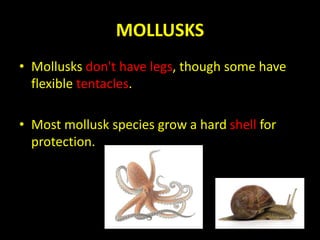
• Mollusks don't have legs, though some have
flexible tentacles.
• Most mollusk species grow a hard shell for
protection.
MOLLUSKS
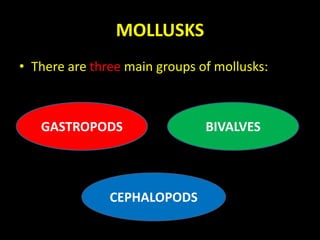
• There are three main groups of mollusks:
GASTROPODS BIVALVES
CEPHALOPODS
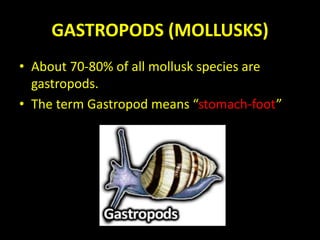
GASTROPODS (MOLLUSKS)
• About 70-80% of all mollusk species are
gastropods.
• The term Gastropod means “stomach-foot”
GASTROPODS (MOLLUSKS)
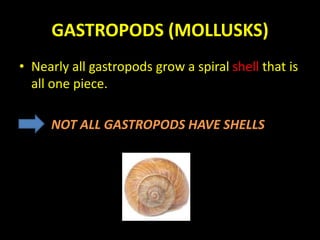
• Nearly all gastropods grow a spiral shell that is
all one piece.
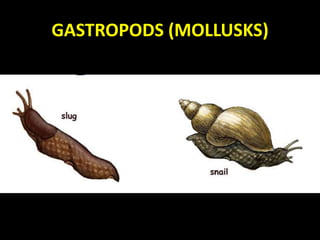
NOT ALL GASTROPODS HAVE SHELLS
GASTROPODS (MOLLUSKS)
BIVALVES (MOLLUSKS)
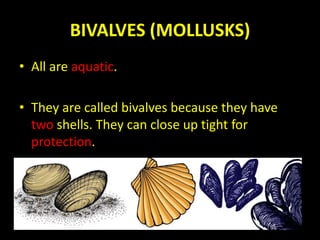
• All are aquatic.
• They are called bivalves because they have
two shells. They can close up tight for
protection.
BIVALVES (MOLLUSKS)
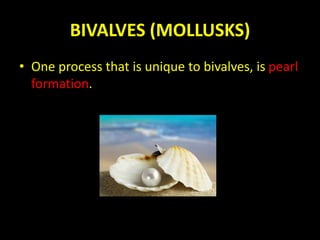
• One process that is unique to bivalves, is pearl
formation.
BIVALVES (MOLLUSKS)
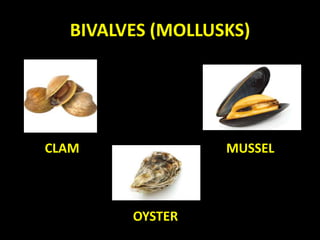
CLAM MUSSEL
OYSTER
CEPHALOPODS (MOLLUSKS)
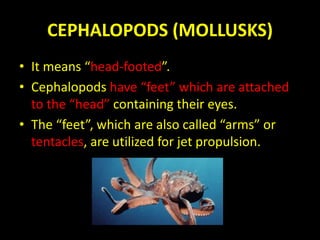
• It means “head-footed”.
• Cephalopods have “feet” which are attached
to the “head” containing their eyes.
• The “feet”, which are also called “arms” or
tentacles, are utilized for jet propulsion.
CEPHALOPODS (MOLLUSKS)
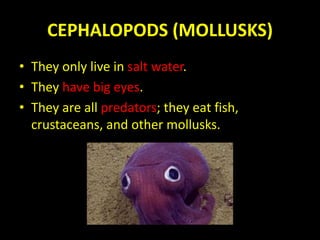
• They only live in salt water.
• They have big eyes.
• They are all predators; they eat fish,
crustaceans, and other mollusks.
CEPHALOPODS (MOLLUSKS)
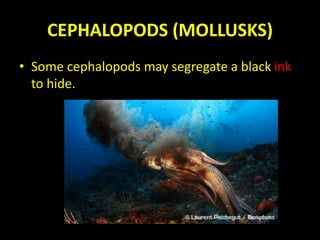
• Some cephalopods may segregate a black ink
to hide.
CEPHALOPODS (MOLLUSKS)
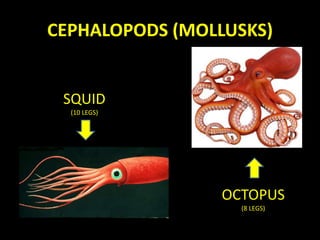
SQUID
(10 LEGS)
OCTOPUS
(8 LEGS)
ARTHROPODS
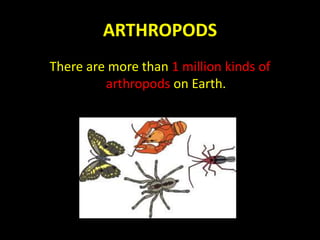
There are more than 1 million kinds of
arthropods on Earth.
ARTHROPODS
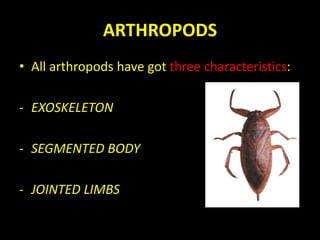
• All arthropods have got three characteristics:
- EXOSKELETON
- SEGMENTED BODY
- JOINTED LIMBS
ARTHROPODS
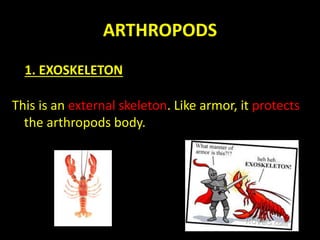
This is an external skeleton. Like armor, it protects
the arthropods body.
1. EXOSKELETON
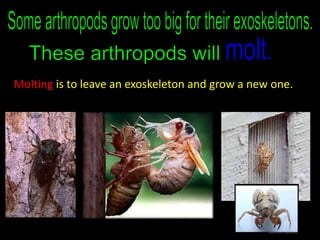
Molting is to leave an exoskeleton and grow a new one.
ARTHROPODS
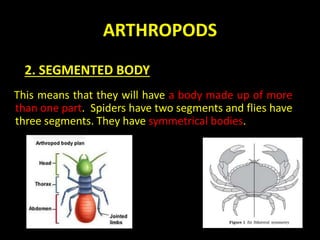
This means that they will have a body made up of more
than one part. Spiders have two segments and flies have
three segments. They have symmetrical bodies.
2. SEGMENTED BODY
ARTHROPODS
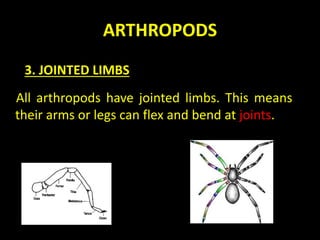
All arthropods have jointed limbs. This means
their arms or legs can flex and bend at joints.
3. JOINTED LIMBS
ARTHROPODS
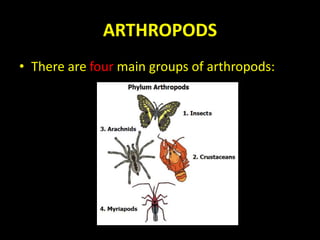
• There are four main groups of arthropods:
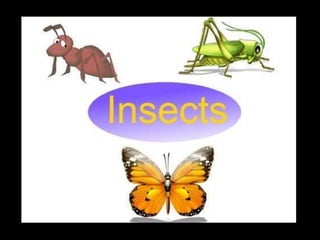
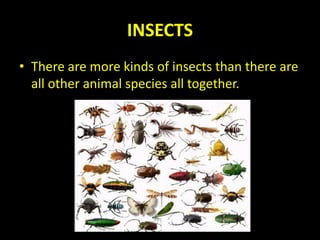
INSECTS
• There are more kinds of insects than there are
all other animal species all together.
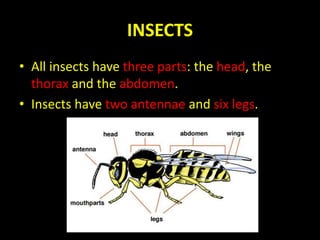
INSECTS
• All insects have three parts: the head, the
thorax and the abdomen.
• Insects have two antennae and six legs.
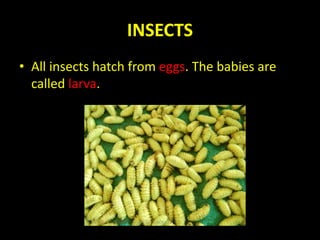
INSECTS
• All insects hatch from eggs. The babies are
called larva.
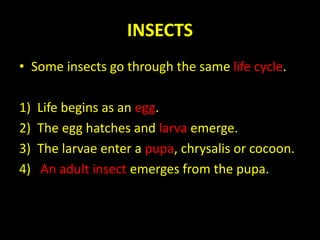
INSECTS
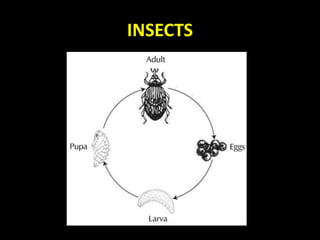
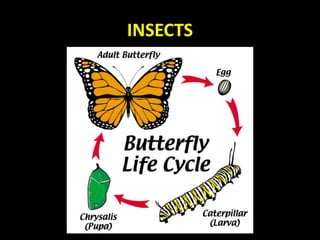
• Some insects go through the same life cycle.
1) Life begins as an egg.
2) The egg hatches and larva emerge.
3) The larvae enter a pupa, chrysalis or cocoon.
4) An adult insect emerges from the pupa.
INSECTS
INSECTS
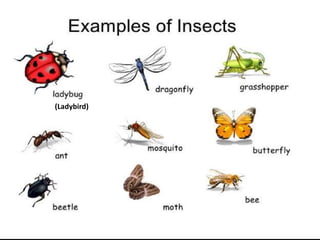
(Ladybird)
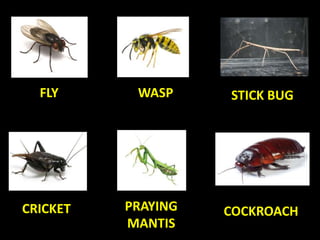
FLY WASP STICK BUG
CRICKET PRAYING
MANTIS
COCKROACH
CRUSTACEANS
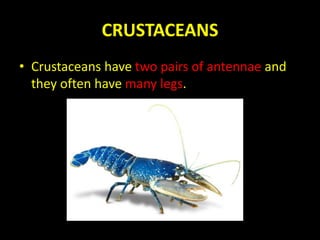
• Crustaceans have two pairs of antennae and
they often have many legs.
CRUSTACEANS
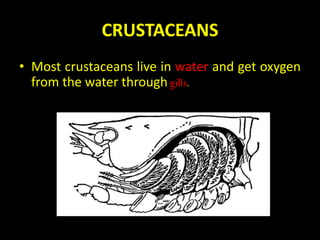
• Most crustaceans live in water and get oxygen
from the water through gills.
CRUSTACEANS
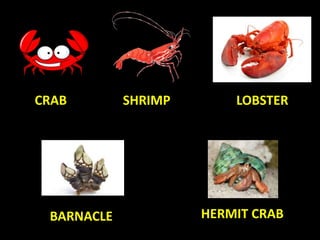
• Crabs and shrimp can swim.
• Lobsters just scuttle about on the bottom of
the ocean.
• Barnacles stick themselves to a hard surface
like a rock or a boat and never move.
• Hermit crabs can’t make their own shells. They
hide in shells left behind by other animals.
CRAB SHRIMP LOBSTER
BARNACLE HERMIT CRAB
ARACHNIDS
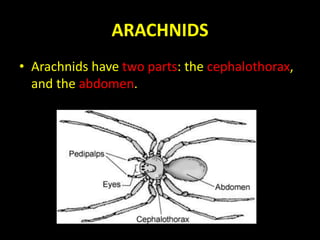
• Arachnids have two parts: the cephalothorax,
and the abdomen.
ARACHNIDS
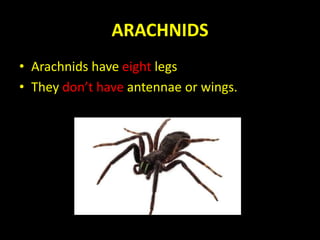
• Arachnids have eight legs
• They don’t have antennae or wings.
ARACHNIDS
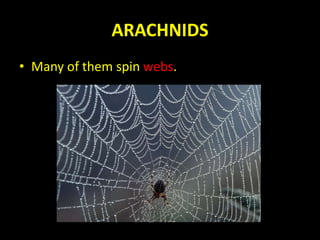
• Many of them spin webs.
ARACHNIDS
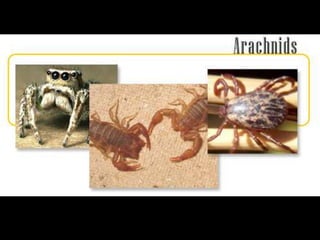
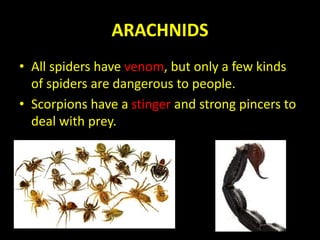
• All spiders have venom, but only a few kinds
of spiders are dangerous to people.
• Scorpions have a stinger and strong pincers to
deal with prey.
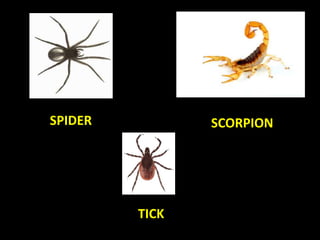
SPIDER SCORPION
TICK
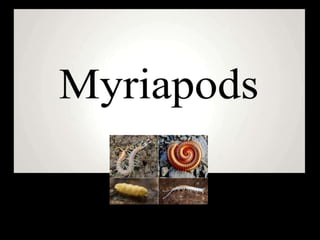
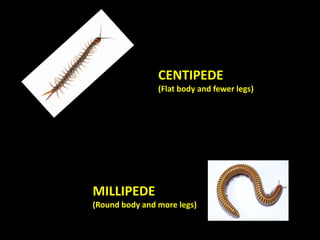
MYRIAPODS
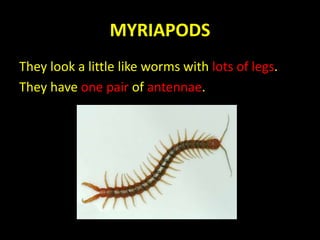
They look a little like worms with lots of legs.
They have one pair of antennae.
CENTIPEDE
(Flat body and fewer legs)
MILLIPEDE
(Round body and more legs)
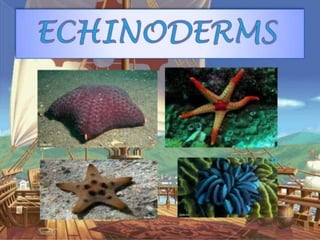
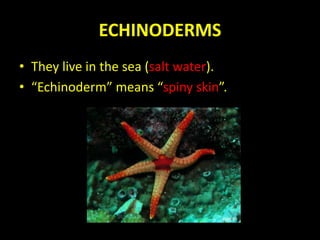
ECHINODERMS
• They live in the sea (salt water).
• “Echinoderm” means “spiny skin”.
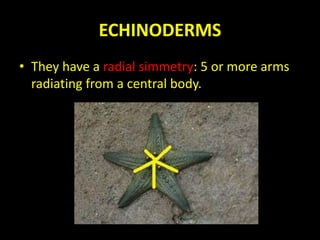
ECHINODERMS
• They have a radial simmetry: 5 or more arms
radiating from a central body.
ECHINODERMS
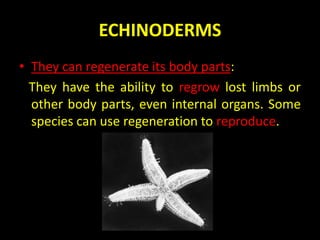
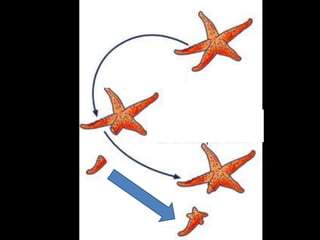
• They can regenerate its body parts:
They have the ability to regrow lost limbs or
other body parts, even internal organs. Some
species can use regeneration to reproduce.
ECHINODERMS
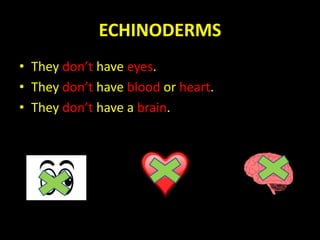
• They don’t have eyes.
• They don’t have blood or heart.
• They don’t have a brain.
ECHINODERMS
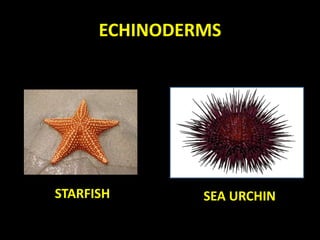
STARFISH SEA URCHIN
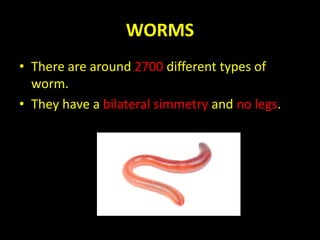
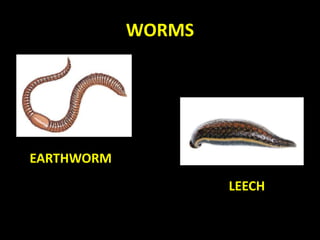
WORMS
• There are around 2700 different types of
worm.
• They have a bilateral simmetry and no legs.
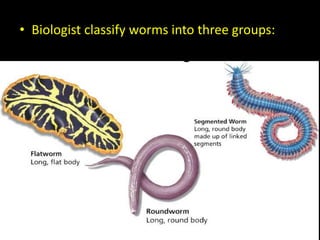
• Biologist classify worms into three groups:
WORMS
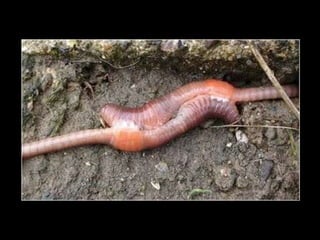
• Most worms are hermaphrodites and have
both male and female organs.
WORMS
EARTHWORM
LEECH
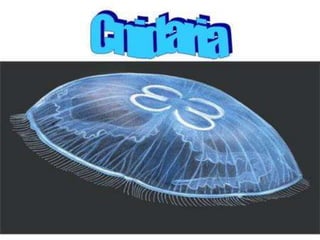
CNIDARIANS
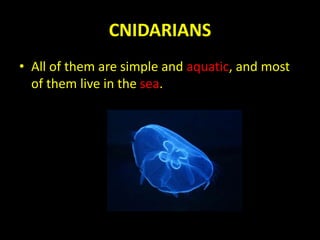
• All of them are simple and aquatic, and most
of them live in the sea.
CNIDARIANS
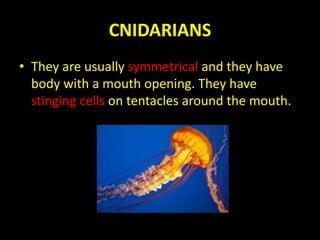
• They are usually symmetrical and they have
body with a mouth opening. They have
stinging cells on tentacles around the mouth.
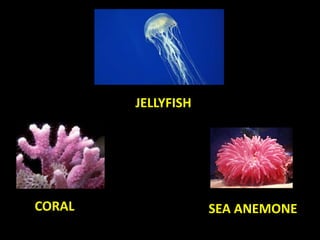
JELLYFISH
CORAL SEA ANEMONE
PORIFERANS (SPONGES)
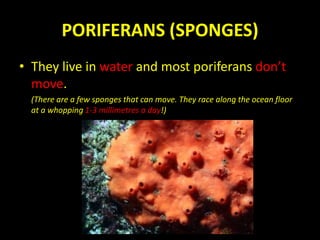
• They live in water and most poriferans don’t
move.
(There are a few sponges that can move. They race along the ocean floor
at a whopping 1-3 millimetres a day!)
PORIFERANS (SPONGES)
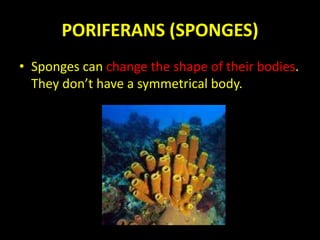
• Sponges can change the shape of their bodies.
They don’t have a symmetrical body.
PORIFERANS (SPONGES)
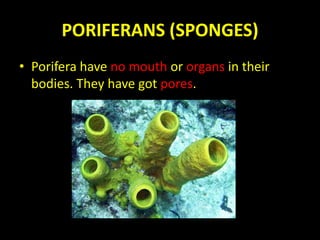
• Porifera have no mouth or organs in their
bodies. They have got pores.
PORIFERANS (SPONGES)
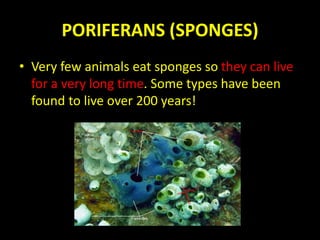
• Very few animals eat sponges so they can live
for a very long time. Some types have been
found to live over 200 years!

Invertebrates