Shafi ul Haq
UNIVERSITY OF HARIPUR
DEPARTMENT OF FORESTRY & WILDLIFE MANAGEMENT
Introduction
 From studies of fossils and comparative
anatomy, zoologists infer that reptiles
arose from amphibians.
 The oldest known fossils of reptiles are
about 350 million-years-old.
 They were found in deposits from the
early carboniferous period, which
occurred between 360 and 286 million
years ago.
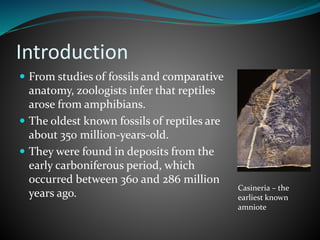
Casineria – the
earliest known
amniote
Introduction
 The earliest reptiles were small, four legged vertebrates
that resembled lizards and had teeth adapted for
eating insects. The abundance of insects at the time
may have been one reason that early reptiles
flourished.
Age of Reptiles
 The reptiles diversified rapidly, and by the Permian
period (286 million to 245 million years ago) they had
become the dominant land vertebrates.
 The Mesozoic era (245 million to 65 million years ago)
is often called the Age of Reptiles because nearly all of
the large vertebrates on Earth were reptiles during that
time.
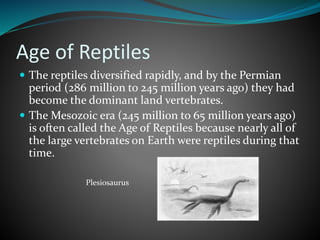
Plesiosaurus
Age of Reptiles
 On land, the most famous and spectacular reptiles –
the dinosaurs – appeared and evolved into a great
variety of forms during the Mesozoic era.
 Dinosaurs are known for the great size of some species.
One of the largest dinosaurs, Brachiosaurus, measured
23 m (75ft) in length, stood 12 m (40 ft) tall, and
weighed more than 77,000 (170,000 pounds). Many
species of dinosaurs, however, were small, some no
larger than chicken.
Age of Reptiles
 Over 300 species of dinosaurs have been identified.
Their fossils have been discovered on all continents,
even Antarctica, which had a much warmer climate
during the Mesozoic era than it does today.
 Dinosaurs were adapted to a wide range of
environments and to different ways of life.
Age of Reptiles
 Reptilian success during the Mesozoic era was not
limited to terrestrial habitats. Several groups of
reptiles, including Ichthyosaurs and Plesiosaurs, lived
in the oceans.
Age of Reptiles
 Ichthyosaurs were sleek reptiles that resembled
modern bottlenose dolphin. Plesiosaurs had long,
flexible necks and compact bodies.
Ichthyosaurus found in Somerset
County, England.
Plesiosaurus
Extinction of Dinosaurs
 Although the fossil record provides many clues about
what dinosaurs were like. Paleontologists who study
dinosaurs still have many unanswered questions. For
example, why did the dinosaurs become extinct 65
million years ago, at the end of the cretaceous period?
 Many species of aquatic and terrestrial organisms
besides the dinosaurs became extinct at this time.
Extinction of Dinosaurs
 Most scientists think that a catastrophic cosmic event
was responsible for the mass extinction. Supporters of
this hypothesis – called the asteroid-impact
hypothesis – suggest that a huge asteroid hit the earth,
sending so much dust into the atmosphere that the
amount of sunlight reaching the earth’s surface was
greatly reduced.
Extinction of Dinosaurs
 The reduced sunlight causes severe climate changes
that led to the mass extinction.
 According to this hypothesis, the dinosaurs would
have become extinct very quickly, perhaps even with a
few months.
Success of Reptiles
 Representatives of the four modern orders of
reptiles—turtles and tortoises, lizards and snakes,
tuataras, and crocodilian—survived the mass
extinction of the Cretaceous period.
 These four orders of reptiles have diversified to more
than 5,000 species.
Success of Reptiles
 Reptiles today successfully occupy a variety of
terrestrial and aquatic habitats on all continents
except Antarctica.
Evolution
Thank You
?