Cell Organelle Notes
Cell Organelles
•READ THE MESSAGE
BELOW!!!!!
• You should already know all of the cell
organelles and their functions, but just in case
you forgot, the following slides will give you
the name and function of the cell organelles
that you need to know.
Cell Organelle
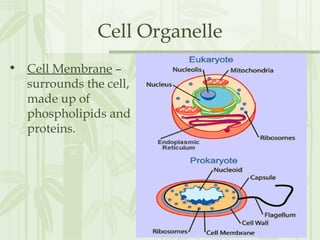
• Cell Membrane –
surrounds the cell,
made up of
phospholipids and
proteins.
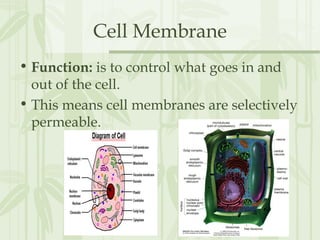
Cell Membrane
• Function: is to control what goes in and
out of the cell.
• This means cell membranes are selectively
permeable.
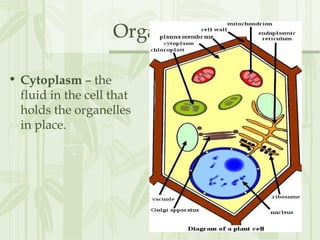
Organelles
• Cytoplasm – the
fluid in the cell that
holds the organelles
in place.
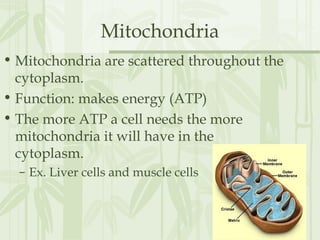
Mitochondria
• Mitochondria are scattered throughout the
cytoplasm.
• Function: makes energy (ATP)
• The more ATP a cell needs the more
mitochondria it will have in the
cytoplasm.
– Ex. Liver cells and muscle cells
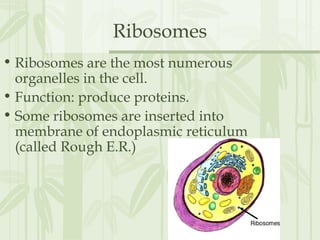
Ribosomes
• Ribosomes are the most numerous
organelles in the cell.
• Function: produce proteins.
• Some ribosomes are inserted into
membrane of endoplasmic reticulum
(called Rough E.R.)
Endoplasmic Reticulum (ER)
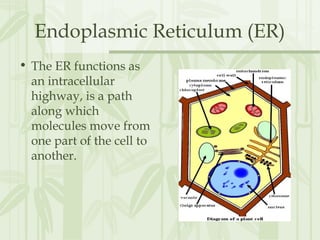
• The ER functions as
an intracellular
highway, is a path
along which
molecules move from
one part of the cell to
another.
Endoplasmic Reticulum (ER)
• A cell has 2 types of ER:
• Rough Endoplasmic Reticulum (rough
ER): which produces large amounts of
proteins to be exported.
– Has ribosome in membrane (makes it rough)
• Smooth ER: is used to synthesis steroids in
gland cells, regulate calcium in muscles,
and break down toxins in liver cells.
Golgi Apparatus
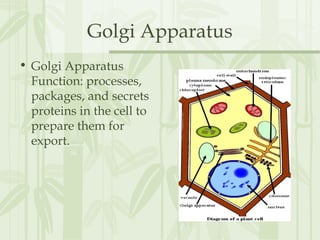
• Golgi Apparatus
Function: processes,
packages, and secrets
proteins in the cell to
prepare them for
export.
Lysosomes
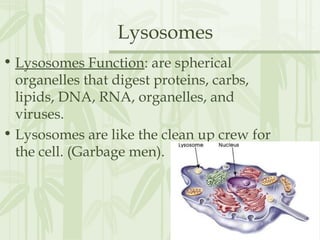
• Lysosomes Function: are spherical
organelles that digest proteins, carbs,
lipids, DNA, RNA, organelles, and
viruses.
• Lysosomes are like the clean up crew for
the cell. (Garbage men).
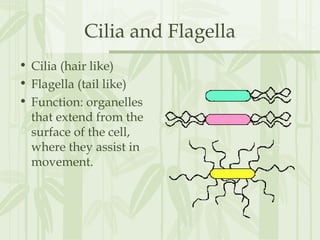
Cilia and Flagella
• Cilia (hair like)
• Flagella (tail like)
• Function: organelles
that extend from the
surface of the cell,
where they assist in
movement.
Cilia and Flagella
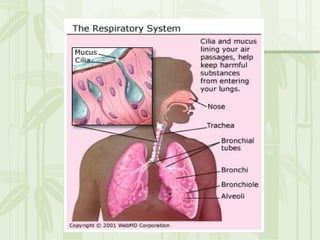
• Cilia are also found on the surfaces of cells
in multicellular organisms.
• Where can they be found on human cell
surfaces?
• On cells lining your respiratory tract
• They trap particles from the air you
inhale.
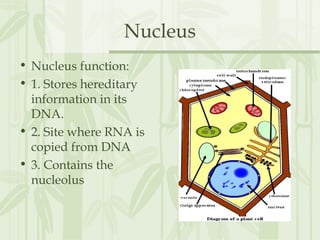
Nucleus
• Nucleus function:
• 1. Stores hereditary
information in its
DNA.
• 2. Site where RNA is
copied from DNA
• 3. Contains the
nucleolus
Nucleus
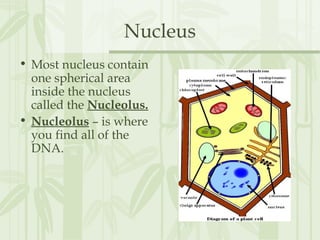
• Most nucleus contain
one spherical area
inside the nucleus
called the Nucleolus.
• Nucleolus – is where
you find all of the
DNA.
Plant Cells
• Plant cell have 3 additional parts.
• 1. Cell walls
• 2. Vacuoles
• 3. Plastids
• All are important to plant functions.
Cell Walls
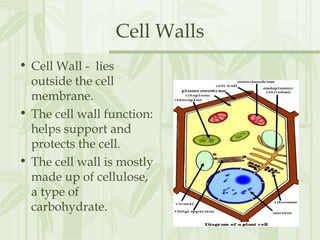
• Cell Wall - lies
outside the cell
membrane.
• The cell wall function:
helps support and
protects the cell.
• The cell wall is mostly
made up of cellulose,
a type of
carbohydrate.
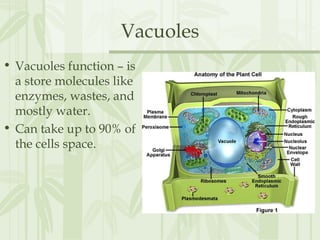
Vacuoles
• Vacuoles function – is
a store molecules like
enzymes, wastes, and
mostly water.
• Can take up to 90% of
the cells space.
Plastids
• Plastids – contain pigments, which absorb
visible light (for photosynthesis).
• Most familiar type of plastid is the
chloroplast.
• Chloroplast – are organelles that convert
light energy into chemical energy
(glucose).

Cell Organelle Notes

  • 1.
  • 2.
    Cell Organelles •READ THEMESSAGE BELOW!!!!! • You should already know all of the cell organelles and their functions, but just in case you forgot, the following slides will give you the name and function of the cell organelles that you need to know.
  • 3.
    Cell Organelle • CellMembrane – surrounds the cell, made up of phospholipids and proteins.
  • 4.
    Cell Membrane • Function:is to control what goes in and out of the cell. • This means cell membranes are selectively permeable.
  • 5.
    Organelles • Cytoplasm –the fluid in the cell that holds the organelles in place.
  • 6.
    Mitochondria • Mitochondria arescattered throughout the cytoplasm. • Function: makes energy (ATP) • The more ATP a cell needs the more mitochondria it will have in the cytoplasm. – Ex. Liver cells and muscle cells
  • 7.
    Ribosomes • Ribosomes arethe most numerous organelles in the cell. • Function: produce proteins. • Some ribosomes are inserted into membrane of endoplasmic reticulum (called Rough E.R.)
  • 8.
    Endoplasmic Reticulum (ER) •The ER functions as an intracellular highway, is a path along which molecules move from one part of the cell to another.
  • 9.
    Endoplasmic Reticulum (ER) •A cell has 2 types of ER: • Rough Endoplasmic Reticulum (rough ER): which produces large amounts of proteins to be exported. – Has ribosome in membrane (makes it rough) • Smooth ER: is used to synthesis steroids in gland cells, regulate calcium in muscles, and break down toxins in liver cells.
  • 10.
    Golgi Apparatus • GolgiApparatus Function: processes, packages, and secrets proteins in the cell to prepare them for export.
  • 11.
    Lysosomes • Lysosomes Function:are spherical organelles that digest proteins, carbs, lipids, DNA, RNA, organelles, and viruses. • Lysosomes are like the clean up crew for the cell. (Garbage men).
  • 12.
    Cilia and Flagella •Cilia (hair like) • Flagella (tail like) • Function: organelles that extend from the surface of the cell, where they assist in movement.
  • 13.
    Cilia and Flagella •Cilia are also found on the surfaces of cells in multicellular organisms. • Where can they be found on human cell surfaces? • On cells lining your respiratory tract • They trap particles from the air you inhale.
  • 15.
    Nucleus • Nucleus function: •1. Stores hereditary information in its DNA. • 2. Site where RNA is copied from DNA • 3. Contains the nucleolus
  • 16.
    Nucleus • Most nucleuscontain one spherical area inside the nucleus called the Nucleolus. • Nucleolus – is where you find all of the DNA.
  • 17.
    Plant Cells • Plantcell have 3 additional parts. • 1. Cell walls • 2. Vacuoles • 3. Plastids • All are important to plant functions.
  • 18.
    Cell Walls • CellWall - lies outside the cell membrane. • The cell wall function: helps support and protects the cell. • The cell wall is mostly made up of cellulose, a type of carbohydrate.
  • 20.
    Vacuoles • Vacuoles function– is a store molecules like enzymes, wastes, and mostly water. • Can take up to 90% of the cells space.
  • 21.
    Plastids • Plastids –contain pigments, which absorb visible light (for photosynthesis). • Most familiar type of plastid is the chloroplast. • Chloroplast – are organelles that convert light energy into chemical energy (glucose).