Comparative anatomy & Physiology of excretion in Non
chordate
Dr. Sonia Bajaj
Assistant Professor
Department of Zoology
Shri Shankaracharya Mahavidyalaya ,Junwani ,Bhilai
Introduction
• Removal of waste products from the body is called excretion.
• Waste products are synthesized in the cells due to metabolic activity.
• Excretion is an essential process in all forms of life. In one celled organisms, waste are
discharged through the surface of the cell. The higher plants eliminate gases through the
stomata or pores present on the leaf surface. Multicellular animals have special excretory
organs.
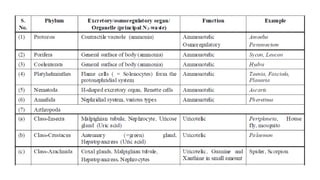
• Ammonia, urea and uric acid are the major forms of nitrogenous wastes excreted by the
animals.
• Ammonia is the most toxic form and requires a large amount of water for its elimination,
whereas uric acid, being the least toxic, can be removed with a minimum loss of water.
• On the basis of main excretory products, animals can be divided into 3 groups – ammonotelic,
ureotelic and uricotelic .
EXCRETORY ORGANS
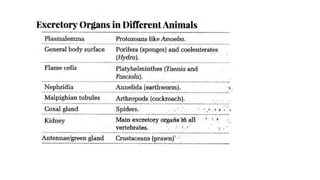
•Excretory organs in Non chordate animals are – Protonephridia, Nephridia, Malpighian tubules, Antennal
glands etc.
• Protonephridia or flame cells are the excretory structures in Platyhelminthes (flatworms, e.g.,
Planaria), rotifers, some annelids and the cephalochordate - Amphioxus. Protonephridia are primarily
concerned with ionic and fluid volume regulation i.e., osmoregulation.
• Nephridia are the tubular excretory structures of earthworms and other annelids. Nephridia help to
remove nitrogenous wastes and maintain a fluid and ionic balance.
• Malpighian tubules are the excretory structures of most of the insects including cockroaches.
Malpighian tubules help in the removal of nitrogenous wastes and osmoregulation.
• Antennal glands or green glands perform the excretory function in crustaceans like prawns.
Excretory system in invertebrates
PROTOZOA
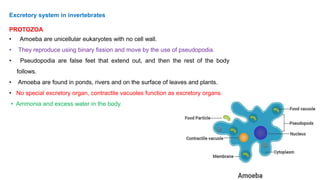
• Amoeba are unicellular eukaryotes with no cell wall.
• They reproduce using binary fission and move by the use of pseudopodia.
• Pseudopodia are false feet that extend out, and then the rest of the body
follows.
• Amoeba are found in ponds, rivers and on the surface of leaves and plants.
• No special excretory organ, contractile vacuoles function as excretory organs.
• Ammonia and excess water in the body.
PORIFERA
• Porifera has a very simple method that utilizes a water flow system
to get rid of its useless waste materials.
• Excretion occurs through both the oscula and the surface of the
sponge.
• They have numerous pores on their body that are used for the intake
of nutrients and a single large opening at the top called osculum
which helps in excretion.
• This process involves the diffusion of waste products particularly
ammonia into cells and archeocytes transporting waste particles
through the mesophyll and into the out going water current to prevent
a blockage of the Ostia and release waste particles into the
environment.
COELENTERATE
•
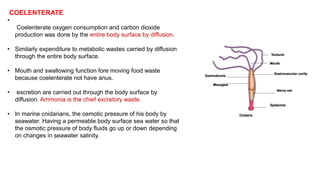
Coelenterate oxygen consumption and carbon dioxide
production was done by the entire body surface by diffusion.
• Similarly expenditure to metabolic wastes carried by diffusion
through the entire body surface.
• Mouth and swallowing function fore moving food waste
because coelenterate not have anus.
• excretion are carried out through the body surface by
diffusion. Ammonia is the chief excretory waste.
• In marine cnidarians, the osmotic pressure of his body by
seawater. Having a permeable body surface sea water so that
the osmotic pressure of body fluids go up or down depending
on changes in seawater salinity.
PLATYHELMINTHES
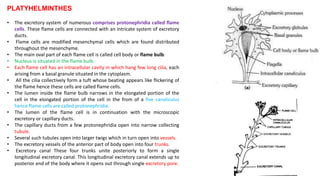
• The excretory system of numerous comprises protonephridia called flame
cells. These flame cells are connected with an intricate system of excretory
ducts.
• Flame cells are modified mesenchymal cells which are found distributed
throughout the mesenchyme.
• The main oval part of each flame cell is called cell body or flame bulb.
• Nucleus is situated in the flame bulb.
• Each flame cell has an intracellular cavity in which hang few long cilia, each
arising from a basal granule situated in the cytoplasm.
• All the cilia collectively form a tuft whose beating appears like flickering of
the flame hence these cells are called flame cells.
• The lumen inside the flame bulb narrows in the elongated portion of the
cell in the elongated portion of the cell in the from of a five canaliculus
hence flame cells are called protonephridia.
• The lumen of the flame cell is in continuation with the microscopic
excretory or capillary ducts.
• The capillary ducts from a few protonephridia open into narrow collecting
tubule.
• Several such tubules open into larger twigs which in turn open into vessels.
• The excretory vessels of the anterior part of body open into four trunks.
• Excretory canal These four trunks unite posteriorly to form a single
longitudinal excretory canal. This longitudinal excretory canal extends up to
posterior end of the body where it opens out through single excretory pore.
NEMATHELMINTHES
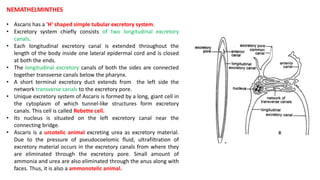
• Ascaris has a 'H' shaped simple tubular excretory system.
• Excretory system chiefly consists of two longitudinal excretory
canals.
• Each longitudinal excretory canal is extended throughout the
length of the body inside one lateral epidermal cord and is closed
at both the ends.
• The longitudinal excretory canals of both the sides are connected
together transverse canals below the pharynx.
• A short terminal excretory duct extends from the left side the
network transverse canals to the excretory pore.
• Unique excretory system of Ascaris is formed by a long, giant cell in
the cytoplasm of which tunnel-like structures form excretory
canals. This cell is called Rebette cell.
• Its nucleus is situated on the left excretory canal near the
connecting bridge.
• Ascaris is a urcotelic animal excreting urea as excretory material.
Due to the pressure of pseudocoelomic fluid, ultrafiltration of
excretory material occurs in the excretory canals from where they
are eliminated through the excretory pore. Small amount of
ammonia and urea are also eliminated through the anus along with
faces. Thus, it is also a ammonotelic animal.
ANNELIDA
Excretory System
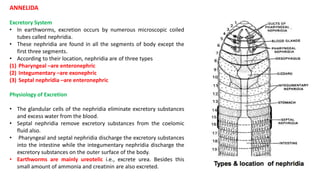
• In earthworms, excretion occurs by numerous microscopic coiled
tubes called nephridia.
• These nephridia are found in all the segments of body except the
first three segments.
• According to their location, nephridia are of three types
(1) Pharyngeal –are enteronephric
(2) Integumentary –are exonephric
(3) Septal nephridia –are enteronephric
Physiology of Excretion
• The glandular cells of the nephridia eliminate excretory substances
and excess water from the blood.
• Septal nephridia remove excretory substances from the coelomic
fluid also.
• Pharyngeal and septal nephridia discharge the excretory substances
into the intestine while the integumentary nephridia discharge the
excretory substances on the outer surface of the body.
• Earthworms are mainly ureotelic i.e., excrete urea. Besides this
small amount of ammonia and creatinin are also excreted.
ARTHROPODS
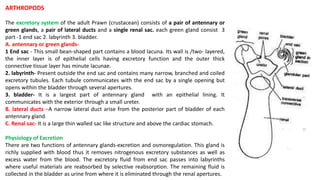
The excretory system of the adult Prawn (crustacean) consists of a pair of antennary or
green glands, a pair of lateral ducts and a single renal sac. each green gland consist 3
part -1 end sac 2. labyrinth 3. bladder.
A. antennary or green glands-
1 End sac - This small bean-shaped part contains a blood lacuna. Its wall is /two- layered,
the inner layer is of epithelial cells having excretory function and the outer thick
connective tissue layer has minute lacunae.
2. labyrinth- Present outside the end sac and contains many narrow, branched and coiled
excretory tubules. Each tubule communicates with the end sac by a single opening but
opens within the bladder through several apertures.
3. bladder- It is a largest part of antennary gland with an epithelial lining. It
communicates with the exterior through a small ureter.
B. lateral ducts –A narrow lateral duct arise from the posterior part of bladder of each
antennary gland.
C. Renal sac- It is a large thin walled sac like structure and above the cardiac stomach.
Physiology of Excretion
There are two functions of antennary glands-excretion and osmoregulation. This gland is
richly supplied with blood thus it removes nitrogenous excretory substances as well as
excess water from the blood. The excretory fluid from end sac passes into labyrinths
where useful materials are reabsorbed by selective reabsorption. The remaining fluid is
collected in the bladder as urine from where it is eliminated through the renal apertures.
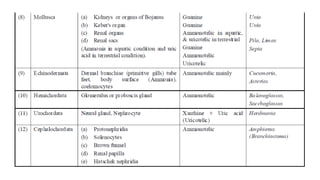
MOLLASCA
They have one or two pairs of kidneys or organs of bojanus in pila and keber's
organ for excretion in unio.
Excretory System of Pila
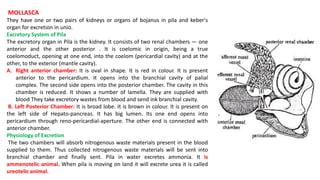
The excretory organ in Pila is the kidney. It consists of two renal chambers — one
anterior and the other posterior . It is coelomic in origin, being a true
coelomoduct, opening at one end, into the coelom (pericardial cavity) and at the
other, to the exterior (mantle cavity).
A. Right anterior chamber: It is oval in shape. It is red in colour. It is present
anterior to the pericardium. It opens into the branchial cavity of palial
complex. The second side opens into the posterior chamber. The cavity in this
chamber is reduced. It shows a number of lamella. They are supplied with
blood They take excretory wastes from blood and send ink branchial cavity.
B. Left Posterior Chamber: It is broad lobe. It is brown in colour. It is present on
the left side of Hepato-pancreas. It has big lumen. Its one end opens into
pericardium through reno-pericardial-aperture. The other end is connected with
anterior chamber.
Physiology of Excretion
The two chambers will absorb nitrogenous waste materials present in the blood
supplied to them. Thus collected nitrogenous waste materials will be sent into
branchial chamber and finally sent. Pila in water excretes ammonia. It is
ammenotelic animal. When pila is moving on land it will excrete urea it is called
ureotelic animal.
ECHINODERMATA
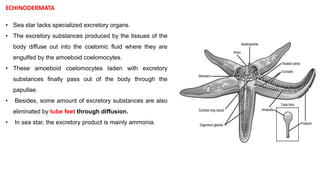
• Sea star lacks specialized excretory organs.
• The excretory substances produced by the tissues of the
body diffuse out into the coelomic fluid where they are
engulfed by the amoeboid coelomocytes.
• These amoeboid coelomocytes laden with excretory
substances finally pass out of the body through the
papullae.
• Besides, some amount of excretory substances are also
eliminated by tube feet through diffusion.
• In sea star, the excretory product is mainly ammonia.
References
• A textbook of chordate-H.S. Bhamrah & kavita Juneja
• Invertebrate Zoology-P.S. Dhami & J.k. Dhami
• Modern text book of Invertebrate-R Kotpal
• Invertebrate Zoology 14 edition-Jordan & Verma