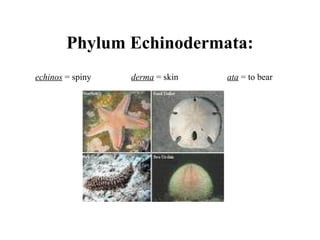
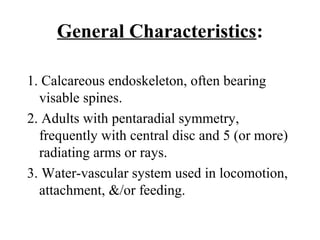
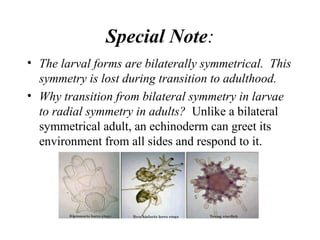
echinos = spiny derma = skin ata = to bear
Phylum Echinodermata:
General Characteristics:
1. Calcareous endoskeleton, often bearing
visable spines.
2. Adults with pentaradial symmetry,
frequently with central disc and 5 (or more)
radiating arms or rays.
3. Water-vascular system used in locomotion,
attachment, &/or feeding.
Special Note:
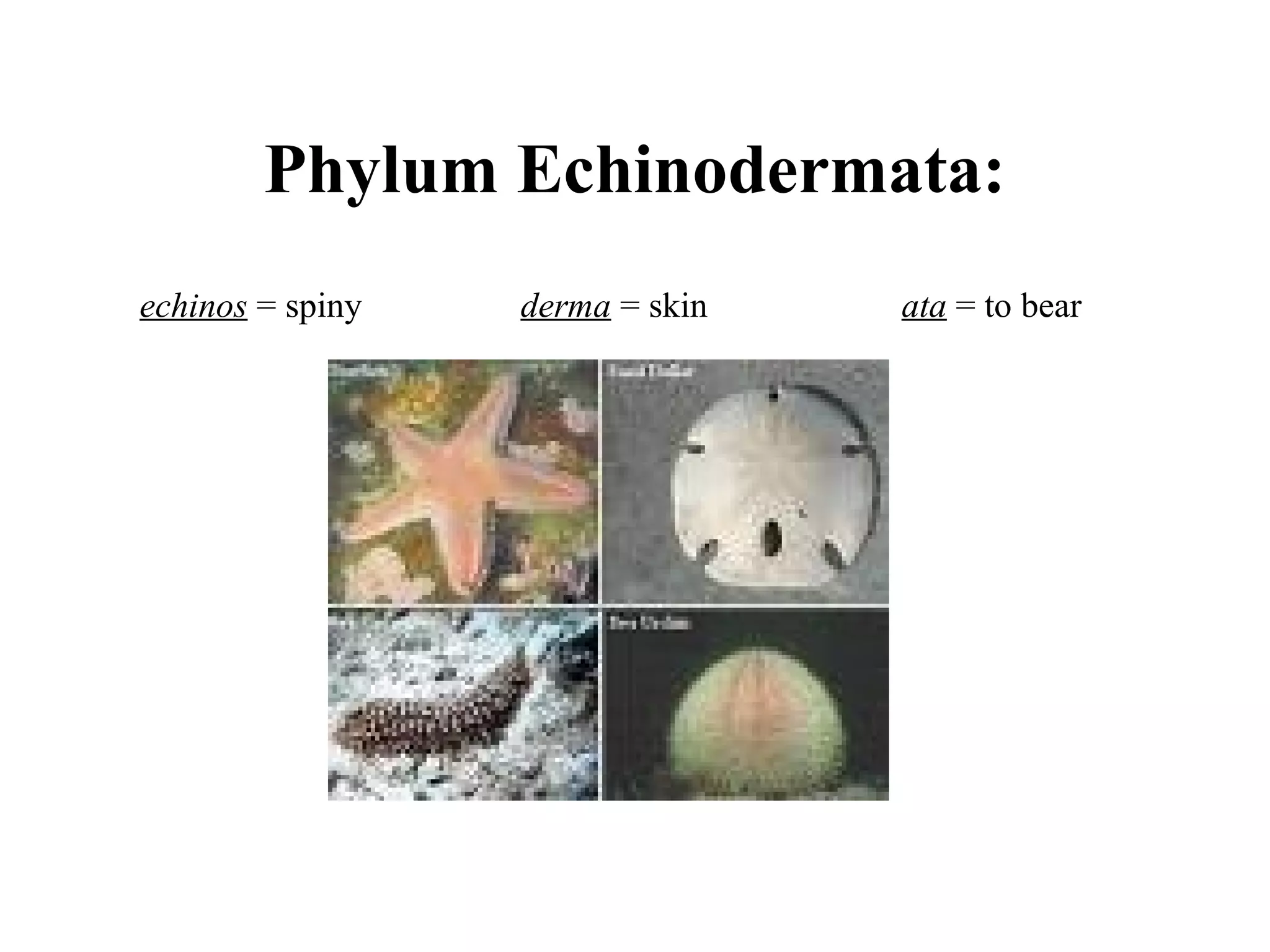
• The larval forms are bilaterally symmetrical. This
symmetry is lost during transition to adulthood.
• Why transition from bilateral symmetry in larvae
to radial symmetry in adults? Unlike a bilateral
symmetrical adult, an echinoderm can greet its
environment from all sides and respond to it.
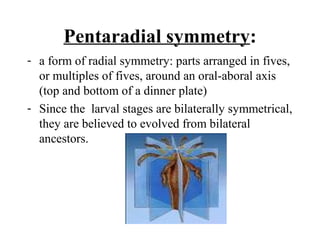
Pentaradial symmetry:
- a form of radial symmetry: parts arranged in fives,
or multiples of fives, around an oral-aboral axis
(top and bottom of a dinner plate)
- Since the larval stages are bilaterally symmetrical,
they are believed to evolved from bilateral
ancestors.
Why 5 arms instead of 6?
• The 5 part organization may be advantageous
because joints between skeletal ossicles (joints)
are never directly opposite one another, as they
would be with an even number of parts.
• Having joints on opposite sides of the body in line
with each other could make the skeleton weaker.
Additions to our directional
terminology:
• Aboral: upper surface (think of the part of
the dinner plate you eat from)
• Oral: lower surface (think of the part of the
dinner plate on the table)
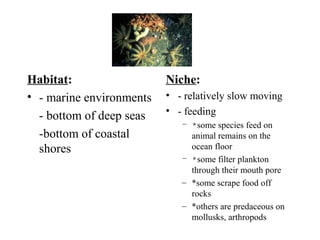
Habitat:
• - marine environments
- bottom of deep seas
-bottom of coastal
shores
Niche:
• - relatively slow moving
• - feeding
– *some species feed on
animal remains on the
ocean floor
– *some filter plankton
through their mouth pore
– *some scrape food off
rocks
– *others are predaceous on
mollusks, arthropods
Classes of Echinodermata:
Class Stelleroidea
examples: sea stars (starfish), brittle stars
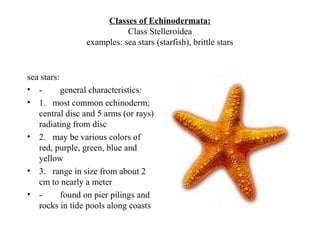
sea stars:
• - general characteristics:
• 1. most common echinoderm;
central disc and 5 arms (or rays)
radiating from disc
• 2. may be various colors of
red, purple, green, blue and
yellow
• 3. range in size from about 2
cm to nearly a meter
• - found on pier pilings and
rocks in tide pools along coasts
Classes of Echinodermata:
Class Stelleroidea
examples: sea stars (starfish), brittle stars
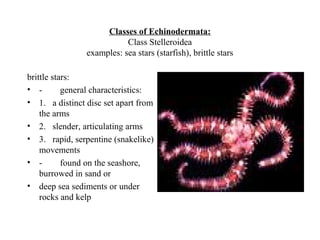
brittle stars:
• - general characteristics:
• 1. a distinct disc set apart from
the arms
• 2. slender, articulating arms
• 3. rapid, serpentine (snakelike)
movements
• - found on the seashore,
burrowed in sand or
• deep sea sediments or under
rocks and kelp
Class Echinoidea
examples: sand dollars, sea urchins
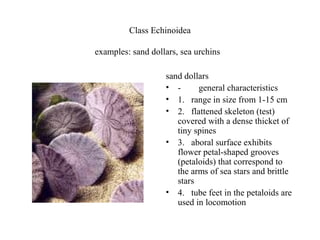
sand dollars
• - general characteristics
• 1. range in size from 1-15 cm
• 2. flattened skeleton (test)
covered with a dense thicket of
tiny spines
• 3. aboral surface exhibits
flower petal-shaped grooves
(petaloids) that correspond to
the arms of sea stars and brittle
stars
• 4. tube feet in the petaloids are
used in locomotion
Class Echinoidea
examples: sand dollars, sea urchins
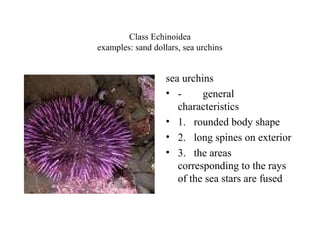
sea urchins
• - general
characteristics
• 1. rounded body shape
• 2. long spines on exterior
• 3. the areas
corresponding to the rays
of the sea stars are fused
Class Holothruoidea
examples: sea cucumbers, feather stars
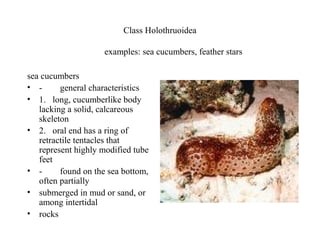
sea cucumbers
• - general characteristics
• 1. long, cucumberlike body
lacking a solid, calcareous
skeleton
• 2. oral end has a ring of
retractile tentacles that
represent highly modified tube
feet
• - found on the sea bottom,
often partially
• submerged in mud or sand, or
among intertidal
• rocks
Class Holothruoidea
examples: sea cucumbers, feather stars
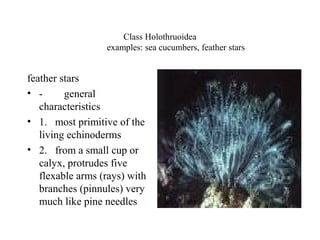
feather stars
• - general
characteristics
• 1. most primitive of the
living echinoderms
• 2. from a small cup or
calyx, protrudes five
flexable arms (rays) with
branches (pinnules) very
much like pine needles
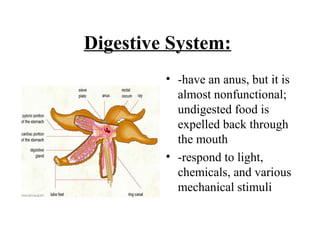
Digestive System:
• -have an anus, but it is
almost nonfunctional;
undigested food is
expelled back through
the mouth
• -respond to light,
chemicals, and various
mechanical stimuli
Reproduction:
• dioecious – the two sexes are
indistinguishable externally
• gamete release by one individual is
accomplished by the release of spawning
pheromones, which induce other sea stars in
the area to spawn, increasing the likelihood
of fertilization
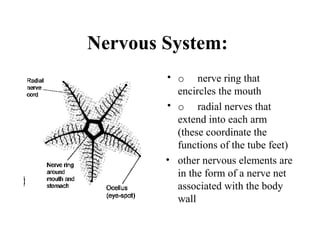
Nervous System:
• o nerve ring that
encircles the mouth
• o radial nerves that
extend into each arm
(these coordinate the
functions of the tube feet)
• other nervous elements are
in the form of a nerve net
associated with the body
wall

Echinoderms (Echinodermata)

  • 1.
    echinos = spinyderma = skin ata = to bear Phylum Echinodermata:
  • 2.
    General Characteristics: 1. Calcareousendoskeleton, often bearing visable spines. 2. Adults with pentaradial symmetry, frequently with central disc and 5 (or more) radiating arms or rays. 3. Water-vascular system used in locomotion, attachment, &/or feeding.
  • 3.
    Special Note: • Thelarval forms are bilaterally symmetrical. This symmetry is lost during transition to adulthood. • Why transition from bilateral symmetry in larvae to radial symmetry in adults? Unlike a bilateral symmetrical adult, an echinoderm can greet its environment from all sides and respond to it.
  • 4.
    Pentaradial symmetry: - aform of radial symmetry: parts arranged in fives, or multiples of fives, around an oral-aboral axis (top and bottom of a dinner plate) - Since the larval stages are bilaterally symmetrical, they are believed to evolved from bilateral ancestors.
  • 5.
    Why 5 armsinstead of 6? • The 5 part organization may be advantageous because joints between skeletal ossicles (joints) are never directly opposite one another, as they would be with an even number of parts. • Having joints on opposite sides of the body in line with each other could make the skeleton weaker.
  • 6.
    Additions to ourdirectional terminology: • Aboral: upper surface (think of the part of the dinner plate you eat from) • Oral: lower surface (think of the part of the dinner plate on the table)
  • 7.
    Habitat: • - marineenvironments - bottom of deep seas -bottom of coastal shores Niche: • - relatively slow moving • - feeding – *some species feed on animal remains on the ocean floor – *some filter plankton through their mouth pore – *some scrape food off rocks – *others are predaceous on mollusks, arthropods
  • 8.
    Classes of Echinodermata: ClassStelleroidea examples: sea stars (starfish), brittle stars sea stars: • - general characteristics: • 1. most common echinoderm; central disc and 5 arms (or rays) radiating from disc • 2. may be various colors of red, purple, green, blue and yellow • 3. range in size from about 2 cm to nearly a meter • - found on pier pilings and rocks in tide pools along coasts
  • 9.
    Classes of Echinodermata: ClassStelleroidea examples: sea stars (starfish), brittle stars brittle stars: • - general characteristics: • 1. a distinct disc set apart from the arms • 2. slender, articulating arms • 3. rapid, serpentine (snakelike) movements • - found on the seashore, burrowed in sand or • deep sea sediments or under rocks and kelp
  • 10.
    Class Echinoidea examples: sanddollars, sea urchins sand dollars • - general characteristics • 1. range in size from 1-15 cm • 2. flattened skeleton (test) covered with a dense thicket of tiny spines • 3. aboral surface exhibits flower petal-shaped grooves (petaloids) that correspond to the arms of sea stars and brittle stars • 4. tube feet in the petaloids are used in locomotion
  • 11.
    Class Echinoidea examples: sanddollars, sea urchins sea urchins • - general characteristics • 1. rounded body shape • 2. long spines on exterior • 3. the areas corresponding to the rays of the sea stars are fused
  • 12.
    Class Holothruoidea examples: seacucumbers, feather stars sea cucumbers • - general characteristics • 1. long, cucumberlike body lacking a solid, calcareous skeleton • 2. oral end has a ring of retractile tentacles that represent highly modified tube feet • - found on the sea bottom, often partially • submerged in mud or sand, or among intertidal • rocks
  • 13.
    Class Holothruoidea examples: seacucumbers, feather stars feather stars • - general characteristics • 1. most primitive of the living echinoderms • 2. from a small cup or calyx, protrudes five flexable arms (rays) with branches (pinnules) very much like pine needles
  • 14.
    Digestive System: • -havean anus, but it is almost nonfunctional; undigested food is expelled back through the mouth • -respond to light, chemicals, and various mechanical stimuli
  • 15.
    Reproduction: • dioecious –the two sexes are indistinguishable externally • gamete release by one individual is accomplished by the release of spawning pheromones, which induce other sea stars in the area to spawn, increasing the likelihood of fertilization
  • 16.
    Nervous System: • onerve ring that encircles the mouth • o radial nerves that extend into each arm (these coordinate the functions of the tube feet) • other nervous elements are in the form of a nerve net associated with the body wall