CIE Color Standards
presented by:
Preeti Choudhary
M.Sc. APPLIED PHYSICS
(17/MAP/016)
Department of Applied Physics
School of Vocational Studies and Applied Sciences
Gautam Buddha University
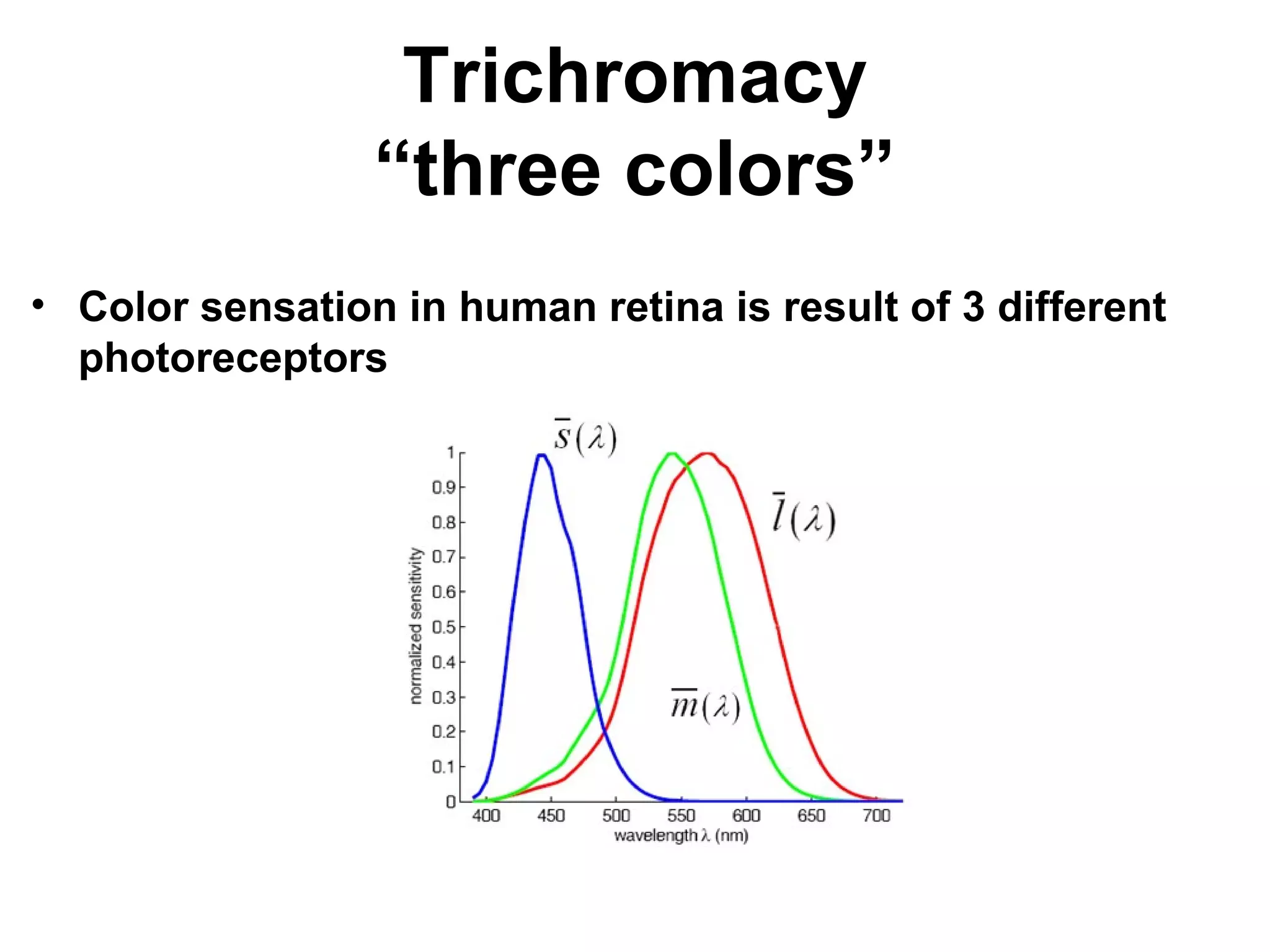
Trichromacy
“three colors”
• Color sensation in human retina is result of 3 different
photoreceptors
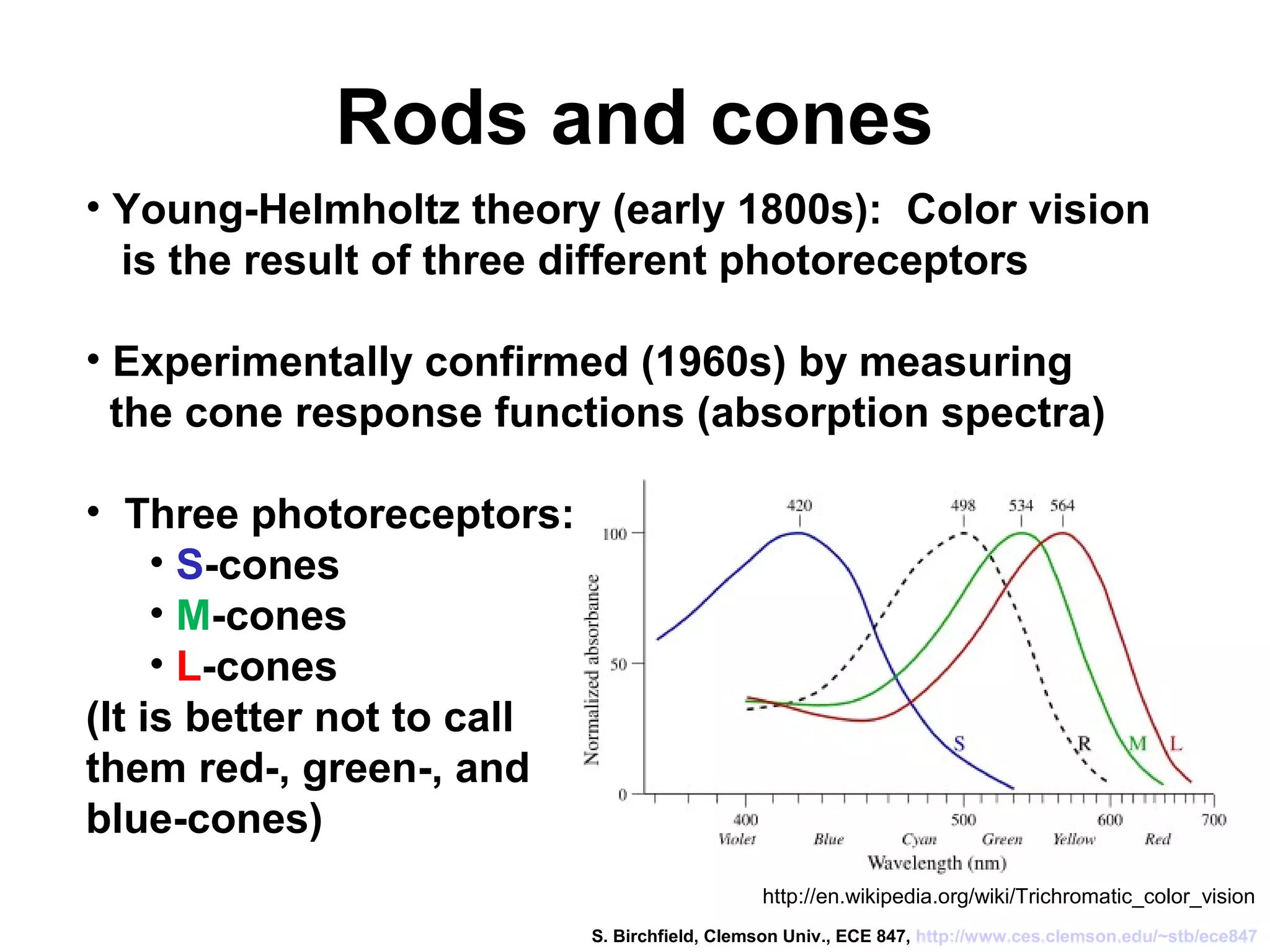
Rods and cones
http://en.wikipedia.org/wiki/Trichromatic_color_vision
• Young-Helmholtz theory (early 1800s): Color vision
is the result of three different photoreceptors
• Experimentally confirmed (1960s) by measuring
the cone response functions (absorption spectra)
• Three photoreceptors:
• S-cones
• M-cones
• L-cones
(It is better not to call
them red-, green-, and
blue-cones)
S. Birchfield, Clemson Univ., ECE 847, http://www.ces.clemson.edu/~stb/ece847
Color matching experiment
Foundations of Vision, by Brian Wandell, Sinauer Assoc., 1995
In the human visual system, every color can be obtained
as the linear combination of three independent primary colors
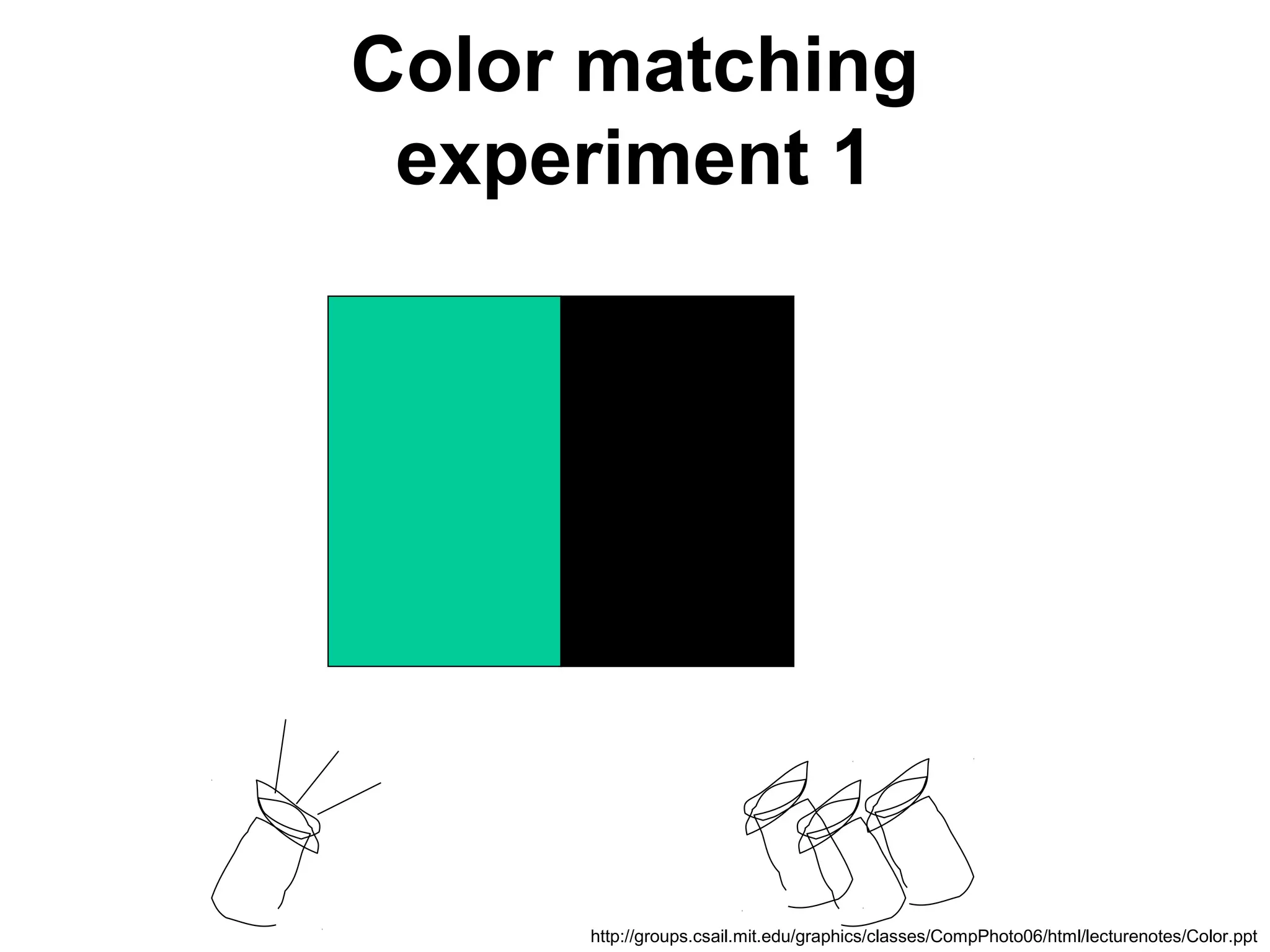
Color matching
experiment 1
http://groups.csail.mit.edu/graphics/classes/CompPhoto06/html/lecturenotes/Color.ppt
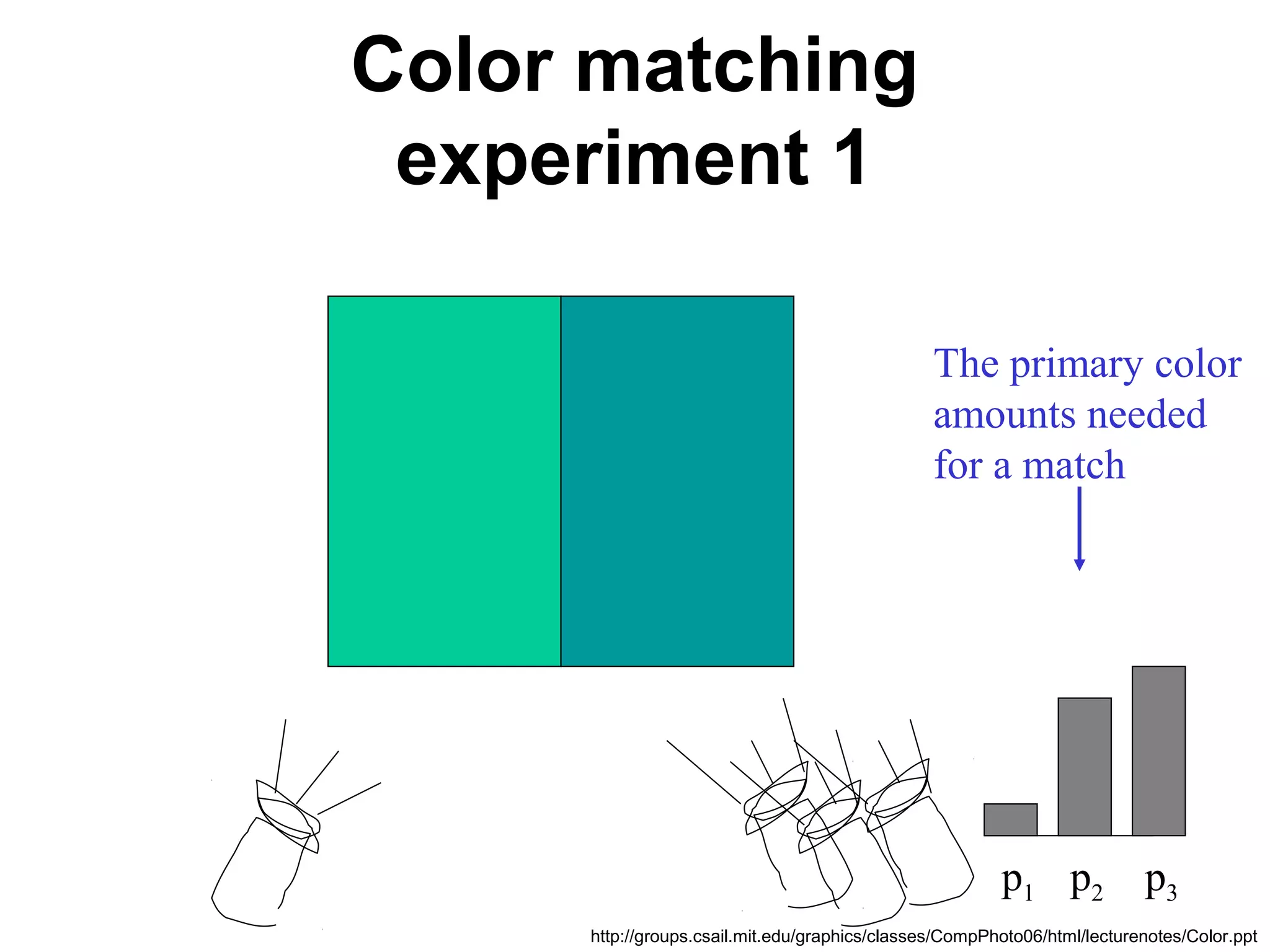
Color matching
experiment 1
p1 p2 p3
The primary color
amounts needed
for a match
http://groups.csail.mit.edu/graphics/classes/CompPhoto06/html/lecturenotes/Color.ppt
Color matching
experiment 1
p1 p2 p3
The primary color
amounts needed
for a match
http://groups.csail.mit.edu/graphics/classes/CompPhoto06/html/lecturenotes/Color.ppt
Color matching
experiment 1
p1 p2 p3
The primary color
amounts needed
for a match
http://groups.csail.mit.edu/graphics/classes/CompPhoto06/html/lecturenotes/Color.ppt
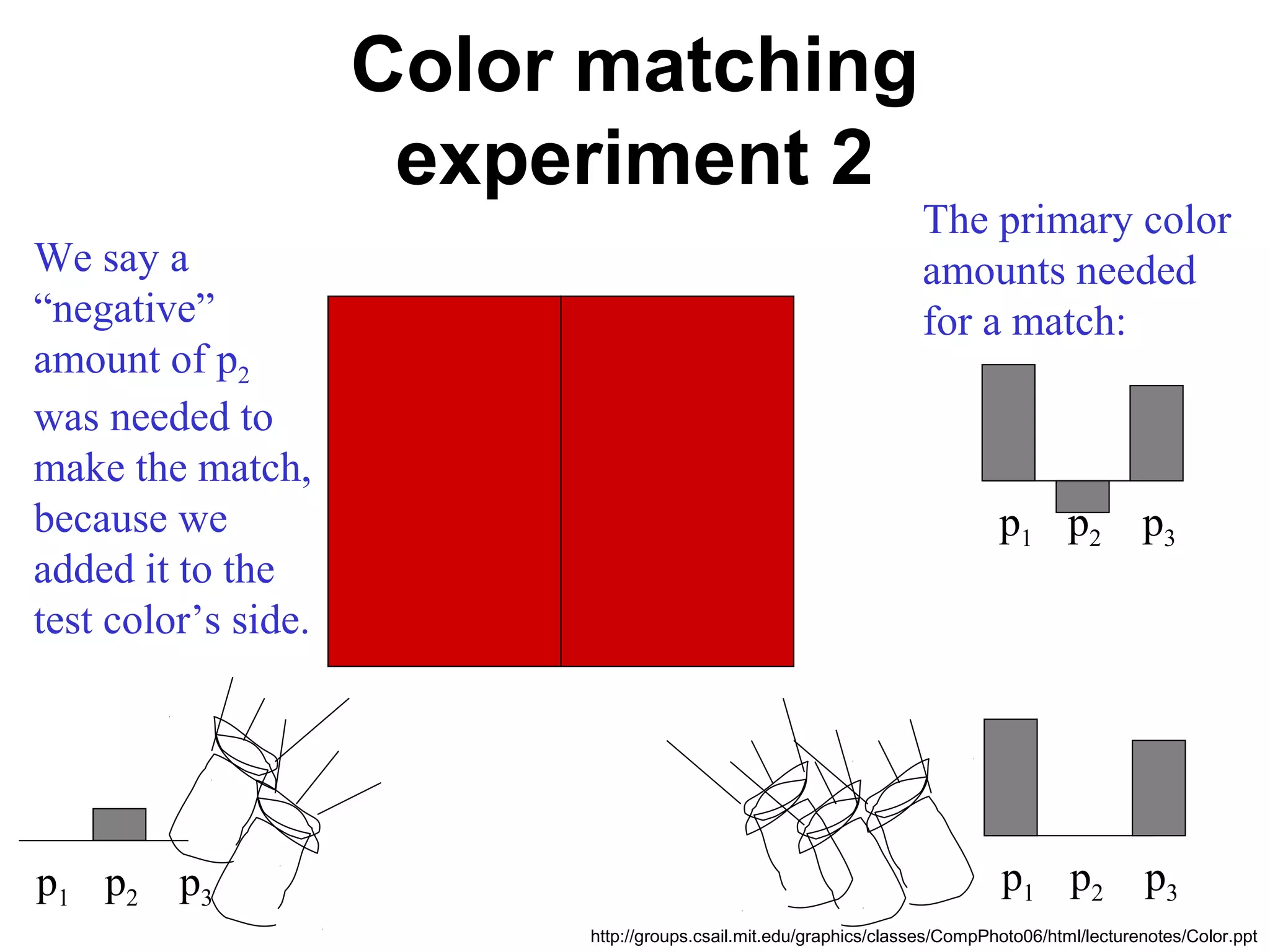
Color matching
experiment 2
http://groups.csail.mit.edu/graphics/classes/CompPhoto06/html/lecturenotes/Color.ppt
Color matching
experiment 2
p1 p2 p3
http://groups.csail.mit.edu/graphics/classes/CompPhoto06/html/lecturenotes/Color.ppt
Color matching
experiment 2
p1 p2 p3
http://groups.csail.mit.edu/graphics/classes/CompPhoto06/html/lecturenotes/Color.ppt
Color matching
experiment 2
p1 p2 p3p1 p2 p3
We say a
“negative”
amount of p2
was needed to
make the match,
because we
added it to the
test color’s side.
The primary color
amounts needed
for a match:
p1 p2 p3
http://groups.csail.mit.edu/graphics/classes/CompPhoto06/html/lecturenotes/Color.ppt
Metamer
Two colors are metamers if they have
• different spectral distributions
• same visual appearance
http://escience.anu.edu.au/lecture/cg/Color/Image/metamer.gif
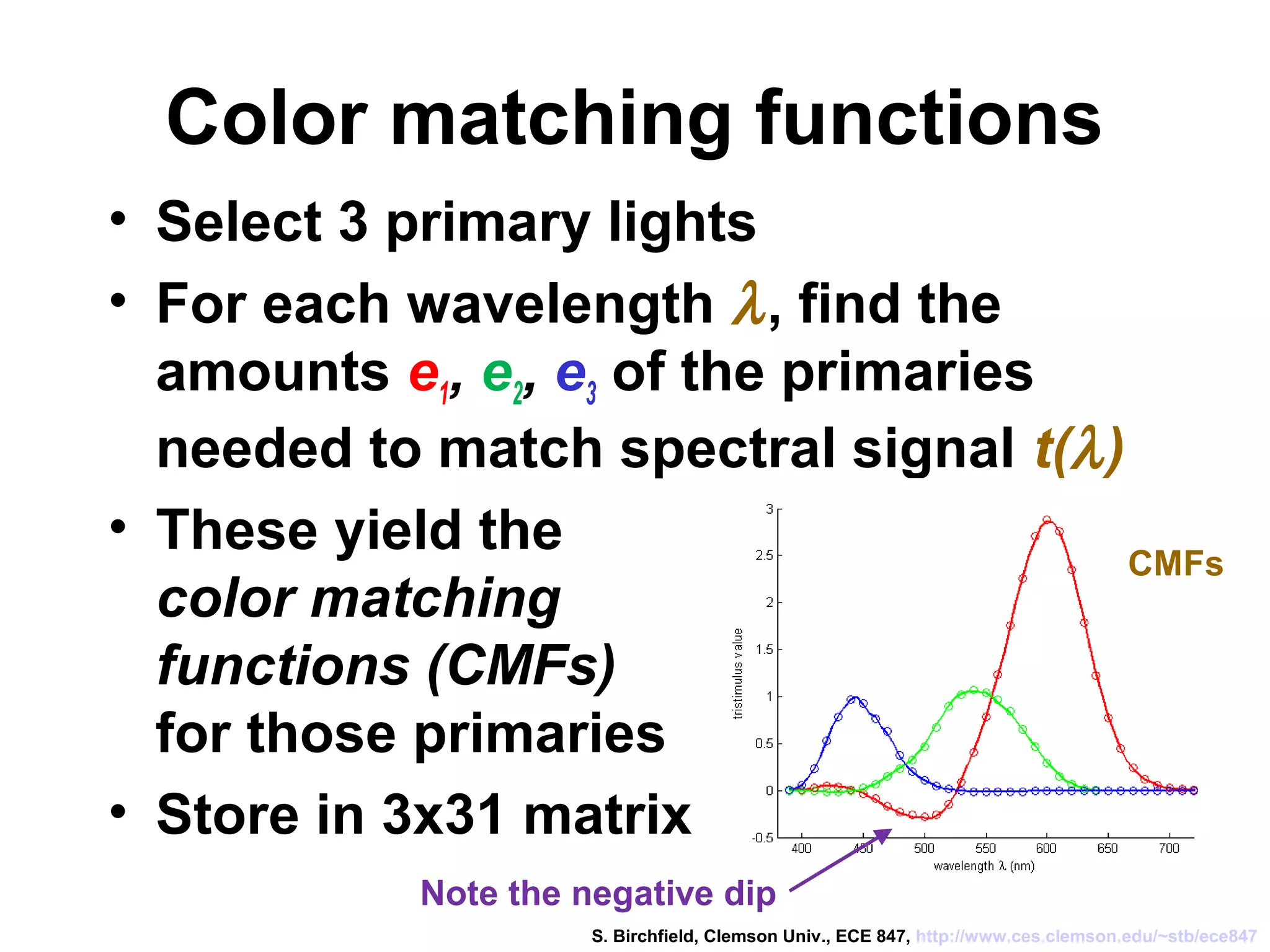
Color matching functions
• Select 3 primary lights
• For each wavelength λ, find the
amounts e1, e2, e3 of the primaries
needed to match spectral signal t(λ)
• These yield the
color matching
functions (CMFs)
for those primaries
• Store in 3x31 matrix
Note the negative dip
S. Birchfield, Clemson Univ., ECE 847, http://www.ces.clemson.edu/~stb/ece847
CMFs
Luminous efficiency
• Another color matching experiment
– Whether one color is brighter or darker than another
• Goal
– Obtain a luminous efficiency function (LEF)
• Experimental environment
– photopic vision:
Daytime (high intensity levels), cones dominate
– scotopic vision:
Nighttime (low-light situation), rods dominate
S. Birchfield, Clemson Univ., ECE 847, http://www.ces.clemson.edu/~stb/ece847
Grassman’s Laws
• Color matching is (approximately) linear
• Principle of superposition:
If
then
S. Birchfield, Clemson Univ., ECE 847, http://www.ces.clemson.edu/~stb/ece847
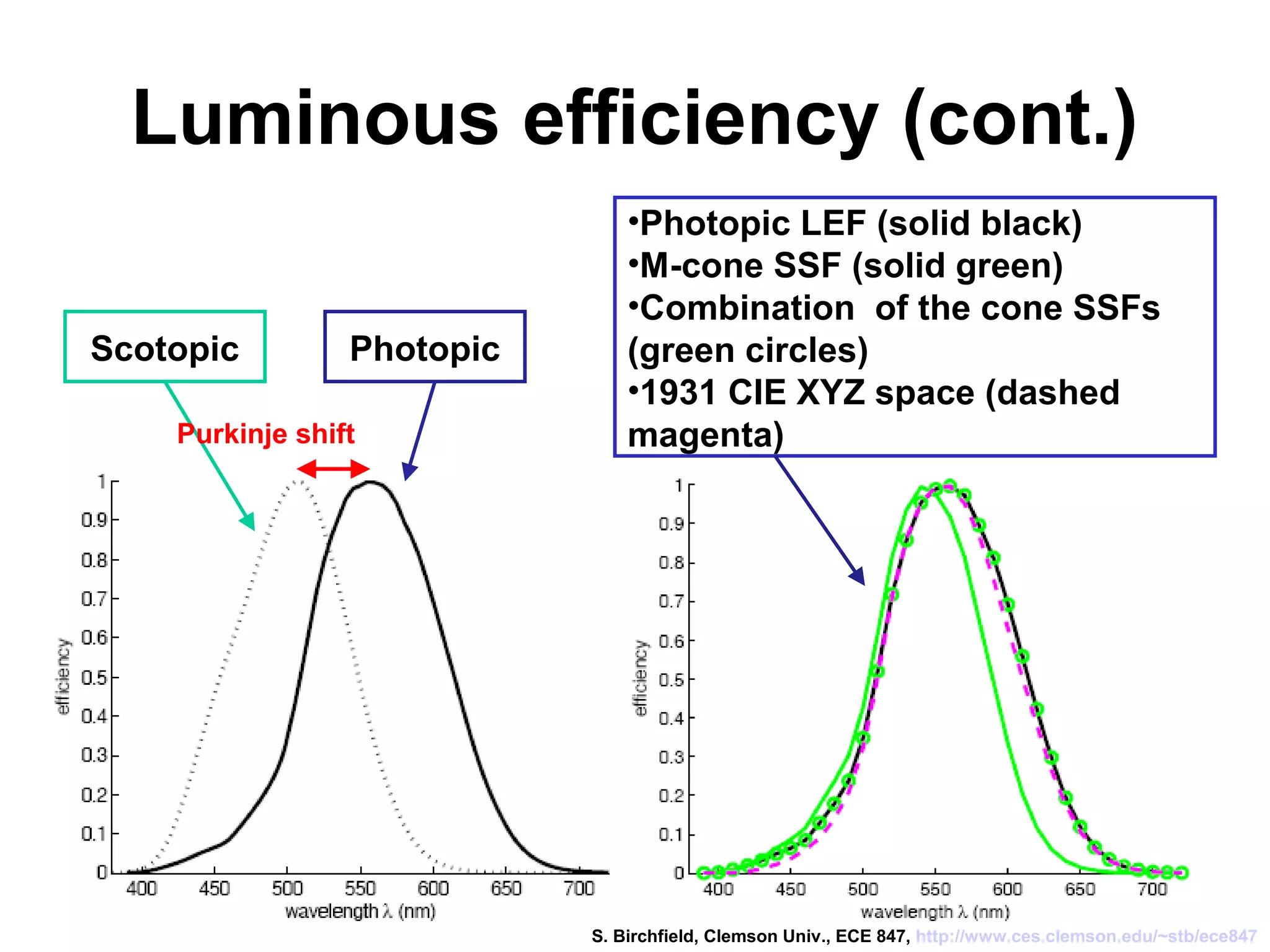
Luminous efficiency (cont.)
Scotopic Photopic
•Photopic LEF (solid black)
•M-cone SSF (solid green)
•Combination of the cone SSFs
(green circles)
•1931 CIE XYZ space (dashed
magenta)Purkinje shift
S. Birchfield, Clemson Univ., ECE 847, http://www.ces.clemson.edu/~stb/ece847
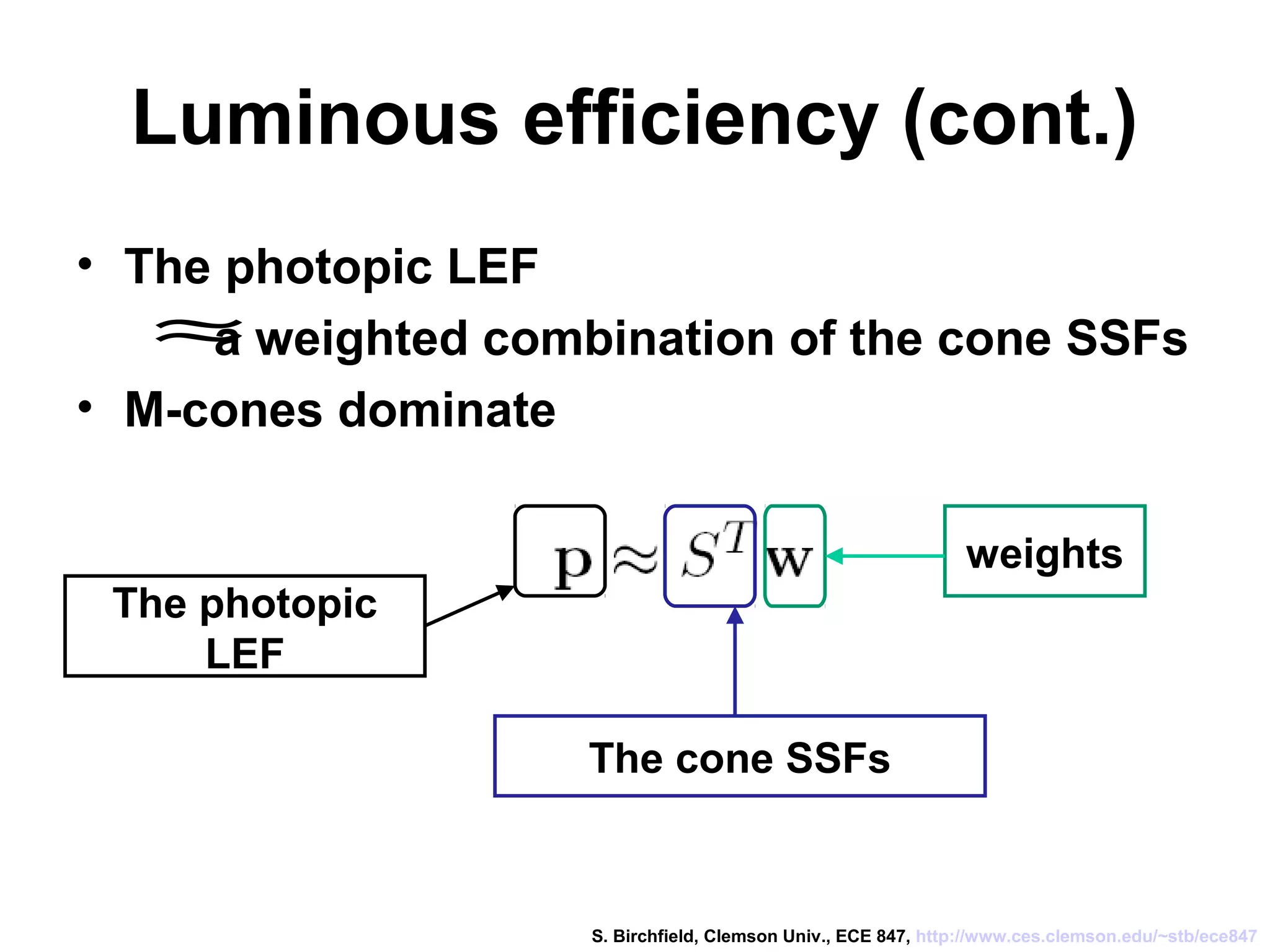
Luminous efficiency (cont.)
• The photopic LEF
a weighted combination of the cone SSFs
• M-cones dominate
≈
The cone SSFs
weights
The photopic
LEF
S. Birchfield, Clemson Univ., ECE 847, http://www.ces.clemson.edu/~stb/ece847
• Output of a single photoreceptor:
Sensing light
SPD of the incident irradiance
(“spectral power distribution”)
SSF of the sensor
(“spectral sensitivity function”)
wavelength
S. Birchfield, Clemson Univ., ECE 847, http://www.ces.clemson.edu/~stb/ece847
• Discrete approximation:
Sensing light (cont.)
SPD of the incident irradiance
(“spectral power distribution”)
SSF of the sensor
(“spectral sensitivity function”)
(wavelength is used to index the elements of the vectors)
v = sT
t
31×1 vector31×1 vector
Recall: 31 numbers capture the values in 10 nm bands from 400 – 700 nm (visible spectrum)
S. Birchfield, Clemson Univ., ECE 847, http://www.ces.clemson.edu/~stb/ece847
Sensing three colors
• Three cone types:
• S-cones (“blue”)
• M-cones (“green”)
• L-cones (“red”)
Projection from a point in a
31D space to a 3D space
31×1 vector3×31 matrix
cone SSFs
S. Birchfield, Clemson Univ., ECE 847, http://www.ces.clemson.edu/~stb/ece847
Color matching
• Grassman’s Laws:
⇒
Test light
Three primaries
(independent)
( )
“the colors match” = “the SPDs are metamers”
 Color matching is (approximately) linear!
S. Birchfield, Clemson Univ., ECE 847, http://www.ces.clemson.edu/~stb/ece847
Color matching (cont.)
• The linear function for modeling
color matching
is the SPD of
the test light
The rows are the color matching
functions (CMFs) of the three primaries
Intensities of the
three primaries
Do not confuse the CMF C with the SSF S
v = St are the cone values; e = Ct are the primary intensities
S. Birchfield, Clemson Univ., ECE 847, http://www.ces.clemson.edu/~stb/ece847
Color matching functions (CMFs)
CMFs using RGB
primaries
(solid lines)
Overlaid circles
obtained by a 3x3 linear
transform of cone SSFs
(close agreement)
Related exactly by a 3 x 3 transform
CMFs using
1931 CIE XYZ
primaries
S. Birchfield, Clemson Univ., ECE 847, http://www.ces.clemson.edu/~stb/ece847
CIE color space
• The most important color space of all
• CIE XYZ tristimulus coordinate system
proposed in 1931
• Note that the CIE XYZ primaries are not
physically realizable
S. Birchfield, Clemson Univ., ECE 847, http://www.ces.clemson.edu/~stb/ece847
CIE 1931 standards
• Commission internationale de l'éclairage (CIE)
• Used primaries:
– Red: 700 nm
– Green: 546.1 nm
– Blue: 435.8 nm
• Procedure:
– Show pure color to observer
– Match using primaries  weights for RGB
– Linear transform from RGB to XYZ
(XYZ are imaginary primaries; in XYZ, all weights are positive)
(using NTSC primaries)
S. Birchfield, Clemson Univ., ECE 847, http://www.ces.clemson.edu/~stb/ece847
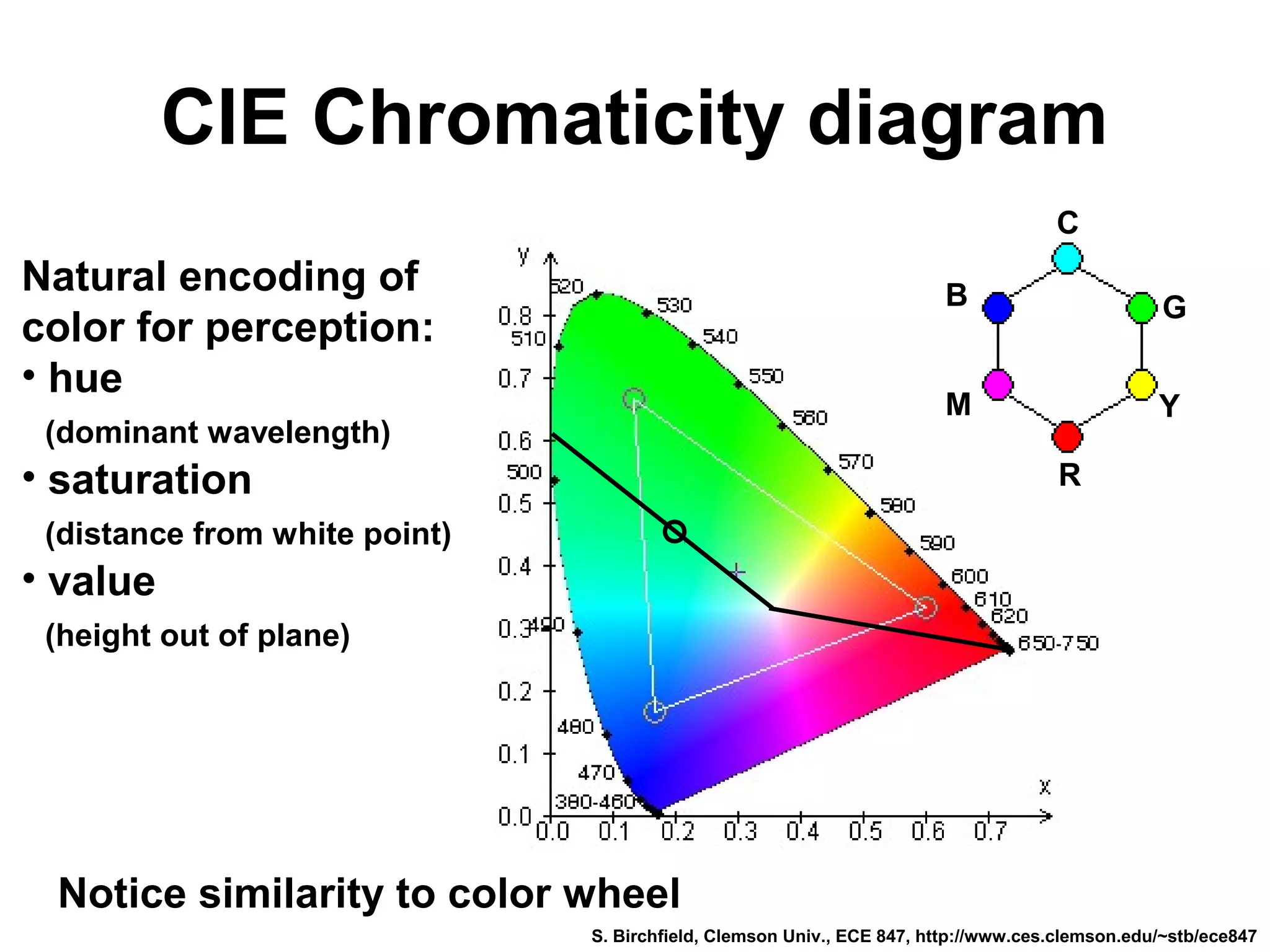
CIE Chromaticity diagram
Normalize:
x = X / (X+Y+Z)
y = Y / (X+Y+Z)
z = 1 – x – y
spectral locus
line of purples
gamut of
device is
convex hull
of primaries
Note: It is misleading to draw colors on the chromaticity diagram
(not recommended), but it makes the slide pretty
S. Birchfield, Clemson Univ., ECE 847, http://www.ces.clemson.edu/~stb/ece847
CIE Chromaticity diagram
Natural encoding of
color for perception:
• hue
(dominant wavelength)
• saturation
(distance from white point)
• value
(height out of plane)
Notice similarity to color wheel
R
C
Y
G
M
B
S. Birchfield, Clemson Univ., ECE 847, http://www.ces.clemson.edu/~stb/ece847
CIE Chromaticity diagram
With 3 fixed
primaries,
any color can be
matched
(allowing negative
weights)
S. Birchfield, Clemson Univ., ECE 847, http://www.ces.clemson.edu/~stb/ece847
CIE Chromaticity diagram
Complementary
colors are on
opposite sides
S. Birchfield, Clemson Univ., ECE 847, http://www.ces.clemson.edu/~stb/ece847
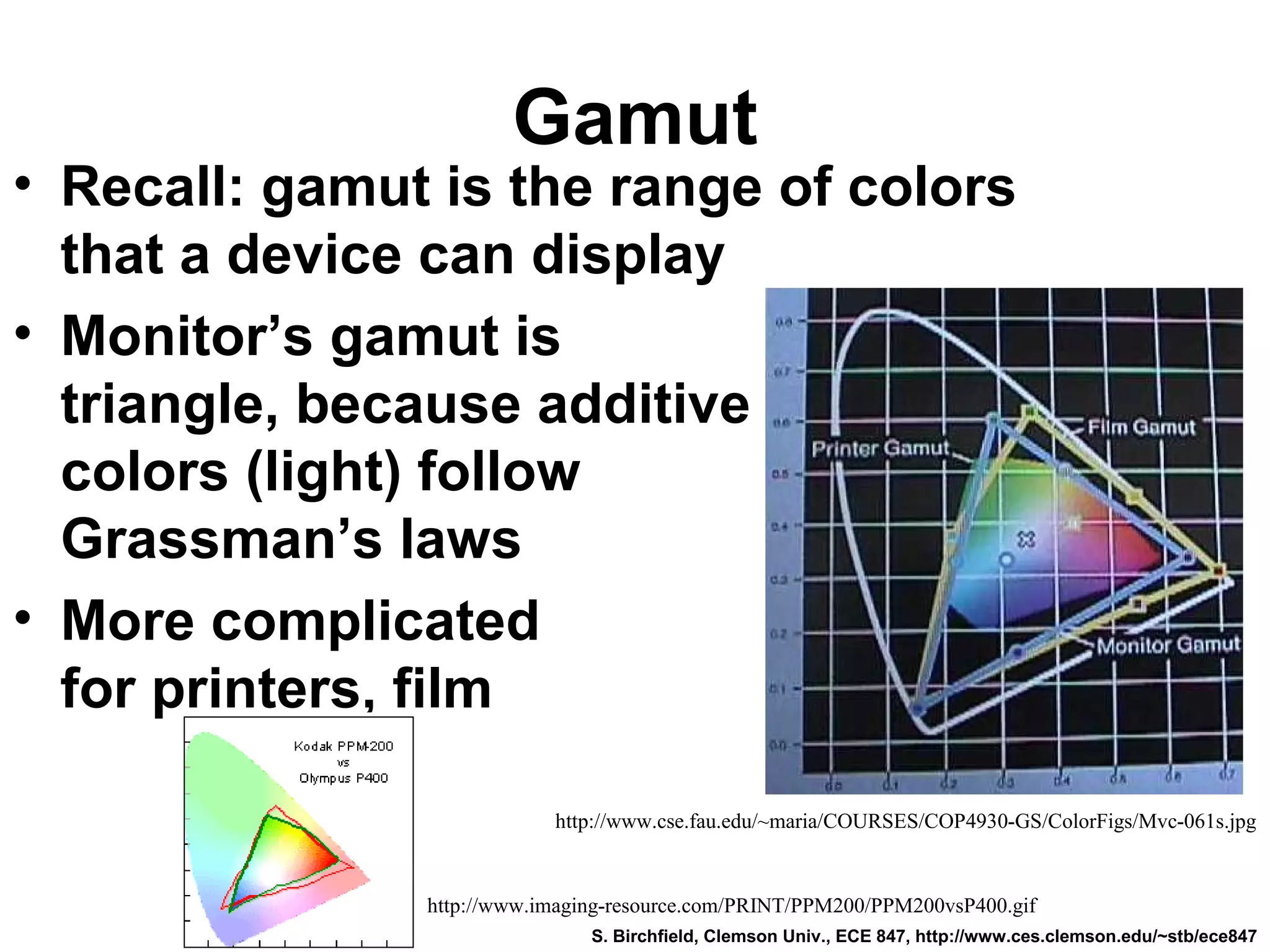
Gamut
• Recall: gamut is the range of colors
that a device can display
• Monitor’s gamut is
triangle, because additive
colors (light) follow
Grassman’s laws
• More complicated
for printers, film
http://www.imaging-resource.com/PRINT/PPM200/PPM200vsP400.gif
http://www.cse.fau.edu/~maria/COURSES/COP4930-GS/ColorFigs/Mvc-061s.jpg
S. Birchfield, Clemson Univ., ECE 847, http://www.ces.clemson.edu/~stb/ece847
This leads us to an important question…
What are the primary colors?
• As children, we learn RYB
• Then we’re told RGB
• When asked about the discrepancy, we’re told
CMY is the same as RYB
S. Birchfield, Clemson Univ., ECE 847, http://www.ces.clemson.edu/~stb/ece847
Something about this is unsettling
• Yellow still appears to be pure
– Even when you know that green and red make
yellow,
– It is impossible to believe
• In fact, red, yellow, blue, and green all
appear pure
• So do black and white
• Could there be six
primary colors?
S. Birchfield, Clemson Univ., ECE 847, http://www.ces.clemson.edu/~stb/ece847
Opponent colors
http://en.wikipedia.org/wiki/Opponent_process
S. Birchfield, Clemson Univ., ECE 847, http://www.ces.clemson.edu/~stb/ece847

CIE color standards

  • 1.
    CIE Color Standards presentedby: Preeti Choudhary M.Sc. APPLIED PHYSICS (17/MAP/016) Department of Applied Physics School of Vocational Studies and Applied Sciences Gautam Buddha University
  • 2.
    Trichromacy “three colors” • Colorsensation in human retina is result of 3 different photoreceptors
  • 3.
    Rods and cones http://en.wikipedia.org/wiki/Trichromatic_color_vision •Young-Helmholtz theory (early 1800s): Color vision is the result of three different photoreceptors • Experimentally confirmed (1960s) by measuring the cone response functions (absorption spectra) • Three photoreceptors: • S-cones • M-cones • L-cones (It is better not to call them red-, green-, and blue-cones) S. Birchfield, Clemson Univ., ECE 847, http://www.ces.clemson.edu/~stb/ece847
  • 4.
    Color matching experiment Foundationsof Vision, by Brian Wandell, Sinauer Assoc., 1995 In the human visual system, every color can be obtained as the linear combination of three independent primary colors
  • 5.
  • 6.
    Color matching experiment 1 p1p2 p3 The primary color amounts needed for a match http://groups.csail.mit.edu/graphics/classes/CompPhoto06/html/lecturenotes/Color.ppt
  • 7.
    Color matching experiment 1 p1p2 p3 The primary color amounts needed for a match http://groups.csail.mit.edu/graphics/classes/CompPhoto06/html/lecturenotes/Color.ppt
  • 8.
    Color matching experiment 1 p1p2 p3 The primary color amounts needed for a match http://groups.csail.mit.edu/graphics/classes/CompPhoto06/html/lecturenotes/Color.ppt
  • 9.
  • 10.
    Color matching experiment 2 p1p2 p3 http://groups.csail.mit.edu/graphics/classes/CompPhoto06/html/lecturenotes/Color.ppt
  • 11.
    Color matching experiment 2 p1p2 p3 http://groups.csail.mit.edu/graphics/classes/CompPhoto06/html/lecturenotes/Color.ppt
  • 12.
    Color matching experiment 2 p1p2 p3p1 p2 p3 We say a “negative” amount of p2 was needed to make the match, because we added it to the test color’s side. The primary color amounts needed for a match: p1 p2 p3 http://groups.csail.mit.edu/graphics/classes/CompPhoto06/html/lecturenotes/Color.ppt
  • 13.
    Metamer Two colors aremetamers if they have • different spectral distributions • same visual appearance http://escience.anu.edu.au/lecture/cg/Color/Image/metamer.gif
  • 14.
    Color matching functions •Select 3 primary lights • For each wavelength λ, find the amounts e1, e2, e3 of the primaries needed to match spectral signal t(λ) • These yield the color matching functions (CMFs) for those primaries • Store in 3x31 matrix Note the negative dip S. Birchfield, Clemson Univ., ECE 847, http://www.ces.clemson.edu/~stb/ece847 CMFs
  • 15.
    Luminous efficiency • Anothercolor matching experiment – Whether one color is brighter or darker than another • Goal – Obtain a luminous efficiency function (LEF) • Experimental environment – photopic vision: Daytime (high intensity levels), cones dominate – scotopic vision: Nighttime (low-light situation), rods dominate S. Birchfield, Clemson Univ., ECE 847, http://www.ces.clemson.edu/~stb/ece847
  • 16.
    Grassman’s Laws • Colormatching is (approximately) linear • Principle of superposition: If then S. Birchfield, Clemson Univ., ECE 847, http://www.ces.clemson.edu/~stb/ece847
  • 17.
    Luminous efficiency (cont.) ScotopicPhotopic •Photopic LEF (solid black) •M-cone SSF (solid green) •Combination of the cone SSFs (green circles) •1931 CIE XYZ space (dashed magenta)Purkinje shift S. Birchfield, Clemson Univ., ECE 847, http://www.ces.clemson.edu/~stb/ece847
  • 18.
    Luminous efficiency (cont.) •The photopic LEF a weighted combination of the cone SSFs • M-cones dominate ≈ The cone SSFs weights The photopic LEF S. Birchfield, Clemson Univ., ECE 847, http://www.ces.clemson.edu/~stb/ece847
  • 19.
    • Output ofa single photoreceptor: Sensing light SPD of the incident irradiance (“spectral power distribution”) SSF of the sensor (“spectral sensitivity function”) wavelength S. Birchfield, Clemson Univ., ECE 847, http://www.ces.clemson.edu/~stb/ece847
  • 20.
    • Discrete approximation: Sensinglight (cont.) SPD of the incident irradiance (“spectral power distribution”) SSF of the sensor (“spectral sensitivity function”) (wavelength is used to index the elements of the vectors) v = sT t 31×1 vector31×1 vector Recall: 31 numbers capture the values in 10 nm bands from 400 – 700 nm (visible spectrum) S. Birchfield, Clemson Univ., ECE 847, http://www.ces.clemson.edu/~stb/ece847
  • 21.
    Sensing three colors •Three cone types: • S-cones (“blue”) • M-cones (“green”) • L-cones (“red”) Projection from a point in a 31D space to a 3D space 31×1 vector3×31 matrix cone SSFs S. Birchfield, Clemson Univ., ECE 847, http://www.ces.clemson.edu/~stb/ece847
  • 22.
    Color matching • Grassman’sLaws: ⇒ Test light Three primaries (independent) ( ) “the colors match” = “the SPDs are metamers”  Color matching is (approximately) linear! S. Birchfield, Clemson Univ., ECE 847, http://www.ces.clemson.edu/~stb/ece847
  • 23.
    Color matching (cont.) •The linear function for modeling color matching is the SPD of the test light The rows are the color matching functions (CMFs) of the three primaries Intensities of the three primaries Do not confuse the CMF C with the SSF S v = St are the cone values; e = Ct are the primary intensities S. Birchfield, Clemson Univ., ECE 847, http://www.ces.clemson.edu/~stb/ece847
  • 24.
    Color matching functions(CMFs) CMFs using RGB primaries (solid lines) Overlaid circles obtained by a 3x3 linear transform of cone SSFs (close agreement) Related exactly by a 3 x 3 transform CMFs using 1931 CIE XYZ primaries S. Birchfield, Clemson Univ., ECE 847, http://www.ces.clemson.edu/~stb/ece847
  • 25.
    CIE color space •The most important color space of all • CIE XYZ tristimulus coordinate system proposed in 1931 • Note that the CIE XYZ primaries are not physically realizable S. Birchfield, Clemson Univ., ECE 847, http://www.ces.clemson.edu/~stb/ece847
  • 26.
    CIE 1931 standards •Commission internationale de l'éclairage (CIE) • Used primaries: – Red: 700 nm – Green: 546.1 nm – Blue: 435.8 nm • Procedure: – Show pure color to observer – Match using primaries  weights for RGB – Linear transform from RGB to XYZ (XYZ are imaginary primaries; in XYZ, all weights are positive) (using NTSC primaries) S. Birchfield, Clemson Univ., ECE 847, http://www.ces.clemson.edu/~stb/ece847
  • 27.
    CIE Chromaticity diagram Normalize: x= X / (X+Y+Z) y = Y / (X+Y+Z) z = 1 – x – y spectral locus line of purples gamut of device is convex hull of primaries Note: It is misleading to draw colors on the chromaticity diagram (not recommended), but it makes the slide pretty S. Birchfield, Clemson Univ., ECE 847, http://www.ces.clemson.edu/~stb/ece847
  • 28.
    CIE Chromaticity diagram Naturalencoding of color for perception: • hue (dominant wavelength) • saturation (distance from white point) • value (height out of plane) Notice similarity to color wheel R C Y G M B S. Birchfield, Clemson Univ., ECE 847, http://www.ces.clemson.edu/~stb/ece847
  • 29.
    CIE Chromaticity diagram With3 fixed primaries, any color can be matched (allowing negative weights) S. Birchfield, Clemson Univ., ECE 847, http://www.ces.clemson.edu/~stb/ece847
  • 30.
    CIE Chromaticity diagram Complementary colorsare on opposite sides S. Birchfield, Clemson Univ., ECE 847, http://www.ces.clemson.edu/~stb/ece847
  • 31.
    Gamut • Recall: gamutis the range of colors that a device can display • Monitor’s gamut is triangle, because additive colors (light) follow Grassman’s laws • More complicated for printers, film http://www.imaging-resource.com/PRINT/PPM200/PPM200vsP400.gif http://www.cse.fau.edu/~maria/COURSES/COP4930-GS/ColorFigs/Mvc-061s.jpg S. Birchfield, Clemson Univ., ECE 847, http://www.ces.clemson.edu/~stb/ece847
  • 32.
    This leads usto an important question…
  • 33.
    What are theprimary colors? • As children, we learn RYB • Then we’re told RGB • When asked about the discrepancy, we’re told CMY is the same as RYB S. Birchfield, Clemson Univ., ECE 847, http://www.ces.clemson.edu/~stb/ece847
  • 34.
    Something about thisis unsettling • Yellow still appears to be pure – Even when you know that green and red make yellow, – It is impossible to believe • In fact, red, yellow, blue, and green all appear pure • So do black and white • Could there be six primary colors? S. Birchfield, Clemson Univ., ECE 847, http://www.ces.clemson.edu/~stb/ece847
  • 35.
    Opponent colors http://en.wikipedia.org/wiki/Opponent_process S. Birchfield,Clemson Univ., ECE 847, http://www.ces.clemson.edu/~stb/ece847