Abstract
A colour order system is any systematic way of arranging all possible colours or subsets
by means of material samples selected so that they may represent all object colours.
There are different methods for the representation of colour order system some of them
are
 Munsell
 Ostwald system
 DIN system
 Natural colour system
 Etc
The method that are discussed in detail here are Munsell and Din systems.
Munsell system represents the colour by defining Hue, Value and Chroma.
DIN color system represents the color by defining Hue, Saturation and darkness.
Munsell system
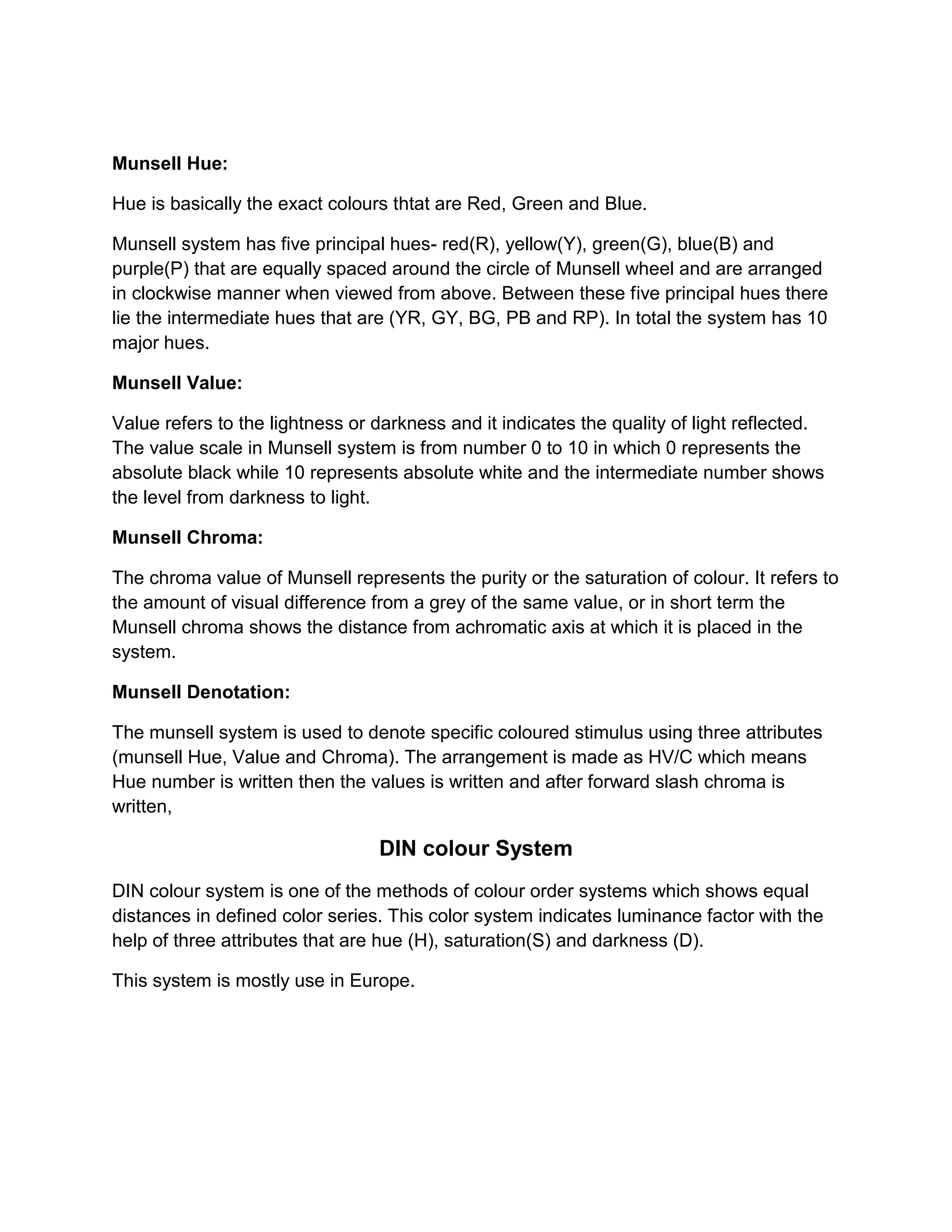
The munsell colour system is a colour space which is used to define colours which are
based on three colour dimensions that are
 Hue (the original color),
 Value (lightness) and
 Chroma (color purity).
It was created by Professor Albert H.Munsell in first deacde of 20th
century.
Munsell Hue:
Hue is basically the exact colours thtat are Red, Green and Blue.
Munsell system has five principal hues- red(R), yellow(Y), green(G), blue(B) and
purple(P) that are equally spaced around the circle of Munsell wheel and are arranged
in clockwise manner when viewed from above. Between these five principal hues there
lie the intermediate hues that are (YR, GY, BG, PB and RP). In total the system has 10
major hues.
Munsell Value:
Value refers to the lightness or darkness and it indicates the quality of light reflected.
The value scale in Munsell system is from number 0 to 10 in which 0 represents the
absolute black while 10 represents absolute white and the intermediate number shows
the level from darkness to light.
Munsell Chroma:
The chroma value of Munsell represents the purity or the saturation of colour. It refers to
the amount of visual difference from a grey of the same value, or in short term the
Munsell chroma shows the distance from achromatic axis at which it is placed in the
system.
Munsell Denotation:
The munsell system is used to denote specific coloured stimulus using three attributes
(munsell Hue, Value and Chroma). The arrangement is made as HV/C which means
Hue number is written then the values is written and after forward slash chroma is
written,
DIN colour System
DIN colour system is one of the methods of colour order systems which shows equal
distances in defined color series. This color system indicates luminance factor with the
help of three attributes that are hue (H), saturation(S) and darkness (D).
This system is mostly use in Europe.
Hue (T):
The hue in DIN colour system is represented by T. This system has 6 principle Hues
that are (white, black, yellow, green, blue and red). The intermediate hues lie in
between these principle hues which sums up to the total of 24 major hues.
Saturation (S):
In DIN colour system saturation is the color strength which is defined as departure from
white in chromaticity diagram towards the specimen. Saturation will be more when the
distance is greater.
DIN value can be calculated as:
D=10-6.1732log(40.7(y/y.)T)
Y=tristimulus value
y.=perfect whitepoint
Darkness (D):
The darkness in DIN color system shows the absorbance of light onto the material.
Likewise Munsell system, this system also represent the brightness and darkness on
the number scale but in this system 0 represent the absolute white while 10 represent
absolute black and the rest of the numbers shows level of darkness in terms of black
and white.

Munsell and DIN Color system

  • 1.
    Abstract A colour ordersystem is any systematic way of arranging all possible colours or subsets by means of material samples selected so that they may represent all object colours. There are different methods for the representation of colour order system some of them are  Munsell  Ostwald system  DIN system  Natural colour system  Etc The method that are discussed in detail here are Munsell and Din systems. Munsell system represents the colour by defining Hue, Value and Chroma. DIN color system represents the color by defining Hue, Saturation and darkness. Munsell system The munsell colour system is a colour space which is used to define colours which are based on three colour dimensions that are  Hue (the original color),  Value (lightness) and  Chroma (color purity). It was created by Professor Albert H.Munsell in first deacde of 20th century.
  • 2.
    Munsell Hue: Hue isbasically the exact colours thtat are Red, Green and Blue. Munsell system has five principal hues- red(R), yellow(Y), green(G), blue(B) and purple(P) that are equally spaced around the circle of Munsell wheel and are arranged in clockwise manner when viewed from above. Between these five principal hues there lie the intermediate hues that are (YR, GY, BG, PB and RP). In total the system has 10 major hues. Munsell Value: Value refers to the lightness or darkness and it indicates the quality of light reflected. The value scale in Munsell system is from number 0 to 10 in which 0 represents the absolute black while 10 represents absolute white and the intermediate number shows the level from darkness to light. Munsell Chroma: The chroma value of Munsell represents the purity or the saturation of colour. It refers to the amount of visual difference from a grey of the same value, or in short term the Munsell chroma shows the distance from achromatic axis at which it is placed in the system. Munsell Denotation: The munsell system is used to denote specific coloured stimulus using three attributes (munsell Hue, Value and Chroma). The arrangement is made as HV/C which means Hue number is written then the values is written and after forward slash chroma is written, DIN colour System DIN colour system is one of the methods of colour order systems which shows equal distances in defined color series. This color system indicates luminance factor with the help of three attributes that are hue (H), saturation(S) and darkness (D). This system is mostly use in Europe.
  • 3.
    Hue (T): The huein DIN colour system is represented by T. This system has 6 principle Hues that are (white, black, yellow, green, blue and red). The intermediate hues lie in between these principle hues which sums up to the total of 24 major hues. Saturation (S): In DIN colour system saturation is the color strength which is defined as departure from white in chromaticity diagram towards the specimen. Saturation will be more when the distance is greater. DIN value can be calculated as: D=10-6.1732log(40.7(y/y.)T) Y=tristimulus value y.=perfect whitepoint Darkness (D): The darkness in DIN color system shows the absorbance of light onto the material. Likewise Munsell system, this system also represent the brightness and darkness on the number scale but in this system 0 represent the absolute white while 10 represent absolute black and the rest of the numbers shows level of darkness in terms of black and white.