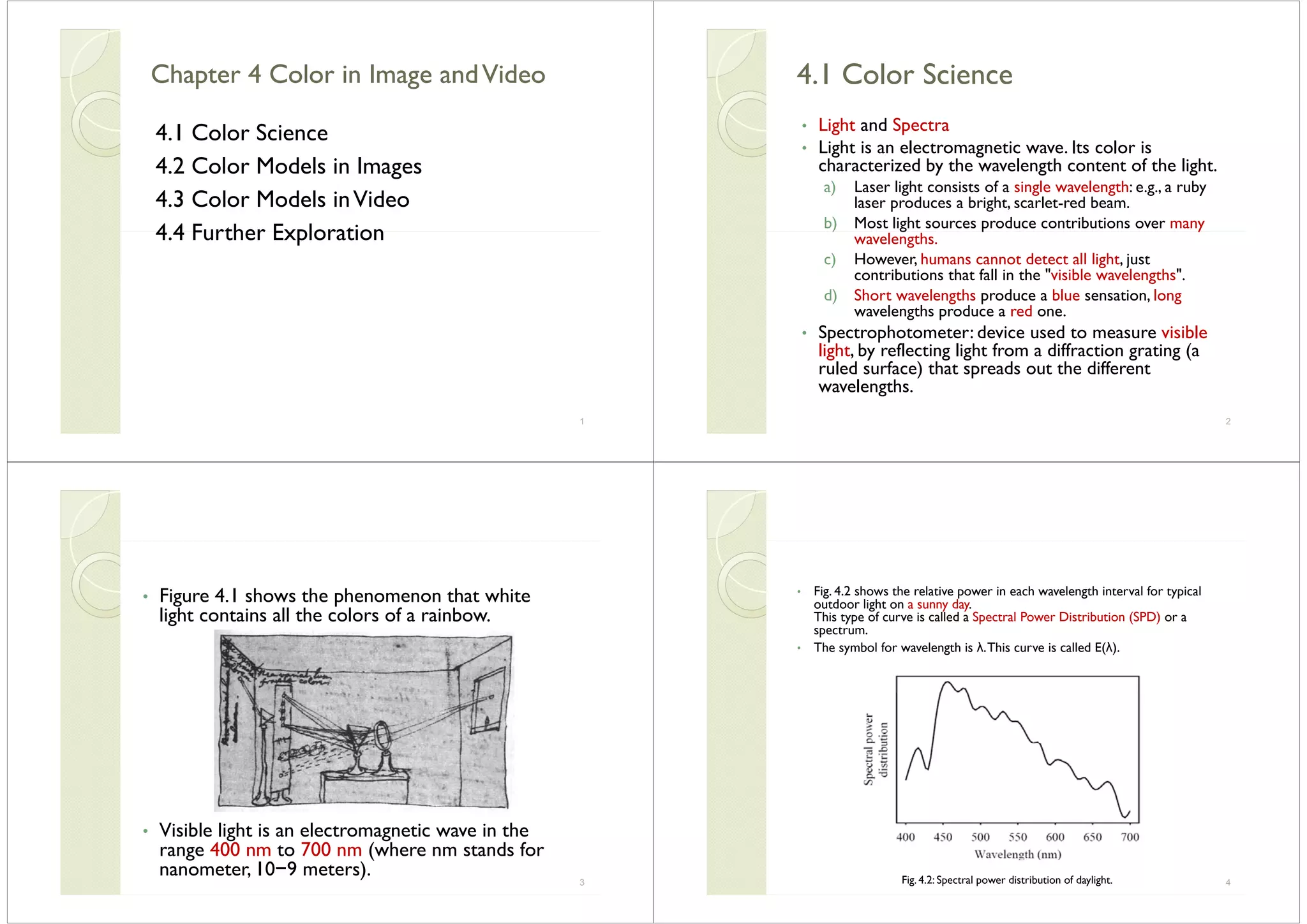
Chapter 4 Color in Image andVideoChapter 4 Color in Image andVideoChapter 4 Color in Image andVideoChapter 4 Color in Image andVideo
4 1 Color Science4.1 Color Science
4.2 Color Models in Images
4.3 Color Models inVideo
4 4 Further Exploration4.4 Further Exploration
1
4 1 Color Science4 1 Color Science4.1 Color Science4.1 Color Science
• Light and SpectraLight and Spectra
• Light is an electromagnetic wave. Its color is
characterized by the wavelength content of the light.
) L l h f l l h ba) Laser light consists of a single wavelength: e.g., a ruby
laser produces a bright, scarlet-red beam.
b) Most light sources produce contributions over many) g p y
wavelengths.
c) However, humans cannot detect all light, just
contributions that fall in the "visible wavelengths".g
d) Short wavelengths produce a blue sensation, long
wavelengths produce a red one.
• Spectrophotometer: device used to measure visible• Spectrophotometer: device used to measure visible
light, by reflecting light from a diffraction grating (a
ruled surface) that spreads out the different
l thwavelengths.
2
Fi 4 1 h th h th t hit• Figure 4.1 shows the phenomenon that white
light contains all the colors of a rainbow.
• Visible light is an electromagnetic wave in the
400 700 ( h d frange 400 nm to 700 nm (where nm stands for
nanometer, 10−9 meters). 3
• Fig 4 2 shows the relative power in each wavelength interval for typical• Fig. 4.2 shows the relative power in each wavelength interval for typical
outdoor light on a sunny day.
This type of curve is called a Spectral Power Distribution (SPD) or a
spectrum.
• The symbol for wavelength is λ.This curve is called E(λ).
Fig. 4.2: Spectral power distribution of daylight. 4
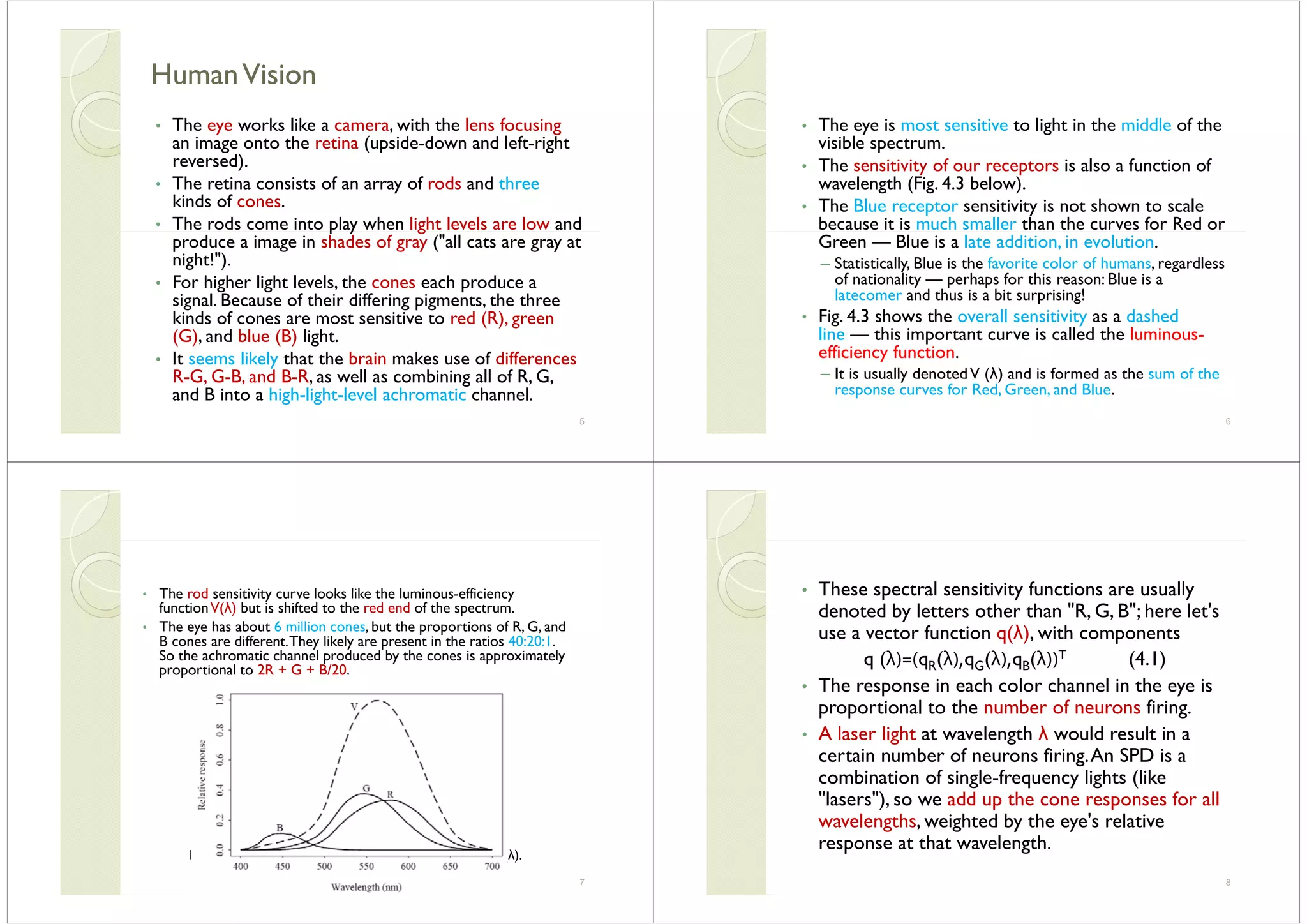
HumanVisionHumanVisionHumanVisionHumanVision
• The eye works like a camera, with the lens focusingThe eye works like a camera, with the lens focusing
an image onto the retina (upside-down and left-right
reversed).
The retina consists of an array of rods and three• The retina consists of an array of rods and three
kinds of cones.
• The rods come into play when light levels are low andp y g
produce a image in shades of gray ("all cats are gray at
night!").
• For higher light levels the cones each produce a• For higher light levels, the cones each produce a
signal. Because of their differing pigments, the three
kinds of cones are most sensitive to red (R), green
(G) d bl (B) li ht(G), and blue (B) light.
• It seems likely that the brain makes use of differences
R-G, G-B, and B-R, as well as combining all of R, G,, , , g , ,
and B into a high-light-level achromatic channel.
5
• The eye is most sensitive to light in the middle of theThe eye is most sensitive to light in the middle of the
visible spectrum.
• The sensitivity of our receptors is also a function of
wavelength (Fig 4 3 below)wavelength (Fig. 4.3 below).
• The Blue receptor sensitivity is not shown to scale
because it is much smaller than the curves for Red or
Green — Blue is a late addition, in evolution.
– Statistically, Blue is the favorite color of humans, regardless
of nationality — perhaps for this reason: Blue is aof nationality perhaps for this reason: Blue is a
latecomer and thus is a bit surprising!
• Fig. 4.3 shows the overall sensitivity as a dashed
line this important curve is called the luminousline — this important curve is called the luminous-
efficiency function.
– It is usually denotedV (λ) and is formed as the sum of the
response curves for Red, Green, and Blue.
6
The r d sensiti it c r e l ks like the l min s efficienc• The rod sensitivity curve looks like the luminous-efficiency
functionV(λ) but is shifted to the red end of the spectrum.
• The eye has about 6 million cones, but the proportions of R, G, and
B cones are different They likely are present in the ratios 40:20:1B cones are different.They likely are present in the ratios 40:20:1.
So the achromatic channel produced by the cones is approximately
proportional to 2R + G + B/20.
Fig. 4.3: R,G, and B cones, and Luminous Efficiency curveV(λ).
7
• These spectral sensitivity functions are usually• These spectral sensitivity functions are usually
denoted by letters other than "R, G, B"; here let's
use a vector function q(λ), with componentsq( ) p
q (λ)=(qR(λ),qG(λ),qB(λ))T (4.1)
• The response in each color channel in the eye isp y
proportional to the number of neurons firing.
• A laser light at wavelength λ would result in ag g
certain number of neurons firing.An SPD is a
combination of single-frequency lights (like
"l ") dd h f ll"lasers"), so we add up the cone responses for all
wavelengths, weighted by the eye's relative
response at that wavelengthresponse at that wavelength.
8
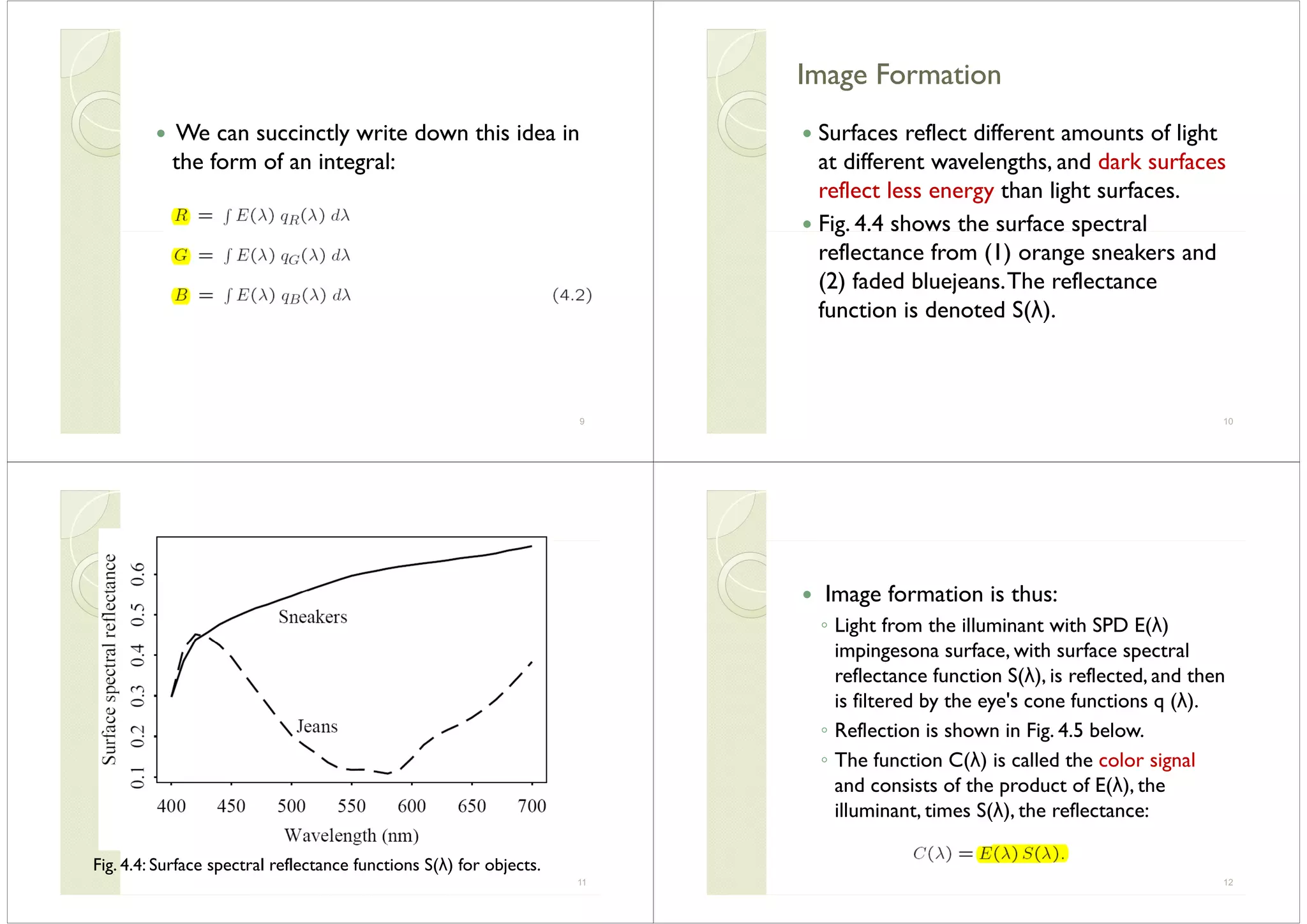
We can succinctly write down this idea inWe can succinctly write down this idea in
the form of an integral:
9
Image FormationImage FormationImage FormationImage Formation
Surfaces reflect different amounts of lightSurfaces reflect different amounts of light
at different wavelengths, and dark surfaces
reflect less energy than light surfaces.
Fig. 4.4 shows the surface spectralg p
reflectance from (1) orange sneakers and
(2) faded bluejeans The reflectance(2) faded bluejeans.The reflectance
function is denoted S(λ).
10
Fig. 4.4: Surface spectral reflectance functions S(λ) for objects.
11
Image formation is thus:Image formation is thus:
◦ Light from the illuminant with SPD E(λ)
impingesona surface, with surface spectral
reflectance function S(λ), is reflected, and then
' λis filtered by the eye's cone functions q (λ).
◦ Reflection is shown in Fig. 4.5 below.
◦ The function C(λ) is called the color signal
and consists of the product of E(λ), thep ( ),
illuminant, times S(λ), the reflectance:
12
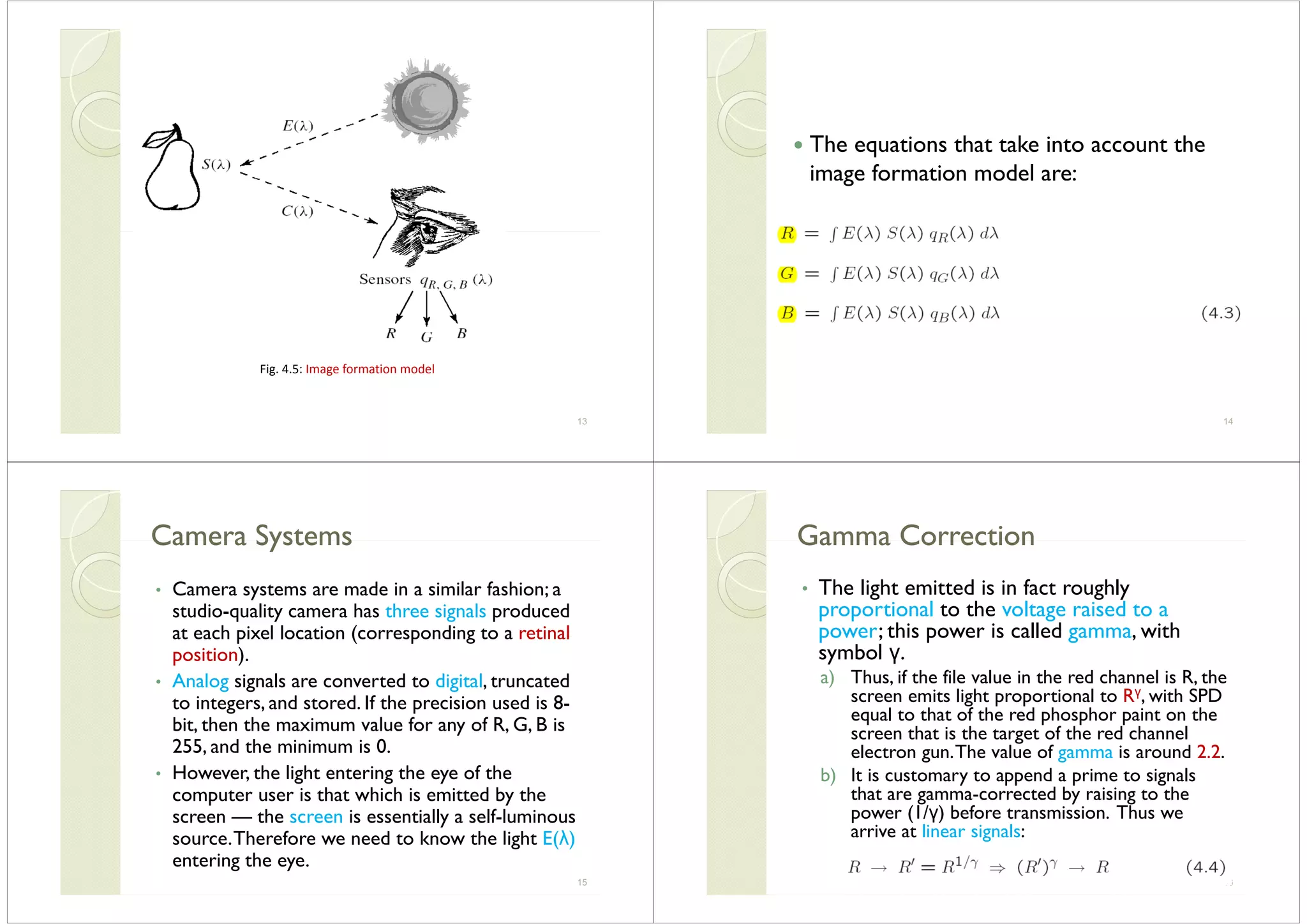
Fig. 4.5: Image formation model
13
The equations that take into account the
image formation model are:g
14
Camera SystemsCamera SystemsCamera SystemsCamera Systems
• Camera systems are made in a similar fashion; a• Camera systems are made in a similar fashion; a
studio-quality camera has three signals produced
at each pixel location (corresponding to a retinalp ( p g
position).
• Analog signals are converted to digital, truncated
to integers, and stored. If the precision used is 8-
bit, then the maximum value for any of R, G, B is
255 d th i i i 0255, and the minimum is 0.
• However, the light entering the eye of the
computer user is that which is emitted by thecomputer user is that which is emitted by the
screen — the screen is essentially a self-luminous
source.Therefore we need to know the light E(λ)source.Therefore we need to know the light E(λ)
entering the eye.
15
Gamma CorrectionGamma CorrectionGamma CorrectionGamma Correction
• The light emitted is in fact roughlyThe light emitted is in fact roughly
proportional to the voltage raised to a
power; this power is called gamma, withp p g
symbol γ.
a) Thus, if the file value in the red channel is R, the
it li ht ti l t Rγ ith SPDscreen emits light proportional to Rγ, with SPD
equal to that of the red phosphor paint on the
screen that is the target of the red channelg
electron gun.The value of gamma is around 2.2.
b) It is customary to append a prime to signals
that are gamma corrected by raising to thethat are gamma-corrected by raising to the
power (1/γ) before transmission. Thus we
arrive at linear signals:
16
Fig 4 6(a) shows light output with no• Fig. 4.6(a) shows light output with no
gamma-correction applied.We see that
darker values are displayed too dark.This
is also shown in Fig. 4.7(a), which displaysg ( ) p y
a linear ramp from left to right.
• Fig 4 6(b) shows the effect of pre• Fig. 4.6(b) shows the effect of pre-
correcting signals by applying the power
l R1/γ i i lilaw R1/γ; it is customary to normalize
voltage to the range [0,1].
17
Fi 4 6 ( ) Eff t f CRT li ht itt d f ( lt i li dFig. 4.6: (a): Effect of CRT on light emitted from screen (voltage is normalized
to range 0..1). (b): Gamma correction of signal.
18
The combined effect is shown in Fig. 4.7(b). Here, aThe combined effect is shown in Fig. 4.7(b). Here, a
ramp is shown in 16 steps from gray-level 0 to gray-
level 255.
19
Fig. 4.7: (a): Display of ramp from 0 to 255, with no gamma correction. (b): 
Image with gamma correction applied 
A f l d f f• A more careful definition of gamma recognizes
that a simple power law would result in an infinite
derivative at zero voltage makes constructing aderivative at zero voltage — makes constructing a
circuit to accomplish gamma correction difficult to
devise in analog.g
20
This is called a camera transfer function, Standard SMPTE-170M
ColorColor--Matching FunctionsMatching FunctionsColorColor Matching FunctionsMatching Functions
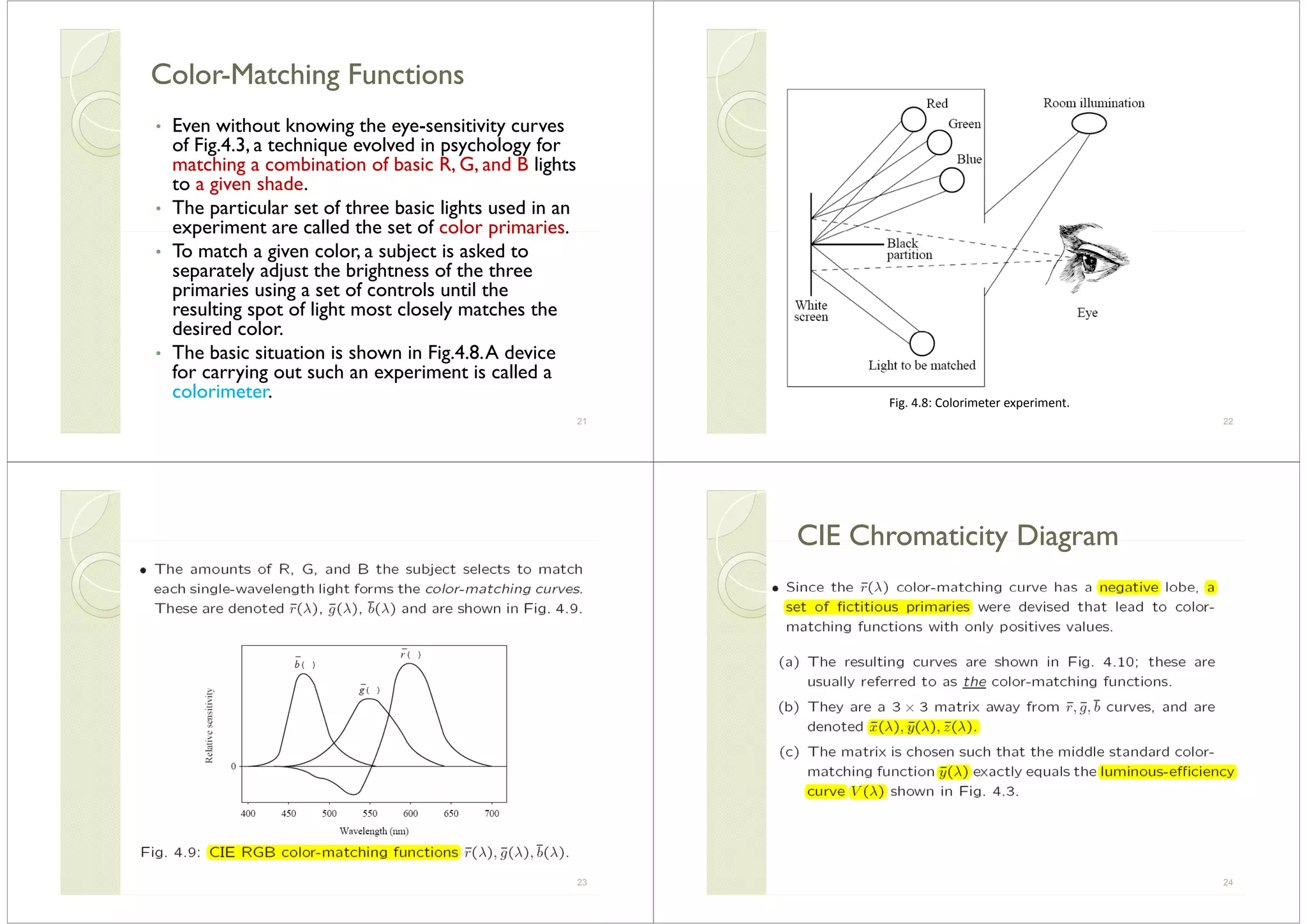
• Even without knowing the eye-sensitivity curvesEven without knowing the eye sensitivity curves
of Fig.4.3, a technique evolved in psychology for
matching a combination of basic R, G, and B lights
t a i en shadeto a given shade.
• The particular set of three basic lights used in an
experiment are called the set of color primaries.experiment are called the set of color primaries.
• To match a given color, a subject is asked to
separately adjust the brightness of the three
primaries using a set of controls until the
resulting spot of light most closely matches the
desired colordesired color.
• The basic situation is shown in Fig.4.8.A device
for carrying out such an experiment is called a
colorimeter.
21 22
Fig. 4.8: Colorimeter experiment.
23
CIE Chromaticity DiagramCIE Chromaticity DiagramCIE Chromaticity DiagramCIE Chromaticity Diagram
24
25
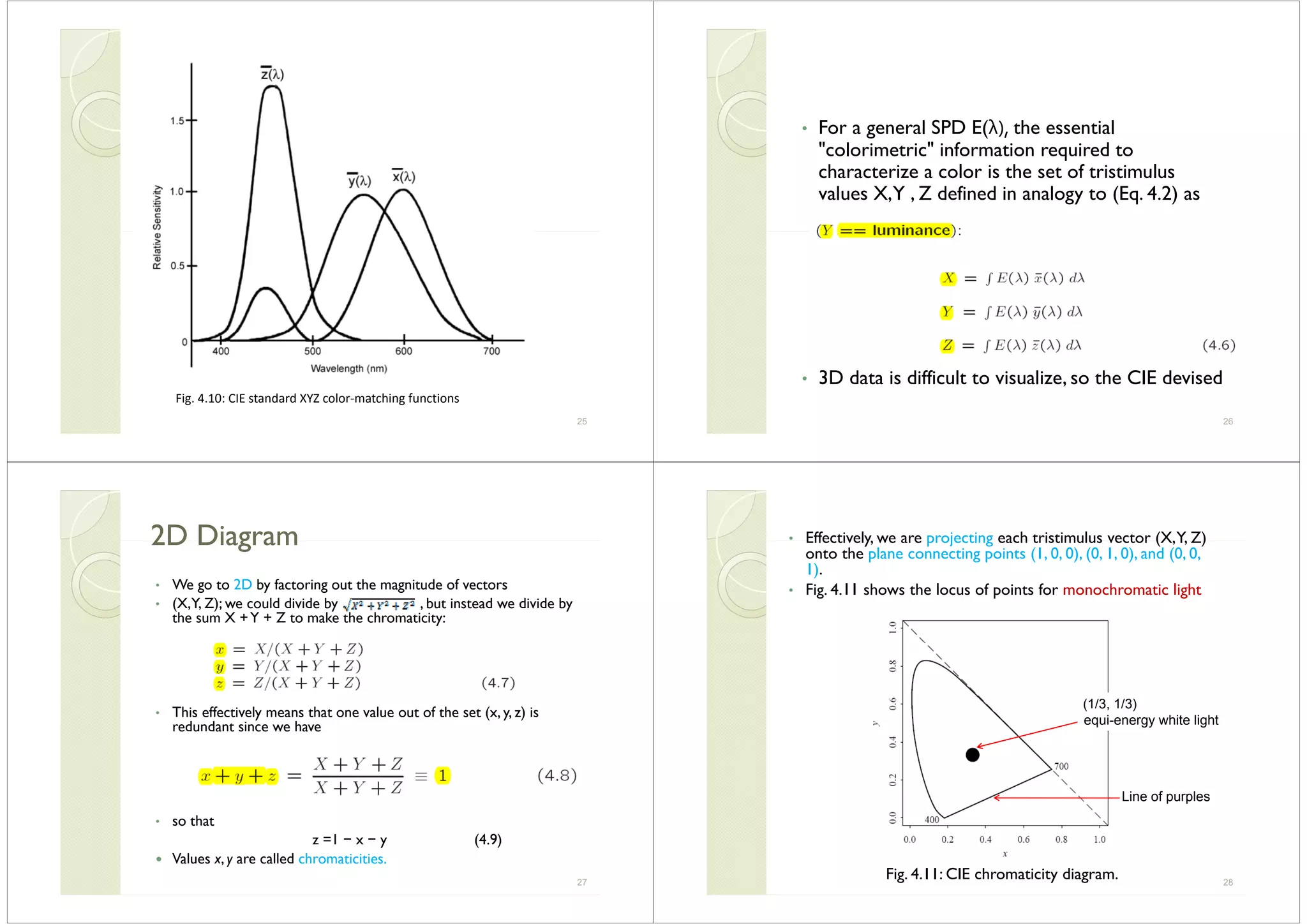
Fig. 4.10: CIE standard XYZ color‐matching functions
• For a general SPD E(λ)  the essentialFor a general SPD E(λ), the essential
"colorimetric" information required to
characterize a color is the set of tristimulus
values X,Y , Z defined in analogy to (Eq. 4.2) as
• 3D data is difficult to visualize, so the CIE devised3D data is difficult to visualize, so the CIE devised
26
2D Diagram2D Diagram2D Diagram2D Diagram
• We go to 2D by factoring out the magnitude of vectorsg y g g
• (X,Y, Z); we could divide by , but instead we divide by
the sum X +Y + Z to make the chromaticity:
• This effectively means that one value out of the set (x, y, z) is
redundant since we have
• so that
z =1 − x − y (4.9)z 1 x y (4.9)
Values x, y are called chromaticities.
27
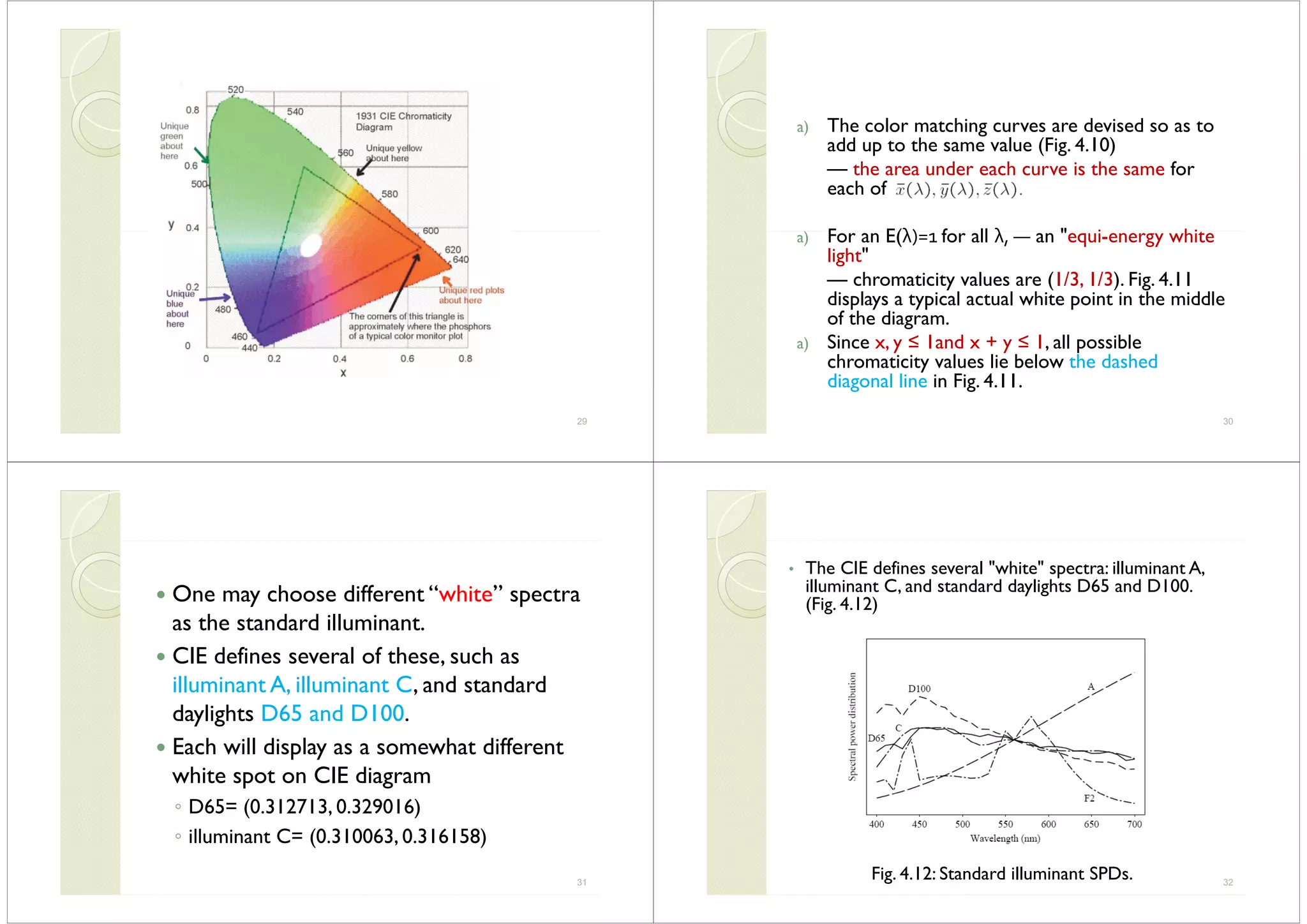
• Effectively, we are projecting each tristimulus vector (X,Y, Z)Effectively, we are projecting each tristimulus vector (X,Y, Z)
onto the plane connecting points (1, 0, 0), (0, 1, 0), and (0, 0,
1).
• Fig 4 11 shows the locus of points for monochromatic light• Fig. 4.11 shows the locus of points for monochromatic light
(1/3, 1/3)
equi-energy white light
Li f lLine of purples
Fig. 4.11: CIE chromaticity diagram. 28
29
a) The color matching curves are devised so as toa) The color matching curves are devised so as to
add up to the same value (Fig. 4.10)
— the area under each curve is the same for
h feach of
) F E(λ)  f ll λ   " i hia) For an E(λ)=1 for all λ, — an "equi-energy white
light"
— chromaticity values are (1/3 1/3) Fig 4 11chromaticity values are (1/3, 1/3). Fig. 4.11
displays a typical actual white point in the middle
of the diagram.
a) Since x, y ≤ 1and x + y ≤ 1, all possible
chromaticity values lie below the dashed
diagonal line in Fig 4 11diagonal line in Fig. 4.11.
30
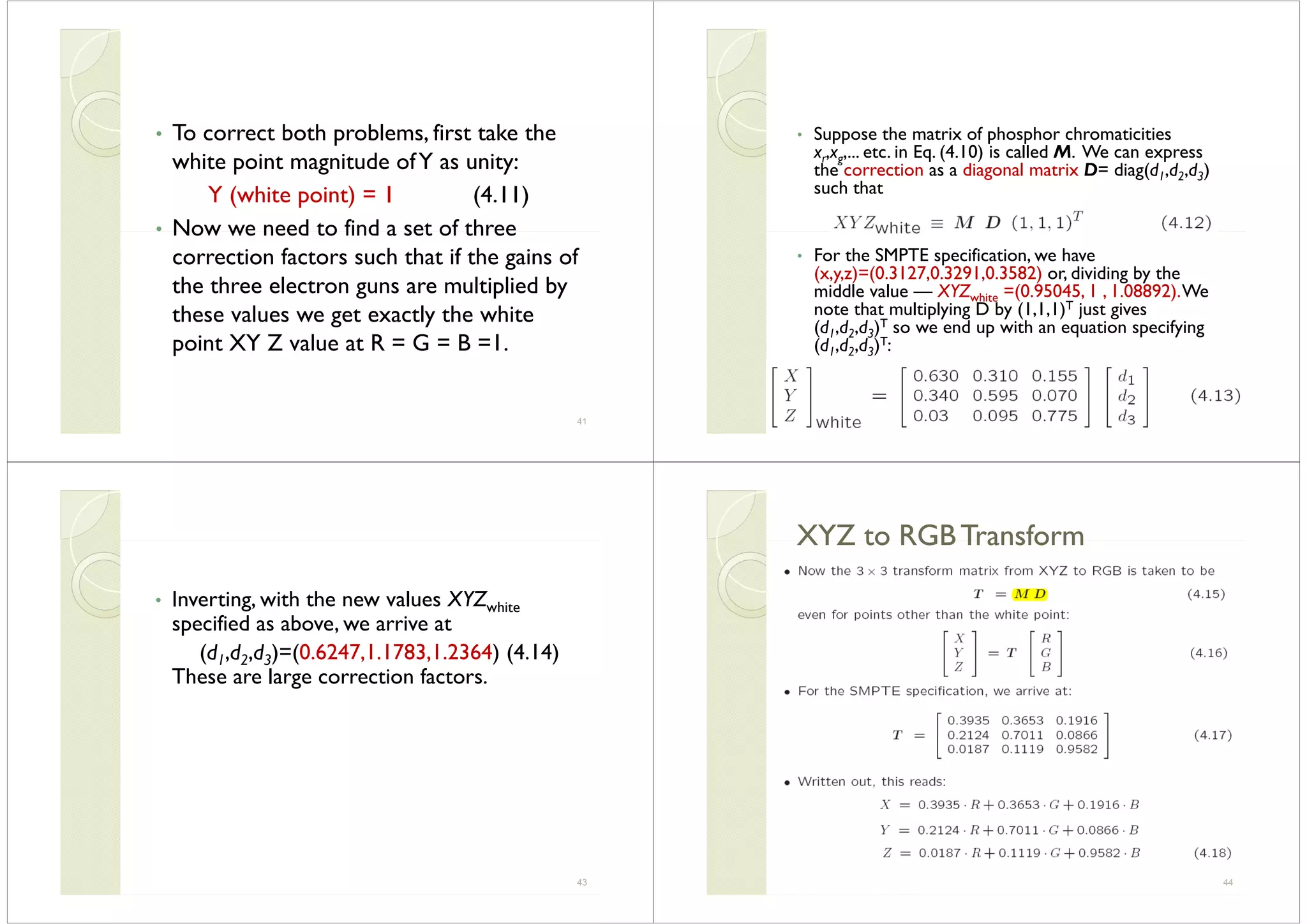
One may choose different “white” spectraOne may choose different white spectra
as the standard illuminant.
CIE defines several of these, such as
illuminant A, illuminant C, and standard, ,
daylights D65 and D100.
E h ill di l h t diff tEach will display as a somewhat different
white spot on CIE diagram
◦ D65= (0.312713, 0.329016)
◦ illuminant C= (0.310063, 0.316158)( , )
31
• The CIE defines several "white" spectra: illuminant A,
illuminant C, and standard daylights D65 and D100.illuminant C, and standard daylights D65 and D100.
(Fig. 4.12)
Fig. 4.12: Standard illuminant SPDs. 32
• Chromaticities on the spectrum locus (theChromaticities on the spectrum locus (the
"horseshoe" in Fig. 4.11) represent "pure"
colors.These are the most "saturated".
Colors close to the white point are more
unsaturated.
Th h d f f• The chromaticity diagram: for a mixture of
two lights, the resulting chromaticity lies on
the straight line joining the chromaticities ofthe straight line joining the chromaticities of
the two lights.
• The "dominant wavelength" is the position• The dominant wavelength is the position
on the spectrum locus intersected by a line
joining the white point to the given color,j g p g
and extended through it.
33
Color Monitor SpecificationsColor Monitor SpecificationsColor Monitor SpecificationsColor Monitor Specifications
Color monitors are specified in part byColor monitors are specified in part by
the white point chromaticity that is
desired if the RGB electron guns are all
activated at their highest value (1.0, if weg (
normalize to [0,1]).
We want the monitor to display aWe want the monitor to display a
specified white when R’=G’=B’=1.
There are several monitor specifications
in current use (Table 4.1).( )
34
Table 4 1: Chromaticities and White PointsTable 4.1: Chromaticities and White Points
of Monitor Specifications
35
OutOut--ofof--Gamut ColorsGamut ColorsOutOut ofof Gamut ColorsGamut Colors
For any (x y) pair we wish to find thatFor any (x, y) pair we wish to find that
RGB triple giving the specified (x, y, z):We
form the z values for the phosphors, via z
=1 − x − y and solve for RGB from they
phosphor chromaticities.
We combine nonzero values of R G andWe combine nonzero values of R, G, and
B via
36
(x y z)=>(R G B)(x y z)=>(R G B)(x, y, z) >(R,G,B)(x, y, z) >(R,G,B)
• If (x y) [color without magnitude] is• If (x, y) [color without magnitude] is
specified, instead of derived as above, we
have to invert the matrix of phosphor (xhave to invert the matrix of phosphor (x,
y, z) values to obtain RGB.
Wh d d if f h RGB• What do we do if any of the RGB
numbers is negative?— that color, visible
h i f f di lto humans, is out-of-gamut for our display.
1. One method: simply use the closest in-
gamut color available, as in Fig. 4.13.
2. Another approach: select the closest
complementary color.
37
Fig. 4.13:  Approximating an out‐of‐gamut color by an in‐gamut one. The out‐of‐gamut 
color shown by a triangle is approximated by the intersection of (a) the line 
38
y g pp y ( )
from that color to the white point with (b) the boundary of the device color 
gamut. 
• Grassman's Law: (Additive) color matching is linear.Grassman s Law: (Additive) color matching is linear.
This means that if we match color1 with a linear
combinations of lights and match color2 with another
set of weights the combined color color1+ color2 isset of weights, the combined color color1+ color2 is
matched by the sum of the two sets of weights.
• Additive color results from self-luminous sources,
h li h j d hi hsuch as lights projected on a white screen, or the
phosphors glowing on the monitor glass. (Subtractive
color applies for printers, and is very different).pp p y )
• Fig. 4.13 above shows the triangular gamut for the
NTSC system, drawn on the CIE diagram — a
monitor can display only the colors inside a triangularmonitor can display only the colors inside a triangular
gamut.
39
White Point CorrectionWhite Point CorrectionWhite Point CorrectionWhite Point Correction
• Problems:Problems:
(a) One deficiency in what we have done so far is
that we need to be able to map tristimulus
l XYZ d RGB l dvalues XYZ to device RGBs including
magnitude, and not just deal with chromaticity
xyz.xyz.
(b) Table 4.1 would produce incorrect values:
E.g., consider the SMPTE specifications. Setting R =g p g
G = B = 1 results in a value of X that equals the
sum of the x values, or 0.630 + 0.310 + 0.155,
which is 1.095. Similarly theY and Z values comey
out to 1.005 and 0.9. Now, dividing by (X +Y + Z)
this results in a chromaticity of (0.365, 0.335),
rather than the desired values of (0.3127, 0.3291).rather than the desired values of (0.3127, 0.3291).
40
To correct both problems first take the• To correct both problems, first take the
white point magnitude ofY as unity:
Y (white point) = 1 (4.11)
• Now we need to find a set of threeNow we need to find a set of three
correction factors such that if the gains of
th th l t lti li d bthe three electron guns are multiplied by
these values we get exactly the white
point XY Z value at R = G = B =1.
41
S th t i f h h h ti iti• Suppose the matrix of phosphor chromaticities
xr,xg,... etc. in Eq. (4.10) is called M. We can express
the correction as a diagonal matrix D= diag(d1,d2,d3)
such that
• For the SMPTE specification, we have
(x,y,z)=(0.3127,0.3291,0.3582) or, dividing by the( y ) ( ) g y
middle value — XYZwhite =(0.95045, 1 , 1.08892).We
note that multiplying D by (1,1,1)T just gives
(d1,d2,d3)T so we end up with an equation specifying(d1,d2,d3) so we end up with an equation specifying
(d1,d2,d3)T:
42
I h h l XYZ• Inverting, with the new values XYZwhite
specified as above, we arrive at
(d1,d2,d3)=(0.6247,1.1783,1.2364) (4.14)
These are large correction factors.
43
XYZ to RGB TransformXYZ to RGB TransformXYZ to RGB TransformXYZ to RGB Transform
44
Transform with Gamma CorrectionTransform with Gamma CorrectionTransform with Gamma CorrectionTransform with Gamma Correction
• Instead of linear R G B we usually have nonlinear• Instead of linear R, G, B we usually have nonlinear,
gamma-corrected R’, G’, B’ (produced by a
camcorder or digital camera).g )
• To transform XYZ to RGB, calculate the linear
RGB required, by inverting Eq. (4.16) above; then
make nonlinear signals via gamma correction.
• Nevertheless this is not often done as stated.
Instead, the equation for theY value is used as is,
but applied to nonlinear signals.
) Th l i i i ha) The only concession to accuracy is to give the new
nameY’ to this newY value created from R’, G’, B’.
b) The significance ofY’ is that it codes a descriptor ofb) The significance ofY is that it codes a descriptor of
brightness for the pixel in question.
45
• Following the procedure outlined above but• Following the procedure outlined above, but
with the values in Table 4.1 for NTSC, we
arrive at the following transform:arrive at the following transform:
X =0.607· R +0.174· G +0.200· B
Y =0 299 R +0 587 G +0 114 BY =0.299· R +0.587· G +0.114· B
Z =0.000· R +0.066· G +1.116· B
(4.19)
• Thus, coding for nonlinear signals beginsg g g
with encoding the nonlinear-signal correlate
of luminance:
Y’ =0.299·R’+0.587·G’+0.114·B’ (4.20)
46
L*a*b* (CIELAB) Color ModelL*a*b* (CIELAB) Color ModelL a b (CIELAB) Color ModelL a b (CIELAB) Color Model
• Weber’s Law: Equally-perceived differences areWebers Law: Equally perceived differences are
proportional to magnitude.The more there is of a
quantity, the more change there must be to perceive
a differencea difference.
• A rule of thumb for this phenomenon states that
equally-perceived changes must be relative —
h b ll i d if h i f hchanges are about equally perceived if the ratio of the
change is the same, whether for dark or bright lights,
etc.
• Mathematically, with intensity I, change is equally
perceived so long as the change ∆I/I is a constant. If
it’s quiet we can hear a small change in sound If thereits quiet, we can hear a small change in sound. If there
is a lot of noise, to experience the same difference
the change has to be of the same proportion.
47
For human vision the CIE arrived at aFor human vision, the CIE arrived at a
different version of this kind of rule —
CIELAB space.What is being quantified in
this space is differences perceived in colorp p
and brightness.
Fig 4 14 shows a cutaway into a 3D solidFig. 4.14 shows a cutaway into a 3D solid
of the coordinate space associated with
hi l diff ithis color difference metric.
48
Fig. 4.14: CIELAB model.
49
CIELAB• CIELAB
with X Y Z the XYZ values of the whitewith Xn,Yn,Zn the XYZ values of the white
point.Auxiliary definitions are:
50
More Color Coordinate SchemesMore Color Coordinate SchemesMore Color Coordinate SchemesMore Color Coordinate Schemes
• Beware: gamma correction or not is usually• Beware: gamma correction or not is usually
ignored.
• Schemes include:• Schemes include:
a) CMY —Cyan(C), Magenta (M) andYellow (Y )
color model;color model;
b) HSL — Hue, Saturation and Lightness;
c) HSV Hue Saturation andValue;c) HSV — Hue, Saturation andValue;
d) HSI — Hue, Saturation and Intensity;
e) HCI C=Chroma;e) HCI — C=Chroma;
f) HVC —V=Value;
g) HSD D=Darknessg) HSD — D=Darkness.
51
4 2 Color Models in Images4 2 Color Models in Images4.2 Color Models in Images4.2 Color Models in Images
• Colors models and spaces used for stored, displayed,Colors models and spaces used for stored, displayed,
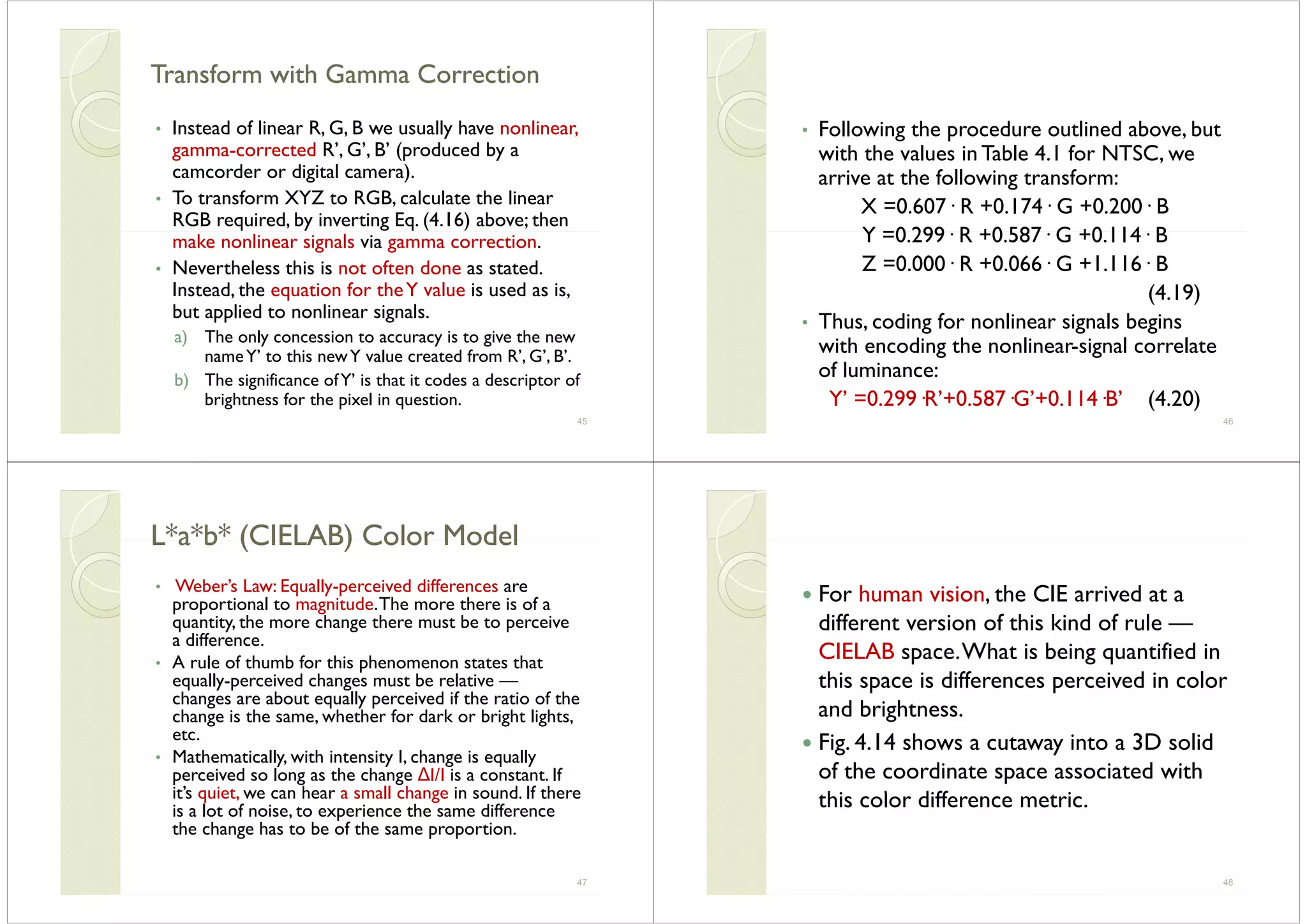
and printed images.
• RGB Color Model for CRT Displays
1 W b bl 8 b l h l1. We expect to be able to use 8 bits per color channel
for color that is accurate enough.
2. However, in fact we have to use about 12 bits perp
channel to avoid an aliasing effect in dark image areas —
contour bands that result from gamma correction.
3. For images produced from computer graphics, we storeg p p g p ,
integers proportional to intensity in the frame buffer. So
should have a gamma correction LUT between the
frame buffer and the CRT.
4. If gamma correction is applied to floats before
quantizing to integers, before storage in the frame buffer,
then in fact we can use only 8 bits per channel and stilly p
avoid contouring artifacts.
52
Subtractive Color: CMY Color ModelSubtractive Color: CMY Color ModelSubtractive Color: CMY Color ModelSubtractive Color: CMY Color Model
So far we have effectively been dealing• So far, we have effectively been dealing
only with additive color. Namely, when
two light beams impinge on a target, their
colors add; when two phosphors on ap p
CRT screen are turned on, their colors
add.add.
• But for ink deposited on paper, the
i i i h ld ll i kopposite situation holds: yellow ink
subtracts blue from white illumination, but
reflects red and green; it appears yellow.
53
1. Instead of red, green, and blue primaries, we need primaries that
am nt t red reen and bl e I e e need t s btract R r Gamount to -red, -green, and -blue. I.e., we need to subtract R, or G,
or B.
2. These subtractive color primaries are Cyan (C), Magenta (M) and
Yellow (Y )inksYellow (Y )inks.
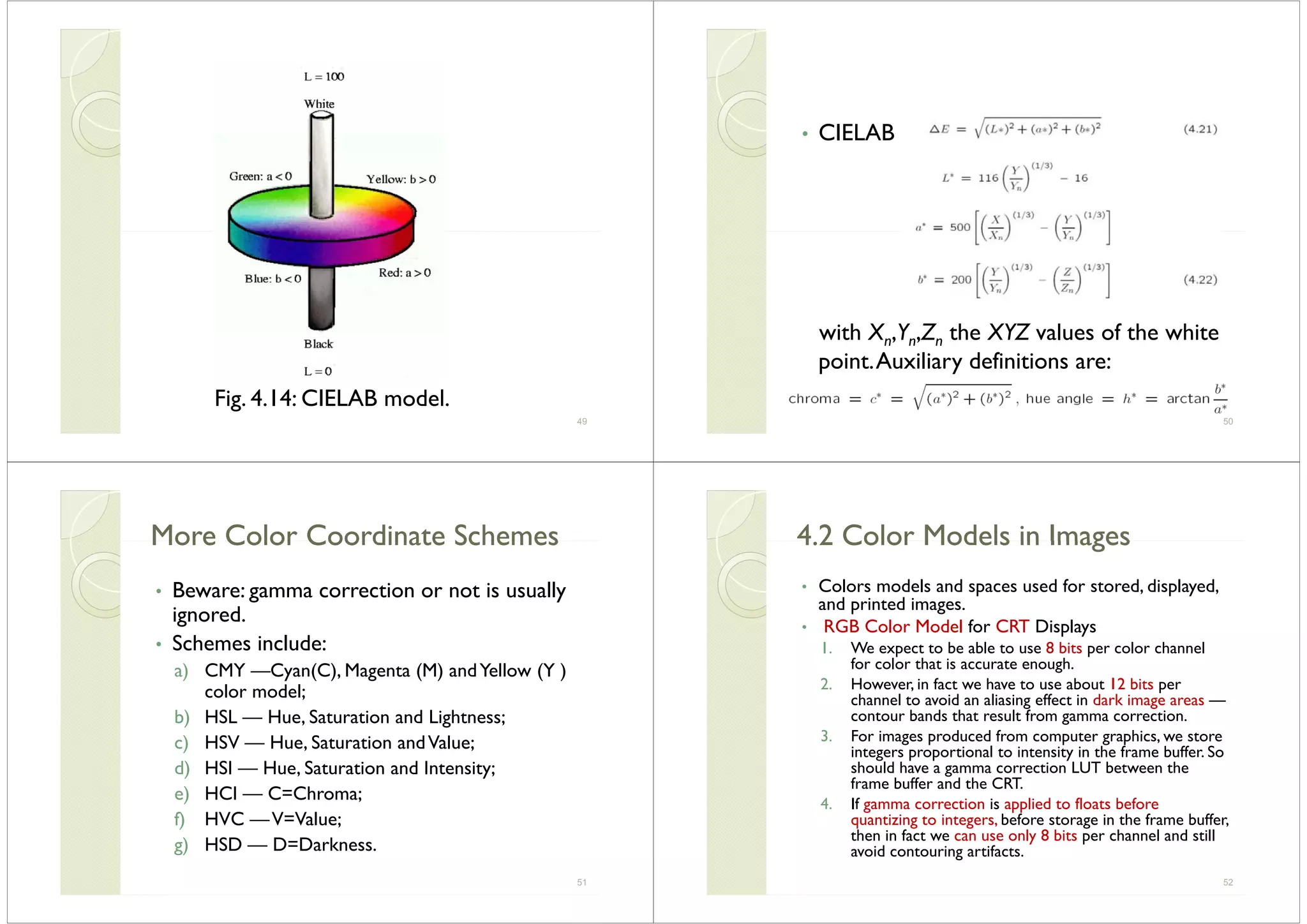
Fig. 4.15: RGB and CMY color cubes.
54
Transformation from RGB to CMYTransformation from RGB to CMYTransformation from RGB to CMYTransformation from RGB to CMY
Simplest model we can invent to specifySimplest model we can invent to specify
what ink density to lay down on paper, to
make a certain desired RGB color:
Th h fThen the inverse transform is:
55
Undercolor Removal: CMYK SystemUndercolor Removal: CMYK SystemUndercolor Removal: CMYK SystemUndercolor Removal: CMYK System
Undercolor removal: Sharper and cheaperUndercolor removal: Sharper and cheaper
printer colors: calculate that part of the
CMY mix that would be black, remove it
from the color proportions, and add itp p
back as real black.
The new specification of inks is thus:The new specification of inks is thus:
56
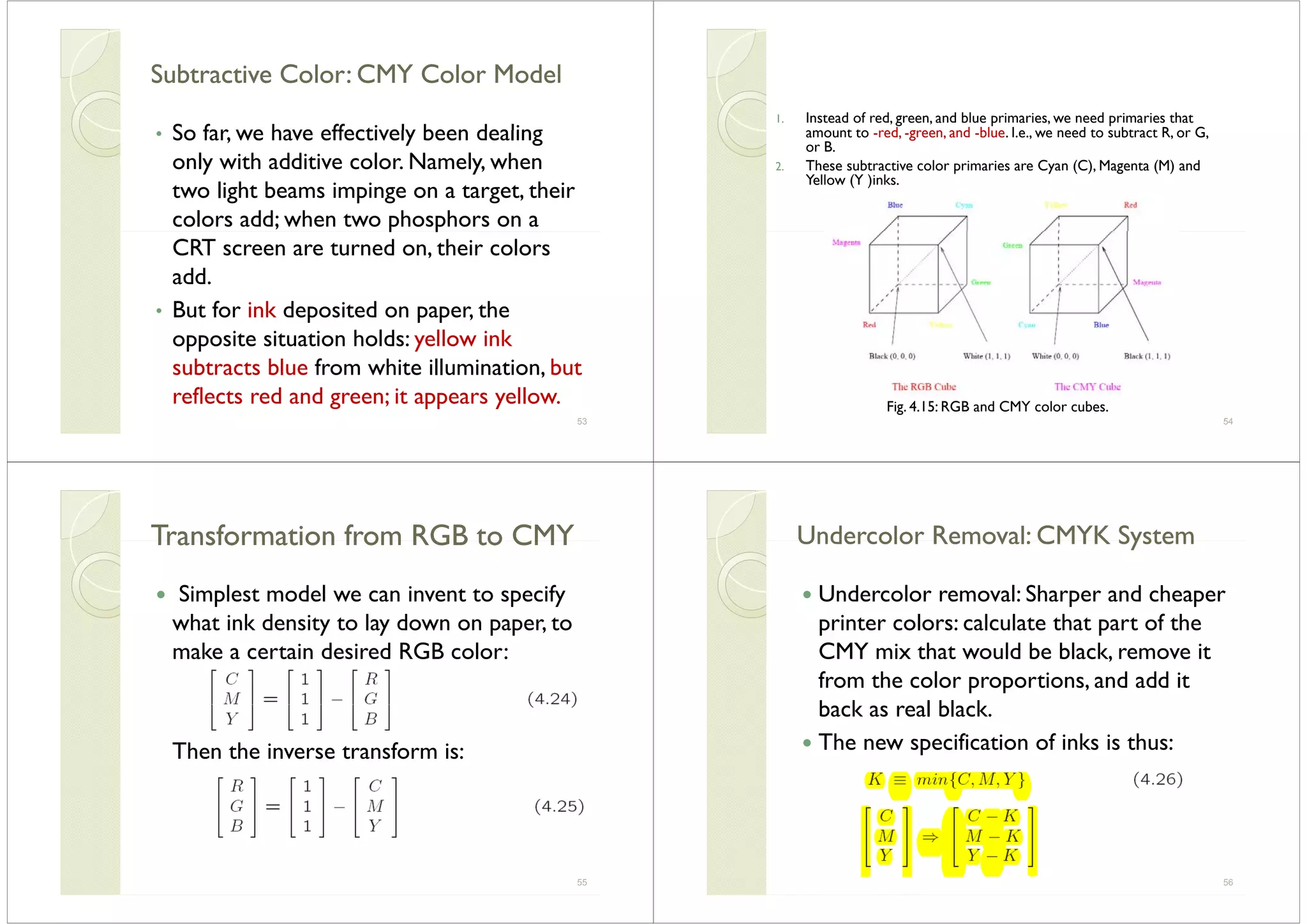
• Fig. 4.16: color combinations that result from combining primary colors
available in the two situations, additive color and subtractive color.
Fig. 4.16: Additive and subtractive color. (a): RGB is used to specify additive
color. (b): CMY is used to specify subtractive color
57
Printer GamutsPrinter GamutsPrinter GamutsPrinter Gamuts
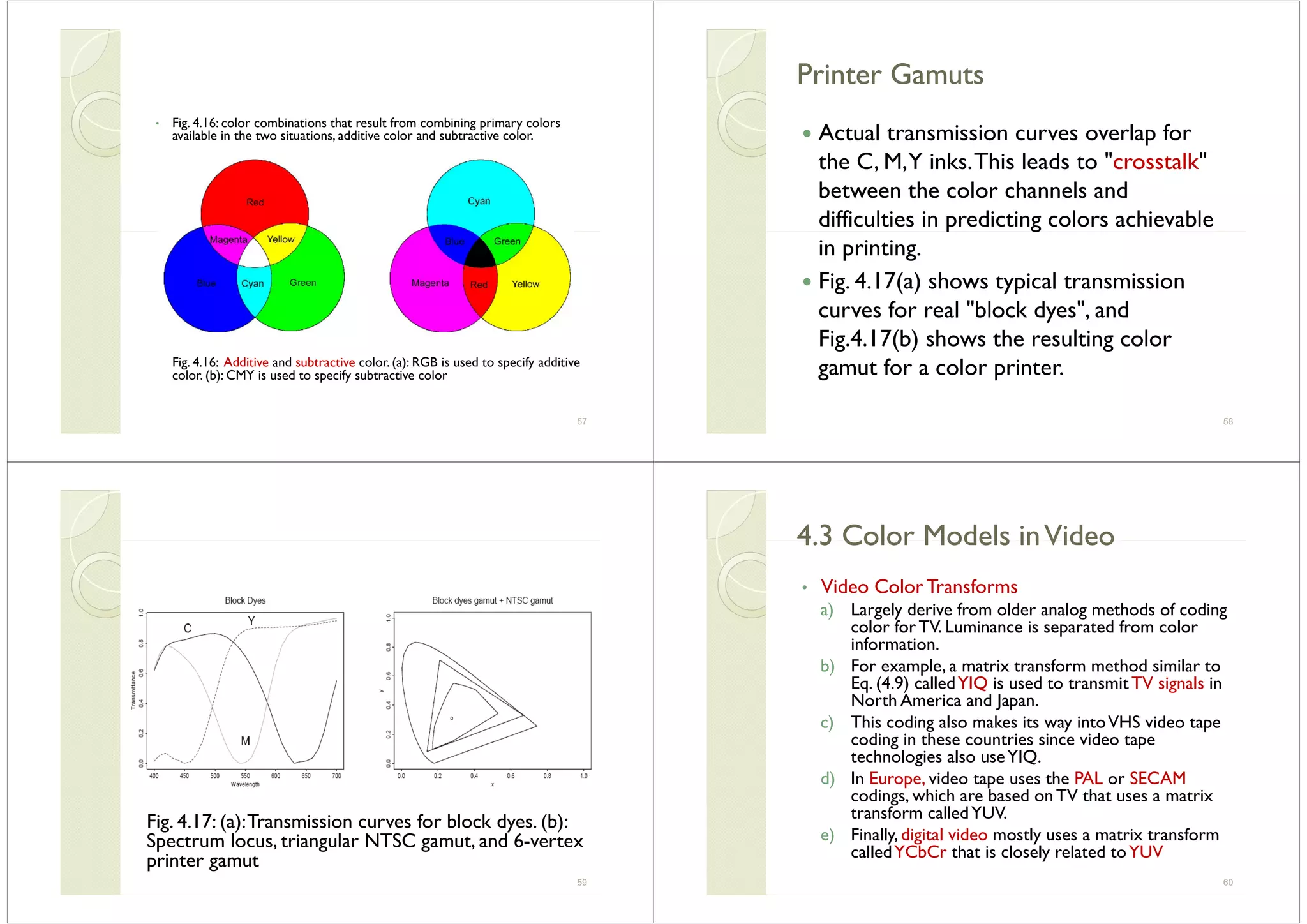
Actual transmission curves overlap forActual transmission curves overlap for
the C, M,Y inks.This leads to "crosstalk"
between the color channels and
difficulties in predicting colors achievablep g
in printing.
Fig 4 17(a) shows typical transmissionFig. 4.17(a) shows typical transmission
curves for real "block dyes", and
Fi 4 17(b) h h l i lFig.4.17(b) shows the resulting color
gamut for a color printer.
58
Fig. 4.17: (a):Transmission curves for block dyes. (b):
Spectrum locus triangular NTSC gamut and 6-vertexSpectrum locus, triangular NTSC gamut, and 6 vertex
printer gamut
59
4 3 Color Models inVideo4 3 Color Models inVideo4.3 Color Models inVideo4.3 Color Models inVideo
• Video Color TransformsVideo Color Transforms
a) Largely derive from older analog methods of coding
color for TV. Luminance is separated from color
informationinformation.
b) For example, a matrix transform method similar to
Eq. (4.9) calledYIQ is used to transmit TV signals inq ( ) g
North America and Japan.
c) This coding also makes its way intoVHS video tape
coding in these countries since video tapecoding in these countries since video tape
technologies also useYIQ.
d) In Europe, video tape uses the PAL or SECAM
codings which are based on TV that uses a matrixcodings, which are based on TV that uses a matrix
transform calledYUV.
e) Finally, digital video mostly uses a matrix transform) y g y
calledYCbCr that is closely related toYUV
60
YUV Color ModelYUV Color ModelYUV Color ModelYUV Color Model
a) YUV codes a luminance signal (for gamma-corrected signals)) g ( g g )
equal toY’ in Eq. (4.20). the "luma".
b) Chrominance refers to the difference between a color andb) Chrominance refers to the difference between a color and
a reference white at the same luminance. −→ use color
differences U,V :
U = B’−Y’ V = R’−Y’ (4 27)U = B −Y , V = R −Y (4.27)
From Eq. (4.20),
a) For gray, R’ = G’ = B’ , the luminanceY’ equals to that gray,
since 0.299 + 0.587 + 0.114 = 1.0.And for a gray ("black
and white") image the chrominance (U V )is zeroand white ) image, the chrominance (U,V )is zero.
61
d) In the actual implementation U andV are rescaled to have a) p
more convenient maximum and minimum.
e) For dealing with composite video, it turns out to be
convenient to contain U,V within the range −1/3to +4/3. Soconvenient to contain U,V within the range 1/3to 4/3. So
U andV are rescaled:
U =0.492111 (B’−Y’)
V =0.877283 (R’−Y’) (4.29)( ) ( )
The chrominance signal = the composite signal C:
C = U·cos(ωt)+V ·sin(ωt) (4.30)
Z i h i i l f U V U i i lf) Zero is not the minimum value for U,V. U is approximately
from blue (U> 0) to yellow (U< 0) in the RGB cube; V is
approximately from red (V> 0) to cyan (V< 0).
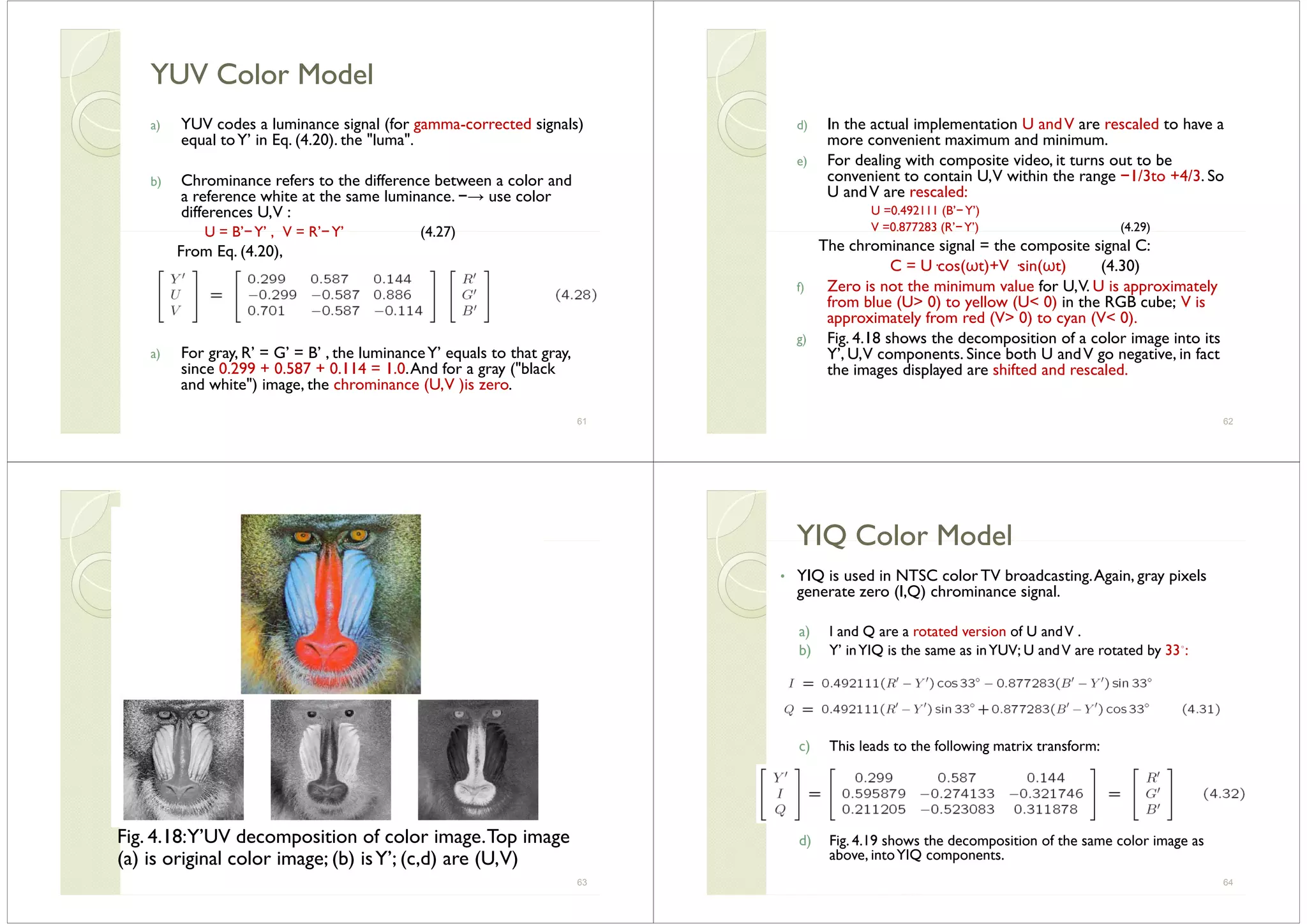
F 4 18 h h d f lg) Fig. 4.18 shows the decomposition of a color image into its
Y’, U,V components. Since both U andV go negative, in fact
the images displayed are shifted and rescaled.
62
Fig. 4.18:Y’UV decomposition of color image.Top imageg p g p g
(a) is original color image; (b) isY’; (c,d) are (U,V)
63
YIQ Color ModelYIQ Color ModelYIQ Color ModelYIQ Color Model
• YIQ is used in NTSC color TV broadcasting.Again, gray pixels
generate zero (I Q) chrominance signalgenerate zero (I,Q) chrominance signal.
a) I and Q are a rotated version of U andV .
b) Y’ inYIQ is the same as inYUV; U andV are rotated by 33◦:
) Thi l d t th f ll i t i t fc) This leads to the following matrix transform:
d) Fig. 4.19 shows the decomposition of the same color image asd) Fig. 4.19 shows the decomposition of the same color image as
above, intoYIQ components.
64
Fig.4.19: I and Q components of color image.
65
YCbCr Color ModelYCbCr Color ModelYCbCr Color ModelYCbCr Color Model
• The Rec 601 standard for digital video usesThe Rec. 601 standard for digital video uses
another color space,YCbCr, often simply
writtenYCbCr — closely related to theYUVy
transform.
a) YUV is changed by scaling such that Cb is U,
b t ith ffi i t f 0 5 lti l i B’ Ibut with a coefficient of 0.5 multiplying B’ . In
some software systems, Cb and Cr are also
shifted such that values are between 0 and 1.
b) This makes the equations as follows:
Cb =((B’−Y’)/1.772) +0.5
Cr =((R’−Y’)/1.402)+ 0.5 (4.33)
c) Written out:
66
d) In practice however Recommendation 601d) In practice, however, Recommendation 601
specifies 8-bit coding, with a maximumY’
value of only 219, and a minimum of +16.y
Cb and Cr have a range of ±112 and offset
of +128. If R’, G’, B’ are floats in [0.. + 1],
then we obtainY’ C C in [0 255] via thethen we obtainY , Cb, Cr in [0..255] via the
transform:
e) TheYCbCr transform is used in JPEG image
compression and MPEG video compressioncompression and MPEG video compression.
67
4 4 Further Exploration4 4 Further Exploration4.4 Further Exploration4.4 Further Exploration
−→ Link to Further Exploration for Chapter 4.Link to Further Exploration for Chapter 4.
• Links in the Chapter 4 section of the “Further
”Exploration” directory on the text website include:
– More details on gamma correction for publication on the
WWW.
– The full specification of the new sRGB standard color
space for WWW applications.
– A link to an excellent review of color transforms– A link to an excellent review of color transforms.
– A Matlab script to exercise (and expand upon) the color
transform functions that are part of the ImageToolbox in
Matlab: the standard ‘Lena’ image is transformed toMatlab: the standard Lena image is transformed to
YIQ and toYCbCr.
– The new MPEG standard, MPEG-7, will be discussed in
Ch t 12 MPEG 7 i l d i lChapter 12. MPEG-7 includes six color spaces.
68

Unit i mm_chap4_color in image and video

  • 1.
    Chapter 4 Colorin Image andVideoChapter 4 Color in Image andVideoChapter 4 Color in Image andVideoChapter 4 Color in Image andVideo 4 1 Color Science4.1 Color Science 4.2 Color Models in Images 4.3 Color Models inVideo 4 4 Further Exploration4.4 Further Exploration 1 4 1 Color Science4 1 Color Science4.1 Color Science4.1 Color Science • Light and SpectraLight and Spectra • Light is an electromagnetic wave. Its color is characterized by the wavelength content of the light. ) L l h f l l h ba) Laser light consists of a single wavelength: e.g., a ruby laser produces a bright, scarlet-red beam. b) Most light sources produce contributions over many) g p y wavelengths. c) However, humans cannot detect all light, just contributions that fall in the "visible wavelengths".g d) Short wavelengths produce a blue sensation, long wavelengths produce a red one. • Spectrophotometer: device used to measure visible• Spectrophotometer: device used to measure visible light, by reflecting light from a diffraction grating (a ruled surface) that spreads out the different l thwavelengths. 2 Fi 4 1 h th h th t hit• Figure 4.1 shows the phenomenon that white light contains all the colors of a rainbow. • Visible light is an electromagnetic wave in the 400 700 ( h d frange 400 nm to 700 nm (where nm stands for nanometer, 10−9 meters). 3 • Fig 4 2 shows the relative power in each wavelength interval for typical• Fig. 4.2 shows the relative power in each wavelength interval for typical outdoor light on a sunny day. This type of curve is called a Spectral Power Distribution (SPD) or a spectrum. • The symbol for wavelength is λ.This curve is called E(λ). Fig. 4.2: Spectral power distribution of daylight. 4
  • 2.
    HumanVisionHumanVisionHumanVisionHumanVision • The eyeworks like a camera, with the lens focusingThe eye works like a camera, with the lens focusing an image onto the retina (upside-down and left-right reversed). The retina consists of an array of rods and three• The retina consists of an array of rods and three kinds of cones. • The rods come into play when light levels are low andp y g produce a image in shades of gray ("all cats are gray at night!"). • For higher light levels the cones each produce a• For higher light levels, the cones each produce a signal. Because of their differing pigments, the three kinds of cones are most sensitive to red (R), green (G) d bl (B) li ht(G), and blue (B) light. • It seems likely that the brain makes use of differences R-G, G-B, and B-R, as well as combining all of R, G,, , , g , , and B into a high-light-level achromatic channel. 5 • The eye is most sensitive to light in the middle of theThe eye is most sensitive to light in the middle of the visible spectrum. • The sensitivity of our receptors is also a function of wavelength (Fig 4 3 below)wavelength (Fig. 4.3 below). • The Blue receptor sensitivity is not shown to scale because it is much smaller than the curves for Red or Green — Blue is a late addition, in evolution. – Statistically, Blue is the favorite color of humans, regardless of nationality — perhaps for this reason: Blue is aof nationality perhaps for this reason: Blue is a latecomer and thus is a bit surprising! • Fig. 4.3 shows the overall sensitivity as a dashed line this important curve is called the luminousline — this important curve is called the luminous- efficiency function. – It is usually denotedV (λ) and is formed as the sum of the response curves for Red, Green, and Blue. 6 The r d sensiti it c r e l ks like the l min s efficienc• The rod sensitivity curve looks like the luminous-efficiency functionV(λ) but is shifted to the red end of the spectrum. • The eye has about 6 million cones, but the proportions of R, G, and B cones are different They likely are present in the ratios 40:20:1B cones are different.They likely are present in the ratios 40:20:1. So the achromatic channel produced by the cones is approximately proportional to 2R + G + B/20. Fig. 4.3: R,G, and B cones, and Luminous Efficiency curveV(λ). 7 • These spectral sensitivity functions are usually• These spectral sensitivity functions are usually denoted by letters other than "R, G, B"; here let's use a vector function q(λ), with componentsq( ) p q (λ)=(qR(λ),qG(λ),qB(λ))T (4.1) • The response in each color channel in the eye isp y proportional to the number of neurons firing. • A laser light at wavelength λ would result in ag g certain number of neurons firing.An SPD is a combination of single-frequency lights (like "l ") dd h f ll"lasers"), so we add up the cone responses for all wavelengths, weighted by the eye's relative response at that wavelengthresponse at that wavelength. 8
  • 3.
    We can succinctlywrite down this idea inWe can succinctly write down this idea in the form of an integral: 9 Image FormationImage FormationImage FormationImage Formation Surfaces reflect different amounts of lightSurfaces reflect different amounts of light at different wavelengths, and dark surfaces reflect less energy than light surfaces. Fig. 4.4 shows the surface spectralg p reflectance from (1) orange sneakers and (2) faded bluejeans The reflectance(2) faded bluejeans.The reflectance function is denoted S(λ). 10 Fig. 4.4: Surface spectral reflectance functions S(λ) for objects. 11 Image formation is thus:Image formation is thus: ◦ Light from the illuminant with SPD E(λ) impingesona surface, with surface spectral reflectance function S(λ), is reflected, and then ' λis filtered by the eye's cone functions q (λ). ◦ Reflection is shown in Fig. 4.5 below. ◦ The function C(λ) is called the color signal and consists of the product of E(λ), thep ( ), illuminant, times S(λ), the reflectance: 12
  • 4.
    Fig. 4.5: Image formation model 13 The equations thattake into account the image formation model are:g 14 Camera SystemsCamera SystemsCamera SystemsCamera Systems • Camera systems are made in a similar fashion; a• Camera systems are made in a similar fashion; a studio-quality camera has three signals produced at each pixel location (corresponding to a retinalp ( p g position). • Analog signals are converted to digital, truncated to integers, and stored. If the precision used is 8- bit, then the maximum value for any of R, G, B is 255 d th i i i 0255, and the minimum is 0. • However, the light entering the eye of the computer user is that which is emitted by thecomputer user is that which is emitted by the screen — the screen is essentially a self-luminous source.Therefore we need to know the light E(λ)source.Therefore we need to know the light E(λ) entering the eye. 15 Gamma CorrectionGamma CorrectionGamma CorrectionGamma Correction • The light emitted is in fact roughlyThe light emitted is in fact roughly proportional to the voltage raised to a power; this power is called gamma, withp p g symbol γ. a) Thus, if the file value in the red channel is R, the it li ht ti l t Rγ ith SPDscreen emits light proportional to Rγ, with SPD equal to that of the red phosphor paint on the screen that is the target of the red channelg electron gun.The value of gamma is around 2.2. b) It is customary to append a prime to signals that are gamma corrected by raising to thethat are gamma-corrected by raising to the power (1/γ) before transmission. Thus we arrive at linear signals: 16
  • 5.
    Fig 4 6(a)shows light output with no• Fig. 4.6(a) shows light output with no gamma-correction applied.We see that darker values are displayed too dark.This is also shown in Fig. 4.7(a), which displaysg ( ) p y a linear ramp from left to right. • Fig 4 6(b) shows the effect of pre• Fig. 4.6(b) shows the effect of pre- correcting signals by applying the power l R1/γ i i lilaw R1/γ; it is customary to normalize voltage to the range [0,1]. 17 Fi 4 6 ( ) Eff t f CRT li ht itt d f ( lt i li dFig. 4.6: (a): Effect of CRT on light emitted from screen (voltage is normalized to range 0..1). (b): Gamma correction of signal. 18 The combined effect is shown in Fig. 4.7(b). Here, aThe combined effect is shown in Fig. 4.7(b). Here, a ramp is shown in 16 steps from gray-level 0 to gray- level 255. 19 Fig. 4.7: (a): Display of ramp from 0 to 255, with no gamma correction. (b):  Image with gamma correction applied  A f l d f f• A more careful definition of gamma recognizes that a simple power law would result in an infinite derivative at zero voltage makes constructing aderivative at zero voltage — makes constructing a circuit to accomplish gamma correction difficult to devise in analog.g 20 This is called a camera transfer function, Standard SMPTE-170M
  • 6.
    ColorColor--Matching FunctionsMatching FunctionsColorColorMatching FunctionsMatching Functions • Even without knowing the eye-sensitivity curvesEven without knowing the eye sensitivity curves of Fig.4.3, a technique evolved in psychology for matching a combination of basic R, G, and B lights t a i en shadeto a given shade. • The particular set of three basic lights used in an experiment are called the set of color primaries.experiment are called the set of color primaries. • To match a given color, a subject is asked to separately adjust the brightness of the three primaries using a set of controls until the resulting spot of light most closely matches the desired colordesired color. • The basic situation is shown in Fig.4.8.A device for carrying out such an experiment is called a colorimeter. 21 22 Fig. 4.8: Colorimeter experiment. 23 CIE Chromaticity DiagramCIE Chromaticity DiagramCIE Chromaticity DiagramCIE Chromaticity Diagram 24
  • 7.
    25 Fig. 4.10: CIE standard XYZ color‐matching functions • For ageneral SPD E(λ)  the essentialFor a general SPD E(λ), the essential "colorimetric" information required to characterize a color is the set of tristimulus values X,Y , Z defined in analogy to (Eq. 4.2) as • 3D data is difficult to visualize, so the CIE devised3D data is difficult to visualize, so the CIE devised 26 2D Diagram2D Diagram2D Diagram2D Diagram • We go to 2D by factoring out the magnitude of vectorsg y g g • (X,Y, Z); we could divide by , but instead we divide by the sum X +Y + Z to make the chromaticity: • This effectively means that one value out of the set (x, y, z) is redundant since we have • so that z =1 − x − y (4.9)z 1 x y (4.9) Values x, y are called chromaticities. 27 • Effectively, we are projecting each tristimulus vector (X,Y, Z)Effectively, we are projecting each tristimulus vector (X,Y, Z) onto the plane connecting points (1, 0, 0), (0, 1, 0), and (0, 0, 1). • Fig 4 11 shows the locus of points for monochromatic light• Fig. 4.11 shows the locus of points for monochromatic light (1/3, 1/3) equi-energy white light Li f lLine of purples Fig. 4.11: CIE chromaticity diagram. 28
  • 8.
    29 a) The colormatching curves are devised so as toa) The color matching curves are devised so as to add up to the same value (Fig. 4.10) — the area under each curve is the same for h feach of ) F E(λ)  f ll λ   " i hia) For an E(λ)=1 for all λ, — an "equi-energy white light" — chromaticity values are (1/3 1/3) Fig 4 11chromaticity values are (1/3, 1/3). Fig. 4.11 displays a typical actual white point in the middle of the diagram. a) Since x, y ≤ 1and x + y ≤ 1, all possible chromaticity values lie below the dashed diagonal line in Fig 4 11diagonal line in Fig. 4.11. 30 One may choose different “white” spectraOne may choose different white spectra as the standard illuminant. CIE defines several of these, such as illuminant A, illuminant C, and standard, , daylights D65 and D100. E h ill di l h t diff tEach will display as a somewhat different white spot on CIE diagram ◦ D65= (0.312713, 0.329016) ◦ illuminant C= (0.310063, 0.316158)( , ) 31 • The CIE defines several "white" spectra: illuminant A, illuminant C, and standard daylights D65 and D100.illuminant C, and standard daylights D65 and D100. (Fig. 4.12) Fig. 4.12: Standard illuminant SPDs. 32
  • 9.
    • Chromaticities onthe spectrum locus (theChromaticities on the spectrum locus (the "horseshoe" in Fig. 4.11) represent "pure" colors.These are the most "saturated". Colors close to the white point are more unsaturated. Th h d f f• The chromaticity diagram: for a mixture of two lights, the resulting chromaticity lies on the straight line joining the chromaticities ofthe straight line joining the chromaticities of the two lights. • The "dominant wavelength" is the position• The dominant wavelength is the position on the spectrum locus intersected by a line joining the white point to the given color,j g p g and extended through it. 33 Color Monitor SpecificationsColor Monitor SpecificationsColor Monitor SpecificationsColor Monitor Specifications Color monitors are specified in part byColor monitors are specified in part by the white point chromaticity that is desired if the RGB electron guns are all activated at their highest value (1.0, if weg ( normalize to [0,1]). We want the monitor to display aWe want the monitor to display a specified white when R’=G’=B’=1. There are several monitor specifications in current use (Table 4.1).( ) 34 Table 4 1: Chromaticities and White PointsTable 4.1: Chromaticities and White Points of Monitor Specifications 35 OutOut--ofof--Gamut ColorsGamut ColorsOutOut ofof Gamut ColorsGamut Colors For any (x y) pair we wish to find thatFor any (x, y) pair we wish to find that RGB triple giving the specified (x, y, z):We form the z values for the phosphors, via z =1 − x − y and solve for RGB from they phosphor chromaticities. We combine nonzero values of R G andWe combine nonzero values of R, G, and B via 36
  • 10.
    (x y z)=>(RG B)(x y z)=>(R G B)(x, y, z) >(R,G,B)(x, y, z) >(R,G,B) • If (x y) [color without magnitude] is• If (x, y) [color without magnitude] is specified, instead of derived as above, we have to invert the matrix of phosphor (xhave to invert the matrix of phosphor (x, y, z) values to obtain RGB. Wh d d if f h RGB• What do we do if any of the RGB numbers is negative?— that color, visible h i f f di lto humans, is out-of-gamut for our display. 1. One method: simply use the closest in- gamut color available, as in Fig. 4.13. 2. Another approach: select the closest complementary color. 37 Fig. 4.13:  Approximating an out‐of‐gamut color by an in‐gamut one. The out‐of‐gamut  color shown by a triangle is approximated by the intersection of (a) the line  38 y g pp y ( ) from that color to the white point with (b) the boundary of the device color  gamut.  • Grassman's Law: (Additive) color matching is linear.Grassman s Law: (Additive) color matching is linear. This means that if we match color1 with a linear combinations of lights and match color2 with another set of weights the combined color color1+ color2 isset of weights, the combined color color1+ color2 is matched by the sum of the two sets of weights. • Additive color results from self-luminous sources, h li h j d hi hsuch as lights projected on a white screen, or the phosphors glowing on the monitor glass. (Subtractive color applies for printers, and is very different).pp p y ) • Fig. 4.13 above shows the triangular gamut for the NTSC system, drawn on the CIE diagram — a monitor can display only the colors inside a triangularmonitor can display only the colors inside a triangular gamut. 39 White Point CorrectionWhite Point CorrectionWhite Point CorrectionWhite Point Correction • Problems:Problems: (a) One deficiency in what we have done so far is that we need to be able to map tristimulus l XYZ d RGB l dvalues XYZ to device RGBs including magnitude, and not just deal with chromaticity xyz.xyz. (b) Table 4.1 would produce incorrect values: E.g., consider the SMPTE specifications. Setting R =g p g G = B = 1 results in a value of X that equals the sum of the x values, or 0.630 + 0.310 + 0.155, which is 1.095. Similarly theY and Z values comey out to 1.005 and 0.9. Now, dividing by (X +Y + Z) this results in a chromaticity of (0.365, 0.335), rather than the desired values of (0.3127, 0.3291).rather than the desired values of (0.3127, 0.3291). 40
  • 11.
    To correct bothproblems first take the• To correct both problems, first take the white point magnitude ofY as unity: Y (white point) = 1 (4.11) • Now we need to find a set of threeNow we need to find a set of three correction factors such that if the gains of th th l t lti li d bthe three electron guns are multiplied by these values we get exactly the white point XY Z value at R = G = B =1. 41 S th t i f h h h ti iti• Suppose the matrix of phosphor chromaticities xr,xg,... etc. in Eq. (4.10) is called M. We can express the correction as a diagonal matrix D= diag(d1,d2,d3) such that • For the SMPTE specification, we have (x,y,z)=(0.3127,0.3291,0.3582) or, dividing by the( y ) ( ) g y middle value — XYZwhite =(0.95045, 1 , 1.08892).We note that multiplying D by (1,1,1)T just gives (d1,d2,d3)T so we end up with an equation specifying(d1,d2,d3) so we end up with an equation specifying (d1,d2,d3)T: 42 I h h l XYZ• Inverting, with the new values XYZwhite specified as above, we arrive at (d1,d2,d3)=(0.6247,1.1783,1.2364) (4.14) These are large correction factors. 43 XYZ to RGB TransformXYZ to RGB TransformXYZ to RGB TransformXYZ to RGB Transform 44
  • 12.
    Transform with GammaCorrectionTransform with Gamma CorrectionTransform with Gamma CorrectionTransform with Gamma Correction • Instead of linear R G B we usually have nonlinear• Instead of linear R, G, B we usually have nonlinear, gamma-corrected R’, G’, B’ (produced by a camcorder or digital camera).g ) • To transform XYZ to RGB, calculate the linear RGB required, by inverting Eq. (4.16) above; then make nonlinear signals via gamma correction. • Nevertheless this is not often done as stated. Instead, the equation for theY value is used as is, but applied to nonlinear signals. ) Th l i i i ha) The only concession to accuracy is to give the new nameY’ to this newY value created from R’, G’, B’. b) The significance ofY’ is that it codes a descriptor ofb) The significance ofY is that it codes a descriptor of brightness for the pixel in question. 45 • Following the procedure outlined above but• Following the procedure outlined above, but with the values in Table 4.1 for NTSC, we arrive at the following transform:arrive at the following transform: X =0.607· R +0.174· G +0.200· B Y =0 299 R +0 587 G +0 114 BY =0.299· R +0.587· G +0.114· B Z =0.000· R +0.066· G +1.116· B (4.19) • Thus, coding for nonlinear signals beginsg g g with encoding the nonlinear-signal correlate of luminance: Y’ =0.299·R’+0.587·G’+0.114·B’ (4.20) 46 L*a*b* (CIELAB) Color ModelL*a*b* (CIELAB) Color ModelL a b (CIELAB) Color ModelL a b (CIELAB) Color Model • Weber’s Law: Equally-perceived differences areWebers Law: Equally perceived differences are proportional to magnitude.The more there is of a quantity, the more change there must be to perceive a differencea difference. • A rule of thumb for this phenomenon states that equally-perceived changes must be relative — h b ll i d if h i f hchanges are about equally perceived if the ratio of the change is the same, whether for dark or bright lights, etc. • Mathematically, with intensity I, change is equally perceived so long as the change ∆I/I is a constant. If it’s quiet we can hear a small change in sound If thereits quiet, we can hear a small change in sound. If there is a lot of noise, to experience the same difference the change has to be of the same proportion. 47 For human vision the CIE arrived at aFor human vision, the CIE arrived at a different version of this kind of rule — CIELAB space.What is being quantified in this space is differences perceived in colorp p and brightness. Fig 4 14 shows a cutaway into a 3D solidFig. 4.14 shows a cutaway into a 3D solid of the coordinate space associated with hi l diff ithis color difference metric. 48
  • 13.
    Fig. 4.14: CIELABmodel. 49 CIELAB• CIELAB with X Y Z the XYZ values of the whitewith Xn,Yn,Zn the XYZ values of the white point.Auxiliary definitions are: 50 More Color Coordinate SchemesMore Color Coordinate SchemesMore Color Coordinate SchemesMore Color Coordinate Schemes • Beware: gamma correction or not is usually• Beware: gamma correction or not is usually ignored. • Schemes include:• Schemes include: a) CMY —Cyan(C), Magenta (M) andYellow (Y ) color model;color model; b) HSL — Hue, Saturation and Lightness; c) HSV Hue Saturation andValue;c) HSV — Hue, Saturation andValue; d) HSI — Hue, Saturation and Intensity; e) HCI C=Chroma;e) HCI — C=Chroma; f) HVC —V=Value; g) HSD D=Darknessg) HSD — D=Darkness. 51 4 2 Color Models in Images4 2 Color Models in Images4.2 Color Models in Images4.2 Color Models in Images • Colors models and spaces used for stored, displayed,Colors models and spaces used for stored, displayed, and printed images. • RGB Color Model for CRT Displays 1 W b bl 8 b l h l1. We expect to be able to use 8 bits per color channel for color that is accurate enough. 2. However, in fact we have to use about 12 bits perp channel to avoid an aliasing effect in dark image areas — contour bands that result from gamma correction. 3. For images produced from computer graphics, we storeg p p g p , integers proportional to intensity in the frame buffer. So should have a gamma correction LUT between the frame buffer and the CRT. 4. If gamma correction is applied to floats before quantizing to integers, before storage in the frame buffer, then in fact we can use only 8 bits per channel and stilly p avoid contouring artifacts. 52
  • 14.
    Subtractive Color: CMYColor ModelSubtractive Color: CMY Color ModelSubtractive Color: CMY Color ModelSubtractive Color: CMY Color Model So far we have effectively been dealing• So far, we have effectively been dealing only with additive color. Namely, when two light beams impinge on a target, their colors add; when two phosphors on ap p CRT screen are turned on, their colors add.add. • But for ink deposited on paper, the i i i h ld ll i kopposite situation holds: yellow ink subtracts blue from white illumination, but reflects red and green; it appears yellow. 53 1. Instead of red, green, and blue primaries, we need primaries that am nt t red reen and bl e I e e need t s btract R r Gamount to -red, -green, and -blue. I.e., we need to subtract R, or G, or B. 2. These subtractive color primaries are Cyan (C), Magenta (M) and Yellow (Y )inksYellow (Y )inks. Fig. 4.15: RGB and CMY color cubes. 54 Transformation from RGB to CMYTransformation from RGB to CMYTransformation from RGB to CMYTransformation from RGB to CMY Simplest model we can invent to specifySimplest model we can invent to specify what ink density to lay down on paper, to make a certain desired RGB color: Th h fThen the inverse transform is: 55 Undercolor Removal: CMYK SystemUndercolor Removal: CMYK SystemUndercolor Removal: CMYK SystemUndercolor Removal: CMYK System Undercolor removal: Sharper and cheaperUndercolor removal: Sharper and cheaper printer colors: calculate that part of the CMY mix that would be black, remove it from the color proportions, and add itp p back as real black. The new specification of inks is thus:The new specification of inks is thus: 56
  • 15.
    • Fig. 4.16:color combinations that result from combining primary colors available in the two situations, additive color and subtractive color. Fig. 4.16: Additive and subtractive color. (a): RGB is used to specify additive color. (b): CMY is used to specify subtractive color 57 Printer GamutsPrinter GamutsPrinter GamutsPrinter Gamuts Actual transmission curves overlap forActual transmission curves overlap for the C, M,Y inks.This leads to "crosstalk" between the color channels and difficulties in predicting colors achievablep g in printing. Fig 4 17(a) shows typical transmissionFig. 4.17(a) shows typical transmission curves for real "block dyes", and Fi 4 17(b) h h l i lFig.4.17(b) shows the resulting color gamut for a color printer. 58 Fig. 4.17: (a):Transmission curves for block dyes. (b): Spectrum locus triangular NTSC gamut and 6-vertexSpectrum locus, triangular NTSC gamut, and 6 vertex printer gamut 59 4 3 Color Models inVideo4 3 Color Models inVideo4.3 Color Models inVideo4.3 Color Models inVideo • Video Color TransformsVideo Color Transforms a) Largely derive from older analog methods of coding color for TV. Luminance is separated from color informationinformation. b) For example, a matrix transform method similar to Eq. (4.9) calledYIQ is used to transmit TV signals inq ( ) g North America and Japan. c) This coding also makes its way intoVHS video tape coding in these countries since video tapecoding in these countries since video tape technologies also useYIQ. d) In Europe, video tape uses the PAL or SECAM codings which are based on TV that uses a matrixcodings, which are based on TV that uses a matrix transform calledYUV. e) Finally, digital video mostly uses a matrix transform) y g y calledYCbCr that is closely related toYUV 60
  • 16.
    YUV Color ModelYUVColor ModelYUV Color ModelYUV Color Model a) YUV codes a luminance signal (for gamma-corrected signals)) g ( g g ) equal toY’ in Eq. (4.20). the "luma". b) Chrominance refers to the difference between a color andb) Chrominance refers to the difference between a color and a reference white at the same luminance. −→ use color differences U,V : U = B’−Y’ V = R’−Y’ (4 27)U = B −Y , V = R −Y (4.27) From Eq. (4.20), a) For gray, R’ = G’ = B’ , the luminanceY’ equals to that gray, since 0.299 + 0.587 + 0.114 = 1.0.And for a gray ("black and white") image the chrominance (U V )is zeroand white ) image, the chrominance (U,V )is zero. 61 d) In the actual implementation U andV are rescaled to have a) p more convenient maximum and minimum. e) For dealing with composite video, it turns out to be convenient to contain U,V within the range −1/3to +4/3. Soconvenient to contain U,V within the range 1/3to 4/3. So U andV are rescaled: U =0.492111 (B’−Y’) V =0.877283 (R’−Y’) (4.29)( ) ( ) The chrominance signal = the composite signal C: C = U·cos(ωt)+V ·sin(ωt) (4.30) Z i h i i l f U V U i i lf) Zero is not the minimum value for U,V. U is approximately from blue (U> 0) to yellow (U< 0) in the RGB cube; V is approximately from red (V> 0) to cyan (V< 0). F 4 18 h h d f lg) Fig. 4.18 shows the decomposition of a color image into its Y’, U,V components. Since both U andV go negative, in fact the images displayed are shifted and rescaled. 62 Fig. 4.18:Y’UV decomposition of color image.Top imageg p g p g (a) is original color image; (b) isY’; (c,d) are (U,V) 63 YIQ Color ModelYIQ Color ModelYIQ Color ModelYIQ Color Model • YIQ is used in NTSC color TV broadcasting.Again, gray pixels generate zero (I Q) chrominance signalgenerate zero (I,Q) chrominance signal. a) I and Q are a rotated version of U andV . b) Y’ inYIQ is the same as inYUV; U andV are rotated by 33◦: ) Thi l d t th f ll i t i t fc) This leads to the following matrix transform: d) Fig. 4.19 shows the decomposition of the same color image asd) Fig. 4.19 shows the decomposition of the same color image as above, intoYIQ components. 64
  • 17.
    Fig.4.19: I andQ components of color image. 65 YCbCr Color ModelYCbCr Color ModelYCbCr Color ModelYCbCr Color Model • The Rec 601 standard for digital video usesThe Rec. 601 standard for digital video uses another color space,YCbCr, often simply writtenYCbCr — closely related to theYUVy transform. a) YUV is changed by scaling such that Cb is U, b t ith ffi i t f 0 5 lti l i B’ Ibut with a coefficient of 0.5 multiplying B’ . In some software systems, Cb and Cr are also shifted such that values are between 0 and 1. b) This makes the equations as follows: Cb =((B’−Y’)/1.772) +0.5 Cr =((R’−Y’)/1.402)+ 0.5 (4.33) c) Written out: 66 d) In practice however Recommendation 601d) In practice, however, Recommendation 601 specifies 8-bit coding, with a maximumY’ value of only 219, and a minimum of +16.y Cb and Cr have a range of ±112 and offset of +128. If R’, G’, B’ are floats in [0.. + 1], then we obtainY’ C C in [0 255] via thethen we obtainY , Cb, Cr in [0..255] via the transform: e) TheYCbCr transform is used in JPEG image compression and MPEG video compressioncompression and MPEG video compression. 67 4 4 Further Exploration4 4 Further Exploration4.4 Further Exploration4.4 Further Exploration −→ Link to Further Exploration for Chapter 4.Link to Further Exploration for Chapter 4. • Links in the Chapter 4 section of the “Further ”Exploration” directory on the text website include: – More details on gamma correction for publication on the WWW. – The full specification of the new sRGB standard color space for WWW applications. – A link to an excellent review of color transforms– A link to an excellent review of color transforms. – A Matlab script to exercise (and expand upon) the color transform functions that are part of the ImageToolbox in Matlab: the standard ‘Lena’ image is transformed toMatlab: the standard Lena image is transformed to YIQ and toYCbCr. – The new MPEG standard, MPEG-7, will be discussed in Ch t 12 MPEG 7 i l d i lChapter 12. MPEG-7 includes six color spaces. 68